Revenue enablement is the strategic glue that binds all your customer-facing teams together—marketing, sales, and customer success. It’s a framework designed to give them the tools, training, and data they need to drive predictable, sustainable growth.
The whole point is to tear down the silos that naturally form in a growing company. When everyone works from the same playbook, you create a seamless customer experience, from the very first ad they see to the day they renew their contract.
Understanding Revenue Enablement
Think of your company’s growth engine like an orchestra. Sales enablement, in its traditional sense, is hyper-focused on making one section—say, the violins—play their part perfectly. That's essential, but it doesn't guarantee a masterpiece.
Revenue enablement, on the other hand, is the conductor. It ensures the violins (sales), the cellos (marketing), and the percussion (customer success) are all playing from the same sheet music, perfectly in sync.
What you get is a unified customer journey. Marketing’s message actually lines up with what the sales team is saying in demos. The promises made during the sale are the same ones the customer success team delivers on after the contract is signed. It’s all about creating a consistent, high-quality experience that doesn’t just win new business, but keeps customers happy and expands their relationship with you over time.
Key Takeaways
- complete Scope: Revenue enablement is not just a sales function. It strategically supports all go-to-market teams, including marketing, sales, customer success, and partnerships, ensuring they work as a single cohesive unit.
- Full Customer Lifecycle Focus: The goal extends beyond closing a single deal. It covers every stage of the customer journey, from initial awareness and onboarding to long-term adoption, retention, and expansion.
- Strategic Alignment: The primary role of revenue enablement is to break down internal silos and build a single, coordinated revenue engine where all teams share common goals, metrics, and playbooks.
- Predictable Growth: The ultimate objective is to generate more predictable and sustainable revenue by systematically optimizing every customer interaction and internal process, turning growth into a repeatable science.
The Modern Pressures Driving the Shift
The move from a narrow sales focus to a broader revenue strategy isn't just a trend—it's a direct response to some major shifts in the market. Today’s buyers are smarter and have higher expectations than ever. A disconnected experience, where they hear one thing from a marketing email and something completely different from a sales rep, just creates friction and kills trust.
On top of that, a lot of companies are drowning in a bloated tech stack. Each department has its own favorite tools that don’t talk to each other, creating data silos that make it impossible to get a clear, single view of the customer. If you're looking to build a more cohesive plan, you can learn a lot from our guide on creating a go-to-market strategy framework.
Impact Opportunity: By aligning teams, standardizing processes, and integrating technology, revenue enablement directly tackles these modern challenges. It transforms a collection of disjointed activities into a simplified, high-performance system, enabling every employee to contribute directly to revenue growth and customer satisfaction.
The demand for this kind of alignment is exploding. The global sales enablement platform market was valued at USD 6.58 billion in 2025 and is on track to hit USD 35.68 billion by 2035, growing at a blistering 18.42% CAGR. That growth is being fueled by the very tools—AI integration, advanced analytics, and CRM syncing—that leaders need to make their revenue strategies work.
Building Your Revenue Enablement Framework
A powerful revenue enablement strategy isn’t just a nice idea—it’s a growth machine. But like any machine, it needs a solid blueprint. This framework is built on four essential pillars, and they all have to work together to drive predictable, repeatable success across the entire customer journey.
Those pillars are People, Process, Technology, and Data. Skimp on any one of them, and the whole structure gets wobbly. You end up with misaligned teams, broken workflows, and a lot of wasted resources. Let's break down how to build each one the right way.
People: Unifying Your Customer-Facing Teams
At its core, any successful enablement program is about people. This isn't just a buzzword; it's about building real, cross-functional alignment and giving your teams the skills they need to deliver a seamless customer experience. It’s no longer enough for marketing, sales, and customer success to just coexist in the same building. They have to operate as a single, cohesive unit.
It all starts by tearing down the silos that keep departments apart. When your teams have different goals and competing incentives, the customer is the one who feels the friction. The first move is to establish shared objectives and KPIs that get everyone pulling in the same direction.
Here are a few practical ways to build up the "People" pillar:
- Cross-Functional Training: Build onboarding and continuous learning programs where everyone participates. A new salesperson should get a real understanding of marketing’s lead gen process, just like a CS manager needs to know the exact promises made during the sale.
- Shared Playbooks: Ditch the separate manuals. Create a single, living playbook that maps the entire customer journey, clearly defining who does what—and when—at every single stage.
- Regular Alignment Meetings: Get leaders from marketing, sales, and CS in the same room on a recurring basis. Use that time to review performance, tackle challenges, and align on what’s coming next.
This is what it looks like in practice. Revenue enablement acts as the strategic brain, coordinating the efforts of marketing, sales, and customer success.
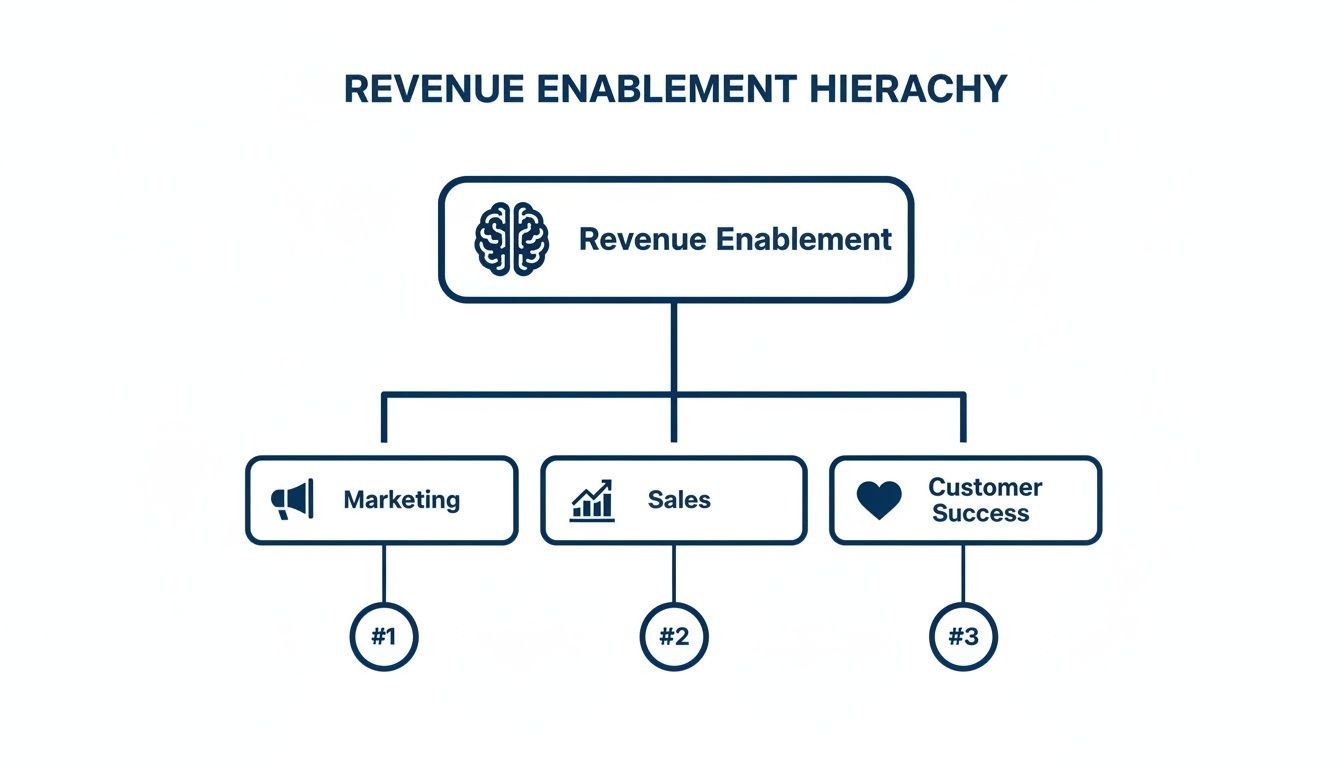
The big takeaway here is that each team is just one part of a much larger system. Enablement provides the central strategy that makes sure they all work in perfect harmony.
Process: Mapping the Customer Journey
Once your people are on the same page, they need a clear process to guide their actions. This pillar is all about mapping the entire customer lifecycle and creating standardized workflows that bring consistency and efficiency. It’s the "how" behind your whole strategy.
A well-defined process eliminates the guesswork. It enables your team to act with confidence at every single touchpoint. This is how you turn random acts of success into a repeatable, scalable system for growth. For a deeper dive, check out our guide on how to align sales and marketing.
Practical Example: A software company maps its customer journey and discovers a significant drop-off between the "sales handoff" and "customer onboarding" stages. To fix this, they implement a standardized handoff process, including a joint call with the Account Executive and the new Customer Success Manager. This single process change reduces early-stage churn by 15% within a quarter.
Technology: Creating a Single Source of Truth
Technology is what makes your people and processes truly scalable. The goal isn’t to just buy more tools; it's to transform a messy collection of software into an integrated ecosystem that provides one reliable source of truth about your customers and revenue.
Far too many companies are wrestling with a fragmented tech stack. Valuable data gets trapped in platforms that don't talk to each other. A true revenue enablement approach means auditing every tool you have—with the CRM at the center—and making sure they all communicate effectively.
Practical Example: A B2B company integrates their marketing automation platform (like HubSpot) with their CRM (like Salesforce). Now, when a salesperson views a lead, they can see the exact marketing campaigns, emails, and web pages that the prospect engaged with. This context allows for a far more relevant and effective sales conversation.
Data: Measuring the Health of Your Revenue Engine
Finally, data is the pillar that holds everyone accountable. It's how you measure what's working, find the bottlenecks, and make smart decisions to tune up your entire revenue engine. Without clear data, you're just flying blind.
This means you have to track analytics that span the full customer journey. Stop focusing on siloed metrics like MQLs or closed-won deals. Instead, you need to look at complete indicators of health, like:
- Customer Acquisition Cost (CAC)
- Customer Lifetime Value (LTV)
- Net Revenue Retention (NRR)
- Sales Cycle Velocity
When you start tracking these comprehensive metrics, you get a true, unfiltered look at your revenue engine's health. And more importantly, you can finally prove the direct business impact of your enablement efforts.
Measuring What Matters: Proving Your Enablement ROI
If you want to get executive buy-in for any enablement initiative, you have to speak their language. That language is measurable results.
Proving the value of revenue enablement means you have to move beyond vanity metrics like content views. Instead, you need to focus on the key performance indicators (KPIs) that show real business impact. This is exactly how you shift enablement from a perceived cost center into a proven profit driver.
A solid measurement framework connects your day-to-day activities directly to financial outcomes. It helps you tell a compelling story, backed by data, about how your programs are actually moving the needle on the company's bottom line.
Leading vs. Lagging Indicators
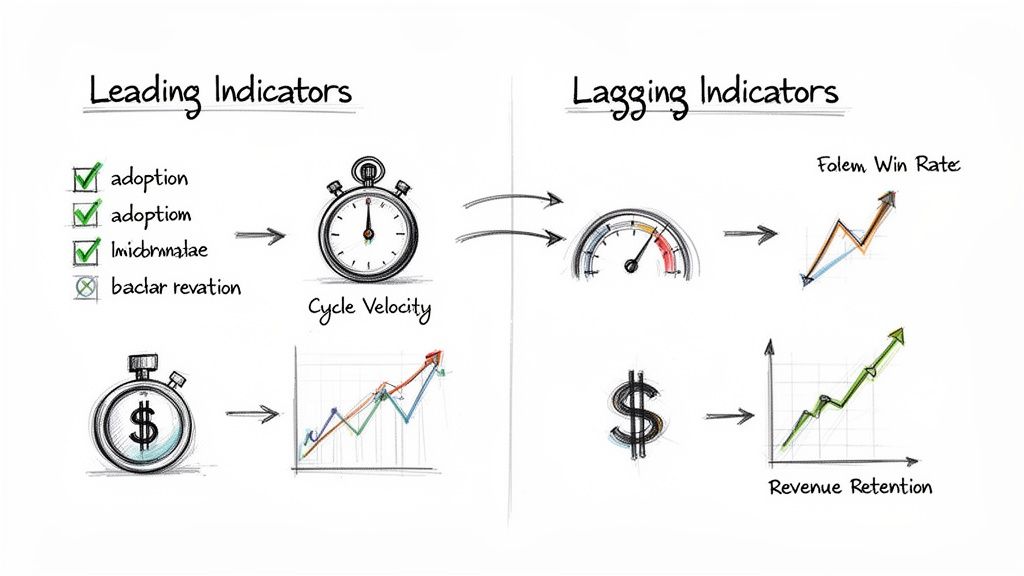
The secret to effective measurement is understanding the difference between two types of metrics: leading and lagging indicators. You need both to paint a complete picture of your program’s health and its overall impact.
Leading indicators are your early warning signs—the first signals that your strategy is working. They're predictive, giving you a glimpse into future performance. Think of them as the vital signs of your enablement efforts.
- Content Adoption Rate: Are your customer-facing teams actually using the new playbooks and sales collateral you created?
- Training Completion and Competency Scores: Are reps finishing their courses and, more importantly, can they demonstrate they've mastered the new skills?
- Sales Cycle Velocity: Are deals moving through the pipeline faster now than before you launched your initiatives?
These metrics tell you if your teams are adopting the new behaviors and tools you've rolled out. While they aren't the final business results, they are absolutely crucial for figuring out what’s working and making smart adjustments on the fly.
Lagging indicators, on the other hand, are the bottom-line results that the C-suite really cares about. They reflect past performance and confirm whether your enablement strategy successfully drove business outcomes. These are your ultimate proof points.
- Win Rates: What percentage of deals in the pipeline are actually being won?
- Quota Attainment: How many of your reps are hitting their sales targets consistently?
- Net Revenue Retention (NRR): Are you not only keeping but also growing the revenue you get from existing customers?
The goal here is to draw a straight line from your leading indicators to these lagging ones. For instance, you could show that reps who completed a specific training program (leading indicator) now have a 15% higher win rate (lagging indicator). That’s a story backed by data.
Key Metrics for Tracking Revenue Enablement Impact
To get started, you need a clear way to organize the KPIs that matter most. The table below breaks down the essential metrics into leading and lagging indicators, giving you a solid foundation for building your own measurement dashboard.
| Metric Category | Key Performance Indicator (KPI) | Business Impact |
|---|---|---|
| Leading Indicators | Content Adoption Rate | Shows if teams are using the resources designed to make them effective. |
| Leading Indicators | Training Completion & Scores | Measures skill development and readiness for real-world application. |
| Leading Indicators | Sales Cycle Velocity | Indicates if reps are moving deals through the pipeline more efficiently. |
| Leading Indicators | Time to First Deal (for new hires) | Tracks how quickly new reps become productive and start generating revenue. |
| Lagging Indicators | Win Rate / Conversion Rate | Directly measures the effectiveness of sales strategies and execution. |
| Lagging Indicators | Average Deal Size | Shows if reps are successfully upselling or closing higher-value contracts. |
| Lagging Indicators | Quota Attainment % | The ultimate measure of individual and team sales performance. |
| Lagging Indicators | Net Revenue Retention (NRR) | Reflects customer satisfaction and the ability to expand existing accounts. |
This isn't an exhaustive list, but it's the right place to start. A dashboard built around these metrics will give you a powerful narrative to share with leadership, demonstrating clear cause and effect.
Building Your Measurement Dashboard
A practical measurement dashboard doesn't just show numbers; it tells a story. It organizes these KPIs into a clear narrative that illustrates cause and effect. To truly prove your enablement ROI, it's essential to understand how to measure sales productivity.
Impact Opportunity: Connecting enablement activities to financial outcomes is where you build credibility. For instance, you can create a cohort of reps who adopted a new sales methodology and compare their average deal size against those who didn't. When that data shows a tangible lift, you have an undeniable success story.
The explosive growth in platforms designed to track this stuff is no accident. The U.S. sales enablement platform market hit USD 1,309.0 million and is projected to soar to USD 2,888.2 million by 2030. This growth is fueled by real results; teams using AI-driven enablement report 15-25% revenue growth and win rates that jump by an average of 22%.
By tracking both leading and lagging indicators, you can build an undeniable case for your strategy's value. For a deeper look into connecting activities to financial results, check out our guide on how to measure marketing ROI. This approach ensures your enablement function is finally recognized as an indispensable driver of company growth.
Your Roadmap to Implementing Revenue Enablement
So, how do you get from theory to reality? A real revenue enablement strategy isn’t a weekend project; it's a fundamental shift in how your business grows. When you do it right, you build a durable engine for growth that lasts.
Let's break down the journey into a practical, step-by-step roadmap. This will guide you from initial discovery to full-scale optimization and give you the confidence to lead the change.
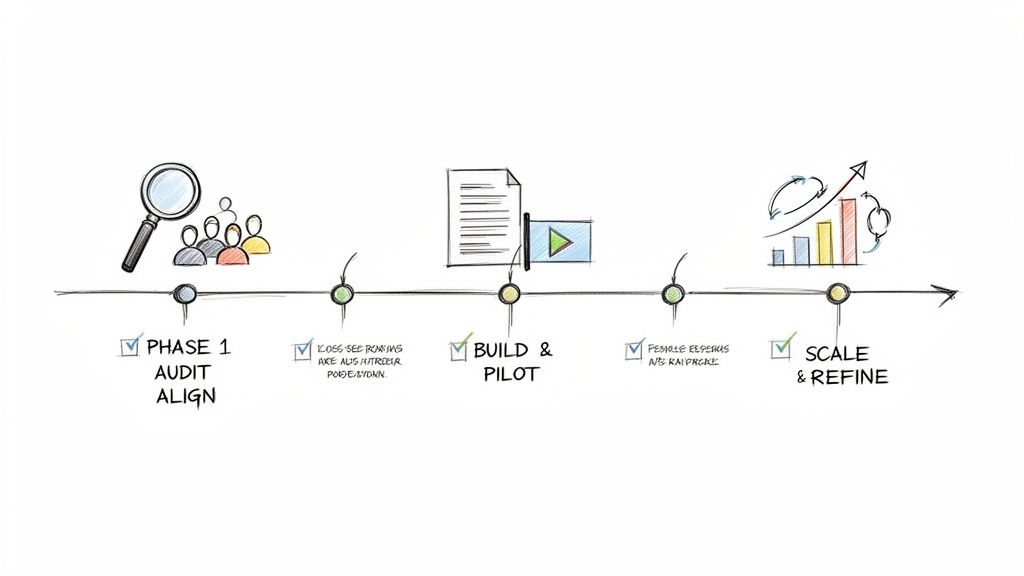
Phase 1: Audit And Align
Before you can build anything, you have to know what you’re working with. This first phase is all about discovery and diagnosis.
The goal here is simple: map out your current go-to-market motion, find the biggest points of friction, and get your key stakeholders to agree on what problems need solving first. Rushing this stage is a classic mistake that leads to teams solving the wrong problems entirely.
Plan for this phase to take 2-4 weeks. It involves a few critical activities:
- Stakeholder Interviews: Talk to everyone. Sit down with leaders and individual contributors from marketing, sales, and customer success. Ask them what works, what’s broken, and where they see the biggest opportunities.
- Process Mapping: Whiteboard the entire customer journey, from the very first marketing touchpoint all the way to a renewal conversation. Pinpoint where handoffs happen and where the message or experience falls apart.
- Tech and Content Audit: Take a hard look at your current tech stack and content library. Find the redundancies, the gaps, and the expensive tools or killer assets that no one is even using.
- Data Analysis: Now, back up the anecdotes with numbers. Dig into your CRM and analytics to find quantitative proof for the pain points you heard about in interviews. Look at conversion rates between funnel stages, sales cycle length, and customer churn.
By the end of this phase, you should have a clear, data-backed diagnosis of your top 2-3 enablement priorities. This keeps your efforts focused where they can make the biggest splash right away.
Phase 2: Build And Pilot
With your priorities locked in, it’s time to build the first version of your solutions and test them in a controlled way. This pilot phase is your chance to score some early wins, gather real-world feedback, and prove that revenue enablement actually works before you roll it out company-wide.
Think of this as building the minimum viable product (MVP) of your enablement program.
Key Takeaway: The pilot isn't about perfection; it's about progress. Focus on launching a targeted program that solves one specific, high-impact problem for a small, manageable group. This approach minimizes risk and builds momentum.
This "Build and Pilot" stage typically takes 4-8 weeks. Your focus should be on creating tangible outputs that directly address the pain points you uncovered in the audit.
Practical Examples:
- Problem: Your audit revealed inconsistent messaging across teams.
- Pilot: Create a unified sales playbook and a core set of customer-facing slides. Train a small group of AEs on how to use these new resources and track their performance.
- Problem: New hire ramp time is painfully long.
- Pilot: Design a new onboarding program for a small group of recent sales and CS hires, complete with structured training, clear benchmarks, and dedicated coaching.
The key is to define what success looks like for your pilot before you start. Track leading indicators like content adoption and training completion, along with early lagging indicators like improved win rates within the pilot group. These early results are the currency you'll use to get buy-in for the next phase.
Phase 3: Scale And Refine
Once your pilot has proven its worth, it's time to scale what works and build a system for continuous improvement. This is the phase where revenue enablement stops being a "project" and becomes an embedded, ongoing part of your organization's DNA.
Honestly, this stage never really ends—the work of enablement is never truly "done."
This is your long-term operational phase, which includes a few key activities:
- Expand Successful Programs: Roll out the validated playbooks, training, and processes from your pilot to the entire revenue organization.
- Establish Feedback Loops: Create simple, formal ways for your customer-facing teams to give ongoing feedback. What content is hitting the mark? What training do they need next? Where are processes still clunky?
- Data-Driven Optimization: Constantly monitor your core enablement KPIs. Use this data to spot new opportunities and fine-tune your strategy over time.
Impact Opportunity: A mature revenue enablement function moves your organization from being reactive to proactive. By using data to anticipate what your teams and customers need, you can continuously tune your revenue engine for peak performance. The result? Higher win rates, shorter sales cycles, and a serious increase in customer lifetime value.
Navigating Common Pitfalls in Your Enablement Journey
Even the sharpest revenue enablement strategies can hit turbulence. The key isn't avoiding every bump in the road—it's knowing where they are so you can steer around them. Getting ahead of these common challenges is what separates an initiative that delivers from one that stalls out.
Lots of companies stumble by treating enablement as a string of one-off projects. That’s a recipe for wasted effort. A truly successful strategy is built on a proactive mindset, one that’s designed to sidestep the roadblocks that derail progress before it even gets rolling.
The Technology-First Trap
It’s one of the most common mistakes in the book: buying the shiny new tool before you’ve defined the process. It's easy to believe a slick platform will magically fix all your alignment issues, but technology is just a force multiplier. It can’t fix a process that’s broken or, even worse, one that doesn’t exist.
Throwing money at a sophisticated tool without first mapping out your customer’s journey or how your teams hand off work is like buying a race car to drive on a dirt road. The tech becomes a complex solution looking for a problem, and you end up with low adoption and a wasted investment.
Practical Example: A company invests in an expensive content management system because reps complained they couldn’t find key assets. However, without a clear process for creating, tagging, and archiving content, the new platform quickly becomes as disorganized as the old shared drive. The real problem was the lack of a content strategy, not the technology itself.
Lacking Executive Sponsorship
Without strong, visible backing from the C-suite, a revenue enablement initiative gets treated like a "nice-to-have," not a strategic must. The moment budgets get tight or priorities shift, it’s the first thing on the chopping block.
Executive sponsorship gives you the authority to break down departmental silos and get everyone rowing in the same direction. It sends a clear signal to the entire company: this is critical for growth.
Key Takeaway: You absolutely must secure an executive sponsor who can champion the vision, articulate its value, and knock down organizational barriers. Their involvement is what turns a departmental project into a company-wide priority.
Creating Content That Gathers Dust
Another classic pitfall is building a massive library of content that nobody on your customer-facing teams ever uses. This usually happens when the enablement team works in a silo, creating materials based on what they think people need instead of what the field is actually asking for.
Content is only valuable if it helps someone move a customer conversation forward. Period. To avoid this trap, build tight feedback loops with your sales, marketing, and customer success teams. Treat them like your internal customers. Co-create resources that solve their real-world problems, and you'll see adoption skyrocket.
Operating Without Clear Metrics
Finally, launching an enablement program without knowing how you’ll measure success is like starting a road trip with no destination. If you can’t connect your work to business outcomes, you'll never be able to prove your value or justify your budget.
This is especially dangerous today. One area many teams completely overlook is the strategic use of AI. Ignoring modern tools isn't just a missed opportunity; it's a competitive liability. Modern B2B growth is fueled by a blend of AI and human expertise, delivering outcomes like 22% higher win rates and 17% larger deals for teams that embrace it. In fact, AI is now producing 15-25% revenue lifts by spotting upsell opportunities early on. Those who ignore it are simply leaving money on the table. You can find more powerful statistics of AI in sales enablement at Cubeo.ai.
Impact Opportunity: By getting ahead of these common pitfalls, you position your revenue enablement function as a strategic driver of growth. You stop fighting fires and start building a resilient system—one that anticipates challenges and consistently delivers measurable results. That’s how you secure your program’s success for the long haul.
Your First Steps Toward a Unified Revenue Engine
Knowing the theory behind revenue enablement is one thing. But turning that knowledge into real, measurable growth is what actually matters. The journey from concept to execution isn’t about flipping a switch; it’s about taking deliberate, focused steps to build a unified revenue engine that works for you.
The secret is to start small and prove the value fast. Instead of trying to boil the ocean with a massive, company-wide overhaul, pick one specific, high-impact problem and solve it. This pilot program approach minimizes risk, builds momentum, and racks up the early wins you need to get everyone else on board.
Building Momentum with Actionable Steps
Don't wait around for the "perfect" plan to materialize. The best way to get started is to take immediate, tangible actions that pull your cross-functional teams together and create alignment right now. These first moves are designed to get you out of the land of theory and into the world of practice, laying the groundwork for a system that can actually scale.
Here’s a simple checklist to get the ball rolling:
- Schedule a Cross-Functional Workshop: Get the leaders from marketing, sales, and customer success in a room together. The goal is simple: map out the customer journey as it exists today and pinpoint the biggest gaps and points of friction.
- Define One Pilot Program: Based on what you uncover in the workshop, choose a single, manageable problem to tackle. This could be anything from standardizing your demo messaging to building a unified playbook for renewals.
- Establish Success Metrics: Before you kick things off, get crystal clear on what success looks like. Pick one leading indicator (like content adoption rates) and one lagging indicator (like the win rate for the pilot group) to track.
Key Takeaway: Revenue enablement is the strategic glue that aligns all your customer-facing teams to unlock sustainable growth. Real success doesn't come from grand theories—it comes from taking practical steps to solve real problems and delivering quick, measurable value.
Accelerate Your Journey with an Expert Partner
Trying to go it alone can be a recipe for frustration. An expert partner brings the structure, experience, and objective viewpoint you need to speed up your progress and sidestep common pitfalls. A great partner doesn’t just give you a generic template; they help you build a clear, actionable plan that fits your unique business goals.
Impact Opportunity: If you’re a leader who wants to build a truly scalable revenue system, you need a clear roadmap. The only way to get that clarity is to start with a deep-dive analysis of your people, processes, and technology. This shows you exactly where to focus your efforts.
That's why the most logical first step for any leader who is serious about growth is a complimentary Growth Audit. This assessment delivers an actionable plan, helping you finally tame the complexity and build an engine for success that lasts.
Common Questions
As you start to think about a more unified revenue strategy, a few key questions usually pop up. Here are some straight answers to the most common ones we hear from leaders.
How Is Revenue Enablement Different From RevOps?
Great question. While they both work toward the same goal—more revenue—they have very different jobs.
Think of it like a Formula 1 team. Revenue Operations (RevOps) is the engineering crew. They build the car, manage the technology, and make sure all the data from the engine is flowing correctly. They design the system for peak performance.
Revenue Enablement, on the other hand, is the driver development program. It’s all about the person behind the wheel. Enablement gives your customer-facing teams the skills, the content, and the coaching they need to actually win the race. RevOps builds the machine; enablement makes the driver a champion.
What Does a Modern Enablement Team Look Like?
Forget the old idea of a simple training department. A modern revenue enablement team is small, strategic, and deeply integrated into the business. It usually reports directly to the Chief Revenue Officer, giving it the influence needed to work across marketing, sales, and customer success.
The team itself is usually made up of a few key specialists:
- Instructional Design: The person who architects effective training and onboarding.
- Content Strategy: The expert who manages every customer-facing asset, from first touch to renewal.
- Enablement Technology: The pro who oversees the tools that make learning and content delivery seamless.
Key Takeaway: A top-tier enablement team isn't just running workshops. It’s a strategic function that blends program management, content creation, and data analysis to lift the performance of the entire go-to-market organization.
Can We Implement This With a Limited Budget?
Yes, absolutely. You don't need a massive budget to make a real impact. The trick is to start small and get a quick win.
First, do a quick internal audit. Where is the biggest point of friction in your customer journey? Is it onboarding? Is it the renewal process? Find that one thing.
Then, launch a focused pilot program to solve it. Maybe you create a unified sales playbook or standardize a process for customer renewals. Measure the result, show the value, and use that success to build momentum. An early, measurable win is the best way to justify more investment down the road.
Ready to build a scalable revenue system with a clear, actionable plan? At Prometheus Agency, we help you tame complexity and build an engine for durable growth. Start with our complimentary Growth Audit and AI strategy session. Learn more at https://prometheusagency.co.