Think of a go-to-market strategy framework as the master blueprint for taking a product to market. It’s not just a marketing plan or a sales deck; it's the repeatable, operational system that gets everyone—product, sales, marketing, and success—rowing in the same direction, toward the same customer, with a clear line to revenue.
Key Takeaways
- A GTM framework is a strategic blueprint that aligns product, sales, and marketing for a unified launch.
- It transforms market entry from a high-risk guess into a repeatable, data-driven process.
- Effective frameworks clarify roles, optimize resource allocation, and accelerate market penetration.
Why a GTM Framework Is Your Blueprint for Growth
Trying to launch a product without a GTM framework is like building a skyscraper without an architectural plan. You might get the foundation poured, but chaos takes over. Sales starts chasing one type of customer while marketing’s message is built for another. You end up with burned cash, missed targets, and a customer experience that feels disjointed.
A solid framework forces you to answer the tough questions before a single dollar is spent on a campaign, making sure every team is building toward the same vision. The numbers back this up. Companies that get this right see 10% higher success rates and can triple their revenue growth. Yet, only about a third of product marketers actually stick to a defined process.
Shifting from Guesswork to a Repeatable System
The real power of a GTM framework is that it pulls you out of a reactive, launch-and-pray cycle. Instead, you're running proactive, strategic campaigns that are designed from the ground up to hit their numbers. For a deeper dive into this, this guide on Go-To-Market Strategy is a great place to start. It lays out a structured path for getting your product in front of the right people with a message that lands.
This diagram shows how all the core pieces of the puzzle fit together, from understanding the market to orchestrating the customer's journey.
Every element is connected. Your channel decisions have to support your product strategy, and your marketing has to be laser-focused on the audience you've defined. It all works together.
Impact Opportunity: A Go-To-Market strategy framework isn’t a pre-flight checklist. It’s the strategic glue that aligns your entire company, turning market entry from a high-stakes gamble into a repeatable science that drives predictable growth.
This structured approach brings a few immediate wins:
- Clarified Roles: Everyone knows exactly what they own, which cuts down on internal friction and dropped balls.
- Efficient Resource Allocation: Money and time go toward channels and tactics that actually work, not just the flavor of the month.
- Accelerated Market Penetration: You find and win your ideal customers faster and more efficiently than the competition.
For any leader focused on growth, putting a strong framework in place is the single biggest lever you can pull. It builds a system that shifts your entire organization from merely hoping for success to deliberately engineering it.
The 6 Core Components of a Winning GTM Framework
A great go-to-market strategy isn't one giant, monolithic plan. It’s better to think of it as an interconnected system—six core pillars that build on each other, guiding you from big-picture analysis to on-the-ground execution.
When you get these six areas right, you build a cohesive GTM engine that doesn’t just stumble into growth but creates it predictably.
The whole point is to get every team—Sales, Marketing, and Product—pulling in the same direction. It’s not just one department’s job.
When these functions are truly in sync, the entire growth engine just runs better. It becomes more efficient, more effective, and a whole lot less frustrating.
So, what are these six components? Let's break down the essential pillars of a strong GTM framework. The table below outlines each component, its main goal, and the critical questions you need to answer to get it right.
Core Components of a GTM Strategy Framework
| Component | Objective | Key Questions to Address |
|---|---|---|
| Market Definition & ICP | To define your target market and the exact company profile that will get the most value from your solution. | Who are we selling to? What specific pains do they have that we can solve? What does our perfect customer look like? |
| Value Proposition & Messaging | To craft a clear, compelling promise that answers the customer's question: "Why should I buy from you?" | What unique value do we deliver? How do we translate product features into tangible customer benefits? How do we stand out from competitors? |
| Pricing & Monetization | To design a pricing model that reflects the product's value, aligns with customer buying habits, and supports business growth goals. | How much is our solution worth to the customer? What pricing model (subscription, usage-based, etc.) fits our market? |
| Distribution & Channel Strategy | To determine the most effective path to deliver your product and message to your defined market. | How will our customers find and buy our product? Should we use a direct sales team, partners, or a self-service model? |
| Marketing & Demand Generation | To build an engine that creates awareness, fills the sales pipeline, and generates qualified leads. | What mix of inbound and outbound tactics will reach our ICP? How will we attract, engage, and convert prospects? |
| Sales Motion & Customer Journey | To orchestrate the end-to-end buying experience, from first contact to closing the deal and beyond. | What steps does our sales team follow? How do we align our sales process with how our customers want to buy? |
Each of these pillars is a critical building block. A weakness in one can undermine the strength of the others, so it's essential to give each the attention it deserves.
1. Market Definition and Ideal Customer Profile
Before you sell anything, you have to know exactly who you're selling to. This sounds obvious, but it’s where so many strategies fall apart. This first step is about defining your battlefield and zeroing in on your best-fit customers.
Your Ideal Customer Profile (ICP) is more than just demographics. It’s a deep-dive into the perfect company for your product—not just their industry or size, but their specific pains, tech stack, and business goals.
Practical Example: A B2B SaaS company’s ICP isn't just "tech companies with 50-200 employees." It's "Series B SaaS companies bleeding efficiency due to poor cross-functional project visibility, currently wrestling with spreadsheets, and aiming to cut their time-to-market by 20%." That level of detail makes every other decision a hundred times easier.
Impact Opportunity: A fuzzy market definition or a weak ICP is the root cause of most GTM failures. If you don't know who you're for, you can't build something they love, write copy that hits home, or find them in a cost-effective way.
2. Value Proposition and Messaging
Okay, you know your audience. Now you need a message that actually makes them listen. Your value proposition is your clear, compelling promise. It’s the straight answer to their unspoken question: “Why you?”
This is not a feature list. It’s about translating what your product does into what your customer gets. A powerful value prop is specific, focuses on the pain you solve, and makes your unique differentiation crystal clear.
A great way to nail this is to create a value matrix. Map each buyer persona’s specific problems directly to your product's benefits and then distill that into a single, punchy marketing message.
Practical Example: Slack’s value prop isn't "we have real-time chat." It’s "Slack is your productivity platform." The focus is entirely on the outcome—less email chaos and faster teamwork.
3. Pricing and Monetization Strategy
How you charge for your product is just as critical as what it does. Pricing is a strategic tool, not just a number. It sends a powerful signal about your product's value, helps you target the right segments, and defines your entire revenue model.
Common B2B pricing models include:
- Subscription-based: The standard for SaaS, creating predictable recurring revenue.
- Usage-based: Customers pay for what they consume.
- Tiered pricing: Offering different feature sets at various price points.
- Per-user pricing: The cost scales with the number of team members.
Practical Example: A B2B analytics platform might use a tiered, subscription model to serve everyone from scrappy startups to massive enterprises, making sure the price always aligns with the value received.
4. Distribution and Channel Strategy
This is the "how." How are you actually going to get your product and message into the hands of your target market? Your channel strategy is about building the pathways to reach, engage, and support your customers.
You have to decide on the right mix to break into your market. Common channels include:
- Direct Sales: Your own team of reps, perfect for complex, high-ticket sales that require a human touch.
- Channel Partners: Using resellers or distributors to sell your product for you, extending your reach.
- Self-Service: A digital-first model where customers can sign up and buy with minimal friction. This is the heart of most product-led growth (PLG) motions.
- Marketplaces: Listing your solution on platforms like the Salesforce AppExchange or AWS Marketplace where customers are already shopping.
Picking the right channels is non-negotiable. You wouldn't use an expensive field sales team to sell a $50/month tool, and you can’t expect a self-service checkout to close a multi-million dollar enterprise deal.
5. Marketing and Demand Generation
You’ve got your who, what, and how. Now it’s time to flip the switch and start generating demand. This is where you build the engine that creates awareness and fills the pipeline with qualified leads.
Your demand gen strategy should be a healthy mix of inbound and outbound plays.
- Inbound Marketing: Pulling customers in with valuable content. Think SEO-driven articles, webinars, and genuinely useful social media content.
- Outbound Marketing: Proactively going after potential customers. This includes smart ad campaigns, targeted cold outreach, and account-based marketing (ABM) for your top-tier prospects.
A truly effective go-to-market strategy framework doesn’t see these as separate. It uses inbound content to educate the broader market and deploys outbound tactics to start conversations with high-value accounts.
6. Sales Motion and Customer Journey
The final piece of the puzzle is choreographing the entire customer experience, from the very first click to the signed contract and beyond. The sales motion is the repeatable playbook your team uses to guide a prospect through their buying journey.
This process has to match how your ICP actually wants to buy. An enterprise CFO expects a consultative, high-touch process with detailed demos and ROI calculators. A small business owner? They probably just want a quick trial and a credit card form.
Mapping this journey ensures nothing falls through the cracks between marketing and sales. It helps define what a "qualified" lead really is (using frameworks like BANT or MEDDPICC) and clarifies who does what, from the first call with an SDR to the handoff to Customer Success. A tight sales motion means shorter sales cycles and better win rates. It's that simple.
Choosing Your GTM Model: Sales-Led, Product-Led, or Marketing-Led
If your go-to-market strategy framework is the blueprint for your house, then your GTM model is the engine running the whole construction site. It’s the fundamental choice that dictates how you actually find customers and make money.
Picking the wrong one is a classic, costly mistake. A mismatch between your product and how you sell it is a surefire way to burn cash and kill momentum. So, let’s break down the three dominant models in B2B today: Sales-Led, Product-Led, and Marketing-Led.
Sales-Led Growth: The High-Touch Engine
This is the traditional powerhouse of B2B. A Sales-Led Growth (SLG) model hinges on a skilled sales team to find, educate, and personally guide prospects through a complex buying journey. It’s the default for products with a high price tag, a long sales cycle, and a messy implementation process.
Practical Example: Think about huge enterprise software from companies like Oracle or SAP. You can't just swipe a credit card and get started. A sales-led motion is absolutely necessary to navigate the multiple stakeholders, custom configurations, and six-figure contracts.
The SLG model is your best bet when:
- The product is complex: Your solution requires deep discovery calls and expert consultation to even understand.
- The price point is high: A big investment demands a relationship-driven sales process to build trust.
- The buyer is an enterprise: The decision involves multiple departments, C-suite executives, and procurement.
Product-Led Growth: The Self-Serve Engine
Product-Led Growth (PLG) completely flips the script. Here, the product itself is the main driver of customer acquisition, conversion, and even expansion. The entire model is built on a frictionless, self-serve experience that lets people see the value before ever talking to a human.
Practical Example: Companies like Slack and Calendly are the poster children for PLG. They hook users with freemium plans or free trials that solve a real problem almost instantly. This hands-on approach builds a massive user base, and the sales team only gets involved when an account shows signals that it’s ready to upgrade to a bigger, enterprise plan.
Key Takeaway: Your GTM model has to match your product's complexity and how your ideal customer wants to buy. Forcing a high-touch sales process on a simple, low-cost tool is just as foolish as expecting a complex enterprise platform to sell itself.
Marketing-Led Growth: The Awareness Engine
Marketing-Led Growth (MLG) lives in the space between SLG and PLG. In this model, the marketing team takes the lead on generating awareness and capturing high-intent leads through brilliant content, SEO, paid ads, and events. The name of the game is to educate the market at scale and hand-deliver qualified opportunities to the sales team.
Practical Example: HubSpot is a masterclass in MLG. They built an entire empire by giving away immense value through their blog, academy, and free tools. This content-first strategy attracts millions of potential customers, who are then nurtured through automation before a sales rep ever picks up the phone.
This isn’t just theory; it’s how the biggest players operate. If you want to see more GTM playbooks in action, Sales Captain breaks down how brands like Oracle (sales-led), Slack (product-led), and even Nordstrom (marketing-led) use these distinct models to own their markets.
At the end of the day, picking your GTM model isn't about chasing trends. It requires an honest look in the mirror. Does your product’s value only click after a demo or a deep conversation? That’s a sign you need a sales-led motion. Can a new user get that "aha!" moment all on their own in just a few minutes? You’re probably looking at a product-led future. Get this right, and every other piece of your GTM framework just works better.
How to Build Your GTM Framework Step-by-Step
Alright, let's get our hands dirty. Moving from the what and why of a GTM framework to the how is where the real work—and the real value—begins. Building one isn't a weekend project; it's a phased, collaborative effort that needs buy-in across the entire company from the very start.
Think of it as a four-stage build. Each stage lays the groundwork for the next, turning what feels like a massive undertaking into a series of clear, manageable steps.

Let's walk through these four stages and what you should actually be producing at each one.
Stage 1: Foundational Research
This is where you put your assumptions on trial. Before you can even think about strategy, you need to get brutally honest about the market, your potential customers, and the competition you're up against. Rushing this part is the fastest way to build a plan on quicksand.
Your main goal here is pure intelligence gathering. You'll need to blend quantitative data with real, qualitative customer interviews to get the full picture.
Key Activities in This Stage:
- Ideal Customer Profile (ICP) Development: Go deeper than just company size and industry. Build a detailed ICP worksheet that includes psychographics (how they think), technographics (what tools they already use), and the specific business pains that keep them up at night.
- Market Sizing (TAM, SAM, SOM): You have to know the size of the prize. Calculate your Total Addressable Market, Serviceable Available Market, and Serviceable Obtainable Market to see if the opportunity is real and to set goals that aren't just wishful thinking.
- Competitive Analysis: Don’t just make a list of logos. Dig into their messaging, their pricing, and where customers think they fall short. This is how you'll find your opening.
Impact Opportunity: Rigorous research ensures your strategy is built on reality, not just what you think you know. It gives your team the confidence to make decisions backed by data that will actually connect with market needs, saving you from expensive miscalculations later.
Stage 2: Strategy Definition
With a solid grasp of the market, you can now start carving out the core pillars of your GTM framework. This is where research becomes a plan. It's about making clear, tough decisions about how you’re going to win.
This stage is all about making choices. You can't be everything to everyone. You have to decide who you're for and then spell out exactly how you'll deliver value that no one else can.
Practical Example: The Messaging Matrix
A messaging matrix is a ridiculously powerful tool you can build right now. It maps your buyer personas to their specific pain points and then connects those pains to your product features and your big-picture value proposition.
| Persona | Pain Point | Key Feature | Value Proposition |
|---|---|---|---|
| Sales Leader | Inaccurate forecasting and missed quotas | Real-time pipeline analytics dashboard | Gain predictable revenue with accurate, data-driven sales forecasting. |
| Marketing Ops | Manual lead routing causing delays | Automated lead assignment rules | Accelerate speed-to-lead and ensure no opportunity falls through the cracks. |
A simple document like this ensures every blog post, ad, and sales call is consistent, relevant, and laser-focused on solving the customer’s actual problem.
Stage 3: Cross-Functional Alignment
A genius strategy that lives in a Google Doc is worthless. This stage is all about getting everyone on the same page and creating a unified plan of attack across product, marketing, sales, and customer success. Frankly, this is the part most companies mess up.
Real alignment means every team knows their role and how their work directly fuels the main GTM goals. This requires open communication and shared KPIs. A tangible example? Getting your marketing automation platform and sales CRM talking to each other. Properly managed CRM integration services can finally create that single source of truth for customer data, tearing down the wall between sales and marketing.
When you nail this, the customer feels it. Their journey is seamless, from the first ad they see to the day they become a raving fan.
Stage 4: Execution and Iteration
This is it—the plan hits the street. You're launching campaigns, your sales team is dialing, and you're officially engaging the market. But the work isn't over. A GTM framework isn’t a "set it and forget it" kind of thing; it’s a living document.
Success here comes down to your ability to measure what’s happening, listen to feedback, and be willing to adjust. The market will change, and your strategy has to be nimble enough to change with it.
Key Takeaways for This Process:
- Start with data, not opinions. Ground every single decision in real research.
- Align teams early and often. Constant communication is the secret to a smooth rollout.
- Treat the framework as a living document. Be ready to test, learn, and iterate based on what the market tells you.
By following this structured, four-stage process, you can build a powerful go-to-market framework that doesn't just look good on paper—it drives alignment and delivers the predictable, scalable growth you're after.
Supercharging Your GTM Strategy with AI and CRM
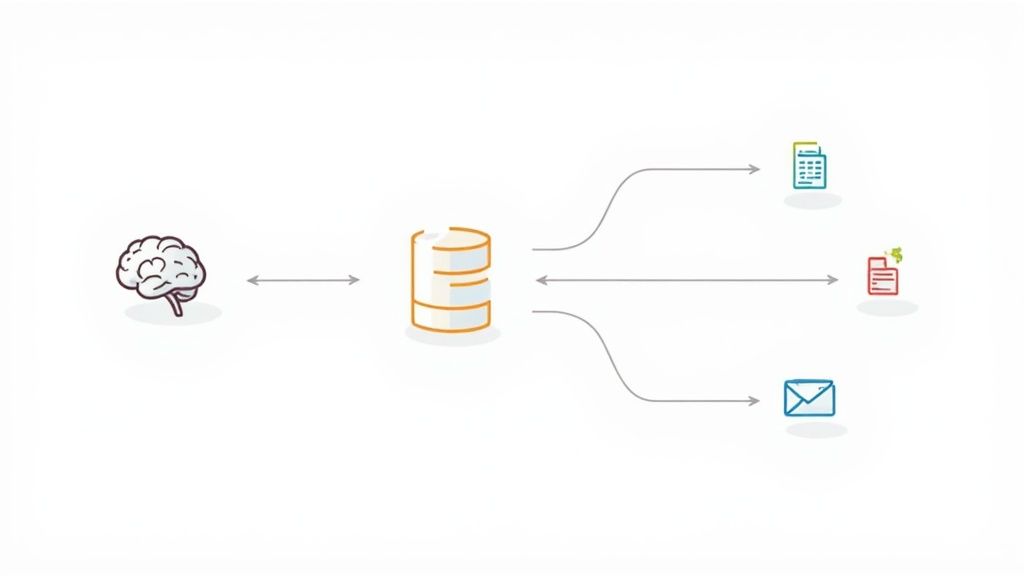
A modern go-to-market strategy without a powerful tech stack is like a high-performance engine without any fuel. All that potential just sits there, going nowhere. Technology—specifically AI and CRM systems—is what bridges the gap between your strategic blueprint and actually getting things done in the real world. It gives you the scale, data, and precision you need to win.
This is all about building a GTM engine that runs on data and operates with intelligence. Instead of relying on gut feelings and guesswork, your teams can use technology to make smarter, faster decisions at every single stage of the customer journey.
Integrating AI for Predictive Insights
AI isn't some far-off concept anymore; it's a practical tool that gives you a serious competitive edge. When you weave AI into your GTM framework, you stop reacting to the market and start predicting it. You can spot opportunities before your competitors even know they exist.
Here’s how it works in practice:
- Lead Scoring: AI algorithms can sift through thousands of data points—website behavior, email engagement, company demographics—to predict which leads are actually ready to buy. This lets your sales team stop chasing ghosts and focus their energy on high-intent prospects, which dramatically boosts their efficiency.
- Market Trend Analysis: AI tools can monitor real-time market chatter, competitor moves, and industry news. For a deep dive on how to use AI for this kind of market intelligence, this AI brand monitoring playbook is a fantastic resource.
This data-first approach completely changes how you engage with potential customers. It's the difference between casting a wide, hopeful net and using a high-powered sonar to find the biggest fish in the sea. The process of AI enablement is about embedding these capabilities directly into your team's day-to-day work.
The CRM as Your Single Source of Truth
Think of your CRM as the central nervous system of your entire GTM operation. When you set it up correctly, it becomes the single source of truth that gets every customer-facing team—from marketing and sales to customer success—on the same page.
A well-tuned CRM like Salesforce or HubSpot tracks every single touchpoint in the customer's journey. This gives you a complete, unified picture of every prospect and customer, finally tearing down the data silos that cause so much friction and miscommunication between departments.
Impact Opportunity: An integrated tech stack solves the chronic misalignment between sales and marketing. By creating a single, reliable data source for lead management and performance metrics, you shorten sales cycles, improve conversion rates, and create a seamless customer experience.
The need for this kind of alignment is more critical than ever. By 2025, over 70% of companies report they'll have at least moderate adoption of AI in their GTM workflows. And yet, a stubborn 53% rate of misalignment between sales and marketing teams continues to be a major roadblock, proving just how essential a unified tech foundation really is.
Key Takeaways
- Technology is the accelerator: A solid tech stack turns a static GTM plan into a dynamic, intelligent engine for execution.
- AI provides predictive power: Use AI to spot high-intent signals and market trends, giving your teams a crucial advantage.
- CRM is your foundation: A properly integrated CRM creates a single source of truth, aligning sales and marketing for maximum impact.
Measuring GTM Success with the Right KPIs
Let's be honest, a go-to-market strategy is just a collection of nice-sounding ideas until you can prove it's actually working. Without the right metrics, you’re flying blind. You have no real way to tell if you’ve built a revenue-generating machine or just a very expensive science project.
To get a real grip on performance, you need a dashboard of key performance indicators (KPIs) that tells the full story of your customer's journey. This isn't about chasing vanity metrics; it's about connecting every action directly to revenue and sustainable growth. By tracking what happens at each critical stage—Acquisition, Conversion, and Retention—you get an unfiltered view of what’s hitting the mark and what’s falling flat.
Balancing Leading and Lagging Indicators
A solid measurement plan isn't just about looking in the rearview mirror. You need a healthy mix of two types of metrics to see the whole picture.
Lagging indicators, like closed-won revenue or your total market share, are great for telling you what already happened. They're your report card on past performance.
But to make smart moves before the quarter ends, you need leading indicators. These are your crystal ball. Metrics like pipeline velocity or the number of qualified demos booked give you a glimpse into future performance, letting you spot trouble and adjust course while there's still time.
Impact Opportunity: A complete view of performance comes from balancing the forward-looking perspective of leading indicators with the hard results of lagging indicators. This is how leaders make decisions backed by data, pivot when they need to, and ultimately prove the GTM strategy is worth the investment.
A Dashboard for GTM Performance
To make sense of it all, organize your KPIs into three buckets that follow the natural flow of the customer journey. This structure makes it much easier to diagnose problems right at the source.
Acquisition Stage: This is all about how efficiently you're attracting your Ideal Customer Profile. The big question here is: how much does it cost to get a qualified prospect to raise their hand?
- Practical Example: Keep a close eye on your Customer Acquisition Cost (CAC). Say you spend $50,000 on a campaign that brings in 50 new customers. Your CAC is $1,000. The next question is obvious: Is that sustainable, or is it eating away at your margins?
Conversion Stage: Okay, you've got their attention. Now, how good are you at turning that initial interest into a legitimate sales opportunity and, finally, a paying customer?
- Practical Example: Watch your lead-to-opportunity rate. If marketing hands over 200 MQLs and sales accepts 40 as real, qualified opportunities, your conversion rate is 20%. This single number tells you a ton about lead quality and the smoothness of your marketing-to-sales handoff.
Retention Stage: Getting the first sale is one thing; keeping and growing that account is where real value is built. This stage measures your ability to deliver on your promise and expand the relationship over time.
- Practical Example: Net Revenue Retention (NRR) is king here. It tells you how much of your recurring revenue you're keeping after factoring in both customer churn (lost revenue) and expansion (upsells/cross-sells). An NRR over 100% is the gold standard—it means your growth from existing customers is more than making up for any customers you lose. For a deeper dive into keeping customers happy, look into what predictive churn modelling can teach you about spotting at-risk accounts before they walk away.
Your GTM Framework Questions, Answered
How often should we update our GTM strategy framework?
Think of your GTM framework less like a stone tablet and more like a living playbook. It's not a "set it and forget it" document.
At a minimum, you should be checking in on it quarterly and giving it a serious overhaul once a year. But the real answer is: you update it whenever reality changes. That could be a major market shift, a disruptive new competitor showing up, or when your own performance metrics start screaming that a core assumption was dead wrong. Staying nimble is the name of the game.
What's the biggest mistake leaders make with these frameworks?
Easy. A complete lack of cross-functional alignment.
I’ve seen brilliant strategies fall flat on their face because the sales, marketing, and product teams were all running completely different plays. If they aren't operating from the same playbook, with shared goals and a clear understanding of their role, you're just burning cash. Getting everyone on board and agreeing on shared KPIs from the very beginning isn't just a nice-to-have—it's everything.
Impact Opportunity: When you treat your GTM framework as a dynamic system, you build a machine for continuous improvement. Those regular check-ins aren't just meetings; they're your defense against strategic drift. They ensure you’re always pointing your resources at the biggest opportunities, protecting every dollar you invest in growth. A flexible plan will always beat a rigid one.
Ready to turn your tech stack into a revenue-generating machine? Prometheus Agency helps growth leaders build and execute winning GTM strategies, powered by AI and an optimized CRM. It all starts with a complimentary Growth Audit. Book yours today.