Predictive churn modeling estimates which customers are likely to cancel or stop buying by scoring CRM and product signals (usage, tickets, payments, engagement). Teams use those scores to intervene early with targeted retention plays instead of spraying discounts at everyone.
What is predictive churn modelling?
Predictive churn modelling uses historical customer data — usage frequency, support tickets, contract value, engagement scores — to estimate the probability that a given account will cancel or fail to renew. The output is a churn risk score, typically between 0 and 1, that feeds CRM workflows so customer-success and sales teams act before the customer is already gone.
Unlike reactive churn analysis (counting who already left), predictive models give RevOps teams a lead time window — often 30 to 90 days — to intervene with targeted plays: executive check-ins, usage enablement, pricing discussions, or escalation paths.
Gartner's 2025 Customer Success Technology research found that organisations with automated churn early-warning systems reduce annual churn rates by roughly 3.1 percentage points compared with manual monitoring — the gap is wiring scores into action, not the algorithm alone.
Churn risk in 2026: RevOps and revenue process context
Updated April 2026. Predictive churn scores only work if revenue leaders treat retention as part of the same system as acquisition. Forrester’s 2025 B2B marketing and sales predictions (October 2024) highlight that more than half of large B2B transactions (about US$1M or greater) are moving through digital self-serve channels — and urge leaders to “prioritize improving revenue processes” and reorient their growth strategies around their customers. That is the backdrop for churn modelling: scores should feed the CRM workflows sales and customer success already use.
Sharyn Leaver, Chief Research Officer at Forrester, said generational shifts and generative AI are reshaping B2B buying, and that B2B leaders’ focus in 2025 will shift to the bottom line after bold 2024 AI experiments — a useful framing when tying model outputs to revenue outcomes, not side experiments.
Gartner’s 2025 Customer Success Technology research (cited across our retention content) found organizations with automated churn early-warning systems reduce annual churn rates by about 3.1 percentage points on average compared with manual monitoring — the operational difference is wiring scores into tasks and playbooks, not the algorithm alone.
Next reads: implement scores with our churn prediction model implementation guide, align tooling via best RevOps software (2026), and ground the function in the revenue operations framework. For hands-on CRM work, see CRM & revenue operations or book a CRM audit.
Predictive churn modelling is all about identifying customers who are likely to leave before they actually hit the cancel button.
Think of it as an early warning system for customer relationships. It analyzes user behavior, flags at-risk accounts, and gives you a chance to step in and save the day. This moves your retention efforts from a reactive guessing game to a precise, data-driven strategy.
Key Takeaways
- Proactive vs. Reactive: Predictive churn modelling shifts your strategy from asking "Why did they leave?" to "Who is about to leave, and how can we convince them to stay?"
- Data-Driven Decisions: It replaces guesswork with statistical probability, allowing you to focus retention efforts on the customers who are most at risk.
- Revenue Protection: The ultimate goal is to reduce customer churn, which directly protects your recurring revenue and increases customer lifetime value (LTV).
What Is Predictive Churn Modelling?
Imagine you’re trying to forecast the weather. You wouldn’t just stick your head out the window; you’d look at data on temperature, barometric pressure, and wind patterns. Predictive churn modelling does the same thing, but for your customers.
It’s a proactive approach that uses machine learning to sift through customer data—things like product usage, support ticket history, and past purchases—to calculate a "churn score" for every single user. This score tells you the statistical likelihood that a customer will bail.
Instead of getting blindsided by a cancellation email, you get a "customer health forecast" that highlights risky accounts far in advance. This gives your teams the heads-up they need to intervene at the perfect moment, turning retention from a defensive cost center into a real engine for growth.
Practical Example: How It Works in a SaaS Business
Let's walk through a real-world scenario. A B2B SaaS company’s predictive model is constantly monitoring user engagement. One day, it flags an account where logins have dropped by 40% in the last month. The team has also stopped using a key reporting feature they used to rely on daily.
Instead of waiting for the subscription to lapse, this alert automatically creates a task in the company's CRM for the account's Customer Success Manager. The CSM gets an alert with the specifics, prompting them to schedule a call.
On the call, they learn the customer is struggling to fit that reporting feature into a new internal workflow. The CSM provides a quick training session and a new report template. Problem solved. The user is re-engaged, and a potential churn is completely avoided.
The Strategic Impact Opportunity
The real magic of predictive churn modelling is how it can transform your entire retention philosophy. As companies mature from looking in the rearview mirror (post-churn analysis) to looking ahead, they get much better at forecasting and preventing revenue loss.
By pulling in data from different sources like your CRM and product analytics, machine learning models can assign precise churn probability scores to every customer. This allows for timely, personalized interventions. It's a proactive approach that doesn't just cut down on customer loss; it makes your entire operation more efficient. You end up focusing your most valuable resources on the customers who truly need them, turning retention into a reliable driver of growth.
Gathering the Right Ingredients for Your Model
A predictive churn model is a lot like a gourmet dish—its success comes down to the quality of the ingredients. You can have the most skilled chef in the world, but if they start with stale produce or mismatched flavors, the final product will fall flat. In the same way, your model is only as good as the data you feed it.
This whole process of choosing, cleaning, and shaping raw data into something your model can actually use is called feature engineering. Think of it as the prep work in a kitchen: peeling the vegetables, searing the meat, balancing the spices. Each step is designed to bring out the best in the final flavor. For a data scientist, this means turning raw data points into powerful signals that clue the model into a customer’s real behavior.

Key Takeaways
- Garbage In, Garbage Out: The accuracy of your churn predictions is directly tied to the quality and relevance of your data. No shortcuts.
- Feature Engineering Is Everything: Raw data rarely tells you what you need to know. Transforming it into meaningful features (like "days since last login") is what gives a model its predictive muscle.
- Pull from Multiple Sources: The most insightful models don’t rely on a single data source. They combine information from your CRM, product analytics, billing platform, and support desk to build a complete customer picture.
- Data Cleaning Isn't Optional: You have to handle missing values, fix inconsistencies, and standardize formats. Skipping this step guarantees an unreliable model.
Practical Example: From Raw Data to Predictive Features
This is where the real magic happens. Feature engineering is the art of turning a simple, raw data point into a powerful predictor. It’s what separates a generic, off-the-shelf model from one that delivers real, tangible business value.
Good feature engineering is the secret sauce. It’s not just about having the data; it’s about framing that data in a way that directly answers the question, "Is this customer showing signs they're about to leave?"
Let’s look at a few practical examples of how you can transform raw data into engineered features that actually mean something:
| Raw Data Point | Engineered Feature | Why It Matters |
|---|---|---|
last_login_date |
Days Since Last Login | A direct measure of recent engagement. A high number is a classic churn signal. |
| List of support tickets | Support Tickets Per Month | Normalizes support activity to spot trends. A rising number suggests growing friction. |
| Purchase timestamps | Average Time Between Purchases | Catches changes in buying habits. A longer gap can predict disengagement. |
| Subscription start date | Customer Tenure (in months) | Adds crucial context. New customers often churn for very different reasons than loyal, long-term ones. |
The Impact Opportunity
The effort you put into gathering data and engineering features pays off massively. A clean, well-structured dataset can dramatically improve your model's accuracy—and, more importantly, its reliability. By turning abstract data points into clear, actionable signals, you build a churn prediction system you can actually trust. This foundation enables you to spot at-risk customers with confidence and roll out retention campaigns that directly protect your revenue.
Choosing Your Churn Prediction Technique
Once your data is prepped and ready to go, it’s time to pick the right recipe—the machine learning model that will power your entire predictive system. Think of these models as different tools in a toolbox. You wouldn't use a sledgehammer to hang a picture frame; the right model always depends on your specific needs, data complexity, and business goals.
There’s no single “best” technique here. Each one offers a different trade-off between simplicity, accuracy, and the ability to explain why it made a certain prediction. The goal is to find that sweet spot that gives you reliable forecasts without becoming a "black box" that nobody on your team actually understands.
Key Takeaways
- Start Simple: You don't always need the most complex algorithm. A simple model like Logistic Regression can provide huge value and is easier to interpret.
- Accuracy vs. Interpretability: More powerful models (like Gradient Boosting) are often more accurate but harder to explain. Choose the model that fits your team's needs.
- No "One-Size-Fits-All": The best model depends on your data, your business goals, and your technical resources.
Logistic Regression: The Reliable Starting Point
Imagine you're trying to predict a simple yes/no outcome: will a customer churn? Logistic Regression does exactly that. It takes your customer data—like login frequency and support ticket volume—and calculates the probability of a single outcome: churn or no churn.
It's a fantastic starting point because it's fast, efficient, and incredibly easy to interpret. You can literally see which factors are pushing a customer's churn score up or down.
Practical Example: A mobile gaming company uses Logistic Regression for its first churn model. It quickly reveals that players who don't complete the tutorial and make zero in-app purchases in their first week have an 85% probability of churning. This is a clear, actionable insight the marketing team can use immediately to target new users with a "welcome" offer.
Random Forests: The Wisdom of the Crowd
While Logistic Regression makes a single, clear judgment, a Random Forest model takes a "wisdom of the crowd" approach. It builds hundreds or even thousands of individual decision trees, with each one analyzing the data from a slightly different angle. Then, it polls all of them to arrive at a final, more strong forecast.
This leads to a much more accurate result, especially for complex datasets with lots of variables.
Gradient Boosting: The High-Performance Engine
If a Random Forest is a team of experts, Gradient Boosting is a team where each new expert learns from the mistakes of the one before them. This technique builds models sequentially. The first model makes a prediction, the second model focuses on correcting the errors of the first, and so on down the line.
This iterative process makes Gradient Boosting models (like XGBoost or LightGBM) incredibly powerful and often the top performers in machine learning. They excel at finding subtle, complex patterns in large datasets that other models might miss.
Statistically, churn rates vary widely across industries but are generally high enough to drive expansive use of predictive modelling tools. Using machine learning techniques such as logistic regression, random forests, and neural networks, businesses analyze patterns like transaction frequency and app usage to predict who is most at risk. This application of AI and analytics is fundamental, as it moves churn management beyond static historical analyses to dynamic, personalized customer engagement. You can discover more insights about applying AI to business challenges and how it drives growth.
| Modelling Technique | Complexity | Typical Performance | Best For |
|---|---|---|---|
| Logistic Regression | Low | Good | Teams needing a fast, transparent, and easy-to-interpret baseline model. |
| Random Forests | Medium | High | Companies with complex data that need a strong model that prevents overfitting. |
| Gradient Boosting | High | Very High | Organizations seeking maximum predictive accuracy from large, nuanced datasets. |
The Impact Opportunity
Your choice of model directly impacts the ROI of your retention efforts. Starting with a simple, interpretable model like Logistic Regression lets you score quick wins and build trust with stakeholders. As your data and needs mature, you can graduate to more powerful methods like Gradient Boosting to squeeze every last drop of accuracy out of your predictions. The key is to match the tool to the task, ensuring your efforts are both effective and sustainable. For businesses looking to implement these advanced strategies, exploring AI enablement services can provide the necessary expertise.
Measuring if Your Churn Model Truly Works
Building a predictive churn model is like constructing a race car engine. It looks impressive on the stand, but you have no idea if it will win the race until you get it on the track. Model evaluation is your test drive. It's how you verify that your churn predictions are accurate and trustworthy enough to steer critical business decisions.
Without rigorous testing, you’re flying blind. Imagine launching an expensive retention campaign for customers your model flagged as "high-risk," only to find out you were trying to "save" your most loyal fans.
Key Takeaways
- Accuracy Is Deceiving: Don't get fooled by a high accuracy score. A model that’s 99% accurate is useless if it never correctly identifies a single customer who is actually about to leave.
- Precision vs. Recall: This is the balancing act. Precision is about not flagging happy customers by mistake. Recall is about catching as many actual churners as possible.
- Beware of Overfitting: A model that just "memorizes" old data will fail spectacularly when it sees new customer behavior. Regular testing on unseen data is your only defense.
- Trust Over Complexity: A reliable, understandable model that your team actually trusts is far more valuable than a slightly more accurate but fragile "black box."
Practical Example: Understanding Precision vs. Recall
To really know if your model works, you have to look beyond simple accuracy. Two of the most important metrics here are Precision and Recall.
Here’s a simple way to think about it:
Imagine a security guard (your model) trying to spot shoplifters (churning customers) in a crowded store.
- High Precision means the guard only stops people who are actually stealing. No false alarms, no bothering innocent shoppers. This is key to avoid annoying your happy customers with irrelevant retention offers.
- High Recall means the guard catches almost every single shoplifter, even if it means they accidentally question a few innocent people. This ensures very few at-risk customers slip through the cracks.
The best models strike a healthy balance. You want to identify at-risk customers (good Recall) without flooding your retention team with false alarms about perfectly happy users (good Precision). For a deeper dive on tracking these kinds of metrics, check out our guide on reporting and analytics.
Avoiding the Overfitting Trap
One of the biggest dangers in building a model is overfitting. This is what happens when your model doesn't learn the general patterns in your data—it just memorizes the specific details and noise from your historical examples.
To prevent this, you have to split your data into two distinct piles:
- Training Set: This is the data used to teach the model.
- Testing Set: This data is kept completely separate and is used to see how the model performs on new, unseen information.
If your model scores well on both sets, you can be confident it has learned real, generalizable patterns about what makes a customer churn.
The Impact Opportunity
Don't underestimate the impact of proper model evaluation. When you can trust your predictive model, you stop wasting money on ineffective campaigns and stop your teams from chasing ghosts. A well-validated model gives you the confidence to make strategic decisions, allocate your budget where it counts, and act decisively to save at-risk accounts—directly protecting your bottom line.
Putting Your Churn Predictions into Action
A predictive churn model sitting on a server is just a collection of numbers. It has no value until you put it to work. The true power of predictive churn modelling gets unlocked only when you weave its insights into your daily business operations. This is where abstract probabilities become tangible, revenue-protecting actions.
The whole point is to bridge the gap between knowing who might churn and actually doing something about it. It’s about building automated workflows that turn a high churn score into an immediate, personalized intervention.
Key Takeaways
- Operationalize Your Insights: A model is useless until it’s connected to your business tools. The goal is to make churn scores an active part of your daily workflows.
- CRM Integration is a Must: Pushing churn scores directly into your CRM (like Salesforce) enables your customer success and sales teams to act on real-time data.
- Automate Your Retention Campaigns: Connecting your model to marketing automation platforms (like Marketo or ActiveCampaign) allows you to trigger personalized emails, offers, and messages at the exact moment they’re needed.
- Convert Scores into Actions: The ultimate goal is to translate a high churn score into a specific, predetermined action—like a check-in call, a special discount, or an educational email series.
Practical Example: Triggering Personalized Retention Campaigns
Beyond one-on-one outreach, you can integrate your churn model with marketing automation platforms. This allows you to launch segmented, personalized retention campaigns at scale. It’s about understanding the entire customer journey and intervening at just the right moments.
Here’s a real-world example:
A SaaS company segments its at-risk users based on their churn score and how they use the product.
- High Churn Score + Low Feature Adoption: These users are automatically enrolled in an email sequence highlighting the value of features they haven't touched. The campaign includes short video tutorials and relevant case studies.
- High Churn Score + Price Sensitivity: For customers on a monthly plan whose behavior suggests price is an issue, the system can automatically trigger an email offering a 15% discount if they switch to an annual plan.
These automated interventions hum along in the background, engaging at-risk users with the right message at the right time.
This infographic shows the delicate balance between precision and recall, essential for ensuring your model's predictions are both accurate and actionable.
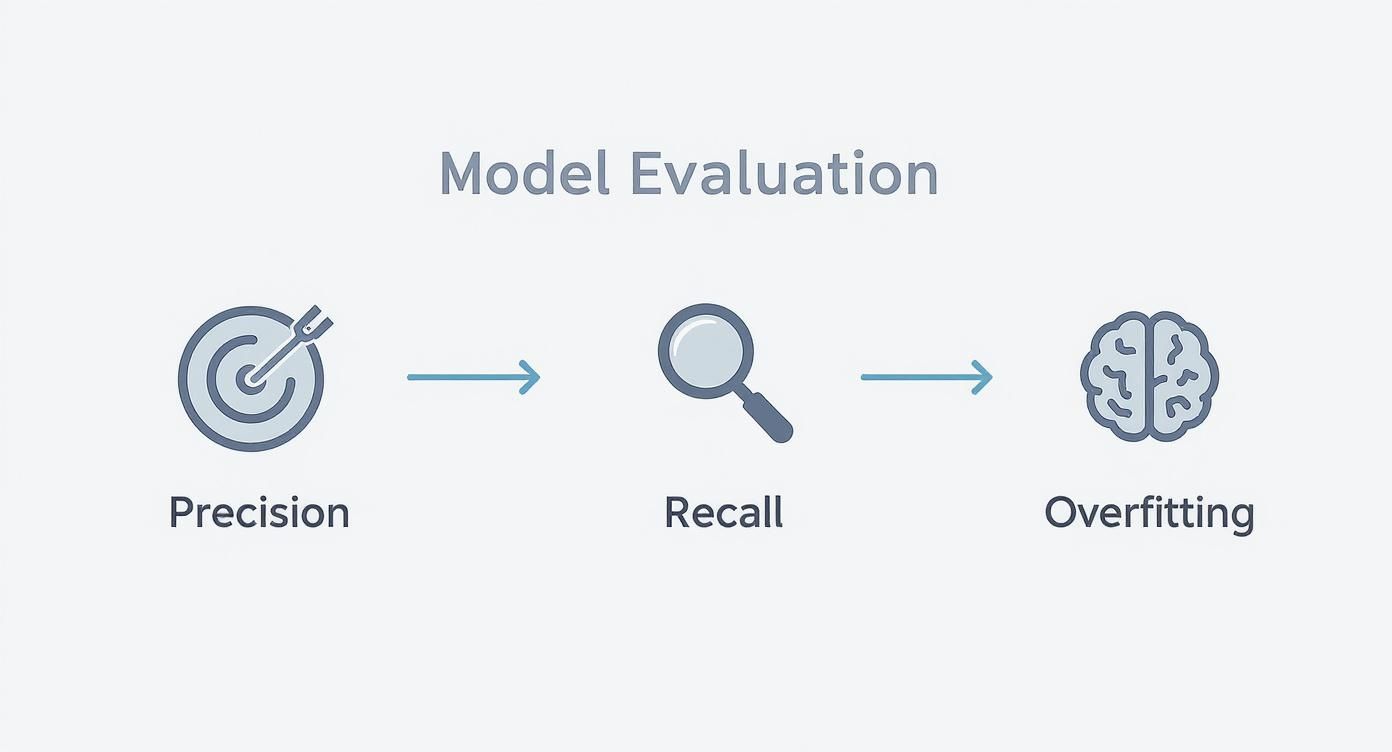 By carefully tuning your model, you can effectively target customers who are genuinely at risk without overwhelming your teams with false alarms about happy clients.
The Impact Opportunity
From a market perspective, churn prediction software has become a major growth segment. Top platforms automate model building and generate personalized risk scores that prioritize retention efforts. For example, Degreed, a learning platform, used AI-driven insights to proactively address user issues, achieving a 100% retention rate over a significant timeframe. Find out more by exploring insights on today's churn prediction software.
By putting your churn predictions into action, you close the loop between data science and business results. You convert your model's intelligence into automated, scalable workflows that directly prevent customer loss, protect recurring revenue, and strengthen customer relationships. This is how a predictive model evolves from a technical asset into a core engine for sustainable growth.
Avoiding Common Pitfalls in Churn Modelling
Even the sharpest predictive churn models can completely miss the mark if they fall into a few common, avoidable traps. Building a churn prediction program that actually works—and keeps working—means knowing what these pitfalls look like from the very beginning.
It all starts and ends with your data. The old saying, "garbage in, garbage out," has never been more true.
Key Takeaways
- Data Quality Is Everything: Your model's accuracy is a direct reflection of your data's cleanliness and relevance. Period.
- Models Have a Shelf Life: Customer behavior is always changing. A model built last year won’t understand today’s customers unless you keep it fresh.
- Ethics Are Not Optional: How you use churn scores is just as important as how you calculate them. Getting this wrong can destroy customer trust in an instant.
Practical Example: The Pitfall of Stale Models
One of the biggest mistakes is treating your churn model as a "set it and forget it" project. Customer behaviors shift, market conditions change, and your product evolves. A model that was dead-on accurate six months ago might be completely out of touch today. This is a classic case of model drift.
Think of it like using a year-old weather forecast to plan a beach trip. The original prediction might have been perfect, but conditions have obviously changed.
Here’s a real-world example: A subscription box company noticed their retention campaigns were falling flat. Their model, built a year ago, still flagged infrequent logins as a top churn predictor. But a huge chunk of their customers had switched to managing subscriptions on the mobile app—something the original model wasn’t tracking. By failing to retrain the model with new data, the company was chasing ghosts while ignoring real risk signals.
The Ethical Tightrope of Customer Profiling
A churn score is a powerful piece of information, but it can easily be misused. Using a high score to justify giving a customer subpar service or to penalize them is a fast track to destroying trust. The goal of a churn model should always be to help customers, not to punish them for being at risk.
This means you need clear governance and ethical guardrails for how your teams use these predictions.
- Establish Clear Usage Policies: Define exactly how customer-facing teams should act on a high churn score.
- Train Your Teams: Make sure everyone understands that a churn score is a signal to engage and help.
- Prioritize Positive Interventions: Use scores to trigger helpful outreach and special offers that genuinely make the customer's experience better.
The Impact Opportunity
When you get this right, you build a sustainable, effective, and ethical churn program that delivers huge value. By keeping your data clean, retraining your model on a regular schedule (quarterly is a good starting point), and setting clear guidelines for your teams, you create a system that reliably protects your revenue. This approach doesn't just prevent churn; it strengthens customer relationships by showing you use data to understand and support them.
Common Questions About Churn Modelling
When you're getting started with predictive churn modelling, a few key questions always come up. Here are some straight answers to help you set expectations and plan your approach.
Key Takeaways
- Start with Quality Data: You need less data than you think, but it must be clean and relevant. Quality over quantity.
- Adaptable to Any Business: Churn modelling isn't just for subscriptions. It can be adapted to any business model with repeat customers by redefining what "churn" means (e.g., time since last purchase).
- High ROI Potential: The ROI is direct and significant. A small reduction in churn can lead to a substantial increase in overall profitability.
How Much Data Do I Really Need to Start?
You probably need less than you think. While more data is generally better, a solid predictive churn model can get off the ground with just a few months of clean, well-structured historical data. The real key here is quality over quantity. A model built on three months of high-quality records will always outperform one fed three years of messy data.
Practical Example: Churn Modelling for a Non-Subscription Business
Absolutely. While churn prediction is a perfect fit for SaaS, its principles work for any business that depends on repeat customers. You just have to adapt your definition of "churn."
For an e-commerce store, "churn" might mean a customer hasn't purchased anything in their typical 90-day buying cycle. For a brick-and-mortar retailer, it could be a sharp drop-off in visit frequency. The model is simply trained to spot the unique patterns of declining engagement for your business.
What Is the Typical ROI of a Churn Model?
The return on investment for predictive churn modelling is incredibly direct. By saving even a small fraction of at-risk customers, the model can pay for itself almost immediately. Some studies show that a mere 5% boost in customer retention can drive profitability up by 25% to 95%.
The ROI comes from two main places. First, you save the future revenue from the customers you successfully keep. Second, you stop wasting your retention budget on broad, ineffective campaigns and instead focus your resources precisely where they’ll have the biggest impact.
Ready to turn your data into a scalable revenue system? Prometheus Agency is an AI transformation partner that helps growth leaders build durable growth systems. Start with a complimentary Growth Audit and AI strategy session. Learn more at prometheusagency.co.
Article created using Outrank