
When sales and marketing aren't on the same page, you're not just dealing with a bit of internal friction. You're actively bleeding revenue. Getting these two teams to operate as a single, unified revenue engine is one of the most powerful moves you can make for growth.
It's about creating a seamless journey for the customer, from the very first ad they see to the final signature on a contract.
The Hidden Drain of Sales and Marketing Misalignment
Before we jump into fixing the problem, let's get real about what a disconnected sales and marketing relationship actually costs you. This isn't just about arguments over lead quality; it’s a direct drain on your profitability. It creates a vicious cycle of wasted effort and missed opportunities that can silently suffocate your company's growth.

Tangible Costs of Disconnected Teams
The financial fallout here is staggering. Research shows that this operational gap costs businesses a jaw-dropping $1 trillion annually in lost productivity and squandered marketing spend.
Let that sink in.
A shocking 79% of leads generated by marketing never convert into sales. On top of that, up to 70% of B2B content goes completely unused by sales teams. This inefficiency can cost companies 10% or more of their annual revenue—a massive loss that hits the bottom line hard.
Key Takeaway: Misalignment isn't just an operational headache; it's a major financial liability. Every lead that falls through the cracks and every piece of content that gathers dust represents a tangible loss of potential revenue.
Practical Examples of Misalignment
I see this all the time. Marketing will launch an expensive campaign and generate hundreds of leads, feeling pretty good about their numbers. But then sales gets them and realizes they're completely unqualified, forcing reps to waste hours on prospects who aren't ready to buy. The result? Wasted ad spend and a sales team that’s beyond frustrated.
On the flip side, sales reps are on the front lines, gathering incredible insights from customer conversations about specific pain points and needs. But without a clear feedback loop, that goldmine of information never makes it back to marketing. This leaves the marketing team creating content based on assumptions, not what customers are actually saying.
For a structured approach to fixing this, a practical guide to revenue alignment can help bring a go-to-market strategy into focus.
The Opportunity Cost
Here’s the good news: fixing this disconnect is one of the biggest growth levers you can pull. Companies that get this right see a dramatic improvement in lead quality, shorter sales cycles, and a much more consistent customer experience.
A well-integrated CRM is the foundation for this whole process. Understanding what a CRM system really does for your sales team shows how it can become the central source of truth that both teams need.
Ultimately, turning these two functions into a single, cohesive unit is what sets the stage for real, sustainable growth.
Create a Unified Language with Shared Revenue Goals
True alignment isn't accidental. It's engineered. It starts with a shared vocabulary and one single, unifying objective: revenue.
The classic disconnect—marketing celebrating lead volume while sales laments lead quality—has to end. To stop the cycle, both teams have to ditch their siloed metrics and rally around the numbers that actually grow the business. This means moving beyond vanity KPIs.
Instead of marketing owning "website traffic" and sales owning "calls made," both teams become accountable for the entire funnel. It's a fundamental shift from tracking activity to driving outcomes, and it's the first real step in building a powerful revenue engine.
Defining Your Target with Precision
The first move is getting both teams in the same room—physically or virtually—to hammer out your Ideal Customer Profile (ICP) and buyer personas together. This can't be a task marketing handles alone. Sales is on the front lines, hearing objections, pain points, and buying triggers straight from the source. Their real-world insights are what turn a generic persona into a killer targeting tool.
During this joint workshop, you need to answer some critical questions as one team:
- What traits define our best customers? Look at your high-value clients right now. What industries are they in? How big are they? What tech do they already use?
- What are the biggest pain points we solve for them? Sales can bring direct quotes and real-world examples to the table that are far more powerful than marketing’s best guess.
- Who are the key players in the buying process? Map out the whole buying committee, from the economic buyer to the end-user who just wants an easier workday.
- What are the most common objections sales hears? This intel helps marketing create content that smashes those hurdles early in the journey.
This isn't just an exercise. The output is a shared strategic asset that guides everything from campaign creative and content strategy to sales outreach.
Impact Opportunity When sales and marketing co-create the ICP, marketing starts generating leads that sales is genuinely excited to work. This simple act of collaboration directly boosts morale and, more importantly, sends the lead-to-opportunity conversion rate through the roof.
Standardizing Lead Definitions to Eliminate Ambiguity
One of the biggest sources of friction is the fuzzy definition of a "good lead." What marketing calls a Marketing Qualified Lead (MQL) is often miles away from what sales considers a Sales Qualified Lead (SQL). The fix is to create crystal-clear, universally accepted definitions for every single stage.
Separate metrics guarantee separate priorities—it's that simple. You need shared KPIs that both teams live and die by, like lead-to-opportunity conversion rates and speed-to-lead response times. In fact, a staggering 47% of organizations blame separate sales and marketing funnels for their misalignment. That number alone should tell you how critical operational unity is. You can learn more about how shared funnels can unify your revenue operations.
Here’s a practical way to standardize those all-important definitions.
The table below offers a straightforward framework for getting everyone on the same page. These aren't just suggestions; they should become the law of the land for your revenue teams.
Defining Key Lead Stages for Sales and Marketing Alignment
| Stage | Definition for Marketing | Definition for Sales | Shared Goal |
|---|---|---|---|
| MQL | A lead who has shown intent by engaging with high-value content (e.g., webinar attendance, demo request) and matches key ICP criteria. | A lead that meets the minimum threshold of engagement and fit, ready for initial qualification. | Ensure a steady flow of leads who fit the target profile and show legitimate interest. |
| SAL | A lead that marketing has qualified and passed to sales, pending formal acceptance by a sales representative. | An incoming lead from marketing that a rep is actively reviewing to confirm it meets the criteria for outreach. | Guarantee a smooth and rapid handoff of qualified leads from marketing to the sales floor. |
| SQL | A lead that sales has accepted and confirmed has a legitimate need, budget, and authority to purchase. This lead is now an active opportunity. | A fully vetted prospect who has entered the active sales pipeline and is being worked toward a close. | Convert accepted leads into tangible pipeline revenue at a predictable rate. |
Once you agree on these, build them directly into your CRM and marketing automation platform. This creates a single source of truth and kills subjective interpretation. When a lead is marked as an MQL, everyone in the organization knows exactly what that means. You've just created the common language essential for true alignment.
Design a Bulletproof Lead Handoff Process with an SLA
Even when everyone agrees on the big picture, the single greatest point of failure between sales and marketing is the handoff. This is that critical moment when a lead, warmed up and qualified by marketing, gets passed over the fence to sales.
Without a rock-solid process, this is where your best leads vanish into thin air. It’s where the finger-pointing starts and old frustrations bubble up.
The fix? A Service Level Agreement (SLA). This isn't just corporate jargon—it's an operational contract. It holds both teams accountable to specific, measurable promises, turning vague complaints like "the leads are bad" into objective conversations about real numbers and timelines.
Building Your Core SLA Commitments
A good SLA kills ambiguity. It needs to spell out exactly what each team will deliver, when, and how. To get there, you need a steady pipeline of quality prospects, which starts with implementing proven SaaS lead generation strategies.
From there, your SLA should nail down the specifics.
Marketing’s Commitment to Sales:
- Lead Volume: We will deliver a minimum of 120 Sales Qualified Leads (SQLs) per month that fit our agreed-upon ICP.
- Lead Quality: At least 85% of those SQLs will meet the BANT criteria (Budget, Authority, Need, Timeline) when sales makes their first contact.
- Data Completeness: Every single lead record will include full contact info, company details, lead source, and a quick summary of their marketing engagements (like which webinar they attended or what PDF they downloaded).
Sales’ Commitment to Marketing:
- Speed to Lead: Sales will make the first contact (a call or a personalized email) on 100% of new SQLs within 3 hours of assignment. The data doesn't lie—contacting a lead in that first hour can boost conversion rates through the roof.
- Follow-Up Cadence: Every SQL gets at least 7 follow-up attempts over a 14-day period before being marked as closed-lost or sent back for nurturing.
- Lead Disposition: Sales will update the CRM status for every lead they work within 24 hours of the final follow-up attempt. This means clear, honest feedback on why it was qualified or disqualified.
Impact Opportunity: An SLA isn’t about assigning blame. It’s about creating mutual accountability. When you define specific promises, you build a framework for productive talks focused on improving the entire pipeline, not just one team's stats.
Mapping the Handoff and Recycle Workflow
Beyond the numbers, your SLA has to map out the actual mechanics of the handoff. A simple flowchart can work wonders here, clarifying the lead's journey from an Ideal Customer Profile (ICP) to a Marketing Qualified Lead (MQL) and finally to a Sales Qualified Lead (SQL).
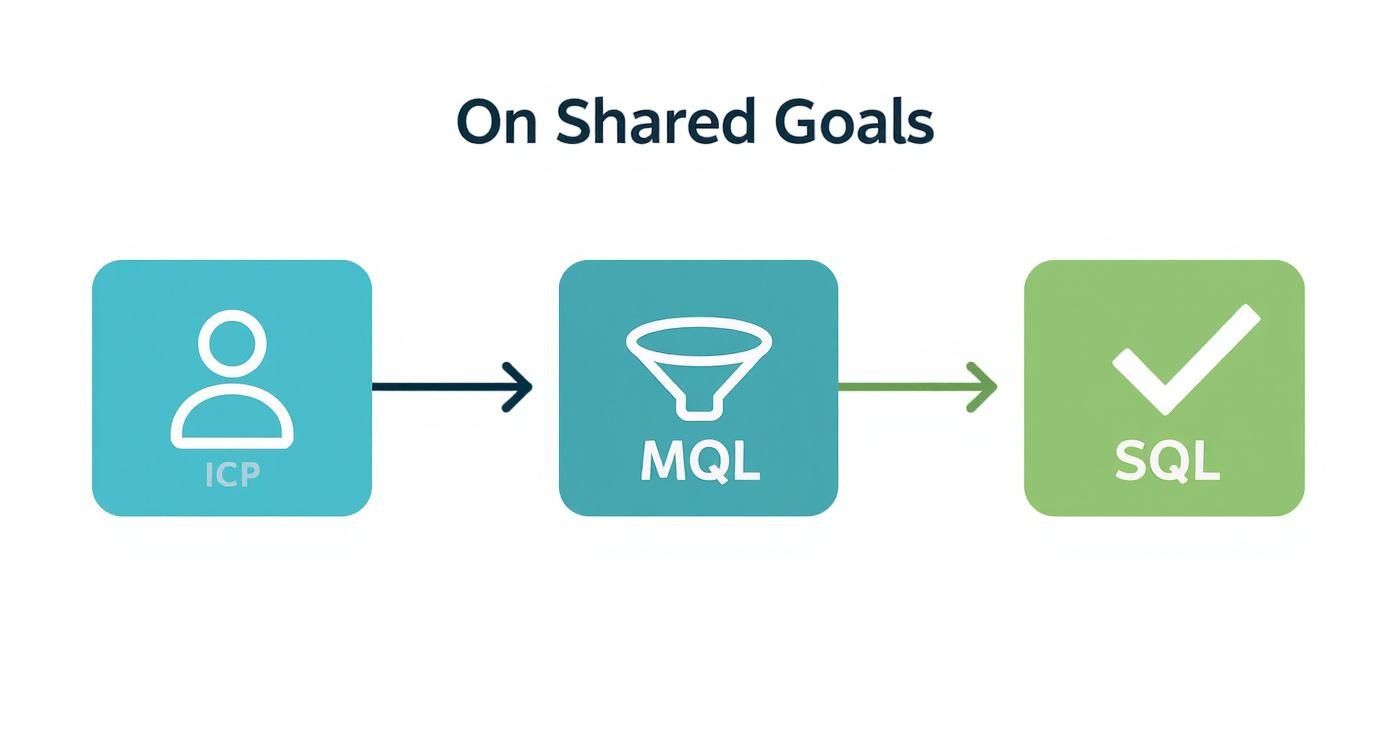
When this process works, leads get passed between teams at the perfect moment. When it breaks, you're just throwing revenue away.
But what about leads who aren't quite ready to buy? This is where the lead recycling process comes in. A sales rep shouldn’t just toss these leads aside. They need a clear path back to marketing for more nurturing.
Your SLA should define this loop:
- Recycling Criteria: What are the official reasons a lead gets sent back? Common ones are "Not ready to buy," "No budget this quarter," or "Couldn't reach after 7 attempts."
- Re-engagement Protocol: What happens next? Maybe they’re dropped into a long-term email sequence or retargeted with content that addresses the feedback sales provided.
- Requalification Threshold: What specific action sends a recycled lead back to sales? This could be a new high-intent signal, like requesting a demo or revisiting the pricing page.
The Real-World Impact
This whole system lives or dies by your CRM. It's your single source of truth. The SLA should be built directly into your CRM workflows with automated lead routing, task creation for follow-ups, and mandatory fields for dispositioning leads.
Get this right, and you've turned a document into a revenue-driving machine. A professional CRM implementation can give you the technical and strategic muscle to make it happen.
By designing this bulletproof handoff, you eliminate the gray area where leads—and revenue—disappear. You create a closed-loop system where both teams work from the same playbook, with clear rules and a shared mission: turning prospects into happy, profitable customers.
Integrate Your Tech Stack for a Seamless Data Flow
Your shared goals and airtight SLA are the strategic foundation, but it's your technology that actually brings them to life.
Let's be real—without a connected tech stack, even the best-laid plans fall apart. You end up with digital silos that are just as damaging as organizational ones. The goal here is to build a system where data flows freely, giving every single person the right information at the right time.
This isn’t about buying more software. It’s about making the tools you already have work together, with your Customer Relationship Management (CRM) platform as the central nervous system. When your CRM and marketing automation platform are in constant conversation, you unlock a whole new level of operational intelligence.
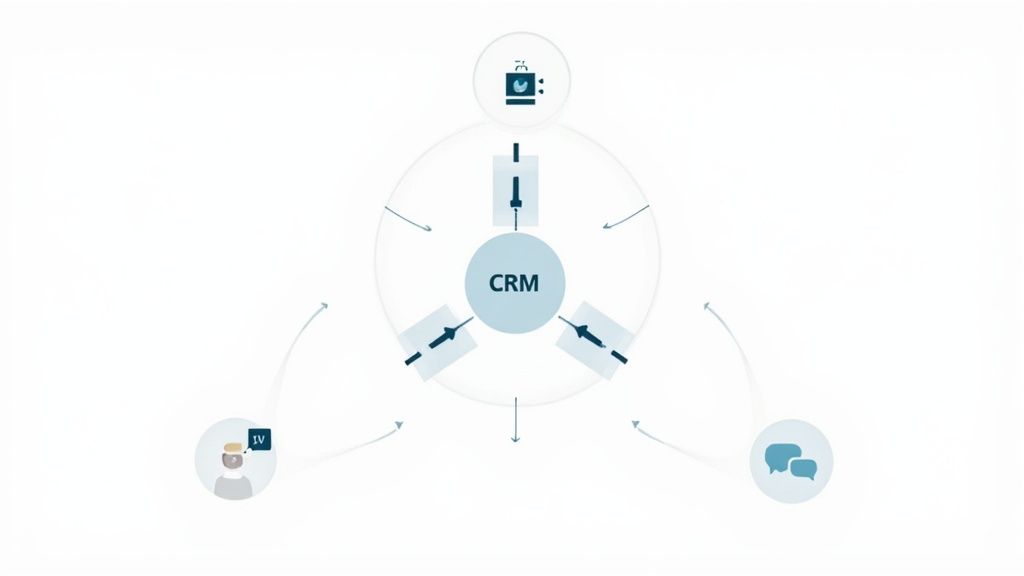
Establishing a Bi-Directional Sync
A one-way data push from marketing to sales is a recipe for disaster. I've seen it fail too many times. True alignment demands a bi-directional sync—a two-way street where information is exchanged automatically and in near real-time. This creates a powerful feedback loop that benefits everyone.
For sales, this means instant visibility into a lead's entire history. When a new lead lands in their queue, they can see every blog post they read, every webinar they attended, and every email they opened. That context is gold. It lets reps tailor their outreach for maximum impact instead of going in cold.
For marketing, the sync delivers the ground truth on sales outcomes. They can finally see which campaigns are generating leads that actually turn into revenue, not just MQLs that go nowhere. This closed-loop reporting is how you double down on what works and cut spend on the channels that just produce noise.
Key Takeaway: A bi-directional sync turns your CRM into the single source of truth. It gives sales reps the full story behind a lead's journey and gives marketing the hard data they need to prove ROI and make smarter decisions.
Practical Examples of Integrated Tech in Action
When your systems are properly connected, you can move way beyond basic automation and start creating genuinely intelligent workflows. The possibilities are powerful and directly impact your bottom line.
Here are a few ways this plays out in the real world:
AI-Powered Predictive Lead Scoring: Forget the old-school points system (+5 for an email open). You can use AI to analyze thousands of data points—behavioral, firmographic, and intent signals—to predict which leads are most likely to close. The system automatically surfaces the hottest leads for sales, making sure reps are always working on the opportunities with the highest probability of success.
Automated Sales Alerts for High-Intent Actions: Set up triggers that ping a sales rep in real-time when a lead they own takes a high-value action. For example, if a prospect in their pipeline revisits your pricing page or downloads a technical case study, an instant alert can be sent via Slack or email. This prompts the rep to follow up while the lead's interest is at its absolute peak.
Conversation Intelligence for Marketing: Tools that record and analyze sales calls can pull out key phrases, common objections, and competitor mentions. This "voice of the customer" data is then fed back to marketing, giving them incredible insights to refine ad copy, create more relevant content, and build campaigns that speak directly to what buyers actually care about.
The Impact Opportunity
Integrating your tech stack does way more than just save a few hours. It creates that unified view of the customer that is absolutely essential for aligning sales and marketing.
When both teams operate from the same data, the classic arguments over lead quality just fade away. They get replaced by strategic conversations about how to improve the entire revenue funnel, together.
This seamless data flow ensures marketing efforts are directly tied to sales outcomes and that sales outreach is informed by marketing intelligence. This closed-loop system is the technical backbone of any high-performing, fully aligned revenue organization, turning your disconnected tools into a powerful engine for growth.
Establish a Rhythm with Joint Meetings and Unified Dashboards
Alignment isn't a project you complete and check off a list. It's a living practice. It needs a steady rhythm of communication and shared accountability to survive.
Without a consistent cadence for collaboration, even the most buttoned-up SLAs and tech integrations will slowly drift apart. Old habits have a way of creeping back in.
The fix is to embed alignment into your operational DNA. You do this with two things: structured, purposeful meetings and a single, unified dashboard that becomes everyone's source of truth. This is how you shift the conversation from finger-pointing and anecdotal complaints to data-driven problem-solving.
This regular interaction is the glue that holds the entire strategy together. It’s what turns your goals and agreements into a day-to-day reality, fostering a culture where sales and marketing truly function as one revenue team.
The Tactical Weekly Huddle
Think of the weekly meeting as your frontline check-in. It needs to be quick, tactical, and laser-focused on the immediate flow of leads through the funnel. This isn't the time for deep strategic dives; it’s about spotting and clearing roadblocks in real-time to keep the pipeline moving.
Keep this huddle to a tight 30 minutes with a non-negotiable agenda. The only people who need to be there are the marketing manager responsible for lead gen and a sales manager or team lead.
Your agenda should be simple:
- Lead Volume and Quality: Did we hit our MQL target for the week? What percentage did sales accept as SQLs?
- SLA Check-in: Is sales hitting the speed-to-lead time we agreed on? Are leads getting dispositioned correctly in the CRM?
- Urgent Blockers: Are there any tech issues with lead routing? Is a specific campaign sending junk leads that we need to pause right now?
This huddle stops small issues from becoming massive problems. It turns potential conflicts into quick, collaborative fixes and keeps the operational engine humming along.
Key Takeaway: Alignment is a continuous practice, not a one-time initiative. Establishing a consistent meeting rhythm and a unified dashboard fosters a culture of collaborative problem-solving, turning 'your leads were bad' into 'how can we improve lead quality together?'
The Strategic Monthly Review
If the weekly huddle is about the "what," the monthly review is all about the "why." This is a longer, more strategic session where leadership from both departments comes together to look at trends, evaluate outcomes, and make bigger decisions.
This meeting should be 60 minutes long and entirely data-centric, driven by that unified dashboard you've built.
To keep everyone on the same page, a structured meeting cadence is essential. Here’s what a good rhythm looks like in practice:
Sales and Marketing Joint Meeting Cadence
| Meeting Type | Frequency | Attendees | Key Agenda Items |
|---|---|---|---|
| Tactical Huddle | Weekly | Marketing Manager, Sales Manager | Review MQL/SQL flow, SLA adherence, immediate pipeline blockers. |
| Strategic Review | Monthly | VP of Sales, VP of Marketing | Analyze funnel conversion rates, sales cycle by lead source, campaign ROI. |
During this strategic review, you’ll dig into the metrics that really matter. You'll analyze the MQL-to-Opportunity conversion rate for different campaigns. You can compare the sales cycle length for leads from your latest webinar versus your paid search ads. This is the kind of analysis that gives you the insights needed to actually allocate budgets and resources effectively.
For businesses that need help building these kinds of insightful views, investing in professional reporting and analytics services can provide the exact framework to connect the dots between data and real business outcomes. This is where you finally connect marketing activities directly to closed-won revenue, proving the value of your collaborative efforts and making smarter strategic bets for the next quarter.
Got Questions? Let’s Tackle the Tough Stuff.
Kicking off a sales and marketing alignment project always surfaces some tricky, practical questions. The kind that can stop momentum in its tracks if you're not ready for them. Getting ahead of these hurdles is half the battle.
Let's dive into the common obstacles I see derail these initiatives and talk through how to handle them. Because aligning teams isn't just about process—it's about managing people and navigating change.
How Do We Get Executive Buy-In for This?
Let’s be blunt: without leadership's backing, this initiative is dead on arrival. Executives run on numbers, so you have to speak their language. That means building a rock-solid business case centered on revenue, efficiency, and ROI.
Forget framing this as an internal "process improvement." Pitch it as a direct path to growth. The best way to do that is to start by putting a dollar amount on the cost of your current misalignment.
Get specific with your numbers:
- Wasted Spend: "Marketing generated 1,500 MQLs last quarter, but Sales rejected 70% of them. At $150 per lead, we essentially burned $157,500 on leads that went straight into the trash."
- Opportunity Cost: "Our main competitor’s sales cycle is 60 days. Ours is 90. If we can improve lead quality and our handoff process, we believe we can shorten that cycle by 20%. That would let us close an extra $500,000 in pipeline revenue each quarter."
When you present hard data like this alongside a clear, phased plan, you’re no longer talking about a departmental project. You’re talking about a strategic business priority. Suggest a small pilot to prove the concept and show some quick wins. That’s how you get leadership to listen—and invest.
What if We Have Strong, Clashing Personalities?
Ah, the classic standoff. The data-obsessed marketer and the relationship-driven salesperson just can't seem to find common ground. When big personalities clash, it can turn any collaboration toxic, fast.
The key here is to take subjectivity off the table. You need to shift the conversation away from personal opinions and ground it in objective data and shared goals.
Impact Opportunity: Your Service Level Agreement (SLA) is the ultimate peacemaker. It becomes the single source of truth, reframing disagreements from personal attacks into collaborative problem-solving. The focus shifts from "I think" to "the data shows."
So, when a salesperson claims marketing's leads are junk, the conversation isn't about their gut feeling. It’s about the numbers. "The SLA defines an SQL with criteria X, Y, and Z. Let's pull the last 50 leads you rejected and see which criteria they missed. From there, we can work backward and fix the root cause."
This simple shift depersonalizes the feedback. It turns a potential argument into a productive workshop focused on making the whole system better for everyone.
How Much Time Should This Realistically Take?
Alignment is a marathon, not a sprint. It’s a fundamental change in culture and operations, and setting realistic expectations from the start is critical to avoid burnout. I've seen too many teams fizzle out because they expected overnight results.
A phased approach is almost always the answer. Here’s a timeline that I’ve seen work well:
| Phase | Duration | Key Activities & Milestones |
|---|---|---|
| Foundation | Months 1-2 | Run joint ICP workshops. Nail down your MQL/SQL definitions. Draft the first version of your SLA. Build the unified dashboard. |
| Implementation | Months 3-4 | Roll out the SLA. Connect the CRM and marketing automation platforms. Kick off weekly tactical huddles and monthly strategic reviews. |
| Optimization | Months 5-6 | Start analyzing the data from your new dashboard. Tweak your lead scoring models. Iterate on the SLA based on what you're seeing in the real world. |
Breaking the project into manageable 90-day sprints helps you show tangible progress quickly. If you can get that unified dashboard live in the first two months, you've scored an early win. That builds confidence and secures the support you'll need for the long haul.
Remember, this timeline isn’t just about checking boxes. It’s about giving new habits and collaborative behaviors the time they need to actually stick. True alignment happens when this new way of working just becomes how things are done.
Prometheus Agency helps growth leaders turn complex tech stacks into scalable revenue systems. If your goal is to build a durable, data-driven engine for growth by truly aligning your sales and marketing teams, our expertise in AI enablement and CRM optimization can provide the roadmap. Start with a complimentary Growth Audit and AI strategy session to see how we can help you tame technology and accelerate results. Learn more at prometheusagency.co.