The popular advice is to pick a high-value AI use case, launch a pilot, and let productivity gains create momentum. That advice is incomplete. AI transformation doesn't stall because companies lack another model or application. It stalls because leaders add AI to workflows that were never redesigned, governed, measured, or connected to revenue.
The distinction matters for B2B growth teams. A sales assistant that drafts messages is useful, but it won't transform go-to-market execution if account data is fragmented, routing rules are unclear, managers don't trust lead scores, and no one owns the resulting workflow. The practical question isn't, “Which AI tool should we buy?” It's, “Which business system must change for AI to produce durable value?”
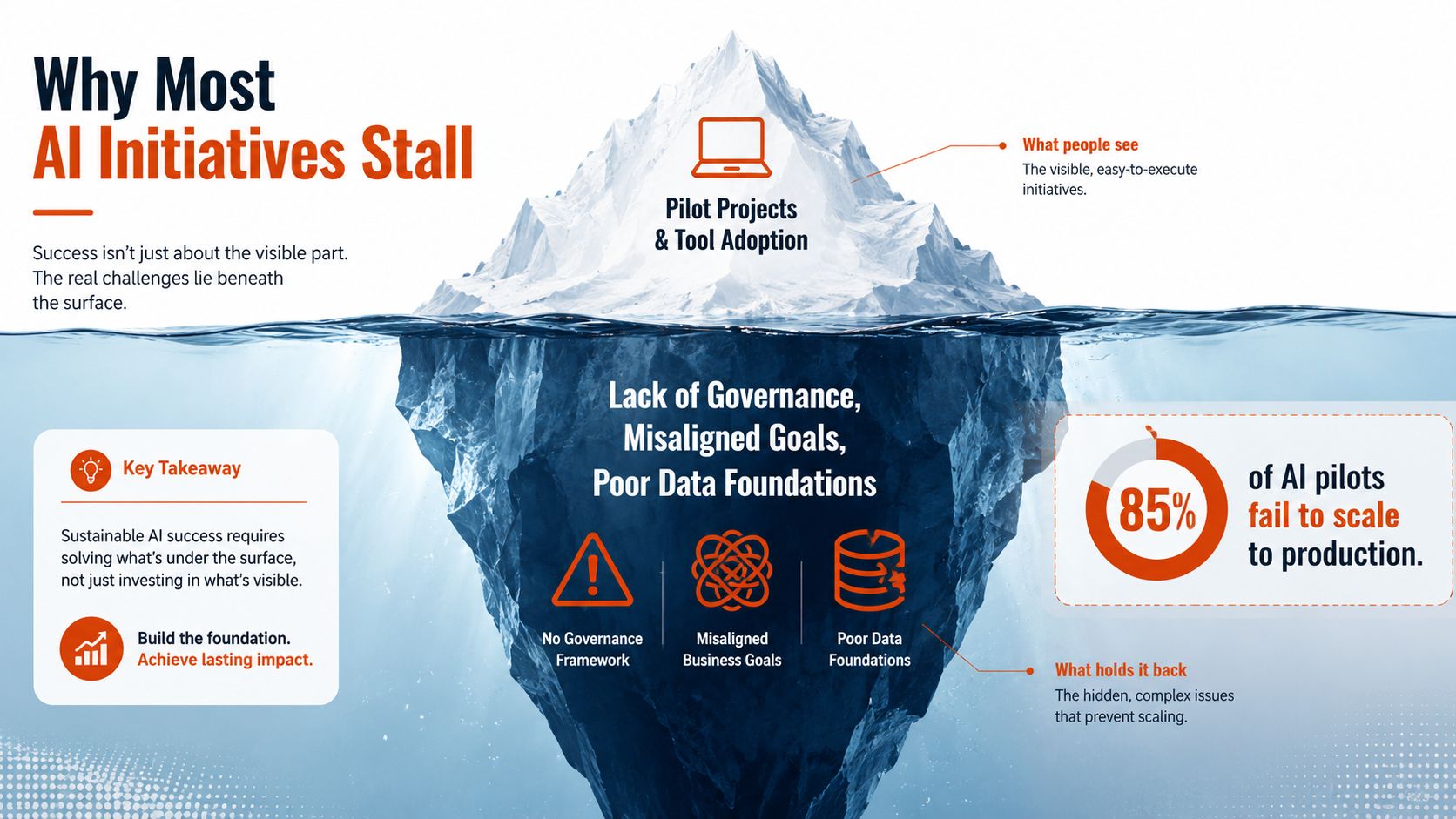
Why Most AI Initiatives Stall Before Real Transformation Begins
Broad usage can create a misleading sense of progress. A 2026 McKinsey global survey found that 88% of organizations use AI in at least one business function, yet only 39% report enterprise-level EBIT impact, and nearly two-thirds still haven't scaled AI across the enterprise (McKinsey's State of AI research). Adoption is ahead of business transformation.
That gap shows up in middle-market firms every week. Marketing uses generative AI for copy, sales uses it for account research, and operations tests automation. Each team may report local wins, but the company still has inconsistent definitions, duplicated data, disconnected approvals, and no enterprise view of cost or risk. The organization is using AI, but AI isn't yet changing how the organization operates.
Adoption is Not Integration
The same McKinsey survey reports that 64% of respondents believe AI is enabling innovation, while many organizations remain stuck between experimentation and enterprise scaling (McKinsey's State of AI research). That combination is perfectly rational. Teams can produce compelling outputs from isolated tools long before they solve data ownership, workflow dependencies, security reviews, training, and accountability.
OECD-linked 2025 data adds another layer. 36.8% of individuals across OECD countries used generative AI tools, while firm-level adoption rose to more than 20% in 2025 from 14.2% in 2024 (OECD-linked adoption analysis). AI literacy is spreading through the workforce, but unevenly. More than 75% of students aged 16 and over used generative AI during the year, compared with 14% of people aged 55 to 75 (OECD-linked adoption analysis).
Growth leaders should diagnose their current state:
- Tool adoption: Employees use AI applications independently.
- Use-case adoption: Specific teams apply AI to repeatable tasks.
- Workflow integration: AI changes how work moves through systems.
- Operating-model transformation: Roles, controls, metrics, and decisions are redesigned around the new capability.
Practical rule: If the AI output still requires people to copy, reconcile, approve, and re-enter information manually, you may have enabled a task, but you haven't transformed the workflow.
A useful next step is to map the path from AI pilot to production and identify where ownership, data, and controls break down. The firms that move forward treat those gaps as transformation work, not as reasons to buy another tool.
What AI Transformation Means for B2B Growth
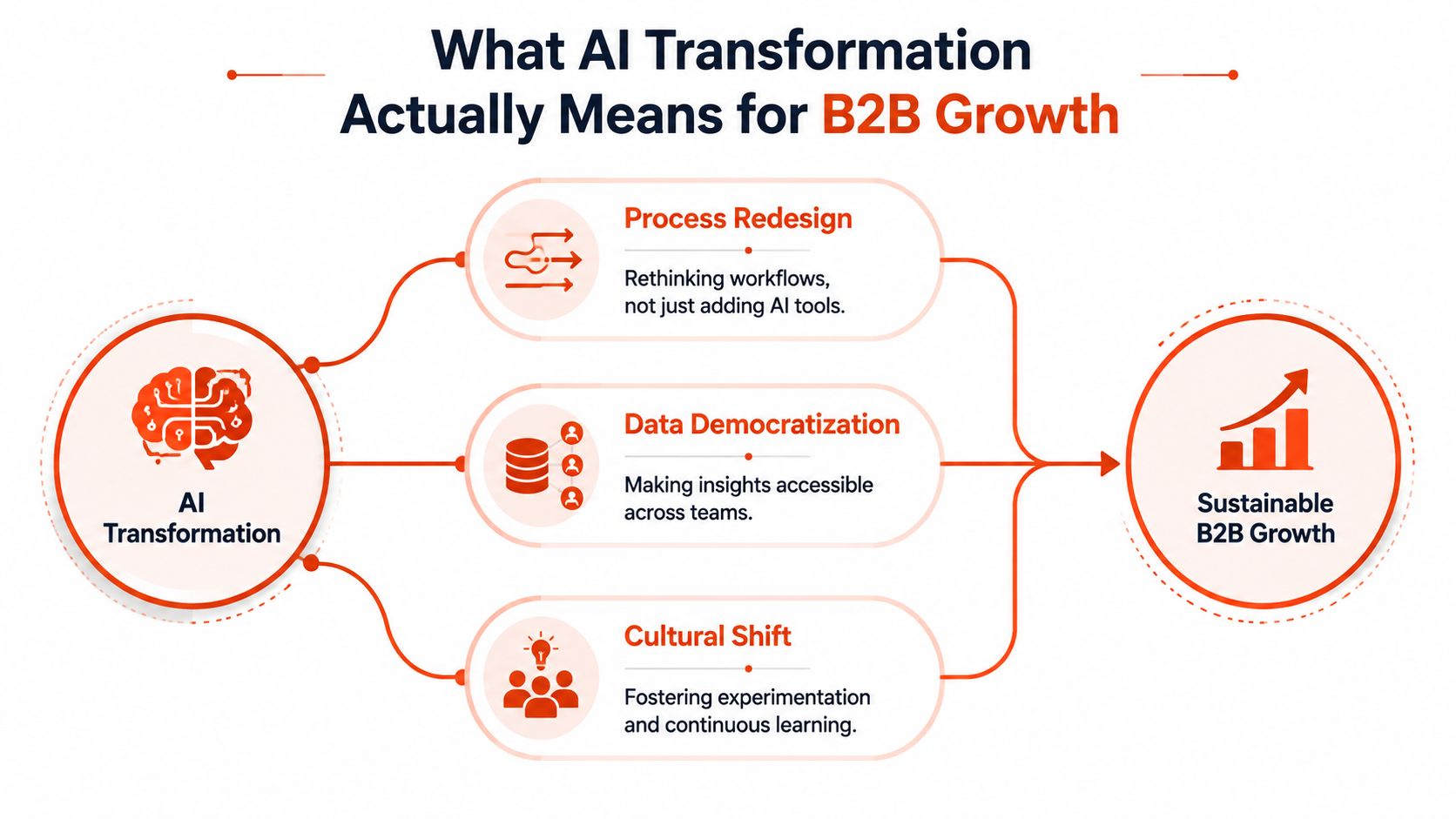
AI transformation redesigns the business system around better decisions, customer service, demand creation, and execution. Technology supports that work, but it does not define it. Transformation takes hold when process design, data access, team behavior, and commercial priorities reinforce one another.
AI enablement gives employees approved tools for specific tasks. Transformation changes how work moves through the company. A sales representative using an AI writing assistant has a useful application. A revenue organization with connected customer data, governed recommendations, automated handoffs, and measures for decision quality has redesigned part of its operating model. The difference is integration, ownership, and repeatability.
The four connected layers
AI enablement sets the operating conditions. Employees need approved tools, role-specific training, clear data rules, and guidance on when human review is required. Without those controls, adoption fragments across teams and creates unmanaged workarounds.
CRM optimization places AI inside the customer journey. That requires dependable lifecycle stages, accurate account relationships, useful activity data, and workflows that turn a recommendation into an action in the system where the team already works. A disconnected assistant may produce strong content while leaving routing, qualification, and follow-up unchanged.
GTM alignment ties AI use to commercial priorities. A company pursuing expansion needs different signals from one focused on new-logo acquisition. A manufacturing business with long buying cycles may prioritize account intelligence and opportunity inspection. A SaaS firm may place more weight on segmentation, product signals, and sales development.
Organizational change management determines whether the redesigned process becomes normal practice. Managers must coach to the new workflow instead of rewarding the old one. Employees need a clear reason to trust the system, a channel for reporting errors, and enough context to understand how their responsibilities change.
Integration also exposes the trade-offs that tool demos hide. Faster output can create more review work if data is incomplete or recommendations lack account context. Automation can reduce manual effort while increasing the cost of an unhandled exception. Leaders assessing why AI matters for scaling SaaS should apply the same commercial test across B2B: AI creates growth when it improves a repeatable operating system, not when it adds another isolated capability.
The Assess-Pilot-Scale Framework for AI Enablement
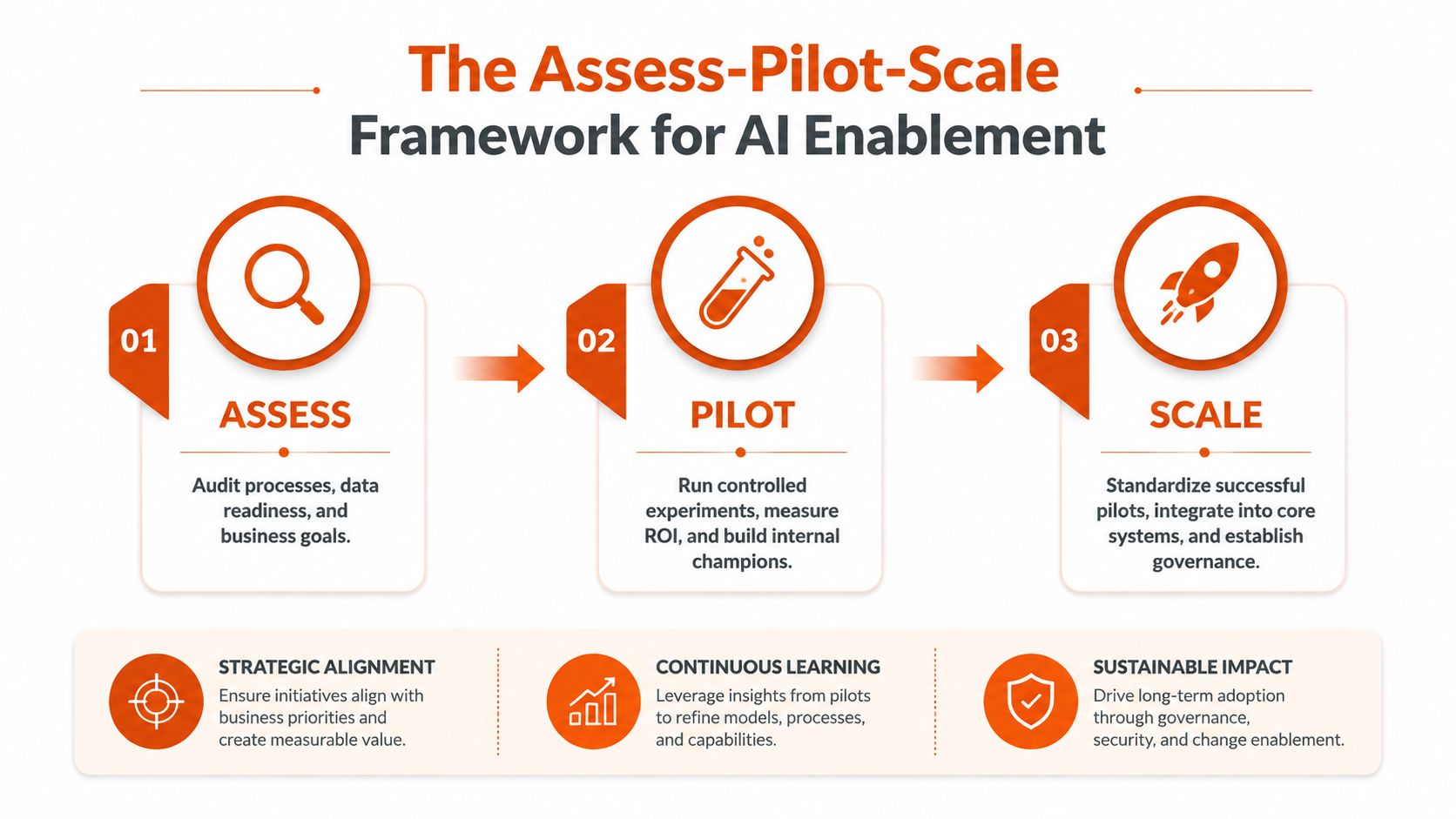
AI enablement works through assess, pilot, and scale, provided each phase changes how work gets done. Assessment identifies the workflow and constraints. A pilot tests value under controlled conditions. Scaling makes the new operating model repeatable across teams and systems.
Assess the system before selecting the use case
Map the current workflow from trigger to outcome before choosing a tool. Document the systems involved, human decisions, handoffs, rework, data sources, approval points, and consequences when something fails. Audit the technology stack as well, including the CRM, marketing automation platform, customer support tools, data warehouse, collaboration applications, and existing AI subscriptions.
Score each opportunity against four criteria:
- Business consequence: Does the workflow affect revenue, cost, customer experience, or decision speed?
- Data readiness: Can the system access consistent, timely, permissioned information?
- Execution feasibility: Can the capability fit an existing process without creating manual work elsewhere?
- Risk profile: What happens if the system is wrong, incomplete, biased, or unavailable?
The assessment should produce a short list rather than a catalog of AI ideas. Require a named owner, a measurable baseline, a defined user group, and a specific description of how responsibilities and workflow steps will change.
Pilot a contained commercial problem
Choose one workflow with a bounded scope and an outcome the business already understands. Lead research, opportunity prioritization, service triage, proposal preparation, and forecast inspection can work when the team defines the baseline before deployment.
A pilot must test the operating process, not only model output. Track accuracy, latency, decision quality, adoption behavior, exception volume, review time, and operating cost. The available PwC research reports cross-industry reference averages of 81% accuracy, 85% decision quality, 8% deceptive outputs, and 1.01 seconds latency (PwC benchmark reference). Use these figures as comparison points, then set thresholds that match the risk and economics of the specific workflow.
Scale the workflow, not just the model
Scale only after the pilot owner can demonstrate a repeatable process, acceptable risk, user adoption, and a credible value case. Scaling requires integration with core systems, standardized prompts or decision rules, monitoring routines, and a named support owner. It also requires an exception path, because unresolved edge cases can return manual work to the team at a higher cost.
The Hackett Group evaluates AI World Class performance through productivity, cost, speed, and business outcomes across 16 end-to-end processes, including cost, FTE requirements, cycle time, and error rates (Hackett Group benchmark discussion). That measurement approach keeps leadership focused on redesigned work and commercial results rather than a successful demonstration.
Integrating AI with CRM Optimization and GTM Strategy
AI transformation becomes commercially visible in the CRM. If the system sits in a separate browser tab, salespeople must remember to open it, interpret the output, and update records manually. Embedding recommendations in the existing workflow reduces that friction and connects AI to qualification, prioritization, forecasting, and follow-up.
Lead qualification shows the difference. A useful system combines firmographic data, engagement history, account relationships, buying signals, territory rules, and rep feedback. Its recommendation should appear in the salesperson's workspace, explain the signals behind it, and trigger a defined next action. A score without context creates false precision and weakens rep trust.
Measure the workflow, not just the model
AI performance needs measures tied to the work. Track whether recommendations improve qualification, account research, forecast preparation, or service triage. Set a baseline for each use case, define the threshold for human review, and monitor adoption, exception volume, review time, and operating cost.
A practical CRM scorecard can use the following comparison points from internal workflow results or the organization's own baseline:
| Function | Measures to track |
|---|---|
| Lead qualification | Recommendation accuracy, accepted opportunities, rep overrides, time to disposition |
| Account research | Research completeness, preparation time, account insight usage |
| Forecast support | Forecast changes, inspection time, manager confidence, missed risks |
| Service triage | Routing accuracy, response time, escalation volume, resolution quality |
The 8% deceptive-output reference rate cited earlier remains a useful risk reminder for customer-facing and executive workflows. Fluent output can still produce a commercially damaging answer. Log errors, classify them by risk, and require escalation for claims or recommendations that affect customers, pricing, or executive decisions.
GTM strategy must change with the signal model
AI can improve segmentation, outreach sequencing, opportunity inspection, and sales forecasting. It also changes buyer expectations. Prospects may complete more research before speaking with sales, compare vendors faster, and expect relevant answers earlier. Growth teams need sharper positioning, stronger account context, and content that supports the decisions buyers are making.
The operating model must connect those signals across marketing, sales, and customer teams. Marketing should pass usable buying context into the CRM. Sales should record disposition and rep feedback in a consistent format. Revenue leaders should review whether the signal changes a decision, not merely whether users generate more activity.
McKinsey's 2025 State of AI found that 71% of respondents said their organizations regularly use generative AI in at least one business function, up from 65% in early 2024. Common use cases included marketing and sales, product and service development, service operations, and software engineering (McKinsey State of AI summary). These functions provide practical starting points because they contain repeatable decisions tied to revenue or customer experience.
Leaders can use this guide to integrate AI with CRM systems, then test each recommendation against a defined commercial outcome. A pilot that adds another dashboard may show activity. A workflow that changes routing, prioritization, or follow-up can improve how the revenue team operates.
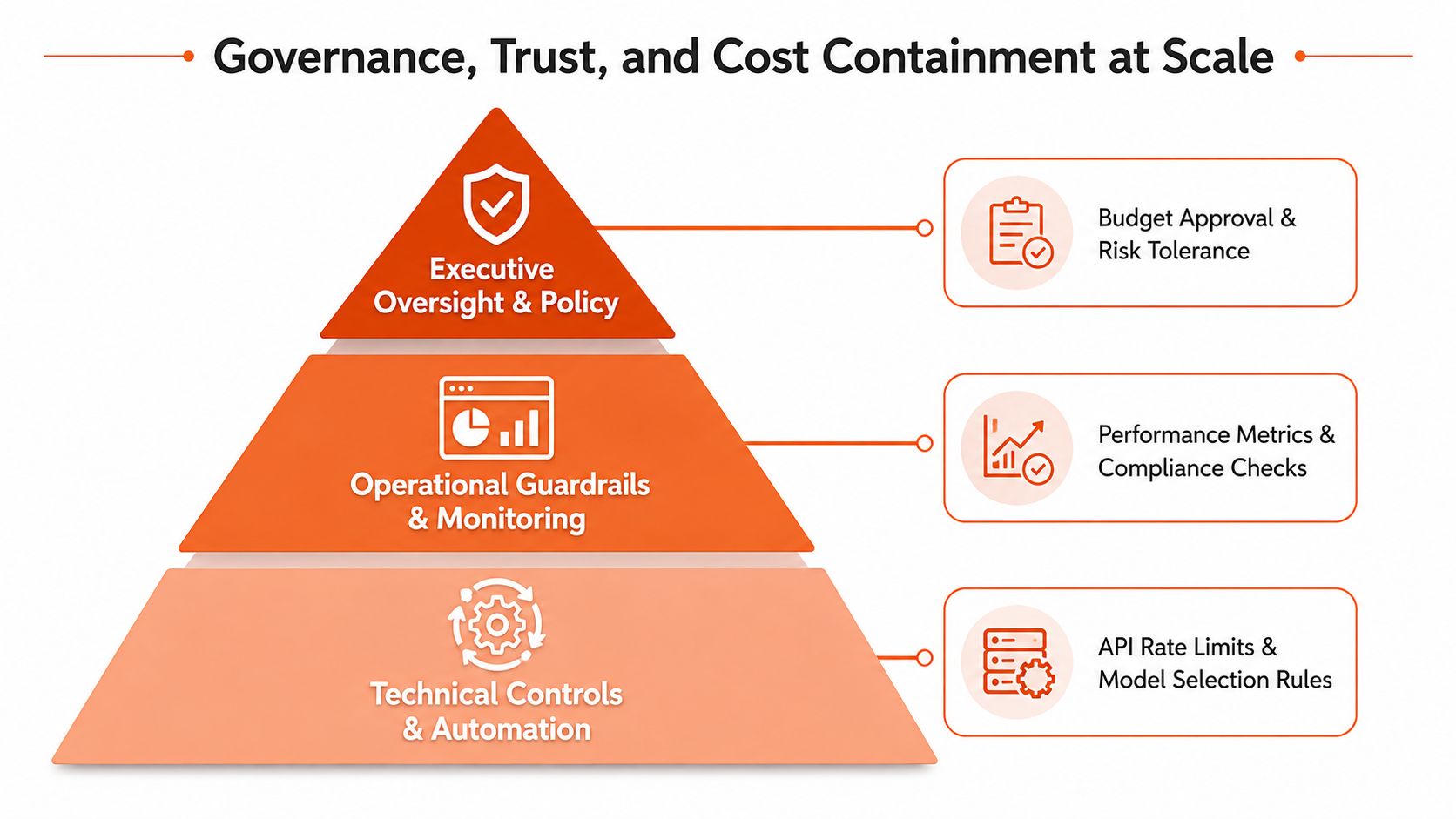
Governance Trust and Cost Containment at Scale
AI transformation stalls when governance remains an approval exercise instead of part of the operating model. Once AI affects pricing, lead routing, customer communications, hiring, support, or financial decisions, leaders need clear answers: who approved the use case, which data it can access, when a person must intervene, and how the company will detect and correct failure.
Trust is an operating metric
Capgemini's 2025 research reports that generative AI adoption rose from 6% in 2023 to 30% in 2025, while 93% of organizations are only exploring or enabling capabilities and 71% say they can't fully trust autonomous AI agents for enterprise use (Capgemini's 2025 research). Those findings support a staged approach to autonomy. An agent can draft, classify, or recommend before it receives authority to execute an irreversible action.
Put the controls inside each workflow:
- Permission boundaries: Restrict access by role, account, data class, and action type.
- Human escalation: Send ambiguous, high-risk, or customer-visible decisions to a named reviewer.
- Evidence capture: Record the source context, recommendation, action, reviewer, and outcome.
- Performance monitoring: Track accuracy, deceptive outputs, latency, exception rates, and policy adherence.
- Rollback procedures: Keep automated actions easy to disable or reverse.
Cost containment requires design choices
AI costs include more than subscription fees. Model calls, retrieval, storage, integration maintenance, monitoring, human review, and failure recovery all affect the operating budget. Set model-selection rules, request limits, caching policies, and escalation thresholds before usage expands.
A 2025 research finding says organizations expect ROI only after about 28 months on average. That expectation requires a staged business case, with explicit investment limits and review points rather than a promise of immediate payback.
McKinsey's research reports that only 19% of C-level leaders see revenues increase by more than 5% from enterprise-wide AI investments, while only 23% see favorable cost change (McKinsey's Superagency research). Governance protects the conditions for finding value without allowing uncontrolled risk or cost to spread. Executives can also review AI transformation as a governance problem for a practical operating-model perspective.
Common Pitfalls That Derail AI Transformation Initiatives
A B2B company launches an AI prospecting pilot because the sales team wants more qualified meetings. The vendor demo looks strong, but no one defines what “qualified” means, which accounts should be prioritized, or how reps should record outcomes. After launch, managers compare anecdotes instead of baseline metrics, reps use the tool inconsistently, and leadership concludes that AI isn't reliable.
The technology may be functioning. The initiative failed because the business never defined the decision.
The familiar failure patterns
The tool-first purchase starts with a platform and searches for a problem afterward. Warning signs include overlapping applications, unclear data permissions, and employees exporting information into personal workspaces. Corrective action starts with workflow mapping and a stack audit. Buy or build only after the company knows which process must improve.
The pilot without a decision gate produces activity without learning. Teams celebrate generated content, summaries, or recommendations but can't state what result would justify expansion. Set a baseline, name the owner, define the review period, and specify the conditions for scaling, pausing, or stopping.
The isolated department creates local efficiency while damaging cross-functional consistency. Marketing changes account definitions, sales ignores the new scores, and customer success can't see the context. The fix is a shared process owner and a system-level design that connects handoffs.
The ungoverned agent receives broad access because autonomy sounds like the payoff. Early signals include unexplained actions, inconsistent policy adherence, rising model spend, and reluctance from legal or compliance teams. Start with constrained permissions, observable actions, and human approval for consequential steps.
Diagnostic question: What would have to change in the CRM, manager scorecard, approval process, and employee role description for this pilot to become standard work?
The strongest recovery plans don't add more experimentation. They narrow the use case, repair the data path, clarify accountability, and reconnect the project to a commercial outcome.
Your Next Steps to Launch an AI Transformation Initiative
Start on Monday with a Growth Audit and AI strategy session. Bring the revenue leader, operations owner, CRM administrator, finance partner, and a frontline user into the same conversation. The first meeting should identify a painful workflow, its current baseline, the systems involved, and the executive outcome that matters.
The first month
Create a practical evidence pack:
- Workflow map: Document triggers, handoffs, decisions, rework, and exceptions.
- Stack inventory: List CRM objects, automation, data sources, AI applications, integrations, and owners.
- KPI baseline: Record the current measures for cycle time, conversion, error rate, decision quality, cost, and user effort.
- Risk register: Classify data sensitivity, customer impact, approval requirements, and failure consequences.
- Pilot brief: State the target user, workflow, business outcome, success threshold, review cadence, and decision gate.
Choose a use case that can show value without requiring the entire company to change at once. A contained CRM workflow is often a better starting point than an ambitious autonomous agent because the team can observe behavior, collect feedback, and improve the operating process while risk remains manageable.
The second and third months
Run the pilot with a small, accountable user group. Review performance weekly, log exceptions, interview users, and compare outcomes with the baseline. Don't treat adoption as a vanity metric. Ask whether the new workflow changes decisions, reduces avoidable effort, improves response quality, or makes revenue execution more consistent.
For teams deciding whether to expand sales development capacity alongside AI, a practical resource on Hire SDRs can help frame the people and process implications. AI may improve prioritization and preparation, but the operating model still needs owners who act on signals and learn from results.
Use finance language when presenting the business case. KPMG's 2025 GenAI opportunity analysis estimated an addressable opportunity of 4% to 18% of EBITDA annually from labor productivity alone, with a broader sector opportunity of 19% to 23% of salary cost annually (KPMG opportunity analysis). Google Cloud reported that 74% of executives achieved ROI within the first year, 56% said generative AI led to business growth, and 51% moved an AI application from idea to production within 3 to 6 months (Google Cloud executive study). Present these as external reference points, not promises. Your baseline and workflow determine the actual case.
Book the audit, select one workflow, and assign its owner this week. The firms that move beyond AI experimentation are the ones willing to redesign the work around measurable outcomes.
Prometheus Agency helps B2B growth leaders assess readiness, optimize CRM workflows, select ROI-focused AI initiatives, and stay embedded through adoption and scale. Visit Prometheus Agency to request a complimentary Growth Audit and AI strategy session for your organization.