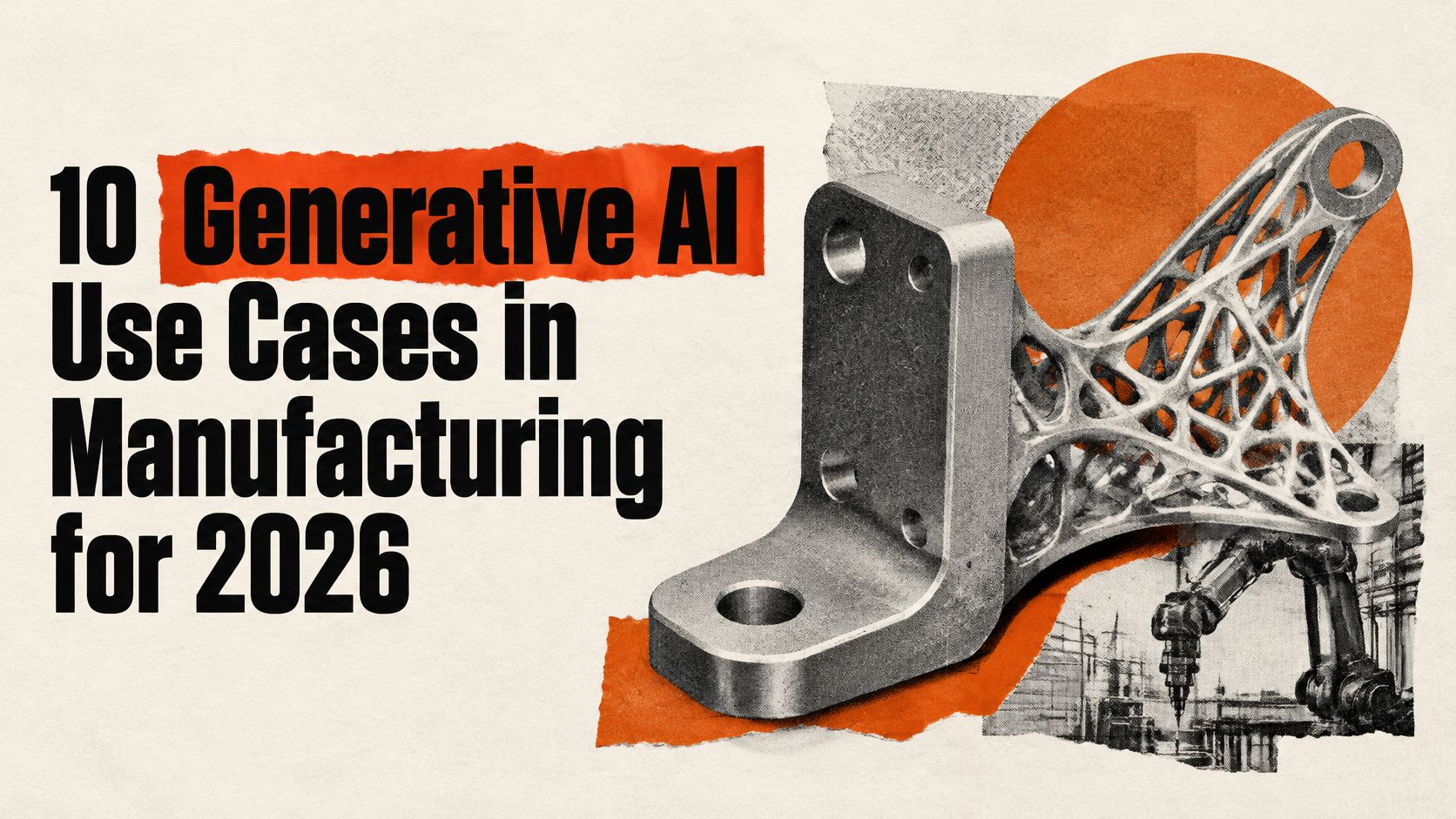
Most manufacturers don't need another AI tool. They need to know which generative use case fits the data and systems they already run, and that choice matters more than model size. In a June 2024 ABI Research survey of 461 manufacturing decision-makers across the United States, Germany, and Malaysia, 78% identified faster root-cause analysis of production issues as the most common generative AI use case. That's diagnostics, not chatbot novelty, leading adoption.
This ranking of Generative AI Use Cases in Manufacturing orders ten options by pilot readiness and data prerequisites, starting with lower risk work you can bound tightly and ending with heavier R and D and robotics plays. Each entry covers the problem, the concrete application, data needs, estimated impact, a bounded pilot scope, a named failure mode, change notes, and a sample prompt. You'll also get a short fictionalized scenario showing how we approach CRM, data readiness, and workflow redesign before recommending new purchases, consistent with AI-driven modernisation in manufacturing.
Key Takeaways are simple. Start where source documents or master data are already clean. Keep human review in every decision loop. Measure against a baseline you recorded before the build, not after users say they like it.
1. Generative Design for Parts and Components
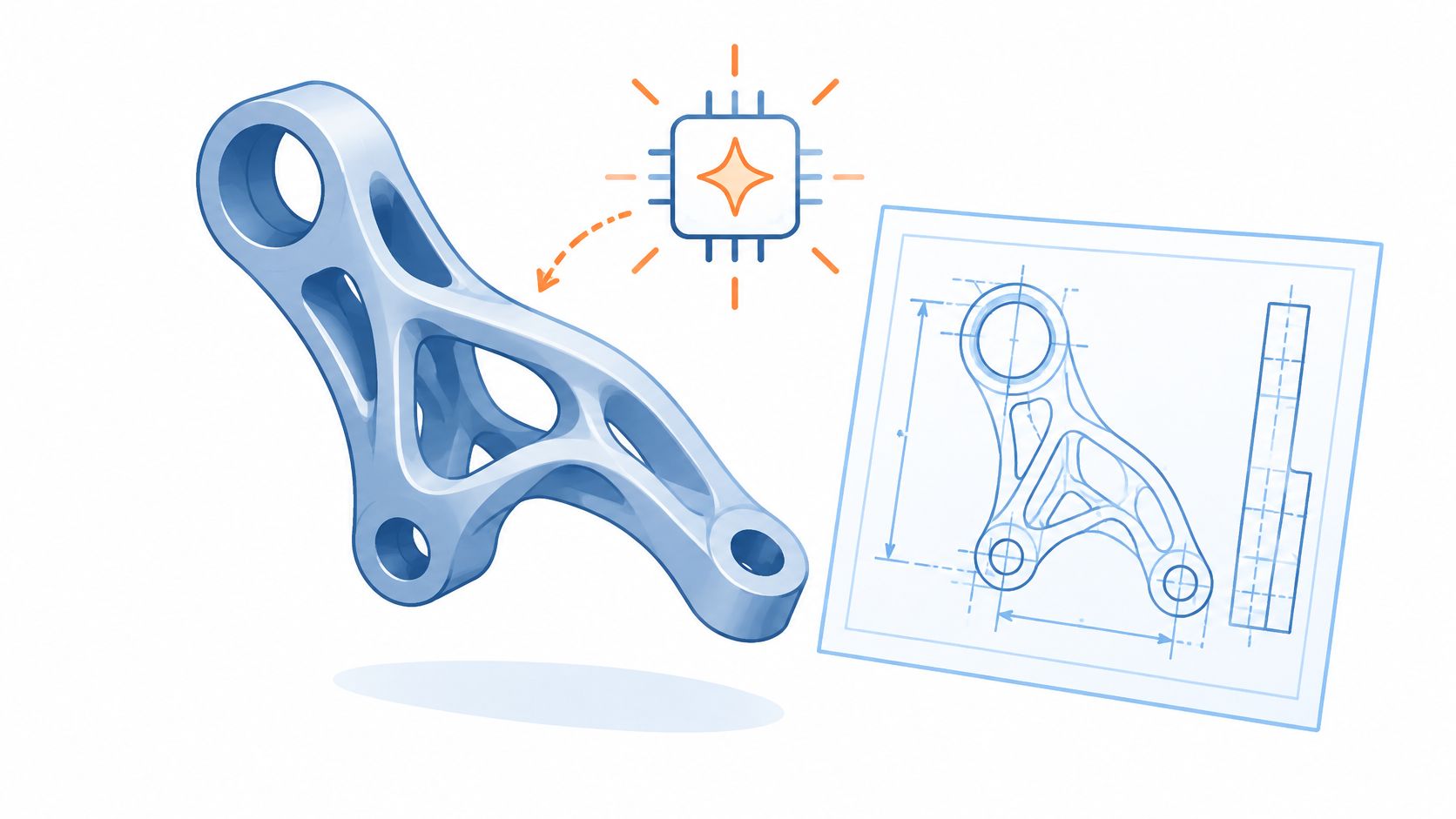
Engineers set loads, keep-out zones, material, and manufacturing method. The software returns many candidate geometries, often lattice or organic shapes, that meet those constraints. Practical examples include Airbus working with Autodesk on a lighter A320 cabin partition bracket and General Motors consolidating a multi-part seat bracket into a single component with Autodesk tools, both described in our guide to generative AI applications in manufacturing plants.
What it needs and where it breaks
You need accurate load cases, material properties, and constraints that reflect real tooling, casting, machining, or printing. The named failure mode is unmanufacturable beauty. The model proposes a shape your shop can't make, inspect, or afford.
- Bounded pilot: Pick one high-volume bracket, fixture, or housing where weight or part count already hurts cost.
- Sample prompt: Generate ten variants under this load case, in this alloy, for five-axis machining, with no enclosed voids.
- Impact opportunity: Fewer parts, less material, and shorter assembly time if simulation and physical testing pass.
Say a Tier 2 supplier redesigns one bracket. We'd first audit CAD, PLM, and quoting data so engineering, manufacturing, and sales price the same revision. That discipline matters for additive design for aerospace components and for machined parts alike. Manufacturing engineers must co-own the design space from day one, or you'll validate geometry nobody can produce.
2. Digital Twins and Factory Layout Simulation
A twin lets you test layout, staffing, and changeover choices before moving steel. Watch how a line model surfaces a bottleneck before you touch the floor.
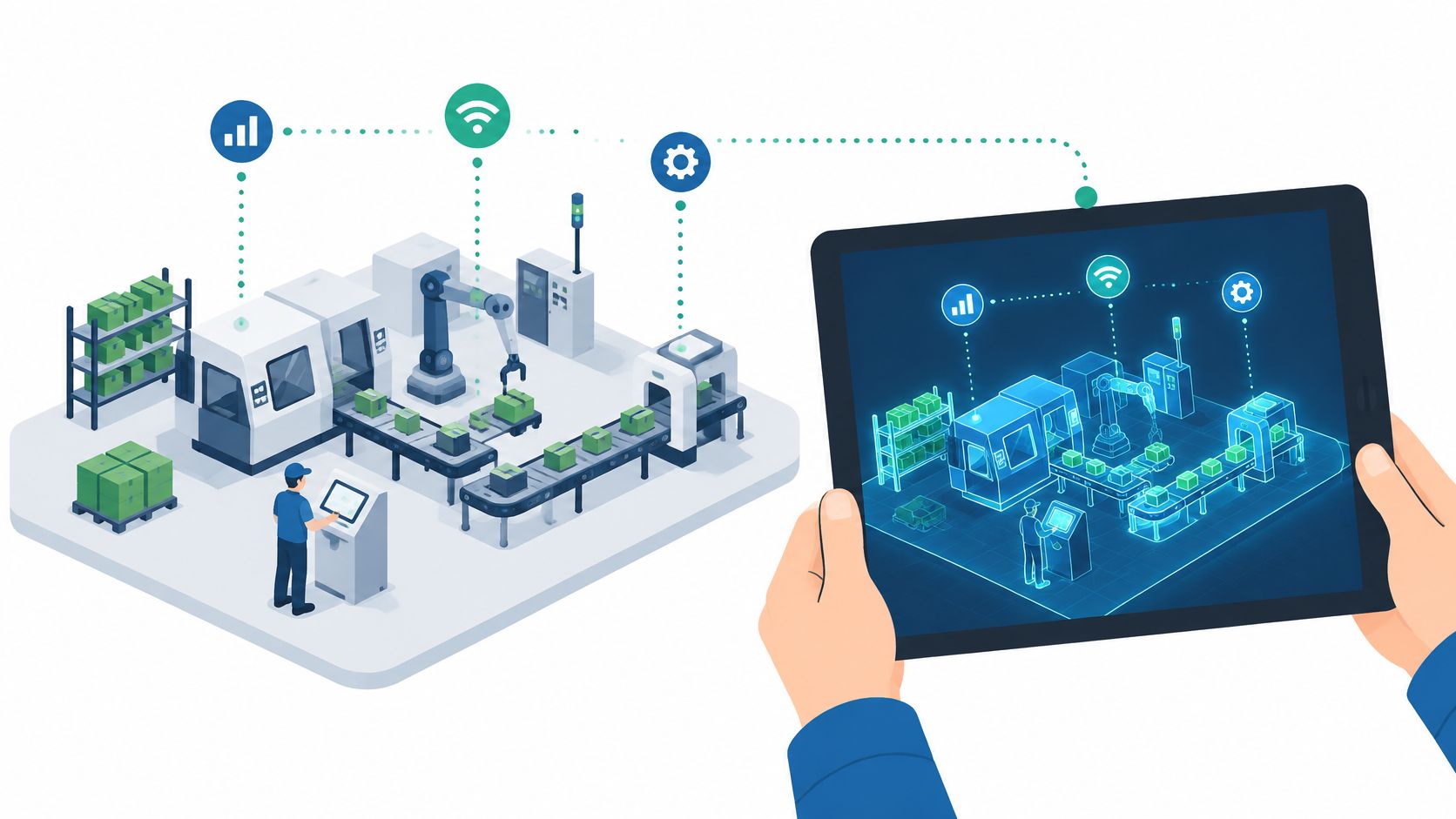
BMW Group has used NVIDIA Omniverse for production network planning, and Foxconn has announced NVIDIA work on factory and robotics twins. The generative layer helps you describe scenarios in plain language and generate layout options, while physics-based simulation checks throughput, ergonomics, and queues. Don't confuse a pretty 3D model with a calibrated twin.
Data and pilot discipline
You need MES cycle times, routings, downtime reasons, and equipment states flowing reliably. If those feeds are stale, the named failure mode is confident simulation of a fictional plant.
- Bounded pilot: Model one cell facing a capacity decision, not the whole plant.
- Sample prompt: Show three layouts that add a second pack station without moving utilities, and rank them by changeover risk.
- Impact opportunity: Fewer layout rework loops and a clearer capital case.
The clip below shows the workflow pattern to replicate at cell scale first.
Say a plant debates adding a shift or a machine. We'd map the systems of record, name the decision owner, and require the twin to answer that one question before expanding scope.
3. Maintenance and Shop-Floor Knowledge Assistants
This is usually the fastest pilot to value because the documents already exist. A retrieval-augmented assistant answers from manuals, SOPs, and closed work orders, with citations, instead of guessing from general training data. Siemens Industrial Copilot follows this pattern for automation support, and many plants build similar tools on Microsoft Azure OpenAI with document search.
At ACG Capsules, a copilot connected to SOPs was deployed in under five weeks and reduced mean time to repair and unplanned downtime by 40%. Nearly three-quarters of operators and technicians used it after initial deployment. Treat those results as a benchmark for a governed pilot, not a promise for an ungoverned one.
Pilot scope and failure mode
- Bounded pilot: Clean your 50 most-used manuals and SOPs, pilot with one maintenance team, and measure time to repair before and after.
- Sample prompt: For alarm E-214 on filler 3, give lockout steps, likely causes in order, and cite the source page for each step.
- Failure mode: Stale SOP retrieval, where the assistant confidently returns a superseded revision.
Practical rule: If an answer has no citation to a current, approved document, the technician treats it as no answer.
Say a food plant loses senior mechanics to retirement. We'd start with document control and escalation rules, then connect the assistant to the CMMS so accepted answers and overrides are logged for review.
4. Synthetic Data Generation for Visual Quality Inspection
Defective parts are rare. That's good for customers and bad for training vision models, because your dataset is imbalanced from the start. Synthetic generation creates realistic defect images across lighting, angle, and severity so inspection models learn rare failure modes sooner.
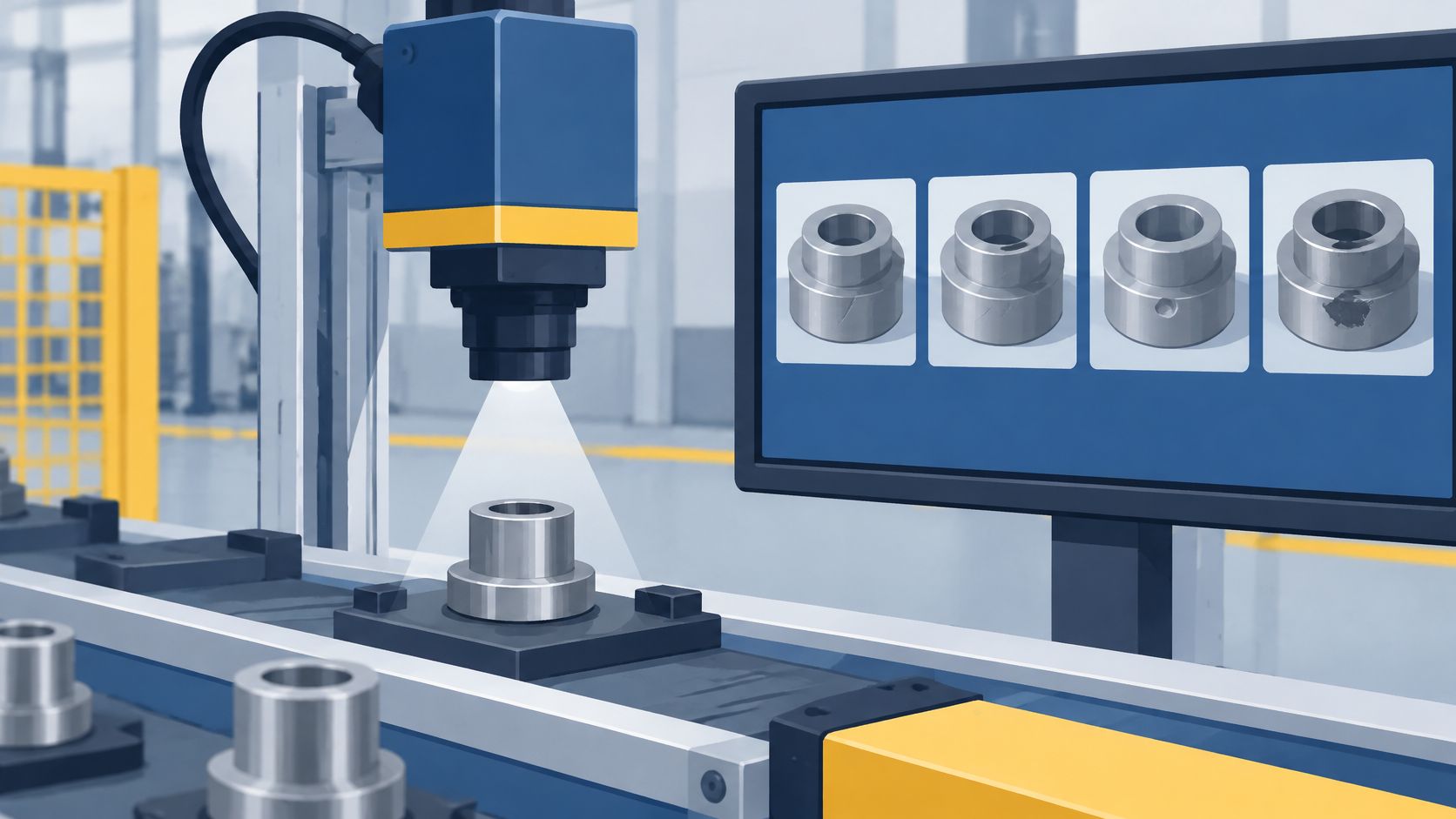
NVIDIA Omniverse Replicator is built for this kind of industrial synthetic data, and electronics and automotive teams augment real defect libraries the same way. The work pairs well with computer vision for predictive maintenance, but inspection needs its own validation discipline.
Proof standard
Measure detection on real held-out images, never on synthetic ones. The named failure mode is synthetic overfit, where the model learns rendering artifacts instead of cracks, dents, or missing fasteners.
- Bounded pilot: Start with the defect driving the most customer returns on one line and one camera position.
- Sample workflow: Generate variants of that defect, retrain, then test blind against last month's real escapes and good parts.
- Impact opportunity: Faster model readiness for rare defects without waiting to collect failures naturally.
Say a metal stamper misses hairline cracks. We'd document every generation method for the quality system, tie results to first-pass yield and escapes in existing reporting, and keep quality engineering as the approver. Document the method now, because auditors will ask later.
5. Generative Production Scheduling and Planning Assistants
A planning assistant is useful when it explains feasible options, not when it invents a schedule. The scheduling system must still respect machine capacity, labor, material availability, and delivery commitments. Tools such as Microsoft Dynamics 365 Supply Chain Management Copilot and SAP's embedded assistants can help planners query and summarize operational data.
Industrial AI optimization can improve throughput and energy use when recommendations stay within hard operating limits and operators retain approval authority. The same discipline applies to production planning: keep recommendations inside validated constraints, then let planners decide which trade-offs to accept.
Where planning pilots stall
- Data prerequisite: Check routings, lead times, calendars, and inventory records in the systems already in use. Incorrect master data makes schedule suggestions unreliable.
- Bounded pilot: Test one product family in shadow mode. Planners compare recommendations with the schedule they ran before using the assistant in production.
- Sample prompt: “Machine 4 is down for six hours. Rank three recovery schedules by late orders, overtime, and changeovers.”
- Failure mode: Master-data mirage, where a clear explanation masks incorrect routings or capacity assumptions.
For a job shop where rush orders disrupt the weekly plan, start by checking routing and capacity data in the ERP and the sales promise process in the CRM. Track schedule adherence and forecast-to-actual variance. Give sales a limited view of available capacity so representatives can avoid promising dates the plant cannot meet.
6. AI-Accelerated Materials Discovery and Formulation
This is a heavier play. Generative models propose alloys, polymers, crystal structures, or formulations that meet target strength, heat resistance, conductivity, or cost. Scientists then screen candidates in simulation and validate a short list in the lab.
Google DeepMind's GNoME work shows the scale of candidate generation now possible, and Citrine Informatics sells materials data platforms for formulation work. Neither removes lab validation. They change how you prioritize experiments.
Prerequisites before you start
You need structured experiment records, including failures. If technicians log results in scattered notebooks and spreadsheets, the model learns a biased history of successes only. The named failure mode is unvalidatable candidate, a promising structure you can't synthesize, source, or test safely at reasonable cost.
- Bounded pilot: One product line where lab testing is slow or expensive, with a fixed number of candidates advanced to testing.
- Sample prompt: Propose formulations within our approved raw material list that hold viscosity at target temperature, and flag any regulatory concern.
- Impact opportunity: Fewer dead-end experiments and a shorter path to a testable short list.
Say a coatings maker wants lower curing energy. We'd structure historical lab data, define the validation protocol up front, and connect wins to product and quoting systems only after scientists approve a formulation. I wouldn't pilot this before your experiment data is structured.
7. Automated Technical Documentation, Work Instructions, and Multilingual Content
Documentation debt is operational risk. Generative AI can draft work instructions, SOP revisions, and training material from drawings, process data, and approved manuals, but a human approver must release anything safety-related. Siemens and Microsoft promote assistants for creating and querying technical content, and the practical pattern is drafting inside document control, not in a separate chat window.
Governance isn't optional here. In Deloitte's 2025 smart-manufacturing survey, 65% of respondents ranked operational risk among their top two concerns, and 21% lacked an AI policy or governance framework. A drafting tool without approval rules closes neither gap.
Controls that make drafting safe
- Bounded pilot: One product family's work instructions, drafted from current approved sources, with quality as approver.
- Sample prompt: Draft a revision from this engineering change, highlight every safety step changed, and keep approved glossary terms.
- Failure mode: Fluent but wrong instruction, where clean language hides a changed torque, sequence, or warning.
Keep version history inside your document control system. If you can't trace who approved a generated instruction, don't put it on the floor.
Say a multi-site assembler struggles with translated instructions lagging engineering changes. We'd enforce approved glossaries, role-based approval, and audit logs, then measure revision cycle time and document-related deviations.
8. Supply Chain Risk Sensing and Supplier Communication
Buyers can't manually monitor every supplier, port, and sub-tier signal. Generative AI can summarize risk signals, draft escalation notes, and prepare alternative-sourcing briefs for review. Resilinc and Everstream Analytics focus on supplier risk intelligence, while Coupa and SAP Ariba add AI support for supplier communication and spend analysis, a pattern explored in our view of generative AI across supply chain workflows.
The tool doesn't fix an unmapped supply base. If your bill of materials isn't tied to suppliers and sites, alerts will be noisy or miss the part that stops your line.
Pilot design
- Bounded pilot: Your top critical components only, with thresholds so only high-impact risks reach buyers.
- Sample prompt: Summarize risks affecting these five components in the next eight weeks, rank by line-down exposure, and draft supplier confirmation requests.
- Failure mode: Alert fatigue, where low-value warnings train buyers to ignore the system.
Pre-approve templates for common supplier messages. That keeps tone and commitments consistent while buyers retain send authority.
Say an electronics assembler faces repeated allocation surprises. We'd map BOM to supplier and CRM account records, clean lead-time fields, and measure time from signal to buyer action. The impact opportunity is earlier reaction, not automated purchasing.
9. Natural-Language Robot Programming and Task Generation
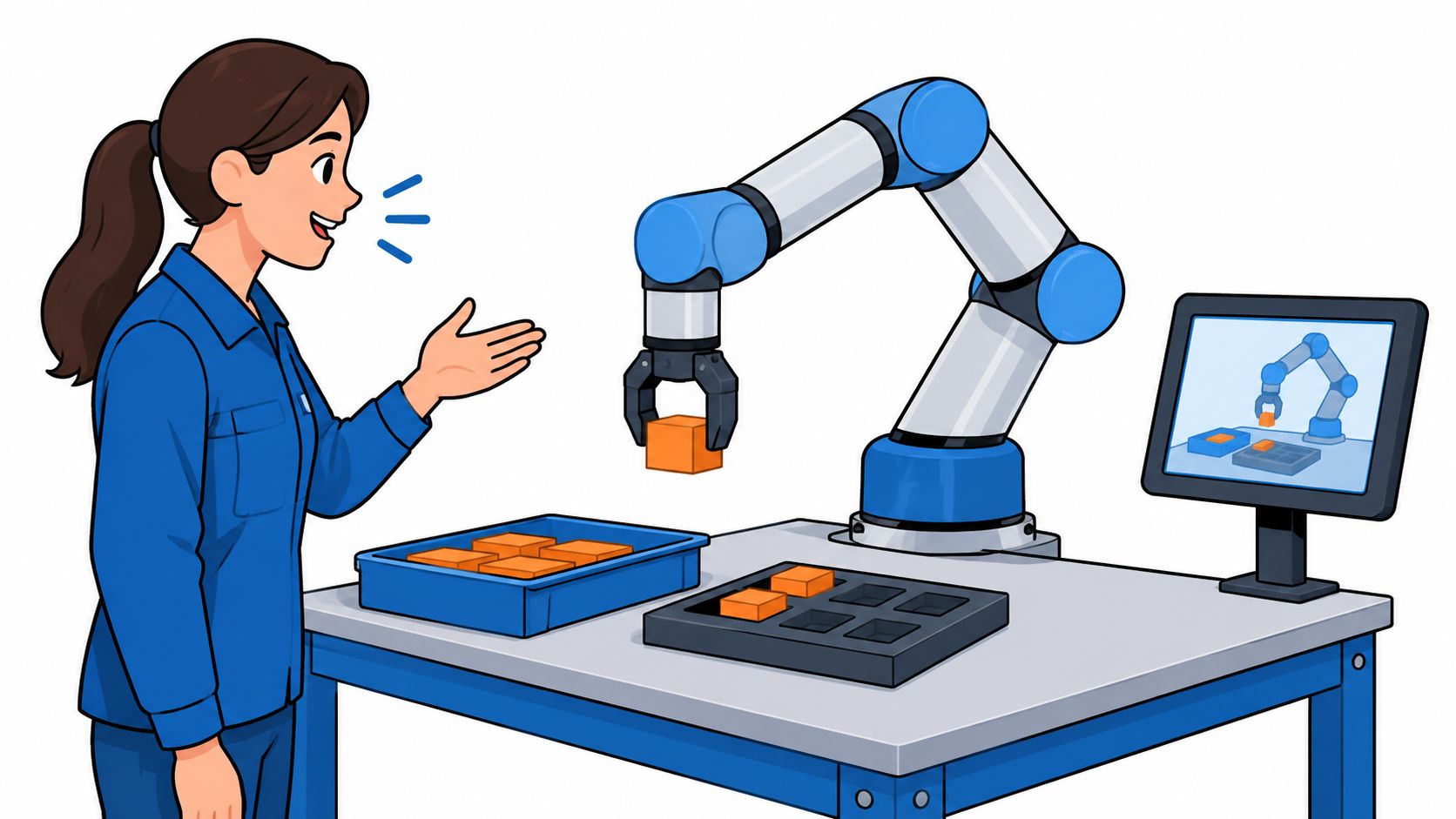
Operators describe a task, the system drafts a robot program or motion plan, and engineers test it in simulation before anything moves. Covariant has demonstrated generalized warehouse picking from natural instructions, and NVIDIA Isaac with Omniverse supports simulation and training before deployment. Simulation first isn't caution theater. It's how you catch reach, collision, and gripper errors cheaply.
This ranks lower on readiness because safety validation, cell integration, and exception handling dominate the work. The model writing code is the easy part.
Guardrails for a first cell
- Bounded pilot: One low-risk pick, palletizing, or machine-tending task, fully in simulation, then at reduced speed with safety-rated monitoring.
- Sample prompt: Palletize these cases by weight, heaviest on the bottom, within this footprint, and stop if a case is damaged.
- Failure mode: Simulation-to-cell gap, where real part variation, lighting, or fixtures break a program that passed virtually.
Require a documented validation checklist before any generated program goes live. Track changeover time before and after, plus interventions per shift, so you know whether flexibility actually improved.
Say a contract packer reconfigures cells weekly. We'd examine existing robot controllers and simulation licenses first, redesign the changeover workflow, and keep a named engineer accountable for release. I wouldn't let generated motion bypass your normal safety sign-off.
10. Generative Sales Configuration, Quoting, and CRM Integration for Manufacturers
A quote assistant is only as reliable as its product rules, pricing, and CRM records. For configured and engineered-to-order products, generative AI can summarize requirements from calls and emails, flag missing specifications, and draft quotes using approved catalog and pricing data. Salesforce Einstein and Microsoft Dynamics 365 Sales offer this pattern. For a related example, see AI support for wholesale quote generation.
Keep commercial controls outside the AI layer. RSM reported that 64% of manufacturing organizations using GenAI said implementation was harder than expected, while expectations included roughly 6% to 10% sales growth over the next two to three years. RSM's report on AI investment in manufacturing supports separating quote cycle time from win rate and discounting. Otherwise, finance cannot tell whether faster quotes improve commercial results.
Pilot scope
- Bounded pilot: Start with one product family and one sales team. Keep discount and margin approvals as hard controls outside the AI layer.
- Sample prompt: Summarize this customer's requirements, flag missing specifications, and draft a quote using only approved catalog and pricing data.
- Failure mode: Plausible but unbuildable configuration, or a valid configuration quoted at the wrong margin.
For a machinery maker whose reps spend time chasing engineering by email, first check the product catalog, pricing, and account fields in its existing CRM, such as Salesforce or HubSpot. Pilot with those records before buying another tool. Compare quote cycle time, win rate, and average discount with the baseline.
How the ten generative AI use cases compare by fit, capability, and main trade-off
| Item | Best Suited For | Core Capability | Main Trade-off |
|---|---|---|---|
| Generative Design for Parts and Components | Lightweight or high-cost parts where strength, weight, or assembly count matters | Generates and ranks geometry options against engineering and manufacturing constraints | Designs may be difficult to manufacture and require expert validation |
| Digital Twins and Factory Layout Simulation | Plants planning layout, capacity, staffing, or equipment changes | Simulates production scenarios using virtual factory models and operational data | Accuracy depends on data quality; building and maintaining twins can be costly |
| Maintenance and Shop-Floor Knowledge Assistants | Maintenance teams needing faster troubleshooting and knowledge transfer | Retrieves grounded guidance from manuals, SOPs, and work-order history | Poor documentation can lead to unreliable answers; safety-critical advice needs human verification |
| Synthetic Data Generation for Visual Quality Inspection | Quality teams with limited images of rare defects | Creates labeled synthetic defect images to augment vision-model training | Unrealistic images can mislead models, so validation against real images is essential |
| Generative Production Scheduling and Planning Assistants | Job shops and make-to-order manufacturers facing frequent schedule changes | Supports natural-language queries and explains ranked optimization scenarios | Poor master data can produce poor schedules; legacy-system integration may be costly |
| AI-Accelerated Materials Discovery and Formulation | Manufacturers with materials or formulation R&D programs | Proposes candidate materials and prioritizes them using predicted properties | Predictions require costly lab validation and specialized expertise |
| Automated Technical Documentation, Work Instructions, and Multilingual Content | Regulated or multi-site manufacturers with heavy documentation needs | Drafts, updates, and translates technical documents for human review | Generated errors can create safety or quality risks; approval remains necessary |
| Supply Chain Risk Sensing and Supplier Communication | Procurement teams monitoring large, complex supplier networks | Identifies risk signals and drafts supplier communications and sourcing summaries | Incomplete supplier visibility can limit alerts, while false positives create noise |
| Natural-Language Robot Programming and Task Generation | Flexible automation cells with frequent product or task changes | Converts plain-language task descriptions into robot programs for simulation | Generated code requires rigorous safety validation; reliability varies in unstructured settings |
| Generative Sales Configuration, Quoting, and CRM Integration for Manufacturers | Manufacturers selling configured or engineered-to-order products | Summarizes customer needs, checks configuration feasibility, and drafts quotes | Poor CRM or product data can cause inaccurate quotes; pricing controls must remain enforced |
Choose One Pilot This Quarter and Measure It Against a Baseline
Pick the use case where your data is cleanest and the pain is already measured. For most plants, that's maintenance knowledge retrieval, documentation drafting under document control, or quoting for one product family. Those pilots use systems you already own, produce an answer a named human can approve, and show results within one production or sales cycle.
Don't start with the most impressive demo. Execution is the constraint. The Federal Reserve summary of workplace AI uptake reported AI use at 16% among manufacturing businesses in a 2024 survey of 350 firms in the New York and New Jersey region, with approximately 80% of AI-using firms using generative AI services. Adoption is real but uneven, which is why narrow scope beats enterprise ambition in quarter one.
What proven sites do differently
The strongest programs combine generative AI with analytical models, automation, and industrial data systems instead of treating it as a standalone chatbot. The World Economic Forum reported generative AI use cases represented 23% of top solutions across its Global Lighthouse Network in 2025, up from 9% in 2024, while analytical AI and machine learning still accounted for approximately 62% of Lighthouse top solutions in 2025. That mix is the model to copy. Let predictive systems detect, let optimization systems calculate, and let generative AI explain, retrieve, and draft.
Scale only after the baseline moves. In its 2025 Global Lighthouse announcement, the World Economic Forum reported newly recognized sites achieved an average 40% increase in labor productivity and a 48% reduction in lead time. Those are mature program outcomes across many use cases, not a forecast for a single pilot. Use them to justify disciplined expansion, not to inflate a first business case.
Your pre-build checklist
- Confirm systems of record: Name where documents, routings, pricing, or experiment results are authoritative, and fix obvious gaps there first.
- Name the human approver: Specify who can accept, edit, or reject every output type, and log that decision.
- Bound the scope: One team, one line, one product family, or one document set, with a stop date for the pilot review.
- Record the baseline: Time to repair, quote cycle time, schedule adherence, escapes, or revision time, measured the same way after launch.
- Agree acceptance criteria: Decide in advance what result earns expansion, what result triggers rework, and what result kills the pilot.
Our assessment phase begins with an evaluation of existing systems, data quality, and business processes to identify high-impact opportunities. Before recommending another AI tool purchase, we examine the capability you already own, then agree responsibilities, integration points, acceptance criteria, and team training before implementation begins. Customer-facing workflows include a documented human-review checkpoint, and your team keeps decisions about access, approval, and deployment.
No AI strategy is needed before the first call. Bring one business question, such as why repairs take too long or why quotes stall, and use a working session to map current state, rank opportunities, and define one lightweight proof of concept. That's how Generative AI Use Cases in Manufacturing become operational gains instead of a longer tool list.
Start with a readiness assessment that maps your current CRM, plant systems, and data quality against the one pilot you can measure this quarter, then build only after approval rules and acceptance criteria are agreed. Prometheus Agency helps manufacturers turn existing stacks into governed AI workflows for maintenance, quoting, and revenue operations without buying tools first. Visit Prometheus Agency to book your complimentary Growth Audit and AI strategy session.