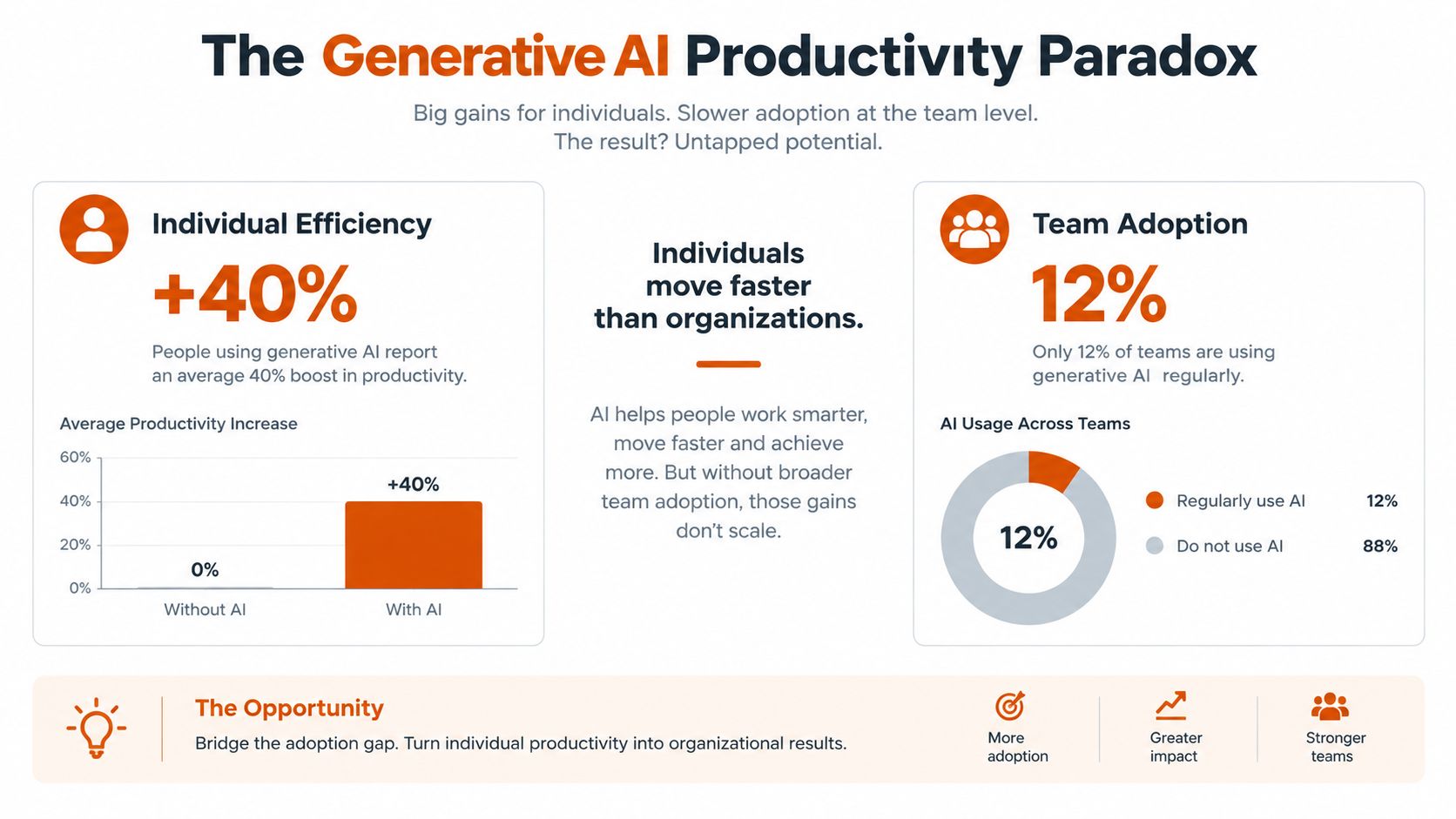
Generative AI adoption alone doesn't transform a supply chain. Gartner found that 72% of supply-chain organizations were already deploying generative AI, yet team-level time savings averaged only 1.5 hours per week, compared with 4.11 hours for individual desk-based employees.
That gap is the central business question. If an assistant drafts supplier summaries faster but planners still work from fragmented data, duplicate decisions, and unmeasured exceptions, the organization has automated activity, not improved performance. Generative AI in the supply chain creates value when it improves a decision, reduces a measurable operational loss, or helps a team respond sooner without weakening control.
The Generative AI Productivity Paradox
Gartner's survey of 265 global respondents conducted in August 2024 captures the paradox clearly. Although 72% of supply-chain organizations were deploying generative AI, desk-based employees saved an average of 4.11 hours per week, while the saving dropped to 1.5 hours per team member per week when evaluated at team level. Gartner found no correlation between team-level time savings and improved output or higher work quality. (Gartner's supply-chain GenAI survey)
The reason is operational, not mysterious. One planner can use an assistant to summarize supplier correspondence, draft an analysis, or prepare a disruption update. The broader team may still lack a shared source of truth, a defined handoff, permission to access relevant records, or a rule for deciding whether the generated recommendation should be accepted.
Activity is Not an Outcome
Individual productivity is useful, but it's an intermediate measure. A faster draft doesn't automatically lower inventory exposure, reduce expedite costs, improve service levels, or shorten exception-resolution time. It may even create more review work if the output lacks provenance or contains unsupported assumptions.
This distinction matters because early adoption often happens before companies have redesigned workflows. Teams add assistants to existing processes, then measure usage or hours saved instead of measuring whether the resulting decisions are better. Leaders assessing the real AI advantage and its operational risks should ask what changed in the operating model, not merely how many employees opened the tool.
Practical rule: Treat time saved as a signal for investigation, not proof of return on investment.
A supply-chain assistant becomes strategically useful when it connects the right records, gives the right person a traceable recommendation, and fits the approval process already used to execute a purchase, allocation, production, or logistics decision. Without those elements, adoption can spread while business performance remains flat.
What Generative AI Actually Does in Supply Chains
Generative AI is most valuable in supply chains where important signals exist in language, documents, and conversation. Supplier emails, contracts, quality reports, shipping documents, disruption notices, and market commentary contain context that structured planning systems often don't capture directly.
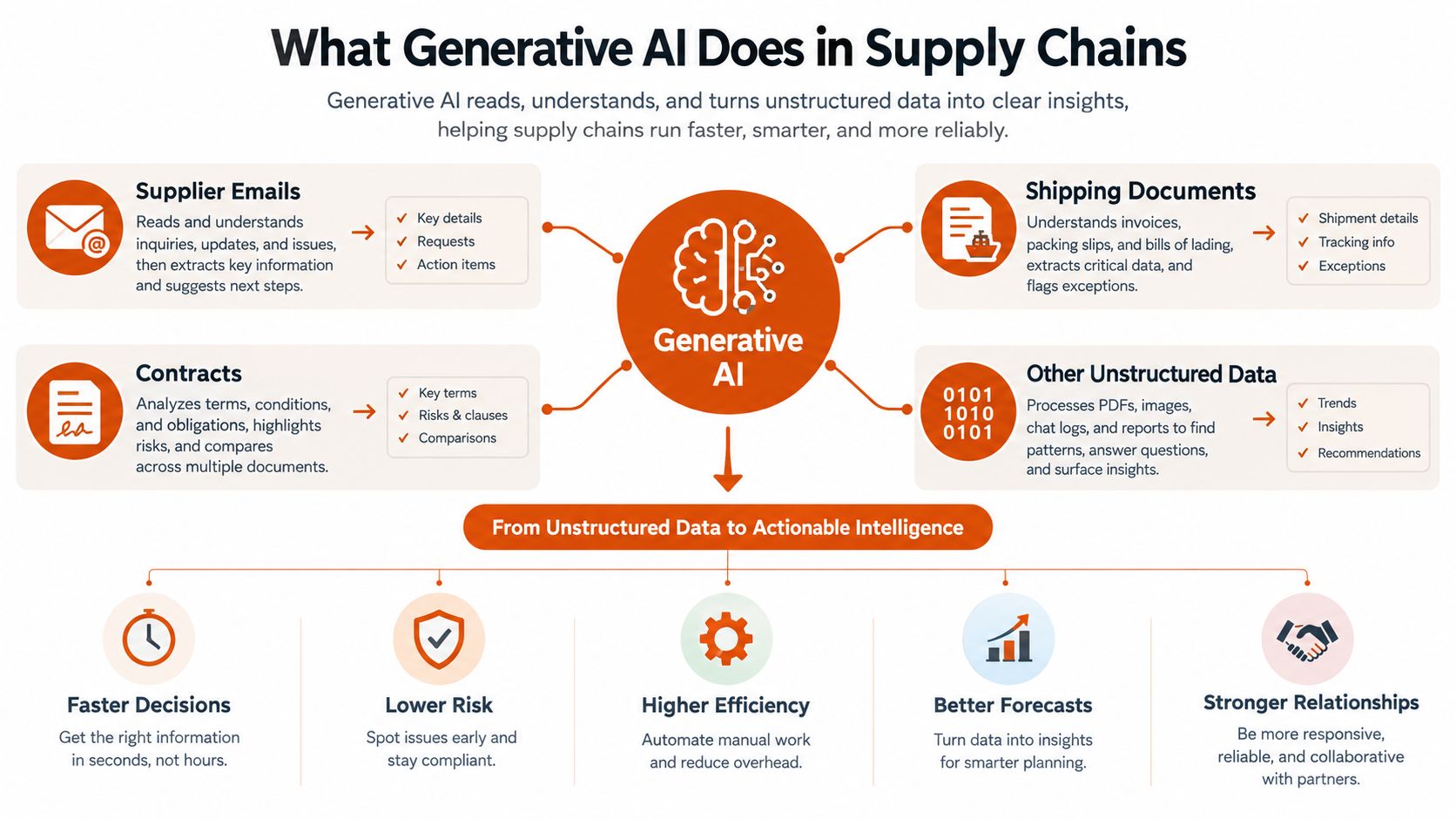
The operating pattern is straightforward:
- Retrieve permitted information. The system reads approved records from ERP, WMS, TMS, supplier, customer-order, and market sources.
- Interpret unstructured signals. It extracts dates, commitments, risks, constraints, reasons for delay, and changes in supplier language.
- Connect context to structured data. It relates a supplier statement to open purchase orders, inventory positions, production schedules, or customer requirements.
- Recommend a next action. The output might prioritize an exception, summarize alternatives, or prepare a scenario for planner review.
- Keep execution controlled. Deterministic rules and authorized employees approve changes to purchasing, allocation, production, or transport.
That boundary separates generative AI from traditional automation. Traditional automation follows predefined logic against structured fields. Generative AI handles ambiguity and language, but it shouldn't be allowed to invent authority, override business rules, or execute high-consequence decisions without controls.
The strongest initial use cases are therefore decision-support workflows such as shipment-status interpretation, supplier-communication summaries, demand-planning copilots, and exception triage. A systematic review of 67 peer-reviewed contributions found that Plan, Source, Deliver, and Enable represented 83% of observed use cases, while manufacturing and returns were comparatively underdeveloped. (Review of large-language-model applications across SCOR processes)
For a manufacturing perspective on overlooked software capabilities, teams can also visit Uptool resources. The useful question isn't whether a model can produce fluent text. It's whether the output is grounded in current operational evidence and improves a decision someone owns.
A practical overview of generative AI in manufacturing workflows should therefore start with the system boundary. The model interprets information. The planning process determines what matters. Rules and people retain responsibility for execution.
High-Value Use Cases That Drive Measurable Results
The strongest generative AI use cases in supply chains improve a decision that already has an owner, a cadence, and a measurable cost when judgment is slow or inconsistent.
Demand and supply planning
A planning copilot can combine demand history with signals from sales notes, customer service, supplier updates, promotions, and disruption reports. Used well, it helps planners see why a recommendation changed, which products or locations are affected, and what assumptions sit behind the proposal.
That transparency matters more than fluent output. Planners need to compare the suggested action against the current baseline, test whether the new signal is material, and decide whether conditions justify a change in supply, inventory, or allocation.
Inventory health and root-cause analysis
Inventory problems rarely come from one cause. Excess stock may trace back to forecast drift, supplier changes, substitution rules, open purchase orders, or a service target that no longer fits actual demand. Generative AI is useful here because it can assemble those signals into a readable explanation faster than an analyst working manually across multiple systems.
The decision to measure is straightforward. Did the team reduce avoidable exposure while protecting service and limiting new stockout risk? If the answer is no, the summary was polished but not valuable.
Supplier collaboration
Supplier email, portal updates, and meeting notes carry real operating signals, yet teams often review them inconsistently. An assistant can summarize commitments, flag changed dates, classify delay reasons, and draft a response tied to the relevant order or contract language.
Keep the boundary clear. Human review is still required for negotiation, supplier fairness, and any message that changes a commercial commitment. AI speeds up preparation and gives buyers a cleaner starting point. It should not speak for the company on its own.
Production and product decisions
Production teams see value when the model helps frame trade-offs instead of pretending to run the plant. If a key component slips, the system can compare expedite, substitution, and resequencing options against capacity, quality constraints, and customer priorities, then present the planner with the consequences of each path. That improves decision quality because the team can review options side by side rather than chase fragmented updates across functions.
The same discipline applies in product-related work. Translating requirements into candidate specifications or identifying likely bottlenecks can save time, but manufacturing execution still depends on physical constraints, quality controls, and safety rules that a language model cannot infer reliably from partial context.
Exception handling and delivery
Delivery operations are full of fragmented signals. Shipment events, carrier messages, customer orders, and transport records often conflict or arrive out of sequence. Generative AI can group related exceptions, identify exposed customer commitments, prepare tracking updates, and route the case to the person best placed to resolve it.
That is why many teams start with an AI approach for logistics operations. The workflow is narrow enough to validate quickly and close enough to service and cost outcomes to show whether the system is improving real operating decisions, or just producing faster documentation.
Measuring Impact and KPIs That Matter for Supply Chains
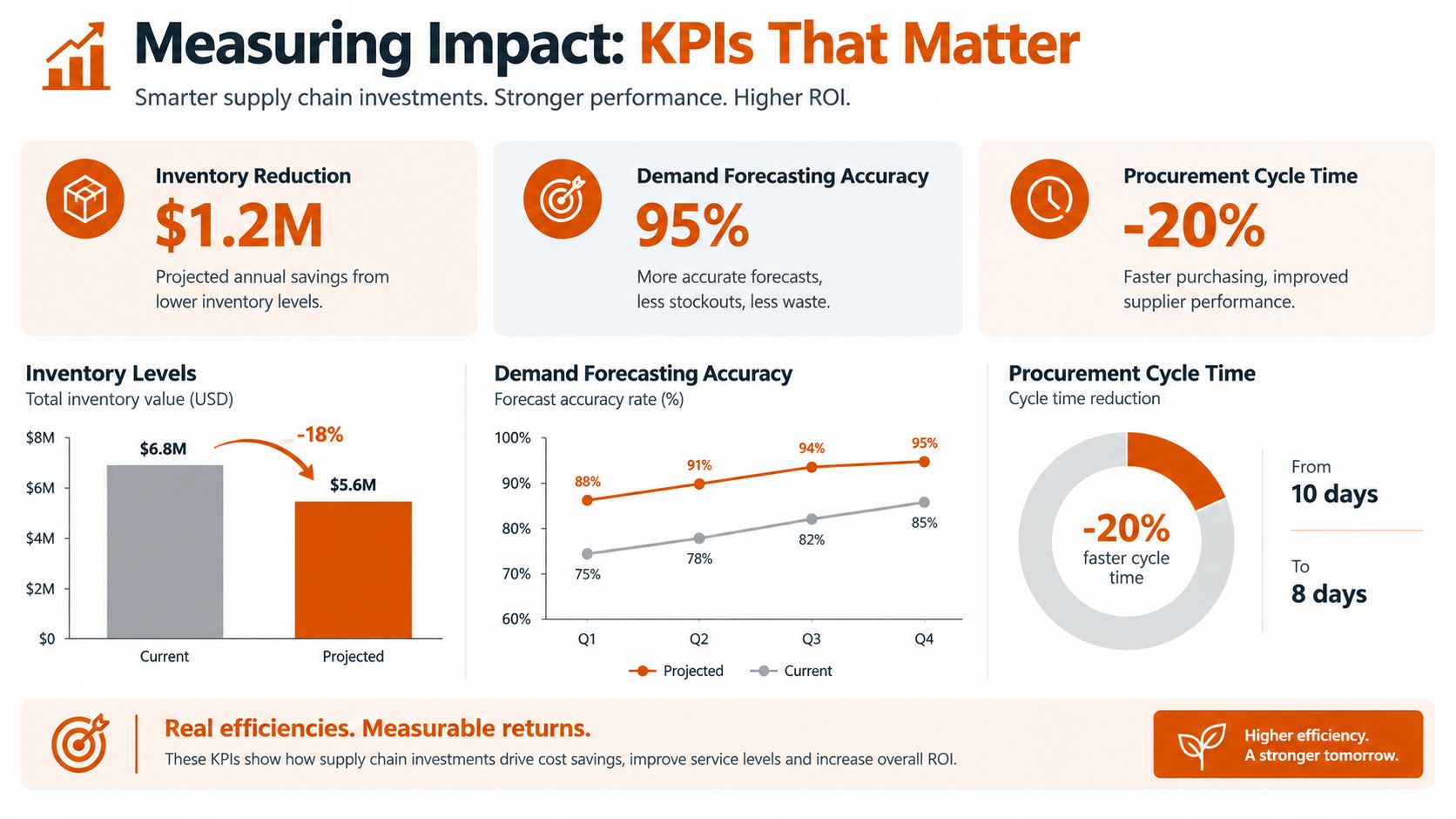
Executives should reject pilots that report only prompts, users, or hours saved. Each use case needs a baseline and a business measure that reflects the decision being improved.
For demand planning, track forecast error, bias, forecast refresh latency, planner overrides, and the financial effect of errors. For inventory, track inventory turns, stockouts, excess exposure, expedite costs, and service levels. For supplier workflows, measure exception-resolution time, response latency, late-order recovery, and the percentage of recommendations accepted after review.
IBM's 2025 survey of more than 300 global chief supply-chain and operations officers found that 67% ranked improved operational performance as the leading benefit of generative AI investment, while 60% cited greater predictability and responsiveness to disruptions. Earlier IBM research found that 81% believed predictive capabilities could detect problems earlier, 77% expected models to identify geopolitical and climate risks, 79% expected demand-pattern prediction to improve inventory management, and 80% anticipated visualization and simulation tools such as digital twins would reveal bottlenecks in real time. (IBM's research on AI-enabled supply-chain automation)
Use weighted business loss
Forecast accuracy alone can mislead. A small error on a high-margin or capacity-constrained item may matter more than a larger error on an item with flexible supply. Compare the generative model with existing statistical forecasts and XGBoost, then evaluate the alternatives against weighted business loss.
That loss should reflect the consequences the business experiences:
- Working capital: How much inventory does each forecast require?
- Stockout exposure: Which errors threaten customer service?
- Obsolescence: Which recommendations create aging or unusable inventory?
- Expedite cost: Which misses trigger premium freight or emergency production?
- Planner effort: How much review and correction does each approach require?
A pilot earns expansion when it improves the business measure without creating unacceptable override rates, compliance problems, or service deterioration. The correct question is not whether AI is more accurate in isolation. It's whether the decision is financially and operationally better.
Technical Architecture and System Integration
Generative AI should sit inside the operating architecture, not beside it as an unconnected interface. The model needs controlled access to the records that define current supply, demand, commitments, constraints, and risk.
A useful pattern has four layers:
- Source systems. ERP holds orders and purchasing, WMS holds inventory and warehouse activity, TMS holds transportation events, and CRM or customer-order systems provide demand and service context.
- Data and retrieval layer. APIs and governed retrieval services expose the relevant records while enforcing permissions. Every answer should preserve provenance back to the source record.
- Decision-support layer. The model interprets documents, summarizes exceptions, generates scenarios, and explains recommendation drivers.
- Execution and control layer. Business rules, workflow approvals, and authorized system actions determine what can happen next.
| System | Data Type | Integration Pattern | Security Requirement |
|---|---|---|---|
| ERP | Orders, purchasing, inventory, suppliers | API and governed batch feeds | Role-based access and record-level permissions |
| WMS | Stock positions, movements, warehouse exceptions | Event feeds and operational APIs | Site and task-level authorization |
| TMS | Shipment status, routes, carrier events | Event-driven integration | Carrier, lane, and customer-data controls |
| CRM and customer orders | Demand context, commitments, service issues | API retrieval with context filters | Account-level permissions and audit logging |
The evidence favors caution. A systematic review of 67 peer-reviewed contributions found that only 24% described an operational deployment, while prototypes and proof-of-concept systems dominated. The same review supports a champion-challenger architecture that compares generative models with XGBoost and classical forecasting methods, using weighted business loss rather than MAPE alone and simulating working capital, stockouts, obsolescence, and service penalties before production. (Systematic review and forecasting deployment guidance)
This design also clarifies responsibility. The model handles interpretation and recommendation. Deterministic logic handles thresholds, approvals, and execution. A human owner handles exceptions that exceed the model's authority.
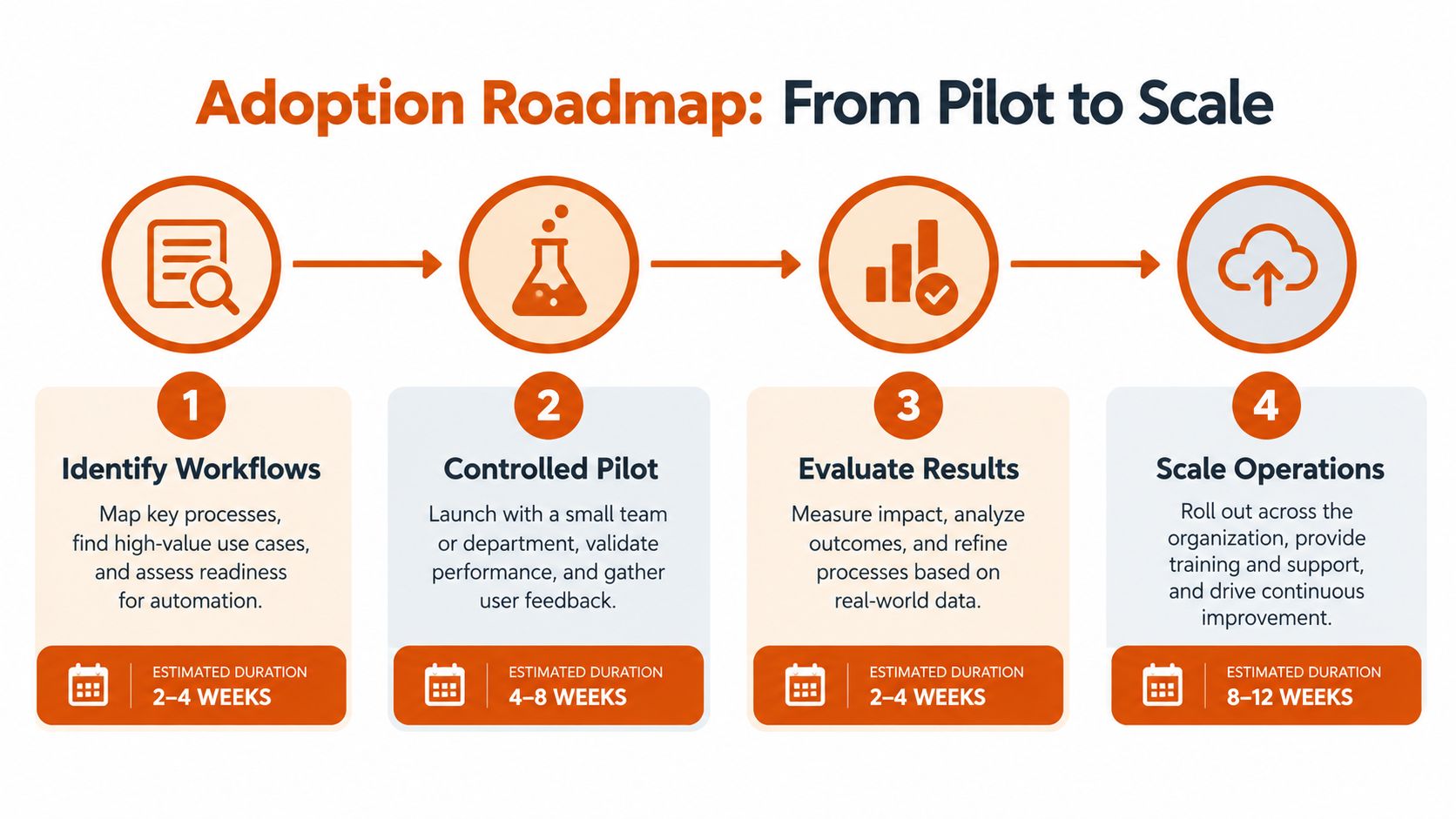
Adoption Roadmap and From Pilot to Scale
A credible roadmap starts with a constrained workflow, not an enterprise-wide announcement. Choose a decision with an identifiable owner, accessible data, a meaningful baseline, and a clear consequence when performance improves or deteriorates.
Identify and validate
Select one workflow such as supplier-exception triage, shipment-status interpretation, or a demand-planning copilot. Document the current process, source systems, approval points, baseline KPIs, and failure modes before connecting a model.
Test the recommendation against historical or live cases while keeping the existing process in place. Record whether the output was accurate, explainable, useful, adopted, and financially preferable to the current decision.
Govern the workflow
Once the pilot shows a credible signal, integrate it into the process rather than asking users to visit a separate tool. Establish retrieval permissions, provenance requirements, human approval steps, escalation rules, and an audit trail for inputs, recommendations, overrides, and outcomes.
IBM's research with Oxford Economics found that 64% of chief supply-chain officers said generative AI was completely transforming their workflows. Sixty percent expected AI assistants to handle most traditional and transactional processes by 2025, while 90% expected supply-chain workflows to incorporate intelligent automation and AI assistants by 2026. Executives also projected a 21% increase in decision-making performed by digital assistants over two years. These are projections and expectations, not proof that every organization will achieve them. (IBM research on supply-chain AI workflows)
Expand by evidence
Scale only when the workflow performs reliably across relevant scenarios. Expand by product category, site, supplier group, or lane, and monitor drift as data, policies, and operating conditions change.
The sequence matters. A controlled pilot exposes integration gaps and adoption friction while the cost of correction remains manageable. Enterprise rollout before that learning usually spreads inconsistency faster than it spreads value.
Governance, Risk Mitigation, and Decision Quality
Supply-chain AI fails most often when leaders treat governance as paperwork rather than as part of decision quality. A recommendation can be fluent, timely, and wrong. The operating design must make that error visible before it changes a purchase order, supplier ranking, allocation, or compliance record.
A 2025 survey of 217 retail supply-chain professionals found that 72.8% identified data quality as the critical implementation constraint, while 58.3% said poor explainability caused organizations to reject AI recommendations. Research on greener supply chains reported that nearly half of surveyed firms viewed poor data as the largest barrier to AI for ESG purposes. The same research found 12% worried about algorithmic bias favoring certain suppliers, and 19% cited data security concerns when sensitive information crossed platforms. (Research on supply-chain AI constraints and risks)
Make uncertainty explicit
For supplier and sustainability decisions, classify every important input as one of four states:
- Verified measurement: Supported by an identifiable record or accepted calculation.
- Supplier assertion: Provided by the supplier but not independently validated.
- Modeled estimate: Produced from assumptions or incomplete evidence.
- Unknown: Missing information that should not be filled in without disclosure by the model.
This classification prevents polished language from disguising weak evidence. It also gives procurement teams a defensible way to request missing documentation, challenge a recommendation, or preserve an appeal process for smaller suppliers.
Human review should remain mandatory before procurement, compliance, sustainability, or supplier-ranking actions. Teams responsible for resilience can also use practical guidance on how to protect operations from disruptions, but no risk framework substitutes for clear data lineage and accountable decision ownership.
Decision-quality test: Can a reviewer explain which evidence drove the recommendation, what remains uncertain, and why the proposed action is better than the current alternative?
Security controls should cover retrieval permissions, sensitive supplier information, cross-platform transfers, retention, and audit access. Governance works when it changes the workflow. A policy document that doesn't affect what the model can retrieve or what a planner must approve won't protect the operation.
Key Takeaways and Next Steps for Executives
Generative AI in the supply chain deserves investment, but not because every team needs a chatbot. The strongest business case appears where unstructured information slows a recurring decision and where the organization can connect that information to trusted operational data.
Key takeaways:
- Start with decision quality. Define the decision, owner, baseline, acceptable error, and financial consequence before selecting a model.
- Prioritize controlled workflows. Shipment-status interpretation, supplier-communication summarization, demand-planning copilots, and exception triage are stronger starting points than autonomous execution.
- Use a champion challenger. Compare generative approaches with XGBoost and classical forecasts, then evaluate weighted business loss, service effects, working capital, and planner overrides.
- Treat governance as architecture. Retrieval permissions, provenance, audit trails, deterministic rules, and human approvals belong in the workflow from the beginning.
- Scale only after evidence. Expand when the pilot improves the chosen operational metric without creating unacceptable risk, rework, or service deterioration.
Executives should leave the first planning meeting with a ranked pilot backlog, a data-owner map, a measurement plan, and a named person accountable for the go or no-go decision. Prometheus Agency offers a complimentary Growth Audit and AI strategy session to map operations, identify an auditable priority use case, and build an implementation roadmap around measurable outcomes.
Prometheus Agency helps growth leaders and manufacturing, distribution, and logistics companies connect AI strategy, existing systems, and operating processes around measurable business results. Visit Prometheus Agency to discuss a focused supply-chain AI pilot, its success metrics, and the path from validated workflow to governed scale.