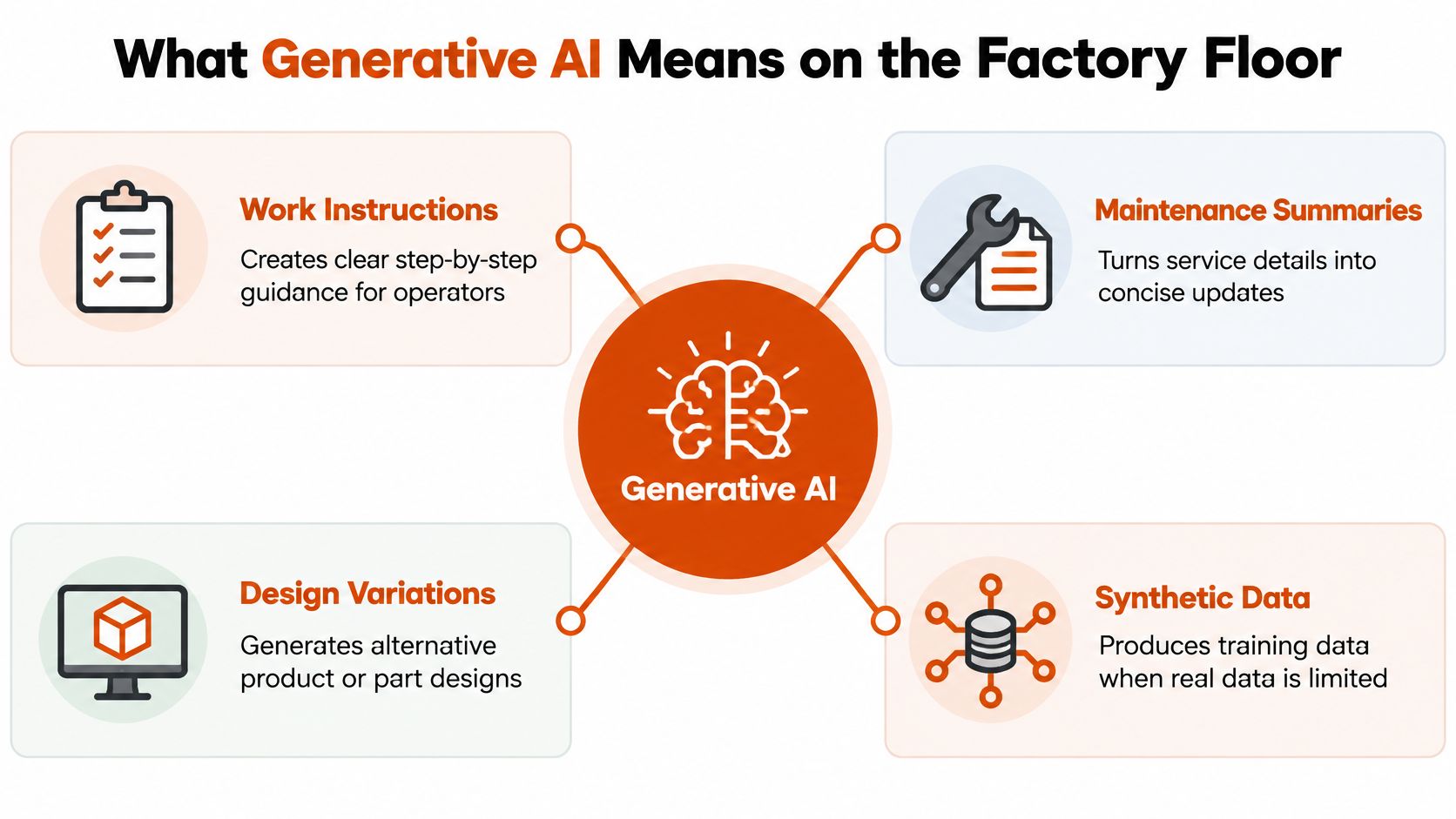
Generative AI in manufacturing means systems that create new content, such as work instructions, maintenance diagnoses, and synthetic training data, from existing plant knowledge. With 24% of manufacturers deploying it at facility or network level and 38% piloting it, the executive decision is how to move from testing to dependable operational use.
The first investment shouldn't automatically be a larger model. It should be determining whether the plant can provide enough reliable context to connect an AI-generated recommendation to a measurable production outcome.
What Generative AI Means on the Factory Floor
Think of generative AI as an assistant to an experienced shift supervisor. The supervisor draws on previous incidents to draft a procedure, explain a recurring fault, or summarize a repair. A generative system can produce similar material from operational records, but it doesn't inherit the supervisor's judgment or authority.
The adoption figures above come from Deloitte's 2025 Smart Manufacturing and Operations Survey, which distinguishes facility- or network-level deployments from pilots. That distinction matters: testing a useful capability isn't the same as embedding it in production. The figures establish adoption status, not deployment quality, financial return, or operational safety.
Separate Generation from Prediction
Executives should distinguish the functions inside a proposed solution before approving its scope.
| Function | What it produces | Manufacturing example |
|---|---|---|
| Generative output | New text, images, or synthetic examples | A draft troubleshooting procedure |
| Predictive analysis | A score, classification, or forecast | An estimated equipment-failure risk |
| Interaction layer | A usable explanation of underlying information | An engineer querying production records conversationally |
A maintenance assistant might combine all these functions. The predictive model flags abnormal behavior; retrieval supplies relevant records; the generative model explains the evidence and drafts an inspection sequence. Calling the whole system generative AI obscures which component determines the recommendation.
The concept map below separates common generative outputs.
Treat operator usefulness as a design requirement
Manufacturing decision-makers are evaluating these systems for operational work, not just office drafting. In a 2024 survey of 458 decision-makers, 76% of German respondents, 79% of U.S. respondents, and 62% of Malaysian respondents believed generative AI could accelerate work-instruction creation, according to the manufacturing technology survey reported by ABI Research.
Those responses measure expectations, not demonstrated improvements. Their practical significance is that leaders see a potential role for generated information close to production.
Selection rule: If the required output is only a forecast or an optimization result, don't assume the project needs generative AI.
Use it when someone needs a new explanation, procedure, summary, design candidate, or training example. Then specify who will verify that output before anyone acts on it.
High-Value Generative AI Use Cases Across the Plant
The useful unit of analysis isn't the model. It's the job to be completed, the information required, and the person authorized to approve the result.
Assign outputs and approval rights
The following applications should be treated as bounded workflows, not permission to automate production decisions.
| Application | Proposed output and required data | Approval owner |
|---|---|---|
| Design | Candidate geometries or design variations informed by specifications, constraints, and approved designs | Design engineer |
| Simulation | Virtual test scenarios using asset geometry, process metadata, and operating conditions | Simulation or process engineer |
| Documentation | Draft instructions and maintenance summaries from controlled procedures and service records | Document owner or maintenance supervisor |
| Process optimization | Explanations of analytical findings and proposed operating changes using production histories and optimization results | Process engineer |
| Human-in-the-loop augmentation | Inspection guidance or decision summaries using approved knowledge and current operating context | Responsible operator or supervisor |
These are proposed operating designs, not claims of achieved performance. In particular, design candidates need engineering validation, and documentation should be drafted from approved records rather than invented from general knowledge.
Simulation also requires a clear boundary: a convincing virtual result isn't evidence that a physical process will behave identically.
Predictive maintenance needs more than generated explanations
A concrete research architecture combines a variational autoencoder, or VAE, for unsupervised anomaly detection, a generative adversarial network, or GAN, for synthesizing rare failure sequences, and a LightGBM classifier for final fault prediction.
In experiments using NASA's C-MAPSS turbofan data, the combined pipeline achieved 86% AUC, while adding GAN-generated minority-class failure data increased F1 from 0.44 to 0.70, according to the VAE–GAN–LightGBM predictive-maintenance study.
The generative component addresses a specific problem: failure examples can be scarce, leaving the classifier with insufficient examples of unusual degradation. It doesn't make the final fault prediction itself.
Before such a pipeline influences work orders, an engineering team should:
- Validate physical plausibility: Check synthetic sequences against known degradation mechanisms and equipment limits.
- Check sensor behavior: Compare generated distributions and timing relationships with observed records.
- Separate research from deployment: Test whether improved classification supports useful maintenance decisions under plant conditions.
- Retain authorization: Require the maintenance owner to approve intervention rules.
The governing principle is straightforward: generative output proposes; qualified people decide. Approval requirements should become stricter as the proposed action approaches equipment control, product release, or worker safety.
Business Outcomes and KPIs That Prove Value
A credible business case starts with a production constraint. If the plant can't identify which constraint the pilot should relieve, model accuracy won't resolve the investment decision.
The strongest reported outcomes also require careful labeling. Manufacturing lighthouse results concern AI broadly, not generative AI alone.
Reported Manufacturing AI Outcomes by KPI
McKinsey's analysis of manufacturing lighthouse facilities reports the following outcomes. The table distinguishes portfolio-level examples from the named steelmaking application.
| KPI | Reported result | Driving use case |
|---|---|---|
| Productivity | Two- to three-times higher | Manufacturing AI applications across lighthouse facilities |
| Service level | 50% improvement | Lighthouse AI applications supporting operational performance |
| Defects | 99% reduction | Lighthouse manufacturing AI applications |
| Energy consumption | 30% decrease | Lighthouse manufacturing AI applications |
| Throughput | 15% increase | CITIC Pacific Special Steel's blast-furnace prediction and real-time parameter optimization |
| Energy consumption | 11% reduction | The same CITIC Pacific Special Steel application |
These aren't comparable experimental results, a combined outcome from one plant, or reasonable default targets for a new pilot. They demonstrate what particular manufacturing AI applications have achieved under their operating conditions.
CITIC Pacific Special Steel illustrates the closed-loop logic: predict furnace behavior, identify useful parameter changes, and adjust the process. Generative AI could support the engineer-facing explanation of that analysis, but the reported result shouldn't be reclassified as a generative-AI result.
Rank metrics by the plant constraint
For an executive review, I would prioritize metrics according to where the plant currently loses value:
- Capacity-constrained operations: Track throughput, with quality and energy intensity as guardrails.
- Quality-constrained operations: Track defect rate, while checking that inspection changes don't merely increase rejection.
- Reliability-constrained operations: Track unplanned downtime and maintenance consequences.
- Delivery-constrained operations: Track service level against actual customer commitments.
- Energy-constrained operations: Track energy intensity alongside output and product mix.
This ranking is a decision framework, not a universal ordering. A faster line doesn't create useful capacity if it produces more rework or misses the required mix.
A model metric establishes technical performance. A plant KPI establishes whether the operating change was worth making.
The maintenance experiment's classification measures belong in the technical scorecard. They don't, by themselves, establish fewer breakdowns or better production performance.
Impact opportunity: improvements in capacity, quality, delivery, and energy use may reinforce each other, but each claimed benefit needs its own measurement. During monthly reviews, compare the chosen KPI with its baseline, document changes in operating conditions, and have finance validate the realized benefit.
Building a Data Foundation for a Pilot-to-Scale Roadmap
Production records aren't the same as production context. A data-readiness study reports that 83.7% of surveyed operations maintained some production records, but only 27.4% preserved detailed context; data-quality and standardization problems accounted for approximately 76.5% of implementation barriers, with preparation averaging 8.3 months, according to the manufacturing data-readiness research.
These findings don't establish the preparation time for any particular manufacturer. They do justify making data readiness an investment gate rather than a cleanup task after software selection.
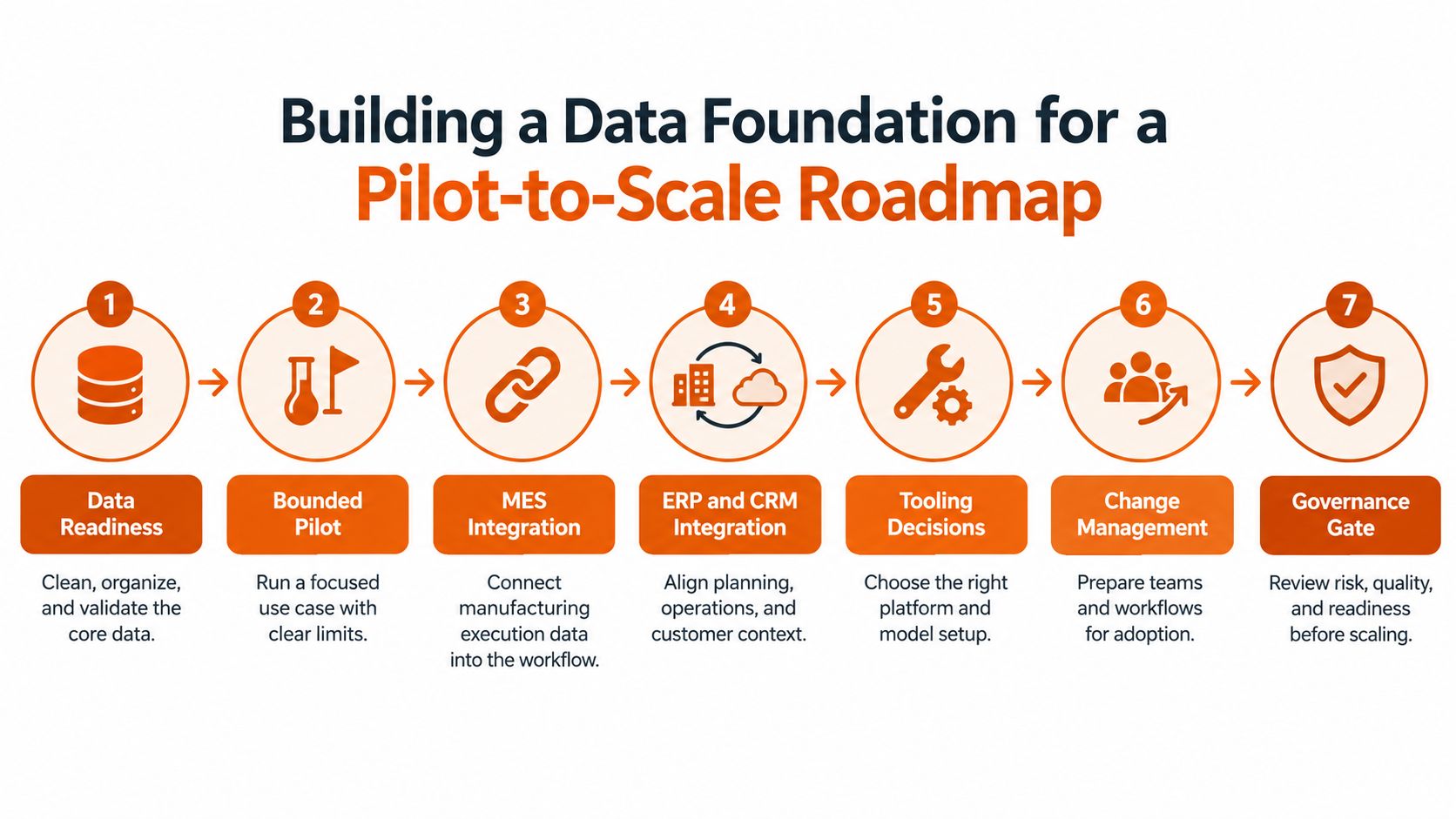
The roadmap below places those dependencies in operating order.
Establish the minimum viable evidence
Begin with the records needed to support the selected decision, not every available database.
- Preserve identity and timing: Match equipment identifiers, event timestamps, material lots, and work orders.
- Capture operating context: Retain equipment state, environmental conditions, material variations, and relevant process settings.
- Control technical knowledge: Identify approved document versions and assign owners.
- Define evidence boundaries: Mark missing values and distinguish observed measurements from generated examples.
Price remediation as work packages: instrumentation, extraction, record matching, document cleanup, ownership decisions, and validation. Estimate effort with the people who maintain those systems, then compare the remediation cost with the value the bounded pilot could realistically address.
For implementation planning, digna's resource on feeding LLMs clean enterprise data offers a relevant starting point for enterprise-data discussions. Use an AI data-readiness assessment to organize the gaps around the proposed business decision.
Connect systems before expanding scope
Run the bounded pilot with a named process owner, an agreed baseline, and a success threshold. Where appropriate, begin with read-only access and human-approved outputs.
Connect MES execution data first to establish production context. Add ERP materials and order information, then CRM demand and service commitments when the decision requires customer context. This isn't a requirement to connect every system before testing; it's a dependency sequence for avoiding recommendations based on incomplete operational meaning.
Choose build-versus-buy options against that workflow. Evaluate retrieval controls, deployment requirements, integration effort, and supportability rather than model novelty.
Train users on verification and escalation before expanding access. Finally, require the process owner to demonstrate that the pilot cleared its KPI threshold without unacceptable effects on safety, quality, or workload.
Expansion gate: Scale only when the team can explain both the measured benefit and the operating conditions required to reproduce it.
Practical Examples from Maintenance and Operations
Consider a proposed maintenance workflow based on Deloitte's multimodal maintenance-chatbot concept. A technician photographs a damaged component, enters an error code, and adds an audio description of the symptoms.
The image illustrates the technician-facing interaction.

Follow the evidence to human confirmation
The assistant retrieves the relevant manual, site-specific work orders, sensor readings, technician reports, and visual inspection records. Through retrieval-augmented generation, it drafts an answer using those controlled materials rather than relying solely on pretrained knowledge.
A sound workflow would rank plausible causes, display supporting records, and present a guided inspection sequence. The technician confirms what is physically present; an experienced engineer approves safety-critical actions. When the evidence conflicts or the asset can't be identified confidently, the assistant should escalate instead of filling the gap.
Safety review must cover the task itself, not merely the wording of the response. Safety Space's discussion of AI applications in workplace health and safety is a useful adjacent resource for framing that review.
The accompanying video provides additional context for the discussion.
Apply the same discipline beyond maintenance
Quality inspection. A quality team could use synthetic defect examples to stress-test inspection models before deployment. A manufacturing digital-twin framework describes combining generative data augmentation and virtual testing with predictive monitoring and defect analysis.
For this proposed workflow, the quality engineer should preserve asset and process metadata, label generated examples explicitly, and evaluate the inspection model on a time-separated real-world test set. The human review concerns whether performance transfers to future production, not whether the generated images look realistic.
Operations investigation. An operations team could query production data to investigate an emerging quality problem. Analytical tools identify patterns; the generative layer summarizes the evidence and drafts hypotheses; the process engineer decides which hypothesis merits a controlled investigation.
Neither example should authorize automatic process changes merely because the explanation sounds plausible.
Impact opportunity: the maintenance workflow could support faster diagnosis, more consistent repairs, fewer escalations to scarce experts, and lower downtime. Those remain intended outcomes until the plant measures them against comparable operating conditions.
Managing Risk, Compliance, and ROI Trade-offs
A successful pilot doesn't automatically justify scale. It may have benefited from unusually clean records, close expert supervision, or an operating environment that other sites can't reproduce.
Workforce evidence reinforces the need to examine those conditions. The 2025 Aerospace and Defense World of Work Outlook reports that high cost, regulation, and skills gaps were each cited by 31% or more of manufacturing employers, with high cost cited by 33%; employers expected to upskill 29% of workers in their current roles and reskill 15% over the following five years.
Those findings describe the surveyed employers, not a staffing forecast for every manufacturer.
Challenge the assumptions behind scale
Review risks in distinct groups:
- Data and model reliability: Can the team recognize missing context, unsuitable synthetic examples, and deteriorating performance?
- Unsafe or unreliable outputs: Does the workflow prevent an unsupported recommendation from becoming an authorized action?
- Cybersecurity and access: Can users retrieve only the operational and customer information their roles permit?
- Workforce capability: Can technicians, engineers, and supervisors verify outputs and handle uncertainty?
NIST's AI Risk Management Framework and its generative-AI profile provide structures for identifying and managing AI risks. They shouldn't be presented as proof that a deployment satisfies every applicable legal, contractual, or safety obligation.
Use AI governance documentation to record ownership, validation evidence, access decisions, approval boundaries, and escalation procedures. Audit trails and source citations should make recommendations reviewable after an incident, not just understandable during a demonstration.
Evaluate total operating cost
The relevant comparison isn't license cost against theoretical labor savings. Include data remediation, integration, validation, training, monitoring, and the human review needed to keep the workflow dependable.
Finance should also distinguish released capacity from realized savings. Time saved doesn't automatically reduce expenditure or increase saleable output.
A scale decision should therefore answer a harder question than whether users liked the pilot: Does the verified operating benefit exceed the full cost of maintaining the controls that produced it?
Key Takeaways and How to Choose a Partner
Generative AI in manufacturing is an operating-model decision before it's a model-selection decision. The important lessons concern how the plant will use evidence, approve actions, and recognize value.
- Treat it as an operations tool: Select a specific production job rather than a broad ambition to adopt AI.
- Require a plant-level result: Keep technical evaluation separate from the business outcome.
- Fund context preservation: Useful records need equipment, material, timing, and operating-state context.
- Validate before expansion: Require reproducible performance, workforce readiness, and documented controls.
Compare delivery options against the same requirements
An in-house team, a platform vendor, and a specialist partner can each be appropriate. Compare them against the work that must remain dependable after the initial implementation.
| Decision criterion | In-house build | Platform vendor | Specialist partner |
|---|---|---|---|
| MES, ERP, and CRM integration | Assess internal engineering capacity and ownership | Verify connector depth and customization limits | Require a concrete integration scope and handover |
| Validation | Assign independent domain review | Examine evidence under relevant conditions | Require an agreed testing and acceptance approach |
| Workforce enablement | Budget internal training ownership | Check whether support extends beyond product training | Specify role-based adoption and escalation work |
| Governance | Maintain internal documentation and controls | Clarify shared responsibilities | Require usable documentation, not just presentations |
| Outcome accountability | Name a plant sponsor | Avoid substituting feature delivery for value | Tie milestones to the selected operating result |
These are evaluation criteria, not claims that any delivery model is superior. An internal team may understand the equipment best but lack implementation capacity; a platform may shorten setup while leaving substantial integration work; an advisory engagement may clarify priorities without supplying long-term operational support.
Separate relevant capabilities from sector proof
A specialist combining AI enablement, CRM implementation and optimization, and go-to-market strategy can be relevant when the workflow crosses production, service, and customer commitments. That combination should still be tested against plant-specific requirements.
For the publisher's offering, the distinction is important: its published case studies concern CRM and marketing outcomes, not manufacturing deployments. Corporate delivery metrics aren't evidence that a maintenance or quality application will improve plant performance.
Ask prospective partners to map the proposed workflow, identify unavailable context, define the approval boundary, and explain how the engagement will prove its selected KPI. A complimentary Growth Audit and AI strategy session can provide a practical starting point when it produces that concrete decision record.
Prometheus Agency offers AI enablement, CRM implementation and optimization, and go-to-market strategy, and reports 300+ projects, a 58% average manual-effort reduction, and 91% client satisfaction across its work, not manufacturing-specific results. Visit the agency to arrange a complimentary Growth Audit and AI strategy session focused on mapping your plant's data readiness against a bounded pilot KPI. Bring a candidate workflow, its current performance baseline, and the owners of the systems needed to support it.