Your maintenance manager wants better failure warnings. Your quality lead wants fewer rejected batches. Your commercial team wants delivery dates it can promise. Meanwhile, someone has proposed an AI pilot, and you're the person expected to explain when it will pay back.
The right starting point isn't a model demonstration. It's a production problem with a measurable cost, a named owner, and records your finance team can reconcile. AI in manufacturing earns its budget when people change an operating decision and prove the result.
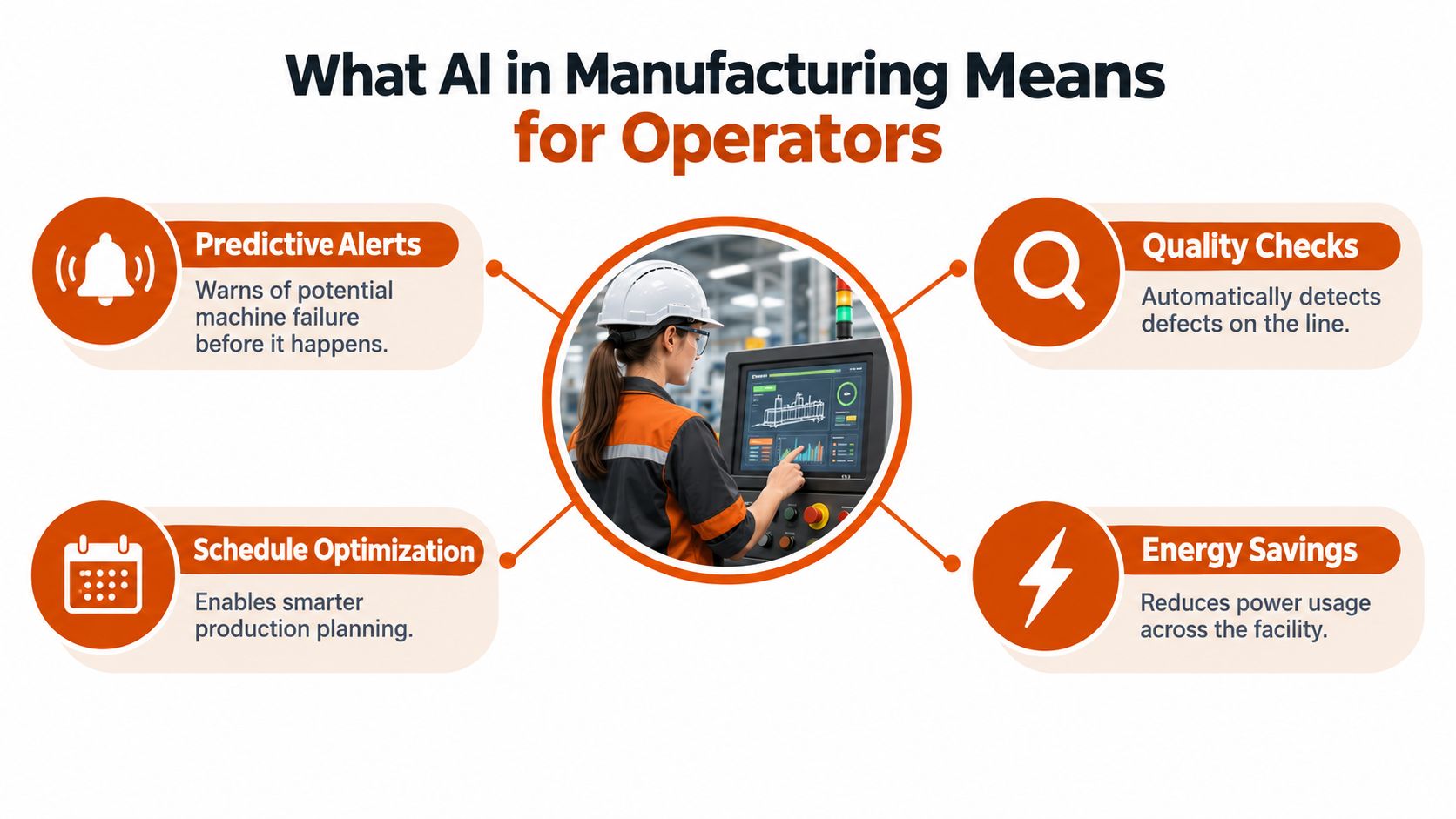
What AI in Manufacturing Actually Means for Operators
Consider a familiar situation: a maintenance lead receives an anomaly alert on a stamping press at 2 a.m. The press is still running. Stopping it could disrupt an urgent order, but ignoring the warning could mean an unplanned shutdown.
The useful question isn't whether the algorithm is complex. It's whether the lead can see what changed, verify the condition, and authorize an appropriate response. Without that chain, the plant has another notification, not a better maintenance process.
An Industrial Nervous System, Not a Robot
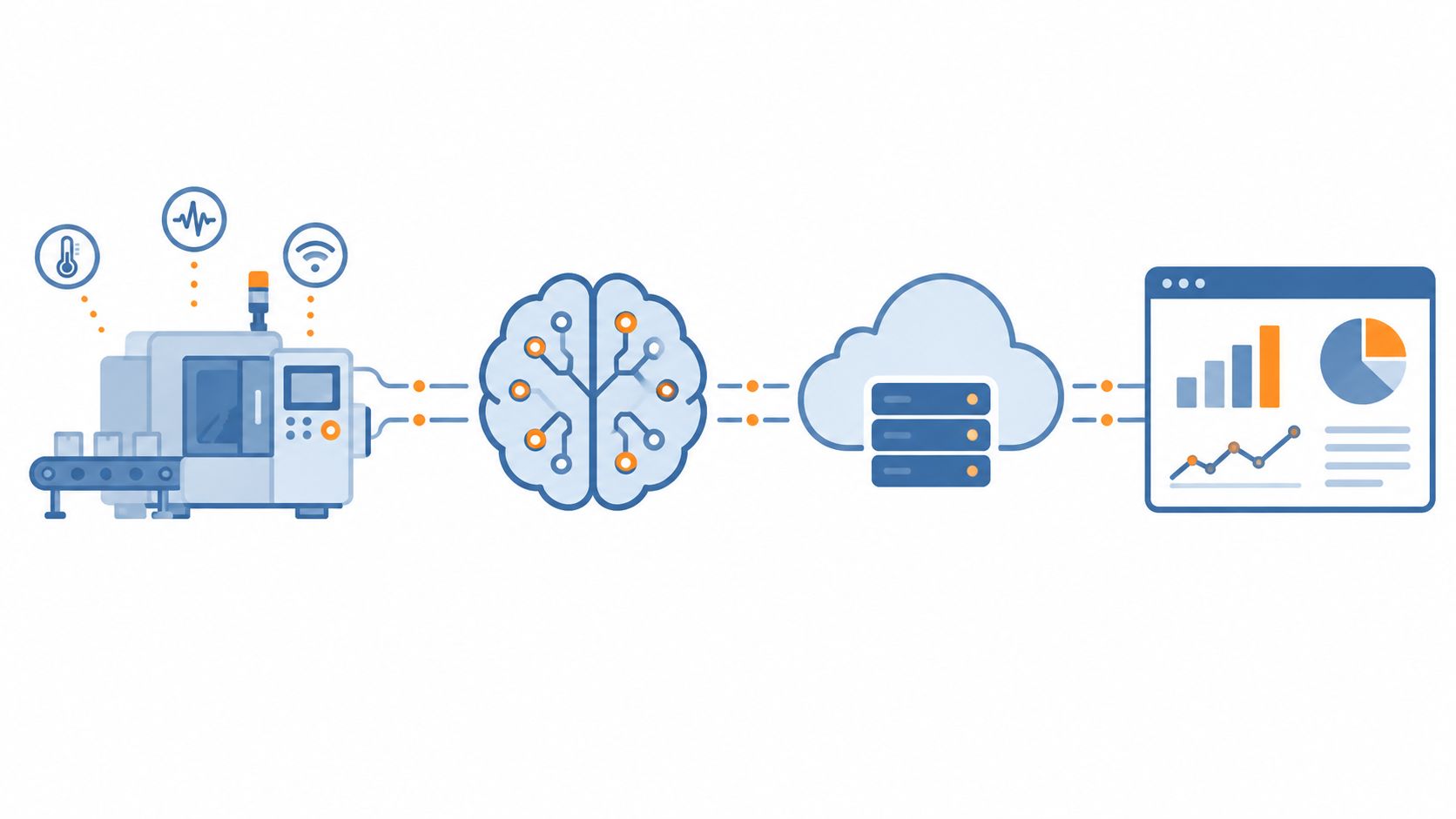
Think of manufacturing AI as an industrial nervous system. Sensors and business systems supply signals. A model interprets patterns. People receive a recommendation in the context of the work they're responsible for completing.
The distinction from adjacent technologies matters:
- Digitization turns paper inspection records into searchable information.
- Automation executes a defined instruction, such as routing an approved work order.
- Robotics performs physical tasks, with or without AI.
- AI estimates, classifies, or recommends based on patterns in data.
Don't pay an AI premium for a rules-based capability your existing software already provides.
This operator-centered view connects predictions to practical decisions.
Adoption Is Not the Same as Readiness
U.S. manufacturing AI adoption reached 22.8% of roughly 28,500 surveyed plants by 2021, with adoption concentrated in larger and younger firms while smaller establishments lagged, according to Census-linked manufacturing adoption research.
That's a useful corrective to autonomous-factory hype. A middle-market plant doesn't need to imitate the most capital-intensive deployment it can find.
Explain the opportunity to your board through decisions: maintenance identifies equipment worth inspecting, quality flags a suspected defect, and planning adjusts a schedule before a material shortage disrupts production. Treat deployment as an operating transformation, not a software purchase.
The Core Building Blocks Behind Manufacturing AI
A fitness tracker can interpret a signal, but it can't make you exercise. A manufacturing model has the same limitation: a prediction matters only when someone can act on it.
Build the system around these connected ingredients.
From Signal to Work Order
- Operational data. On a CNC line, combine vibration and current readings with operating load, asset identity, and maintenance history. A signal without machine context is difficult to interpret.
- A decision model. Translate those inputs into a failure probability or inspection recommendation. The output should answer a planner's question, not merely display a technical score.
- An integration layer. Deliver the recommendation to the maintenance planner's tablet and connect an approved intervention to the ERP work order.
- A human workflow. Specify who validates the alert, who authorizes downtime, and who records the result.
This is the architecture to discuss before selecting a vendor.
Start With the Business Question
Match the information to the decision. Maintenance needs condition and repair history. Inspection needs representative defect examples. Supply-chain decisions need inventory and supplier records. Forecasting needs demand history and commercial context. Intelligent automation needs task conditions and operating boundaries.
Before sharing records with a development partner, establish an approved-data inventory. SourceX's resource to find approved business data for AI is a starting point for that discovery work, not a substitute for your own access approvals.
My recommendation is to investigate integration and decision ownership first. Don't assume the model is the weakest ingredient.
Practical rule: Ask an operator to demonstrate what happens after a recommendation arrives. If the answer ends at a dashboard, the design isn't complete.
Five Use Cases That Move the Most Money
Choose the use case that addresses your plant's largest controllable loss, not the one with the best demonstration. Early industrial AI adopters reported 14% average savings on the manufacturing costs their initiatives addressed, but only 16% achieved their AI-related targets, according to the World Economic Forum's industrial operations analysis.
Those aren't plant-wide savings guarantees. The denominator matters.
Manufacturing AI Use Cases at a Glance
| Use case | Primary P&L lever | Minimum data needed | Honest risk |
|---|---|---|---|
| Predictive maintenance | Downtime and repair expense | Sensor history, operating conditions, maintenance events | False alerts trigger unnecessary work |
| Computer-vision inspection | Scrap, rework, warranty expense | Representative images, defect labels, dispositions | Lighting or product changes undermine detection |
| Supply-chain optimization | Freight expense and working capital | Inventory, supplier performance, lead times, constraints | Recommendations depend on unreliable stock records |
| Demand forecasting | Inventory carrying cost and contribution margin | Orders, shipments, promotions, lost-demand context | Shipment history can conceal unmet demand |
| Robotics and intelligent automation | Conversion cost and usable throughput | Task variation, cycle records, exception conditions | Engineering and exception handling consume savings |
Where Each Candidate Earns Its Keep
Predictive maintenance belongs on a bottleneck asset where a missed failure has a meaningful production consequence. Establish unplanned downtime and maintenance cost per operating hour before launch. Use SIX ERP predictive maintenance insights to frame the ERP, machine-data, and maintenance discussion.
Don't confuse benchmark performance with operational proof. The AI4I predictive-maintenance benchmark analysis supports evaluating deployment with time-ordered or asset-level holdouts rather than random splits alone.
Computer-vision inspection should target an expensive, clearly defined defect family. Establish first-pass yield and escaped-defect records, then test across actual cameras, lighting, and product variants. Research on explainable manufacturing inspection shows why checking whether a model attends to real defects rather than background cues matters.
Supply-chain optimization should address a specific decision, such as expediting or replenishment. Measure inventory, shortages, and premium freight together, so reducing stock doesn't masquerade as savings while service deteriorates. The AI in supply-chain guide provides a broader decision framework.
Demand forecasting deserves a segment-level baseline and comparison with the current planning method. A better aggregate score doesn't necessarily improve the products that consume your working capital.
Robotics and intelligent automation should be judged on accepted output and total operating expense. Include commissioning, maintenance, supervision, and exception recovery. Skip a complex deployment when conventional automation can solve the same bounded problem.
A Practical Nine-Step Implementation Roadmap
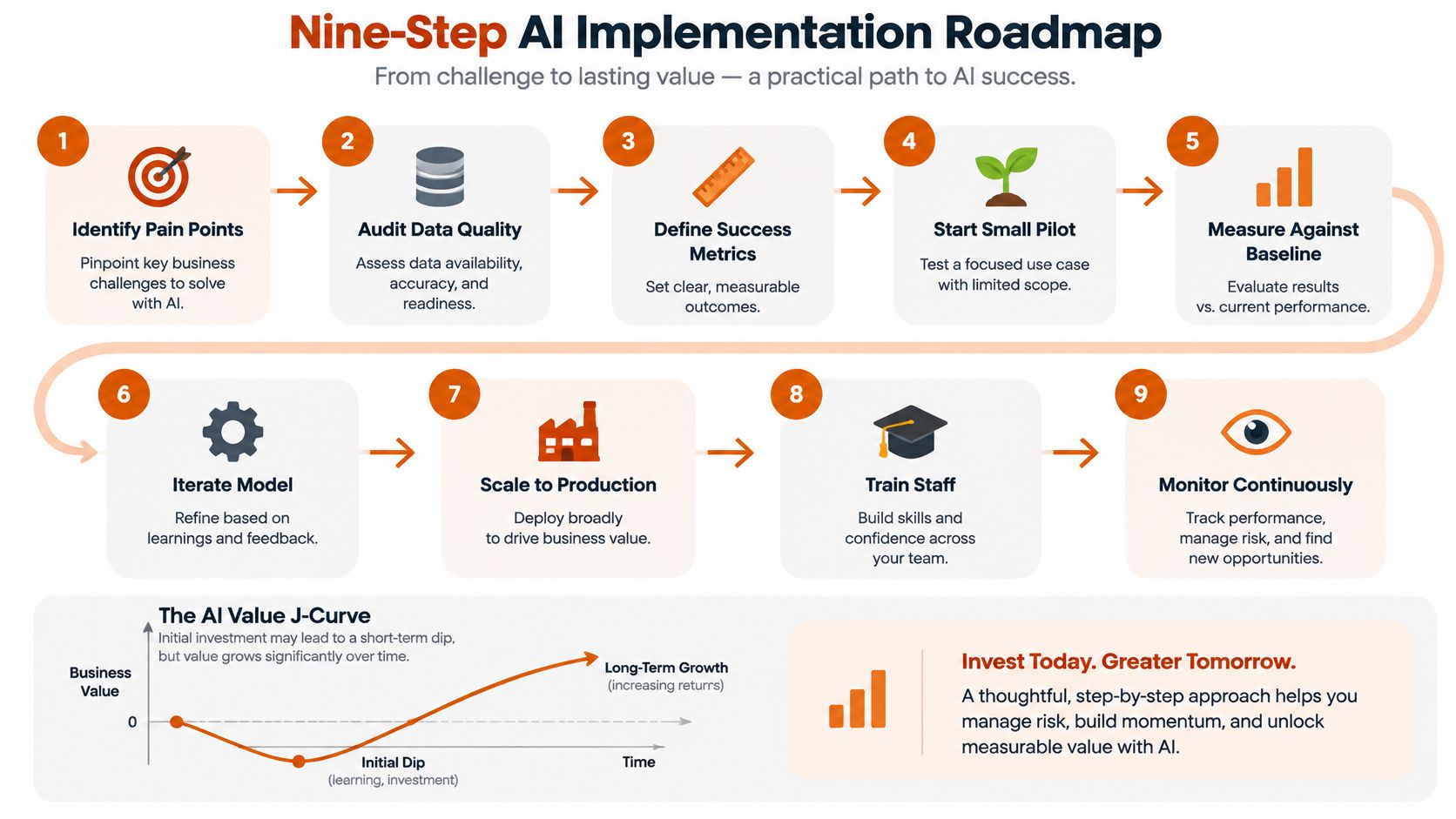
Budget for the dip before the improvement. A 2025 U.S. Census Bureau working paper found that industrial AI adoption initially harmed productivity and profitability as manufacturers adjusted production processes, with benefits emerging after the adjustment period.
That J-curve isn't permission for indefinite experimentation. It's a reason to fund integration, process redesign, and training explicitly, then test whether the expected benefits materialize.
Use this sequence as a working plan.
Establish the Economics and Evidence
- Identify the pain point. The operations VP names a specific loss and its budget line. Deliverable: a signed problem statement. Executive check: would fixing this matter without AI?
- Audit data quality. The IT/OT lead maps records, identifiers, timestamps, permissions, and missing events. Deliverable: a readiness assessment. Check whether a sample decision can be reconstructed.
- Define success. Finance and operations agree on the baseline, benefit calculation, and evaluation window. Deliverable: a measurement charter that accounts for product mix, volume, staffing, and other process changes.
Complete this groundwork in the opening planning period rather than spending it comparing model demonstrations.
Test a Bounded Workflow
- Start a small pilot. The plant sponsor selects a contained asset or process and defines kill criteria before spending. Deliverable: a pilot charter covering scope, cost, and unacceptable errors.
- Measure against the baseline. A finance analyst maintains a benefit ledger, separating realized savings, released capacity, and hypothetical opportunity. Check whether another improvement could explain the result.
- Iterate the model and workflow. The technical lead reviews errors with operators. Deliverable: an exception log and revised thresholds. Stop if usable data or an actionable decision remains unavailable.
Use the middle planning period for a controlled trial, not an unsupported deadline for guaranteed payback.
Release With Accountability
- Scale to production deliberately. The integration lead connects approved outputs to ERP and CRM records. Deliverable: a release package with rollback procedures. Treat another plant as a fresh validation environment.
- Train staff before operational release. Supervisors rehearse normal operation, overrides, escalation, and fallback. Deliverable: demonstrated role readiness, not an attendance sheet.
- Monitor continuously. A named service owner reviews business results, model drift, incidents, and costs. Deliverable: an operating scorecard with a decision to continue, revise, or retire.
Use a closing executive gate to decide whether the evidence supports expansion. The AI pilot-to-production checklist can support that release review.
Don't authorize replication because the demonstration worked. Authorize it because the operating team can repeat the result.
Two Middle-Market Case Studies Worth Stealing From
Verified, comparable middle-market results aren't available for the scenarios below. Treat them as illustrative implementation cases, not claims of customer outcomes or quick ROI.
The practical change is moving from disconnected records to decisions people can document.
A Regional Food-and-Beverage Producer
A useful design pairs vision inspection with demand forecasting connected to CRM order context. The quality manager owns reject dispositions; the demand planner distinguishes recurring demand from exceptional customer orders.
The likely friction is conflicting records: inspection labels don't match disposition codes, while commercial forecasts omit changed customer commitments. Resolve those definitions before treating lower scrap or inventory as attributable benefits. Ekipa's agile manufacturing case study offers adjacent organizational context, not proof of this illustrative AI result.
- Transfer the workflow. Capture human inspection decisions for review.
- Transfer the discipline. Separate customer demand from shipment constraints.
- Hold the sponsor accountable. Track scrap expense and inventory exposure together.
A Specialty Metals Fabricator
For a fabricator, start with a bottleneck press and route verified condition alerts into the existing computerized maintenance management system, or CMMS. Give commercial teams approved delivery-risk information rather than raw failure probabilities.
The failure to avoid is counting an alert as an avoided breakdown. An engineer must document the condition and intervention before finance considers the benefit credible.
- Keep the existing work queue. Don't create a parallel maintenance inbox.
- Record the counterfactual carefully. Distinguish confirmed deterioration from precautionary work.
- Use an operational KPI. Hold the sponsor to unplanned downtime and intervention cost.
For a separate visual perspective on manufacturing transformation, the following video is available.
What Documented Results Actually Show
A multinational-manufacturer case study reported 80% less scoping time, 92% faster production planning, 13% better demand-prediction accuracy, a 0.6% yield gain, and more than $50 million in forecast economic value across business units.
Borrow the connected-workflow logic, not the enterprise-scale forecast. Forecast value is not realized cash.
From Plant Floor to Pipeline Through CRM and GTM
Extra capacity isn't revenue until someone sells and fulfills profitable demand. That's why operations and commercial leaders should design the handoff together.
Manufacturers implementing broader smart-manufacturing initiatives reported average improvements of 10%–20% in production output, 7%–20% in employee productivity, and 10%–15% in freed capacity, according to Deloitte's manufacturing industry outlook. Those results cover smart manufacturing, not AI alone.
Translate Operating Signals Into Customer Actions
A manufacturing execution system, or MES, records production execution. A historian preserves machine and process signals. ERP holds inventory and production orders, while CRM connects commercial commitments to accounts and opportunities.
Connect them through governed customer, product, order, and asset identifiers. Don't copy every machine reading into CRM. Send the approved business event and enough context for someone to act.
For example, a planning exception can trigger this sequence:
- Operations validates the constraint. The planner checks whether capacity or material availability threatens an accepted order.
- ERP records the feasible response. The approved production plan establishes an achievable fulfillment position.
- CRM routes the customer action. The account owner receives a task to confirm a revised commitment or offer an approved alternative.
- Finance evaluates the outcome. The team distinguishes retained orders, changed margins, and service expense.
The same approach can connect confirmed quality issues to service follow-up and warranty records. Keep unverified model suspicions out of customer communications.
Make GTM Capacity-Aware
For go-to-market teams, account-based marketing should reflect what the plant can profitably supply. Don't accelerate demand for a constrained product while another qualified line sits underused.
Quote-to-cash workflows should also preserve the assumptions behind an offer: expected availability, approved alternatives, pricing, and delivery conditions. A manufacturing CRM framework helps frame those commercial handoffs.
Commercial test: If operations releases capacity, identify who will pursue suitable demand and how finance will recognize the resulting contribution.
Treat commercial integration as part of the value design, not an extra feature after installation.
Why Most Pilots Stall and How to Avoid It
Buying a more advanced model won't resolve contradictory asset records or an unowned approval queue. My advice is to scrutinize the operating model before funding another technical upgrade.
A global study covering more than 1,500 manufacturers found 95% had invested or planned to invest in AI and ML over five years, while 29% were using AI and ML at facility or network scale; it also reported 41% using AI and automation to address skills shortages and 48% expecting to repurpose or hire workers because of smart-manufacturing investment, as summarized in the 2025 smart-manufacturing study announcement.
Those measures describe different things, but they make a useful distinction: investment intention isn't scaled operating capability.
The Operating Failures to Fix
| Failure | Executive counter-move |
|---|---|
| Weak baseline | Require finance to approve the comparison method before development |
| Over-broad scope | Constrain the process, product family, and decision being tested |
| No owner after go-live | Assign operating budget and service accountability before release |
| Recommendations without decision rights | Name who acts, who can override, and who handles exceptions |
| Fragile legacy architecture | Fund identifiers, interfaces, access control, and fallback procedures |
Train for Judgment, Not Compliance
Frontline trust requires more than telling employees that a model is accurate. Show operators what it can miss, when they should challenge it, and how their corrections will be reviewed.
Don't classify every objection as resistance. An experienced technician questioning a failure alert may be identifying a missing operating condition that the development team never captured.
My recommendation is to protect time for operators, maintenance engineers, planners, and supervisors to participate in validation. Their contribution should be part of assigned work, not an unpaid addition to an already full shift.
Key Takeaways
- Fund the operating capability. Include data stewardship, integration support, and role redesign.
- Preserve human authority. Make approval boundaries and fallback behavior explicit.
- Scale repeatable work. Don't reproduce unresolved exceptions across plants.
KPIs, Compliance, and the Questions to Answer Before You Spend
A 2026 manufacturing survey found 48% piloting AI but only 10% fully integrated, with no manufacturing respondents reporting significant revenue uplift or significant cost savings. That describes the respondents, not a verdict that manufacturing AI cannot pay back.
Keep a Business Scorecard
Baseline the measures relevant to your pilot before deployment, then retain the same definitions afterward.
| KPI | Measurement discipline |
|---|---|
| Unplanned downtime hours | Separate equipment failures from planned stops |
| First-pass yield | Track accepted output without rework |
| Forecast accuracy | Preserve product segment and forecast horizon |
| On-time-in-full | Measure against the agreed customer commitment |
| Revenue per production hour | Interpret alongside product mix and contribution margin |
Impact Opportunity
The opportunity is better use of existing assets, fewer avoidable losses, and more credible customer commitments. Don't approve an investment solely because a technical metric improved. Require evidence that someone made a better decision and that the economic benefit exceeds the ongoing cost.
Before release, ask legal, security, and operations to verify data residency, retention, training-data permissions, ownership and usage rights for trained models, vendor access, cybersecurity controls, audit logs, and recovery procedures. Have counsel assess applicable AI governance requirements rather than relying on a generic compliance promise.
Bring these questions to the approval meeting:
- What improves, and by when? Name the metric, target, evaluation window, and spending limit.
- Who acts when the model speaks? Identify the accountable role and override authority.
- What gets retired if it works? Specify the duplicate report, manual task, or existing expense you expect to remove.
Approve a bounded decision system, not an open-ended AI ambition.
Prometheus Agency offers AI enablement, CRM implementation and optimization, and go-to-market strategy to connect operational improvements with measurable business outcomes. Visit Prometheus Agency to request a complimentary Growth Audit and AI strategy session, and bring a costly plant workflow, your existing system map, and the result you need to prove.