A Customer Relationship Management (CRM) platform built for manufacturing isn't just another sales tool. It's a specialized system that manages the entire customer journey, from the first contact right through to after-sales service and support. Unlike a generic CRM that tracks a simple sales funnel, a true manufacturing CRM ties into your production, inventory, and supply chain data. The goal? A single, unified view of your entire operation and how it connects to your customers.
Why Generic CRMs Fail In Manufacturing
Trying to run a manufacturing business on a standard, off-the-shelf CRM is a recipe for frustration. These platforms are designed for straightforward sales cycles, but manufacturing is a different beast entirely. We're talking long sales cycles, complex technical specs, and a web of interconnected dependencies that generic software just can't handle.
The Disconnect With Manufacturing Realities
Standard CRMs are great at tracking leads and closing deals. But they hit a wall when they come up against the realities of the factory floor. They simply don't have the depth to manage the intricate details that define a manufacturing sale.
A typical sales funnel, for example, doesn't have a field for a multi-stage quoting process that involves engineers, procurement, and distributors. A generic system can't process a complex Bill of Materials (BOM) or link a sales forecast directly to your shop's production capacity. This disconnect leads to blown timelines, unhappy customers, and lost revenue.
Manufacturing isn't just about selling a product. It's about managing a technical, long-term relationship built on precise specifications, production schedules, and ongoing support. A generic CRM treats every interaction the same, completely missing this crucial context.
The table below breaks down the critical differences between a standard CRM and one designed with a manufacturer's needs in mind.
Generic CRM vs Manufacturing CRM Feature Comparison
| Feature Area | Generic CRM Capability | Manufacturing CRM Requirement |
|---|---|---|
| Quoting | Creates simple, price-list-based quotes. | Handles complex, multi-level quotes with configurable parts, variable costs, and dynamic lead times. |
| Forecasting | Projects sales revenue based on pipeline stages. | Integrates with production capacity and material availability for realistic demand planning. |
| Inventory Management | No native inventory tracking. | Provides real-time visibility into stock levels, work-in-progress (WIP), and finished goods. |
| Product Information | Stores basic product SKUs and descriptions. | Manages detailed Bill of Materials (BOM), engineering specs, and revision histories. |
| Partner Management | Basic contact management for partners. | Specialized portal for distributors, reps, and suppliers to track orders and collaborate on quotes. |
| After-Sales Service | Standard ticketing for customer support issues. | Manages warranties, service contracts, spare parts orders, and field service technician dispatch. |
As you can see, the gap is significant. The shortcomings of a one-size-fits-all CRM become painfully obvious when you start looking at what a manufacturer actually needs to do every day.
Key Limitations Of Standard Systems
When your sales and operational data live in separate silos, you're flying blind. This is the core problem with generic systems. For a deeper look at modernizing your operations, check out our guide on go-to-market strategies for the manufacturing industry.
Here’s where they fall short:
- Complex Quoting: Standard CRMs can't generate accurate quotes for products that can be configured with different materials and shifting lead times. It's a non-starter.
- Inventory Blindness: Your sales team has no real-time visibility into inventory. This leads to them making promises that production can't possibly keep.
- Inaccurate Forecasting: Without a direct line to production data, sales forecasts are just educated guesses. You can't plan resources or manage cash flow effectively that way.
- Poor Partner Management: Managing relationships with distributors, suppliers, and service partners requires dedicated tools that just don't exist in standard CRMs.
Trying to force a generic CRM to work in a manufacturing environment is like trying to build a precision engine with a hammer and a wrench. You might get a few pieces to fit, but the final result will be clunky, unreliable, and bound to fail. A specialized CRM for manufacturing companies isn't a luxury—it's a foundational tool for growth.
What a Real Manufacturing CRM Looks Like
When we talk about a CRM for manufacturing companies, we’re not talking about a generic sales tool with a few extra fields. A true manufacturing CRM is built differently from the ground up. It’s less of a digital Rolodex and more like the central nervous system connecting your front office to the shop floor.
The features that matter aren't just nice-to-haves; they’re the core of the whole system. Let's break down what separates a purpose-built platform from a standard one.
Advanced Quote Management
In manufacturing, a quote is never just a price. It’s a complex puzzle of configurable parts, fluctuating raw material costs, labor projections, and shifting lead times. This is where a specialized CRM earns its keep.
It needs to handle multi-level quotes with ease, letting your sales team build accurate proposals that reflect the realities of production. This single capability prevents the all-too-common problem of sales promising something that production can't deliver profitably—or on time.
Tying Sales Forecasts to Shop Floor Reality
Here’s another big differentiator: Sales Forecasting Tied to Production Planning. Your average CRM forecasts revenue based on pipeline stages, which for a manufacturer, is basically a shot in the dark. It doesn't account for a single physical constraint.
A manufacturing CRM connects the dots. It integrates sales pipeline data with your actual production capacity, inventory levels, and supply chain schedules. This turns a simple sales projection into a realistic demand plan.
- Practical Example: When your sales team projects a 20% jump in orders for a specific product, the system can immediately flag a potential shortage of a key component or a bottleneck at a particular machine. This allows you to get ahead of problems instead of constantly reacting to them.
A manufacturing CRM transforms forecasting from a sales-centric activity into a cross-functional strategic tool. It answers not just "How much will we sell?" but "How will we actually build and deliver what we sell?"
Managing Your Entire Partner Ecosystem
Manufacturers don't operate in a vacuum. You rely on a complex network of distributors, resellers, and service partners. A strong CRM has to include Distributor and Partner Relationship Management tools to keep everyone on the same page.
Think of it as a dedicated portal where your partners can collaborate on quotes, check order statuses, get the latest product specs, and manage shared accounts. It replaces the chaos of endless emails and phone calls with a single source of truth, enabling your partners and giving you a clear view of your channel's performance.
Putting AI to Work on Practical Problems
The best manufacturing CRMs are now using Artificial Intelligence (AI) to automate tedious work and give your teams an edge. This isn't just hype; it's about solving real-world problems.
Here are a few ways AI is making a tangible difference:
- AI-Powered Voice Applications: A field sales rep can be on-site and use voice commands to update an opportunity, log meeting notes, and schedule a follow-up, all without touching a keyboard. This is a massive time-saver.
- Smart Opportunity Routing: Instead of just round-robin lead assignment, AI can look at the deal size, product complexity, and each rep's historical performance. It then routes the new lead to the person most likely to close it.
- Automated Operational Workflows: Imagine an AI grabbing a customer inquiry, checking inventory in your ERP, confirming lead times with the production schedule, and then generating a draft quote for sales to review. That entire chain of events can happen in minutes.
These aren't futuristic ideas. AI is already creating a smarter, more efficient system that frees your people to focus on building relationships and closing deals.
Integrating Your CRM with ERP and MES Systems
A specialized CRM for manufacturing companies is a game-changer on its own. But its real power gets unlocked when it starts talking to your other core systems—the ones that run your actual operations.
Think of it this way: your CRM is the nerve center for everything customer-facing. Meanwhile, your Enterprise Resource Planning (ERP) and Manufacturing Execution Systems (MES) are the backbone, managing everything from inventory to the shop floor. When these systems don't communicate, you get data silos. That means inefficiency, wires getting crossed between departments, and golden opportunities slipping through the cracks.
When you connect them, you create a single, unified view of the entire business. It breaks down the walls between sales, finance, and production, letting you operate as one cohesive machine instead of a collection of disconnected parts.
This map shows how all the pieces of the puzzle fit together in a manufacturing workflow, from the first quote all the way to sales forecasting and managing your partners.
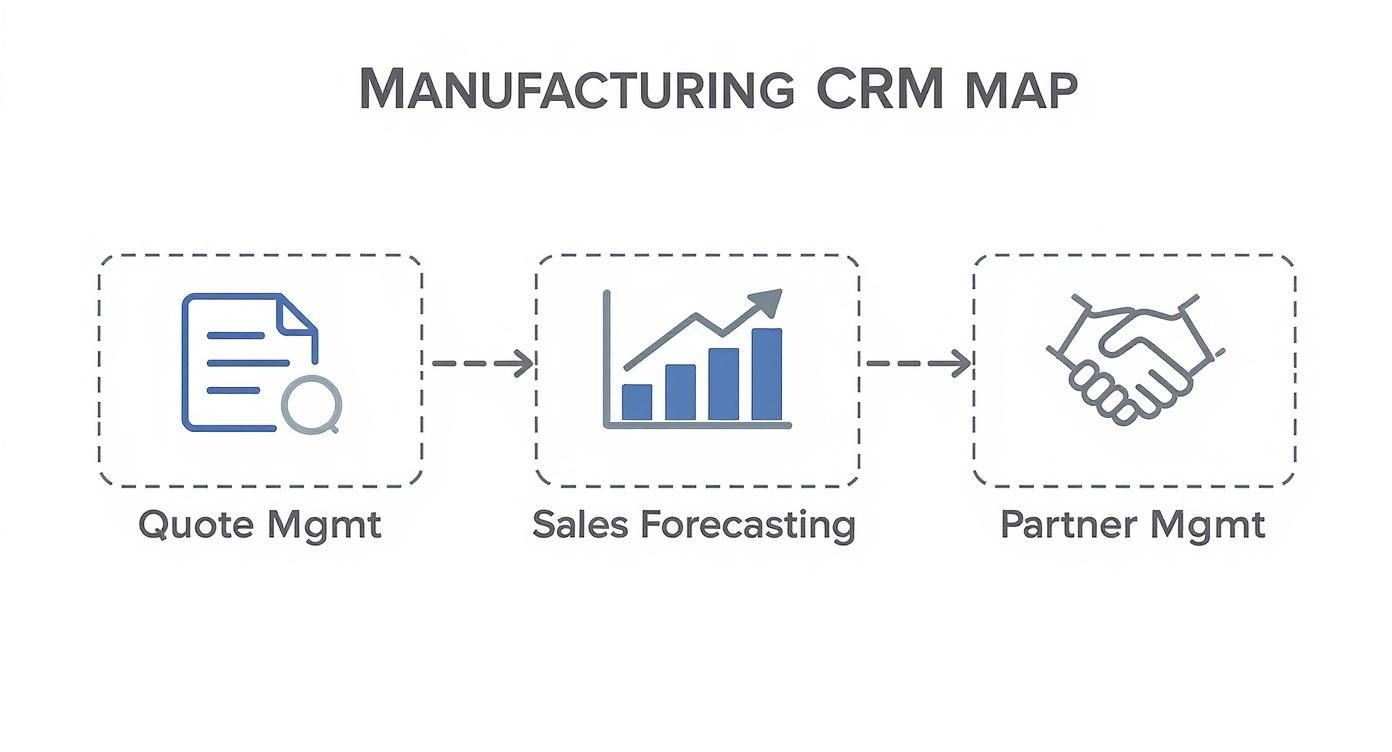
You can see how a solid CRM strategy isn't about just one piece of software; it's about connecting all these distinct processes into a fluid, data-driven cycle.
The CRM and ERP Symbiosis
Your ERP is the heart of your financial and operational data. It handles accounting, procurement, inventory—the works. Integrating it with your CRM creates an incredibly powerful feedback loop that helps both your sales team and your customers.
When these two systems are in sync, your sales reps get a level of visibility they could only dream of before.
Imagine a rep putting together a quote. Instead of having to chase down info from three different departments, they can instantly see real-time inventory levels, accurate production lead times, and the customer’s credit status, all right there in the CRM. It means they can give customers precise, reliable answers on the spot. This slashes the time it takes to generate a quote and, more importantly, prevents them from making promises that production can't keep.
An integrated CRM-ERP system lets your sales team sell with total confidence. They’re no longer just selling a product; they’re selling a concrete promise backed by real-time operational data.
Connecting the Front Office to the Shop Floor with MES
While the ERP handles the big picture of what and when to produce, the Manufacturing Execution System (MES) is all about the how—the real-time action on the factory floor. The MES tracks raw materials as they become finished goods, minute by minute.
Integrating your CRM with your MES links customer demand directly to what's happening on the assembly line.
This connection creates a truly demand-driven production environment. When a big, high-priority order hits the CRM, that integration can automatically signal the MES to prioritize that production run. This direct line of communication keeps your production schedules perfectly aligned with sales promises, which is crucial for hitting those on-time delivery numbers and keeping customers happy. Getting this kind of complex integration right is why many manufacturers look into professional CRM integration services to make sure it all runs smoothly.
Key Takeaways
Bringing your CRM, ERP, and MES systems together delivers some serious wins by creating a single, cohesive view of your entire operation.
- Impact Opportunity: The biggest win is the death of data silos. This lets you build a highly responsive organization where sales, finance, and operations are all reading from the same playbook. The result? Faster decisions and a much better customer experience.
- Practical Example: A salesperson gets a request for a rush order. From the CRM, they can see the necessary components are in stock (thanks to the ERP link) and there’s available capacity on the production line (from the MES link). They can confidently confirm the order and give an accurate delivery date in minutes, not days.
This level of integration isn't a luxury anymore. For modern manufacturers, it's a competitive necessity that turns your CRM from a simple sales tool into the strategic hub that aligns your entire business around your customers.
Using AI to Reinvent Sales and Operations
A modern CRM for manufacturing companies is so much more than a digital filing cabinet. It’s an engine. When you add artificial intelligence to the mix, that engine gets a serious upgrade, turning raw data into smart, decisive action.
AI takes your CRM from a passive database to a proactive partner. It helps you get ahead of customer needs, automate clunky operational workflows, and free up your team from the tasks that drain their time and energy. It’s about moving from just keeping up with demand to actually anticipating it.
Smart Automation for Sales Teams
Ask any field sales rep what their biggest time-sink is, and they’ll probably say "admin work." This is where AI-powered voice applications in a mobile CRM can be a game-changer.
- Practical Example: Imagine your rep just finished a great client visit. Instead of pulling over to spend 20 minutes typing up notes, they just talk to their phone. They can log meeting details, update the opportunity, and set a follow-up task, all with voice commands. This saves hours every week, the data is more accurate, and your reps can spend more time building relationships.
The whole point is to make capturing data feel effortless. When it’s easy, it gets done, and your CRM stays filled with fresh, valuable information.
Intelligent Routing for Leads and Service
Let’s be honest: not all leads are the same. A simple round-robin assignment system for new inquiries is easy, but it’s rarely effective. It completely ignores context, and that’s where AI-driven smart routing steps in.
An AI model can look at your historical data and figure out which rep has the best track record with a certain product line, industry, or even deal size. When a new lead comes in that fits that profile, the system instantly sends it to the person most likely to close it.
Impact Opportunity: Smart routing is about playing to your team's strengths. It can significantly boost conversion rates by making sure every single opportunity goes to the person with the highest probability of success. You stop guessing and start making data-driven decisions.
The same idea works for service requests. The AI can analyze a technical question and assign it to the support agent or field tech with the exact right expertise. That means faster resolutions and happier customers.
AI-Powered Operational Workflows
The real magic happens when AI starts connecting the dots between departments. By building custom AI-driven workflows or integrating AI services, you can link your CRM directly to other core systems, like your ERP, and automate entire processes from end to end.
Here’s a practical example of how that works:
- A prospect fills out a web form for a custom part, and the request lands in your CRM.
- An AI workflow kicks in automatically, reading the inquiry to pull out product specs and quantity.
- The AI then pings your ERP to check if you have the raw materials in stock right now.
- At the same time, it looks at your production schedule to find the earliest possible manufacturing slot.
- With all that information, the AI instantly generates a preliminary quote and a realistic delivery date.
- Finally, it creates a task for the right sales rep to give the quote a quick once-over before sending it off to the customer.
This whole chain of events can unfold in just a few minutes, completely hands-free. Think about how much time that saves. Your team is no longer bogged down in manual data lookups and can instead focus on more complex, high-value work. Getting this right means having a solid plan; this guide on implementing AI in business offers a great framework for thinking through the process.
Building these kinds of intelligent systems, either through custom software builds or AI integrations, doesn't happen by accident. It requires a clear strategy, which is why many manufacturers work with experts to get it right. You can see what that looks like with professional AI enablement services.
Key Takeaways
Bringing AI into your manufacturing CRM isn’t about chasing buzzwords. It’s about building a smarter, faster, and more connected business.
- Boost Sales Productivity: Give your reps time back with AI tools like voice-to-text, so they can spend less time on admin and more time selling.
- Optimize Team Performance: Use smart routing to match every lead and service ticket to the best person for the job, maximizing your win rate.
- Automate Complex Operations: Connect your CRM and ERP with AI workflows to automate everything from inventory checks to quote generation, supercharging your inquiry-to-order process.
Your Implementation Roadmap for a Manufacturing CRM
Picking the right CRM for manufacturing companies is just the first step. A state-of-the-art system is nothing more than a shiny new tool unless you have a rock-solid plan for weaving it into the fabric of your business. A clear, structured implementation roadmap is what separates a smooth rollout from a frustrating, budget-draining mess.
This isn't about just flipping a switch on new software. It’s a full-scale initiative to rebuild your processes with the customer at the absolute center of your operations. The goal here is to sidestep the classic blunders—poor adoption by your team, garbage-in-garbage-out data, and a system that feels completely disconnected from your real-world business goals.
Setting the Stage with a Vendor Evaluation Checklist
Before you can implement anything, you have to choose the right partner. Let's be honest: not every CRM is cut out for the gritty realities of manufacturing. Your vetting process needs to be tough, focused, and dialed into the functions that actually matter on the shop floor and in the field.
Use this checklist to cut through the noise when you're talking to vendors:
- Industry-Specific Functions: Can the platform handle complex, multi-level quotes where material costs fluctuate? Does it get how distributor channels work? Can it track after-sales service and warranty contracts without a dozen workarounds?
- ERP and MES Integration: How real is the integration with your ERP and MES? Don't settle for flimsy API connections. You're looking for deep, native, two-way syncs that keep everyone on the same page.
- Scalability for Growth: Will this system choke when you grow? You need to know it can handle more users, bigger data sets, and more complex workflows without forcing you into a painful migration in three years.
- Mobile Access for Field Teams: Is there a bulletproof mobile app with offline mode for your sales reps and field techs? For teams out on the road, this is a deal-breaker.
Your Phased Implementation Plan
Rolling out a CRM is a marathon, not a sprint. Taking it one step at a time lets you manage the complexity, rack up some early wins to build momentum, and fine-tune your approach as you learn. Break the whole project down into these manageable stages for a much smoother ride.
Phase 1: Define Goals and KPIs
Start with the most important question: What problem are we actually trying to solve? Get crystal clear on your objectives. Maybe you want to slash quote generation time by 30% or boost on-time delivery rates. These Key Performance Indicators (KPIs) become your North Star for measuring whether this whole thing is working.
Phase 2: Strategize Data Migration
Your customer and product data is gold. You need a meticulous plan to move historical data from all those scattered spreadsheets and clunky old systems. That means cleaning it up, standardizing it, and getting it ready before it ever touches the new CRM. A clean start is non-negotiable.
Phase 3: Map and Align Processes
This is where the rubber meets the road. Sit down with your sales, production, and service teams to map out how they actually work today. Then, configure the CRM to support and improve those workflows—not the other way around. Don't force your people to bend to the software; make the software bend to your people.
Phase 4: Drive User Adoption
Technology is useless if no one uses it. You need a real change management plan, complete with hands-on training. The key is to show every single person how the CRM makes their job easier—from the sales rep who can now check inventory from their phone to the service manager who can track a warranty claim in seconds.
Impact Opportunity: When you get this right, you do more than just install software. You create a single source of truth for all customer and operational data, aligning your entire organization. The silos that create friction, delays, and headaches finally come down, making your business faster and more responsive.
This push for connected systems is happening across the industry. The global CRM software market is expected to hit around $254.89 billion by 2025, and manufacturing is a huge driver of that growth. A whopping 86% of manufacturers are bringing in these systems to sharpen their processes and finally unify data across sales, engineering, and production. You can find more insights on this trend at Dialectica.io. This just goes to show how critical it is to get your implementation right, right from the start.
Measuring the ROI of Your CRM Investment
Putting a specialized CRM for manufacturing companies into play is a big move. But the real test isn't just getting it running—it's proving it was worth the investment. To do that, you need to go beyond gut feelings and look at the hard numbers.
This means you’ve got to measure your performance before the CRM goes live to get a baseline. Then, you track those same numbers afterward. Only then can you connect the CRM's features directly to real business results and see a clear Return on Investment (ROI).
Key Metrics to Track for Manufacturing ROI
To build a solid business case, you have to focus on the metrics that actually move the needle for your sales and operations. For manufacturers, success is all about how well you translate data into dollars, and that’s where solid analytics for manufacturers to turn data into profit come in.
Start by zeroing in on these critical KPIs:
- Reduced Quote Generation Time: How long does it take to get a quote to a customer? A CRM that automates pricing and pulls real-time data can shrink this from days to hours, getting you ahead of the competition.
- Increased Sales Forecast Accuracy: How close are your sales forecasts to what you actually sell? When your CRM talks to your ERP, you get a data-backed forecast that helps you dial in production and avoid sitting on expensive inventory.
- Improved On-Time Delivery Rates: What percentage of your orders get to the customer when you promised? A CRM helps align sales with production schedules, which means fewer delays and happier customers.
- Faster Customer Service Response Times: How fast can your team resolve an issue? With a centralized customer history, everyone has the info they need to solve problems quickly, which is huge for retention.
Practical Examples of CRM Impact
The financial payoff becomes crystal clear when you see these numbers in action. Take an industrial machinery maker who brought in a manufacturing CRM and cut quoting errors by 40%. They did it by automating complex configurations, which stopped them from losing money on under-priced deals and rework.
Another game-changer is enabling your people in the field. Mobile CRM is blowing up—it's expected to jump from $28.43 billion in 2024 to nearly $58 billion by 2034. For a manufacturer, that means service techs can pull up inventory levels and schematics right on-site. This completely transforms first-time fix rates and overall service efficiency. You can dig into more of these trends in CRM statistics at DigitalSilk.com.
When you track the right metrics, you change the entire conversation. Your CRM is no longer just another expense—it’s a strategic investment. The data proves it’s a core driver of efficiency and profitability across your entire operation.
Your Questions, Answered
Jumping into a new software system, especially one this specialized, always brings up questions. Let's tackle some of the most common ones we hear about manufacturing CRMs.
Can a Smaller Shop Really Benefit from a Specialized CRM?
Absolutely. It's a common misconception that powerful CRM is only for the big players. The reality is that small and mid-sized manufacturers grapple with the same headaches—quote accuracy, inventory visibility, and keeping customers in the loop. A manufacturing CRM solves these problems head-on.
Many of the best systems are cloud-based and offer pricing that scales with you. This gives smaller businesses access to the same powerful tools without a huge upfront cost. The real win here is building efficient, scalable habits early on. It sets a solid foundation to grow on.
How Long Does a Typical CRM Implementation Take?
This is the classic "it depends" answer, but for good reason. The timeline hinges on a few key things: the complexity of your operations, how much data you need to bring over, and how many other systems it needs to talk to—especially your ERP.
For a more straightforward setup, you might be looking at 3-6 months. But for a complex project with deep customizations and multiple integrations, it’s more realistic to plan for 9-12 months, sometimes longer. We often recommend a phased rollout; it lets you get value from the most critical features much faster while managing the complexity.
What's the Biggest Hurdle to Getting Our Team on Board?
It almost always comes down to people and habits. Your team—from sales reps to production planners—is likely comfortable with their current process, even if it's just a collection of spreadsheets and legacy tools. Those routines are hard to break.
The key to overcoming that resistance is showing them how the CRM makes their job easier, not just different. For a sales rep, it’s seeing live inventory data that helps them close a deal on the spot. For a planner, it’s a clear view of the sales pipeline. You need great training, of course, but you also need leadership to champion the change from the top down.
Ready to see how a system that connects sales, production, and strategy can work for your business? Prometheus Agency specializes in implementing AI-enabled CRM solutions that drive real results. It all starts with a complimentary Growth Audit to build your strategic roadmap.