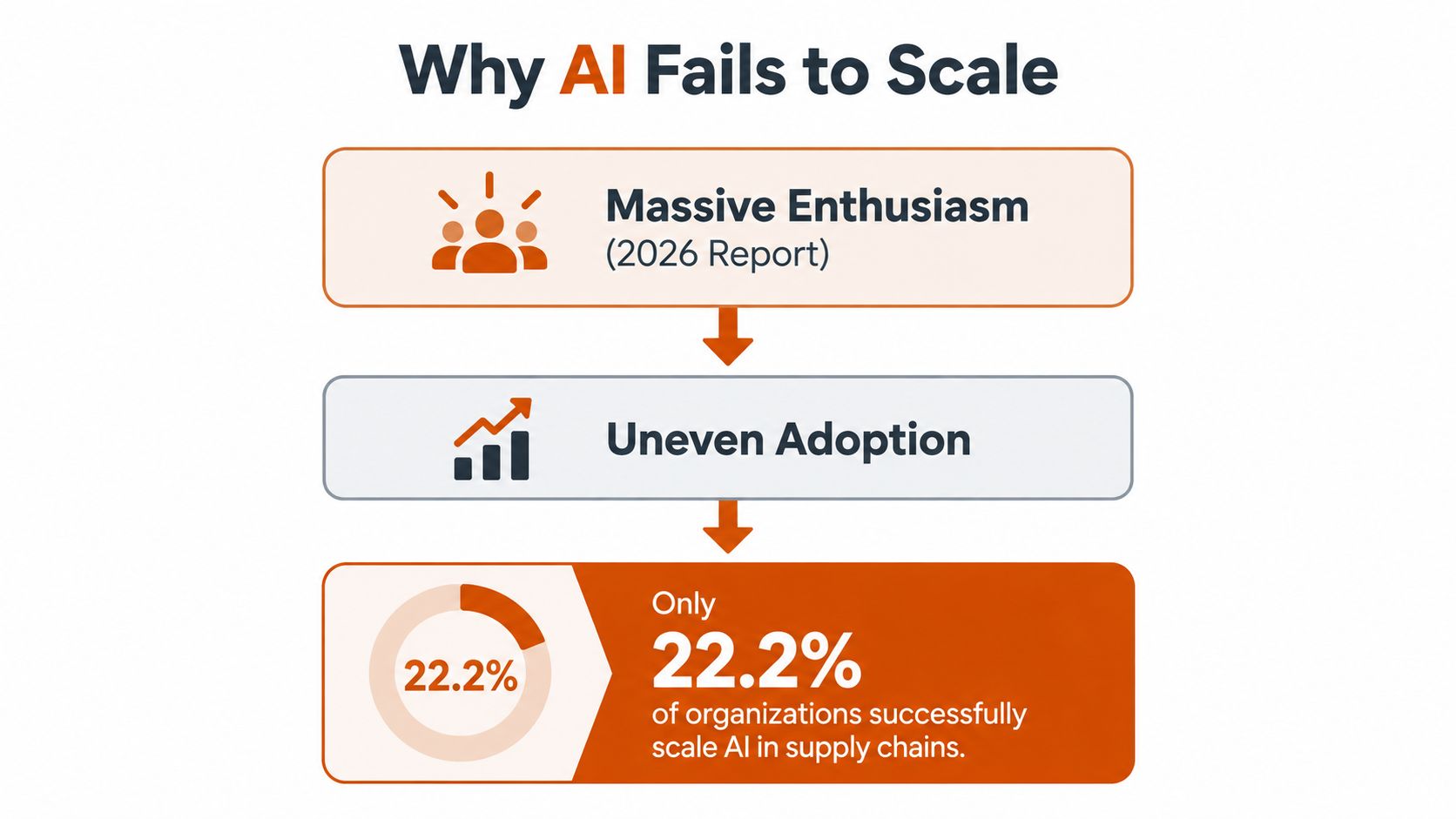
Only 22.2% of supply chain organizations have deployed AI at scale across multiple teams or embedded it in core operations, while 43.2% remain in experimentation or haven't started. That gap changes the question executives should ask. The issue isn't whether AI can forecast demand, optimize inventory, or identify supplier risk. The issue is whether your operating model can turn a promising pilot into a trusted capability that planners, procurement teams, logistics operators, and finance leaders use every day.
AI in supply chain is becoming a serious investment category, but most companies still treat it like a technology project. That's the wrong frame. The winners will redesign decisions, ownership, data flows, and workflows around AI while keeping people accountable for consequential choices.
Key Takeaways
- Scale is the competitive advantage. Most organizations can demonstrate an AI use case. Far fewer can integrate it into core operations.
- Change management is a bigger constraint than model quality. The 2026 global industry report on supply chain AI adoption found that lack of in-house expertise and change-management capability was the biggest barrier for 53.8% of respondents.
- Start with measurable operating outcomes. Forecast error, inventory exposure, logistics cost, service levels, maintenance downtime, and response time are more useful than model accuracy in isolation.
- Data governance comes before sophistication. Incomplete supplier disclosures and fragmented emissions data don't make AI impossible, but they do make normalization, validation, and auditability essential.
- Human approval remains the practical default. Only 10% of executives are willing to let AI make fully independent supply chain decisions, while 54% prefer AI recommendations with human approval, according to HFS research on AI operating models.
Why Most Supply Chain AI Projects Fail to Scale
The supply chain AI adoption curve exposes a sharp execution gap. Only 22.2% of organizations have deployed AI at scale across multiple teams or embedded it in core operations, while 43.2% are still experimenting or have not begun adoption, according to the 2026 industry report.
That result should unsettle any executive who treats a successful proof of concept as evidence of transformation. A pilot can rely on clean data, a narrow workflow, cooperative users, and temporary executive attention. Production requires integration with enterprise resource planning systems, warehouse management platforms, supplier portals, planning calendars, approval policies, and performance incentives. The technical demonstration is often the easiest part.
The leading barriers reinforce the diagnosis. 53.8% of respondents identified a lack of in-house AI expertise and change-management capability as the biggest obstacle, while 48.7% cited integration with existing systems as a major challenge, according to the same report. The bottleneck is organizational. Teams must trust each recommendation, understand when to override it, and know who owns the resulting decision.
The maturity gap is operational, not theoretical
| Maturity stage | Percentage of organizations | Key characteristics |
|---|---|---|
| Scaled deployment | 22.2% | AI operates across multiple teams or sits inside core operations |
| Experimentation or not started | 43.2% | Organizations are testing possibilities or have not begun adoption |
The remaining organizations sit between these broad conditions, but the message is clear. Adoption interest is not the same as operational maturity. The scaled-deployment figure reflects an operating-model gap, not a shortage of promising technology. Companies need defined ownership, decision rights, integration standards, and funding that continues after the pilot.
Practical rule: Don't approve an AI pilot unless you can name the future process owner, integration path, decision rights, and production funding source.
A common failure pattern starts with a technology team selecting a compelling use case without involving the people who carry the operational risk. Planners may reject a forecast because they know a major customer is delaying an order. Procurement may distrust a supplier-risk alert because its source data is stale. Warehouse leaders may ignore a recommendation that conflicts with labor constraints. Without redesigned workflows and feedback loops, the model becomes another dashboard nobody uses.
Governance belongs in implementation from the start. Executives should define what AI may recommend, what requires human approval, how overrides are recorded, and how performance is reviewed. The discussion of AI transformation as a governance problem reinforces this operating-model view. The relevant test is whether the organization can make better decisions consistently because the model is embedded in daily work, with results tracked against service, cost, inventory, or response-time outcomes.
Core AI Applications Transforming Supply Operations
The strongest supply chain AI programs begin with a business constraint, not a fashionable algorithm. Four applications stand out because they connect directly to working capital, service reliability, transport efficiency, and asset availability.
Demand forecasting and inventory control
Demand forecasting is usually the clearest starting point because planners already make recurring decisions with measurable consequences. AI models can combine historical demand with promotions, weather, lead-time changes, supplier disruptions, and other real-time signals. According to research on AI-based demand forecasting, these methods can reduce forecasting errors by 30% to 50% and lower inventory holding costs by 10% to 20%.
The operational mechanism matters more than the headline. A tighter demand distribution lets planners size safety stock and reorder points with greater precision. In a multi-echelon manufacturing network, that can reduce the tendency to protect every location with excessive inventory while still exposing likely stockout risks.
A distributor, for example, can use an AI forecast to distinguish a genuine demand shift from a temporary promotional spike. The system can recommend a revised reorder point, show which signal drove the change, and route the recommendation to a planner for approval. That's more useful than replacing an existing spreadsheet with an opaque score.
Logistics and routing decisions
Logistics teams face simultaneous constraints. Delivery windows, traffic conditions, fuel costs, carrier capacity, customer priority, and loading schedules can all change the preferred route. Predictive analytics can evaluate these variables together and recommend dispatch plans that reflect the network's current state.
The right target isn't “the shortest route.” It's a plan that balances cost, reliability, customer commitments, and operational feasibility. A transport manager should be able to compare the recommended route with alternatives and understand the trade-off before approving it.
Predictive maintenance
Predictive maintenance shifts equipment management from fixed schedules and emergency repairs toward condition-based intervention. Models can analyze machine readings, maintenance history, production patterns, and operator observations to identify abnormal wear.
A factory can use that signal to schedule an inspection during a planned production changeover rather than waiting for an unplanned failure. The value comes from protecting throughput and maintenance capacity, not from generating a prediction for its own sake.
Manufacturing specifications and workflow automation
AI also reduces friction in the information flows surrounding physical operations. Teams can extract specifications from engineering documents, compare supplier requirements, identify missing fields, and route exceptions to the right owner. For organizations dealing with complex product variants, it's useful to streamline manufacturing specs with AI when the alternative is manual interpretation across disconnected files.
The practical sequence is straightforward:
- Choose a decision: Start with a recurring choice such as reorder quantity, dispatch priority, or maintenance scheduling.
- Connect the signals: Bring together the data that influences that decision, including structured records and relevant unstructured inputs.
- Define the intervention: Specify whether AI recommends, triggers a workflow, or acts automatically.
- Measure the outcome: Track the operating result, such as inventory exposure, service reliability, transport cost, or downtime.
AI delivers value when it changes a decision at the right moment. A technically impressive model that arrives after the purchase order, dispatch, or production slot has been finalized has little operational value.
The Business Case for AI Investment in Supply Chain
Supply chain AI has become a significant investment category. A market analysis of AI in supply chain estimates the global market at US$14.5 billion in 2024, growing to about US$106.7 billion by 2030, with a 39.5% compound annual growth rate. Alternative cuts in the same analysis show a similar trajectory. Use your own operating baseline rather than the headline CAGR when planning investment.
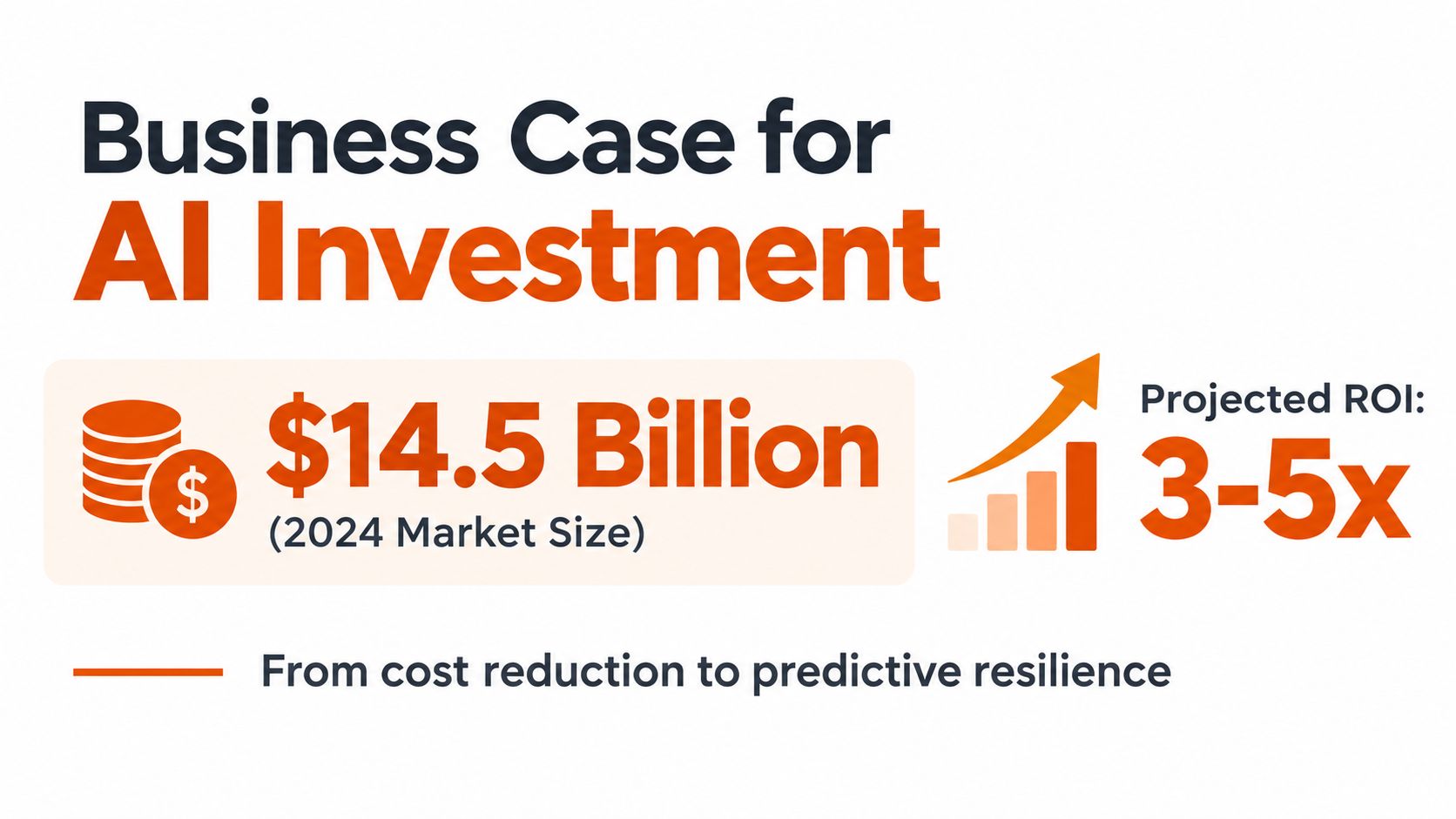
Market growth signals sustained investment from suppliers, competitors, and technology providers. It does not justify a project by itself. Executives need a business case tied to the company's cost structure, service commitments, and growth constraints.
Translate capability into financial outcomes
Reported operating benefits include a 12.7% reduction in logistics costs and a 20.3% reduction in inventory levels for companies using AI, according to the same analysis. A separate survey cited there found that high-maturity organizations could achieve 23% higher margins and up to 50% lower costs over time through AI-powered supply chain capabilities.
Treat those figures as external benchmarks, not promised returns. Build the case around a measured internal baseline:
- Inventory: Identify working capital held in slow-moving stock, duplicated buffers, or weak safety-stock decisions.
- Logistics: Quantify premium transport and expediting caused by late visibility into constraints.
- Margin: Measure whether pricing, allocation, and service decisions account for supply limits early enough.
- Capacity: Calculate production loss caused by maintenance failures, schedule changes, and unplanned disruption.
McKinsey has estimated that generative AI could reduce manufacturing and supply chain expenses by up to half a trillion dollars, as described in its analysis of generative AI in operations. That opportunity supports serious investment, but the value depends on operating discipline. A prototype may prove technical feasibility while still failing to change decisions across planning, procurement, manufacturing, and finance.
The board case should fund a measurable operating change, not a collection of AI features.
A credible proposal defines the baseline, target decision, required systems, accountable executive, adoption plan, and review cadence. It also states what the company will not automate. Fund shared data, workflow integration, training, and process ownership alongside the model. Without those conditions, each function can produce a successful pilot that never becomes a dependable production capability.
The Sustainability and Data Quality Opportunity
Most supply chain AI conversations stop at demand, inventory, and routing. That leaves a substantial opportunity in sustainability and supplier intelligence, where data is harder to collect and decisions are more difficult to standardize.
One recent analysis of AI in next-generation supply chains found that only one in four firms uses AI to support sustainability and ESG efforts, even though respondents viewed the technology as relatively effective in those functions. Nearly half of surveyed firms identified poor data as the biggest barrier.
That creates a misleading assumption: companies often say they must wait for perfect supplier data before using AI. They shouldn't. They need controls that distinguish verified information from estimates, identify missing inputs, normalize inconsistent formats, and show users how much confidence to place in an output.
Use AI to organize imperfect inputs
Scope 3 tracking illustrates the challenge. Emissions data often arrives from multiple suppliers and partners with different boundaries, units, methodologies, and levels of completeness. An AI system can help classify documents, identify contradictions, map supplier records, and prioritize follow-up. It can't turn unsupported disclosures into facts.
The operating model should therefore separate three functions:
- Normalization: Convert inconsistent supplier submissions into a common structure.
- Validation: Check whether the input has supporting evidence, plausible values, and the required context.
- Prioritization: Direct human attention toward suppliers, categories, or facilities where uncertainty and potential impact are highest.
Data governance creates competitive advantage. Companies that can work responsibly with messy inputs may act sooner than companies that wait for every upstream partner to adopt the same standard. The AI data readiness framework provides useful context for treating data structure and ownership as prerequisites for dependable automation.
Govern the source before improving the model
Investment intentions are rising around both generative and predictive AI. The analysis cited 71% of organizations planning to invest in GenAI and 60% planning to invest in predictive AI over the next three to five years, while only 27% had fully embedded an AI strategy across business units. The contrast points to a familiar risk. Companies can buy models faster than they can establish shared definitions, accountable owners, and repeatable controls.
Start with a supplier data contract. Define required fields, acceptable evidence, update responsibilities, and escalation rules. Then make the AI output explainable enough for procurement, sustainability, finance, and legal teams to challenge it. Data quality isn't a back-office concern. It determines whether sustainability intelligence can influence supplier selection, risk mitigation, and capital allocation.
Implementation Roadmap from Pilot to Production
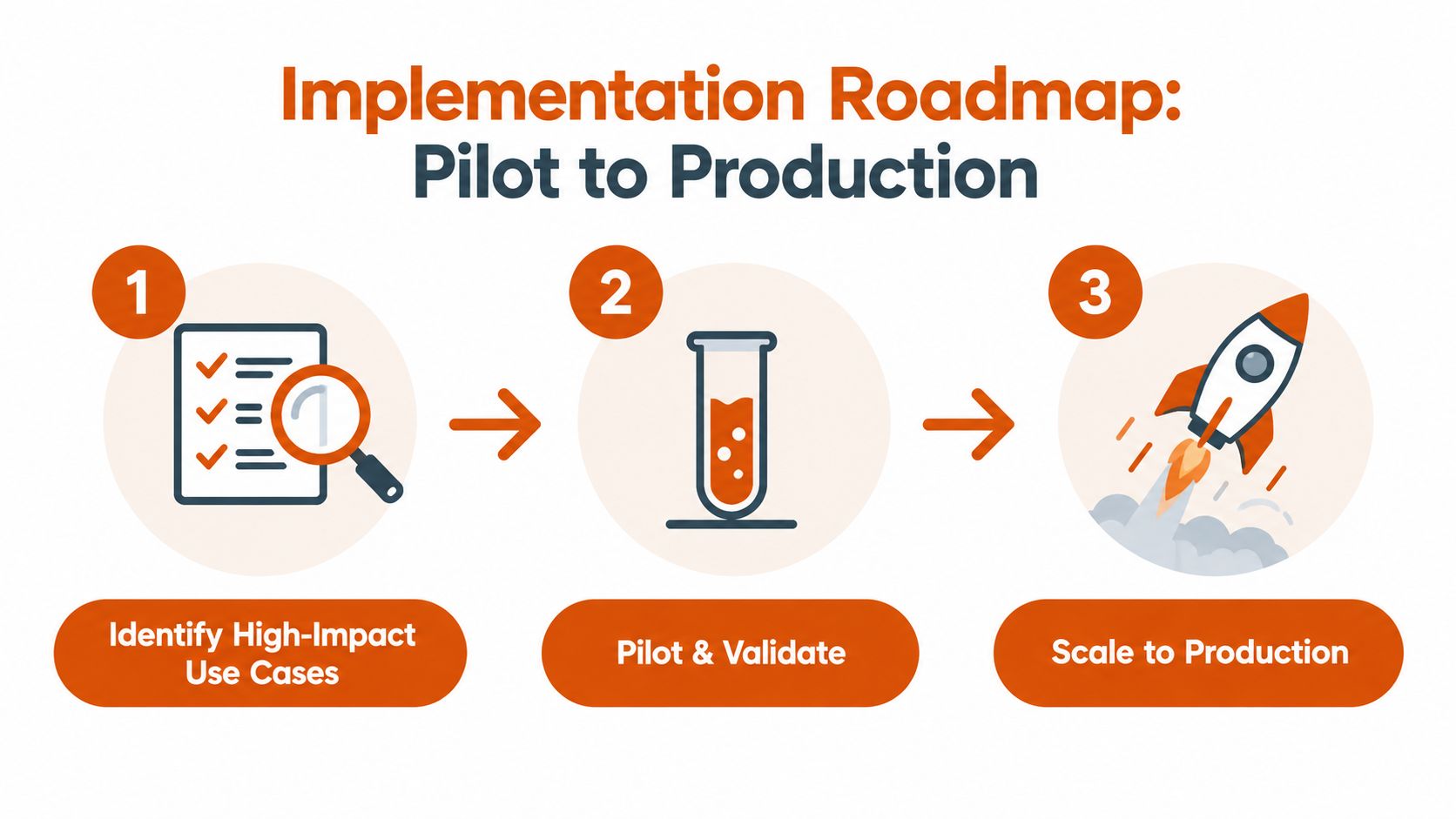
Production starts with a narrow operating decision, not an enterprise-wide AI program. Select one decision with visible economic value, an accessible data trail, and an executive accountable for adoption. This focus exposes the process, ownership, and integration work that prototypes often avoid.
Identify the use case and owner
Strong candidates include demand forecasting, inventory exception management, supplier-risk alerts, and predictive maintenance. Rank each by business value, data availability, workflow readiness, and integration cost. The best first use case is the one that fits an existing operating rhythm and gives users enough time and authority to act on the output.
Define ownership before building anything. Supply chain owns the decision. IT owns integration and security. Data teams own quality and monitoring. Finance validates the economic baseline. A senior sponsor resolves process conflicts and keeps the pilot from becoming an innovation-team experiment.
Given the 83% to 13% investment-to-deployment gap noted earlier, narrow the roadmap to one decision and one accountable owner. The wider scaling gap also shows why ownership must extend beyond the innovation team. Enterprise deployment requires operating units to change how work gets done, not merely approve another model.
Pilot with a production path
Set a baseline before introducing the model. For forecasting, measure error, stockout exposure, planner overrides, and inventory levels. For maintenance, track unplanned downtime, intervention timing, and spare-parts availability. The pilot must test the workflow around the prediction, including who reviews the recommendation, who acts, and how exceptions are recorded.
Use a controlled rollout. Let planners compare AI recommendations with the existing approach, record overrides, and explain rejected outputs. These explanations improve the model and reveal process barriers, such as missing data, unclear authority, or recommendations arriving too late.
Connect the pilot to the relevant ERP, WMS, supplier portal, or maintenance system early. A standalone interface can produce positive demonstrations while leaving day-to-day operations unchanged. The guide to moving AI pilots into production emphasizes this operational transition rather than treating proof of concept as the finish line.
Scale through repeatable controls
Production requires monitoring for model drift, data gaps, workflow adoption, and business impact. Create a release process for model changes and a fallback process for degraded inputs. Document which decisions remain human-controlled and which actions can be automated. Review these controls in normal operating meetings, not only in innovation reviews.
Use a recommendation-first workflow. The cited research indicates that executives generally prefer AI recommendations with human approval over fully independent supply chain decisions. Build approval thresholds, override capture, and escalation paths into the process from the start. Human oversight should be an explicit control with a defined business purpose, not an informal safeguard that disappears under delivery pressure.
Use this production sequence:
- Identify: Select one decision with a measurable operating outcome.
- Pilot: Validate the recommendation, data quality, user behavior, and integration path.
- Scale: Extend to adjacent teams only after controls, ownership, and monitoring work reliably.
The implementation team should review progress at regular operating meetings. That cadence turns AI from a funded project into a managed supply chain capability, with clear accountability for adoption and measurable results.
Managing Risks and Building Resilient AI Systems
AI doesn't remove supply chain risk. It changes how teams detect, prioritize, and respond to it. A system can combine supplier financial information, long-range weather forecasts, logistics data, and social-media traffic to flag emerging threats earlier, as described in McKinsey's supply chain risk research. The same system can mislead users if signals are stale, incomplete, or interpreted outside their proper context.
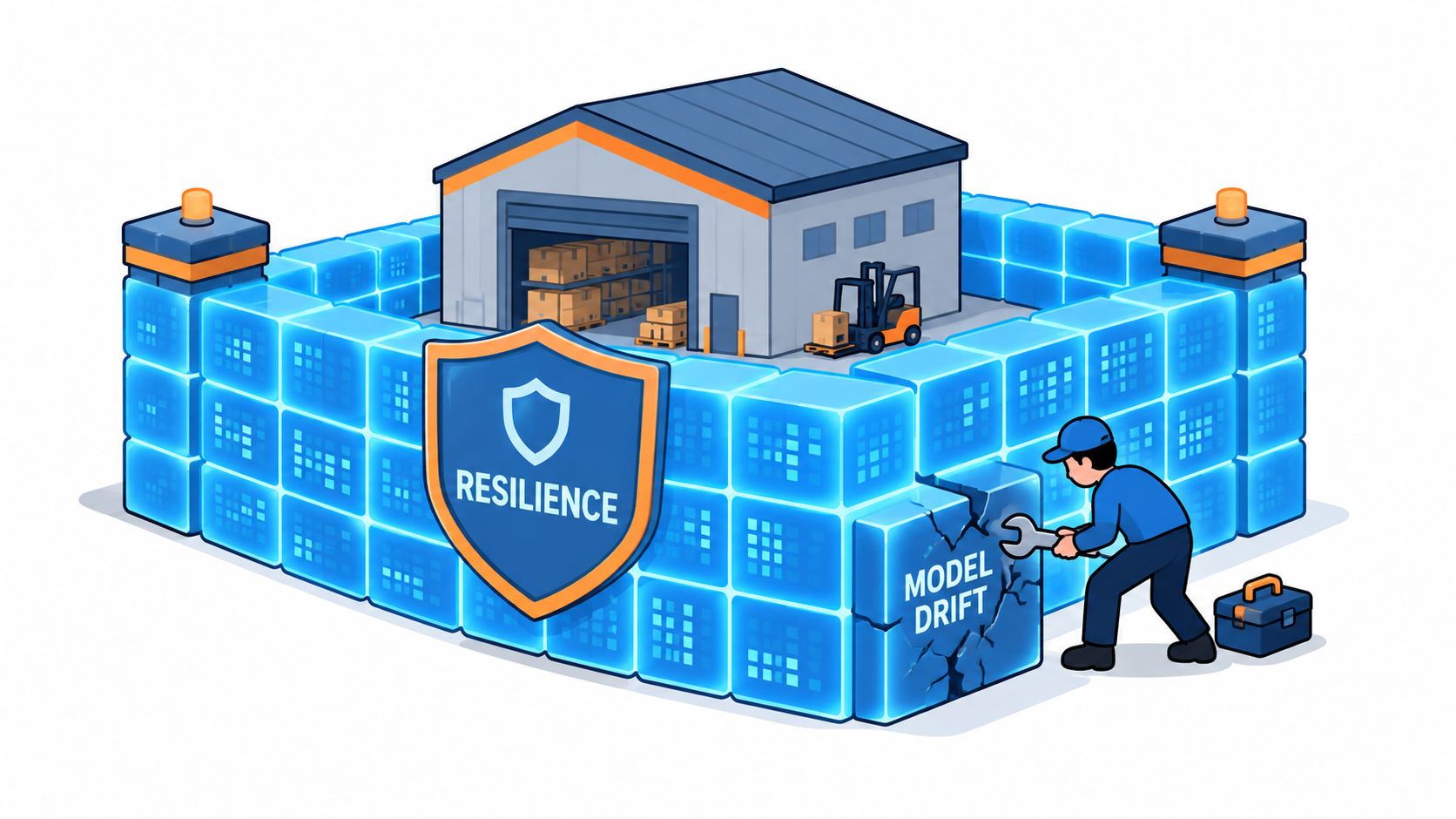
Treat model drift as an operating issue
Demand patterns change. Suppliers alter lead times. Carriers change service behavior. Weather conditions and geopolitical conditions reshape routes and availability. A model that performed well during one operating environment may degrade when the underlying relationships change.
Monitor more than technical accuracy. Track whether users act on alerts, whether overrides increase, whether recommendations arrive early enough to matter, and whether the promised business outcome remains visible. Assign a person to investigate deteriorating performance and pause automation when the input conditions fall outside the approved range.
Keep accountability visible
Experienced planners may resist AI because they carry responsibility for service failures, excess inventory, and customer escalations. Telling them to “trust the model” won't solve that problem. Give them evidence, an override mechanism, and a clear escalation route when the recommendation conflicts with operational knowledge.
Critical controls should include:
- Human approval: Require accountable users to approve high-impact purchasing, allocation, supplier, and production decisions.
- Audit trails: Record the input data, recommendation, user action, and reason for any override.
- Fallback procedures: Define how teams operate when the model, integration, or source data is unavailable.
- Access controls: Limit sensitive supplier, pricing, customer, and production information to authorized roles.
- Review cycles: Reassess thresholds, features, and business outcomes as operating conditions change.
Resilient AI doesn't eliminate judgment. It gives judgment better evidence and a faster way to act.
The strategic pressure is increasing. A World Economic Forum article cites a BearingPoint survey of 620 senior executives across Europe, the United States, and China, finding that more than 90% expect AI to significantly reshape supply chains by 2030, as reported by the World Economic Forum.
That expectation makes risk management a differentiator, not a brake on adoption. Companies that automate without accountability will create fragile dependencies. Companies that combine AI recommendations with strong data controls, human decision rights, and tested fallback procedures can improve responsiveness without surrendering operational judgment.
The immediate priority is clear. Choose one supply chain decision, define the business outcome, map the data and ownership, and design the production workflow before selecting the model. Prometheus Agency helps growth leaders connect AI enablement, existing technology stacks, process design, and accountable implementation, so visit Prometheus Agency to discuss an AI strategy session and a practical path from pilot to production.