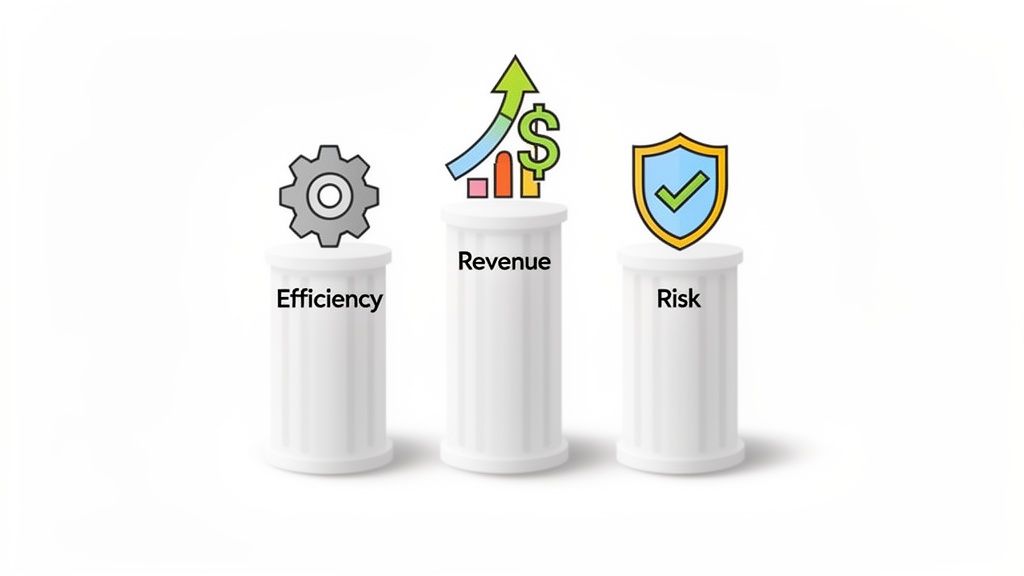
When we talk about the ROI of an AI transformation, we're really asking a simple question: "Is this investment making our business stronger?" The answer isn't found in technical jargon but in its impact on three fundamental areas of your business: boosting operational efficiency, driving revenue growth, and reducing operational risk.
It’s a shift in perspective. You stop seeing AI as a line item on the IT budget and start treating it as a core strategic investment with a clear, measurable financial return. Getting this right means looking at the obvious cost savings and the not-so-obvious gains, like a leap in customer loyalty.
Key Takeaways
- Calculating the ROI of AI transformation requires focusing on three core business pillars: Efficiency, Revenue Growth, and Risk Reduction.
- Successful AI adoption is not about technology alone; it's a strategic shift that requires significant investment in people and process redesign.
- A phased "Crawl, Walk, Run" approach minimizes risk, builds momentum, and demonstrates value through early, measurable wins.
- A strong business case and continuous governance are essential for securing funding and sustaining long-term value from AI initiatives.
Moving Beyond Buzzwords to Define AI ROI
Defining the ROI of AI means cutting through the hype to find real, tangible value. The focus isn't on the AI models themselves but on what they allow your business to do. Think of it less like buying a new piece of software and more like bringing on a team of super-powered analysts who work 24/7 to optimize every corner of your operation.
This kind of strategic investment creates value in three distinct ways. To truly get a handle on the ROI, you have to measure how every AI project moves the needle on one—or all—of these pillars.
The Three Pillars of AI Transformation
Let's break down how AI delivers value in these key areas. Each pillar represents a different lever you can pull to improve financial and operational performance.
| The Three Pillars of AI Transformation |
|---|
| Value Pillar |
| Boosting Efficiency |
| Driving Revenue Growth |
| Reducing Operational Risk |
By categorizing your initiatives this way, you start building a clear, compelling story about how AI is creating tangible business results, not just interesting tech demos.
From Abstract Concepts to Concrete Value
Boosting Efficiency: This is often the easiest win to spot and measure. AI can take over repetitive, time-consuming tasks, simplify complex workflows, and make sure your resources are where they need to be. The result? Lower costs and a team that can focus on creative, high-impact work.
- Practical Example: A manufacturing company implements an AI-powered predictive maintenance system on its assembly line. By analyzing sensor data, the system predicts equipment failures before they happen, reducing unplanned downtime by 30% and saving thousands in emergency repair costs.
Driving Revenue Growth: Here, AI becomes your growth engine. It can sift through data to find your most promising leads, help you craft marketing campaigns that feel personal to every customer, or adjust prices in real-time to match demand.
- Practical Example: An e-commerce retailer uses an AI recommendation engine to personalize the shopping experience. By suggesting products based on browsing history and past purchases, they increase the average order value by 15% and see a 10% lift in customer lifetime value.
Reducing Operational Risk: This is all about playing defense. AI can be trained to spot the signs of fraud, keep you on the right side of industry regulations, and bolster your cybersecurity. By flagging anomalies before they become full-blown crises, AI helps shield the business from expensive fines, losses, and damage to its reputation.
- Practical Example: A financial institution deploys an AI algorithm to monitor transactions in real-time. The system flags suspicious activity with 99.5% accuracy, leading to a 60% reduction in fraudulent losses in its first year of operation.
Tying It All Together
To get from high-level ideas to actual ROI, you need to connect the dots. You have to show how tools that enable things like low-code automation through Power Platform directly fuel these three pillars. These platforms give your teams the ability to build and launch solutions that solve specific business problems—whether it’s an efficiency bottleneck or a revenue opportunity.
Ultimately, your goal is to speak the language of the C-suite. That means framing every AI initiative not as a technology project, but as the answer to a critical business question.
Why So Many AI Projects Never Pay Off
For all the hype, there’s a massive gap between the money being poured into artificial intelligence and the actual results hitting the bottom line. It’s a familiar story: companies go all-in, spending a fortune on AI, only to see their projects die in the pilot stage or, worse, generate nothing close to a positive return. This isn’t just bad luck—it’s a pattern.
The problem usually starts with where companies focus their attention. They get excited about the tech itself, chasing the shiniest new algorithm or platform, and then try to jam it into a business problem. That's completely backward. It’s like buying a Formula 1 engine without having a car, a track, or even a driver. You’ve got a seriously impressive piece of engineering that does absolutely nothing for you.
The Sobering Numbers Behind AI Spending
This isn't just a feeling; the data paints a pretty stark picture. A 2023 report from the IBM Institute for Business Value found that while companies are dedicating about 10% of their capital spending to AI, the average return on that investment is a meager 5.9%.
Dig a little deeper, and it gets worse. While many leaders think their AI projects are profitable, only about 47% actually are. A painful 14% are actively losing money. The truly shocking statistic? A separate MIT study revealed that only 5% of generative AI pilots ever deliver real, sustained value once they’re scaled up.
It’s easy to mistake motion for progress, but these numbers tell us that most of the frantic activity around AI isn't translating into meaningful business success.
Common Traps That Kill AI ROI
So, where does it all go wrong? A few classic mistakes pop up again and again. Spotting them is the first step to making sure your own projects don't fall into the same traps.
- Garbage In, Garbage Out: AI runs on data. If your data is a mess—stuck in different silos, full of errors, or just plain bad—your AI model will be useless. Building a world-class algorithm on a weak data foundation is like building a skyscraper on a swamp. It's going down.
- No Clear Finish Line: How do you know if you've won if you never defined the game? Too many teams kick off an AI project without agreeing on what success actually looks like. You need clear, measurable goals tied to real business outcomes, not just technical metrics.
- Forgetting About the Humans: You can build the most incredible AI tool in the world, but if your team doesn't—or can't—use it, it's a multi-million dollar paperweight. A company can sink a fortune into a new AI-powered sales platform, but if it doesn't fit how the sales team actually works, adoption will be zero and the ROI will be even less.
"The primary reason AI projects fail isn't the technology; it's the failure to bridge the gap between the technology and the business. Success demands a relentless focus on solving a specific, high-value problem from day one."
By facing these hard truths, you can start shifting your thinking from "what can this tech do?" to "what business problem can we solve?". Getting real about the risks is the only way to build a practical plan that actually delivers. The path to a successful AI transformation doesn’t start with writing code; it starts with learning from the expensive mistakes others have already made.
The Widening Gap: Why Early Movers are Winning Big
Let's be blunt: while most companies are stuck in analysis paralysis over AI transformation, a handful of early movers are already building an insurmountable lead.
They're not just running a few pilot programs. They are actively digging a competitive moat so wide and deep that laggards may never be able to cross it. Every day they operate, that gap widens, and the game gets harder for everyone else.
The returns they're seeing aren't just incremental improvements, either. For those who jumped on generative AI early, the results are staggering. We're seeing data that shows for every dollar they put into Gen AI, they’re getting back between $3.70 and $3.71. That's not a small win; it's the kind of outsized return that fundamentally separates the pack.
It's Not About Automation, It's About Acceleration
Here’s where a lot of people get it wrong. The real power these companies have unlocked has little to do with simply cutting costs or automating tedious tasks. They're using AI as a growth engine.
Think bigger. They're achieving accelerated revenue growth and much higher returns on capital, fundamentally outmaneuvering their peers. It's not just about having shinier tech—it's about having a smarter strategy for putting that tech to work.
Over a three-year span, companies leading the charge on AI have booked 1.5x higher revenue growth and 1.4x higher returns on invested capital compared to their slower competitors. They're wiring AI into everything from sales and marketing to strategic planning, turning their data into a direct line to financial performance.
The 70-20-10 Rule for Winning with AI
So, what’s their secret? It’s a surprisingly human-centric investment strategy. While laggards get fixated on the technology itself, the leaders have cracked the code by putting their money where it actually counts.
Their blueprint is simple but powerful:
- 70% goes to People and Process. The lion's share of investment is spent on redesigning workflows, retraining teams, and leading the organizational change needed to make AI stick.
- 20% is for the Technology. This covers the cloud infrastructure, data plumbing, and software needed to power the AI.
- 10% is for the Models. The smallest slice of the pie is for the actual algorithms that solve the business problem.
This 70-20-10 model is probably the single most important insight for anyone trying to calculate AI ROI. The technology is just the tip of the iceberg. Your success—or failure—will almost entirely depend on how well you weave that technology into the very fabric of your business.
This is precisely why the early adopters are pulling away so fast. They get that AI isn't just another software project; it's a root-and-branch change in how the business thinks and operates.
And this shift is happening at lightning speed. Enterprise adoption of Gen AI shot up from 32.5% in 2023 to 65% in 2024. This is quickly becoming the new table stakes. If you want to see the full picture, you can find more generative AI statistics that paint a pretty clear picture of where things are headed.
Impact Opportunity: By reallocating investment focus from technology (10-20%) to people and process change (70%), organizations can dramatically increase the probability of achieving a positive ROI on AI transformation. This strategic shift moves the focus from technical implementation to business adoption, which is the primary driver of sustained value.
By following this proven blueprint, you're not just adopting AI—you're positioning your company to take market share from everyone who is still waiting for the perfect moment.
Building a Business Case That Gets Approved
A brilliant AI idea without a solid business case is just a conversation. To turn that vision into a funded, approved project, you have to build a rock-solid, data-backed argument that can stand up to serious scrutiny from your finance and executive teams. This is where you translate AI's potential into the language they speak fluently: numbers, risk, and return.
A strong business case does more than just ask for money. It forces the entire organization to align around a clear goal. It defines what success actually looks like, maps out the path to get there, and gives you a framework for measuring the ROI of AI transformation at every single step. This process creates clarity and discipline, ensuring you're solving a real business problem, not just chasing shiny new tech.
Start With a High-Impact Problem
Before you can calculate a single dollar of return, you need to lock onto a specific, high-impact business problem. Don't fall into the trap of proposing a vague, all-encompassing "AI strategy." Instead, pick one tangible use case where the pain is real and the potential for improvement is massive.
Is it about stopping customer churn in its tracks? Speeding up your production line? Or maybe just automating a painfully slow manual process that’s draining your team’s time and morale?
Start by asking questions that directly connect operational headaches to financial outcomes:
- Where are our biggest operational bottlenecks? Hunt for areas where manual work creates delays, errors, or bloated labor costs.
- What's our single biggest source of revenue leakage? Pinpoint where you’re losing money in the sales funnel or customer journey.
- Which business process, if we improved it by just 20%, would create the biggest ripple effect on our bottom line? This question helps you find the opportunities with the most use.
Once you’ve identified your target, you can start building the financial model that will anchor your entire case.
Map Out the Full Spectrum of Costs and Benefits
A business case that gets taken seriously has to account for everything. That means looking way beyond the obvious software license fees and including all the resources required to actually make it work. As the flow below shows, a complete view of any AI investment has to balance the technology, the people, and the process.
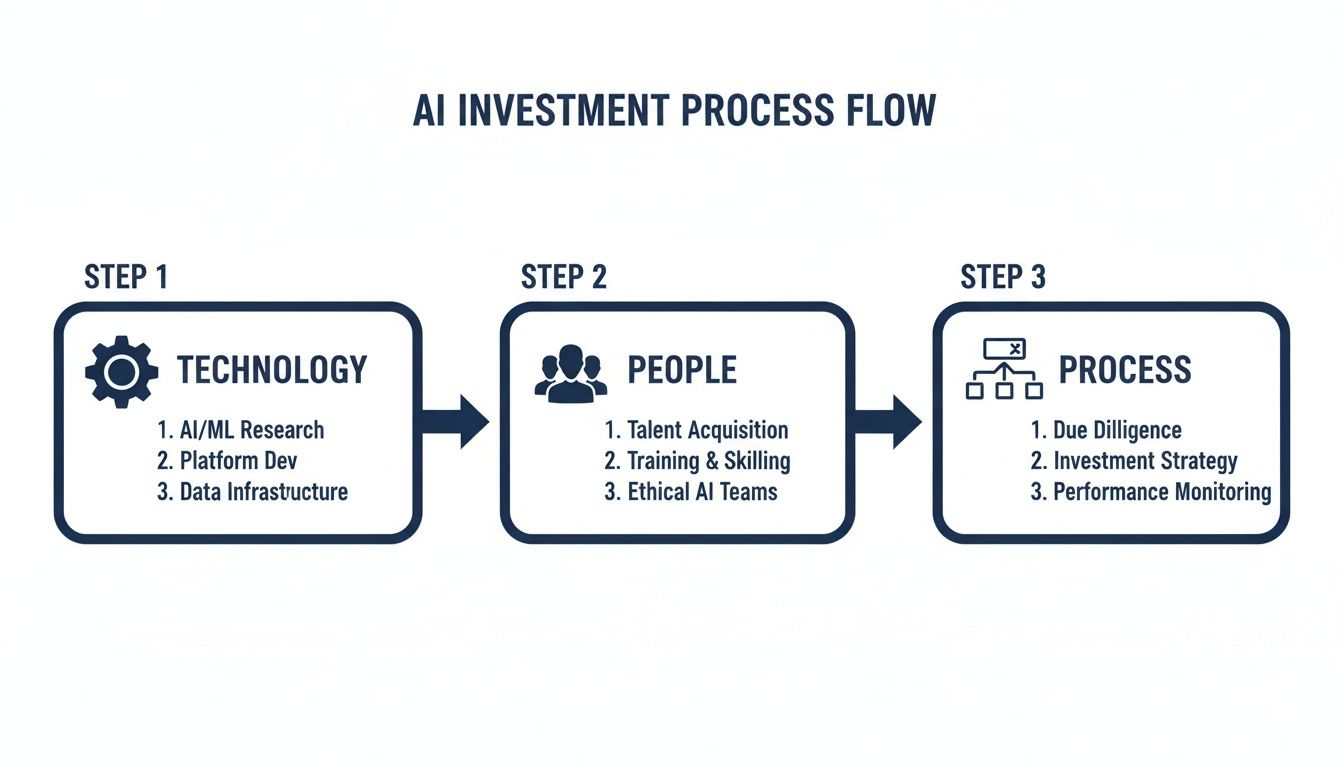
As you can see, technology is just one piece of the puzzle. The heavier lifts are often in getting your people ready and redesigning your processes to actually use the new capabilities.
On the flip side, you have to quantify both the "hard" and "soft" benefits. Hard benefits are the direct financial gains everyone loves, like cost savings or increased sales. Soft benefits—like smarter decision-making or happier customers—are just as critical, but they need a clear methodology to be translated into financial terms.
The table below breaks down the common cost and benefit categories you'll want to consider. Don't leave anything out; a comprehensive list shows you've done your homework.
Cost and Benefit Categories for Your AI Business Case
| Category | Component | Example | How to Measure |
|---|---|---|---|
| Costs (CAPEX & OPEX) | Technology & Infrastructure | AI platform licenses, cloud computing costs, data storage. | Vendor quotes, projected cloud usage bills (e.g., AWS, Azure). |
| Implementation & Integration | Consulting fees, internal developer time, API integrations. | SOWs from vendors, internal time tracking estimates. | |
| People & Training | Hiring data scientists, upskilling existing teams, change management. | Salary data, training program costs, consultant fees. | |
| Data Management & Governance | Data acquisition, cleaning, labeling, and ongoing security. | Data vendor costs, estimated hours for data prep, security tool licenses. | |
| Ongoing Maintenance | Model monitoring, retraining, software updates, support contracts. | Annual support fees, estimated internal hours for MLOps. | |
| Benefits (Hard & Soft) | Increased Revenue | Higher sales conversion rates, upselling/cross-selling, new products. | Δ in conversion rate %, Δ in average order value (AOV), new revenue streams ($). |
| Cost Savings | Automation of manual tasks, reduced headcount, lower operational costs. | Hours saved x hourly wage, reduction in SG&A, decreased cost of goods sold (COGS). | |
| Efficiency & Productivity | Faster process completion times, higher output per employee. | Reduction in cycle time (%), increase in units produced/tasks completed per hour. | |
| Risk Reduction | Lower fraud rates, improved compliance, reduced customer churn. | $ saved from fraud prevention, reduced fines, Δ in customer lifetime value (CLV). | |
| Strategic & Intangible | Better decision-making, improved customer satisfaction, competitive edge. | Link to hard metrics: e.g., improved CSAT leading to lower churn; better forecasts reducing inventory waste. |
Thinking through each of these categories ensures your financial projections are grounded in reality, building credibility with stakeholders.
Putting a Number on the Intangible
So, how do you put a dollar value on something like "better decision-making"? You have to connect it to a measurable outcome.
For instance, if an AI tool helps your sales team spot at-risk customers, you can directly measure the impact on your churn rate. By understanding what drives customers away, you can build smarter retention strategies. Many companies are already doing this with predictive churn modelling, turning data insights into tangible revenue protection.
Similarly, an improved employee experience isn't just a nice-to-have. It can be measured through lower turnover rates and reduced hiring costs. The goal is always to build a clear, logical bridge from the soft benefit to a hard number that can be plugged right into your ROI calculation.
To really seal the deal, build a sensitivity analysis showing potential ROI under best-case, worst-case, and expected scenarios. This proves to finance leaders that you’ve acknowledged the uncertainty and are prepared for it. It's how you transform a good AI idea into a compelling, investable business case that gets the funding—and the organization—it needs to succeed.
Executing a Phased Rollout for Early Wins

Getting your business case signed off is the starting line, not the finish. The real work begins when you have to turn those carefully crafted spreadsheets and strategic plans into a functioning reality. Trying to execute a massive AI transformation in one big bang is a recipe for disaster—a single wrong move can burn through your budget and vaporize the stakeholder confidence you just earned.
A much smarter play is to roll out your initiative in phases, stacking up small, tangible wins along the way. This approach systematically takes the risk out of the investment, builds real operational momentum, and proves the ROI of AI transformation at every single step.
The Crawl, Walk, Run Methodology
The "Crawl, Walk, Run" model is a classic for a reason: it works. It's a battle-tested framework for navigating complex technology projects without getting overwhelmed. Instead of trying to make one giant leap, you break the entire transformation down into a sequence of manageable phases. Each one builds on the last.
- Crawl: You begin with a single, tightly focused pilot project. The goal here isn't to change the world overnight; it's about learning and validation. You’re proving the tech works and can deliver real value in a controlled, low-risk setting.
- Walk: Once the pilot is a success, you take what you learned and expand. This might mean rolling out the AI solution to an entire department, a specific product line, or a single geographic market. It's a bigger test, but still contained.
- Run: With a proven model and established best practices, you can finally hit the accelerator. This is where you execute the full, enterprise-wide deployment with confidence.
This methodical progression turns a scary, monolithic project into a series of achievable milestones. It gives your teams the space to adapt, learn, and build the skills they need to succeed.
Selecting Your First Pilot Project
Frankly, the success of your entire AI program often rides on the outcome of that very first pilot. That makes picking the right project a make-or-break strategic decision. The ideal pilot has a few key characteristics that stack the deck in its favor.
Your pilot project should be:
- High-Impact and Visible: Go after a problem that, when solved, will get noticed by leadership. If you can move a metric the C-suite obsesses over, you've got their attention.
- Clearly Measurable: You need a simple, undeniable success metric. Avoid pilots where the benefits are "soft" or hard to pin down, as that will just weaken your ROI argument later.
- Feasible Within a Short Timeframe: Look for a project that can show real results in 90 to 120 days. Momentum is everything, and quick wins are the fuel that keeps the engine running and the funding flowing.
- Well-Defined and Contained: Keep the scope narrow and manageable. Don't try to boil the ocean. Conquer one well-defined challenge first. For a great example of a focused project, you can learn more about how to structure a pilot around AI-powered lead generation for a sales team.
Practical Example: A logistics company might kick things off with a pilot AI project to optimize a single, notorious delivery route (Crawl). After they prove a 15% reduction in fuel costs and faster delivery times on that route, they expand the system to their entire regional fleet (Walk). Finally, armed with rock-solid data and a proven process, they scale the solution across the entire national network (Run).
Each phase provides the proof and the confidence needed to justify the next, turning a massive investment into a predictable, value-generating program.
Establishing Governance to Sustain Long-Term Value
Getting a positive ROI on your first AI pilot is a huge win, but it’s just the starting line. The real marathon is keeping that value coming year after year.
Without a strong system for governance and measurement, even the most promising projects can fizzle out. They become shiny objects that lose their luster, never delivering on their full potential.
Lasting success demands a different way of thinking. You can't treat AI as a collection of one-off projects. It has to become a core, value-cranking business program. That means building a system to watch performance, manage the inevitable risks, and make sure every AI initiative stays locked on to your business goals, long after the launch party is over.
Building a Continuous Measurement Framework
To keep the momentum going, your measurement strategy has to grow up. The initial business case was a snapshot, a single moment in time. What you need now is a live feed.
This means tracking a mix of metrics that paint the full picture.
- Lagging Indicators: These are your classic ROI numbers—the hard cost savings, the extra revenue, the productivity bumps. They tell you what you’ve already achieved.
- Leading Indicators: These are your crystal ball. They predict future results. Think user adoption rates, model accuracy trends, or how quickly a process runs. If a leading indicator like user engagement starts to dip, it’s an early warning flare. You can jump in and fix things before the bottom-line results take a hit.
This data shouldn't be buried in a spreadsheet. It needs to live on real-time dashboards that key people can actually see and use. You should also hold structured ROI reviews—maybe quarterly, maybe twice a year—to check the health of each project. It's your chance to move resources around and make smart calls on which projects to scale, tweak, or even shut down.
The Critical Role of AI Governance
Once you start scaling AI, governance isn't optional. It’s the guardrails that keep your program from flying off a cliff. It ensures your AI systems are reliable, ethical, and secure.
Good governance is what protects the long-term ROI of AI transformation. It stops preventable risks from blowing up your hard work and destroying value.
A well-defined governance structure is what turns a few successful AI pilots into a powerful, enterprise-wide capability. It provides the consistency and oversight needed to build trust and deliver real, sustainable impact.
So, what does a solid AI governance framework actually look like? It stands on a few key pillars:
- Data Quality and Management: Your models are only as good as the data they eat. You need to keep that data clean, accurate, and secure for its entire life.
- Model Monitoring and Maintenance: AI models aren't "set it and forget it." You have to constantly watch their performance for drift or decay and have a plan for regular retraining.
- Ethical Guidelines and Fairness: Set clear rules for how AI will be used. Actively audit your algorithms to find and fix hidden biases.
- Risk Management and Compliance: Identify the operational, reputational, and legal risks for every AI project and put controls in place before they become problems.
Impact Opportunity: Creating a centralized "AI Center of Excellence" can be a powerful accelerator. This dedicated team acts as the hub for best practices, standards, and strategic alignment, ensuring that individual AI projects contribute to a cohesive, enterprise-wide capability rather than becoming isolated silos. Learn more about how to get these programs off the ground in our guide to AI enablement.
By building this foundation, you set yourself up for an AI program that delivers compounding returns for years to come.
Your Toughest AI ROI Questions, Answered
When you start talking about pouring real money into AI, the same handful of tough questions always come up. Getting these right is the difference between a confident, well-funded strategy and a project that stalls out.
Here are the straight-up answers to the questions we hear most often from leaders on the ground.
How Long Until We Actually See a Return on This?
There’s no magic number here—it all comes down to the scope of what you’re trying to do. If you’re running a tight, focused pilot, say, to automate invoice processing, you can realistically see a positive ROI in as little as three to six months.
But for the big, significant stuff? Think overhauling your entire supply chain with an AI optimization engine. For something that massive, you're looking at a 12 to 24-month journey before the full financial impact really shows up on the P&L. The smartest play is to score those smaller, early wins to build momentum and earn the trust you need for the bigger, long-term bets.
What’s the Biggest Hidden Cost We’re Missing?
It's almost never the technology. The single most underestimated cost in nearly every AI project is change management. Getting your team to actually use the new tools is where the real work—and cost—lies.
The technology is often the easy part. The hard part is retraining employees, redesigning entire workflows, and getting genuine buy-in from the people who have to live with these changes every day. We’ve seen successful leaders allocate a huge slice of their budget—sometimes up to 70%—to the "people and process" side of the equation. Why? Because the most brilliant AI on the planet is worth exactly zero if your team won’t or can’t use it properly.
How on Earth Do We Measure ROI for Something "Fluffy" Like Customer Experience?
You have to connect the dots between the "fluffy" and the financial. Don't just stop at measuring experience metrics like Net Promoter Score (NPS) or Customer Effort Score (CES). That’s just step one—proof that your AI is actually making things better for customers.
The real trick is to tie those improvements to a number your CFO cares about. For instance, what is a 5% reduction in customer churn worth to your business? Calculate it based on your average customer lifetime value. Suddenly, that "soft" benefit has a hard dollar value you can plug right into your ROI model.
Should We Build Our Own AI or Just Buy a Solution?
This one’s pretty simple for most companies: buy, don't build.
Building a custom AI model from the ground up is a massive undertaking. It requires an army of specialized, expensive talent that’s incredibly hard to find and retain. For the vast majority of businesses, buying a solution from a vendor who lives and breathes this stuff is the faster, smarter, and more cost-effective path.
A "buy" strategy lets you deploy proven tech and pour your own precious resources into what really matters: implementation and adoption. That’s where the project will live or die. The only time you should even consider building is if your use case is so unique that it forms the very core of your competitive advantage—and no off-the-shelf tool can replicate it.
Ready to move from questions to a clear, actionable AI strategy? Prometheus Agency partners with growth leaders to build ROI-proving pilots and scalable AI transformation roadmaps. We help you tame technology and build durable growth systems. Start with a complimentary Growth Audit to see how we can help. Learn more at our website.