Let’s be honest: for any B2B growth leader, the real challenge is scaling lead generation without letting quality nosedive. The old playbook feels like casting a massive, inefficient net. You hope to snag a few good opportunities, but you mostly end up with a mess of unqualified contacts. It’s expensive, it’s slow, and it just doesn’t work anymore.
So, what is AI-powered lead generation? It’s the use of intelligent systems to find, qualify, and nurture potential customers. But it’s more than just simple automation. It’s about using data-driven algorithms to pinpoint high-value prospects, making your entire sales pipeline smarter and more effective.
Key Takeaways
- Precision Over Volume: AI lead generation shifts the focus from a high-volume, low-quality approach to a highly targeted strategy that identifies prospects with a genuine intent to buy.
- Efficiency and Automation: It automates repetitive, time-consuming tasks like data enrichment and initial qualification, allowing sales teams to focus on high-value activities like closing deals.
- Data-Driven Decisions: At its core, AI uses data to predict which leads are most likely to convert, transforming lead generation from a guessing game into a predictable science.
The New Era of AI-Powered Lead Generation
The traditional approach to lead gen is broken. Buyers today expect relevance, and a wide net is anything but.
This is where AI-powered lead generation changes the game. Don't think of it as some far-off sci-fi concept. It’s a practical, data-fueled engine for modern sales. Instead of that wide net, AI acts more like advanced sonar, zeroing in on prospects who are not just a good fit, but are actively showing signs they're ready to buy.
Defining the Impact Opportunity
The move to AI isn't about doing the same things faster; it's about doing everything smarter. Businesses that get this right are already running circles around the competition because they focus their resources with surgical precision. Instead of burning out your team on cold leads, they get to engage warm prospects at the exact right moment.
Impact Opportunity: By automating the grunt work of identifying and qualifying high-intent leads, AI lets your sales team focus entirely on what they do best: building relationships and closing deals. This directly leads to shorter sales cycles, better conversion rates, and a much more predictable revenue forecast.
Practical Examples in Action
This shift from manual to intelligent lead gen isn't just theoretical. It shows up in tangible, measurable ways for teams that make the switch.
- Superior Lead Quality: An AI system can sift through thousands of data points in seconds—things like website visits, recent job changes, or a new round of company funding. It uses this info to score leads, making sure your reps only talk to prospects who match your Ideal Customer Profile (ICP) and are showing real buying signals.
- Enhanced Team Efficiency: Think about all the repetitive tasks: building lists, enriching contact data, sending that first outreach email. All of it can be automated. This frees up your SDRs to have strategic conversations instead of getting bogged down in manual research.
- Accelerated Revenue Growth: When you have a steady stream of high-quality, sales-ready leads hitting the pipeline, deals just move faster. That increased velocity hits the bottom line directly and creates a growth model you can actually scale.
Understanding the Core AI Technologies Driving Success
To really get what makes AI-powered lead generation click, you have to look under the hood. These aren't just buzzwords; they’re the engines that tear down old, clunky processes and build intelligent, data-driven ones in their place. Each piece of the puzzle plays a specific role in making your sales funnel more predictable.
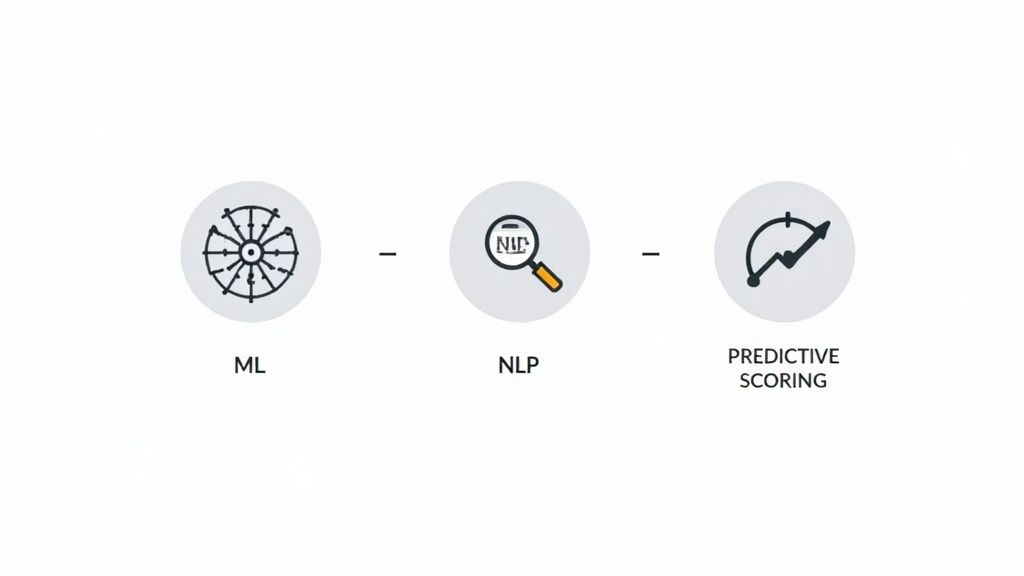
Think of these technologies as a specialized crew. Machine Learning is your strategist, Natural Language Processing is the listener, and Predictive Lead Scoring is the analyst pointing your sales team straight to the hottest opportunities.
Machine Learning: The Strategic Brain
At its heart, Machine Learning (ML) is the part of the system that learns from your data. It digs into past wins and losses—like every closed deal and dead-end opportunity in your CRM—to build an evolving picture of what your ideal customer actually looks like.
This isn't a static, one-and-done profile. ML algorithms constantly refine this model as new data flows in, making your targeting sharper over time. It’s the difference between a blurry photograph and a high-resolution map of your market that updates in real time.
- Practical Example: An ML model analyzes your top 100 customers and pinpoints common traits like company size, tech stack, or recent hiring trends. This creates a data-backed Ideal Customer Profile (ICP) that the AI then uses to automatically find and prioritize similar accounts.
Predictive Lead Scoring: The Opportunity Analyst
Traditional lead scoring relies on simple, manual rules that go stale almost immediately. Predictive Lead Scoring, on the other hand, uses AI to assign a score based on a lead’s actual likelihood to convert.
It looks at hundreds of signals at once—from how a prospect interacts with your website to third-party data showing they’re in a buying cycle. This lets your team zero in on the leads that matter most, slashing wasted effort and boosting efficiency.
This blend of internal data (like engagement) and external intelligence is what defines modern lead generation. AI systems sift through it all to predict intent, pushing the highest-potential leads to the front of the line and speeding up the entire deal cycle.
Natural Language Processing: The Active Listener
Natural Language Processing (NLP) gives AI the ability to understand human language. In lead generation, it acts as a powerful listening tool, scanning the digital world for conversations that signal a need for your solution.
NLP can analyze social media chatter, press releases, news articles, and forum discussions to find companies talking about the exact problems you solve. It uncovers opportunities you would never find manually.
Impact Opportunity: When you combine these technologies, lead generation stops being a reactive numbers game and becomes a proactive, precision-guided strategy. This leads directly to higher conversion rates, shorter sales cycles, and a more effective sales team.
The table below breaks down how each of these technologies translates into real-world business results.
AI Techniques in Lead Generation and Their Business Impact
| AI Technology | What It Does (Simplified) | Practical Example | Business Impact |
|---|---|---|---|
| Machine Learning (ML) | Learns from historical data (CRM, website) to identify patterns of successful customers. | Analyzes past closed-won deals to build a dynamic Ideal Customer Profile (ICP). | Higher-quality leads by focusing outreach on accounts that look like your best customers. |
| Predictive Lead Scoring | Uses hundreds of data points to rank leads by their probability to convert, not just activity. | A lead who visited the pricing page and whose company just received funding gets a score of 95. | Increased sales efficiency; reps spend time on leads ready to buy, not chasing cold trails. |
| Intent Data Analysis | Scours third-party web data to find accounts actively researching solutions like yours. | Identifies a target account that is suddenly reading competitor reviews and visiting industry forums. | Improved timing & conversion rates by engaging prospects at the peak of their interest. |
| Natural Language Processing (NLP) | Understands human language to extract meaning from text and speech. | Scans a press release to find a company announcing an expansion into a new market you serve. | Uncovers hidden opportunities that manual research would miss. |
| Automated Data Enrichment | Automatically finds and adds missing contact and company data to incomplete records. | A new lead signs up with just an email; the AI instantly adds their job title, company size, and location. | Saves countless hours of manual data entry and ensures your CRM is always accurate and actionable. |
Understanding these foundational pieces is the first step. For leaders looking to integrate these powerful tools, a structured AI enablement program can provide a clear roadmap from strategy to execution, ensuring you get it right the first time.
How a Modern AI Lead Generation System Works
Forget thinking of AI-powered lead generation as just another tool. It’s more like a sophisticated factory assembly line. Raw data goes in one end, gets processed by intelligent machinery, and emerges at the other end as a highly qualified, sales-ready opportunity—packaged and delivered to the right person at the perfect moment.
This end-to-end architecture is what separates a truly effective system from a pile of disconnected apps. The entire process breaks down into three core stages: Data Ingestion, AI Processing, and Activation. Each step builds on the last, creating a seamless flow that turns faint interest into real pipeline.
Key Takeaways
- It's a System, Not a Tool: Real AI lead generation is an end-to-end system with distinct stages for data collection, intelligent processing, and automated action. Disconnected tools can't match its speed or precision.
- Data Is the Fuel: The whole process is powered by high-quality data from your CRM, website, and other sources. Garbage in, garbage out—a messy CRM will always lead to messy results.
- AI Is the Engine: This is where the magic happens. The processing stage enriches records, scores intent, and segments leads with machine learning to identify the best opportunities.
- Activation Is the Payoff: The final stage connects those insights to action. It automatically triggers personalized outreach and alerts sales teams to hot opportunities in real time.
Stage 1: Data Ingestion
The journey starts by gathering the raw materials. The AI system plugs into your most critical data sources to build a unified, 360-degree view of your market.
- CRM Data: Your CRM is the bedrock. The AI pulls historical data on all your accounts, contacts, and deal outcomes—both wins and losses. This is the truth serum that teaches the machine learning models what a great lead actually looks like for your business.
- Website and Engagement Data: The system watches visitor behavior like a hawk—pages viewed, content downloaded, time on site. These are the real-time breadcrumbs that signal active interest.
- Third-Party Intent Data: It also pulls in signals from the wider web, like which companies are researching your competitors or reading up on topics directly related to your solution.
A clean, well-organized database is non-negotiable here. For businesses wrestling with data hygiene, a professional CRM implementation can be the difference-maker, ensuring your AI has the clean fuel it needs to run.
Stage 2: AI Processing
Once the data is collected, it’s sent to the AI processing core. This is where raw information gets refined and transformed into actionable intelligence.
- Data Enrichment: The AI instantly fills in the blanks. An incoming lead with just an email is automatically appended with a job title, company size, industry, and location. No more manual research.
- Predictive Scoring: Using the historical data from your CRM, the AI scores every new lead. It analyzes how closely they match your Ideal Customer Profile and how engaged they are. A score of 95 means "call them now," while a 35 means "add them to a nurture sequence."
- Segmentation: The system dynamically groups leads into hyper-specific segments. Think of buckets like "VPs of Operations in manufacturing who visited the pricing page in the last 48 hours."
Stage 3: Activation
The final stage is where intelligence meets action. Insights are worthless until they trigger a response, and the Activation layer connects the AI's brain to your sales and marketing channels' hands.
Impact Opportunity: This connected system obliterates the lag time between a prospect showing interest and a salesperson reaching out. By automating the handoff, you engage leads at the absolute peak of their interest, which dramatically increases response rates and shortens the entire sales cycle.
- Practical Example: Imagine a Director of Logistics from a target account visits your website and downloads a case study.
- Ingestion: The system captures the visit and form submission in milliseconds.
- Processing: It instantly enriches the contact record, confirms the visitor matches your ICP, and assigns a lead score of 92 based on their title and high-intent activity.
- Activation: The system automatically triggers two actions. First, it sends a personalized email from the assigned sales rep that references the case study. Second, it creates a high-priority task in the CRM for that rep to call within the hour.
This entire sequence unfolds in minutes, not days. That combination of speed and relevance is the significant advantage of a fully integrated AI-powered lead generation system.
Measuring Success and Calculating ROI
Adopting any new technology requires a clear-eyed view of its business impact. With AI-powered lead generation, moving beyond theory to tangible results is not just possible—it's essential. This means looking past surface-level numbers like lead volume and focusing on the metrics that truly define success and justify the investment.
To build a defensible business case, executives need a framework to prove the value of AI with hard data. It’s about connecting the dots between the technology and the bottom line.
Key Takeaways
- Go Beyond Volume: Success isn't about more leads; it's about better leads that convert faster and more efficiently. Focus on quality and velocity.
- CAC is Critical: Customer Acquisition Cost (CAC) is a primary metric for ROI. AI’s ability to reduce wasted effort on unqualified leads directly lowers this cost.
- Prove the Value: The ultimate goal is to create a clear, data-backed narrative showing how the upfront investment in AI is dwarfed by increased deal velocity and lower acquisition costs.
- Data Drives Justification: strong tracking and analytics are non-negotiable. You can't prove ROI without the right data infrastructure in place.
The Metrics That Truly Matter
To accurately measure the effectiveness of your AI strategy, you need to track KPIs that reflect the entire sales funnel, not just the top. These metrics reveal the true efficiency gains and revenue impact.
- Lead-to-Opportunity Conversion Rate: This is the ultimate test of lead quality. A high rate shows that the AI is correctly identifying prospects who are not just a good fit, but are ready for a sales conversation.
- Sales Cycle Length: How long does it take to turn a new lead into a closed-won deal? AI should shorten this by getting reps in front of high-intent buyers sooner.
- Customer Acquisition Cost (CAC): This metric totals all your sales and marketing costs over a period and divides it by the number of new customers. AI reduces CAC by automating manual tasks and eliminating wasted spend on low-quality leads.
Establishing a solid foundation for tracking these metrics is crucial. A well-configured system provides the necessary insights, and our services in reporting and analytics can help build that visibility.
A Practical ROI Calculation Example
Let's put this into practice with a hypothetical B2B SaaS company.
Before AI:
- Monthly Marketing/Sales Spend: $50,000
- New Customers per Month: 10
- Customer Acquisition Cost (CAC): $5,000 ($50,000 / 10)
- Average Sales Cycle: 90 days
The company invests in an AI platform for lead scoring and automated outreach, costing an additional $5,000 per month.
After AI (6 months later):
- Monthly Spend (including AI tool): $55,000
- New Customers per Month: 15 (AI improves lead quality and conversion)
- New Customer Acquisition Cost (CAC): $3,667 ($55,000 / 15)
- Average Sales Cycle: 60 days
Impact Opportunity: In this scenario, the company achieved a 27% reduction in CAC and shortened its sales cycle by 30 days. The investment in AI is not a cost center; it's a direct driver of efficiency and profitability, making the ROI clear and compelling for any stakeholder.
This process flow visualizes how AI takes raw inputs and turns them into activated, high-value opportunities.
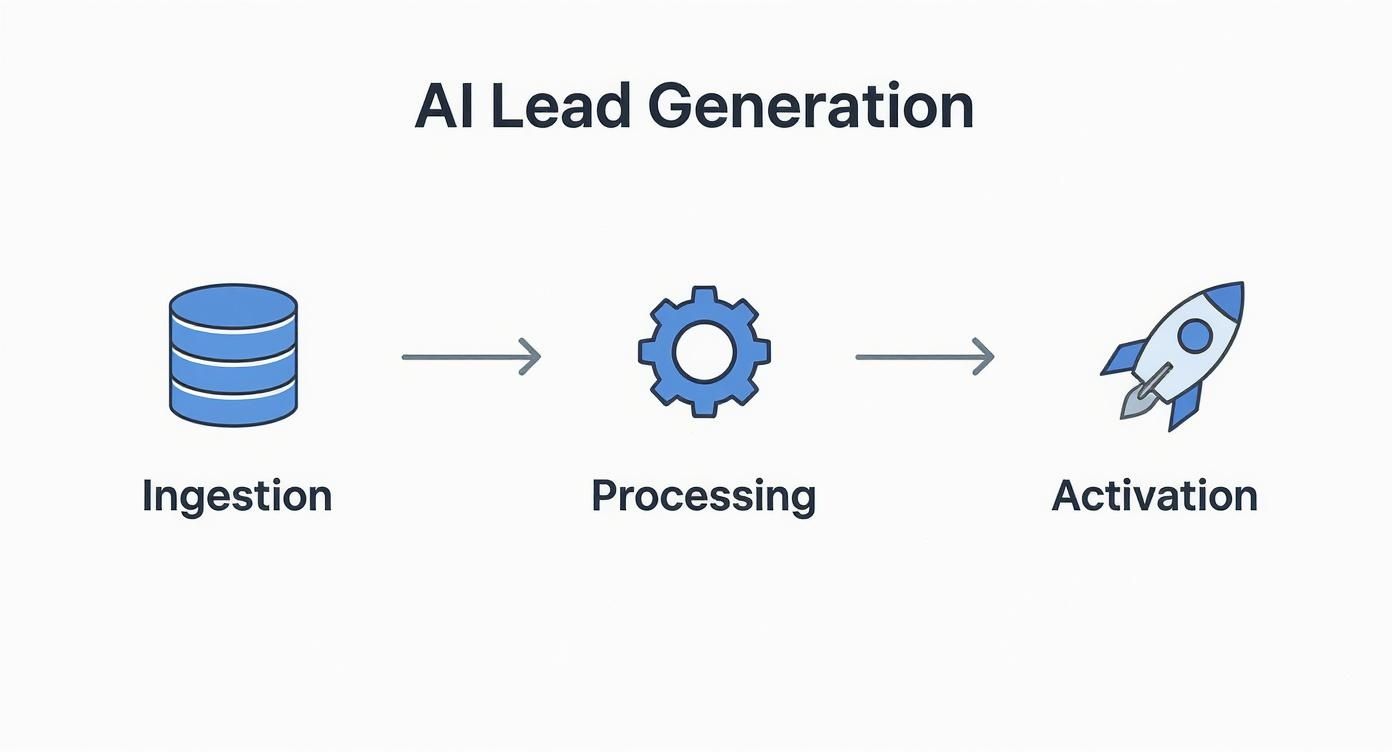
The visualization shows a simplified progression from data ingestion to intelligent processing and finally to sales activation, highlighting the system's efficiency.
The financial upside is significant. Market projections show the lead generation solutions market is expected to reach $21.43 billion by 2033. Companies deploying AI for lead generation often report a 50% increase in sales-ready leads and a 60% reduction in costs, confirming the massive potential for ROI. Discover more insights about lead generation trends on snov.io.
Your Roadmap to Implementing AI in Lead Generation
Moving to an AI-powered lead generation model feels like a huge undertaking, but it doesn't have to be. The key is a structured, phased approach that turns a complex project into a manageable journey. Think of it less as a giant leap and more as a series of deliberate steps that build on each other.
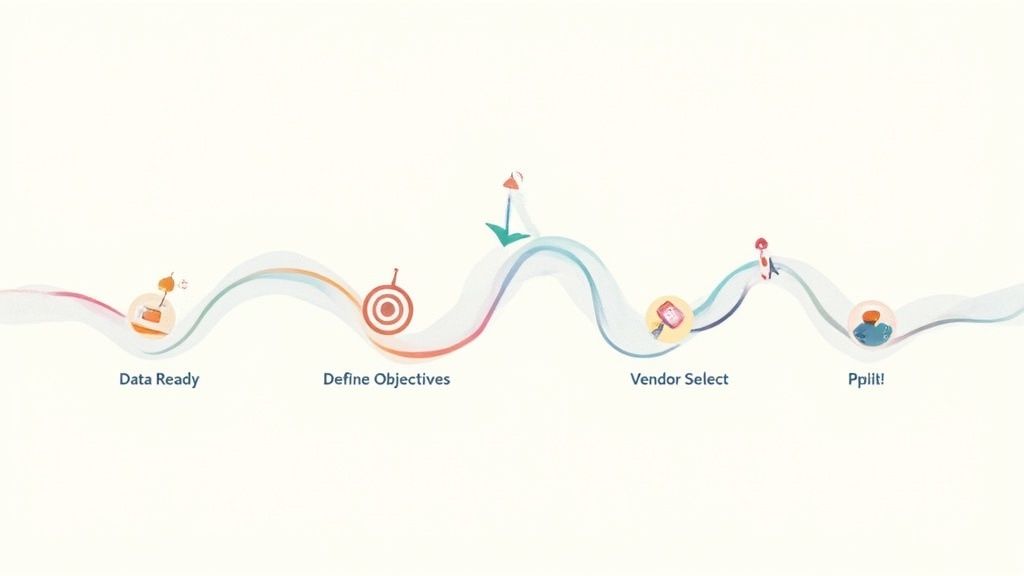
This roadmap breaks down the process into a clear sequence. By starting with a solid foundation and proving value early, you can build momentum and drive long-term success without overwhelming your team or your budget.
Key Takeaways
- Start with Data, Not Tools: The success of any AI initiative hinges on your existing data. The "garbage in, garbage out" rule is non-negotiable—a clean CRM is your first priority.
- Define a Specific Problem: Don't chase AI for the sake of it. Pinpoint a clear, measurable business problem you need to solve, like shortening the sales cycle or boosting lead-to-opportunity conversions.
- Pilot, Prove, and Scale: Begin with a small, focused pilot project to demonstrate value quickly. A quick win builds buy-in and makes the business case for wider integration undeniable.
- Vendor Selection is Strategic: Choose a partner or platform that solves your specific problem and can grow with you. Avoid shiny objects that don't address your core needs.
Phase 1: Foundational Readiness
Before you even glance at an AI tool, you have to get your own house in order. This foundational work is the most critical stage and sets the tone for everything that comes next.
Step 1: Achieve Data Readiness Your CRM is the lifeblood of your AI system. If it’s clogged with incomplete, outdated, or duplicate records, your AI will spit out flawed predictions. It's that simple.
- Practical Example: A manufacturing company wants to use AI to score leads, but their CRM is a mess of inconsistent industry data and contacts with no job titles. The AI can’t build an accurate profile, so it prioritizes the wrong leads, and the sales team wastes its time. They first have to run a data cleansing project to standardize fields and enrich records.
Step 2: Define Clear Objectives What specific pain point are you trying to fix? Vague goals like "improve lead gen" won't cut it. You have to get specific.
Impact Opportunity: By defining a narrow, measurable goal—like "reduce lead qualification time by 50%"—you create a clear benchmark for success. This makes it infinitely easier to prove ROI and secure support for future AI initiatives.
Phase 2: Pilot and Selection
With a clean data foundation and clear goals, you’re ready for the testing phase. This is where you prove the concept on a small scale.
Step 3: Choose the Right Vendor Not all AI platforms are built the same. Some excel at lead scoring, while others are great at automated outreach. Pick a vendor whose strengths directly address the problem you defined earlier. Look for partners who understand your business, not just their technology.
Step 4: Pilot and Prove Value Launch a small pilot project with a limited scope and a dedicated team. The goal here is simple: get a quick win that proves the potential of AI-powered lead generation.
- Practical Example: A B2B software firm pilots an AI lead scoring tool on a single product line. After one quarter, they compare the conversion rates of AI-qualified leads against manually qualified ones. When the AI-scored leads convert at a 30% higher rate, they have a powerful, data-backed case to scale the solution across the entire organization.
Phase 3: Scaling and Integration
Once the pilot proves successful, it's time to expand. This final phase is all about rolling out the technology to the wider team and embedding it into your daily operations. This involves thorough team training, integrating the AI tool with your existing tech stack, and constantly monitoring performance to optimize results. This methodical expansion ensures the technology isn't just adopted, but truly operationalized for sustained growth.
Common Pitfalls and How to Avoid Them
Jumping into AI-powered lead generation has incredible upside, but the path isn't always a straight line. The smartest first step is knowing where others have stumbled. Acknowledging these hurdles prepares your team to navigate them, making sure your investment delivers real returns instead of just frustration.
The most common—and most damaging—pitfall is poor data quality. The old "garbage in, garbage out" mantra has never been more true. If your CRM is a mess of incomplete records, duplicate entries, and inconsistent data, your AI models will learn all the wrong lessons and spit out flawed insights.
Key Takeaways
- Data Quality is Everything: The success of any AI tool is chained directly to the quality of the data it consumes. A "clean house" approach to your CRM isn't just a good idea; it's the most critical first step.
- Set Expectations and Get Buy-In: AI is a powerful tool, not a magic wand. You need to set realistic goals and get your sales team involved from day one. This avoids resistance and ensures people actually use the tool.
- Be Proactive, Not Reactive: Don't wait for problems to pop up. Tackle data hygiene, team alignment, and strategic goals before you even look at vendors. This is how you sidestep the most common implementation failures.
The Peril of Unrealistic Expectations
Another classic mistake is expecting too much, too soon. Leaders sometimes see AI as a silver bullet that will magically triple their pipeline overnight. This mindset completely ignores the reality: AI needs to be tuned, trained, and woven into your existing workflows before it can really shine.
When the tool doesn't deliver instant miracles, disappointment kicks in, and the whole project gets branded a failure. It's vital to treat AI implementation as a strategic initiative, not just another software purchase.
- Practical Example: A company bought a pricey AI platform but couldn't get it off the ground. Their CRM data was a disaster, which led to terrible lead scoring. Worse, the sales team was never consulted, so they saw the tool as a threat, not a help. They flat-out refused to use it, and the project was scrapped in less than six months.
Impact Opportunity: Building trust with your team means being honest about the challenges. When you get ahead of issues like data hygiene and team buy-in, you give your organization the foresight to handle obstacles and make sure your AI investment actually pays off.
Avoiding Failure with Proactive Steps
The good news? These pitfalls are completely avoidable with a little planning. Before you spend a single dollar on an AI platform, get your fundamentals in order.
- Run a Data Cleansing Project: Start with a full audit of your CRM. Standardize your fields, merge all the duplicates, and enrich any records that are missing key information. It's tedious work up front, but it pays off massively down the road.
- Bring the Sales Team in Early: Your sales reps are the ones who will live in this tool every day. Get them involved in the vendor selection process to make sure it solves their actual problems. This builds a sense of ownership and drives adoption through the roof.
- Set Clear, Phased Goals: Don't try to boil the ocean. Start with a specific, measurable pilot project. A goal like, "Increase our lead-to-opportunity conversion rate by 10% in Q3" is far more powerful than a vague objective.
Taking these steps builds a rock-solid foundation for success. The data backs this up: companies that get this right see conversion rates jump by around 25% and cut down on manual work by over 15%. That frees up your team to focus on what they do best. Learn more about the impact of AI on business statistics at Exploding Topics.
Common Questions About AI Lead Generation
If you're exploring AI-powered lead generation, you probably have a few practical questions. Let's tackle the big ones that come up when we talk to growth leaders about strategy, team impact, and compliance.
How Much Do AI Lead Generation Tools Cost?
Pricing for AI tools isn't one-size-fits-all. You’ll generally find a few different models, and the right one depends entirely on how you work.
- Per-Seat Pricing: You pay a flat fee for each user on your team. This model is straightforward and common for platforms where individual rep activity drives everything.
- Usage-Based Pricing: Here, cost is tied to consumption—think number of contacts enriched or emails sent. It’s a great way to start small and scale your investment as you see results.
- Platform Fees: This is a subscription for access to the whole toolkit. You'll often see different tiers that unlock more advanced features as your strategy matures.
Will AI Replace My Sales Development Team?
This is the question on every sales leader’s mind, and the answer is a firm no. AI doesn’t replace Sales Development Representatives (SDRs); it makes them better, faster, and more strategic.
Impact Opportunity: AI handles the frustrating, repetitive work that burns out good reps—all the manual research, data entry, and sorting through low-quality leads. This frees them up to do what people do best: build real relationships, have insightful conversations, and navigate complex deals. Think of AI as the ultimate assistant, not a replacement.
How Do I Keep Our AI Use Compliant with Regulations?
Data privacy is non-negotiable, especially with regulations like GDPR and CCPA. Getting this right from the start is critical and requires a proactive mindset.
Your focus should be on two key areas:
- Vet Your Vendors: Partner with tech companies that built their platforms with data privacy at the core. They should be able to clearly demonstrate how they maintain compliance.
- Stick to Ethical Data: Build your AI strategy around first-party data (information you collect directly from your audience) and publicly available information. Stay far away from sketchy third-party lists.
Ready to move from manual lead generation to a scalable revenue system? At Prometheus Agency, we build ROI-focused AI roadmaps that work. Book your complimentary Growth Audit and AI strategy session today.
Article created using Outrank