Your Monday forecast meeting starts badly. Marketing is celebrating a healthy MQL count, sales is dismissing those leads as unusable, and the CRM dashboard shows a pipeline number that doesn't match the board deck. Customer success has a separate view of what was promised to active accounts. The CEO asks for a confident forecast, and nobody can explain which number deserves trust.
That situation doesn't call for another dashboard. It calls for revenue operations consulting, the discipline of connecting marketing, sales, customer success, data, processes, and technology around one commercial operating model. The work is practical: clarify ownership, repair handoffs, establish reliable definitions, measure the right outcomes, and only then change the stack.
This guide focuses on the decisions that determine whether a RevOps engagement creates business value. You'll see what consultants change, which services matter, how AI should be introduced, how engagement models differ, what measurement must exist before scaling, and which questions expose a tool reseller. You'll also get practical examples, an impact opportunity framework, and a checklist you can use before the first vendor call.
The Moment a Growth Leader Calls a RevOps Consultant
The call usually happens after a familiar operating meeting. Marketing says it generated demand. Sales says the demand was poorly qualified. Operations says the CRM fields are incomplete. Finance says the forecast cannot support a hiring or investment decision. Everyone has activity to report, but nobody can connect that activity to reliable revenue outcomes.
The problem isn't that each department is incompetent. The company grew faster than its connective tissue. A manufacturer may have a capable CRM, a separate marketing platform, spreadsheets for account planning, and customer information trapped in service records. A middle-market B2B company may have talented people doing the right work inside workflows nobody else can see.
A consultant enters this situation to make the commercial system inspectable and manageable.
Operator's test: If leaders can't agree on what a qualified lead, active opportunity, sales stage, or forecast category means, they aren't ready to buy more automation.
A serious engagement begins with the current operating model, not a product demonstration. The consultant maps how demand enters, who owns it, how records move between teams, what managers inspect, where data decays, and which decisions depend on unreliable reports. The resulting work may include CRM changes, but CRM configuration is only one component.
Executives should expect clarity on four points before signing:
- The problem being fixed: Is the priority forecast reliability, lead response, pipeline quality, customer retention, or a broader operating-model rebuild?
- The evidence required: What baseline will exist before changes, and which result would justify further investment?
- The ownership model: Who maintains definitions, approves exceptions, and enforces adoption after launch?
- The exit condition: What will the internal team be able to operate without the consultant?
A capability discussion can help sales leaders prepare for this conversation, including the SE team capability call from PreSales Unleashed GmbH. Use it as a prompt to examine whether your team has the operating capacity to absorb new processes, not as a substitute for diagnosis.
What Revenue Operations Consulting Actually Changes
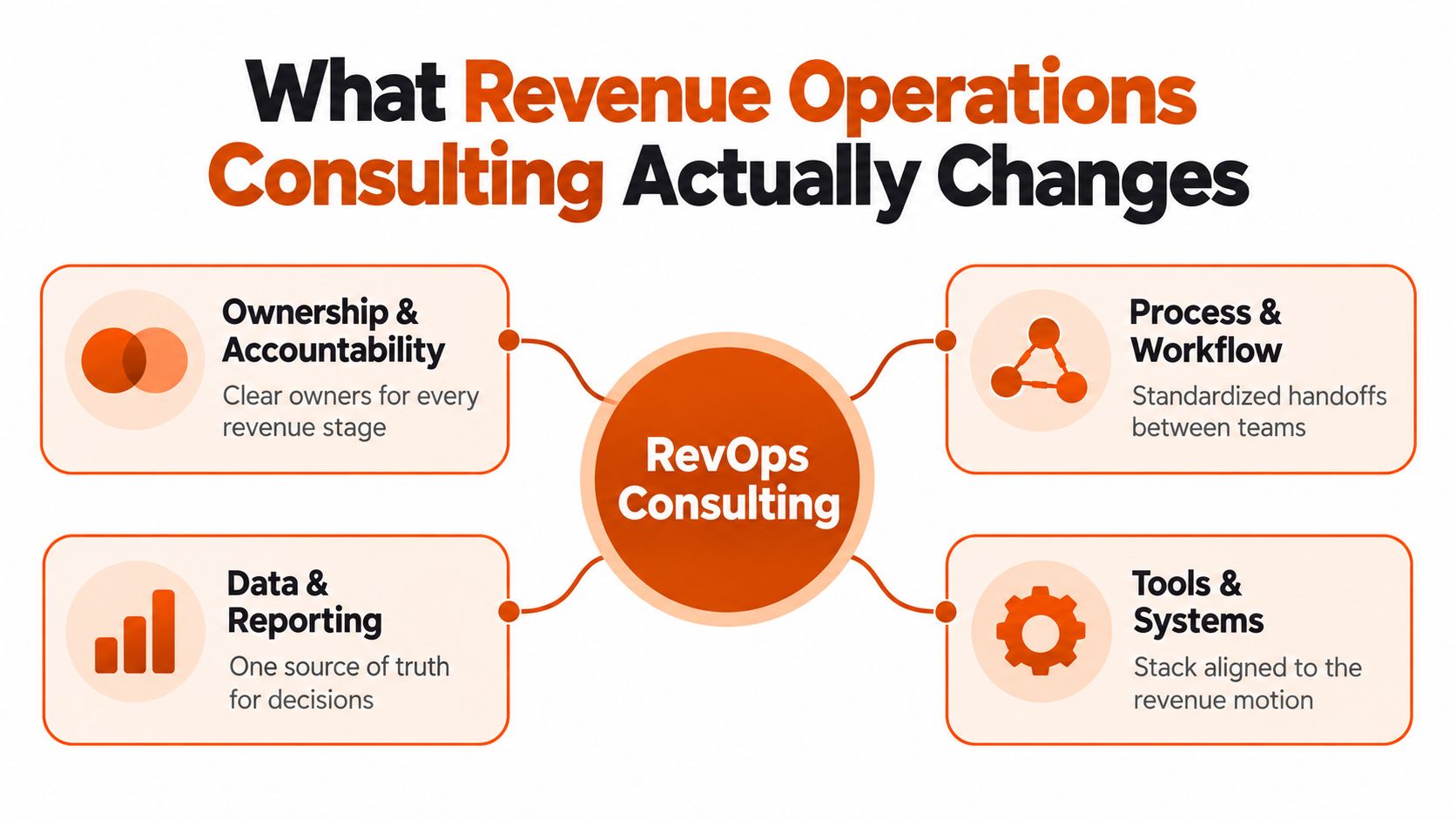
Revenue operations consulting changes the joints between commercial functions. Think of a building's plumbing. Every fixture may work, but pressure drops at the connections. In a revenue organization, the fixtures are campaigns, sales activities, customer handoffs, reports, and tools. The joints are ownership rules, lifecycle definitions, data contracts, and workflow triggers.
Ownership and accountability
Every revenue stage needs a named owner and an escalation path. That includes who accepts an inbound lead, who qualifies an account, who advances an opportunity, who confirms implementation expectations, and who takes responsibility when a record sits untouched. Shared responsibility often means no one acts.
Process and workflow
The consultant documents how work should move, then tests whether systems enforce that movement. A lead-routing process might assign by territory, segment, or account ownership. A customer handoff might require a structured summary before implementation begins. The point isn't documentation for its own sake. The point is to make the intended behavior repeatable and visible.
Data and reporting
A useful data contract defines required fields, accepted values, update timing, and the person responsible for correction. Reports then use consistent stage definitions instead of each department building its own interpretation of the funnel.
Tools and systems
Technology should support the revenue motion already chosen. A consultant may retain the existing CRM, simplify the stack, connect systems, or recommend a migration. The decision follows workflow and data requirements, not a vendor's preferred implementation pattern.
Gartner projects that by 2026, 75% of the highest-growth companies will adopt a RevOps model, compared with fewer than 30% at the time of the forecast, redefining consulting work away from tool deployment toward operating-model transformation, as described in Gartner's overview of revenue operations.
For teams building or restructuring outbound capacity, guidance on scaling SDRs effectively can complement the operating-model work. It becomes useful only when routing, qualification, account ownership, and performance definitions are already clear.
Any consultant worth hiring should map the current operating model before recommending a tool change. If the first workshop is a product demo, the sequence is backwards.
Core Services a RevOps Consultant Delivers
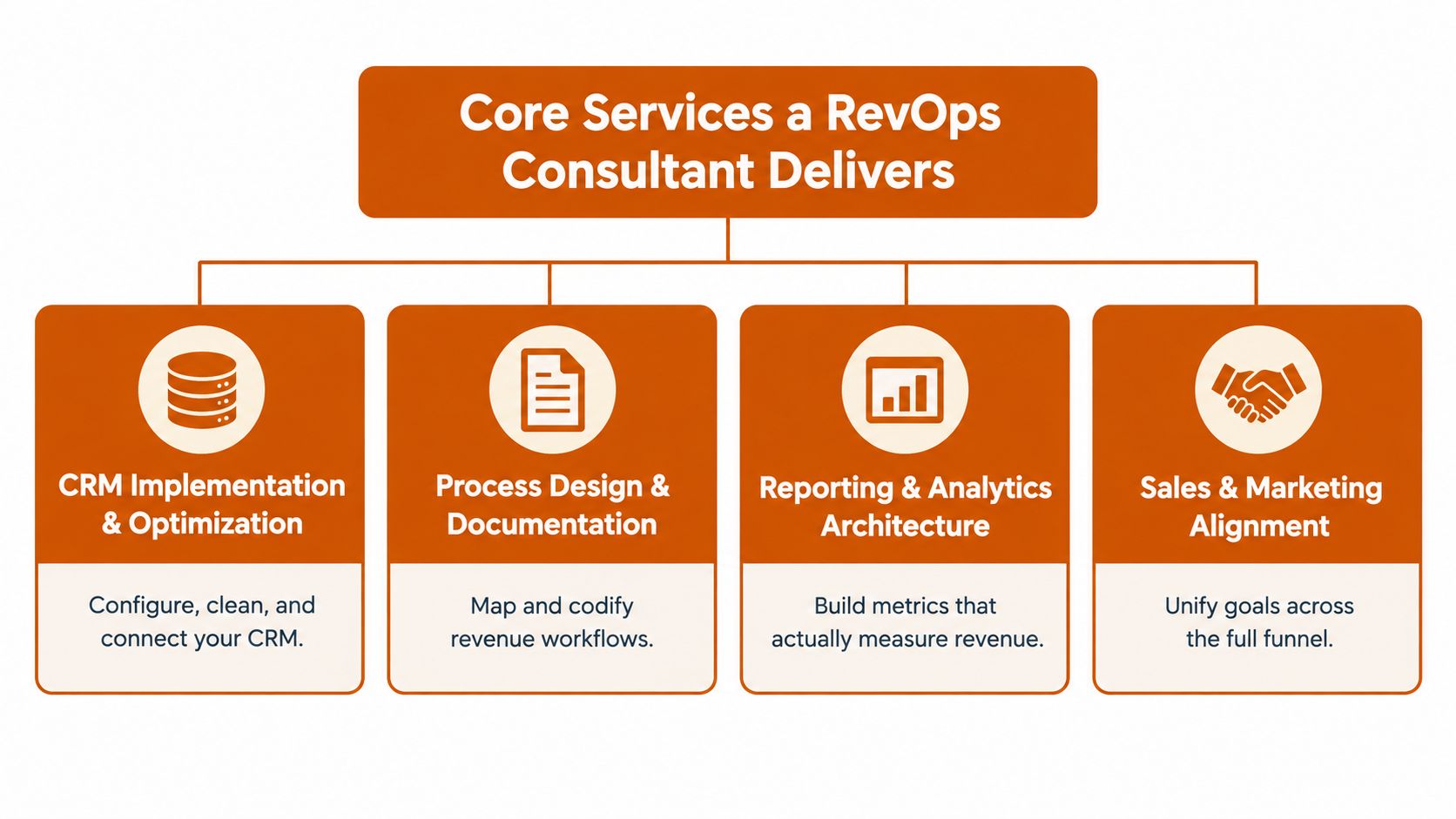
Most engagements combine four service pillars. They shouldn't be purchased as isolated workstreams because a clean CRM with a broken handoff still produces poor revenue execution.
CRM implementation and optimization
The consultant audits objects, fields, lifecycle stages, integrations, permissions, automation, and adoption. A forecast problem often starts with opportunities that lack a defined close date, contain stale next steps, or advance stages without evidence. The fix may be field validation, stage exit criteria, deduplication, or a redesigned forecast view.
For example, a manufacturing company might discover that sales representatives use different account names for the same customer across regions. The consultant can normalize identifiers, define account ownership, and connect opportunity records to a common account structure. That improves inspection because managers are no longer reconciling preventable record differences.
Process design and documentation
Process work converts tribal knowledge into enforceable workflows. A lead-routing redesign might assign a form submission immediately, create a task with a service-level agreement, and escalate an unaccepted record to a manager. The consultant then measures whether the rule works and investigates exceptions caused by missing territory data, duplicate contacts, or unclear qualification.
Reporting and analytics architecture
Executive reporting should begin with decisions, not available fields. A useful scorecard can connect stage movement, qualified opportunity creation, conversion, sales-cycle duration, retention, margin, and customer-acquisition cost. It should also distinguish data quality from commercial performance, so leaders know whether a disappointing result reflects weak demand or weak record capture.
Go-to-market alignment
Alignment requires more than putting marketing and sales in the same meeting. A consultant may refresh the Ideal Customer Profile, redefine qualification, revise account segments, and connect campaign investment to the accounts sales can serve. If customer success reports recurring mismatch between sold expectations and delivered outcomes, the process must include that evidence too.
Companies with mature RevOps functions are about twice as likely to exceed revenue targets and more than twice as likely to beat profit goals than organizations operating with siloed commercial teams, according to ZoomInfo's summary of revenue operations research.
The practical test is whether each pillar reinforces the others. A team structure discussion such as revenue operations team structure is useful when it clarifies who owns these decisions after implementation. Without that ownership, the consultant may deliver a polished system that slowly returns to fragmented behavior.
Where AI Belongs Inside a RevOps Engagement
AI belongs inside a workflow that already has a measurable purpose. It shouldn't arrive as a chatbot, a generic scoring layer, or a dashboard that creates more signals for representatives to interpret.
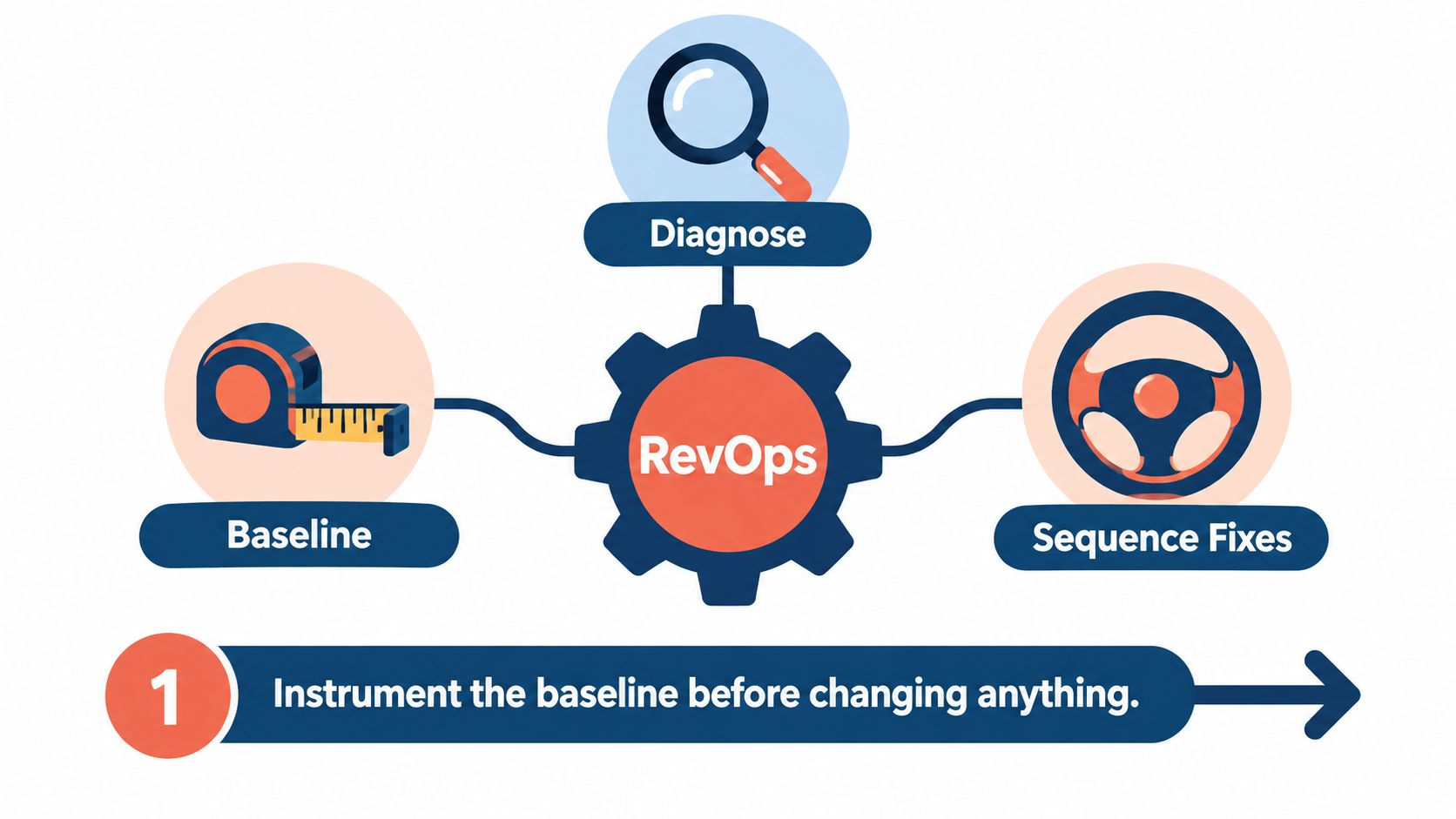
Start with one bottleneck. Account research, qualification, renewal risk, or next-best-action selection can all work, but the intervention needs a defined before-and-after measure. Capture baseline cycle time, conversion, human effort, and cost-to-serve. Then deploy AI with approval controls and compare the results with a control cohort or a comparable group that hasn't received the intervention.
Consider an account-research workflow. The system assembles firmographic information, recent activity, relevant contacts, and known opportunity context inside the CRM. The representative reviews the summary, corrects errors, and approves the recommended action. The useful output isn't an AI-generated brief by itself. It's more qualified preparation time converted into better customer conversations, with the CRM recording what happened next.
McKinsey reports that growth leaders embedding AI into core B2B workflows most often cite seller efficiency at 59% and improved customer experience at 53% as primary benefits. In financial-services examples, workflow rewiring with agentic AI achieved 3–15% higher revenue per relationship manager and 20–40% lower cost-to-serve ratios, as reported in McKinsey's analysis of AI in B2B sales.
A practical RevOps AI stack should connect CRM entities, activity data, pipeline movement, conversion outcomes, and next-best-action logic. Guidance on what a RevOps AI stack includes is most useful when it helps map those connections to a specific workflow rather than encouraging tool accumulation.
A short visual explanation can help teams align on the sequence before building:
Keep a human checkpoint wherever the action affects customer trust, pricing, qualification, or account prioritization. AI can recommend and accelerate. It shouldn't redefine the commercial rules that people are accountable for.
Engagement Models and How to Choose One
The right engagement depends on whether you need an outside diagnosis, a rebuilt operating model, or disciplined execution inside an existing strategy.
| Dimension | Diagnostic Audit | Transformation Program | Embedded RevOps Leader |
|---|---|---|---|
| Time to first insight | Fast, focused assessment | Early findings followed by staged delivery | Immediate operational visibility |
| Depth of change | Prioritized diagnosis and backlog | Cross-functional redesign and implementation | Ongoing execution and adoption |
| Cost structure | Fixed scope and deliverable | Milestone-based or program investment | Recurring fee tied to time and responsibility |
| Accountability | Consultant owns the assessment | Shared ownership across workstreams | Embedded leader owns operating cadence |
| Best fit | CEO needs an outside read | Operating model needs rebuilding | Strategy exists but execution is inconsistent |
Diagnostic audit
Choose an audit when leadership knows the system is underperforming but doesn't yet know why. The deliverable should include stakeholder findings, data-quality observations, workflow maps, priority risks, an impact opportunity model, and a sequenced backlog. A focused audit can be completed in a short engagement, but don't accept a document that only lists tool deficiencies.
Transformation program
Choose transformation when handoffs, definitions, reporting, and systems all need to change together. Expect milestones covering diagnosis, design, implementation, enablement, and measurement. This model suits companies whose commercial complexity has outgrown the original process.
Embedded leadership
Choose an embedded or fractional RevOps leader when the strategy is sound but execution discipline is missing. This person runs operating reviews, manages backlog decisions, enforces data standards, coordinates teams, and helps internal staff adopt the model. The value comes from continuity and decision ownership, not just extra hands.
Pricing varies widely because scope, stack complexity, data condition, and accountability vary widely. A low-cost proposal may be efficient, or it may omit the governance and measurement work that makes the change durable. Ask what the consultant will not do, then compare the answer with the risk you're trying to remove.
Proving the Investment Actually Moves Revenue
More activity doesn't equal more revenue. A team can create more tasks, automate more messages, and produce more dashboards while qualified pipeline, retention, and margin remain unchanged.
Bain's 2025 survey of more than 1,200 senior commercial executives found that over 80% of companies claimed structured sales and marketing plays, yet 70% failed to integrate those plays into their technology, and only about 20% realized the technology's full value, according to Bain's survey findings.
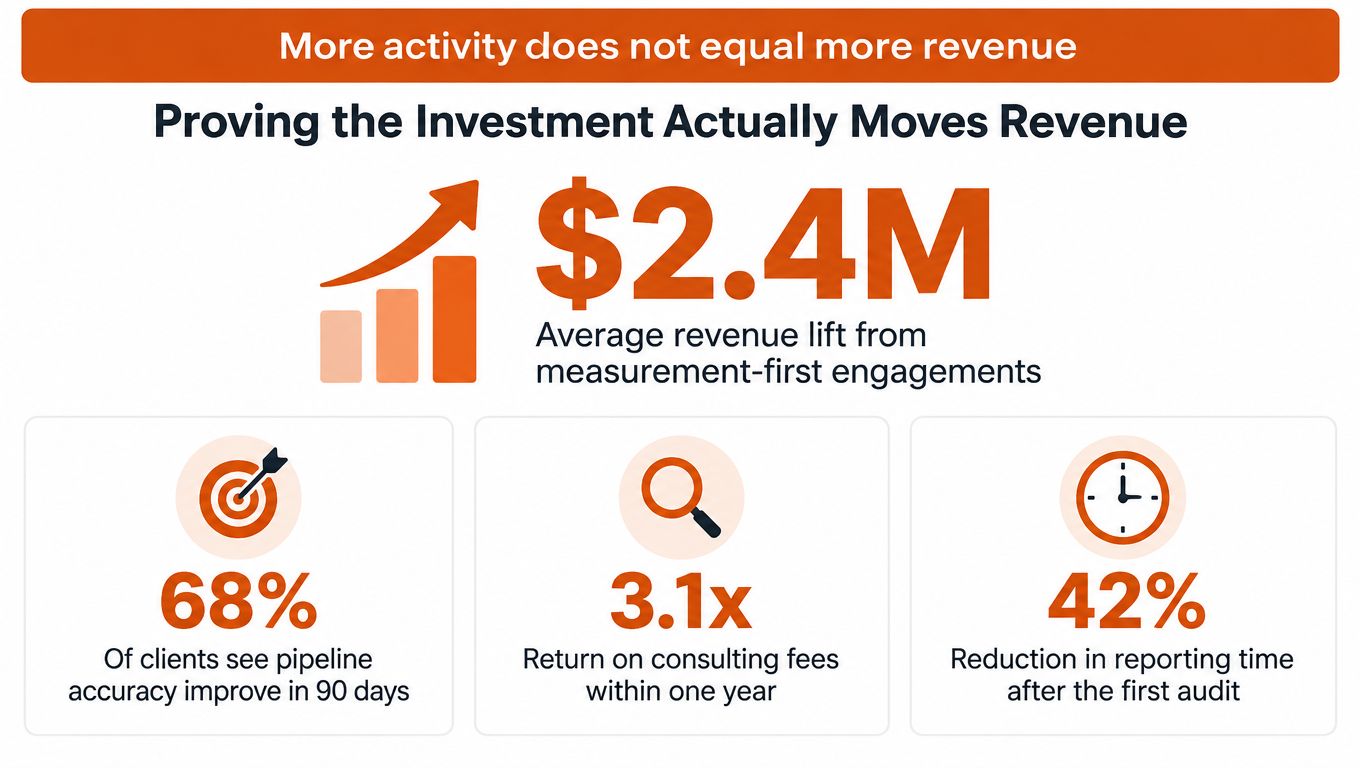
The first deliverable should therefore be a measurement architecture, not a CRM roadmap.
Build the baseline before changing the workflow
Capture the current state of the bottleneck. For speed-to-lead, record inquiry time, first attempted human contact, response band, qualification outcome, opportunity creation, and pipeline value. For forecasting, record stage definitions, inspection frequency, forecast category, actual outcome, and the source of each number.
Use controls and state attribution limits
Compare the pilot group with a control cohort or a comparable historical group. Document factors that could influence the result, including seasonality, campaign mix, territory changes, staffing, and pricing. A consultant should be able to say what the measurement can prove and what it cannot.
Set executive scorecards and kill criteria
A scorecard should connect operational changes to conversion rate, sales-cycle duration, pipeline quality, retention, margin, and customer-acquisition cost. Kill criteria protect the business from funding an intervention that produces activity without economic value. Examples include failing to improve a defined conversion measure, creating unacceptable data errors, or increasing representative workload without a corresponding commercial result.
A measurement-first pilot might compare promptly routed leads with delayed leads, then report qualified pipeline created per response-time band. The point isn't to claim that every company will produce the same lift. The point is to show executives exactly how the intervention changed the economics of the funnel.
Only about one in eight revenue leaders connected AI usage to pipeline growth or improved conversion, while 45% did not know their customer-acquisition cost, according to the benchmark described in Bain's research context above. A RevOps maturity scorecard can help structure the baseline, but the internal team still needs to own the definitions and decisions.
How to Evaluate and Select the Right Partner
A CEO comparing two proposals should ignore the opening slide and start the interview with questions. One firm may lead with a CRM migration plan. The other may spend the first meeting asking how pipeline stages are defined, who owns lead acceptance, and how the board forecast is assembled. The second firm is doing the more valuable work, even if its proposal looks less technologically impressive.
Ask these questions:
- What will you change in our operating model, beyond configuring the CRM?
- What baseline will you capture before recommending tools or automation?
- What measurement deliverable will we have by week four?
- Who owns data quality, handoffs, exceptions, and adoption after launch?
- Which people will do the work, and how much senior operator time is included?
- What happens when the engagement ends?
- What result would make you stop, change, or cancel a proposed intervention?
A strong partner answers with workflows, owners, evidence, and trade-offs. A weak one responds with a product catalog, a generic maturity model, or a promise to “align the teams” without defining the operating mechanisms.
The governance gap deserves special attention. A 2025 survey of 534 B2B marketing professionals found that only 11% reported full alignment with sales, while 63% had no formal process for collecting sales input on buyer identification, according to the survey reported by Martech. Your partner should explain how frontline feedback enters the process, who resolves disagreements, and which adoption thresholds trigger escalation.
Red flags that should end the conversation
- Product-first selling: The consultant recommends a platform before understanding the commercial motion.
- Metric avoidance: The proposal promises efficiency but names no baseline, target, control group, or kill criterion.
- Implementation before diagnosis: The team presents a build plan without inspecting data, workflows, and ownership.
- No post-launch model: The consultant treats training as completion and can't explain the 30-, 60-, and 90-day operating cadence.
- Senior-leader substitution: The person who sells the work disappears after the contract is signed.
The right partner behaves like an operator first and a vendor second. Chemistry matters because the engagement will expose uncomfortable facts about ownership, performance, and leadership habits.
Roadmaps Timelines and a Practical Starting Checklist
A credible roadmap moves from diagnosis to foundation, then from controlled transformation to governance. Each phase needs a measurable outcome, not just a list of activities.
Two to four weeks for diagnosis
The consultant audits CRM data, workflows, integrations, reporting, handoffs, and commercial definitions. The output should be a written operating-model assessment, a prioritized backlog, baseline metrics, named owners, and an impact opportunity hypothesis.
Pressure-test the proposal: Can leadership see which problem gets fixed first and why?
Sixty to ninety days for the foundation
This phase should ship the changes that make the system usable: CRM cleanup, lifecycle and stage definitions, lead routing, ownership rules, required fields, escalation paths, and an executive scorecard. The outcome is not a perfect stack. It's reliable visibility into the revenue-critical workflow.
Three to six months for transformation
Once the foundation holds, add carefully selected AI pilots, account-prioritization logic, workflow automation, customer handoff improvements, and go-to-market alignment. Each pilot should have a baseline, a control or comparison group, human approval rules, and an explicit scaling decision.
Twelve months for governance
Governance turns a project into an operating capability. Establish adoption reviews, audit thresholds, exception handling, feedback loops, and escalation paths. Review whether teams maintain definitions, whether records meet quality standards, and whether the intervention still improves commercial outcomes.
Speed-to-lead deserves immediate attention. Research cited by sales-operations sources indicates that contacting an inbound lead within five minutes makes the lead 21 times more likely to qualify, while average B2B response time is reported at roughly 42 hours, as summarized by RevenueTools' sales operations metrics. Treat that as a benchmark to validate against your own CRM, then instrument the timestamp and ownership chain.
Use this checklist on your next operating day:
- Audit CRM data quality: Check completeness, duplicates, stale records, required fields, and stage evidence.
- Measure response latency: Separate inquiry time, assignment time, first attempted contact, and genuine human engagement.
- Define revenue-critical KPIs: Include conversion, sales-cycle duration, pipeline quality, retention, margin, and customer-acquisition cost.
- Name post-launch owners: Assign responsibility for data contracts, handoffs, exceptions, reporting, and adoption.
- Book a complimentary growth audit: Bring the current forecast, funnel definitions, routing rules, and the last leadership scorecard.
A measurement-first RevOps engagement gives executives a defensible reason to scale, change, or stop an intervention. That's the standard to demand before approving another tool.
Prometheus Agency helps growth leaders audit CRM systems, redesign revenue workflows, implement integrations, and prove AI and RevOps investments through measurable pilots. Visit Prometheus Agency to book a complimentary Growth Audit and AI strategy session for your commercial operation.