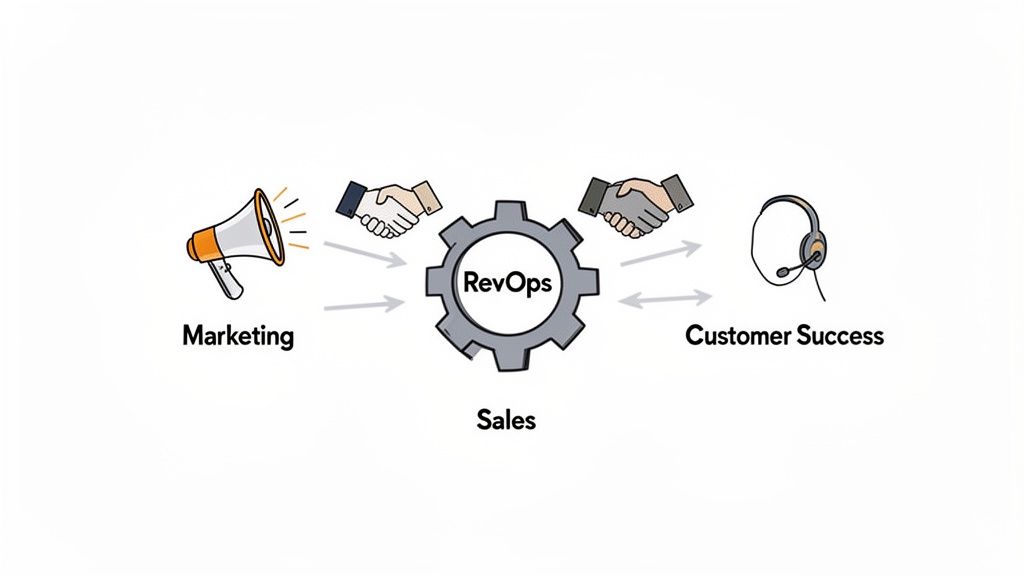
Your revenue operations team structure isn't a static org chart you draw up once and forget. Think of it as the central nervous system for your entire go-to-market engine, designed to connect marketing, sales, and customer success into one cohesive, growth-driving force.
The structure has to evolve right alongside your company, especially as your Annual Recurring Revenue (ARR) climbs. Its real job is to get your people, processes, and tech all speaking the same language across the entire customer journey.
Key Takeaways:
- A RevOps team structure is not static; it must evolve with company growth (specifically ARR).
- The primary function of RevOps is to align people, processes, and technology across the entire go-to-market function (Marketing, Sales, Customer Success).
- Effective RevOps breaks down data silos and smooths the customer journey from the first touchpoint to renewal.
The Blueprint for a High-Growth RevOps Team Structure
Building a true RevOps function is a major upgrade from having isolated ops roles buried in sales or marketing. You're creating a single, unified team that owns the entire revenue process from start to finish. The goal is total strategic alignment.
Without it, you get what most growing companies have: messy data silos, clunky handoffs between teams, and friction that kills deals and frustrates customers. A solid RevOps blueprint ensures that from the very first marketing touchpoint to a final customer renewal, the experience is smooth and the data is clean.
How RevOps Scales With Your Company
The needs of a small startup are worlds away from those of a mid-market player, and your RevOps team should reflect that reality. The team's size and specialization should be a direct mirror of your growth stage.
- Early Stage (<$10M ARR): You start with one person—a versatile RevOps generalist who can do a bit of everything. They’re busy setting up the basics: cleaning up the CRM, building the first few dashboards, and just trying to map out the entire lead-to-cash process. Their primary win is creating a single source of truth.
- Growth Stage ($10M-$50M ARR): The team starts to specialize. This is when you hire an analyst to dig deeper into the data and a systems specialist to tame your growing tech stack. The focus shifts from just building the foundation to actually optimizing and scaling what you've got.
- Enterprise Stage ($50M+ ARR): Now the structure gets more sophisticated. You’ll have dedicated leads for things like enablement, systems architecture, and data insights. At this point, RevOps is driving major strategic projects, like building advanced lead scoring models or redesigning sales territories.
This timeline gives you a great visual for how a RevOps team typically grows as a company's revenue scales.
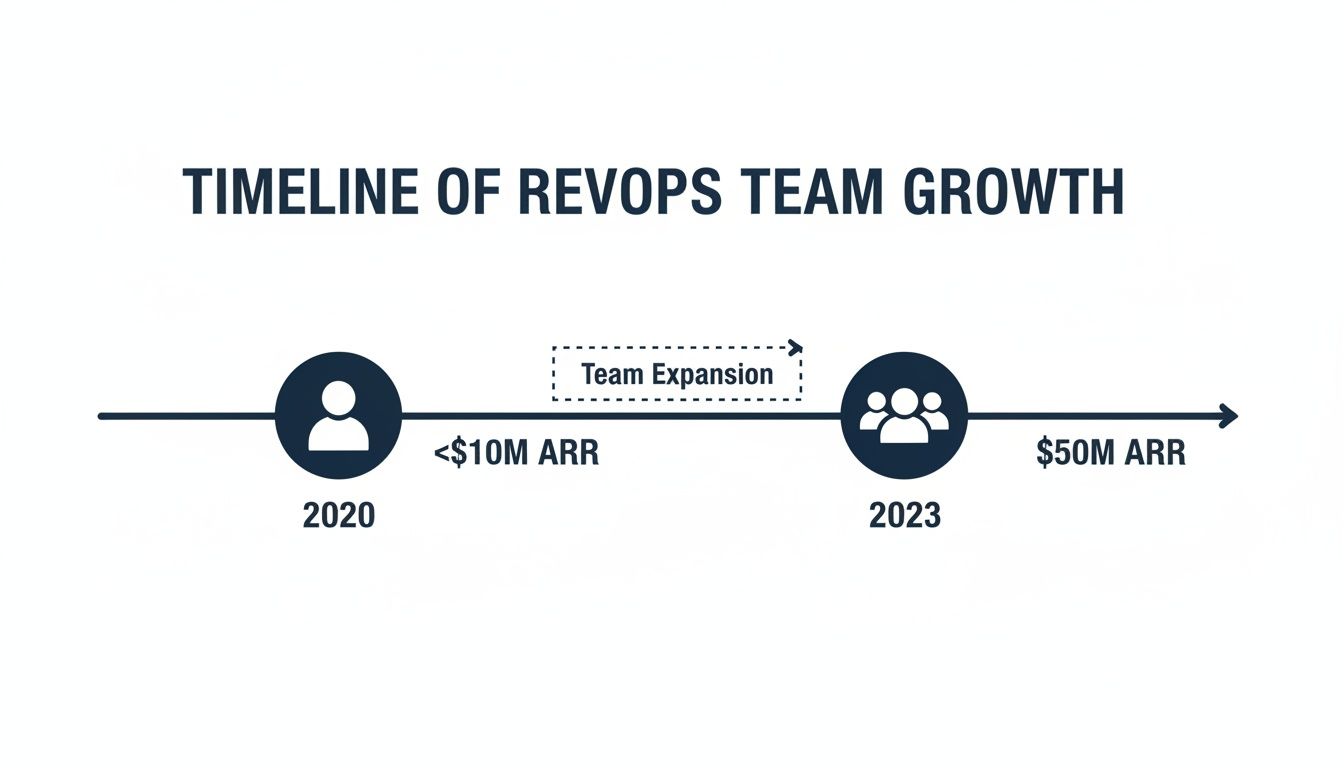
As you can see, headcount and specialization are tied directly to revenue milestones. This ensures your operational support is always keeping pace with the demands of the commercial teams.
RevOps Team Structure by Company Stage and ARR
To make this even clearer, here's a quick reference table breaking down how RevOps teams typically evolve with company growth. It connects the dots between ARR, headcount, and the kind of impact you should expect at each stage.
| Company Stage (ARR) | Typical RevOps Headcount | Core Roles and Focus | Primary Business Impact |
|---|---|---|---|
| <$10M ARR | 1 | RevOps Generalist: CRM admin, basic reporting, process mapping, initial tech setup. | Establishing a "single source of truth" for all revenue data. |
| $10M - $50M ARR | 2-4 | Specialists: Data Analyst, Systems Admin, Enablement Lead. Focus on optimization. | Improving process efficiency, forecast accuracy, and tech stack ROI. |
| $50M+ ARR | 5+ | Team Leads & Architects: Heads of Insights, Enablement, & Systems. Strategic focus. | Driving GTM strategy, advanced analytics, and scalable infrastructure. |
This table isn't a rigid set of rules, but it provides a reliable framework for planning your own team's growth and making sure you're hiring for the right skills at the right time.
The Impact of a Phased Approach
In fast-growing B2B companies, scaling RevOps this way is critical for keeping up momentum. Most companies under $10M ARR get by with that single RevOps generalist who wrangles core processes and reporting.
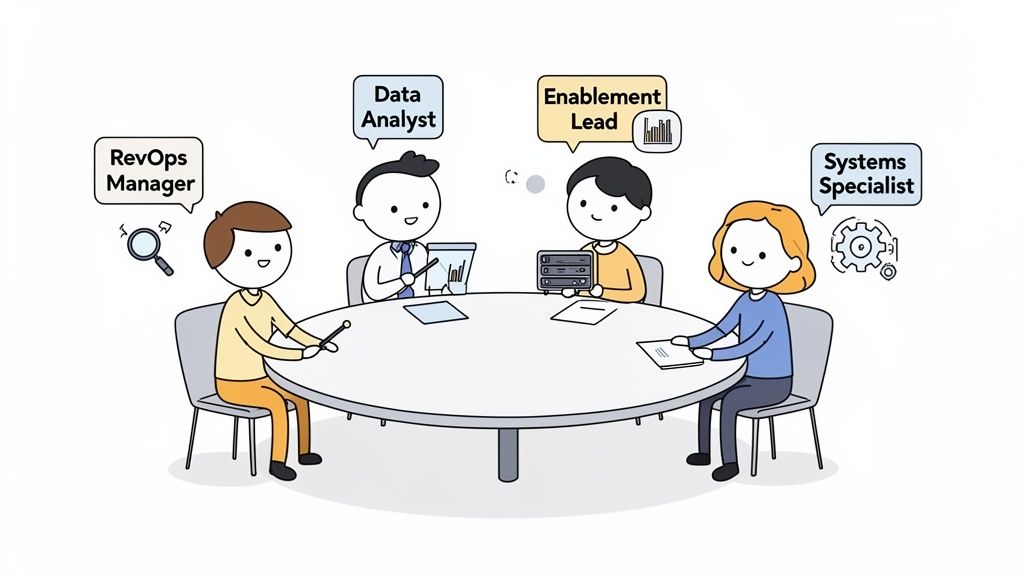
As you push toward $50M ARR, the team often expands to 3–5 members. You bring in a Data Analyst to build better dashboards, a RevOps Manager to run cross-functional projects, and an Enablement Lead to create sales playbooks.
Impact Opportunity: Staging your RevOps hiring like this can deliver a +20% improvement in forecast accuracy. This is a huge win for any go-to-market strategy, as it allows for more predictable revenue and smarter resource allocation. A more accurate forecast means the CFO can plan investments with confidence, and sales leadership can set more realistic quotas. For a deeper dive, the team at RevOpsJet offers some great insights on scaling your team effectively.
Defining Core RevOps Roles and Responsibilities
To build a high-impact RevOps team, you first have to define the players. These aren't just job titles; they’re distinct functions that have to work in lockstep to create a seamless revenue engine. Let's move past the generic descriptions and dig into the real-world responsibilities that make these roles so critical.
A winning RevOps team isn't built on generalists, especially not as you start to scale. You need a mix of strategic thinkers, data analysts, tech specialists, and people-focused coaches. Each role owns a specific piece of the revenue puzzle, making sure nothing falls through the cracks from the first touchpoint to the final renewal.
The RevOps Manager: The Project Conductor
Think of the RevOps Manager as the orchestra conductor, making sure every instrument in the go-to-market ensemble plays in perfect harmony. This isn't an administrative role—it's about managing the cross-functional projects that make the entire revenue process hum.
They’re the go-to for sales, marketing, and CS leadership, turning big-picture goals into concrete operational plans. Their world revolves around process optimization, project management, and ensuring clean handoffs between departments.
A practical example:
A company notices a 48-hour delay between a lead being marked as "Marketing Qualified" and a sales rep making the first call. The RevOps Manager takes ownership. They map the current process, identify the bottleneck in the CRM handoff automation, and work with the Systems Specialist to fix it. They then coordinate with the Enablement Lead to retrain the sales team on the new, faster process, cutting the delay to under one hour.
The Data Analyst: The Insight Hunter
The Data Analyst is the truth-seeker on your RevOps team. They dive headfirst into the data to find trends, spot bottlenecks, and deliver the insights that drive smart, strategic decisions. This person’s job is to turn raw numbers into a clear story about what’s working—and what’s not—in your revenue funnel.
Their work is so much more than building dashboards. A great analyst builds predictive models, stress-tests the health of the pipeline, and measures the actual ROI of marketing campaigns and sales initiatives.
Key Takeaway: The Data Analyst exists to replace gut feelings with hard evidence. Their analysis should directly answer tough questions like, "Which lead sources bring in the highest lifetime value?" or "Where in the sales cycle are our deals dying?"
The Enablement Lead: The Team Empowerer
The Enablement Lead has one mission: make the entire go-to-market team better at their jobs. They own onboarding, continuous training, and arming reps with the content, tools, and skills they need to win.
This role is the critical link between strategy and day-to-day execution. When a new sales process gets launched, they're the ones making sure the team is trained, confident, and ready to adopt it. You measure their success in things like shorter ramp times for new hires, higher quota attainment, and better adoption of sales playbooks.
A practical example:
Sales leadership wants to improve how reps handle pricing objections. The Enablement Lead develops a workshop that includes role-playing common scenarios, creates a one-page "objection handling" guide, and adds it to the team's content library. They then track win rates on deals where pricing objections were noted to measure the training's impact.
The Systems Specialist: The Tech Stack Architect
Your Systems Specialist is both the architect and the master mechanic of your tech stack. This person owns the administration, integration, and optimization of your core revenue tools—think CRM, marketing automation, and sales engagement platforms. To really grasp how central this is, check out our guide on what a CRM system really does for your sales team.
Their job is to make the technology serve the process, not the other way around. They build automations that kill manual work, maintain squeaky-clean data so reporting is trustworthy, and vet new tools that can give the team an edge. A great systems specialist is what stops your tech stack from becoming a tangled, expensive mess.
Why This Specialization Matters
Defining these roles with this kind of clarity does more than help you write a good job description. It builds a framework of accountability and specialization that is absolutely essential for scaling your growth. This is how you avoid the classic startup mistake of having one person trying to be a CRM admin, data scientist, and sales trainer all at once.
And the data backs this up. The best-performing sales orgs often maintain an 8:1 ratio of non-managers to managers, ensuring strong support. Another study of 2,500 companies found the sweet spot was a 12:1 ratio of sales reps to RevOps staff—enough support to be effective without bloating the team. This kind of intentional, specialized team design is a massive competitive advantage.
Choosing Your RevOps Reporting Model and Org Chart
Where your RevOps team reports on the org chart is one of the most important calls you’ll make. This isn't just about drawing lines and boxes; it's about giving the team the political capital it needs to actually break down the silos it was created to fix.
The reporting line signals the team's strategic importance to the entire company. Is it an impartial third party focused on operational truth, or is it embedded deep within the commercial teams it serves? Let's break down the common models.
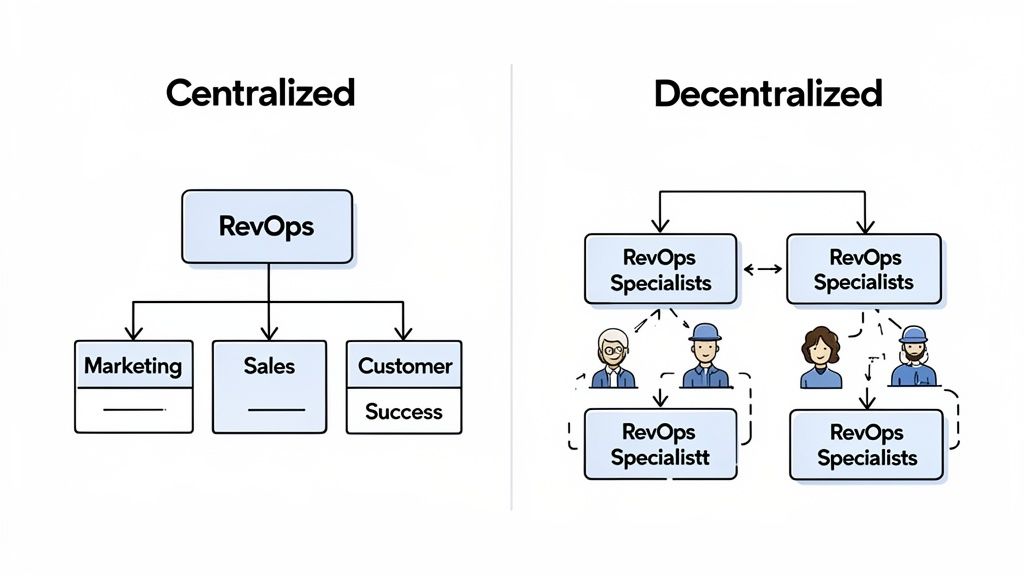
Centralized vs. Decentralized RevOps Structures
Your first big decision is whether to build a single, unified team or scatter specialists across different departments.
- Centralized Model: This is the go-to for a reason. One RevOps team serves marketing, sales, and customer success, creating a single source of truth for all go-to-market data and processes. It’s the best way to get a complete view of the entire customer journey.
- Decentralized (Embedded) Model: Here, you might have a Marketing Ops specialist in the marketing team and a Sales Ops person in sales. While they gain deep departmental expertise, this setup often creates the very silos RevOps is supposed to dismantle. Think fragmented data and competing priorities.
For most companies, a centralized structure is the way to go for driving real end-to-end alignment.
Reporting to the Chief Revenue Officer (CRO)
This is probably the most common and logical home for RevOps. Placing the team under a CRO ensures it’s locked in with the primary revenue-generating functions.
The biggest plus is that RevOps is tied directly to the go-to-market strategy, with a clear line of sight into the sales pipeline and commercial targets. The risk? The team can easily get pulled into being just a sales support function, unintentionally neglecting the needs of marketing and customer success.
Impact Opportunity: When reporting to a CRO, RevOps is perfectly positioned to optimize the entire sales funnel, improve forecast accuracy, and directly influence sales velocity. Its impact on revenue is immediate and easy to measure. This structure enables the team to drive projects that directly contribute to hitting quarterly and annual revenue targets.
Reporting to the CFO or COO
Another option is to have RevOps report to a Chief Financial Officer (CFO) or Chief Operating Officer (COO). This positions the team as a more neutral, data-driven entity.
- Reporting to the CFO: This approach brings a strong emphasis on financial rigor, profitability, and data governance. RevOps decisions get grounded in hard financial metrics like customer acquisition cost (CAC) and lifetime value (LTV).
- Reporting to the COO: This structure elevates the focus to operational excellence across the entire business, not just the GTM teams. RevOps becomes the hub for scaling systems and processes for the whole company.
The recent explosion of the VP of Revenue Operations role shows just how far RevOps has come—from tactical support to strategic leadership. This shift is helping companies achieve 36% higher revenue growth.
With over 174,000 active RevOps job postings on ZipRecruiter and director salaries hitting $273K, the market is screaming about the role's strategic value. As you can discover more insights about RevOps trends, it's clear the function is becoming a core part of the C-suite conversation.
This org chart shows a classic centralized structure reporting into a CRO. It's a solid blueprint.
Here, you see specialized roles for enablement, systems, and insights all rolling up to a single RevOps leader. That person reports directly to the head of revenue. This creates clear accountability across the entire revenue engine—a non-negotiable part of any effective CRM strategy.
Establishing KPIs and Tooling for Your RevOps Team
A slick org chart is one thing, but a RevOps team is only as good as the results it can prove. To move from a cost center to a strategic growth driver, you need the right Key Performance Indicators (KPIs) and a crystal-clear system for who owns what.
This is where we cut through the noise. We're moving past vanity metrics—like the number of dashboards built—and focusing on KPIs that tell the real story of your revenue engine's health. The goal is to measure the tangible impact RevOps has on the entire customer journey, from the first touchpoint to the final renewal.
From Vanity Metrics to Strategic KPIs
An effective RevOps team owns the metrics that speak to efficiency, profitability, and scalability. These aren't just numbers on a slide; they're a complete view of your entire go-to-market motion.
Here are a few of the big ones a strong RevOps team should own or heavily influence:
- Sales Velocity: This isn't just about speed; it's the formula for how quickly you're turning pipeline into cash. RevOps directly juices this number by finding and fixing friction points that slow reps down and stall deals.
- Customer Acquisition Cost (CAC): How much does it really cost to land a new logo? RevOps works to drive this number down by optimizing lead routing, improving conversion rates, and making sure every marketing dollar is spent wisely.
- Customer Lifetime Value (CLV): This KPI reveals the total revenue you can expect from a single customer. RevOps plays a huge role here by engineering smoother post-sale handoffs and arming the CS team with the data they need for smart upsells.
- Net Revenue Retention (NRR): Often pigeonholed as a Customer Success metric, NRR is absolutely a RevOps game. By creating a seamless customer journey and flagging expansion opportunities with data, RevOps helps turn your existing customer base into your biggest growth engine.
Key Takeaway: A mature RevOps function doesn't just report on these numbers. It actively owns the processes, systems, and strategies that make them better. The team’s value is proven when they can draw a straight line from their initiative—like a new lead scoring model—to a tangible improvement in a core metric like sales velocity.
To help clarify ownership, here’s a look at which KPIs a RevOps team should be watching at each stage of the funnel.
RevOps KPI Ownership Across the Funnel
This table clarifies which RevOps-influenced KPIs matter at each stage of the customer lifecycle, helping teams focus on metrics that drive tangible business results.
| Funnel Stage | Primary RevOps KPI | Supporting Metrics | Business Goal |
|---|---|---|---|
| Top of Funnel (TOFU) | Lead-to-MQL Conversion Rate | MQL Volume, Cost Per Lead (CPL) | Increase lead quality and marketing ROI |
| Middle of Funnel (MOFU) | Sales Cycle Length | MQL-to-SQL Conversion, Pipeline Velocity | Shorten time-to-revenue and improve sales efficiency |
| Bottom of Funnel (BOFU) | Win Rate | Average Deal Size, Forecast Accuracy | Close more deals and improve revenue predictability |
| Post-Sale | Net Revenue Retention (NRR) | Churn Rate, Expansion MRR, CSAT/NPS | Maximize customer lifetime value and drive expansion |
By aligning KPIs to each funnel stage, RevOps can pinpoint exactly where the revenue engine needs a tune-up and demonstrate clear, measurable impact on the business's bottom line.
Defining System Ownership with a RACI Framework
Tech stack chaos is the canary in the coal mine for a misaligned GTM strategy. When no one knows who really owns the CRM or the marketing automation platform, data gets dirty, processes shatter, and the finger-pointing begins.
A RACI chart is your best friend here. It’s a simple but incredibly powerful tool for bringing order to that chaos by defining who is Responsible, Accountable, Consulted, and Informed for every key system. It creates unmistakable clarity.
Let’s use it on a classic friction point: the marketing-to-sales handoff inside your CRM.
| Task/System | RevOps | Sales Leadership | Marketing Leadership | Sales Rep |
|---|---|---|---|---|
| Defining MQL Criteria | A | C | R | I |
| Building CRM Automation | R | I | C | I |
| Data Integrity in CRM | A | C | C | R |
| Lead Status Updates | I | A | I | R |
The RACI in Action: A Practical Example
Picture this: your company decides to change its Marketing Qualified Lead (MQL) definition. Without a RACI, Marketing might just change the criteria in their tool, flooding reps with leads that aren't ready. Sales gets frustrated, follow-up tanks, and the pipeline dries up.
Now, let's run that play again with the RACI above:
- Marketing Leadership (R) is Responsible for drafting the new MQL definition.
- They must Consult with Sales Leadership (C) to get their buy-in and feedback. No surprises.
- RevOps (A) is ultimately Accountable for the final call. They ensure the new definition is technically sound, implemented correctly across all systems, and actually aligns with the company's revenue goals. They have the final sign-off.
- Once it's live, Sales Reps (I) are Informed of the change through training orchestrated by RevOps.
This clean system of checks and balances prevents process breakdowns and keeps your data trustworthy. If you want to take your measurement strategy to the next level, exploring advanced reporting and analytics services can give you the framework to track these crucial metrics with precision.
A Practical Roadmap for Transitioning to a RevOps Model
Shifting to a RevOps team is a whole lot more than just shuffling names on an org chart. Think of it as a major change management project. To get it right, you need a deliberate, phased approach to get your people aligned, your processes rewired, and genuine buy-in from every corner of the company.
Without a clear roadmap, even the best-laid plans fall flat. You’ll just end up with the same old silos wearing a new name. This guide gives you an actionable plan to get from where you are today to a fully humming, unified RevOps model. The idea is to get ahead of the change, anticipate the bumps in the road, and be transparent from day one to build real momentum.
Auditing Your Current State to Build the Business Case
Before you can build the future, you have to get painfully honest about the present. The first move is a deep-dive audit of your existing go-to-market engine—all the processes, tech, and data flows. This isn’t about pointing fingers. It’s about putting a dollar amount on the cost of inefficiency.
Your goal here is to find the specific points of friction and show how much they're costing you.
- Process Mapping: Walk the entire customer journey, from the very first marketing touch to a happy renewal. Where are handoffs fumbled? How long does it actually take for a hot lead to get a call from sales?
- Technology Assessment: Get real about your tech stack. Pinpoint the redundant tools, the clunky manual workarounds, and the data that just doesn't line up between your CRM, marketing automation, and other systems. How many hours are reps burning on tasks a simple automation could handle?
- Data Analysis: Dig into the numbers to quantify the damage. What’s the real impact of lead leakage, wildly inaccurate forecasts, or missed expansion deals? Showing that you have a 33% rate of missed cross-sell opportunities because of broken processes is the kind of stat that gets an executive’s attention.
This audit becomes the foundation for a business case that’s impossible to ignore. Frame your findings as opportunities, not just problems. "Our lead routing is slow" is a complaint. "Cutting our lead response time by 24 hours could boost our conversion rate by 15%" is a strategy.
Securing Executive Buy-In and Communicating the Vision
With your business case locked and loaded, it's time to get your executive team not just on board, but excited. Your pitch needs to be all about tangible business results—faster growth, better profits, and a foundation that can actually scale. Make it clear that RevOps is a strategic investment, not just another administrative cost.
Once you’ve got the green light from the top, you need to communicate the vision to your go-to-market teams. People are naturally wary of change, so you have to spell out exactly what’s in it for them.
Key Takeaway: The move to RevOps is a cultural shift. You have to frame it in terms of benefits that matter to each team—less mind-numbing admin for sales, better-qualified leads for marketing, and clearer data for customer success. That’s how you turn resistance into excitement.
When you're laying out the plan, showing that you’ll be bringing in business process automation services is a huge credibility builder. It proves you're serious about taking away the manual grunt work that frustrates everyone on the front lines.
A Sample 90-Day Transition Plan
Trying to boil the ocean is a recipe for disaster. A phased rollout prevents people from getting overwhelmed and lets you score some quick wins to build confidence. Here’s a sample 90-day plan to map out the key moves for a smooth transition.
Phase 1: Foundation (Days 1-30)
The first month is all about laying the groundwork for your new RevOps team structure.
- Finalize the RevOps Charter: Get it in writing. Formally document the team’s mission, scope, reporting lines, and the core KPIs you’ll live and die by.
- Establish Initial Governance: Put together a cross-functional steering committee with leaders from sales, marketing, and CS to help guide priorities.
- Launch a Quick Win Project: Pick something high-impact but low-effort. Maybe it's cleaning up a messy but critical CRM dashboard or automating a report that everyone hates building manually. A tangible win right out of the gate is crucial for building trust.
Phase 2: Process Re-Engineering (Days 31-60)
With the foundation solid, you can start tackling the core process headaches you uncovered in your audit.
- Redesign the Lead-to-Revenue Process: Map out and implement a single, unified process for how leads are managed and handed off between marketing and sales. No more gray areas.
- Consolidate Core Reporting: Build the first version of a unified GTM dashboard that tracks the most important metrics across the entire funnel, from top to bottom.
- Begin Tech Stack Consolidation: Identify one or two redundant tools, get rid of them, and move those users over to the central, official system.
Phase 3: Optimization and Enablement (Days 61-90)
The final sprint is about making the new way of working stick and enabling your teams to actually thrive in the new model.
- Roll Out Team Training: Run hands-on training sessions for all the GTM teams on the new processes and any tech updates.
- Implement Feedback Loops: Set up regular check-ins and forums where teams can give honest feedback on what’s working and what isn’t.
- Publish First RevOps Impact Report: Share a report with the whole company showing the results from your quick win project and the initial process fixes, tying them directly to real business metrics.
This kind of structured plan turns what feels like a massive organizational upheaval into a manageable series of steps, making sure your new RevOps function gets adopted smoothly.
Impact Opportunity: A well-thought-out transition roadmap significantly de-risks the implementation of a new RevOps structure. When you build a strong business case, communicate clearly, and deliver early wins, you accelerate adoption across the board. This allows the business to realize the benefits of unified, scalable growth much faster, turning a potential disruption into a serious competitive advantage.
Common Questions About Building a RevOps Team
Even with the best roadmap, building out a revenue operations team always brings up a few tricky questions. Let's tackle the ones I hear most often, so you can move forward with confidence.
Who Is My First RevOps Hire?
For most companies under $10M ARR, your first hire needs to be a RevOps Generalist. You're looking for a versatile problem-solver, someone who can map out a strategic process one minute and get their hands dirty with CRM admin tasks the next.
Their first jobs are to wrangle your data into a single source of truth, clean up the CRM, build out some foundational reporting, and fix the lead-to-close process. The goal is to hire an agile "doer" who brings order to the chaos. This person lays the groundwork for specialization later on, unlike a niche expert who might be too narrowly focused for the early-stage hustle.
How Do I Justify the Headcount and Budget for a RevOps Team?
You have to build a business case that’s all about ROI, not just another line item on the department budget. Start by putting a price on your current inefficiencies. Calculate the hours your reps are wasting on manual data entry, the revenue leaking from mishandled leads, and the cost of bad decisions made from a shaky forecast.
Then, you can frame RevOps as a revenue multiplier. Project the impact of shortening the sales cycle by just 10% or boosting lead conversion by 5%—these are completely realistic wins for a well-run RevOps function.
Key Takeaway: Back up your case with industry data. For example, companies with a formal RevOps function see 36% higher revenue growth. Stats like that ground your argument in proven results, making it much more compelling to leadership than just your own projections.
What's the Biggest Mistake Companies Make When Structuring RevOps?
The most common trap is treating RevOps as just a new name for Sales Ops. When the team’s focus stays stuck on the sales pipeline, you miss the point entirely. True revenue operations has to span the entire customer lifecycle, which means getting deep into marketing and customer success.
A RevOps structure that only serves sales will never fix the friction at the marketing-to-sales handoff. And it certainly won't help with post-sale retention and expansion, which is where the real growth happens.
Impact Opportunity: The biggest opportunity for impact is when your RevOps team owns KPIs across the full funnel—from the moment a lead comes in all the way through to long-term customer value and net revenue retention. This complete view is what unlocks exponential growth, rather than just incremental sales improvements.
Should RevOps Own the Technology Budget?
Yes, absolutely. In a mature model, the RevOps team should either own the go-to-market tech budget or, at the very least, have a heavy hand in it. When you centralize this, you stop different departments from buying redundant or incompatible tools, which is the number one cause of frustrating data silos.
When RevOps manages the tech stack, you get seamless integrations, consistent data governance, and a unified view of the customer. This doesn't mean they make decisions in a vacuum; collaboration with department heads is still critical. But central ownership guarantees that your tech investments are strategically aligned with the entire revenue engine, not just one team's pet project.
Ready to turn your complex tech stack into a scalable revenue system? At Prometheus Agency, we partner with growth leaders to implement AI-driven strategies that deliver real business outcomes. Start with our complimentary Growth Audit to build your roadmap. Learn more and book your session.