
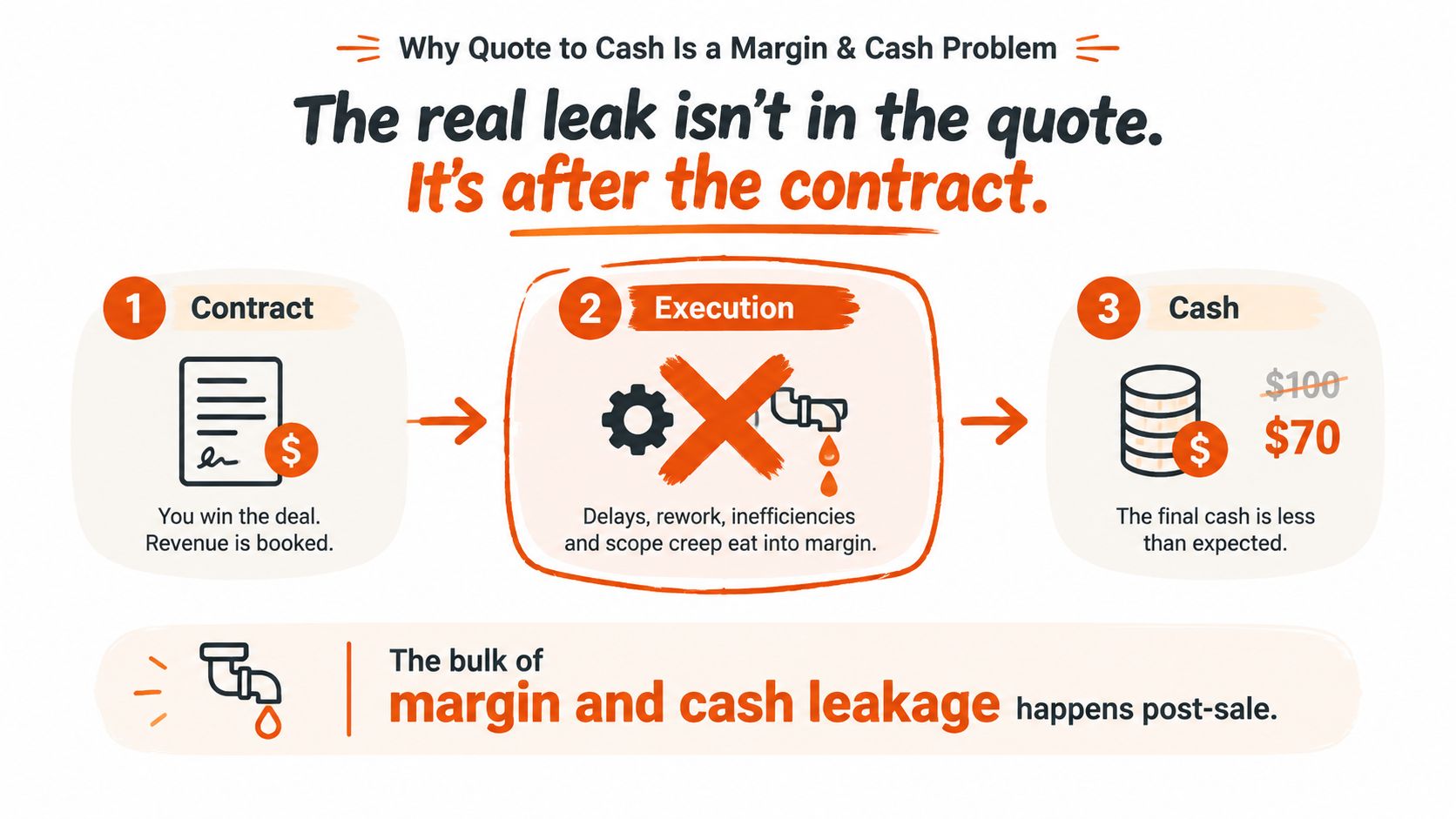
Most quote-to-cash leakage is a post-signature cash-conversion and margin-governance problem, not a quoting problem. Companies can lose an average of 9% of enterprise revenue through leakage, while 62% of manufacturing leaders report at least moderate margin loss between quote and delivery.
That changes the operating question. Instead of asking whether sales can produce quotes faster, growth leaders should ask whether the business can preserve approved pricing, deliver the contracted order, invoice accurately, collect without friction, and recognize revenue on time. The quote to cash process is a chain of commercial, operational, and finance decisions, and the largest losses often appear after the customer has already signed.
Why Quote to Cash Is Really a Margin and Cash Problem
Quote to cash isn't merely a sales handoff. It spans pricing, approvals, contract management, delivery, invoicing, billing, collections, and revenue recognition, tracking the path from a sales rep sending a quote to cash reaching the bank account. The process commonly includes quote volume, quote conversion rate, average quote size, sales cycle time, order fulfillment time, invoice frequency, and payment collection time, as documented in this overview of quote-to-cash metrics.
The familiar workflow diagram hides the risk. A quote can be accurate and still produce weak economics if a negotiated clause changes the commercial promise, an order form drops a line item, delivery costs more than modeled, or billing cannot interpret a usage-based contract. One analysis of 1,840 deals found $4.2 million in leakage, equal to 3.4% of contracted revenue, with major losses arising from quote-to-contract slippage, contract-to-invoice entry errors, and unpaid invoice disputes, according to research on quote-to-cash leakage.
Practical rule: Treat every post-signature handoff as a margin-control point, not an administrative step.
The Commercial Chain Leaders Should Govern
The lifecycle governs at least three outcomes:
- Gross margin: Product configuration, discounts, rush fulfillment, substitutions, and delivery commitments determine whether the economics promised in the quote survive execution.
- Working capital: Q2C cycle time, measured from quote generation to cash receipt, directly affects cash flow and working capital, as described in end-to-end Q2C research.
- Revenue timing: Billing terms, delivery schedules, amendments, and accounting treatment affect deferred revenue, recognized revenue, and the timing of financial close.
Manufacturing makes the issue especially visible. A 2026 KPMG survey of 280 manufacturing leaders found that 62% reported at least moderate margin loss between quote and delivery, while 81% said maintaining CPQ configuration models required moderate to extremely high effort, based on the findings summarized in this analysis of quote-to-cash margin governance. Stale product and cost data can therefore damage margin before finance ever sees an invoice.
Key Takeaways
- Quote to cash is an economic control system, not a sales operations checklist.
- The biggest risks often sit between signature, fulfillment, billing, collection, and renewal.
- Growth leaders should connect CPQ, CLM, ERP, billing, revenue recognition, and analytics around one commercial record.
- The right objective is not maximum automation. It's reliable margin and faster cash conversion with accountable human review.
This guide breaks down the ten stages, the KPIs that predict cash performance, the integrations worth funding, practical AI applications, common failure modes, and a 90-day implementation roadmap. The operating principle is simple: protect the deal you sold all the way to the cash you collect.
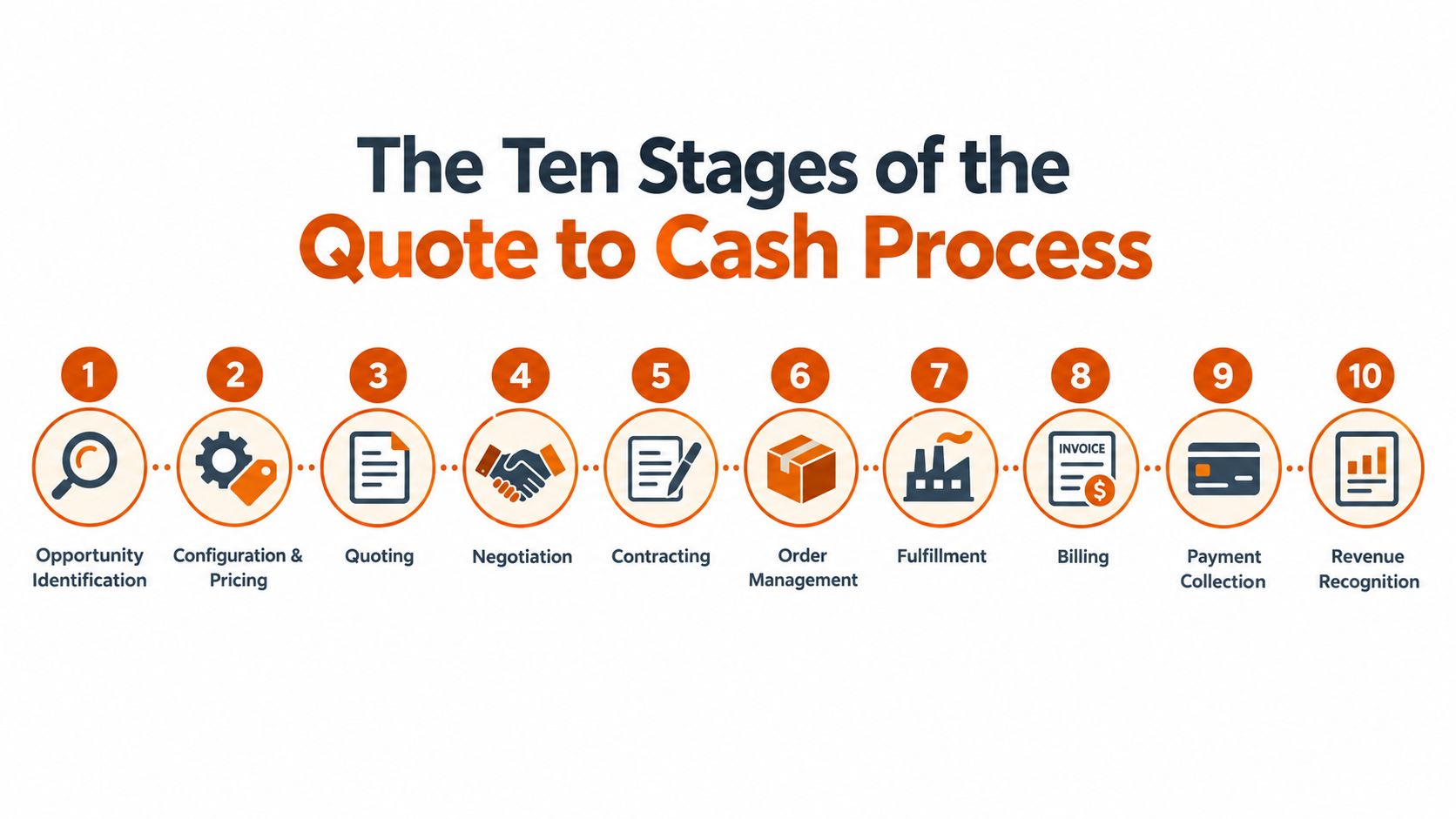
The Ten Stages of the Quote to Cash Process
A precision-parts buyer at an industrial OEM asks a manufacturer for a configured assembly. The buyer doesn't experience ten internal systems. The buyer experiences one promise, and every stage must preserve it.
The standard process has ten stages, from configuration through renewal, as outlined in this ten-step quote-to-cash process guide.
Configuration: The sales engineer selects compatible components, quantities, tolerances, and services. The input is the buyer's specification, the owner is sales engineering or product operations, and the bottleneck is often stale product rules. A wrong configuration creates rework or an unprofitable delivery promise.
Pricing: The commercial team applies the price book, volume logic, discount limits, freight, and service charges. Sales owns the deal, with finance or commercial operations governing exceptions. Off-list discounting is the common margin leak.
Quoting: CPQ generates the customer-facing offer from approved configuration and pricing data. Sales owns the quote, while RevOps owns the template and rules. Manual document editing creates version risk and delays.
Contract creation: Legal or commercial operations turns the approved quote into contractual terms. The input is the structured quote, and the bottleneck is missing language for billing starts, delivery obligations, usage, or renewals.
Contract negotiation: The buyer redlines payment terms, warranties, service levels, and delivery commitments. Legal owns the negotiation, but sales and finance must see deviations. Redline cycles stall cash before fulfillment begins.
Contract execution: Authorized parties approve and sign the final agreement. The owner is usually legal operations or deal desk. The critical control is confirming that the signed document matches the approved commercial record.
Order fulfillment: Operations converts the order into production, provisioning, shipment, or service delivery. The ERP should receive structured order data. Missing line items, incorrect tax treatment, or unrecorded substitutions create downstream disputes.
Billing: Finance or billing operations generates invoices according to the contracted schedule, rates, milestones, or usage. Manual invoicing is especially fragile for subscriptions, amendments, and prorated charges.
Revenue recognition: Accounting maps delivery and billing events to the appropriate revenue schedule. The owner is controllership or revenue accounting. Disconnected systems create reconciliation work and recognition delays.
Renewal or expansion: Customer success, account management, and sales determine what continues, changes, or expands. Missed renewal triggers, weak co-term logic, and inaccurate entitlements leave recurring revenue exposed.
The signed contract is not the finish line. It is the point where execution risk becomes financially measurable.
A manufacturer that connects request intake, quote creation, order validation, ERP entry, and invoice generation can reduce repeated data entry across the chain. The practical example is straightforward: the accepted configuration triggers the production order, the order record carries approved pricing, and the invoice reflects the same commercial terms instead of relying on a person to re-key them.
KPIs That Actually Predict Cash Performance
A Q2C dashboard should help leaders make operating decisions. It shouldn't only report activity. Raw deal count and average deal size can look healthy while billing accuracy falls, payment slows, or usage-based revenue remains unbilled.
The following five metrics connect commercial activity to cash and accounting outcomes. The quote-stage benchmark comes from a Q2C process benchmark library, which rates best-in-class turnaround at less than 24 to 48 hours, compared with 3 to 5 business days on average and more than 1 week in the worst case.
| KPI | What It Measures | Benchmark Range | Decision It Enables |
|---|---|---|---|
| Quote turnaround time | Time from request to customer-ready quote | Best-in-class: less than 24 to 48 hours; average: 3 to 5 business days; worst case: more than 1 week | Redesign approval rules, coach reps, or repair configuration data |
| Quote-to-close conversion rate | Share of qualified quotes that become signed deals | Use an internal baseline by segment and motion | Separate pricing, qualification, configuration, and sales execution problems |
| Billing accuracy | Invoices that match contracted products, prices, terms, tax, and usage | Establish a baseline from invoice exceptions and disputes | Assign billing ownership, correct rate cards, and eliminate manual adjustments |
| Days sales outstanding | Average time required to collect receivables | Track by segment, payment terms, and dispute status | Adjust AR staffing, escalation paths, payment methods, or contract terms |
| Revenue recognition lag | Time between the relevant billing or delivery event and accounting recognition | Establish a close-cycle baseline with controllership | Fix billing-to-rev-rec integration and accelerate review workflows |
What each metric tells you
Quote turnaround is a sales-velocity metric only when accuracy stays intact. If quotes take longer than the average range, don't automatically add deal-desk capacity. First identify whether the delay comes from configuration, discount approvals, legal review, or missing product data.
Conversion rate needs segmentation. A blended rate can conceal the fact that standard configurations close while custom usage models fail. Compare like-for-like motions, then use the result for rep coaching and pricing review.
Billing accuracy and DSO belong together. A DSO spike often reflects disputes rather than unwilling customers. If invoices contain wrong quantities, proration, tax, or start dates, adding collection pressure treats the symptom.
Revenue recognition lag is a controllership signal. A recurring lag means billing and accounting systems aren't sharing enough structured data, and the close process needs a system change rather than another spreadsheet.
For dashboard design, use this sales performance metrics dashboard guidance to connect frontline activity with revenue outcomes. The threshold for redesign is persistent exception volume, repeated manual overrides, or a metric that worsens despite coaching. Those patterns indicate a broken process, not an underperforming individual.
The Quote to Cash Tech Stack and Integrations
The stack should follow the commercial record, not the org chart. Each layer owns a different decision, and leaders should resist buying tools that duplicate ownership.
| Layer | Representative Tools | Primary Job | Integration Priority |
|---|---|---|---|
| CRM | Salesforce, Microsoft Dynamics 365 Sales, HubSpot | Opportunity, account, seller, and commercial context | Critical source for CPQ |
| CPQ | Salesforce CPQ, DealHub, Conga CPQ | Configuration, pricing, discounting, and quote generation | Critical |
| CLM | Ironclad, DocuSign CLM, Conga CLM | Contract creation, redlining, approvals, and execution | Critical |
| ERP | Microsoft Dynamics 365 Business Central, NetSuite, SAP | Orders, inventory, fulfillment, tax, and financial posting | Critical |
| Billing | Zuora, Stripe Billing, Chargebee | Subscription, usage, invoicing, collections support | Critical for recurring and usage models |
| Revenue recognition | Zuora Revenue, NetSuite ARM, Dynamics 365 Finance | Revenue schedules, allocation, and accounting controls | Critical |
| Data and BI | Power BI, Snowflake, Tableau | Cross-system reporting, leakage analysis, and margin dashboards | Critical for governance |
Integrations that prevent expensive ambiguity
CRM to CPQ keeps the opportunity, customer context, products, and commercial assumptions aligned. Drift here causes sellers to quote from outdated data or duplicate account information.
CPQ to CLM passes approved pricing, quantities, payment terms, and renewal provisions into the contract. This reduces the chance that legal drafts a document from an incomplete or stale quote.
CPQ and CLM into ERP creates the order-to-cash handoff. The ERP needs the executed commercial record, not a PDF that an operations employee must interpret.
Billing to revenue recognition is essential for subscriptions, usage, amendments, and complex delivery schedules. It gives accounting the events and terms required to calculate schedules and investigate exceptions.
Revenue recognition to CRM returns commercial truth to the teams managing renewals and expansion. Customer-facing teams need to know what was sold, billed, delivered, and recognized.
Marketing automation and expense systems can be useful, but they shouldn't outrank these connections. A clean marketing sync won't repair a missing invoice line. A polished expense integration won't resolve a billing-to-revenue reconciliation gap.
For leaders evaluating the broader architecture, this guide to an AI-enabled RevOps stack provides a useful way to separate orchestration, data, and decision support. The test for every connector is concrete: what failure does it prevent, who owns the exception, and which KPI should improve?
Where Automation and AI Create Real Impact
Automation should target repetitive decisions with stable inputs. AI should assist people where the data is messy but review remains possible. The business case is strongest where teams re-key information, compare documents, reconcile usage, or investigate exceptions.
Prometheus Agency reports a 58% average manual-effort reduction across its work, based on the publisher information provided for this article. That benchmark is a useful ambition, not a promise for every Q2C deployment. Results depend on data quality, process discipline, integration depth, and whether teams retire the old manual path.
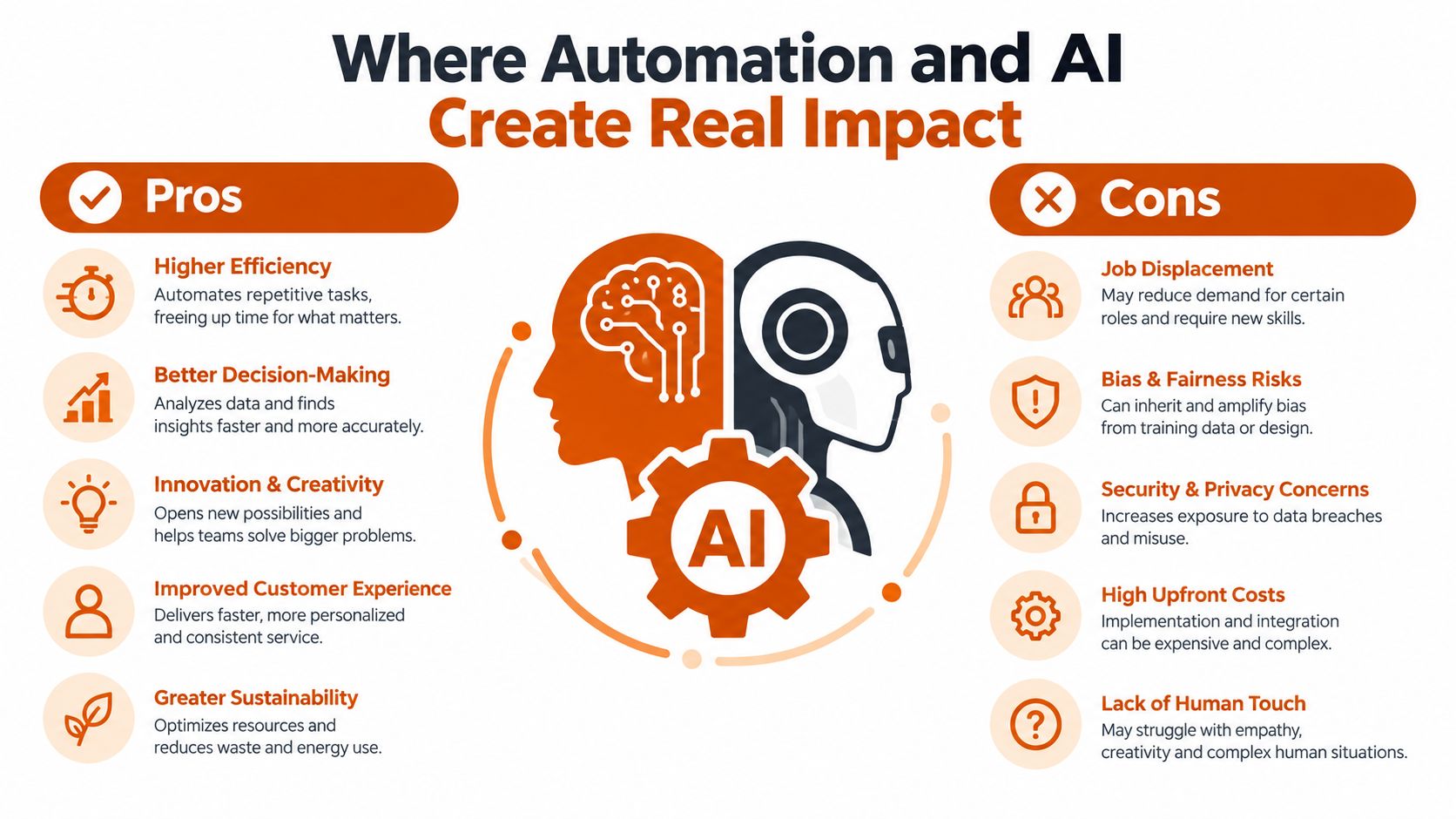
Four applications worth funding
AI-assisted quote generation: A model can use CRM context, approved product rules, customer history, and price books to prepare a draft. A seller or deal desk reviewer should approve exceptions, discounts, and unusual configurations. The opportunity is speed without allowing an AI system to invent commercial terms.
Contract clause extraction: CLM automation can identify payment terms, renewal language, service credits, termination rights, and deviations from approved language. Legal still decides whether a deviation is acceptable. The system's job is to surface risk consistently.
Usage normalization and invoice preparation: Billing automation can standardize incoming usage records, identify missing or malformed events, and prepare invoice calculations. Finance should review anomalies before invoices go out, especially when usage affects customer charges.
Revenue-schedule calculation: Rules-based automation can calculate schedules while AI flags unusual allocations, start dates, amendments, or gaps between billing and delivery. Accounting owns the final decision and audit trail.
Where AI is mostly hype
Fully autonomous negotiation is a poor starting point because commercial concessions carry legal and margin consequences. Generic chatbots won't replace sales engineers who understand product constraints, and black-box forecasting shouldn't determine staffing or revenue plans without traceable inputs.
Start with data that is already structured, such as approved price books, contract metadata, and billing events. Keep a human review step for pricing exceptions, contractual deviations, invoice anomalies, and revenue treatment. Teams that need a broader starting point can review sales automation resources for SMBs before selecting a narrow Q2C pilot. For wholesale teams, AI for wholesale quote generation offers a more targeted application than a generic assistant.
Common Quote to Cash Failure Modes and Fixes
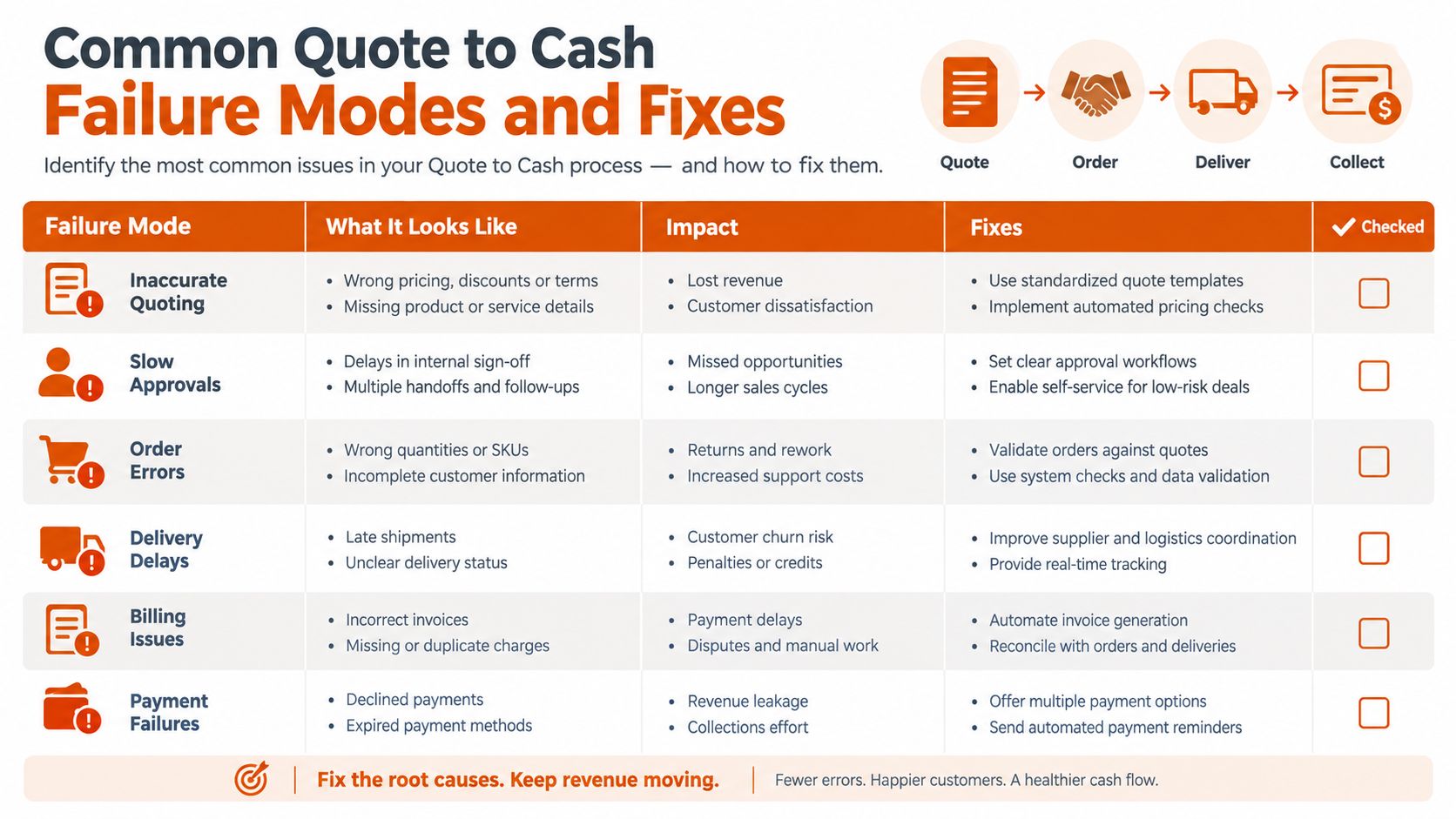
The cost frame is clear. One source cites 9% average enterprise revenue leakage, while another reports 42% of companies experiencing leakage of 3% to 7% of annual revenue, with missed amendments, auto-renewal glitches, order-value rework, and failed payments among the mechanics described in this contract management and quote-to-cash analysis. The right response is not a broad “automation initiative.” It's a short list of owners, system changes, and verification metrics.
Six failure modes that deserve immediate attention
Pricing drift: Sales sees one price book while CPQ applies another. The symptom is unexplained discounting or margin variance. RevOps should make CPQ the governed pricing source, with finance owning discount policy. Track approved versus actual discounting and margin exceptions through the next review cycle.
Contract redlining outside control: Legal edits terms in documents that don't flow back to the commercial record. The symptom is a mismatch between quote, signed contract, and invoice. Legal operations should use CLM clause libraries and deviation fields. Confirm that every material deviation reaches billing and finance.
Order handoff gaps: Operations receives a PDF or incomplete order record. The symptom is missing line items, wrong tax treatment, or fulfillment rework. The ERP owner should require a structured order form generated from the executed agreement. Measure order exceptions and fulfillment rework.
Billing and proration errors: Subscription or usage deals contain rate-card, start-date, or amendment mistakes. The symptom is invoice disputes and a DSO increase. Billing operations should centralize rating rules and test amendments before production. Track first-pass invoice accuracy and dispute reasons.
Revenue-recognition lag: Billing and accounting systems don't share the required contract and delivery events. The symptom is manual schedules, close delays, or audit findings. The controller should own the integration and exception policy. Measure the lag between billing events and completed recognition review.
Renewal surprises: Co-term logic, partial renewals, or entitlement changes aren't captured consistently. The symptom is a rushed renewal, incorrect baseline, or churn risk. Customer success and RevOps should establish a structured renewal record tied to the executed order. Track renewal readiness and amendment completeness.
The 3.4% contracted-revenue leakage finding should be treated as an operational warning, not a universal benchmark for every company. If your team can't reconcile a sampled deal from quote to invoice, start there. A clean trace is more valuable than a polished dashboard built on contradictory records.
A 90-Day Quote to Cash Implementation Roadmap
A Q2C program should produce working controls, not another slide deck. Pair a revenue operations lead with a finance controller from the start. RevOps understands the commercial workflow, while controllership protects billing, recognition, and audit integrity.
Days 1 to 30 diagnose the leak
Map the actual lifecycle using real deals, contracts, orders, and invoices. Instrument quote turnaround, quote conversion, billing accuracy, DSO, and revenue recognition lag. Identify the top three leakage sources by tracing records across systems rather than interviewing teams about the “official” process.
The artifact is a current-state map with an exception register. The exit criterion is agreement on the three highest-value failure points, their owners, and their baseline measures.
Days 31 to 60 remove avoidable friction
Tighten approval thresholds and eliminate duplicate entry between CRM and ERP. Standardize the product catalog and pricing rules in CPQ. Replace the PDF-driven order handoff with one structured source-of-truth order form that carries approved commercial terms into fulfillment and billing.
The artifact is a controlled future-state workflow, updated rule set, and integration backlog. The exit criterion is a live pilot that processes representative deals without the old manual re-entry path.
Days 61 to 90 add automation and governance
Deploy guided selling where configuration data is reliable. Configure renewal triggers tied to contract dates and amendments. Establish a weekly leakage review with sales, RevOps, finance, billing, legal, and operations. Add margin dashboards that show approved price, delivered economics, invoice status, and collection progress.
The artifact is an operating cadence with dashboards, exception ownership, and a prioritized automation backlog. The exit criterion is leadership sign-off based on observed process evidence, not projected benefits.
| Phase | Days | Focus | Key Deliverables | Owner | Exit Criteria |
|---|---|---|---|---|---|
| Diagnose | 1 to 30 | Map and measure the current process | Lifecycle map, KPI baseline, top-three leakage register | RevOps lead with finance controller | Owners and baselines agreed |
| Stabilize | 31 to 60 | Remove duplicate work and clarify rules | CPQ catalog, approval policy, structured order form, integration fixes | RevOps lead | Pilot runs without duplicate entry |
| Govern | 61 to 90 | Automate reliable steps and manage exceptions | Guided selling, renewal triggers, weekly review, margin dashboard | Finance controller and RevOps lead | Leadership verifies controls and ownership |
Don't wait for a perfect architecture before fixing obvious handoff failures. Start with the deal path that produces the most revenue or the most operational exceptions, make the record traceable, and expand only after the control works.
Prometheus Agency helps growth leaders turn CRM, CPQ, ERP, billing, and AI investments into accountable revenue systems through implementation, integration, and go-to-market strategy. Visit Prometheus Agency to request a Growth Audit and AI strategy session focused on margin governance, quote-to-cash leakage, and faster cash conversion.