The current market is saturated with AI-powered marketing tools, each promising revolutionary results. For B2B growth leaders and executives, the challenge is not a lack of options, but a surplus of noise. Sifting through generic feature lists and promotional hype to find platforms that deliver tangible ROI is a significant operational drain. This guide cuts through that noise, providing a curated, comprehensive resource focused on practical application and strategic implementation.
Instead of a simple list, this article offers a structured framework for evaluating the best AI tools for marketing based on specific business needs. We will move beyond surface-level reviews to analyze platforms across key use cases, including content creation, ad optimization, personalization, and CRM automation. For founders seeking to use AI for customer acquisition, a parallel exploration of the best AI tools for sales prospecting offers practical guidance on top-of-funnel strategies.
This resource is designed for decisive action. Each entry includes a concise summary, an honest assessment of pros and cons, and a clear "ideal for" profile to match the tool to your specific operational context. We provide direct links and screenshots to simplify your evaluation process, helping you move from discovery to pilot implementation efficiently. You will gain a clear understanding of not just what these tools do, but how they integrate into a cohesive growth stack to drive measurable outcomes.
1. G2
While not an AI tool itself, G2 is the indispensable starting point for any B2B leader's search for the best AI tools for marketing. It’s the world's largest software marketplace, providing a meta-layer of peer-verified reviews and data-driven comparison grids that cut through marketing hype. For executives tasked with AI adoption, G2 offers a crucial first-pass filter to identify viable solutions based on real user experiences.
Its true power lies in its detailed taxonomy and strong filtering. You can isolate AI tools by specific marketing functions like "AI Sales Assistants" or "Conversational Marketing," then narrow the results by company size, user satisfaction scores, and specific feature requirements. This structured approach transforms a sprawling, confusing market into a manageable shortlist of validated contenders.
Strategic Application
- Key Takeaway: G2 provides the social proof and comparative data needed to de-risk high-stakes AI software investments, ensuring you select tools that are proven to work for businesses like yours.
- Practical Example: A mid-market manufacturing firm can use G2's filters to find AI-powered CRM automation tools that integrate specifically with Salesforce and are highly rated by other industrial companies with 200-500 employees.
- Impact Opportunity: Reduces countless hours of vendor research and demo calls by pre-qualifying top performers based on unbiased peer feedback and objective market presence data.
| Feature | G2's Value for AI Tool Discovery |
|---|---|
| Verified Peer Reviews | Provides authentic insights into a tool's performance, implementation challenges, and actual ROI. |
| Leader & Momentum Grids | Visually maps the market market, identifying established leaders and fast-growing innovators. |
| strong Filtering System | Allows for precise shortlisting based on technical requirements, company size, and user sentiment. |
| Curated "Best Of" Lists | Offers expert-vetted annual rankings for top marketing and advertising products. |
Pros: The sheer volume and recency of reviews provide high-quality, reliable signals. The granular filtering is unmatched for creating precise shortlists.
Cons: Sponsored placements can sometimes give prominent visibility to vendors with larger budgets. Niche, advanced AI tools may not yet have a critical mass of reviews.
To navigate this market effectively, it’s vital to understand which AI capabilities align with your strategic goals. Understanding the scope of an AI enablement initiative can help you better use platforms like G2 to find the right solutions.
Website: https://www.g2.com
2. Capterra
Similar to G2, Capterra is a critical discovery platform for leaders evaluating the best AI tools for marketing, especially for small to mid-market businesses. As part of the Gartner Digital Markets family, it provides a structured environment where decision-makers can compare software based on verified user reviews, detailed feature lists, and curated buyer guides. It helps simplify the initial research phase of AI adoption by organizing tools into practical marketing categories.
Capterra excels at creating clear, direct comparisons. Its side-by-side feature matrices allow users to quickly assess how different AI tools stack up against each other on specific capabilities, from content generation to marketing automation. This granular view is invaluable for teams that have already identified a specific functional need and now require a shortlist of the most suitable vendors.
Strategic Application
- Key Takeaway: Capterra simplifies the vendor selection process with its powerful comparison tools and focus on the SMB to mid-market segment, making it easier to find AI solutions that fit specific budgets and feature needs.
- Practical Example: A marketing manager at a growing e-commerce company can use Capterra to compare three different AI-powered email marketing platforms, directly evaluating their A/B testing capabilities, pricing models, and user ratings from similar-sized businesses.
- Impact Opportunity: Accelerates the creation of a qualified vendor shortlist by providing transparent, feature-level comparison data, reducing the need for preliminary sales calls to gather basic information.
| Feature | Capterra's Value for AI Tool Discovery |
|---|---|
| Side-by-Side Comparisons | Offers direct, feature-to-feature evaluations of competing AI marketing software. |
| Verified User Ratings | Provides trusted feedback on usability, customer support, and value for money from real users. |
| Curated "Top-Rated" Lists | Delivers editorially-vetted roundups that highlight leading tools in specific AI categories. |
| Detailed Filters | Enables shortlisting based on pricing model, deployment type, company size, and specific features. |
Pros: Strong breadth of software reviews across the SMB and mid-market market. The clear pro/con summaries and feature matrices for each product are highly efficient for comparison.
Cons: Editorial content and buyer guides can sometimes lag behind the latest market innovations. Prominence in search results can be influenced by vendor pay-per-click spending.
To make the most of discovery platforms, it's crucial to first define your core marketing challenges. Knowing whether your priority is lead scoring, content personalization, or ad optimization will guide your search and help you use Capterra’s filters effectively.
Website: https://www.capterra.com
3. GetApp
As part of the Gartner Digital Markets family, GetApp specializes in helping marketing leaders create practical software shortlists. It excels at curating dedicated collections, such as “AI Marketing Tools” and “Marketing Automation with Generative AI,” which provide an efficient pathway for buyers to discover relevant solutions. For teams looking to quickly compare top-rated options, GetApp offers a simplified discovery process.
Unlike sprawling marketplaces, GetApp’s interface is designed for rapid comparison and decision-making. Its strength is in its focused category pages and clear comparison grids, which help users quickly understand the key differentiators between various best ai tools for marketing. The "Users also considered" feature is particularly useful for uncovering strong alternative solutions that might have been missed in an initial search.
Strategic Application
- Key Takeaway: GetApp is an accelerator for the software discovery phase, helping you build a data-backed shortlist of viable AI marketing tools in a fraction of the time.
- Practical Example: A marketing manager for a fast-growing SaaS startup can use GetApp to compare three leading AI-powered social media management tools, quickly assessing them based on verified user ratings for ease of use, feature set, and customer support.
- Impact Opportunity: Minimizes discovery fatigue by presenting curated, relevant options, allowing teams to move faster from initial research to hands-on vendor demos with pre-vetted candidates.
| Feature | GetApp's Value for AI Tool Discovery |
|---|---|
| Dedicated AI Collections | Offers curated landing pages for specific AI use cases like content, analytics, and campaign management. |
| Verified User Reviews | Provides score breakdowns for features, support, and value for money to inform buying decisions. |
| Comparison Grids | Enables side-by-side evaluation of up to four tools on key features, pricing, and ratings. |
| “Users Also Considered” | Surfaces relevant competitors and adjacent tools, broadening the discovery process effectively. |
Pros: Excellent for generating quick, actionable shortlists based on user data. The tight integration between related MarTech categories makes it easy to explore comprehensive solutions.
Cons: Contains fewer enterprise-specific solutions compared to larger marketplaces. Some tool descriptions can lean heavily on vendor-supplied marketing copy.
To make the most of GetApp, start with its curated AI categories before diving into broader searches. This ensures your initial exploration is focused on tools already vetted for their AI capabilities.
Website: https://www.getapp.com
4. Product Hunt
While established directories list proven players, Product Hunt is where marketing leaders discover the best AI tools for marketing before they hit the mainstream. It’s a community-driven platform where new tech products, especially nimble AI apps, launch daily. For executives aiming to stay ahead of the curve, Product Hunt offers a real-time feed of innovation, revealing emerging trends and novel applications in marketing AI.
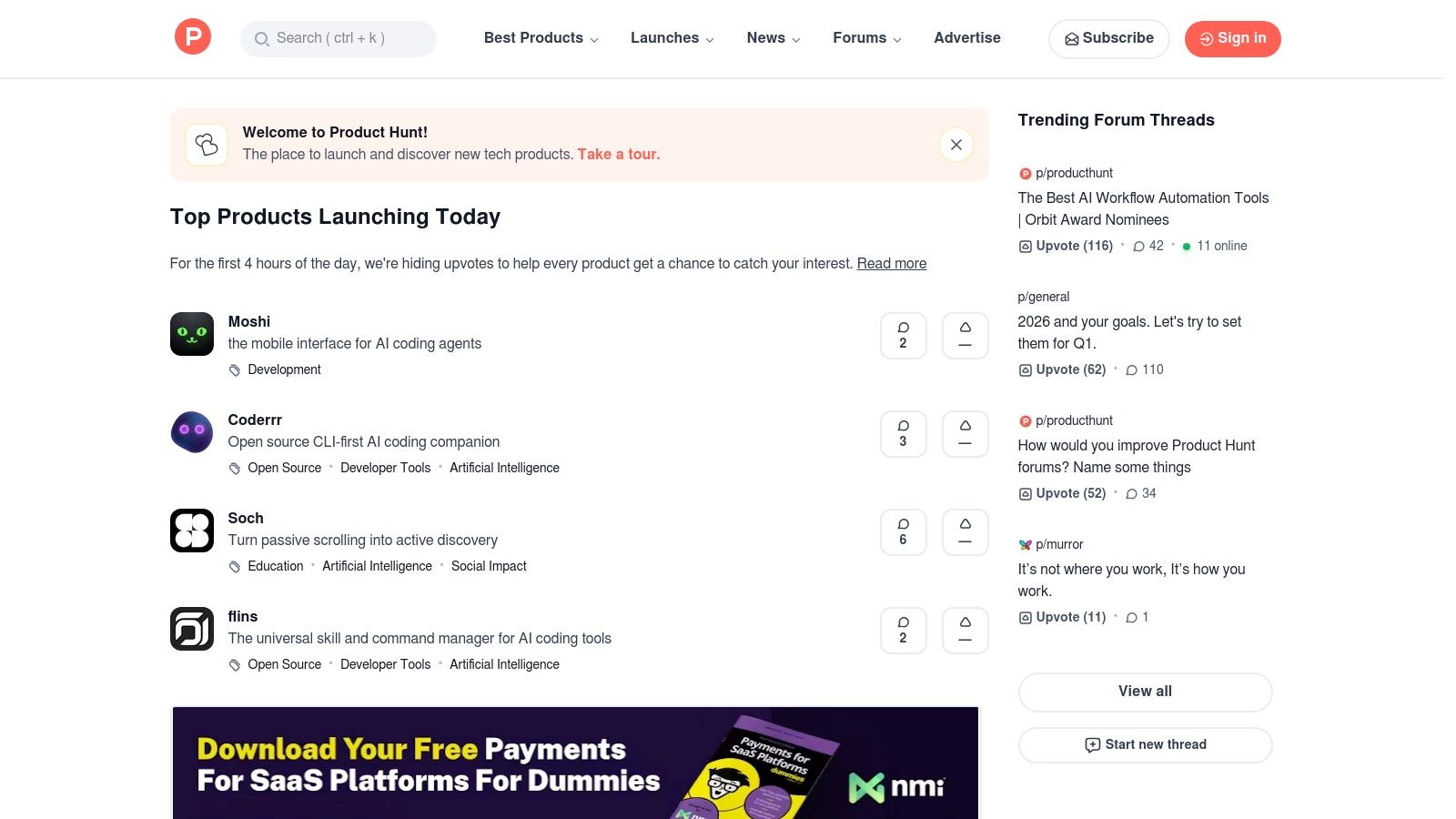
Its strength is the raw, immediate feedback from a tech-savvy community. Upvotes, comments, and collections act as a rapid vetting mechanism, allowing you to gauge initial interest and identify practical use cases from day one. You can spot everything from a new AI-powered content generator to a niche analytics tool, often interacting directly with the creators in the comments to ask pointed questions.
Strategic Application
- Key Takeaway: Product Hunt is the go-to discovery platform for identifying bleeding-edge AI marketing tools and sensing future trends before they are widely adopted or reviewed on larger marketplaces.
- Practical Example: A marketing director at a SaaS startup can monitor daily launches to find a newly released AI agent for automating social media comment moderation, gaining a first-mover advantage over competitors using older tools.
- Impact Opportunity: Reduces the risk of tech obsolescence by providing early visibility into disruptive tools, allowing for pilot programs with innovative solutions before committing to long-term contracts.
| Feature | Product Hunt's Value for AI Tool Discovery |
|---|---|
| Daily Launches | Provides a constant stream of new AI tools, perfect for spotting innovation as it happens. |
| Community Upvotes & Feedback | Offers immediate social proof and unvarnished user opinions on a tool's utility and potential. |
| Curated Collections | Groups emerging tools by categories like "AI for Marketers," simplifying the discovery process. |
| Direct Maker Access | Allows for direct Q&A with the founders and developers in the comment threads for deeper insights. |
Pros: Excellent for early discovery and sensing market trends. The community commentary quickly reveals practical applications and potential flaws.
Cons: Many tools are early-stage and may lack maturity, strong support, or enterprise-grade security. The hype of a launch day can sometimes inflate a tool's perceived value.
Finding the right tool is only part of the equation; understanding its strategic fit is crucial. As AI tools evolve, it is important to learn about how to win traffic with AI SEO content to maximize their impact.
Website: https://www.producthunt.com
5. HubSpot App Marketplace (Breeze agents & assistants)
For organizations already embedded in the HubSpot ecosystem, the HubSpot App Marketplace is a native launchpad for discovering the best AI tools for marketing. More than just a directory, it provides a curated and integrated environment where AI-powered applications, agents, and templates are designed to work seamlessly with HubSpot’s CRM, Marketing, and Sales Hubs. The recent introduction of Breeze AI agents and a customizable Studio makes this an essential resource for teams aiming to enhance their existing GTM motions with tightly coupled AI capabilities.
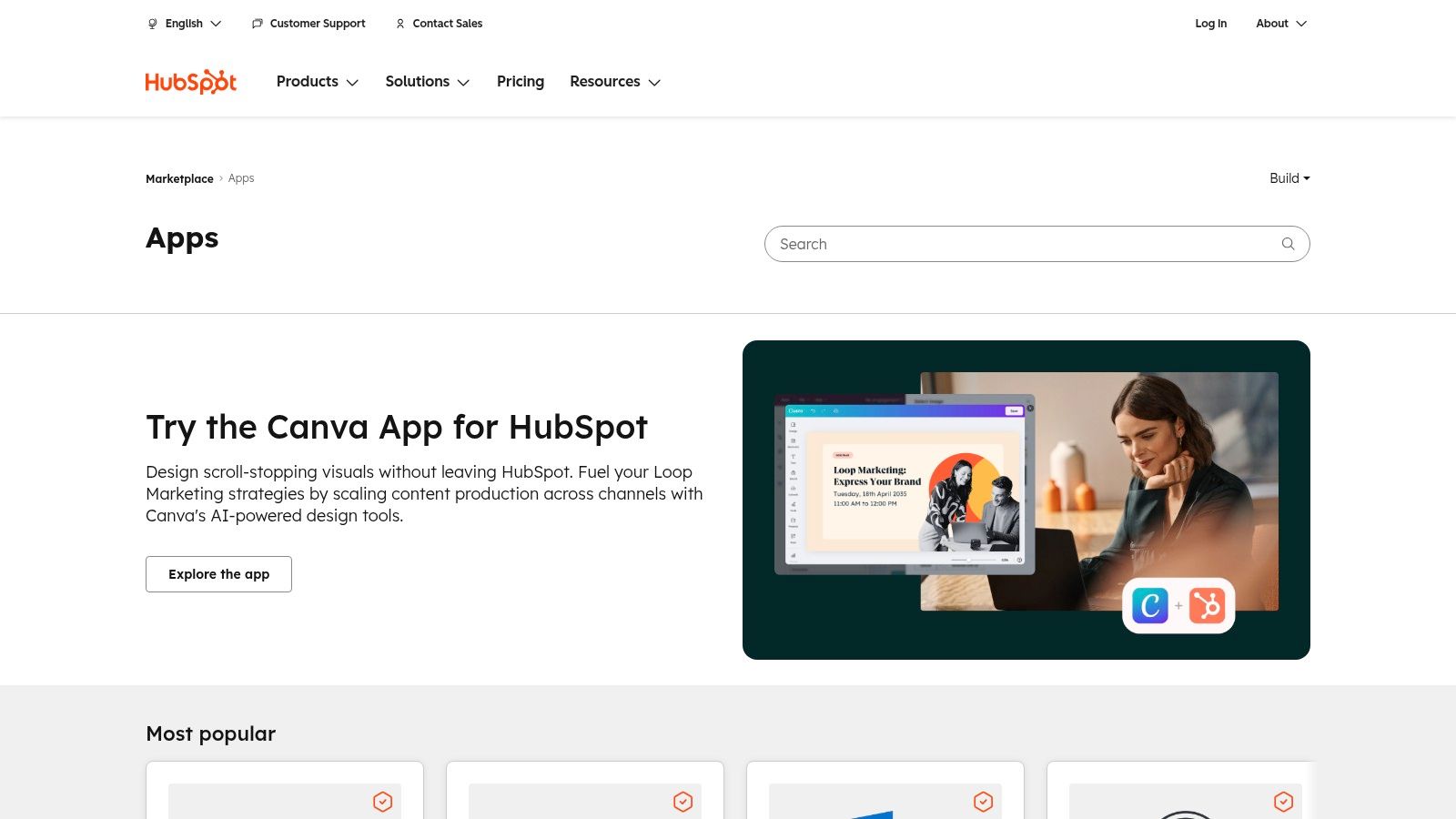
The marketplace's primary advantage is its focus on integration and governance. It provides personalized discovery and clear guidelines for app permissions and data handling, significantly simplifying the vetting process. Instead of searching a vast, open market, HubSpot users can find pre-built AI solutions for content creation, data orchestration, and automation that are already aligned with their core CRM data model.
Strategic Application
- Key Takeaway: The HubSpot App Marketplace de-risks AI adoption for HubSpot users by providing a vetted, integrated ecosystem of apps and agents that extend the platform's core functionality without complex custom development.
- Practical Example: A marketing team using HubSpot can deploy a Breeze AI agent to automatically enrich new contact records with firmographic data from third-party sources, score the lead based on custom criteria, and then assign it to the correct sales rep, all within their existing workflows.
- Impact Opportunity: Accelerates the deployment of AI-driven marketing and sales plays by using pre-built, CRM-native tools, reducing time-to-value and ensuring data consistency across the GTM tech stack.
| Feature | HubSpot Marketplace's Value for AI Tool Discovery |
|---|---|
| HubSpot-Built AI Agents | Offers customizable, pre-built agents (via Breeze Studio) for specific marketing and sales tasks. |
| Unified App Inventory | Provides a single location to find apps, agents, templates, and certified partners. |
| Integrated Security | Simplifies governance with clear SSO/OAuth and permissioning guidance for AI connectors. |
| Native Integration | Ensures seamless data flow and process automation between AI tools and the HubSpot CRM. |
Pros: Unmatched integration with the HubSpot platform ensures data integrity and ease of use. The simplified deployment and governance model is ideal for teams needing quick, secure solutions.
Cons: The value is almost exclusively for existing HubSpot customers. The native AI agent catalog is powerful but still maturing and may not cover every niche use case yet.
using integrated tools is a core tenet of modern GTM strategy. Exploring AI-powered lead generation within this ecosystem can unlock significant efficiencies. For more on this, you can learn more about how to enhance your lead generation with AI.
Website: https://ecosystem.hubspot.com/marketplace/apps
6. Shopify App Store
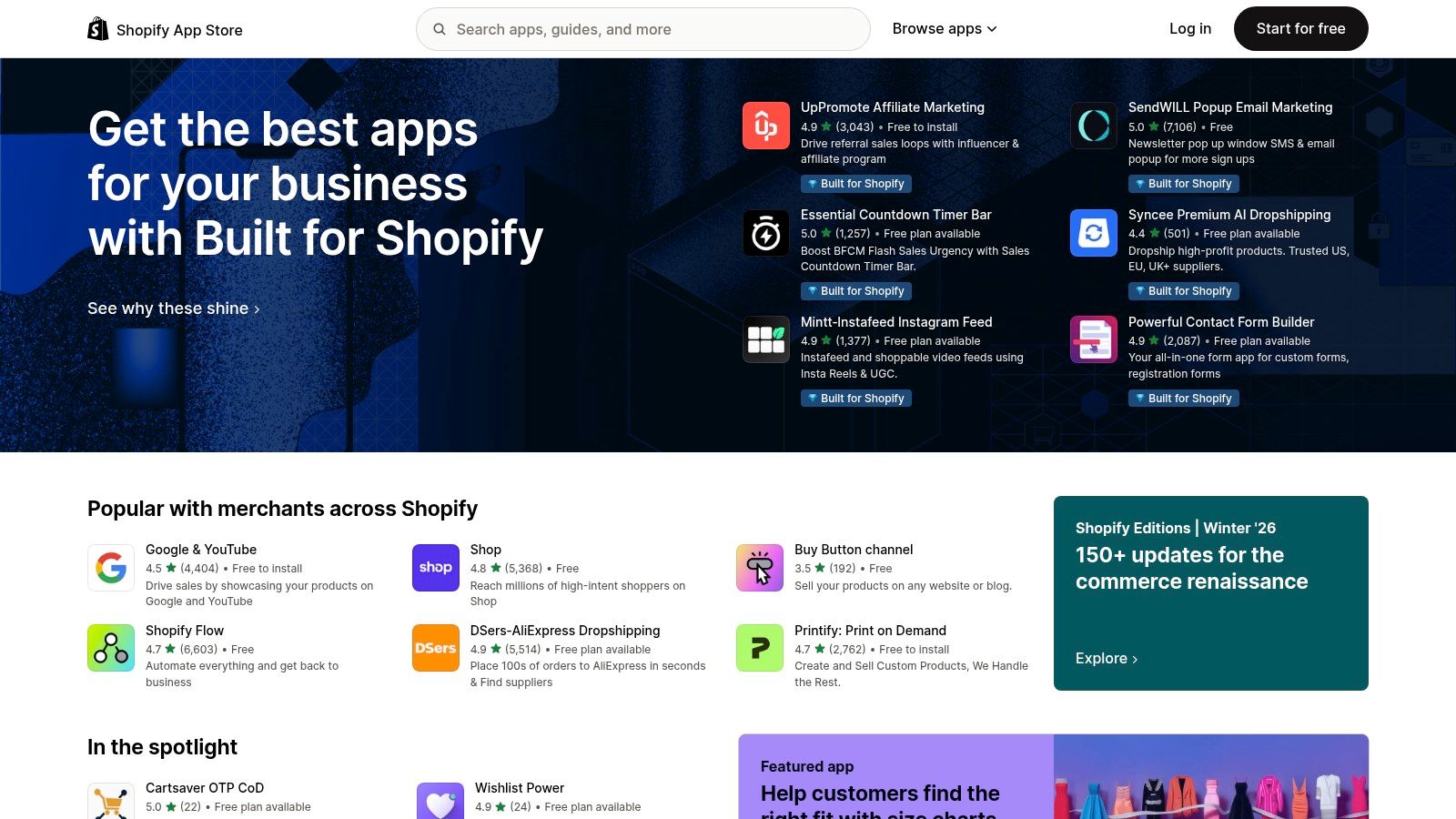
For direct-to-consumer (DTC) brands, the Shopify App Store is a critical ecosystem rather than a single tool. It is a specialized marketplace for the best AI tools for marketing, offering applications designed to integrate seamlessly into the Shopify platform. This direct-install model allows e-commerce leaders to rapidly deploy AI solutions for specific storefront challenges, from generating ad creative to automating personalized email flows.
The value lies in its e-commerce-centric design. Instead of generic AI solutions, you find apps purpose-built to drive tangible storefront KPIs like conversion rate, average order value, and customer lifetime value. Rich app pages provide user reviews, clear pricing tiers, and direct integration notes, which simplifies the otherwise complex process of vetting and implementing new marketing technology.
Strategic Application
- Key Takeaway: The Shopify App Store provides the fastest path for e-commerce brands to deploy and measure the impact of AI marketing tools directly tied to revenue-generating activities.
- Practical Example: A DTC apparel brand can install an AI-powered app to automatically generate on-brand product descriptions and blog content optimized for SEO, directly from their Shopify admin panel.
- Impact Opportunity: Significantly reduces implementation time and technical overhead, allowing marketing teams to quickly test and scale AI applications that have a direct, measurable effect on sales and customer engagement.
| Feature | Shopify App Store's Value for AI Tool Discovery |
|---|---|
| Direct Shopify Installs | Enables one-click implementation of AI tools, eliminating complex integration projects. |
| Verified App Reviews | Offers social proof from other merchants, detailing real-world app performance and support quality. |
| E-commerce Specific Apps | Provides solutions tailored for specific tasks like AI-driven personalization or ad generation. |
| Clear Pricing & Trials | Simplifies budgeting and ROI calculation with transparent pricing tiers and free trial periods. |
Pros: Fast implementation and measurable impact on storefront KPIs. Abundant reviews and clear app compatibility notes help de-risk adoption.
Cons: App quality varies significantly; data permissions and support levels must be carefully verified. Its utility is almost exclusively limited to Shopify merchants.
For leaders in the e-commerce space, this platform is the most direct route to using AI. It turns the abstract concept of AI marketing into a tangible set of solutions you can deploy in minutes.
Website: https://apps.shopify.com
7. Salesforce AppExchange
For organizations standardized on the Salesforce ecosystem, the AppExchange is the primary, trusted marketplace to discover the best AI tools for marketing. It functions less as an open aggregator and more as a curated, enterprise-grade storefront where every application has undergone a rigorous security review. This makes it an essential resource for leaders who need AI solutions that are guaranteed to integrate deeply and securely with their core CRM and Marketing Cloud data.
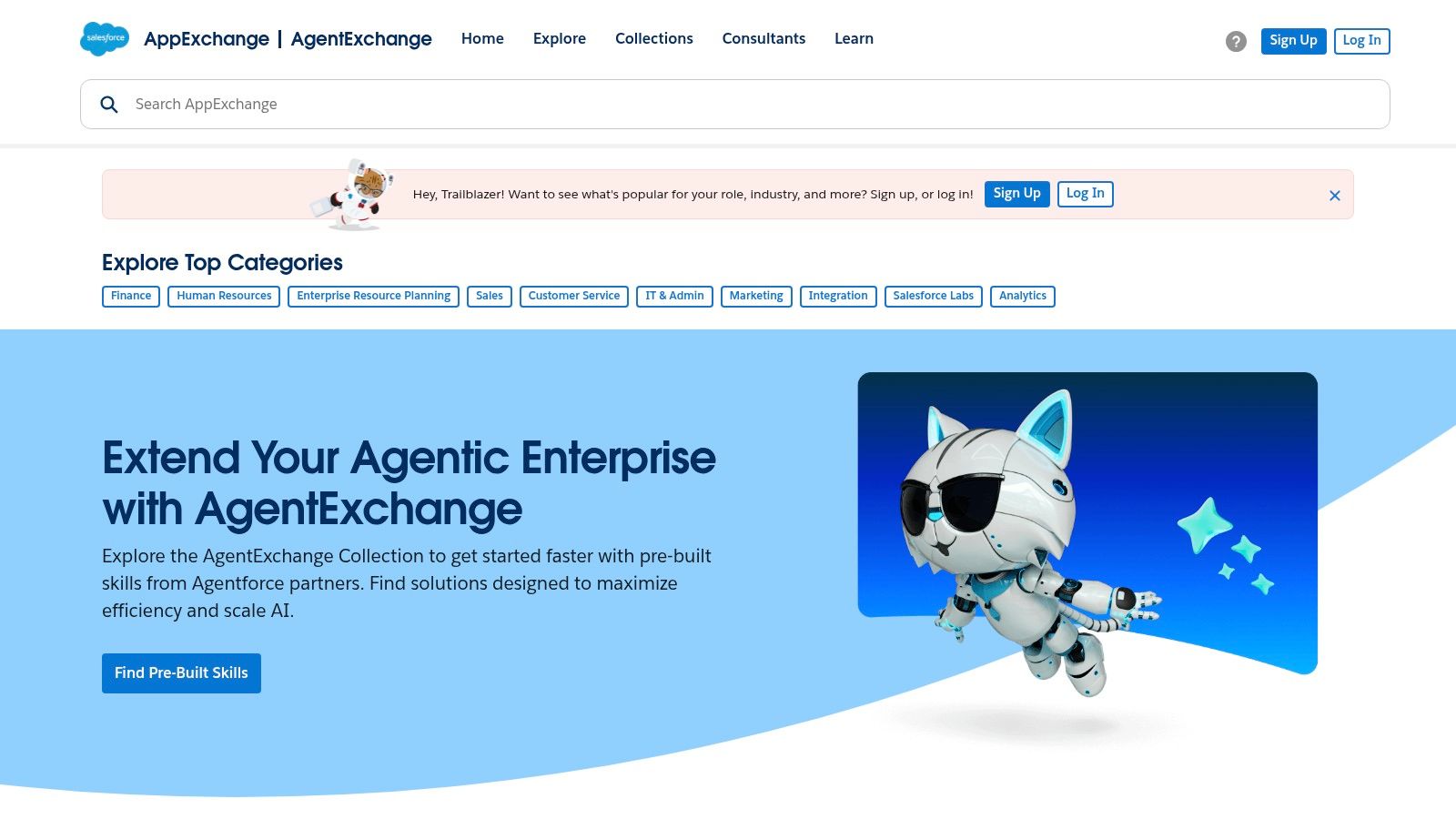
The platform’s value is its native connectivity, eliminating the integration headaches and data siloing risks that come with disparate tools. You can find AI applications purpose-built for Salesforce to enhance everything from audience segmentation and ABM personalization to predictive analytics and creative optimization, all within a governed environment.
Strategic Application
- Key Takeaway: The AppExchange provides a secure, pre-vetted ecosystem of AI tools that directly extend your Salesforce investment, ensuring seamless data flow and enterprise-level governance.
- Practical Example: A B2B enterprise using Marketing Cloud can find a partner-packaged generative AI agent on the AppExchange to create personalized email subject lines and body copy based on individual contact records and past engagement history within Salesforce.
- Impact Opportunity: Significantly shortens the procurement and security review cycle for new AI tools, allowing marketing teams to deploy and scale new capabilities much faster while adhering to strict IT compliance protocols.
| Feature | Salesforce AppExchange's Value for AI Tool Discovery |
|---|---|
| Deep CRM & Marketing Cloud Integrations | Ensures tools work natively with your core customer data, maximizing AI model effectiveness. |
| Vetted Security Reviews | Provides confidence that applications meet stringent enterprise security and compliance standards. |
| Edition Compatibility Details | Clearly lists which Salesforce versions and clouds are supported, preventing procurement errors. |
| Partner-Packaged AI Agents | Offers ready-to-deploy AI solutions for specific tasks like lead scoring or content generation. |
Pros: Enterprise-ready with a strong trust and security posture. simplified provisioning and licensing are often handled directly through Salesforce, simplifying vendor management.
Cons: The platform primarily benefits existing Salesforce customers, offering little value otherwise. Pricing is often opaque, requiring you to contact vendors directly for a quote.
By using the AppExchange, you can augment your existing martech stack with powerful, integrated AI without introducing unnecessary security risks or complex custom integration projects.
Website: https://appexchange.salesforce.com
8. Zapier (AI Tools Directory)
Zapier is the essential connective tissue for the modern marketing stack, and its role has become even more critical with the rise of AI. It's not just an automation platform but also a powerful directory and orchestrator for AI-powered workflows. For marketing leaders, Zapier provides a low-code environment to link disparate AI tools, like an AI content generator and a social media scheduler, into a single, automated process without requiring engineering resources.
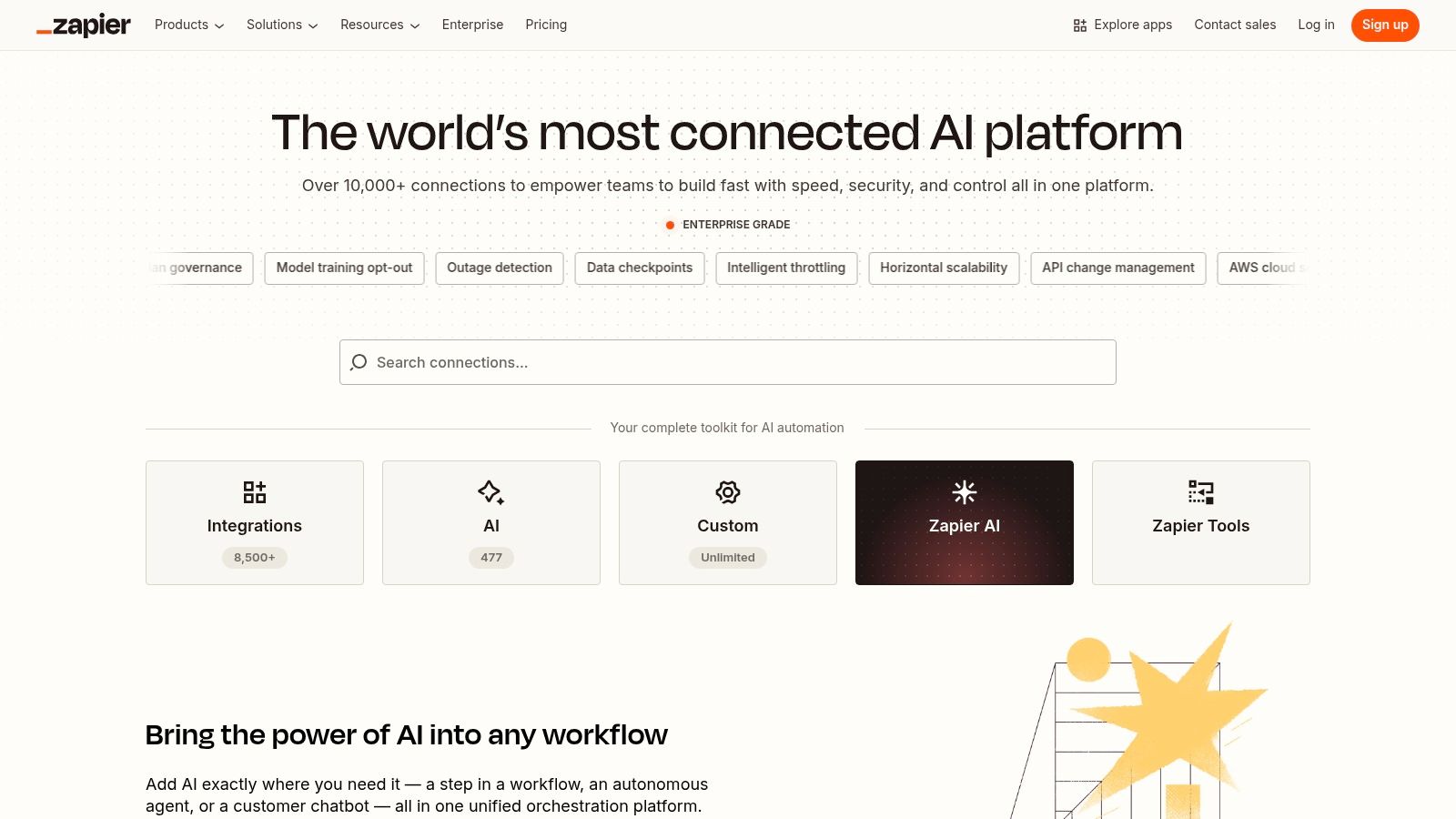
Its true advantage is its ability to operationalize AI across more than 8,500 applications. You can use its native AI capabilities or integrate specialized AI models to trigger actions in your CRM, ad platforms, or analytics tools. This transforms AI from a standalone novelty into an embedded component of your core marketing operations, automating everything from lead enrichment to content distribution.
Strategic Application
- Key Takeaway: Zapier democratizes AI integration, allowing marketing teams to build complex, cross-platform automations that infuse AI into day-to-day workflows without writing a single line of code.
- Practical Example: A content marketing manager can create a "Zap" that automatically sends a draft from a GPT-powered writing tool to a human editor for approval, then, upon approval, publishes it to their blog and shares it across social media channels.
- Impact Opportunity: Dramatically accelerates marketing operations by automating the manual "hand-offs" between different AI and non-AI tools, freeing up teams to focus on strategy rather than repetitive tasks.
| Feature | Zapier's Value for AI Tool Discovery |
|---|---|
| Directory of AI Apps & Integrations | Offers a browsable, searchable database of AI tools that can be immediately connected to your stack. |
| Native AI Capabilities (Agents, Chatbots) | Provides built-in AI tools for creating conversational agents or triggering multi-step AI workflows. |
| Human-in-the-Loop Steps | Allows for manual approval stages within automations, ensuring quality control for AI-generated output. |
| Extensive App Ecosystem & Templates | Provides pre-built workflow templates ("Zaps") for common AI marketing use cases to speed up deployment. |
Pros: The no-code interface enables rapid prototyping and deployment of AI-driven marketing tasks. Its massive library of integrations makes it one of the most versatile best AI tools for marketing orchestration.
Cons: Complex, multi-step automations can become difficult to manage and troubleshoot. The older "AI Actions" model is being phased out, which may require users to migrate existing workflows.
By using Zapier, you can create a customized and automated marketing engine that bridges the gaps between your specialized AI solutions and your core operational platforms.
Website: https://zapier.com/apps/ai-tools
9. AppSumo
For marketing leaders looking to experiment with emerging AI capabilities without committing to significant annual contracts, AppSumo is a unique discovery and procurement platform. It’s a marketplace for time-sensitive, often lifetime, deals on new software, making it an excellent resource for finding niche best AI tools for marketing before they become mainstream. This approach allows teams to pilot multiple tools for content generation, SEO, or analytics at a fraction of the typical cost.
AppSumo's value lies in its role as an incubator for innovation. While not every tool will have the polish of an enterprise-grade solution, the platform provides a low-risk environment to test novel applications of AI. The user reviews and Q&A sections are critical for vetting the viability of a product and understanding the founder's commitment and vision, offering a ground-floor perspective on new market entrants.
Strategic Application
- Key Takeaway: AppSumo is a strategic testing ground, enabling cost-effective experimentation with advanced AI marketing tools to identify high-potential solutions for future, larger-scale adoption.
- Practical Example: A small marketing agency can acquire lifetime deals on three different AI-powered copywriting tools for less than a single month's subscription to a major competitor, allowing them to benchmark performance and find the best fit for their workflow.
- Impact Opportunity: Dramatically lowers the financial barrier to AI adoption, enabling teams to build a versatile and modern marketing stack with minimal upfront investment and discover tools that provide a distinct competitive advantage.
| Feature | AppSumo's Value for AI Tool Discovery |
|---|---|
| Lifetime & Discounted Deals | Provides access to AI software for a one-time fee, eliminating recurring subscription costs for pilots. |
| Curated "Best AI" Collections | Editorial teams and user ratings highlight promising AI tools, simplifying the discovery process. |
| User Reviews & Q&A | Offers direct access to community feedback and founder responses, aiding in due diligence. |
| Early Access to Innovators | Showcases new startups and AI-driven products before they are widely known in the market. |
Pros: The extremely low cost of entry makes it ideal for trialing new tools or supplementing an existing tech stack. It occasionally uncovers high-value products before they hit the mainstream.
Cons: The long-term viability of vendors offering lifetime deals can be uncertain. Tools may lack the strong support, security, and enterprise-grade features required by larger organizations.
To maximize value, focus on tools that solve a specific, immediate problem rather than seeking an all-in-one platform. Vet the product's roadmap and founder engagement in the Q&A section to gauge long-term potential.
Website: https://appsumo.com
10. Microsoft AppSource
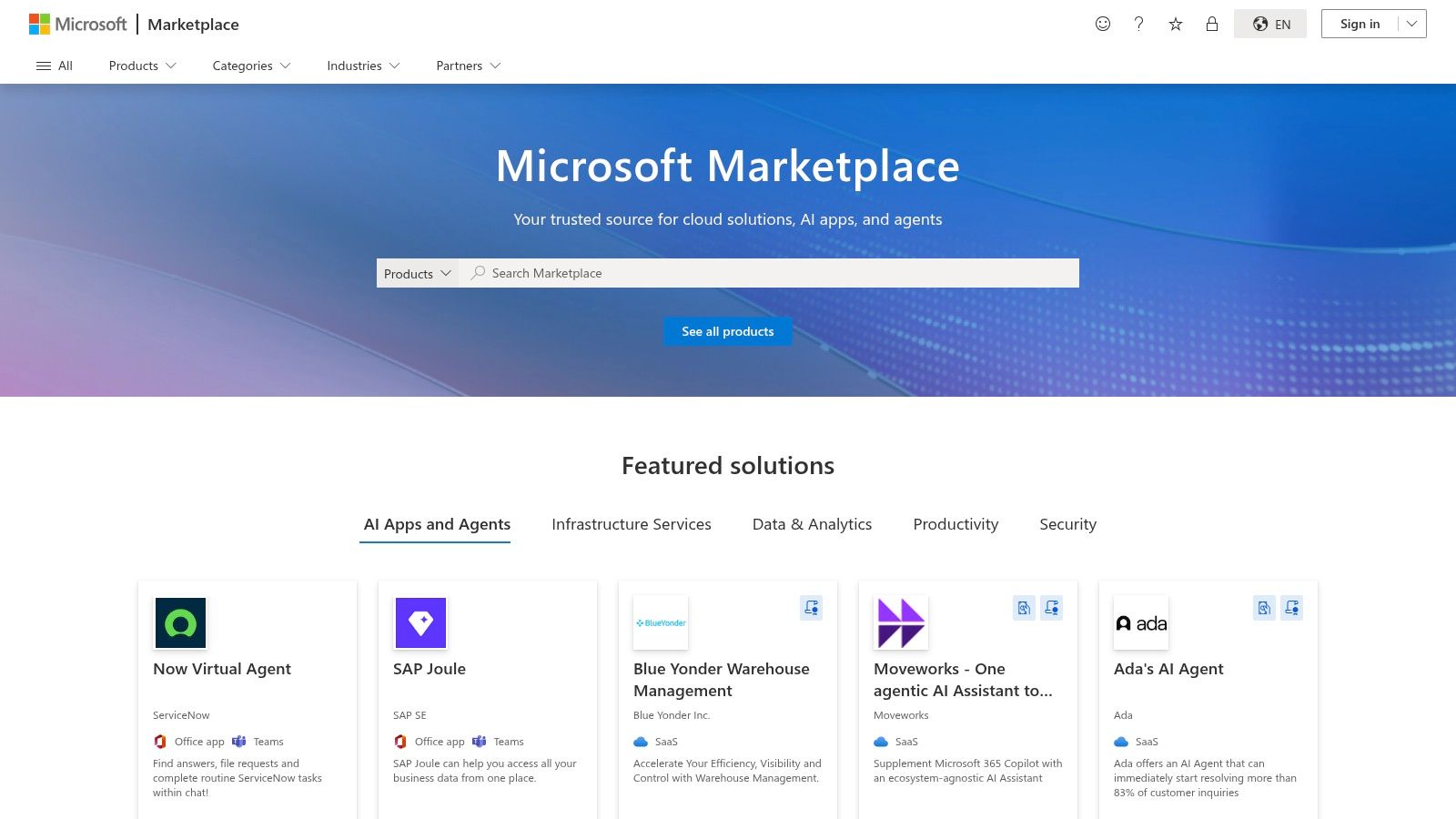
For organizations deeply integrated into the Microsoft ecosystem, AppSource is the essential marketplace for discovering AI tools that natively extend their existing workflows. Rather than a standalone platform, it is a vetted repository for add-ins and applications designed for Microsoft 365, Dynamics 365, and the Power Platform. It is a critical resource for finding the best AI tools for marketing that use your current technology stack.
AppSource excels by embedding AI capabilities directly into the software your team uses daily, like Outlook, PowerPoint, and Excel. This approach minimizes disruption and accelerates adoption, allowing marketers to generate campaign assets, analyze data, and enhance customer engagement without switching contexts. It offers a secure, compliant way to augment familiar tools with powerful new intelligence.
Strategic Application
- Key Takeaway: AppSource de-risks AI adoption for Microsoft-centric organizations by providing a governed marketplace of integrated tools that enhance existing workflows and ensure compliance.
- Practical Example: A marketing team using Dynamics 365 can find and deploy an AI-powered lead scoring app directly from AppSource, which then works seamlessly within their CRM to prioritize sales outreach based on real-time engagement data.
- Impact Opportunity: Dramatically reduces the time-to-value for new AI tools by eliminating complex integrations and embedding AI functionality within the applications marketers already have open all day.
| Feature | AppSource's Value for AI Tool Discovery |
|---|---|
| Native Microsoft Integration | Ensures seamless compatibility with Dynamics 365, Power BI, and Microsoft 365 for unified workflows. |
| Vetted & Certified Apps | Offers enterprise-grade security and compliance, a key requirement for corporate IT governance. |
| Embedded AI in Office Tools | Brings AI features like content generation and data analysis directly into PowerPoint, Excel, and Outlook. |
| Industry & Role-Specific Filters | Allows users to find highly relevant AI solutions tailored for specific sectors and marketing functions. |
Pros: Strong governance and compliance alignment simplifies IT approval. Speeds campaign asset production by embedding AI where marketers already work.
Cons: Marketing-specific curation is broad, so discovery can take time. Many of the most powerful offers are primarily focused on existing Microsoft ecosystem users.
To maximize its value, filter AppSource by the specific Microsoft product you use most, such as "Dynamics 365," and then by capability, like "Marketing Automation" or "Analytics."
Website: https://appsource.microsoft.com
11. Adobe Exchange / Marketo LaunchPoint
For enterprise organizations deeply embedded in the Adobe ecosystem, the Adobe Exchange and its Marketo LaunchPoint counterpart are the definitive hubs for extending marketing automation capabilities. Rather than a standalone tool, this is a strategic marketplace for discovering vetted third-party applications and integrations specifically designed to enhance Adobe Experience Cloud and Marketo Engage. It’s where leaders can find solutions to orchestrate complex, multi-channel marketing campaigns, from advanced analytics to sophisticated ABM.
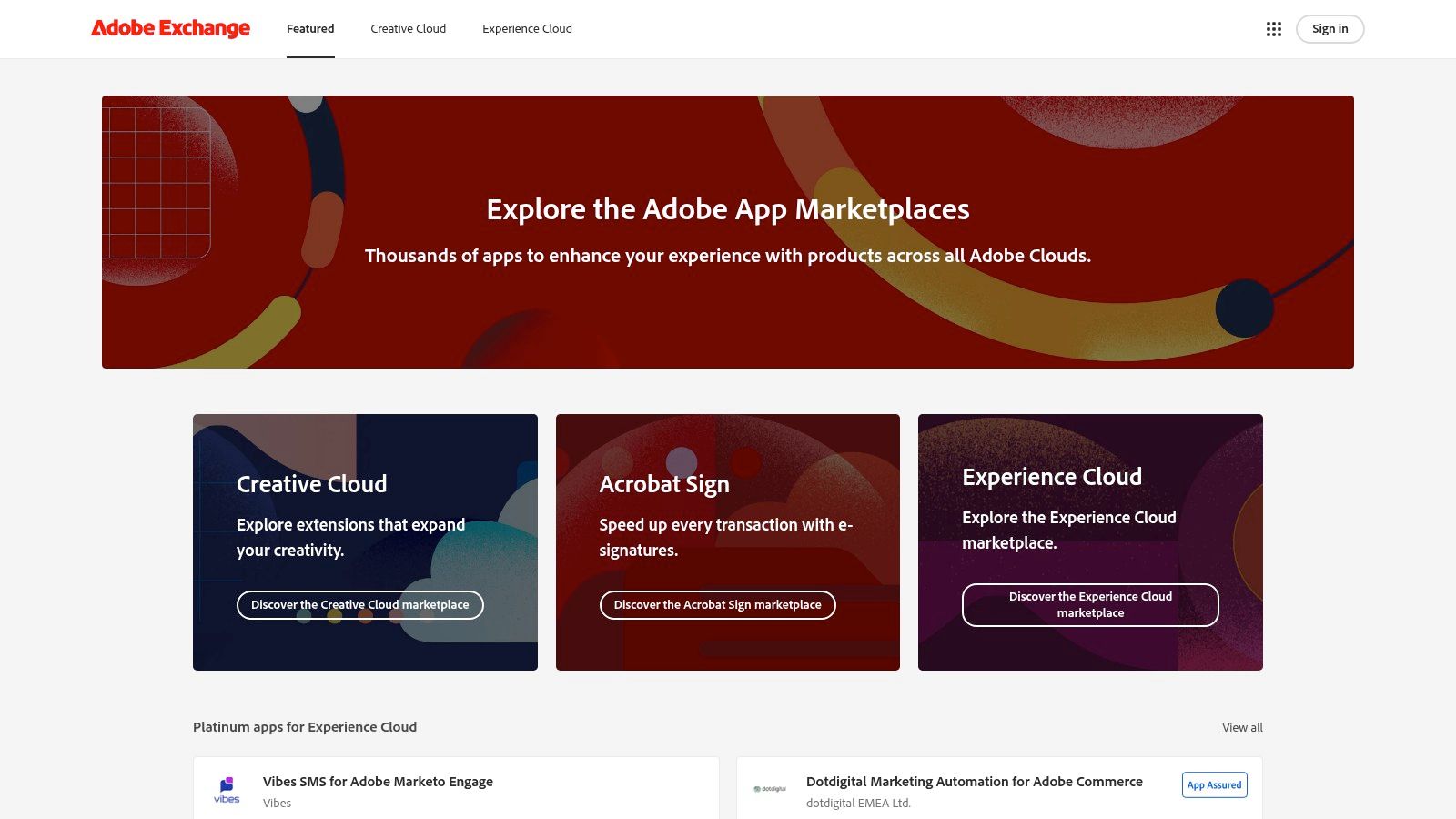
The platform’s value lies in its curated and documented ecosystem. Instead of gambling on unproven tools, marketing leaders can confidently select integrations that are guaranteed to connect seamlessly with their core Adobe infrastructure. This centralized directory is essential for standardizing technology and ensuring data flows correctly across the entire marketing stack, a key requirement when searching for the best AI tools for marketing at an enterprise scale.
Strategic Application
- Key Takeaway: The Adobe Exchange de-risks technology expansion by providing a single source of truth for certified integrations, ensuring any new AI tool complements the existing Adobe investment.
- Practical Example: A global financial services firm using Marketo Engage can use LaunchPoint to find an AI-powered predictive lead scoring partner that natively integrates with their instance, enriching lead data without complex custom development.
- Impact Opportunity: Accelerates the adoption of new marketing technologies by eliminating integration uncertainty and providing clear documentation, allowing teams to focus on strategy rather than technical troubleshooting.
| Feature | Adobe Exchange's Value for AI Tool Discovery |
|---|---|
| Certified Integrations | Ensures seamless data flow and functionality between Adobe products and third-party AI applications. |
| Enterprise Data Products | Offers access to specialized data marketplaces, like Audience Manager, for enriching customer profiles. |
| Comprehensive Docs | Provides detailed guides on licensing, implementation guardrails, and API usage for confident deployment. |
| Solution-Specific Apps | Lists applications for distinct marketing functions like ABM, personalization, analytics, and attribution. |
Pros: Deep, well-documented integrations provide a reliable foundation for complex marketing operations. It is exceptionally well-suited to large-scale, multi-channel and ABM strategies.
Cons: Discoverability can be fragmented, requiring users to navigate both the Exchange and Experience League docs. Pricing and procurement processes are heavily enterprise-oriented and can be complex.
For teams committed to the Adobe stack, using the Exchange is non-negotiable for finding compatible AI enhancements that drive personalization and efficiency at scale.
Website: https://exchange.adobe.com
12. AWS Marketplace
For enterprise teams already building on Amazon Web Services, the AWS Marketplace is a critical procurement hub for deploying the best AI tools for marketing. It functions less like a review site and more like a pre-vetted, enterprise-grade catalog of AI-powered applications that can be deployed directly into your existing cloud infrastructure. This co-location simplifies data integration and enhances security, a major advantage for data-heavy B2B marketing teams.
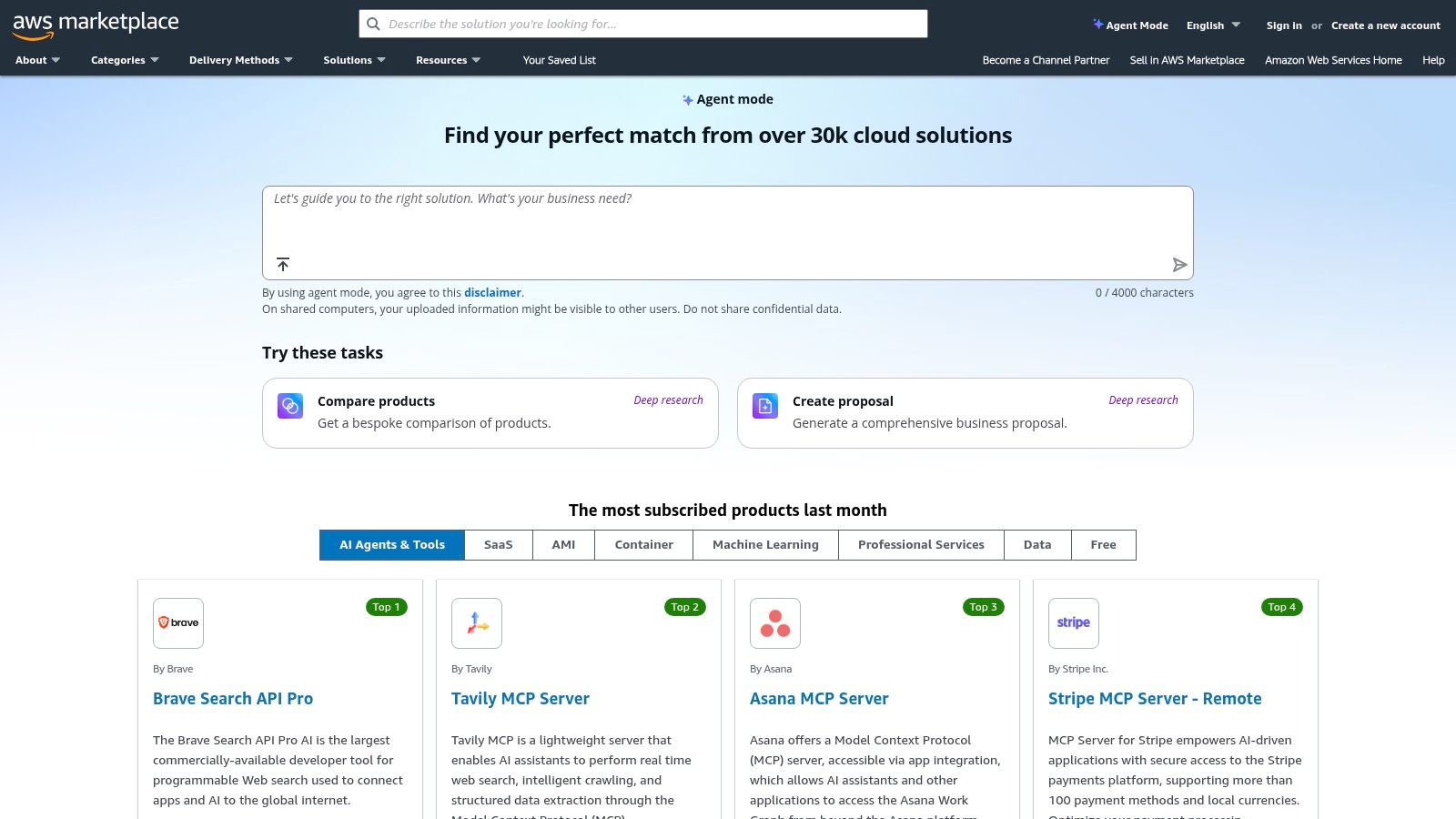
The platform centralizes procurement, offering consolidated billing, usage monitoring, and private pricing offers directly from vendors. This simplifies the often-complex process of acquiring and managing new marketing technologies, enabling leaders to manage software spend through their established AWS relationship. It offers a direct path from discovery to production for tools specializing in analytics, segmentation, and campaign automation.
Strategic Application
- Key Takeaway: AWS Marketplace simplifies procurement and deployment of AI marketing tools for organizations heavily invested in the AWS ecosystem, ensuring technical compatibility and security compliance.
- Practical Example: A financial services firm can use the marketplace to find an AI-powered customer data platform that meets strict FinServ compliance standards and deploys directly into their AWS environment, giving it secure access to their S3 data lakes.
- Impact Opportunity: Significantly shortens the time-to-value for new AI tools by removing procurement friction and simplifying technical integration with existing cloud data sources and services.
| Feature | AWS Marketplace's Value for AI Tool Discovery |
|---|---|
| Integrated Procurement | Centralizes billing and cost management through existing AWS accounts, simplifying budget approvals. |
| Private Offer Pricing | Allows for negotiating custom pricing and terms directly with software vendors for enterprise needs. |
| Security & Compliance | Lists solutions vetted for enterprise security standards, often with industry-specific compliance. |
| Cloud-Native Deployment | Ensures tools are optimized to run efficiently within the AWS environment, reducing integration friction. |
Pros: Enterprise-grade security, compliance, and procurement workflows are built-in. It offers a simplified path to production for AI marketing workloads co-located with AWS data lakes and ML services.
Cons: Many listings require requesting a quote and technical involvement from IT or DevOps. It is best suited for organizations already committed to and building on the AWS cloud platform.
For teams operating at scale, aligning your marketing tool stack with your core cloud infrastructure is a strategic imperative. The AWS Marketplace provides a controlled environment to do just that, ensuring new AI capabilities are built on a solid foundation.
Website: https://aws.amazon.com/marketplace
12 AI Marketing Marketplaces & Directories Comparison
| Marketplace | Core features | Quality | Price/value | Target | USP |
|---|---|---|---|---|---|
| G2 | Deep peer reviews, leader/Momentum grids, rich filters | ★★★★★ | Free discovery; some sponsored bias | B2B buyers, procurement, mid→enterprise | Verified reviews + market momentum insights |
| Capterra | Side‑by‑side comparisons, buyer guides, feature matrices | ★★★★☆ | Free; vendor PPC can affect prominence | SMB → mid‑market buyers | Structured shortlists & clear pro/con notes |
| GetApp | Category shortlists, verified ratings, comparison grids | ★★★★ | Free; focused shortlist value | SMB buyers & fast evaluators | Quick practical shortlists across MarTech |
| Product Hunt | Daily launches, community upvotes, discussion threads | ★★★★ | Free; great for early access | Early adopters, product scouts, startups | Early discovery of cutting‑edge AI apps |
| HubSpot App Marketplace | Unified apps + Breeze AI agents, templates, SSO guidance | ★★★★★ | Free listings; app pricing varies | HubSpot customers & HubOps teams | Tight CRM integration + customizable HubSpot agents |
| Shopify App Store | Direct installs, pricing tiers, trials, storefront integrations | ★★★★☆ | App pricing + trials; clear compatibility notes | DTC & retail merchants | Fast install → measurable storefront impact |
| Salesforce AppExchange | Edition compatibility, security reviews, enterprise provisioning | ★★★★★ | Vendor pricing/quotes typical | Enterprise Salesforce customers | Enterprise governance & simplified provisioning |
| Zapier (AI Directory) | No‑code automations, AI app directory, templates | ★★★★☆ | Free tier; paid for advanced workflows | Ops teams, growth & integration owners | Rapid cross‑stack orchestration without engineers |
| AppSumo | Time‑bound deals, lifetime offers, curated deals lists | ★★★ | Low upfront cost; risk on vendor longevity | Cost‑conscious startups & experimenters | Cheap pilots & occasional high‑value finds |
| Microsoft AppSource | Dynamics/Office integrations, trials, industry filters | ★★★★ | Free discovery; enterprise licensing common | Microsoft ecosystem & enterprise IT | Strong compliance & Office‑embedded AI |
| Adobe Exchange / Marketo LaunchPoint | Integration guides, enterprise data products, docs | ★★★★☆ | Enterprise‑oriented procurement | Adobe/Marketo enterprise marketers | Deep multi‑channel integrations for ABM |
| AWS Marketplace | AI apps, private offers, procurement & billing controls | ★★★★☆ | Quote/private offers; consolidated billing | Data‑heavy teams on AWS & enterprise IT | Production‑ready, secure deployments & procurement |
From Discovery to Deployment: Building Your Actionable AI Roadmap
Navigating the expansive market of AI marketing tools can feel overwhelming, but this guide has aimed to transform that chaos into a structured discovery process. We haven't just listed tools; we've explored the very marketplaces and ecosystems where the best AI tools for marketing are vetted, reviewed, and integrated. The goal was to equip you not just with a fish, but with the skills and frameworks to fish for the perfect AI solutions for your unique business challenges, now and in the future.
The core takeaway is a strategic shift in perspective. Instead of chasing individual "magic bullet" tools, the most successful B2B growth leaders are building integrated AI stacks. They start by identifying their most significant operational friction points, whether in content creation, ad spend efficiency, lead qualification, or customer data analysis, and then seek out solutions that plug seamlessly into their existing technology, like their CRM or marketing automation platform. This ecosystem-first approach ensures compatibility, simplifies data flow, and maximizes the return on your technology investment.
Key Takeaways for Building Your AI Stack
As you move from evaluation to implementation, keep these guiding principles leading of your strategy:
- Start with the Problem, Not the Platform: The most dazzling AI tool is useless if it doesn't solve a core business problem. Before you get lost in feature comparisons, clearly define the specific metric you want to move. Are you trying to reduce customer acquisition cost (CAC), increase lead conversion rates, or improve customer lifetime value (LTV)? Let the desired outcome dictate the tool selection.
- Prioritize Integration and Workflow: A powerful, standalone AI tool that creates data silos is a liability. The best AI tools for marketing are those that enhance your current systems. Prioritize solutions with strong, native integrations for your CRM (like Salesforce or HubSpot), your ad platforms, and your analytics dashboards to create a unified, intelligent GTM engine.
- Pilot, Measure, and Scale: Avoid the temptation of a company-wide, "big bang" rollout. Identify a single, high-impact use case and run a controlled pilot project with a small, dedicated team. Meticulously track key performance indicators (KPIs) before and after implementation to build a clear business case for a broader deployment. This iterative approach minimizes risk and builds internal momentum.
Your Actionable Next Steps
The journey to AI-powered marketing maturity is a marathon, not a sprint. The platforms we've detailed, from G2 and Capterra for broad reviews to specialized marketplaces like the Salesforce AppExchange and HubSpot App Marketplace, are your strategic maps.
- Audit Your Current Stack: Map out your existing marketing and sales technologies. Identify gaps, bottlenecks, and areas ripe for AI-driven automation and optimization.
- Define Your Pilot Project: Select one specific challenge from your audit. For example, "Automate the initial scoring and routing of inbound leads from our website" is a perfect, measurable pilot.
- Use the Marketplaces to Create a Shortlist: Based on your pilot project's needs and your existing CRM, use the platforms discussed in this article to build a shortlist of 3-5 potential AI tools. Pay close attention to recent user reviews, integration capabilities, and pricing models.
- Engage with Vendors and Run Demos: Reach out to your shortlisted vendors for demonstrations that are customized to your specific use case. Prepare a scorecard to evaluate each tool against your predefined requirements.
Ultimately, integrating AI into your marketing strategy is no longer a futuristic concept; it's a competitive necessity for B2B growth. By adopting a methodical, problem-focused approach and using the rich ecosystems available, you can build a powerful, efficient, and intelligent marketing function that not only keeps pace with the market but defines its future. The right tools are out there, waiting to transform your data into decisions and your efforts into exponential growth.
Navigating this complex market and ensuring a successful implementation can be challenging. If you need an expert partner to help you develop your AI roadmap, select the right tools, and manage the integration, Prometheus Agency specializes in guiding B2B companies through their AI transformation. Visit Prometheus Agency to learn how we can help you build a strategic, high-ROI AI stack.