Buying an AI agent platform isn't a transformation strategy. It's a procurement event. The companies getting real value from AI agents for business redesign the workflow first, clean up the systems around it, and then choose technology that can execute safely inside those constraints.
That distinction matters because adoption is already moving into production. PwC's survey of 300 senior executives found that 79% said AI agents were being adopted in their companies, while adopters reported gains in productivity, cost savings, and decision-making speed. Yet adoption alone doesn't create value. The operating model around the agent determines whether it becomes a dependable digital worker or another impressive demo that nobody trusts.
Why Most AI Agent Programs Stall Before They Scale
The popular advice says to choose a powerful model, connect it to your CRM, and let it automate work. That sequence is backwards. A model can reason well and still fail because it has no reliable account record, no permission to write a field, no escalation route, and no owner responsible for the outcome.
The failure usually begins in procurement. A team buys an agent license before mapping the process the agent is supposed to improve. The platform answers questions in a vacuum, but it can't complete the next step. It doesn't know whether a lead belongs in qualification, whether a support issue needs a specialist, or whether a proposed discount requires approval.
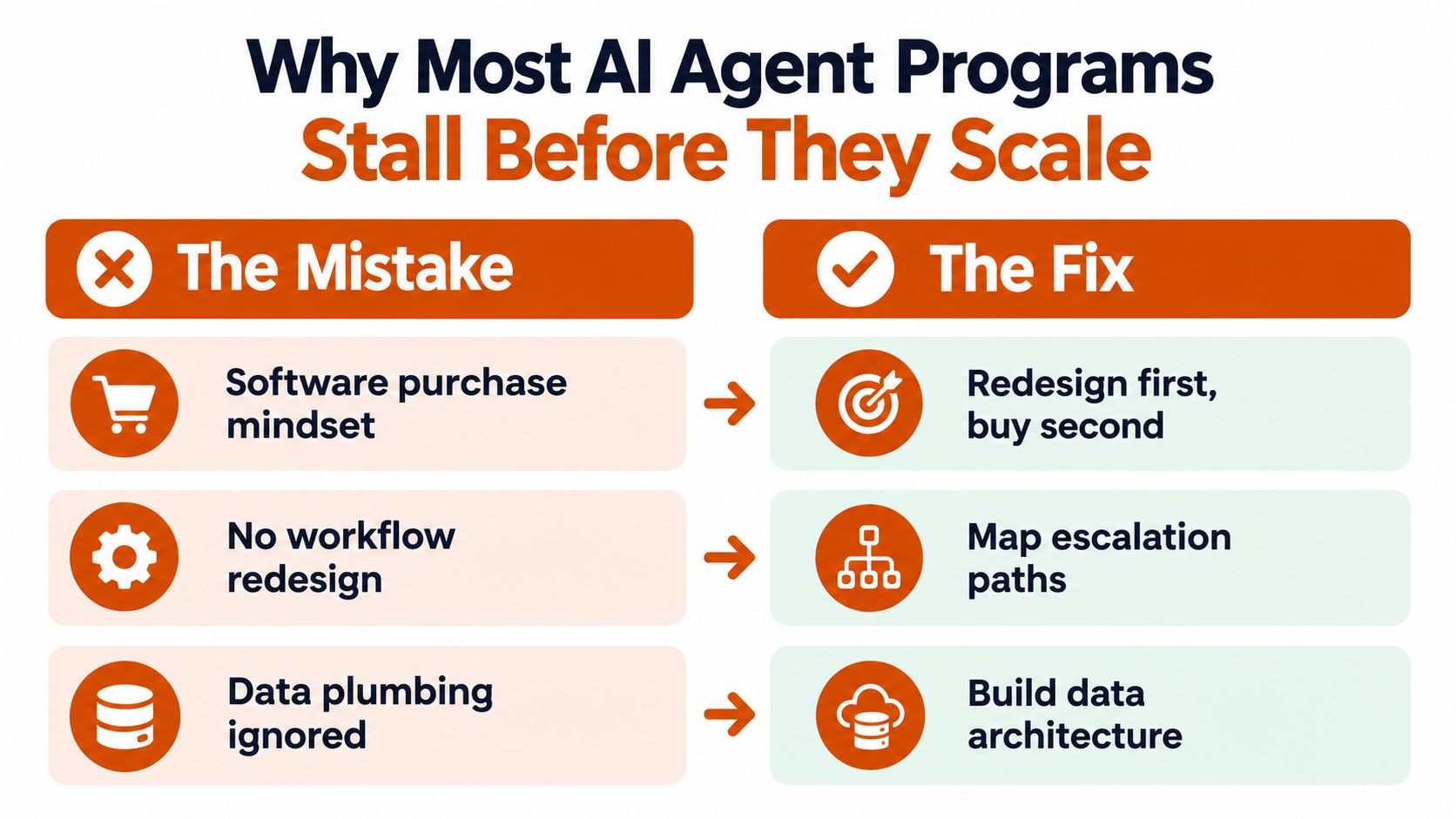
Practical rule: If you can't name the system of record, the human owner, and the failure handoff, you haven't selected an agent use case. You've selected a conversation.
The Workflow-First Test
Start with a broken process, not a category such as “sales AI” or “customer service AI.” Document the trigger, the decisions, the systems touched, the write actions, and the point where a person must take over. Then measure the current process before introducing automation.
A useful first-week workshop should answer:
- Trigger: What event starts the workflow, such as a form submission, reply, ticket, or contract change?
- Context: Which CRM records, emails, tickets, documents, and product events does the agent need?
- Action: What can it read, update, create, or route?
- Escalation: Which conditions require a person, and who receives the handoff?
- Accountability: Which executive owns the business result?
This is why the market is confusing procurement progress with transformation. A signed contract creates access to software. It doesn't redesign incentives, repair data plumbing, or give RevOps and IT shared accountability. Teams evaluating the move from an AI pilot to dependable production should also review this pilot-to-production perspective, because the difficult work starts after the demo.
Key Takeaways
Treat the agent as part of an operating system for work. Select one bounded workflow, instrument its baseline, assign an owner, and design the human handoff before comparing vendors. The best platform is the one that fits your data, identity, controls, and workflow architecture, not necessarily the one with the most impressive chat experience.
What AI Agents Actually Are and How They Differ From Chatbots
An AI agent is best understood as a progression of capabilities. The interface may look like a chat window, but the business value comes from what happens after the response.
Start with a scripted FAQ bot. It follows a decision tree, retrieves a prepared answer, and stops. Add a knowledge layer, and it can search approved content for a more relevant response. Add tools and write permissions, and it can check an order, create a task, update a CRM field, or route a ticket. Add planning, state tracking, and recovery logic, and it can pursue a goal across several steps.
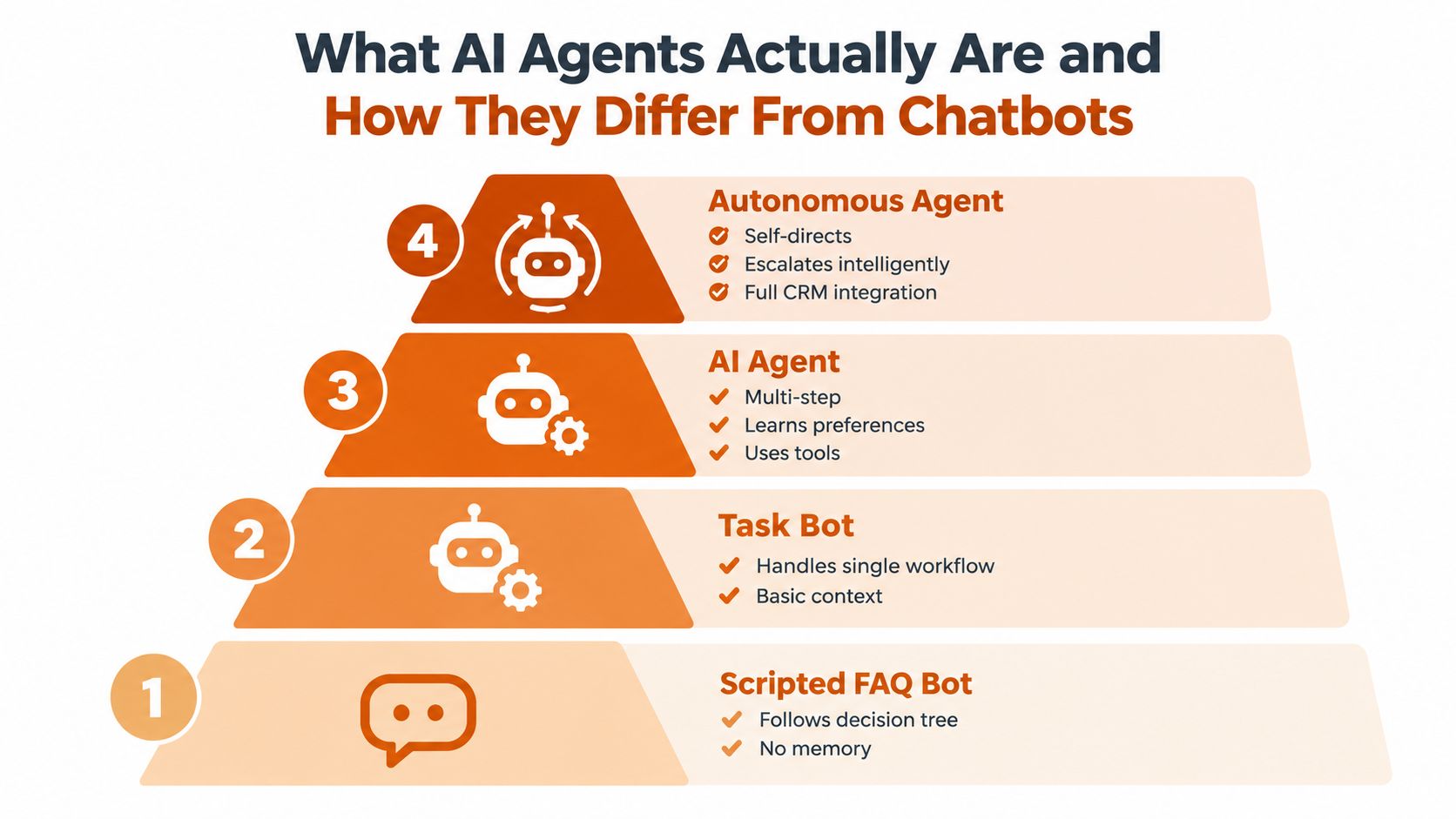
A chatbot reacts to a prompt. An agent receives an objective, breaks it into tasks, selects tools, checks results, updates systems, and escalates exceptions. That difference changes the risk profile. Each additional action creates another opportunity for a wrong decision, malformed parameter, stale record, permission failure, or incomplete recovery.
The business-context explanation of AI agents is useful for executives because it keeps the definition operational. A sales agent isn't valuable because it writes a persuasive email. It's valuable when it identifies the account, checks existing activity, applies qualification rules, drafts the next action, updates the opportunity, and sends the right cases to a rep.
Four capability levels
- Scripted FAQ bot: It handles predictable questions with fixed logic and no meaningful memory.
- Task bot: It completes a defined action, such as creating a ticket or generating a report, with limited context.
- AI agent: It combines retrieval, reasoning, tool use, and multi-step execution inside a bounded workflow.
- Autonomous agent: It self-directs within approved limits, monitors outcomes, and escalates when the situation exceeds its authority.
The enterprise sweet spot usually sits between task automation and controlled autonomy. Give the system enough freedom to remove coordination work, but keep irreversible actions behind explicit rules and human approval.
A procurement team should therefore ask what the agent can do, not only what it can say. A benchmark that tests agents across 47 real tools spanning sales, marketing, operations, support, finance, and HR illustrates why full-workflow reliability matters more than a single-turn answer score. The right evaluation repeats representative workflows from a fresh state and measures whether the agent completes the intended outcome consistently, as described in Zapier's agent benchmark.
Where AI Agents Deliver Value Across the Business
The strongest use cases have a clear trigger, structured data, repeatable decisions, and a measurable human checkpoint. They don't begin with “let's add an agent to sales.” They begin with “when this event occurs, the agent will complete these actions, and this person will approve the consequential step.”
In sales, an inbound form submission can trigger enrichment, account matching, qualification, routing, and a personalized first draft. The agent reads the form, CRM history, account data, and product signals. A rep reviews the qualification and message before the system changes opportunity ownership or sends outreach.
Marketing agents work best when they connect campaign activity to revenue context. They can assemble account segments, personalize nurture steps, summarize content performance, and route high-intent accounts to sales. The human checkpoint should sit around audience rules, claims, brand language, and budget changes, not around every low-risk classification.
Customer service offers another practical workflow. A new ticket triggers intent classification, account lookup, knowledge retrieval, response drafting, and priority assignment. A specialist approves sensitive responses, while the agent records the resolution and identifies whether the knowledge base needs an update.
Operations agents can reconcile records between systems, watch service-level commitments, flag exceptions, and start procurement or finance workflows. They should not change vendor terms or release payments without an approval boundary. The value comes from reducing coordination and surfacing exceptions earlier.
| Function | Agent Use Case | Data Sources | Human Checkpoint | Typical Lift |
|---|---|---|---|---|
| Sales | Qualify, enrich, route, and update inbound opportunities | CRM, forms, email, firmographic data, product activity | Rep approval for qualification and outreach | Faster response and less manual research |
| Marketing | Personalize nurture and route high-intent accounts | Marketing automation, CRM, campaign analytics, web activity | Marketer approval for audience, claims, and budget | More relevant follow-up and better routing |
| Customer service | Triage, retrieve context, draft, and log resolutions | Ticketing system, CRM, knowledge base, order history | Specialist review for sensitive or complex cases | Shorter handling work and cleaner records |
| Operations | Reconcile data, monitor commitments, and trigger workflows | ERP, CRM, procurement, finance, service systems | Manager approval for financial or contractual actions | Fewer handoffs and faster exception management |
The same principle applies to paid acquisition. An AI agent for Google Ads is most useful when it connects campaign signals to budget rules, conversion data, landing-page context, and a defined approval process. Automated bid or budget changes without those boundaries can move quickly in the wrong direction.
PwC's executive survey found active or planned agent use across customer service, sales and marketing, and IT and cybersecurity, which supports a broad operating view rather than an R&D-only view. The opportunity isn't to scatter agents across every department. It's to find the cross-functional workflows where one reliable handoff improves the customer journey.
Measuring the ROI of AI Agents: A Three-Layer Model
AI-agent ROI comes from workflow mechanics, not vendor promises. Define the business outcome first, then identify the operational measure the agent can directly change. A productivity claim has no financial value until you can show which tasks disappeared, which cycle time improved, or which capacity returned to the team.
PwC's survey found that AI-agent adopters reported increased productivity, cost savings, and faster decision-making. Those findings provide directional evidence, but they do not establish your business case. Finance and RevOps must define the unit of work, execution cost, error rate, review burden, and value of capacity released.
Treat model selection as a secondary decision. The defensible result comes from redesigning the workflow, assigning approval rights, and measuring the handoffs the agent changes. Set a baseline in week one, validate a planning benchmark by day 30, and make the build-or-buy decision by day 90 using evidence from production work.
A three-layer measurement model
Lagging outcomes connect the program to the P&L. Track revenue contribution, gross margin, support cost, retained capacity, or cash conversion where the workflow has a credible causal path.
Leading operational KPIs show whether the agent changes work. Examples include lead-to-quote cycle time, research hours removed from a rep's week, ticket handling time, qualified handoff rate, and the percentage of records completed without rework.
Input health metrics show whether the pilot can scale safely. Measure containment, tool-call success, escalation accuracy, record-match quality, and human override rates. An agent that creates attractive drafts but fails tool calls is not healthy.
Use the following as planning benchmarks, then validate each range against your baseline, workflow complexity, and review policy.
| Function | Headline ROI Range | Primary Driver | Leading KPI to Track |
|---|---|---|---|
| Sales | 10-25% cycle-time reduction on qualified handoffs | Less research and faster follow-up | Time from inbound signal to qualified owner |
| Marketing | 10-25% faster routing of high-intent accounts | Better account routing and personalization | High-intent accounts routed with usable context |
| Customer service | 10-25% handling-time reduction | Triage, retrieval, and draft assistance | Resolution time and escalation accuracy |
| Operations | 10-25% exception-cycle reduction | Reconciliation and exception handling | Exception cycle time and manual rework |
Treat saved time as capacity only when a manager reassigns it to selling, retention, or higher-value analysis. Otherwise, the saving never reaches the P&L. Give RevOps a finance-ready worksheet covering baseline volume, unit cost, agent-assisted volume, human review time, error cost, software cost, and the outcome attached to released capacity. Use this AI ROI measurement framework to structure the review.
CRM Data and Integration Prerequisites Leaders Cannot Skip
Agents pass demos because demos use clean records and forgiving conditions. Production exposes the environment: duplicate accounts, fragmented schemas, missing activity histories, read-only write paths, stale ownership, and middleware that can't handle unpredictable tool-call patterns.
A CIO or RevOps leader can test the foundation in a one-week audit. First, identify the canonical account, contact, and opportunity model. If Salesforce, HubSpot, the data warehouse, and billing system disagree about ownership or lifecycle stage, the agent will inherit that disagreement.
The four technical checks
- Canonical records: Define which system owns each customer, contact, opportunity, ticket, and commercial attribute.
- Historical integrity: Check whether activity, email, ticket, and product histories are complete enough to support decisions.
- Governed access: Separate read and write permissions, issue scoped tokens, and document which actions require approval.
- Event readiness: Confirm that the agent can receive relevant events instead of polling blindly or relying on delayed batch exports.
The audit should also expose rate limits, PII fields that require masking, webhook gaps, duplicate records, and legacy middleware that breaks under agent-driven call volume. A system that works for a handful of test records may fail when enrichment, routing, logging, and CRM updates happen together.
A Monday morning checklist
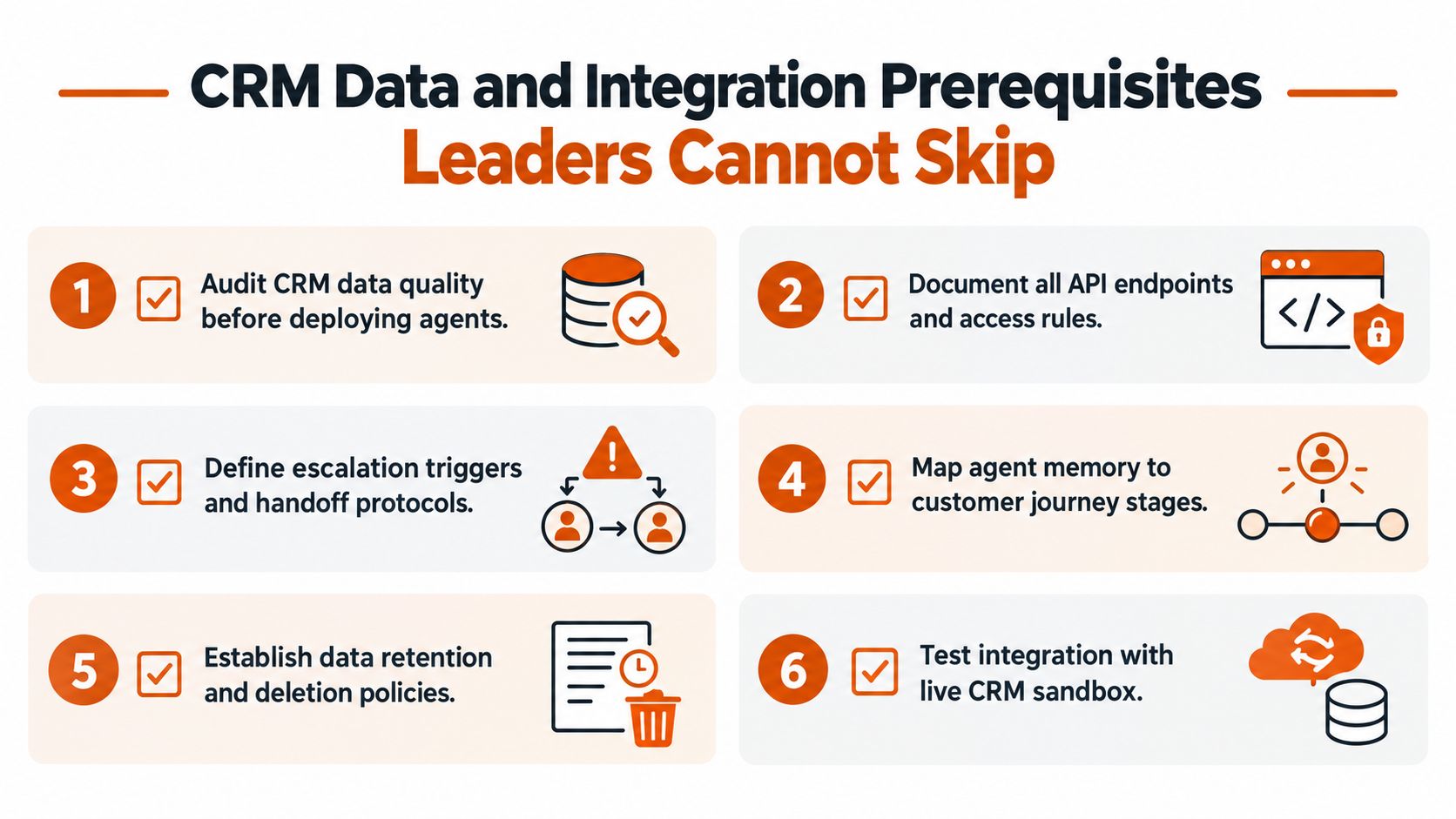
- Map ownership: Write down the source of truth for every field the agent will use or change.
- Test writes: Run approved create and update actions in a CRM sandbox, not against production records.
- Trace permissions: Record every API endpoint, identity, token scope, and approval requirement.
- Define memory: Specify what context the agent retains and how it maps to each customer journey stage.
- Set retention: Establish deletion and retention rules for prompts, outputs, records, and audit logs.
- Rehearse failure: Simulate a timeout, duplicate match, malformed response, and human escalation.
Don't sign a statement of work until RevOps and IT can explain how a failed action is detected, reversed, and assigned. Integration isn't a deployment detail. It's the constraint that determines whether the agent can operate.
Governance Security and Change Management That Decide Scale
Most agent programs can clear a proof of concept. They get blocked later by security, procurement, legal, or the first handoff between departments. The problem isn't only model quality. It's the absence of rules for access, approval, monitoring, and accountability.
Deloitte's survey of 3,235 business and IT leaders across 24 countries found that only 21% said their organizations had a mature governance model for agentic AI. The same research found that 74% expected their companies to be using AI agents at least moderately by 2027, including 23% expecting extensive use and 5% expecting full integration into core operations. That gap between expected use and mature control is a board-level risk.
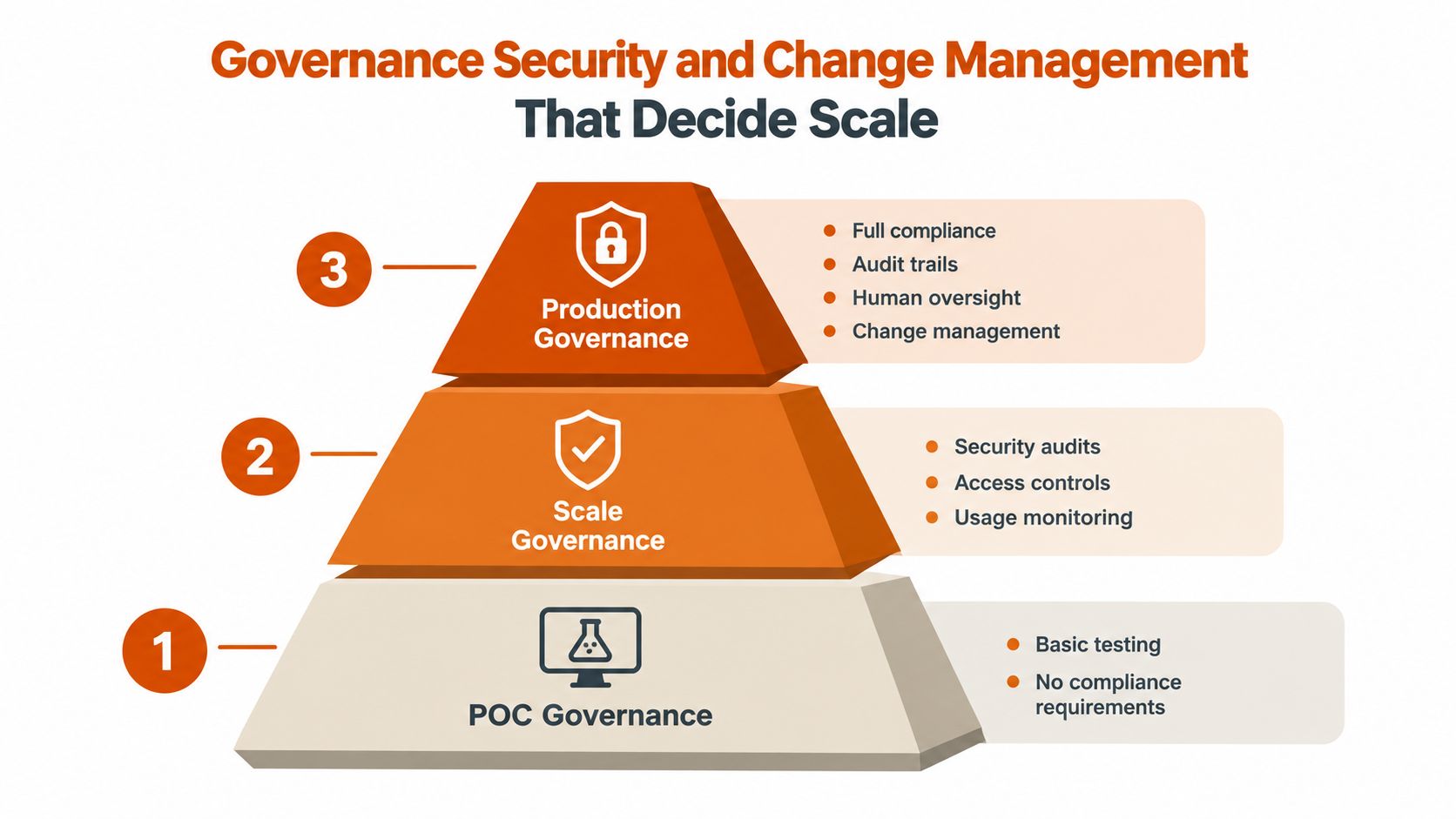
Three layers leaders must fund
Approval and escalation policy defines what the agent may do automatically. It should block actions involving sensitive data, customer commitments, financial changes, legal terms, or irreversible records unless the required person approves.
Auditability means logging every material tool call, retrieved source, decision, write action, approval, and failure. A transcript of the final answer isn't enough. Operators need to reconstruct what the agent saw and why it acted.
Human control places people at the right points in the workflow. Reviewers shouldn't approve every harmless classification, but they must control consequential actions and have an immediate kill switch.
Liferay's study of 500 U.S. professionals involved in AI decision-making found that 54% of companies were running agents in production or actively piloting them, while only 24% had a company-wide AI usage policy. Security or privacy concerns, cost, and lack of training were identified as leading barriers, while better accuracy was the most requested improvement. The message is direct: adoption without policy creates operational debt.
Change management needs equal attention. The people resisting an agent may be the people whose judgment, status, or workload it changes. Give them a role in defining exceptions, reviewing outputs, and redesigning responsibilities. A governance charter should name the business owner, technical owner, data owner, approval roles, kill-switch criteria, incident-response path, and review cadence.
A 90 Day Roadmap From Pilot to Production With the Right Vendor
Treat build versus buy as a sequence of operating decisions, not a vendor bake-off. The first question is whether the workflow is stable and valuable enough to automate. The second is whether your team can support the integrations, evaluations, controls, and monitoring after launch.
Days 1 through 30
Choose one workflow with a clear trigger, bounded data access, and an outcome the business already measures. Baseline the current process, collect representative examples, document exception types, and audit CRM readiness. Interview the people who perform the work, because their workarounds often reveal missing fields and hidden approval rules.
By the end of this phase, you should have:
- A signed workflow map and named owner.
- A baseline for time, volume, quality, and cost.
- A test set containing normal and difficult cases.
- A data-access and permission design.
- A written definition of success and failure.
Days 31 through 60
Run one agent on one workflow. Keep autonomy narrow. Start with retrieval, recommendations, drafts, or internal updates before allowing customer-facing or irreversible actions. Compare agent-assisted work with the baseline and inspect every escalation, tool call, and write.
A vendor shortlist should cover:
- Architecture openness: Can you change models, tools, and orchestration without rebuilding the workflow?
- CRM depth: Does it support your identity model, read and write actions, sandbox, and event layer?
- Observability: Can operators inspect traces, costs, failures, and human overrides?
- Evaluation tooling: Can you run repeatable tests against your own workflow library?
- Unit economics: Can you calculate total cost per resolved task, not just license cost?
- Data ownership: Do the contract and retention terms protect your records and outputs?
For a practical view of implementation choices, compare your plan with how AletheionAGI tackles agentic AI, while keeping your own workflow and governance requirements in control of the decision.
Days 61 through 90
Set explicit gates. Scale only if the agent meets the agreed quality threshold, completes tool actions reliably, escalates the right cases, stays within budget, and produces a defensible business result. If it misses one critical safety gate, contain and iterate. If it fails the core outcome after workflow and data corrections, kill it.
Hand your RevOps lead this checklist:
- Select one workflow and exclude adjacent scope.
- Name the executive owner and daily operator.
- Capture the baseline and define one primary outcome.
- Approve tools, fields, identity, and escalation rules.
- Build a representative evaluation set.
- Launch in a sandbox or restricted production mode.
- Review traces and exceptions every operating day.
- Decide scale, iterate, or stop against preset gates.
The Operating Principle That Separates Winners From Pilots
Pick the workflow before the model, instrument it before the launch, and govern it before the scale. That sequence turns AI agents from a technology experiment into an operating discipline.
Four questions should decide every proposal:
- Workflow: Does the agent remove coordination from a process that already matters?
- Data: Can it access trustworthy context and write safely to the system of record?
- Governance: Can the organization control access, approvals, auditability, and incidents?
- Measurement: Is there a baseline, a leading KPI, and a business outcome tied to the work?
McKinsey's 2026 global survey of 1,719 participants found that 44% said AI was scaling across their enterprise, up from 38% a year earlier. Among large organizations with more than $1 billion in annual revenue, 40% reported scaling AI agents, up from 27% the prior year. The remaining opportunity isn't another isolated chatbot. It's the operating work required to connect agents to real workflows.
Impact opportunity
The market is expanding while production maturity remains uneven. DataM Intelligence estimated the enterprise AI agent adoption market at US$6.65 billion in 2025 and projected it to reach US$142.35 billion by 2035, a 36.9% CAGR, while reporting that fewer than 25% of enterprises had reached production deployment because of data silos and governance issues. Those figures point to a practical opportunity for operators who can integrate agents with CRM, revenue, service, and approval systems.
The winners won't be the teams that buy the most agents. They'll be the teams that build a repeatable method for finding valuable workflows, preparing data, governing autonomy, and proving outcomes. Start with a Growth Audit that identifies workflow readiness, data maturity, and governance gaps before any vendor conversation begins.
Prometheus Agency helps growth leaders design AI workflows, optimize CRM and revenue operations, and connect agents to the systems that run the customer journey. Visit Prometheus Agency to request a complimentary Growth Audit and AI strategy session before committing to a pilot.