AI agents are software systems that use large language models to reason, plan, and take actions toward a goal: querying systems, calling APIs, and updating records, rather than just generating text. A single agent handles one job (like enriching a lead); orchestration coordinates multiple specialized agents into a digital workforce that runs complete business workflows end to end.
Last updated July 2026
Let’s be honest: your business has probably dabbled in AI. Maybe you’ve got a chatbot on your website or a tool that helps draft marketing emails. These standalone tools are fine for simple, isolated tasks. But they operate in silos, creating digital dead ends that leave the real heavy lifting to your team.
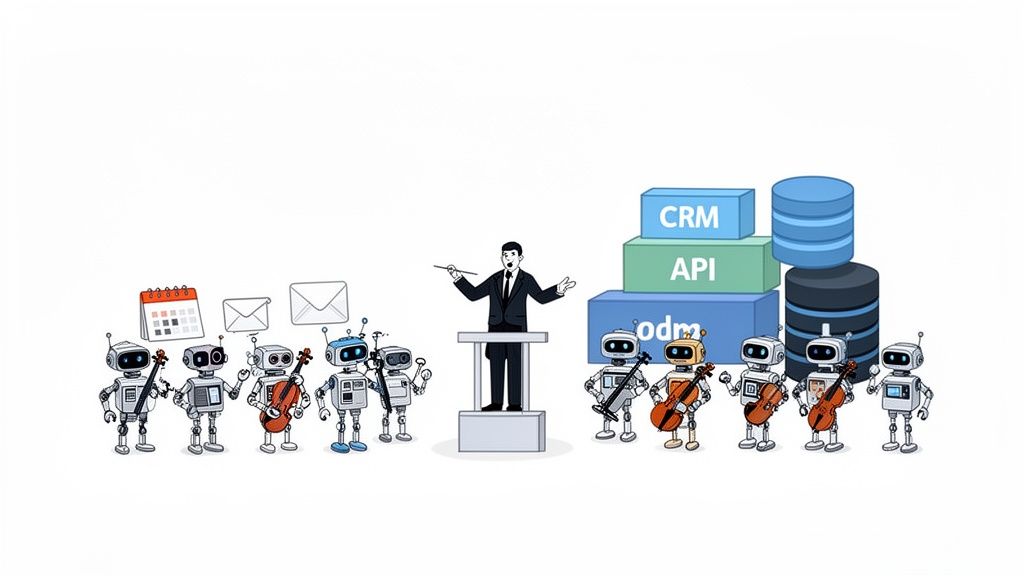
This siloed approach is like having a single musician playing in an empty hall. It’s better than silence, but it’s not an orchestra.
Moving Beyond Standalone AI Tools
Custom AI Agent Orchestration is about moving from a solo performer to a full-blown symphony. It’s the strategy of coordinating multiple, specialized AI agents to work together on complex business goals. Think of it as building a cohesive digital workforce that can reason, plan, and act in concert.
Key Takeaways
- From Silos to Symphony: Orchestration coordinates multiple specialized AI agents to tackle complex business goals, moving beyond isolated, single-task tools.
- Digital Workforce: The core concept is creating an interconnected team of AI agents that can reason, plan, and execute workflows autonomously.
- Strategic vs. Tactical: Standalone AI provides tactical efficiency, while orchestrated agents drive strategic growth by automating end-to-end processes.
The Power of a Digital Workforce
This isn't just theory; it’s a reflection of how high-performing human teams work. You wouldn’t ask your best salesperson to spend their day on data entry and technical support. You build a team of specialists. Orchestration applies that exact logic to your AI, creating a system that’s far more powerful than the sum of its parts.
To get there, you need to understand the principles behind agentic workflows, which form the foundation of this coordinated approach.
The market is already shifting this way—and fast. Projections show the global market for this technology is set to skyrocket from USD 11.02 billion in 2025 to USD 30.23 billion by 2030. This isn't just hype. It’s a clear signal that businesses are moving away from basic chatbots and toward intelligent systems that can slash manual efforts by up to 58% and plug directly into core platforms like your CRM.
To put this strategic shift into perspective, let's compare the old way with the new. The table below breaks down the difference between relying on single-purpose AI tools and deploying a fully orchestrated team of AI agents.
Single-Purpose AI vs Orchestrated AI Agents
| Capability | Single-Purpose AI (e.g., Chatbot) | Orchestrated AI Agents (Your Digital Team) |
|---|---|---|
| Task Scope | Handles simple, isolated tasks (e.g., answer FAQs). | Manages complex, end-to-end workflows (e.g., lead gen to close). |
| Collaboration | Works in a silo; no context sharing with other tools. | Collaborates seamlessly, sharing data and context across agents. |
| System Integration | Limited, often requiring manual data transfer. | Deeply integrated with CRM, APIs, and your entire tech stack. |
| Decision-Making | Follows a predefined script. | Reasons, plans, and makes autonomous decisions to achieve a goal. |
| Business Impact | Tactical efficiency gains. | Strategic revenue growth and significant competitive advantage. |
| Scalability | Difficult to scale for complex processes. | Highly scalable; add new agents to handle new business functions. |
The difference is stark. One offers a band-aid for a specific pain point, while the other provides a scalable system for proactive growth.
Unlocking Proactive Growth
The real magic of orchestration is its ability to flip your processes from reactive to proactive. Instead of waiting for a human to qualify a lead, an orchestrated system can autonomously identify, enrich, score, and route high-intent leads to the right sales rep—all in real time.
You’re no longer just answering questions; you’re building a system that takes decisive action to generate revenue. This same principle of building intelligent, coordinated systems can even be applied on a personal level, a concept we explore in our guide on how to build a personal board of directors with AI.
Impact Opportunity By transitioning from reactive, single-purpose tools to a proactive, orchestrated system, businesses can automate entire revenue-generating workflows. This shift not only eliminates manual bottlenecks but creates a competitive advantage by enabling real-time, intelligent actions that directly drive growth.
Nail Your Business Case and ROI
One of the biggest mistakes people make when adopting new tech is starting with the shiny new tool instead of the nagging business problem. If you want Custom AI Agent Orchestration to actually move the needle, you have to tie it to a clear business objective right from the start. Before you even think about architecture or integrations, you need a rock-solid business case that links your efforts to a measurable outcome.
This isn’t about vague goals like "improving efficiency." It's about getting brutally specific. Where are the friction points costing you real time and money? The best way to find them is to walk through your entire customer journey, from the first touchpoint all the way to post-sale support.
Key Takeaways
- Problem-First Approach: Start with a specific, high-pain business problem, not the technology. A strong business case is crucial for securing buy-in and measuring success.
- Focus on Bottlenecks: Identify repetitive, manual tasks in your customer journey—like lead qualification or data entry—as these are prime opportunities for immediate impact.
- Quantify the Impact: Build a clear ROI model by comparing the current manual state to the projected automated state, focusing on metrics like response time, manual effort reduction, and customer acquisition cost.
Pinpoint the High-Impact Use Cases
Look for the repetitive, manual, soul-crushing tasks that create bottlenecks in your revenue engine. These are the goldmines where an orchestrated team of AI agents can deliver an immediate and massive impact. For most B2B companies, the top of the funnel is practically begging for this kind of help.
Think about these common headaches:
- Manual Lead Qualification: Your sales reps are stuck sifting through a mountain of inbound leads, most of which are duds, instead of actually talking to people who want to buy.
- Slow Lead Routing: A hot lead comes in and... sits there. It's waiting for someone to manually assign it, giving your competitors a head start. We know that responding within the first five minutes can increase lead conversion rates by 8x. That's not a small number.
- Inconsistent Data Enrichment: Reps are wasting time jumping between LinkedIn, company websites, and other tools just to piece together basic info, which often leads to messy or incomplete CRM data.
A Real-World Example: Lead Qualification and Routing
Let's make this tangible. Imagine a B2B SaaS company drowning in MQLs from all their marketing channels. The process is slow, clunky, and riddled with human error, causing good leads to go stale and opportunities to vanish.
Here’s how an orchestrated agent system could completely fix this:
- Ingestion Agent: An agent is always on, watching for new leads from web forms, your marketing automation platform, and any other source you use.
- Enrichment Agent: The moment a lead appears, it's handed off to a specialized agent that uses APIs to instantly pull firmographic data, social profiles, and recent company news.
- Scoring Agent: A third agent takes this enriched data and runs it against the company's Ideal Customer Profile (ICP), assigning a qualification score on the spot.
- Routing Agent: High-scoring leads? They’re immediately routed to the right sales rep’s calendar through a CRM integration. Lower-scoring leads? They get dropped into a nurture sequence automatically.
Calculating Your Potential Return on Investment
The opportunity here is massive. By automating this entire workflow, the company frees up its SDRs to do what they were hired to do: have high-value conversations with pre-qualified, high-intent buyers. This isn't just a "nice to have"—it directly juices key business metrics.
To get buy-in, you can build a simple ROI model. It’s pretty straightforward.
| Metric | Current State (Manual) | Projected State (Automated) | Impact |
|---|---|---|---|
| Lead-to-Appointment Time | 24-48 hours | < 5 minutes | 69% or more reduction in response time |
| SDR Manual Effort | 15 hours/week | 2 hours/week | 87% reduction in manual data tasks |
| Customer Acquisition Cost | $5,000 | $3,500 | 30% reduction due to higher efficiency |
This ‘business outcomes first’ approach grounds your pilot project in financial reality. You’re not just implementing AI for the sake of it; you’re cutting costs, shrinking the sales cycle, and driving more revenue.
If you want to get a deeper sense of whether your organization is ready for this kind of initiative, you can assess your team's current skills with our AI Quotient framework. It's a great way to make sure your team is fully prepared to execute and measure the results of your AI strategy.
Impact Opportunity Automating high-friction processes like lead qualification doesn't just improve efficiency; it directly accelerates the sales cycle and lowers customer acquisition costs. By proving a clear financial return with a focused pilot project, you build the organizational momentum needed to scale AI initiatives across the company.
Designing a Scalable Orchestration Architecture
Once you’ve nailed down your business case, it’s time to get into the technical weeds: designing the foundation for your custom AI agent system. This isn’t just about picking a few tools off a shelf. It's about architecting a resilient framework that can actually scale with your business instead of buckling under pressure.
Get this part right, and your agents work in harmony. Get it wrong, and you’re looking at a system that can’t handle complexity and quickly falls apart.
The stakes are higher than you might think. Poor AI agent orchestration could sink over 40% of agentic AI projects by 2027, derailed by runaway costs and scaling nightmares. Yet, the pressure to adopt is mounting fast. Projections show that by 2028, a staggering 33% of enterprise software will have agentic AI embedded, a huge leap from less than 1% in 2024. This just proves how critical it is to have a solid architectural plan from day one—one that coordinates your multi-agent systems across your entire tech stack.
Key Takeaways
- Four Core Layers: A scalable architecture consists of four essential layers: the Agent Layer (specialist workers), the Orchestration Engine (project manager), the Tool Layer (APIs and software), and the Governance Layer (rules and oversight).
- Orchestration Patterns: The two primary patterns are sequential (assembly line for linear tasks) and hierarchical (management structure for complex, parallel tasks).
- Future-Proof Design: A well-designed, modular architecture allows you to add or modify agents without rebuilding the entire system, ensuring long-term adaptability.
The Core Components of Your Architecture
A truly scalable orchestration architecture is built on four distinct, yet interconnected, layers. Think of it like a well-run company, where every department knows its role. To get this right, it helps to understand the core ideas behind things like orchestration in data engineering, which involves wrangling similarly complex workflows.
- The Agent Layer: This is your digital workforce. Each agent is a specialist, built for a specific job—like researching prospects, drafting personalized emails, or cleaning up CRM data.
- The Orchestration Engine: This is your conductor, the project manager of the whole operation. The engine is responsible for assigning tasks, managing how information flows between agents, and making sure the entire workflow runs without a hitch.
- The Tool Layer: These are the resources your agents need to get their jobs done. This includes APIs for pulling external data, your CRM (like Salesforce or HubSpot), and any other software you rely on.
- The Governance Layer: This is your compliance and oversight team. It sets the rules of engagement, manages permissions, and provides that critical human-in-the-loop checkpoint for key decisions. It’s what keeps your agents operating safely and responsibly.
These layers don't work in isolation; they’re designed to work together. The engine gives an agent a task, the agent uses a tool to complete it, and the governance layer makes sure everything stays within the guardrails you’ve set.
Orchestration Patterns: Hierarchical vs. Sequential
How your agents actually collaborate comes down to the orchestration pattern you choose. The two most common models are sequential and hierarchical, and each one is better suited for different kinds of work.
A sequential pattern is like a factory assembly line. One agent finishes its task and hands the baton to the next agent in a straight line. It’s perfect for simple, linear processes where each step logically follows the last.
A hierarchical pattern, on the other hand, works more like a corporate management structure. A primary "manager" agent takes a complex goal, breaks it down into smaller sub-tasks, and delegates them to specialized "worker" agents. This model is built for tackling complex problems that need parallel work and dynamic decision-making.
Practical Example: An Automated ABM Engine
Let's bring this down to earth with a real-world scenario: building an automated account-based marketing (ABM) engine. The goal is to identify, research, and engage high-value accounts without a human touching a thing.
Here’s what that architecture looks like using a hierarchical pattern:
- Manager Agent: A top-level agent gets the broad directive: "Engage target accounts in the enterprise manufacturing sector."
- Delegation: The manager agent immediately delegates the work to three specialist agents.
- Research Agent: Dives into data sources like LinkedIn Sales Navigator and company databases to find companies matching the ICP and pinpoint key decision-makers.
- Personalization Agent: Takes that research and drafts hyper-personalized outreach emails, weaving in details like recent company news or a contact's specific role.
- Outreach Agent: Schedules and sends the emails, then monitors for replies and automatically updates the CRM.
Each agent works on its own but is perfectly coordinated by the orchestration engine. This modular design makes the whole system incredibly flexible. Want to add a social media engagement agent down the line? You just plug it into the framework. No need to tear everything down and start over.
Impact Opportunity: Building a Future-Proof System
The real opportunity here is to build a system that’s not just powerful today but is ready for whatever comes next. Your business needs will evolve, and new AI capabilities are always on the horizon. A well-designed, modular architecture means you can adapt your digital workforce without getting stuck in costly, time-sucking rebuilds. This foundational work is what separates a successful long-term AI strategy from a short-lived experiment.
Integrating Agents with Your Core Tech Stack
Your AI agents are only as good as the data they can access. If they're not plugged directly into the systems where your business actually operates, they're flying blind. Real orchestration isn't about running standalone bots; it's about weaving agents into the very fabric of your core tech stack, like Salesforce or HubSpot.
This is the bridge between AI-powered insights and tangible business actions. It’s what lets your agents do more than just see data—it enables them to push updates, create tasks, and kick off workflows inside the platforms your team already lives in.
Think of it like this: your core systems are the foundation. Everything else—your agents, the orchestration engine, and your governance rules—gets built on top.
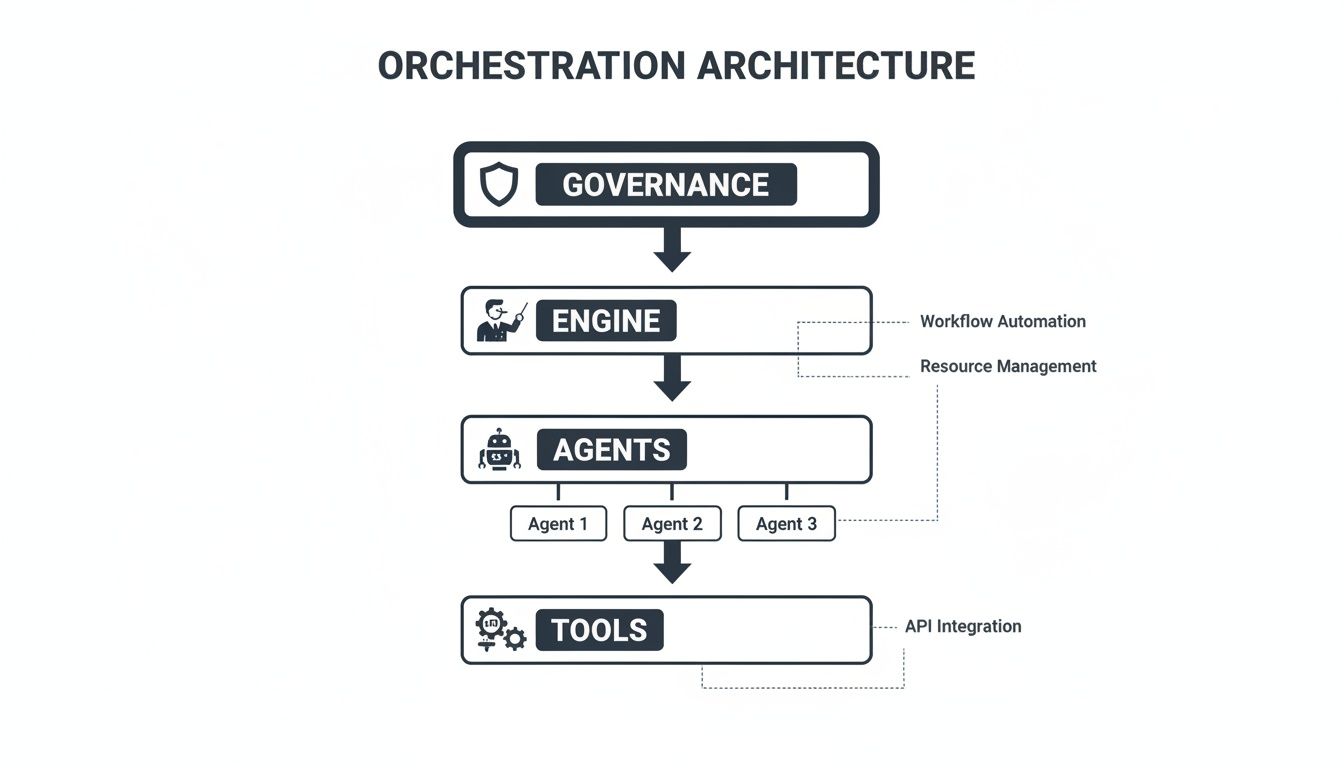
This diagram makes it clear: tight integration with your foundational tools isn’t just a "nice-to-have." It's a non-negotiable prerequisite for any multi-agent system that’s meant to be functional, scalable, and secure.
Key Takeaways
- Integration is Non-Negotiable: Agents are only effective if they have real-time, two-way access to your core business systems like your CRM.
- Choose the Right Method: The most common integration methods are APIs (for direct control), webhooks (for real-time notifications), and middleware (for complex connections).
- Create a Single Source of Truth: Proper integration eliminates data silos, ensuring both your human team and AI agents work from the same accurate, up-to-date information.
Choosing Your Integration Method
Connecting your agents to your tech stack isn't a one-size-fits-all job. The right method really boils down to your specific goals, your team's technical chops, and what your existing platforms can handle. Most integrations fall into one of three buckets.
- APIs (Application Programming Interfaces): This is the gold standard for a reason. APIs are like a secure, controlled doorway, letting your agents request specific data from your CRM or send commands back to it. It’s a direct line of two-way communication.
- Webhooks: These are more reactive. Instead of your agent constantly asking for updates, webhooks are event-driven. They automatically push data to your agent when something specific happens—like a new lead hitting your CRM. It’s an instant notification system.
- Middleware: For more complex setups, middleware platforms like Zapier or Workato can act as a universal translator. They sit between your agents and your various apps, handling tricky data transformations and logic without you having to build custom code for every connection.
For most businesses just getting started, a smart mix of APIs for direct control and webhooks for real-time alerts is a fantastic and flexible starting point.
Practical Example: Integrating a Sales Support Agent
Let's make this real. Imagine you want to build a "Sales Support Agent" to automate the top of your sales funnel and connect it to Salesforce. The mission: kill manual data entry and make sure your reps only talk to hot, fully-qualified leads.
Here's how that would actually play out:
- A new lead from a web form hits Salesforce. A webhook instantly pings your orchestration engine, which fires up the Sales Support Agent.
- The agent uses the Salesforce API to pull the basic lead details—name, company, email.
- Next, it calls out to data enrichment tools (think Clearbit or ZoomInfo) via their APIs to flesh out the profile with firmographics, social links, and recent company news.
- The agent crunches all this new data, scores the lead against your Ideal Customer Profile (ICP), and then uses the Salesforce API again to update the lead record with the score and enriched data.
- If the lead scores high, the agent creates a new task in Salesforce and assigns it directly to the right sales rep, complete with a neat summary of its findings.
The Impact: Creating a Single Source of Truth
When you get this right, the result is a single, unified source of truth right inside your CRM. No more data silos where critical customer info is lost in random spreadsheets or other disconnected apps.
This isn't just about saving a few minutes on data entry. It's about making your entire go-to-market motion smarter. When your AI agents and your human team are all working from the same real-time data, you create a far more cohesive and powerful customer experience.
Properly integrating these systems is a cornerstone of any meaningful digital transformation. To see how we help organizations build this capability from the ground up, check out our approach to strategic AI enablement.
Impact Opportunity By integrating AI agents directly with your CRM, you break down data silos and create a unified operational view. This ensures that every action, whether taken by a human or an AI, is based on the same real-time information, leading to smarter decisions, a more cohesive customer experience, and a more efficient revenue engine.
Implementing Governance and Human Oversight
Once your AI agents start operating more independently, you absolutely need a way to keep them in check. It's a classic case of power and control. Without a solid governance framework, you’re essentially deploying a powerful, autonomous system with no off-switch. Good Custom AI Agent Orchestration isn’t about letting agents run wild—it’s about carefully augmenting your human teams by building safety, control, and human-in-the-loop (HITL) workflows right into the architecture.
This isn’t just about ticking a compliance box. Think of it as a core strategic requirement for managing risk while still getting all the efficiency wins. When your leadership team knows that every high-stakes action is traceable, accountable, and ultimately signed off by a real person, it builds the trust you need to scale these AI initiatives across the company.
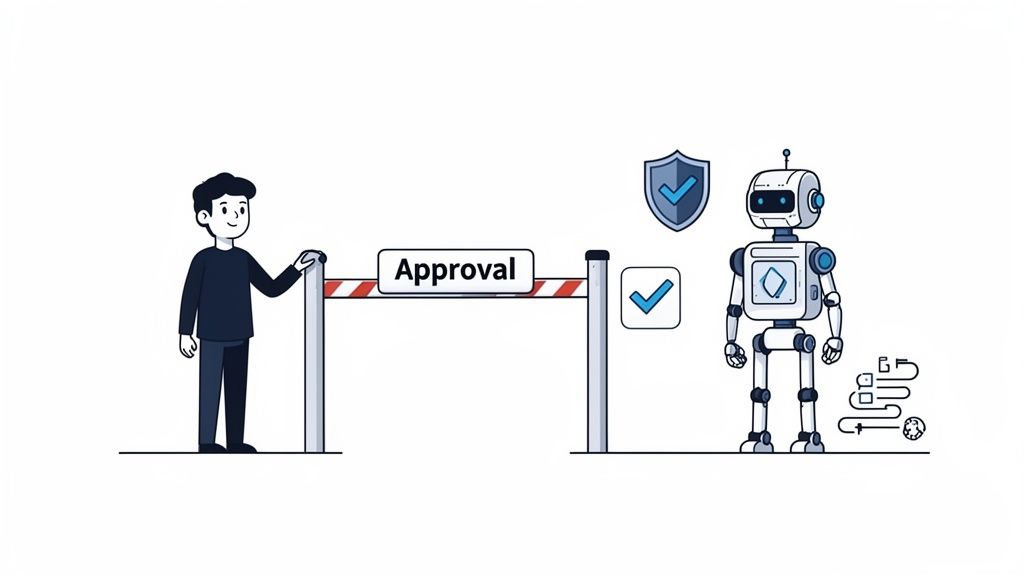
This whole approach sends a clear message to the organization: orchestration is about smart augmentation, not unchecked replacement. It’s about building a hybrid workforce where humans and AI work together in a secure, collaborative space.
Key Takeaways
- Augmentation, Not Replacement: Governance ensures AI agents augment human teams safely, building trust and enabling scalable adoption.
- Establish Clear Guardrails: Define strict permissions for what each agent can access and do, including action permissions, data access controls, and spending limits.
- Human-in-the-Loop is Critical: Implement "approval gates" for high-stakes decisions, ensuring a human expert validates critical actions before they are executed.
Establishing Operational Guardrails
First things first, you have to define clear operational guardrails. This really just means setting strict permissions for what each agent can and cannot do. I always tell clients to think of it like assigning user roles to a new employee; you wouldn't give an intern admin access to your entire financial system, right? The same logic applies here.
Your governance framework should map out:
- Action Permissions: Get specific about which systems an agent can touch and what it can do there. For instance, an agent might have read-only access to your CRM but need explicit approval to delete a record.
- Data Access Controls: Limit the data an agent is allowed to see or process. A marketing agent probably needs access to lead data, but it should be walled off from sensitive customer financial information.
- Spending Limits: For any agent authorized to use paid APIs or other services, set hard budget caps to prevent costs from spiraling. A research agent could be capped at $50 per day in API calls, for example.
These guardrails are your first line of defense, ensuring agents operate within safe, predefined boundaries from the moment they're switched on.
Designing Human-in-the-Loop Workflows
Real governance, however, comes alive with human-in-the-loop (HITL) workflows. These are deliberately designed "approval gates" where an agent has to pause what it's doing and get a human's green light before moving forward. This is absolutely critical for high-stakes actions that carry any kind of financial, legal, or reputational risk.
The trick is to be strategic about it. You don't need a human to approve every tiny task—that would just kill the whole point of automation. Instead, focus on those critical moments where human judgment is simply irreplaceable.
A Practical Example in Customer Service
Let's ground this in a real-world scenario. Imagine a B2B company that deploys a customer service agent to handle support tickets. The goal is to resolve simple issues instantly but escalate the complex stuff.
Here’s how an HITL workflow provides that crucial safety net:
- Autonomous Handling: The agent handles standard stuff on its own—password resets, basic feature questions—by pulling answers from a knowledge base. No human needed.
- Triggering an Approval Gate: A customer requests a refund for a $10,000 annual contract. This dollar amount is way over a predefined threshold, which automatically triggers the HITL workflow.
- Human Review: The agent stops, bundles a neat summary of the request (including customer history and the reason for the refund), and pings a human support manager for review.
- Validated Action: The manager reviews the details and approves the refund with a single click. Only then is the agent authorized to actually process the transaction in the billing system.
This workflow strikes the perfect balance. The company automates 90% of routine tickets, reaping huge efficiency gains, while ensuring a human expert always makes the final call on high-value decisions. The risk of an AI mistakenly issuing a huge, costly refund is completely eliminated.
Impact Opportunity Implementing strong governance with human-in-the-loop checkpoints minimizes risk and builds organizational trust. This allows businesses to confidently automate a high volume of routine tasks while ensuring that critical, high-value decisions are always validated by human experts, achieving the optimal balance between efficiency and control.
Launching Your Phased Rollout for Maximum Impact
Jumping straight into a full-scale Custom AI Agent Orchestration is a recipe for getting overwhelmed. The real key to success is a phased rollout, not a big-bang launch. This approach lets you prove value quickly, get the rest of the organization on board, and fine-tune your strategy with actual feedback.
The best place to start? A focused, low-risk pilot project designed to solve a single, high-impact business problem.
Think of this first project as your internal proof of concept. The goal isn't just to show that the technology works—it's to prove its business value in a way leadership understands. When you target a specific, measurable pain point, you can generate tangible results that make the case for a broader, more ambitious rollout all on their own. Success here creates the momentum you need for long-term investment.
Key Takeaways
- Start with a Pilot: Avoid a "big bang" launch. A phased rollout, starting with a 90-day pilot project, is the key to proving value and minimizing risk.
- Focus on a Single Problem: The pilot should solve one specific, high-impact business problem to demonstrate a clear and tangible return on investment.
- Measure Business Outcomes: Success should be measured by business metrics (e.g., hours saved, lead velocity) not technical stats. A successful pilot builds the momentum for broader adoption.
Designing a 90-Day Pilot Project
A good pilot needs a clear timeline, solid milestones, and success metrics that actually matter to the business. Forget about tracking abstract technical stats like API call latency. You need to focus on outcomes that directly impact the bottom line.
Here’s a straightforward way to structure a 90-day pilot:
Days 1-30: Discovery and Design
- Pinpoint one process to automate (e.g., lead qualification is a classic for a reason).
- Map out the current workflow and identify exactly where the bottlenecks are.
- Design the new agentic workflow and map out the required integrations.
Days 31-60: Build and Test
- Get to work developing and configuring the specialized agents.
- Integrate them with your core systems, like your CRM.
- Run rigorous tests in a controlled, sandboxed environment before anything touches a real customer.
Days 61-90: Deploy and Measure
- Go live, but only with a small, hand-picked group of users.
- Track performance against the business metrics you defined from day one.
- Gather feedback from your pilot users and get ready to present the results to stakeholders.
Measuring What Truly Matters
Your pilot’s success completely depends on measuring the right things. The metrics you choose need to tell a simple, clear story of business impact. Instead of getting lost in technical jargon, frame your results around outcomes like these:
- Reduction in manual effort: How many hours are you saving the team each week?
- Increase in qualified lead velocity: How much faster are leads getting from creation to a sales conversation?
- Improvement in data accuracy: What’s the percentage drop in CRM data entry errors?
The market is moving fast, which underscores the urgency here. By 2025, an estimated 57% of companies are already expected to be running AI agents in production. And analysts predict that 40% of enterprise apps will have them integrated by 2026. Custom orchestration allows these "digital coworkers" to resolve up to 80% of customer issues without human help, delivering immediate productivity gains. You can find more on these AI market trends from Grand View Research.
Impact Opportunity A successful 90-day pilot is a powerful proof of concept. By delivering measurable improvements in key business metrics like reduced manual effort and increased lead velocity, it provides a compelling, data-backed case to stakeholders for securing the investment and support needed for a full-scale rollout.
Burning Questions
Let's tackle some of the common questions B2B leaders have when they start thinking about Custom AI Agent Orchestration. Getting these answers straight helps build the confidence to move forward.
Key Takeaways
- Orchestration vs. Automation: Automation executes a single, repetitive task. Orchestration manages a team of agents to achieve a complex, multi-step business goal.
- Start Small to Win Big: A focused 90-day pilot project is the most effective way to start, proving ROI with minimal risk and building a business case for expansion.
- Focus on Augmentation: The goal is to augment your team, not replace them. AI agents handle repetitive work, freeing up humans for strategic, high-value tasks.
What’s the real difference between AI Automation and AI Agent Orchestration?
It's a great question, and the distinction is crucial. Think of standard AI automation as a single-purpose tool. It’s perfect for one, linear task, like sending a templated email after someone fills out a form. It follows a simple, pre-set script and doesn't deviate.
Custom AI agent orchestration, on the other hand, is like managing a high-performing team. You have multiple, specialized AI agents that can think, plan, and work together to handle complex business goals. It's the difference between an assembly line worker doing one repetitive job and a project manager coordinating an entire team to launch a new product.
Practical Example:
- AI Automation: Automatically sending a "thank you" email when a form is submitted.
- AI Agent Orchestration: An entire system where one agent ingests the form submission, a second agent enriches the lead data, a third scores the lead against an ICP, and a fourth routes it to the correct sales rep in the CRM with all context included.
How do we get started without a massive upfront investment?
You don't need to boil the ocean. The smart move is to start with a focused, 90-day pilot project. Pick one high-pain, high-impact process in a single department—maybe it's a bottleneck in your sales qualification process or a manual grind in marketing operations.
The goal is to solve that one specific problem first, using low-code tools and your existing APIs. A successful pilot proves tangible ROI with minimal risk, which builds a rock-solid business case for a wider rollout. This approach is all about getting a quick win and demonstrating value from day one.
Are these AI agents going to replace our team?
This is probably the most important question, and the answer is no. The entire point of orchestration is augmentation, not replacement. These systems are built to take over the tedious, data-heavy, repetitive work that burns out your best people.
When you free up your team from that grunt work, they can finally focus on what humans do best: building client relationships, thinking strategically, and creative problem-solving. It creates a hybrid workforce where your top talent is amplified by AI, allowing them to perform at a whole new level.
Impact Opportunity By clearly addressing common concerns around cost, complexity, and job replacement, leaders can build buy-in and align the organization. Emphasizing a pilot-based approach and the goal of human augmentation transforms skepticism into support, paving the way for a successful and scalable AI strategy.
Ready to turn your tech stack into a genuine revenue engine? Prometheus Agency helps B2B leaders implement custom AI agent orchestration with a sharp focus on business outcomes. Start with a complimentary Growth Audit and AI strategy session.