In the B2B market, the line between automated efficiency and personalized human interaction is where deals are won or lost. AI agents handle routine inquiries with unprecedented speed, but knowing precisely when and how to transition a conversation to a human expert is a critical capability. A clumsy handoff can lead to customer frustration, lost context, and abandoned sales cycles. Conversely, a seamless transition builds trust, accelerates problem-solving, and deepens customer relationships. Mastering this process requires more than a simple "talk to an agent" button; it demands a sophisticated set of Agent-to-Human Handoff Strategies that operate with precision and intelligence.
This article moves beyond generic advice to provide a strategic roundup of eight sophisticated handoff models designed for complex, high-stakes B2B environments. Understanding the foundational role of AI agents in customer service is crucial for mastering these advanced transitions. We'll explore the specific triggers, technology, and tactics that transform this critical moment from a potential friction point into a powerful opportunity for growth.
You will learn how to implement strategies based on nuanced signals like customer sentiment, knowledge gaps, service-level agreements (SLAs), and even subtle behavioral anomalies. We will cover actionable blueprints for each method, detailing everything from contextual data mapping into your CRM to the specific user interface patterns that create a frictionless experience for both the customer and your internal team. Each strategy presented here is a blueprint for building a more intelligent, responsive, and scalable revenue system, ensuring your human experts are engaged only when their impact is greatest.
1. Sentiment & Intent Analysis Handoff
One of the most effective agent-to-human handoff strategies involves using AI to analyze customer sentiment and intent in real time. This approach moves beyond simple keyword triggers, using Natural Language Processing (NLP) to understand the emotional tone and underlying goal of a conversation. The AI agent monitors language patterns, urgency indicators, and specific phrases to detect signals of frustration, confusion, or high-purchase intent, automatically escalating the interaction to a human agent at the optimal moment.
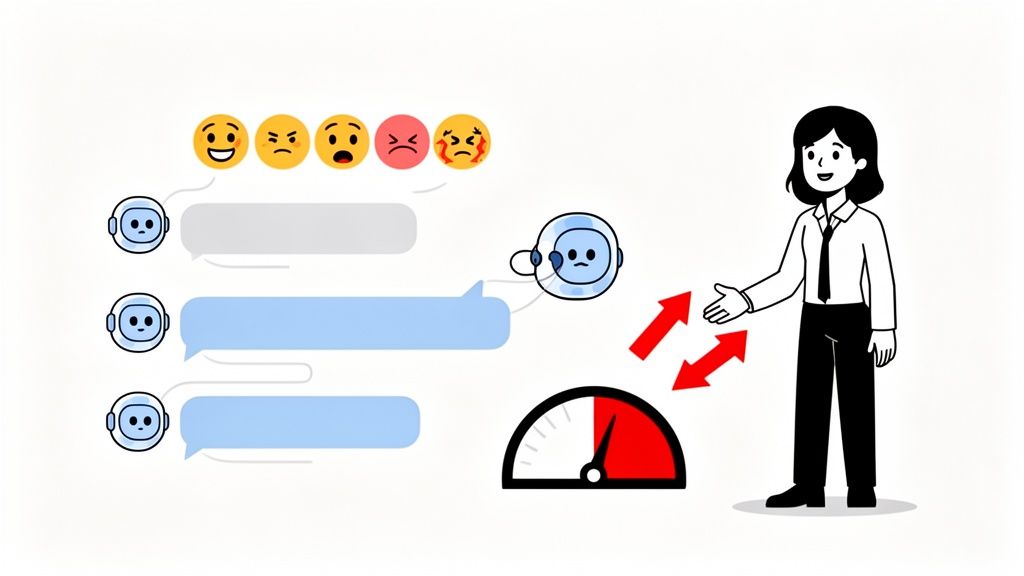
For B2B organizations, this proactive escalation is critical. In complex sales cycles, a poorly timed automated response can derail a high-value opportunity, whereas a swift, empathetic human intervention can build trust and accelerate the deal. By identifying and acting on these nuanced emotional and intentional cues, businesses can rescue at-risk relationships and capitalize on fleeting sales opportunities. This intelligent routing is a core component of modern customer engagement, a concept further explored in advanced AI-powered lead generation systems.
Impact Opportunity
Implementing sentiment and intent analysis for handoffs directly impacts customer satisfaction and conversion rates. It ensures high-value or high-risk conversations receive immediate human attention, preventing churn and maximizing revenue. This strategy transforms the automated agent from a simple gatekeeper into an intelligent filter that enhances both efficiency and the customer experience.
Practical Examples
- B2B SaaS: An AI chatbot detects a prospect repeatedly using phrases like "your competitor does this" or "this is too complicated." Recognizing this frustration and competitive pressure, the system instantly routes the chat to a senior sales engineer who can address the complex comparison and save the deal.
- Manufacturing: A bot identifies an urgent inquiry on a parts-sourcing portal containing terms like "line down," "production halt," and "ASAP." It bypasses the standard queue and escalates directly to a critical response team to prevent costly operational delays for the client.
- Financial Services: A community bank's AI agent flags a customer's message containing distressed language about "financial hardship" or "late payment." The conversation is immediately handed off to a specialized financial hardship team trained to provide empathetic, personal support.
Key Takeaways
- Set Custom Thresholds: Do not rely on default sentiment scores. Define escalation triggers based on specific business outcomes, such as cart abandonment rates or negative CSAT scores.
- Train with Domain-Specific Data: Include industry jargon, technical terms, and common customer acronyms in your AI's training data to ensure it accurately interprets intent within your specific context.
- Document Handoff Rationale: Configure the system to pass the "reason for escalation" (e.g., "Negative Sentiment Detected: Frustration") to the human agent. This provides immediate context and helps refine the AI model over time.
2. Contextual Knowledge Threshold Handoff
A highly effective agent-to-human handoff strategy is to trigger an escalation when a query exceeds the AI's programmed knowledge domain. Instead of providing an incorrect or generic response, the agent is designed to recognize the limits of its expertise. It maintains the full conversation context, acknowledges its knowledge gap, and seamlessly transfers the interaction, along with a detailed history, to a human specialist equipped to handle the specific, complex inquiry.
This method ensures that customers always receive accurate, expert-level answers without having to repeat themselves, preserving the continuity and quality of the support experience. For B2B companies dealing with technical products or specialized services, this strategy is essential for maintaining credibility and trust. It positions the AI as an intelligent triage system that efficiently routes inquiries to the correct subject matter expert, rather than a frustrating barrier to information.
Impact Opportunity
Implementing knowledge threshold handoffs dramatically improves first-contact resolution rates and customer trust. It prevents the AI from providing inaccurate information that could damage a client relationship or lead to incorrect product usage. This approach ensures that complex, high-stakes questions are immediately addressed by the most qualified person, protecting brand reputation and turning potentially negative interactions into opportunities to showcase deep expertise. For implementing such prioritized handoffs effectively, explore how new tools enable accurate human escalation classification tools.
Practical Examples
- Manufacturing: An AI on an equipment vendor's site receives a question about integrating a new CNC machine with a proprietary legacy software system. Recognizing the query's high technical specificity, it escalates the chat directly to a certified integration engineer.
- B2B SaaS: A user asks a CRM provider's chatbot about creating a custom API workflow for a niche, third-party application. The agent identifies this as beyond standard support and transfers the conversation to a solution architect who specializes in custom integrations.
- Compliance Services: A B2B compliance platform's bot is asked about specific regulatory nuances in the German medical device market. The system flags this as a specialized legal query and routes it to a legal specialist with expertise in EU regulations.
Key Takeaways
- Map Knowledge Domains: Clearly define and map your service offerings and product features into distinct knowledge domains. Assign clear ownership for each domain to ensure escalations go to the right team or individual.
- Set Confidence Thresholds: Configure the AI to only attempt an answer if its confidence level is high (e.g., 75% or greater). Below this threshold, it should default to a transparent handoff to a human expert.
- Tag Knowledge Base Articles: Use metadata tags within your knowledge base to classify content by domain. This helps the AI more accurately identify the boundaries of its own knowledge and make smarter handoff decisions.
3. Priority Queue & SLA-Based Handoff
A sophisticated agent-to-human handoff strategy involves creating an intelligent routing system based on predefined business priorities and Service-Level Agreements (SLAs). The AI agent acts as a strategic gatekeeper, classifying incoming interactions based on customer value, urgency, or contract terms. It then routes high-priority conversations to specialized human teams or dedicated queues, ensuring that the most critical issues and valuable customers receive the fastest and most expert attention.
This method moves beyond a first-in, first-out model to a value-based allocation of human resources. By embedding business logic directly into the handoff process, organizations can align their customer service operations with strategic goals. This ensures that a high-value enterprise client with a critical system issue isn't stuck waiting behind a low-priority informational query, directly protecting revenue and contractual obligations.
Impact Opportunity
Implementing SLA-based handoffs directly impacts customer retention, operational efficiency, and contract compliance. It guarantees that high-value relationships are nurtured with premium service levels, reducing churn risk among key accounts. This strategic allocation also optimizes the use of senior agents, focusing their expertise where it generates the most significant business impact and validating the ROI of premium support tiers.
Practical Examples
- B2B SaaS: A chatbot identifies a customer as an "Enterprise Tier" client with a contractually guaranteed one-hour response SLA. It automatically escalates their "system down" ticket to a Tier 3 support queue, bypassing general support and alerting the dedicated account manager.
- Community Banks: An AI agent recognizes an inquiry from a high-net-worth customer based on their account value in the CRM. The conversation is immediately routed away from the general queue and placed directly with a senior relationship manager for a personalized, high-touch experience.
- Manufacturing Suppliers: A bot on a supplier portal receives a message containing an urgent part number and the phrase "production line halt." The system cross-references the part with a high-volume client and immediately escalates the request to a dedicated engineering and logistics team to prevent costly downtime for the customer.
Key Takeaways
- Define Tiers by Revenue Impact: Explicitly link customer tiers to their direct or potential revenue impact, not just their company size. This ensures resources are allocated to protect and grow the most valuable segments.
- Integrate SLA Rules with your CRM: Build priority rules and SLA timers directly within your CRM or helpdesk platform. Avoid manual tracking, which is prone to error and cannot scale effectively.
- Establish Overflow Protocols: Create clear procedures for when high-priority queues are at capacity. This may involve routing to a secondary expert group or alerting management to prevent lower-priority backlogs from growing indefinitely.
- Measure SLA Compliance: Continuously track metrics like Time to First Response and Resolution Time for each priority tier. Use this data to validate the effectiveness of your routing strategy and justify premium service offerings.
4. Gradual Escalation with Progressive Agent Involvement
Instead of an abrupt, all-or-nothing transfer, this advanced handoff strategy introduces human agents progressively into an AI-led conversation. The AI handles initial queries and data gathering, and as the conversation's complexity or value increases, it strategically brings in human experts. This hybrid, collaborative approach ensures that agent expertise is applied precisely when it matters most, allowing them to gain context before taking full ownership, thereby optimizing for both efficiency and a high-quality customer experience.
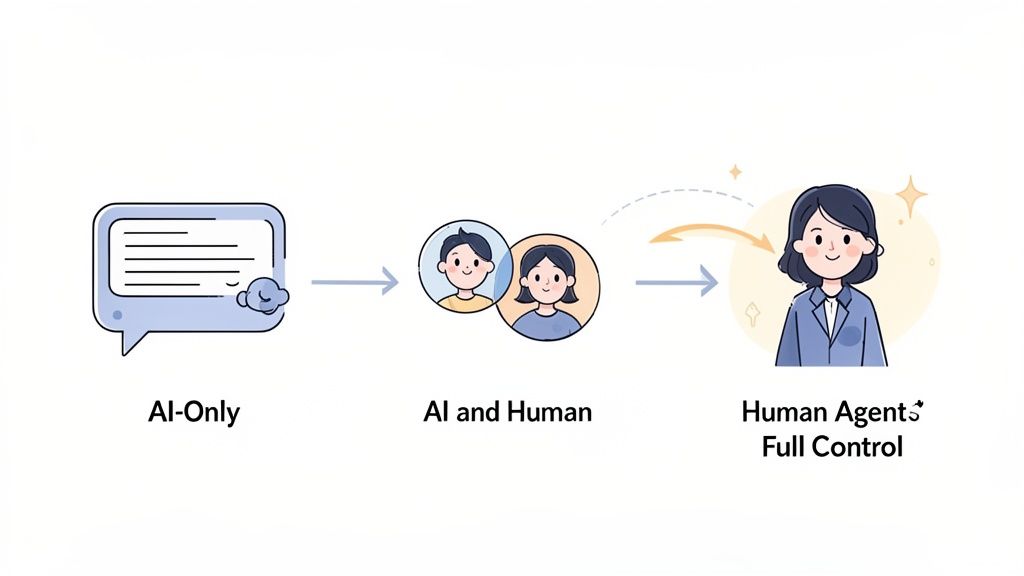
For enterprise-level interactions, this method is invaluable. It avoids forcing high-value clients to repeat themselves while preventing skilled agents from being bogged down by routine qualification questions. The conversation smoothly transitions from automated to human-assisted and finally to human-led, creating a seamless and intelligent journey. This progressive model is one of the most effective agent-to-human handoff strategies for complex B2B scenarios where deep expertise is a key differentiator.
Impact Opportunity
This gradual escalation model significantly improves agent efficiency and customer satisfaction. It reduces resolution time by allowing AI to handle foundational tasks, freeing up human agents to focus on high-impact activities like strategic problem-solving and relationship building. The result is a more simplified workflow, reduced customer wait times, and a superior perception of service quality.
Practical Examples
- B2B SaaS Onboarding: An AI assistant walks a new user through initial setup and feature questions. When the user asks about API integration for their specific tech stack, a customer success manager is silently added to the chat to monitor and then interjects to schedule a technical deep-dive call.
- Manufacturing Supply Chain: A bot handles an initial query about a part's availability and specs. Once the customer mentions a custom fabrication requirement, the system alerts a specialized engineer who joins the conversation to discuss bespoke solutions and provide a quote.
- Enterprise Sales: An AI agent qualifies a website lead, gathering information on company size, budget, and pain points. A Business Development Representative (BDR) is then looped into the chat to co-engage, ask nuanced questions, and book a demo, before the Account Executive takes full ownership of the relationship.
Key Takeaways
- Design Phased Conversation Flows: Map customer journeys to identify natural escalation points where human expertise adds the most value, building these transitions directly into your conversational AI's logic.
- Utilize "Whisper" or Co-Pilot Modes: use platform features that allow human agents to privately observe an AI conversation and provide real-time guidance or take over seamlessly.
- Establish Clear Tiered Involvement Rules: Define specific triggers and responsibilities for each stage of involvement, from AI-only to AI-assisted to full human control, so your team understands their roles.
- Track Escalation Triggers: Analyze data to identify at what point conversations are most frequently escalated. Use this insight to refine the AI's capabilities and optimize the timing of human intervention.
5. Behavioral Pattern & Anomaly Detection Handoff
Beyond analyzing individual messages, sophisticated AI agents monitor overarching behavioral patterns to identify anomalies that signal risk or opportunity. This agent-to-human handoff strategy involves establishing a baseline of normal customer behavior, such as typical query frequency, product usage, or transaction patterns. When the AI detects a significant deviation from this baseline, it automatically flags the interaction and escalates it to a human agent for investigation and intervention.
This proactive approach allows businesses to address potential issues before the customer explicitly reports them. Whether it's a sudden spike in support tickets from one account, an unusual purchasing pattern, or a sudden drop in engagement, these anomalies often indicate underlying problems like integration failures, potential fraud, or customer dissatisfaction. By escalating these situations, companies can apply human judgment to nuanced scenarios that an automated system might misinterpret.
Impact Opportunity
Implementing behavioral anomaly detection for handoffs provides a critical early warning system. It enables organizations to preemptively tackle fraud, technical glitches, and potential customer churn before they escalate into major problems. This strategy shifts customer support from a reactive model to a proactive one, safeguarding revenue, enhancing security, and building customer trust by demonstrating attentive, forward-thinking service.
Practical Examples
- B2B SaaS: An AI platform observes that a high-value enterprise client, which typically logs 10 support queries a month, has suddenly filed 30 tickets in 48 hours related to API errors. Recognizing this anomaly, the system bypasses the Tier 1 queue and escalates the account directly to a dedicated technical account manager to investigate a potential critical integration failure.
- Financial Services: A community bank's monitoring system detects a series of small, rapid-fire transactions from a business account that deviates from its established monthly payroll and vendor payment patterns. The system flags this as potential fraudulent activity and immediately transfers the alert to a human fraud specialist to contact the client and verify the transactions.
- Manufacturing: A supplier's automated inventory management bot notes that a long-term customer has abruptly stopped their regular weekly order of a specific raw material. This deviation triggers a handoff to an account manager, who can then investigate if the customer is facing production issues or being poached by a competitor, an essential tactic in predictive churn modelling.
Key Takeaways
- Segment Baselines: Establish separate behavioral baselines for different customer segments (e.g., by industry, company size, or subscription tier). A large enterprise's "normal" activity will look very different from a startup's.
- Define Remediation Workflows: Create clear, documented procedures for agents to follow for different types of anomalies. The response to a fraud signal should be different from the response to a product usage spike.
- Incorporate Agent Feedback: Build a mechanism for human agents to validate or dismiss anomaly flags. This feedback is crucial for refining the AI model's accuracy and reducing the rate of false positives over time.
6. Multi-Channel Context Unification Handoff
A critical agent-to-human handoff strategy involves unifying customer context from all interaction channels before the transfer occurs. The AI agent acts as a central data aggregator, pulling together a customer’s history from email, chat, phone logs, social media, CRM records, and billing systems. This creates a single, coherent view of the customer journey, preventing the common frustration of forcing customers to repeat themselves to a new agent. The human agent receives a complete, summarized dossier, enabling them to provide seamless and deeply informed support from the first second of the interaction.
For complex B2B relationships, where a single account may have multiple touchpoints across sales, support, and billing, this unified context is not a luxury but a necessity. It ensures that an agent handling a support ticket is aware of an ongoing contract renewal discussion or recent product usage spikes. This complete understanding transforms the quality of service, making the handoff feel like a coordinated continuation rather than a disruptive break in the conversation. Building this unified view is a core objective of strategic CRM integration and optimization.
Impact Opportunity
Implementing a unified context handoff directly improves first-contact resolution rates and reduces average handling time. Agents spend less time gathering information and more time solving problems, which significantly boosts both agent efficiency and customer satisfaction. This strategy turns every handoff into an opportunity to demonstrate organizational competence and strengthen the client relationship by showing you know and value their entire history with your company.
Practical Examples
- B2B SaaS: A customer initiates a chat about a billing issue. The AI aggregates their recent support tickets, notes from their account manager in the CRM, and in-app usage data showing they recently adopted a new feature. The human agent receives this summary and can proactively address how the new feature impacts their billing tier, solving the immediate issue and a future one.
- Manufacturing Supplier: An engineer from a key account emails a query about a custom part. Before escalating to a human, the AI system pulls their complete RFQ history, recent order data, and communication logs from other contacts at the same company. The specialist who receives the handoff immediately understands the full project scope and history.
- Community Bank: A customer calls about a flagged transaction. The automated system unifies their checking account activity, recent loan applications, and a note from a branch visit last week. The agent receives a concise brief and can address the customer’s concern with full awareness of their broader financial relationship with the bank.
Key Takeaways
- Prioritize CRM Integrity: This strategy is only as good as the data it pulls from. A well-implemented and clean CRM is the foundational requirement for success.
- Summarize Intelligently: Do not just dump raw data on the human agent. Configure the AI to create a concise, relevant summary highlighting the most critical context points for the specific inquiry.
- Use Real-Time APIs: Rely on API connections for real-time data synchronization between systems. Batch updates or manual syncs can lead to agents receiving outdated, inaccurate context.
- Audit Data Quality: Regularly audit the quality and accuracy of the data being passed. Inaccurate context is often more damaging than no context at all.
7. Approval Gate & Authority-Based Handoff
An approval gate is a strategy where an AI agent handles routine, low-risk decisions autonomously but escalates to a human when a request exceeds predefined authority limits. This could involve refund amounts, contract modifications, or policy exceptions. This approach creates a critical control point, balancing the efficiency of automation with the necessary governance and judgment required for high-stakes decisions.
For B2B organizations, this is a fundamental component of scalable and compliant operations. An AI can instantly approve standard requests that fall within policy, freeing up human agents to focus on complex negotiations or judgment-based approvals. This ensures that decisions with significant financial or contractual impact always receive appropriate human oversight, mitigating risk while maintaining operational speed.
Impact Opportunity
Implementing an authority-based handoff strategy directly impacts operational efficiency and risk management. It enables the AI to resolve a high volume of standard requests without human intervention, reducing bottlenecks and response times. Simultaneously, it ensures that sensitive or high-value decisions are managed by personnel with the correct authority, protecting the business from costly errors and maintaining governance standards.
Practical Examples
- B2B SaaS: An AI chatbot is authorized to grant standard subscription discounts up to 15%. When a high-value enterprise prospect requests a 25% discount, the system automatically escalates the chat, along with the deal context, to a regional sales director for approval.
- Manufacturing: A supplier's automated system can approve standard purchase order changes, such as a 5% quantity increase. However, a request to modify material specifications or change contractual delivery terms triggers an immediate handoff to the account manager and engineering lead for review.
- Financial Services: A community bank’s AI agent can instantly approve overdraft fee waivers under $100 for eligible customers. A request for a larger waiver or one related to a formal hardship claim is escalated to a specialized financial support officer who can provide a more nuanced, personal evaluation.
Key Takeaways
- Tie Thresholds to Impact: Define authority limits based on clear financial, operational, or legal impact, not just generic request categories. For example, specify dollar amounts for refunds or contract value percentages for discounts.
- Document Escalation Paths: Create and document clear escalation paths for different approval types, including expected turnaround times (SLAs) for the human approver. This manages customer expectations effectively.
- Provide Full Context: Ensure the handoff includes all necessary context for the human approver, such as the customer's request, the specific policy being referenced, and the reason for the escalation.
- Review Thresholds Regularly: Analyze approval patterns quarterly to identify if your thresholds are too restrictive (creating bottlenecks) or too permissive (introducing risk). Adjust as needed to optimize the process.
8. Skill-Match & Agent Capability Routing
Beyond simple availability, one of the most sophisticated agent-to-human handoff strategies involves routing conversations based on an agent's specific skills and capabilities. The AI system first analyzes the customer's inquiry to determine the required expertise, such as technical knowledge, product specialization, or language proficiency. It then consults a real-time directory of human agents, matching the inquiry to the individual best equipped to resolve it efficiently and accurately.
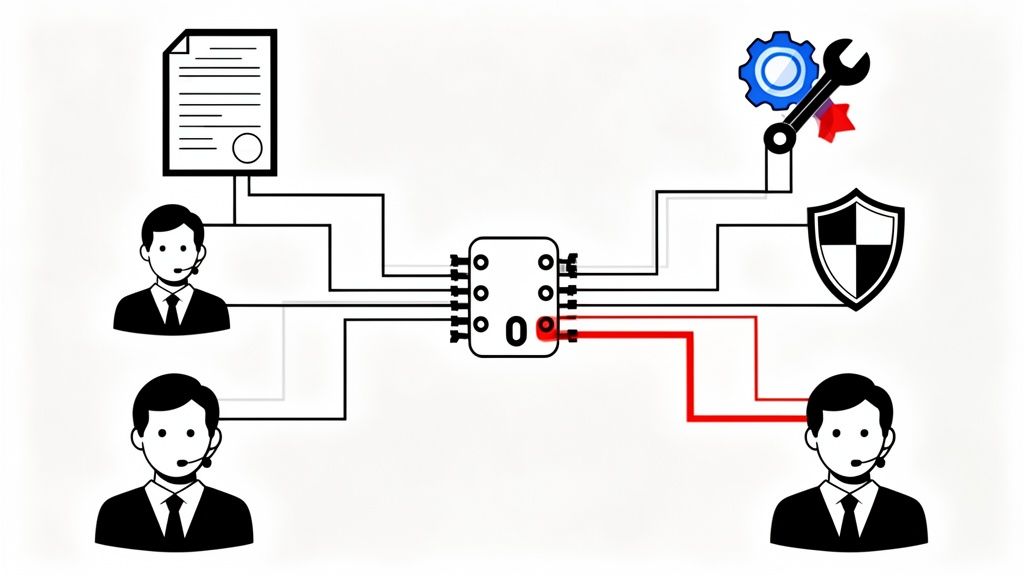
This intelligent routing moves beyond a "first-available" model to a "best-available" approach, drastically improving first-contact resolution rates. For B2B companies dealing with complex products or services, connecting a customer with a true expert on the first try is not just a matter of efficiency; it is a powerful demonstration of competence and a key driver of customer loyalty. This method ensures that high-stakes problems are met with high-level expertise, turning potential support crises into opportunities to strengthen client relationships.
Impact Opportunity
Skill-match routing directly boosts operational efficiency and customer satisfaction. By minimizing internal transfers and repeat contacts, it reduces the average handling time and operational costs. More importantly, it provides a superior customer experience by ensuring inquiries are resolved by the most knowledgeable agent, which builds trust and improves key metrics like Net Promoter Score (NPS) and Customer Satisfaction (CSAT).
Practical Examples
- B2B SaaS: An AI agent identifies a complex API integration question from a new enterprise client. Instead of routing to the general support queue, it escalates the conversation directly to an engineer who is certified in that specific API, bypassing Tier 1 support entirely.
- Manufacturing: A supplier's chatbot receives a troubleshooting request for a specialized piece of machinery. The system cross-references the machine's model number with its agent database and connects the customer to a senior engineer who has a documented history of resolving issues with that exact product line.
- Financial Services: A community bank’s automated system detects a query from a high-value commercial client regarding industry-specific lending options. The interaction is instantly routed to the dedicated relationship manager who handles accounts in that particular industry, ensuring contextual and expert advice.
Key Takeaways
- Create a Skills Taxonomy: Develop a detailed skills matrix that maps agent capabilities to specific business outcomes and customer needs, not just generic job titles. This should include product knowledge, technical certifications, and soft skills.
- Implement Regular Assessments: Use regular skills assessments and certifications to keep the agent capability data current and accurate. This ensures the routing logic remains effective over time.
- Use Data to Identify Training Gaps: Analyze routing data to see which skills are in high demand or where resolution rates are low. Use these insights to inform your agent training and development programs, creating a more capable team overall.
- Balance Specialization and Availability: While specialization is powerful, avoid creating extreme silos where only one or two agents can handle a specific issue. Ensure there is adequate coverage and cross-training to manage agent availability and prevent bottlenecks.
Agent-to-Human Handoff: 8-Point Comparison
| Strategy | Implementation Complexity | Resource Requirements | Expected Outcomes | Ideal Use Cases | Key Advantages |
|---|---|---|---|---|---|
| Sentiment & Intent Analysis Handoff | Moderate–High: real‑time NLP, thresholds and monitoring | Training data, real‑time compute, annotation, human on‑call | Faster escalation of high‑intent/frustration; improved CSAT and deal velocity (target 60–80% high‑intent × <2min) | B2B SaaS sales cycles, high‑emotion support scenarios | Early frustration capture; preserves context; prioritizes high‑intent prospects |
| Contextual Knowledge Threshold Handoff | High: knowledge mapping, confidence scoring, KB architecture | Knowledge base authors, domain experts, taxonomy management | Fewer incorrect AI responses; higher specialist resolution (aim 95%+ FCR on escalations) | Technical integrations, regulatory/compliance questions, specialist support | Prevents hallucinations; transparent handoffs; reduces rework |
| Priority Queue & SLA‑Based Handoff | Moderate: priority rules, SLA enforcement, queue optimization | Accurate customer data, CRM integration, capacity planning tools | Improved SLA compliance and faster responses for high‑value accounts (95%+ SLA; wait time −40%+) | Enterprise customers, at‑risk renewals, revenue‑critical incidents | Revenue‑aligned routing; churn reduction; optimized team utilization |
| Gradual Escalation with Progressive Agent Involvement | High: orchestration, co‑response, staged escalation logic | Platform features for warm handoff, agent training, workflow design | Reduced average handle time (~−30%) while maintaining ≥90% CSAT; smoother context transfer | Onboarding, staged implementations, complex sales/support flows | Seamless warm handoffs; better agent context; improved utilization and experience |
| Behavioral Pattern & Anomaly Detection Handoff | High: baseline behavior models, anomaly detection, risk scoring | Substantial historical data, privacy controls, monitoring infrastructure | Early detection of fraud/distress (detect ~85%+ with <15% false positives) | Financial services, fraud/risk detection, sudden usage anomalies | Proactive risk mitigation; early churn or fraud intervention; reduces losses |
| Multi‑Channel Context Unification Handoff | High: cross‑system integration, context summarization, data mapping | APIs, CRM implementation, data quality and governance efforts | Faster resolutions (≈−35% time) and high agent satisfaction (95%+ with context quality) | Omni‑channel B2B support, accounts with many touchpoints | Eliminates repetition; informed agents; improved cross‑sell and fewer repeat escalations |
| Approval Gate & Authority‑Based Handoff | Moderate: authority matrix, threshold detection, audit trails | Policy documentation, approval workflows, logging and routing tools | Automates routine approvals (95%+); timely handling of exceptions (<2h turnaround) | Refunds, contract changes, policy exceptions, high‑impact decisions | Balances automation and governance; auditability; reduces leadership load |
| Skill‑Match & Agent Capability Routing | Moderate–High: capability profiles, matching algorithm, routing logic | Agent skill tracking, performance data, training programs | Higher first‑contact resolution (target 80%+); −25% time‑to‑resolution | Technical support, specialized product issues, complex troubleshooting | Better FCR; targeted training insights; improved agent satisfaction and expertise |
Building Your Integrated Handoff Engine
Mastering the art and science of the agent-to-human handoff is no longer a peripheral concern; it is a central pillar of a modern, scalable, and customer-centric growth engine. We've explored a comprehensive suite of eight distinct agent-to-human handoff strategies, moving beyond rudimentary "can't answer, escalate" logic to a more sophisticated, context-aware framework. The true power, however, lies not in cherry-picking a single strategy but in thoughtfully architecting a multi-layered system that dynamically responds to the nuances of each customer interaction.
An effective handoff is invisible to the customer but invaluable to your business. It transforms a potential point of friction into a seamless continuation of a positive brand experience. By integrating these strategies, you shift from a reactive support model to a proactive, intelligent system that anticipates needs, prioritizes resources, and enables your human agents to perform at their absolute best.
Key Takeaways: From Siloed Tactics to a Unified System
The journey to an optimized handoff process requires a strategic, complete approach. The most successful implementations treat these strategies as interconnected components of a larger machine, each playing a crucial role.
- Foundation First: The Multi-Channel Context Unification Handoff is the bedrock of any advanced system. Without a single, coherent view of the customer's journey, even the most intelligent routing logic will fail. Clean, accessible, and unified data is non-negotiable.
- Prioritize with Purpose: Layering on Priority Queue & SLA-Based Handoffs ensures your most valuable customers receive the attention they deserve. This aligns your operational resources directly with your core business objectives, protecting revenue and nurturing key relationships.
- Add Nuance and Empathy: With a solid foundation, you can introduce more sophisticated triggers like Sentiment & Intent Analysis and Behavioral Pattern Detection. These strategies allow your system to read the emotional and behavioral cues of an interaction, enabling preemptive escalations that prevent frustration before it builds.
- Optimize for Expertise: Finally, integrating Skill-Match & Agent Capability Routing with Gradual Escalation models ensures that when a handoff occurs, the customer is connected to the right human agent. This not only resolves issues faster but also maximizes the efficiency and job satisfaction of your team.
Impact Opportunity: Moving from a simple, single-trigger handoff to an integrated, multi-layered system can decrease customer churn by up to 15% and increase agent efficiency by over 25%. This is because complex issues are routed to specialists faster, while simpler queries are deflected, freeing up valuable human resources for high-impact conversations.
Your Actionable Next Steps
Translating these concepts into operational reality requires a clear plan. Avoid the temptation to implement everything at once. Instead, adopt a phased approach to build a strong and scalable handoff engine.
- Audit Your Current State: Begin by mapping your existing handoff triggers and processes. Identify the most common points of failure, sources of customer frustration, and gaps in contextual data transfer.
- Establish Your Data Foundation: Focus on unifying customer data across all channels (e.g., chat, email, phone, CRM). Implement a solution for a single customer view before attempting to build complex routing logic on top of fragmented information.
- Implement a Priority-Based Framework: Define your customer tiers and associated SLAs. Implement a basic but effective priority queue system. This initial step delivers immediate, measurable value by protecting your most important accounts.
- Pilot and Iterate: Select a single, advanced strategy-like sentiment analysis-and pilot it with a small segment of interactions. Measure its impact on KPIs like Customer Satisfaction (CSAT), First Contact Resolution (FCR), and Average Handle Time (AHT). Use these learnings to refine the model before a full rollout.
Ultimately, a world-class system for agent-to-human handoff strategies is a powerful competitive differentiator. It’s an engine that not only boosts customer satisfaction and retention but also creates a more efficient, intelligent, and scalable organization. By treating this as a core business process rather than a simple technical feature, you unlock a powerful lever for durable, predictable growth.
Ready to transform your customer interactions from a cost center into a strategic growth asset? The team at Prometheus Agency specializes in designing and implementing the sophisticated, integrated AI and automation systems discussed in this article. We help B2B leaders build intelligent handoff engines that drive efficiency and delight customers. Learn how Prometheus Agency can architect your complete agent-to-human handoff strategy.