Let's be honest—the corporate graveyard is filled with expensive, failed AI pilot programs. The pressure from the board to "do something with AI" is intense, leading to a frantic scramble for tools and tech. But this reactive, tech-first approach is exactly why most of these initiatives flame out after burning through massive investments.
This isn't a technology problem. It’s a strategy problem. A Sustainable AI Business Strategy isn't about collecting shiny new toys; it's about building a coherent system designed for durable, measurable results that show up on your P&L.
Key Takeaways
- A sustainable AI strategy is built on solving specific business problems, not on adopting technology for its own sake.
- The primary failure point for AI initiatives is a lack of clear, measurable goals tied to business outcomes like revenue growth or cost reduction.
- Moving from a reactive, tool-focused mindset to a proactive, problem-focused strategy is the critical first step.
Why Most AI Strategies Are Built to Fail
Too many executives jump into AI without a clear destination in mind. They're driven by FOMO, not a well-defined business case. This leads to rushed projects completely disconnected from the company's core objectives, which is the number one reason AI investments so rarely deliver a meaningful return.
The issue is almost never the sophistication of the AI model itself. I've seen brilliant tech sit on a shelf. The real failure point is strategic. Teams dive headfirst into implementation without first answering the most basic questions: What problem are we actually trying to solve? What specific outcome do we need? How will we know if we've succeeded?
The Great Disconnect
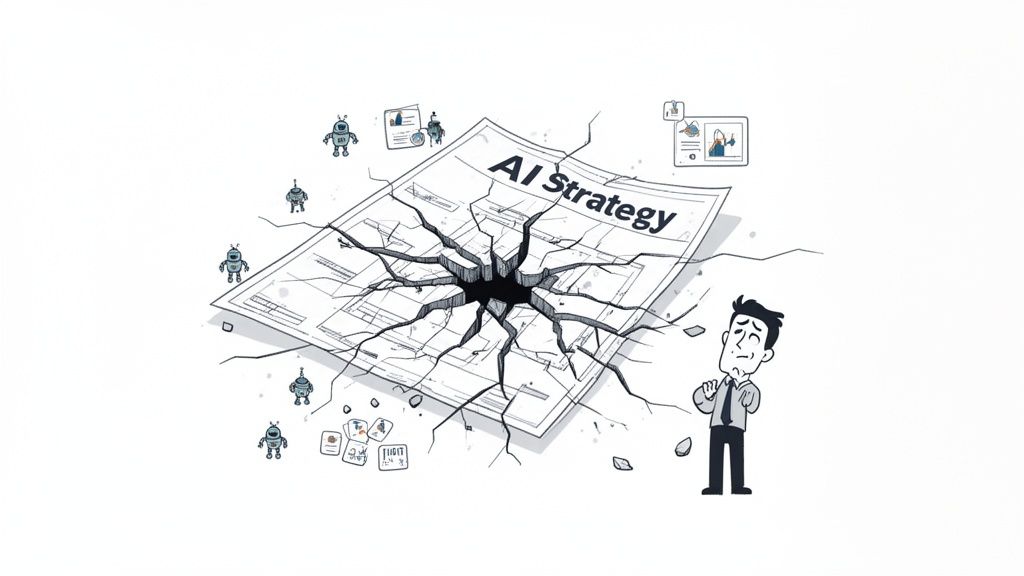
This strategic vacuum creates a massive gap between the AI project and any real business value. I've seen marketing teams deploy an AI content generator without ever tying its output to lead quality or conversion rates. It just becomes a content mill. Likewise, a sales team might adopt a forecasting tool but never actually integrate its insights into their weekly planning, rendering it completely useless.
These isolated efforts create what some are calling the 'GenAI Divide'—the widening gap between companies that actually profit from AI and those that just spin their wheels. The numbers are frankly brutal.
Recent MIT research found that a staggering 95% of generative AI pilots in enterprise companies fail to deliver a measurable impact. The problem isn't the AI; it's a fundamental 'learning gap' inside the organization.
A sustainable AI strategy isn't about adopting the latest tool. It's about fundamentally rethinking how your business operates, identifying specific high-value problems, and applying AI as a precise solution with clear, measurable goals.
Building for Sustainability, Not Hype
A strategy built to last prioritizes long-term capability over short-term buzz. It requires a foundational shift in thinking—moving away from treating AI as a series of disconnected projects and toward building an integrated system that actually improves decision-making across the entire organization. This playbook is designed to show you exactly how to do that.
Practical Examples
- Unsustainable: A manufacturer buys an expensive AI platform to "predict maintenance needs" but never connects it to their parts inventory or work order systems. The predictions are made, but nobody can act on them.
- Sustainable: The same manufacturer identifies that machine downtime is their biggest cost center. They pilot a targeted AI tool on one critical production line, defining success as a 15% reduction in unplanned downtime within six months.
That subtle shift from a reactive, tool-focused approach to a proactive, problem-focused strategy is the single most important step you can take. It changes the entire conversation from "What AI should we buy?" to "What's our biggest business challenge, and how could AI help us solve it?"
This change in perspective is the foundation of every successful AI implementation I've ever seen.
Setting the Foundation with Clear Goals and Governance
Let's get one thing straight: a winning AI strategy starts with business outcomes, not a fascination with the tech itself. I’ve seen too many expensive pilot programs go nowhere because they were chasing shiny objects. The most successful AI implementations are always anchored in what the C-suite actually cares about: boosting revenue, finding efficiencies, and creating real, sustainable growth.
The first step is to get beyond vague goals like, "we want to use AI in marketing." That kind of thinking is impossible to measure and almost guaranteed to fizzle out. Instead, you need to define specific, quantifiable targets. This instantly shifts the conversation from a tech discussion to a business one.
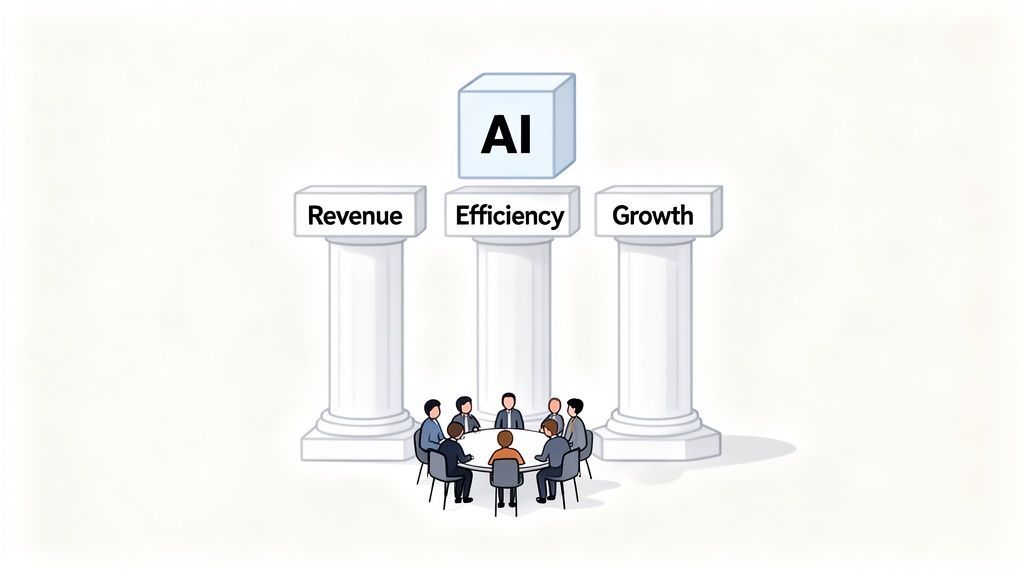
This discipline forces you to pinpoint a real, painful business problem before you even start thinking about a solution. That goal becomes your north star, guiding every decision that follows, from the data you use to the vendors you choose.
From Vague Ideas to Quantifiable Targets
Turning broad ambitions into concrete metrics is where a real strategy begins. Your goals need to be so clear that anyone in the organization—from an intern to the CEO—can understand what winning looks like and how their work connects to it.
Here’s how to reframe those fuzzy goals into something you can actually build on:
Practical Examples
- Instead of: "Improve sales productivity."
- Try: "Cut the time sales reps spend on manual data entry by 5 hours per week by bringing in an AI-powered CRM data enrichment tool."
- Instead of: "Enhance customer support."
- Try: "Decrease average customer ticket resolution time by 25% within six months using an AI chatbot for first-level triage."
- Instead of: "Optimize our supply chain."
- Try: "Get a 15% reduction in shipping costs by using a predictive logistics model to fine-tune our routing and carrier selection."
This level of detail gives you clarity and, just as importantly, a clear benchmark for measuring your return on investment.
Key Takeaways
Your AI strategy must be defined by business metrics, not tech capabilities. If you can't articulate the desired outcome in terms of dollars saved, hours reclaimed, or percentage points gained, you aren't ready to invest.
Establishing strong Governance from Day One
With clear goals in place, the next move is setting up governance. An AI strategy without governance is a ship without a rudder—it’s going to drift, and it's probably going to hit something. Governance is what keeps your AI initiatives aligned with business objectives, ethically sound, and legally compliant.
The best way to handle this is by creating a cross-functional AI governance council. And no, this isn't just another IT committee. This group must include leaders from every corner of the business: operations, finance, legal, marketing, and sales.
This council’s job is to:
- Maintain Strategic Alignment: Make sure every proposed AI project directly supports a defined business goal. No pet projects.
- Manage Risk: Identify and head off potential risks around data privacy, model bias, and regulatory headaches.
- Prioritize Projects: Decide which AI ideas get funding and resources based on potential impact and whether they're actually doable.
- Provide Ethical Oversight: Create and enforce clear rules on data usage, model transparency, and responsible AI deployment.
Governance in Action: A Practical Scenario
Imagine a mid-market manufacturing firm that wants to build a predictive maintenance system. Their AI council would bring the plant manager (operations), the CFO (finance), the head of IT, and their legal counsel to the same table.
The plant manager sets the success metric: a 20% reduction in unplanned machine downtime. The CFO runs the numbers, projecting the ROI to justify the budget. IT assesses the data coming off the machine sensors, and legal reviews data handling policies to ensure everything is above board.
This collaborative approach stops the project from becoming a siloed IT experiment. It becomes a unified business initiative with shared ownership and a clear line of sight to delivering value. This is what separates a successful AI program from a failed one. It's the engine that ensures every effort is focused, measured, and aligned with moving the business forward.
Assessing Your True Readiness for AI
Before you even think about signing a contract for a flashy new AI tool, you need to take a hard, honest look in the mirror. Jumping in blind is the fastest way to burn through your budget and end up with a failed project. A durable AI strategy isn't built on hype; it's built on a clear-eyed understanding of where you stand today across three pillars: your data, your tech, and your people.
Too many executives get swept up in a sales pitch, only to find out their own house isn't in order. This audit isn't about hitting the brakes. It's about finding the gaps so you can build a bridge to success, ensuring every dollar you invest actually delivers a return.
Key Takeaways
- AI readiness is not just about technology; it encompasses your data quality, tech stack integration, and organizational culture.
- An honest internal audit is a prerequisite for investment, preventing wasted resources on solutions your organization is not prepared to implement.
- Identifying and closing readiness gaps before selecting an AI tool is the key to a successful pilot and long-term adoption.
Is Your Data an Asset or a Liability?
Your AI is only as smart as the data you feed it. Think of it like a world-class chef—give them a state-of-the-art kitchen but rotten ingredients, and you're still going to get a terrible meal. It's the exact same principle with AI.
The first place to look is your CRM. For most businesses, this is ground zero. A messy, incomplete, or untrustworthy CRM is the single biggest roadblock to AI success. You have to ask the tough questions:
- Data Quality: Are key fields actually filled out? Are duplicates running rampant? Can you trust the historical data to tell the real story?
- Accessibility: Is your data trapped in disconnected silos, or can new tools actually tap into it through APIs?
- Completeness: Do you have the depth of data needed to answer your big business questions? An AI for sales can't work its magic with just a list of contact names; it needs rich deal histories.
An AI model trained on bad data just gives you bad answers, faster. Getting your data house in order isn't a "nice-to-have" first step—it's the absolute foundation of a sustainable AI business strategy.
What’s Really Going on With Your Tech Stack?
Next up is your existing technology. There's a persistent myth that AI means ripping and replacing everything you already use. The reality is, the smartest play is often to get more out of the tools you're already paying for.
Before you start window shopping for new platforms, talk to your teams. Where are the integration gaps forcing people into mind-numbing manual work? Can your current systems talk to each other better? Many modern CRMs and marketing automation platforms have powerful AI features hiding in plain sight. You might be sitting on a goldmine of untapped potential.
To really get this right, you need to map out the gaps. A crucial move here is conducting a comprehensive gap analysis to pinpoint the exact distance between your current capabilities and where you want to be with AI.
Are Your People Ready for Change?
This is the big one. You can have flawless data and a perfectly integrated tech stack, but if your team isn't ready, willing, and able to adapt, your AI initiatives are dead on arrival. This is where most AI strategies fall apart.
Your people assessment needs to hit three key areas:
- Skills and Expertise: Do you have anyone in-house who has wrangled data or implemented AI before? If not, what’s the plan? You'll need to either upskill your current team or bring in some specialized help.
- AI Champions: Look for the people in your organization who are genuinely excited about this stuff. These are your internal evangelists who will help win over the skeptics and drive real adoption.
- Cultural Readiness: Be honest. Is your company culture one that embraces change and data-driven decisions? Or is it a place where "we've always done it this way" is the standard response? A resistant culture will sabotage even the best AI tools.
This brief framework is a starting point for your internal audit. Use it to have honest conversations and assign a score from 1 (Low Readiness) to 10 (High Readiness) for each area.
AI Readiness Assessment Framework
| Pillar | Low Readiness (Score 1-3) | Medium Readiness (Score 4-7) | High Readiness (Score 8-10) |
|---|---|---|---|
| Data | Data is siloed, inconsistent, and has significant quality issues. No clear data governance. | Data is mostly centralized but may have quality gaps. Basic governance and hygiene processes exist. | Data is clean, centralized, accessible via APIs, and governed by clear standards. |
| Technology | Tech stack is fragmented with poor integration. Heavy reliance on manual processes. | Key systems (like CRM) are in place, but many tools are underutilized or disconnected. | Tech stack is modern, integrated, and flexible. Existing platforms have AI capabilities. |
| People | Low AI literacy and significant resistance to change. No internal AI skills or champions. | Some teams are open to new tools, but there's a lack of formal training and a clear adoption plan. | Culture embraces data-driven decisions. There are internal AI champions and a plan for upskilling. |
A realistic score from this table doesn't just give you a number—it gives you a roadmap.
Finishing this three-part assessment gives you a clear, unflinching baseline. Instead of guessing, you’ll know exactly where to focus your energy first—whether it's a three-month data cleanup sprint, a small but vital systems integration, or a targeted training program for your team. This stops you from throwing money at tech you're not ready for and paves the way for a successful, high-ROI pilot.
If you’re looking for a more structured way to benchmark your current state, an assessment can help you calculate your organization's AI Quotient and give you that all-important starting point.
Prioritizing High-ROI AI Use Cases
Alright, you’ve taken an honest look at your data, your tech stack, and your team's readiness. Now it's time to pick your first fight. A successful AI strategy is all about momentum, and you build momentum by delivering real, measurable value—fast. The goal here isn't to boil the ocean. It's to find a "quick win" that proves AI's worth and builds credibility across the business.
This isn’t about thinking small; it's about being smart. So many organizations get this completely backward. They pour time and money into massive, customer-facing projects that are notoriously difficult to get right on the first try. A much savvier path often starts in the back office, targeting internal processes where automation can deliver a faster, more predictable return.
Key Takeaways
- Prioritize AI projects using an "Impact vs. Complexity" matrix to identify quick wins (high impact, low complexity).
- Your first project should target internal, process-oriented problems with clear, easily measurable ROI, such as automating manual tasks.
- A successful first project builds critical momentum and secures buy-in for more ambitious future initiatives.
The Impact vs. Complexity Matrix
To cut through the noise of a hundred different "great ideas," a simple prioritization matrix is your best friend. This framework is brilliant because it forces you to grade every potential AI project on two critical scales:
- Potential Business Impact: How much value will this actually create? Think in concrete terms—dollars saved, hours of manual work eliminated, revenue generated, or risk stamped out.
- Implementation Complexity: How hard is this really going to be? Be honest about the data you'll need, the tech integrations, the skills required, and the amount of organizational change you'll have to drive.
When you plot your potential projects on this matrix, the path forward becomes incredibly clear. Your prime targets are sitting right there in the top-left quadrant: high impact, low complexity. These are the projects that get you the budget and the buy-in for your more ambitious plans down the road.
The goal of your first AI project isn't to change the world. It's to prove to your CFO, your board, and your most skeptical middle managers that this technology delivers a tangible return. Start with a clean, defensible win.
Finding Your First High-ROI Project
The best starting points are often hiding in plain sight. They're buried in the manual, repetitive tasks that drain your team's energy and productivity every single day. These are perfect candidates for AI-powered automation because the ROI is direct and incredibly easy to calculate.
Practical Examples
- For a Sales Team: Roll out an AI-powered quoting tool that spits out proposals automatically. This directly slashes the time reps spend buried in admin work, freeing them up to do what they do best: sell. The impact? Shorter sales cycles and happier, more productive reps.
- For a Finance Department: Set up an automated invoice processing system. An AI model can read, categorize, and route invoices for approval, killing manual data entry and drastically reducing errors. The ROI is measured in pure labor cost savings and faster payment cycles.
- For a Customer Service Team: Use AI to analyze customer emails and chat logs to spot common issues or sentiment trends. You could also explore how predictive churn modelling can flag at-risk accounts before they leave, giving you a chance to step in and save them.
See the pattern? These projects all attack a specific, painful process. The data they need is usually well-defined (quotes, invoices, support tickets), and the success metrics are dead simple to track. If you need more inspiration, check out these 7 Proven Ways AI Helps Sales Teams to get the brainstorming started.
The Widening Gap Between Talkers and Doers
This disciplined approach to picking your shots is exactly what separates the companies cashing in on AI from those just talking about it. The gap is getting wider and wider. According to recent research from BCG, only a tiny 5% of companies globally are considered 'AI-future-built'—meaning they're actually generating substantial returns from AI.
Impact Opportunity
These leaders are seeing five times the revenue increases and three times the cost reductions compared to everyone else. Meanwhile, a shocking 60% of companies are getting almost no material value from their AI efforts at all. You can discover more insights about these findings from BCG.
The difference isn't that they have better technology. The difference is a strategy that relentlessly, obsessively focuses on tangible business impact from day one. By prioritizing use cases with a clear and achievable ROI, you join that small but growing group of firms building a real, lasting competitive advantage with AI.
Running a Pilot That Proves Business Value
A well-designed pilot is your bridge from a promising AI use case to a scalable, company-wide capability. Think of it less as a tech experiment and more as a strategic tool with a single, crucial purpose: to prove tangible business value in a controlled setting.
The goal here is to deliver the clear, quantifiable results you need to secure broader investment. A successful pilot builds the momentum your sustainable AI strategy needs to get off the ground. You have to shift from a "let's see what this can do" mindset to a laser-focused approach. Your pilot needs a tight scope, a clear finish line, and success metrics that speak directly to the C-suite. It's all about demonstrating impact—quickly and efficiently—to create a compelling business case built on real data, not just projections.
Designing a Pilot for Quantifiable Results
First things first: treat this pilot like any other critical business project. It’s not a casual test run. That means defining its parameters with absolute precision. You need to lock in a clear timeline—I’ve found that 90 to 120 days is usually the sweet spot to generate meaningful data without letting the project lose steam.
Next, assemble a dedicated, cross-functional team. This can't just be an IT project siloed away from the rest of the business. The right team includes:
- An Executive Sponsor: You need a leader who can clear roadblocks and champion the pilot's success when things get tough.
- A Project Lead: This is the person managing the day-to-day and keeping the train on the tracks.
- Subject Matter Experts: These are the end-users who will actually work with the AI. Their real-world feedback is invaluable.
- Technical Support: Your IT or data specialists are essential for setup, integration, and troubleshooting.
With the team in place, define what "success" actually looks like. These metrics must tie directly to the business problem you're solving. If your goal is to speed up the sales cycle, a key metric might be a 20% reduction in time-to-quote. If it's about pure efficiency, you could aim for a 50% decrease in manual data entry for a specific team.
The framework below is a simple but effective way to filter your ideas through the lens of business impact and complexity, pointing you toward the best opportunities for your pilot.
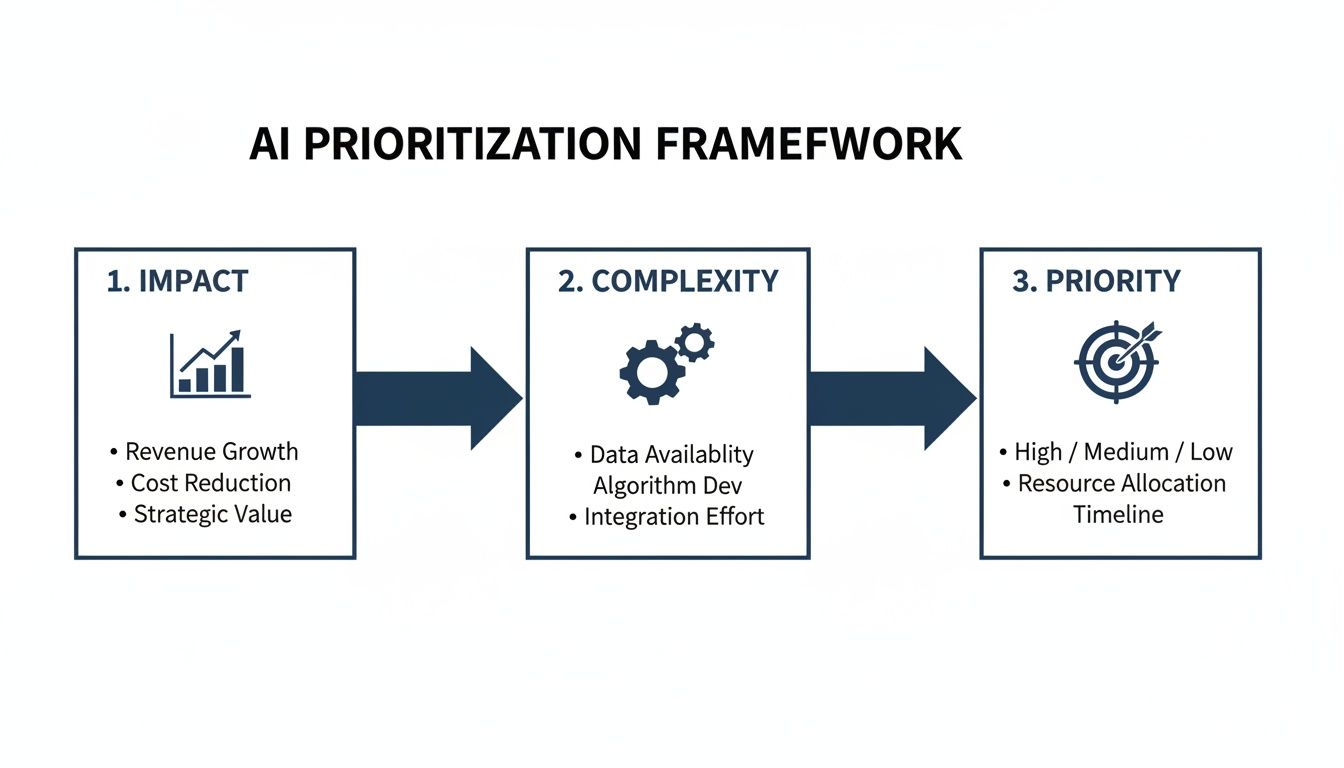
This kind of disciplined approach ensures you're not just picking a project that sounds cool, but one that has the highest odds of delivering a big win.
Executing and Measuring the Pilot
Once you have a solid plan, execution is all about disciplined measurement and documentation. Track everything from day one. I recommend setting up simple dashboards to monitor your key metrics in real-time. This isn't just about collecting data for a final report; it’s about seeing trends as they happen and being able to pivot if needed.
A huge part of this phase is getting the AI to talk to your existing data sources, especially your CRM. The data has to flow smoothly and accurately for the AI to work its magic and for your measurements to mean anything. Document every single challenge and small win during setup—believe me, these notes will be gold when you’re planning a broader rollout.
Impact Opportunity
A successful pilot does more than prove ROI. It makes AI real for your organization, transforming it from an abstract concept into a tangible solution. By documenting every lesson—the wins, the headaches, and the surprises—you create a repeatable playbook that de-risks future AI investments and makes organizational change that much easier.
As the pilot wraps up, your focus shifts to building the business case. Your final report should tell a clear, concise story backed by hard numbers. Present a "before and after" picture, showing the baseline performance and the exact improvements you achieved. Whenever possible, frame the results in dollars and cents to make the impact impossible to ignore.
This sense of urgency is reflected across the market. Global investment in generative AI is accelerating, hitting $33.9 billion in private investment last year—an 18.7% increase. At the same time, 78% of organizations now report using AI. As you can learn more about AI adoption trends from Stanford University's report, these numbers tell a clear story: the window to gain a competitive edge with AI is closing. Your pilot is the first, most important step to making sure you’re on the right side of this shift.
Scaling AI for Long-Term Success
A successful pilot is a great start, but it's just that—a start. The real test, and the biggest opportunity, comes when you scale that initial win across the entire organization. This is the moment you transform a promising experiment into a durable competitive advantage.
Think of it less as a project with an end date and more as the beginning of a constant evolution for your business.
So many AI initiatives falter when moving from pilot to production. It’s almost never because the tech fails. It’s because the human element gets overlooked. This transition demands a thoughtful, deliberate change management plan. Your success hinges entirely on adoption, which begins with crystal-clear communication and training that actually sticks.
Key Takeaways
- Scaling from a successful pilot requires a deliberate change management strategy focused on driving user adoption.
- Effective communication must answer the "what's in it for me?" question for every user group.
- A sustainable AI strategy is a continuous process of monitoring, feedback, and optimization, not a one-time project.
Driving Adoption Through Change Management
To get your teams on board, you have to answer the "what's in it for me?" question, and you have to do it fast. Show them exactly how this new AI tool makes their specific job easier, not just how it helps the company's P&L. Frame it as a way to get rid of the tedious work so they can focus on the stuff that really matters.
A solid change management plan always includes a few key pieces:
- Targeted Communication: Your messaging can't be one-size-fits-all. The way you pitch a new AI tool to the sales team should sound completely different from your presentation to the board.
- Comprehensive Training: Go beyond a simple feature tour. Host hands-on sessions focused on real-world workflows. Show people precisely how the AI fits into the rhythm of their day.
- A Champion Program: Find your early adopters from the pilot—the ones who are genuinely excited. enable them to be internal champions. Their peer-to-peer support can build grassroots momentum faster than any top-down mandate.
Sustainable AI isn't a technology problem; it's a human one. Scaling successfully is less about the algorithm and more about your ability to communicate value, provide excellent training, and build a culture that embraces data-driven decisions.
Creating Continuous Improvement Loops
A sustainable AI strategy is never "finished." To make sure it delivers value for the long haul, you have to build a continuous improvement loop. This means you're constantly monitoring performance, gathering feedback, and tweaking your AI models and workflows to keep them aligned with shifting business goals.
Start by looking at the key performance indicators (KPIs) you set during the pilot. Are you still hitting that 20% reduction in lead-to-appointment time? Has the 30% efficiency gain held up now that more people are using the system?
Constant measurement helps you spot problems early and make adjustments before they become major issues. As you scale, your AI governance council needs to evolve, too. Its job shifts from greenlighting projects to overseeing this ongoing optimization process. This is what ensures your AI initiatives keep delivering more and more value over time.
For a deeper dive into enabling your teams with the right tech, check out our guide on how AI-enabled leaders are growing differently.
Questions We Hear All the Time
Getting a real, sustainable AI strategy off the ground can feel daunting. Here are some straight answers to the questions that come up most often with leaders we work with.
What's the Number One Reason AI Pilots Fail?
It almost always comes down to a disconnect from a clear business outcome. Too many pilots get kicked off as tech experiments—they’re busy chasing a cool capability instead of solving a specific, measurable problem.
A pilot aiming to "improve sales efficiency" is just a vague wish. But one designed to "reduce quote generation time by 30%"—that has a clear, defensible goal. It’s a target you can build a business case around and prove real value with. If you can't quantify the finish line, you'll never convince anyone to fund a wider rollout.
Your first AI initiative needs a finish line defined by a business metric, not a tech milestone. Success has to be measured in dollars saved, hours clawed back, or risks avoided.
We Want to Start, but Our Data Is a Complete Mess. Where Do We Begin?
Forget about perfection. Just aim for progress on a small, manageable scale.
Go back to that single, high-impact AI use case you prioritized and focus only on cleaning the specific dataset required for that one pilot.
Practical Example
If you want to build a lead scoring model, you don't need to clean your entire database. Start by cleaning only the last 12 months of CRM data related to your won and lost deals. This surgical approach gets you the data quality you need for the pilot without getting bogged down in a massive, never-ending project.
This isn't just a one-off fix. By focusing on one small dataset, you build a repeatable process. You can apply that same method to the next project, and the next, creating incremental improvements across your entire data ecosystem over time.
Ready to move from scattered experiments to a coherent AI strategy that drives real growth? Prometheus Agency is an AI enablement partner that helps leaders build scalable revenue systems. We combine AI strategy, CRM optimization, and go-to-market expertise to deliver actionable roadmaps with clear ROI. Start with our complimentary Growth Audit and AI strategy session to build your durable advantage. Learn more at https://prometheusagency.co.