Most advice about sales enablement tools starts with feature grids. That's usually the wrong starting point. Adding another platform rarely fixes a fragmented sales process. It often adds one more login, one more data silo, and one more argument about who owns adoption.
The better question is simpler. What operating problem are you trying to solve? Content chaos, slow onboarding, weak manager coaching, poor buyer collaboration, or a rep workflow that depends on tribal knowledge all point to different categories of tools. That's why the best stack for a global enterprise won't look like the best stack for a growing mid-market team. A company that needs governed readiness programs should evaluate very differently from a team that just needs contextual guidance inside Salesforce and Gmail.
That matters more now because sales enablement is no longer a niche category. One industry roundup cites an independent estimate of the global sales enablement platform market at USD 5.23 billion in 2024, with adoption rising from fewer than 20% of organizations in 2013 to more than 60% by 2019, and recent reporting saying about 9 in 10 revenue professionals now use enablement technology at work according to this sales enablement statistics roundup. The category is large. The implementation mistakes are, too.
If you need a quick refresher on the basics, this guide to sales enablement definition and benefits is a useful starting point.
The shortlist below evaluates platforms by use case, company complexity, CRM and AI integration, governance, pricing model, implementation effort, and measurable impact. Key takeaways are straightforward. Define the revenue bottleneck before you buy software. Sequence rollout based on rep workflow, not vendor breadth. Expect practical examples where a contextual knowledge layer beats a full suite, and where a governed enterprise platform earns its cost.
Key Takeaways
- Start with the bottleneck: Content discovery, readiness, buyer engagement, value proof, and in-workflow guidance are different problems. Different tools solve them well.
- Integration matters more than feature count: Tool sprawl is expensive in adoption, governance, and reporting.
- Enterprise suites need ownership: Broad platforms can work well, but only when enablement, RevOps, and frontline managers share rollout responsibility.
- Embedded guidance can outperform portals: If reps won't leave CRM, email, or call tools, point-of-work enablement often gets better adoption.
- ROI comes from process change: Usage data alone won't satisfy leadership. You need baseline measures tied to sales execution and revenue outcomes.
1. Highspot
Highspot fits teams that want one core system for content, readiness, coaching, and buyer-facing execution. If your current problem is that reps can't find the right content, managers can't reinforce plays consistently, and buyer collaboration happens in disconnected tools, Highspot is a strong candidate.
This is a mature enterprise platform, so the upside is breadth with governance. The trade-off is rollout burden. Teams that treat Highspot like a file repository usually underuse it. Teams that define standards for content lifecycle, training paths, and seller workflows usually get more value.
Where Highspot Fits Best
Highspot works best when enablement has real operating scope, not just content publishing. It suits mid-market and enterprise teams that need governed sharing, analytics, digital sales rooms, and structured playbooks in one place.
A practical example is a regional B2B team expanding fast across product lines. If sellers keep using outdated decks and onboarding depends on shadowing, Highspot can centralize approved content and connect learning to execution. A smaller team with only one urgent problem might find it broader than necessary.
- Best use case: Unified content, training, coaching, and buyer engagement
- Best company context: Mid-market to enterprise teams with formal enablement ownership
- Main implementation burden: Requires content governance, taxonomy, and rollout planning
- Website: Highspot
What Works and What Doesn't
- What works: Strong governance, analytics depth, digital sales rooms, and broad integration coverage
- What doesn't: Quote-based enterprise pricing can be hard to benchmark, and the platform needs structured change management
- Practical example: If legal, product marketing, and enablement all approve customer-facing content, Highspot's governance model is useful. If one sales manager is running enablement off the side of their desk, adoption can stall.
Practical rule: Buy Highspot when you want to standardize how sellers prepare, share, and follow through. Don't buy it just to create a nicer content library.
2. Seismic
Seismic makes sense after enablement has already become an operating problem.
The trigger is usually familiar. Content lives in too many places, regional teams modify core messaging, compliance wants tighter control, and training sits far from day-to-day selling. Seismic is a fit for companies that need those workflows tied together under one system, with enough structure to support governance across business units and geographies.
That also explains the trade-off. Seismic can improve consistency and execution at scale, but only if the company is prepared to define ownership, publishing rules, and rollout sequence first. Teams exploring broader automation and workflow design should also compare that choice against a more AI sales enablement platform strategy, especially if AI search, CRM workflows, and content recommendations are part of the business case.
A good way to evaluate Seismic is to ask one question: where does revenue execution break today?
If the answer is "reps cannot find the right file," Seismic may be too much platform for the first fix. If the answer is "our content, readiness, approvals, and CRM workflows are disconnected, and that is slowing launches and creating risk," Seismic moves much higher on the shortlist.
Here is where it tends to fit best:
- Best use case: Enterprise content operations tied to readiness, governance, and structured rollout
- Best company context: Large or regulated sales organizations with multiple stakeholders managing customer-facing assets
- Main implementation burden: Requires dedicated administration, clear taxonomy, and cross-functional agreement on process
- Website: Seismic
The implementation burden is real. Seismic usually needs more than a content migration. It needs decisions about metadata, permissions, asset lifecycle, seller workflows, and adoption measurement. That is why it often performs better in organizations with established enablement, sales ops, and marketing operations support than in lean teams looking for a quick library refresh.
One practical test case is a global firm rolling out new messaging across regions and product groups while keeping approved claims consistent. Seismic handles that kind of controlled distribution well. A smaller sales org with a single painful gap, such as onboarding speed or in-call guidance, may get faster ROI from a narrower tool.
Where Seismic is strongest
- Governance for complex content environments
- Alignment between readiness programs and field execution
- Integration depth with CRM and adjacent enterprise systems
Where teams get stuck
- Pricing is quote-based and harder to benchmark
- Adoption slips if the rollout starts with migration instead of workflow design
- The platform can feel heavy when process discipline is still immature
3. Showpad
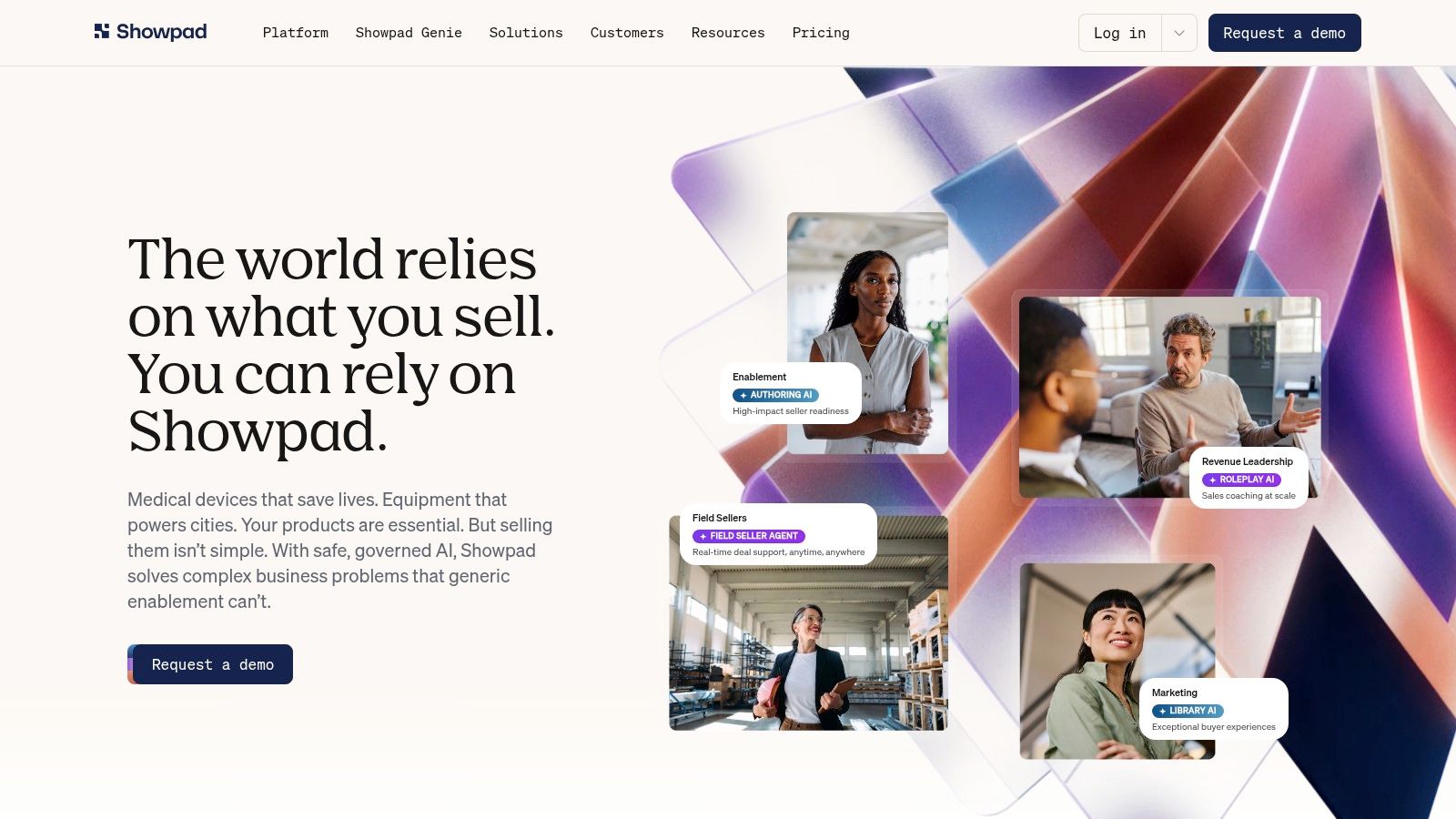
Showpad fits companies that need enablement to work in the field, not just in a desktop portal. That sounds narrow, but it changes the buying decision. If reps, channel sellers, or account teams need approved content, coaching, and buyer follow-up during live selling, usability and mobile access matter as much as governance depth.
That is Showpad's position in this market. It solves for execution friction across content, readiness, and buyer engagement without asking the business to start with a heavy enterprise redesign.
I usually look at Showpad through one question: is the operating problem fragmented rep execution, or is it enterprise control? If the first problem is bigger, Showpad often makes more sense than broader suites that require more process maturity before sellers see value.
A practical fit is a manufacturer or healthcare supplier with distributed reps, frequent product updates, and managers who need more than a content repository. In that setup, Showpad can support onboarding, surface current assets, and give teams visibility into what buyers opened after the meeting. That creates a cleaner rollout sequence. Start with content access and buyer sharing, then add coaching and readiness once usage is established.
The trade-off is packaging discipline. Showpad covers enough ground that teams can buy for the roadmap instead of the current bottleneck, which increases cost and slows adoption. It also may not replace a dedicated conversation intelligence product if call analysis, inspection, and coaching workflows need deeper specialization.
Best fit: Mid-market to enterprise revenue teams that need sellers to find, use, and share the right content in live sales motions
Why teams buy it: Better seller adoption, strong mobile experience, and enough breadth to connect content with coaching and buyer engagement
What creates work during rollout: Defining the first use case, limiting scope, and setting clear adoption measures before adding more modules
Website: Showpad
One reason Showpad wins shortlists is practical coverage. It can improve rep readiness and buyer engagement without forcing the organization to implement every enablement process at once.
That does not make it lightweight. Teams still need decisions on content ownership, publishing rules, manager involvement, CRM workflow touchpoints, and what success looks like after launch. If those choices stay vague, the platform becomes another well-designed destination reps visit only when asked.
For companies that want a balanced platform and a more manageable implementation path than the largest suites, Showpad is often a sensible middle option. The ROI case is strongest when the rollout is sequenced around one sales motion and measured through adoption, content usage in active deals, and manager follow-through.
4. Mindtickle
Mindtickle earns its place on a shortlist when sales performance is uneven because reps are not consistently ready for live buyer conversations. Teams usually arrive here after realizing content access was never the core issue. Reps can find the deck. They still miss discovery, struggle with objection handling, or ramp too slowly.
That operating problem changes the evaluation criteria. Feature count matters less than whether the platform can turn training into observable manager coaching, certifications, and repeatable behavior in the field.
A useful test is simple. If leadership wants proof that onboarding, reinforcement, and coaching are improving execution, Mindtickle fits the brief better than content-led platforms. If the main gap is finding approved assets inside active deals, look elsewhere.
Where Mindtickle Fits Best
Mindtickle is built around readiness mechanics: structured onboarding, certifications, skills assessments, role-play, coaching workflows, and ongoing reinforcement. That makes it a stronger fit for companies with larger sales teams, frequent hiring, multiple regions, or tightly controlled messaging.
It also demands more operating discipline than many buyers expect. Program owners need to define competencies, build learning paths, keep scenarios current, and involve frontline managers after launch. Teams already dealing with sales enablement challenges around reinforcement and program consistency usually feel this trade-off immediately. The software can enforce structure, but it cannot supply it.
Instead of a standard pros and cons list, here is the practical buying lens:
- Buy Mindtickle if: the business case is faster ramp, better coaching consistency, and measurable readiness across teams
- Expect friction if: managers are not prepared to review role-plays, coach to a rubric, and reinforce behavior weekly
- Implementation burden: moderate to high, because content setup is only part of the work. The larger lift is program design and ongoing governance
- Website: Mindtickle
The payoff is real when the rollout is narrow and specific. For example, a company hiring across segments can standardize onboarding and certify core messaging before reps carry quota independently. That is easier to defend than a broad "train everyone on everything" launch, which often produces course completion without much change in pipeline execution.
Mindtickle is less compelling for small teams that mainly need in-the-flow answers inside CRM or quick access to sales content. In those environments, readiness depth can become administrative weight. The strongest ROI case appears when leadership treats enablement as a performance system, not a content library.
5. Allego
Allego works best when the operating problem is fragmentation, not content quality alone. Teams usually land here after building an enablement stack in pieces: one system for learning, another for coaching, a separate content repository, a video tool, buyer rooms, and often another layer for conversation data. At that point, the cost is not just software spend. It is admin overhead, inconsistent reporting, and a rollout sequence that breaks because every workflow crosses systems.
That is the appeal of Allego. It pulls learning, coaching, content, analytics, and buyer collaboration into one environment. For a company that already knows its sales process and wants fewer handoffs between tools, that can improve adoption.
The trade-off shows up during implementation.
Allego creates value when leadership is willing to standardize how reps learn, managers coach, and teams share buyer-facing material. Without that operating discipline, consolidation can turn into a larger version of the same mess. One contract replaces several, but the workflow problems stay in place.
A practical fit is a mid-market or enterprise revenue team that has outgrown point solutions and now needs common governance across readiness and field execution. For example, if onboarding lives in one platform, call review in another, and customer-facing follow-up in a third, managers struggle to connect training completion to actual behavior in deals. Allego is stronger in that environment than in a smaller team with one clear need.
Here is the buying lens that matters:
- Best use case: Reducing tool sprawl across training, coaching, content, and buyer engagement
- Best company context: Mid-market and enterprise teams with enough process maturity to standardize workflows
- Main implementation burden: Scoping modules carefully, aligning ownership, and redesigning workflows before rollout
- Website: Allego
The biggest mistake is buying Allego as a feature bundle instead of an operating model decision. If the company only needs onboarding, or only needs governed content inside CRM, a narrower platform is often easier to launch and easier to measure. When usability limits adoption, a narrower platform that reps use often beats a larger suite they avoid.
The ROI case gets stronger when the rollout is sequenced. Start with one broken workflow, such as onboarding-to-certification or manager coaching tied to live deal execution. Prove adoption there. Then expand into content and buyer engagement once ownership, reporting, and manager behavior are in place. That path is usually more defensible than a broad launch that tries to replace half the stack at once.
6. Bigtincan
Bigtincan fits companies that have outgrown a simple content portal but are not well served by stitching together separate tools for readiness, content distribution, and buyer follow-up. The practical question is not how many modules it offers. The question is whether the business needs one governed system across direct sales, field teams, and partner channels.
That distinction matters.
Bigtincan is stronger in environments where content accuracy, channel distribution, and rep readiness all create operational risk. Brainshark adds weight here because it pushes the platform beyond asset management into training and certification. For teams with regulated messaging, complex product catalogs, or channel sales, that combination can reduce handoff problems between enablement and the field.
A common fit is a manufacturer or large distributor. Product updates change often, partners need the right version of materials, and sales leaders want to see whether training completion connects to what buyers receive. Bigtincan can support that model, but it usually requires clearer ownership than buyers expect at the start.
The trade-off is implementation burden. Bigtincan can cover content, learning, coaching, and buyer engagement, but broad coverage creates packaging and rollout decisions that need active administration. If the company lacks a dedicated owner, the platform can become a collection of partly adopted modules instead of a consistent operating layer.
That is why sequencing matters more here than feature breadth. Start with the workflow that is creating the highest cost of inconsistency, often governed content for field and channel teams, or certification tied to product launches. Add buyer engagement and wider coaching workflows after adoption is visible and reporting is trusted.
Use this buying lens:
- Best use case: Unifying governed content, readiness, and buyer engagement across direct and partner sales
- Best company context: Enterprise or complex mid-market teams with channel motion, product complexity, or strict content control needs
- Main implementation burden: Product packaging, admin ownership, and rollout discipline across multiple teams
- Website: Bigtincan
7. Mediafly
Mediafly is one of the more interesting options because it tackles a problem many enablement stacks leave unresolved. Proving value in the deal. Not just sending content. Not just certifying reps. Helping sellers build and communicate the business case.
That makes Mediafly particularly relevant for B2B teams selling complex or financially scrutinized purchases. If deals stall because buyers can't defend the decision internally, value-selling tools matter more than another content repository.
Where Mediafly Stands Out
Mediafly combines content, digital sales rooms, learning, conversation and revenue intelligence, and buyer engagement. The differentiator is native value-selling support such as ROI and TCO calculators plus business case builders.
This is useful in practical terms. A seller can move from sharing collateral to quantifying the business case inside the same operating environment. That helps when procurement, finance, or executive buyers need more than messaging confidence.
- Best use case: Value selling plus enablement in one platform
- Best company context: Teams with complex deals that need quantified business cases
- Main implementation burden: Value tool rollout needs process alignment and often services support
- Website: Mediafly
Impact Opportunity
The impact opportunity with Mediafly is stronger than average when revenue teams already know they lose momentum at the value-proof stage. That is common in larger B2B deals, where internal buyer consensus matters as much as rep presentation quality.
The platform won't create a value narrative for a weak sales motion. It can, however, make a strong value-selling process repeatable.
- What works: Native business-case support, buyer tracking, and reduced tool sprawl
- What doesn't: Enterprise scoping can be heavy, and teams need clear definitions for how calculators and business cases will be used in the sales process
8. SalesHood
SalesHood is built for teams that want enablement to turn into field execution quickly. It has a practical bias toward guided selling, training, role-play, digital sales rooms, and revenue-linked insights rather than a purely content-centric approach.
That makes it appealing for teams that need fast program build-out. If your enablement team wants to launch onboarding, certifications, guided messaging, and buyer-facing workspaces without waiting on a giant enterprise rollout, SalesHood is often worth a close look.
Practical Examples of Good Fit
SalesHood fits a growing B2B team that wants to move from informal coaching to structured programs without adopting the heaviest suite on the market. It also fits organizations that want mutual action plans in digital sales rooms because deals involve multiple stakeholders and agreed next steps matter.
A practical example is a middle-market SaaS company that needs onboarding, content activation, and deal execution support within one system, but doesn't want a long transformation project before reps see value.
- Best use case: Fast deployment of content activation, readiness, and execution programs
- Best company context: Mid-market teams with an active enablement function
- Main implementation burden: Plan fit and partner integrations need review
- Website: SalesHood
What Works in Practice
- What works: Intuitive authoring, quick rollout potential, and a clear focus on connecting enablement work to revenue activity
- What doesn't: Teams needing very deep standalone conversation intelligence may still want a separate platform
- Practical example: SalesHood works well when the company wants a single place to train reps, activate messaging, and coordinate buyers through mutual action plans
9. Guru
Guru isn't a full enablement suite, and that's exactly why it can be valuable. Some teams don't need another destination platform. They need reliable answers inside the systems reps already use. Guru is best understood as a knowledge layer, not as a replacement for a broader enablement platform.
That distinction matters when the operating issue is answer retrieval rather than formal training or digital buyer engagement. If reps keep slacking subject matter experts for pricing language, product positioning, or objection handling, Guru solves a very specific and expensive workflow problem.
Embedded Knowledge Over Another Portal
Guru delivers permission-aware answers across CRM, chat, email, and productivity tools. That makes it useful for rep acceleration, objection handling, and preserving institutional knowledge without forcing sellers into a separate portal every time they need context.
For teams exploring more embedded knowledge design, this perspective on AI for knowledge management is relevant because the challenge isn't just storing answers. It's making them trustworthy, current, and available at the moment of use.
- Best use case: Trusted Q&A and knowledge delivery across existing workflows
- Best company context: Teams with knowledge fragmentation across departments and systems
- Main implementation burden: Requires strong content ownership and verification habits
- Website: Guru
Where Guru Wins and Where It Doesn't
- What works: Fast answers, embedded access, security controls, and reduced context switching
- What doesn't: It won't replace training systems, digital sales rooms, or broader content governance by itself
- Practical example: A sales team selling technical products can use Guru to surface approved responses inside daily tools instead of relying on inbox searches and tribal memory
10. Spekit
Spekit solves one of the most common failures in enablement. Reps don't leave their workflow to look things up. They stay in Salesforce, Gmail, Outlook, LinkedIn, Gong, and browser tabs. So the enablement layer has to meet them there.
This is why Spekit often outperforms broader platforms in adoption-heavy environments. It pushes bite-size guidance, change communications, playbooks, and learning into the point of work. For fast-moving teams, that's often more practical than expecting portal visits.
Best Use Case for Spekit
Spekit is a strong fit when your problem is contextual execution. Reps need reminders, definitions, process prompts, and recommended content exactly where they work. It's especially useful during CRM process changes, product launches, or messaging updates.
That model aligns with broader market behavior. Industry reporting says 73% of sales teams use sales enablement software, including 89% of enterprises and 60% of SMBs, while one cited data set says 81% of mid-market companies used it in 2023, up from 68% in 2021 in this roundup of sales enablement software industry statistics. As adoption broadens, embedded guidance becomes more important because not every team wants another standalone destination.
- Best use case: In-workflow enablement and change management
- Best company context: Growing teams, CRM-heavy motions, and organizations where portal adoption is weak
- Main implementation burden: Needs disciplined knowledge maintenance and browser-based workflow alignment
- Website: Spekit
What to Expect
- What works: High usability, contextual delivery, and fast time-to-value
- What doesn't: It's not a full DAM or digital sales room replacement for every enterprise use case
- Practical example: If a revenue team is changing opportunity stages, call notes standards, and messaging at the same time, Spekit can surface the right guidance directly in the rep workflow
Top 10 Sales Enablement Tools Comparison
| Platform | Core features | UX / Measurable outcomes | Best fit / Target audience | Price / Deployment notes |
|---|---|---|---|---|
| Highspot | Content hub, AI-assisted training, Digital Sales Rooms, 100+ integrations | Enterprise governance, deep analytics, in‑flow rep guidance | Enterprises wanting one connected enablement→deal system | Quote-based, enterprise-level; structured rollout needed |
| Seismic | Unified Enablement Cloud, AI recommendations, compliance, CRM integrations | Proven at scale, strong content→revenue attribution | Large/global or regulated revenue teams | Quote-only, premium; needs dedicated enablement ownership |
| Showpad | Centralized content, Showpad Genie, conversation intelligence, DSRs | Field-friendly UX, fast time‑to‑value, strong mobile support | Teams needing rapid adoption and mobile-first enablement | Custom packaging; no public list rates |
| Mindtickle | Readiness programs, certifications, convo intelligence, DSRs | Best-in-class readiness, links skills to pipeline | Organizations prioritizing onboarding and competency at scale | Enterprise-oriented pricing; requires program design/services |
| Allego | LMS/LXP, coaching, video selling, convo intelligence, DSRs | Lowers tool sprawl, success services included, mobile heritage | Teams wanting an all‑in‑one platform and reduced TCO | Quote-based; multiyear contracts common |
| Bigtincan | Content mgmt, Brainshark readiness, DSR analytics, CRM integrations | End‑to‑end seller→buyer workflows, granular DSR metrics | Organizations wanting a governed full-stack enablement solution | Complex packaging; needs careful scoping/admin resources |
| Mediafly | Content hub + DSRs, ROI/TCO calculators, adaptive learning, AI Command Center | Differentiated value‑selling, consolidates enablement + intelligence | Sales leaders who must quantify value and build business cases | Quote-based; value-tool rollout may need services |
| SalesHood | Content activation, AI role‑play/coaching, DSRs w/ mutual action plans, impact insights | Quick program build-out, ties enablement to revenue metrics | Teams seeking fast, measurable enablement outcomes | Tiered/quote-based; plan fit requires scoping |
| Guru | AI knowledge layer, permissioned answers, CRM/Slack/ChatGPT integrations, governance | Faster ramp, better objection handling, reduced context‑switching | Orgs needing embedded, governed Q&A across apps; pairs with core enablement | Solution-based pricing; not a full DSR/training suite alone |
| Spekit | Embedded micro‑learning in Salesforce/Email/Gong, AI Sidekick, in‑app prompts | High rep adoption, rapid time‑to‑value, contextual coaching at point‑of‑work | Teams wanting in‑context enablement and change communications | Chrome-centric delivery; not a full DAM/DSR replacement; solution-priced |
Turn the Shortlist Into Revenue Impact
The right shortlist starts with diagnosis, not demos. Identify the bottleneck first. Is the issue content discovery, rep readiness, buyer collaboration, value proof, or in-workflow guidance? Most failed purchases happen because leadership buys a broad platform for a narrow problem, or a narrow tool when the operating issue is governance across the entire revenue motion.
Then score each shortlisted tool against the realities of your company. Team size matters. Complexity matters more. A global organization with compliance needs should weight governance, permissions, and structured program ownership heavily. A middle-market team with a messy CRM and uneven manager coaching should weight time-to-value, workflow fit, and implementation load more heavily. This is also where CRM and AI integration stops being marketing language and becomes an operating requirement.
The market is still expanding quickly, but growth in the category doesn't solve execution by itself. Grand View Research estimates the global sales enablement platform market at USD 5.23 billion in 2024 and projects it to reach USD 12.78 billion by 2030, citing demand for real-time data and analytics to improve sales decision-making and strategy optimization in its sales enablement platform market report. That projection is useful context, but software growth isn't the same as process maturity.
A contained pilot is usually the smartest next step. Set baseline measures before launch. Useful examples include time to find approved content, onboarding completion, system usage, conversion through key stages, sales-cycle movement, and pipeline influence. The point isn't to prove every downstream revenue effect immediately. The point is to show whether the tool changes seller behavior in the part of the process you targeted.
This is also where many enablement teams get stuck. Adoption is visible. ROI is harder. Independent discussion of enablement measurement challenges regularly points to fragmented data, inconsistent metric definitions, and difficulty tying activity to quota attainment or win rates in this discussion of sales intelligence data challenges. That's why ownership matters. Someone has to connect CRM, LMS, content, and manager workflows into one reporting model.
The impact opportunity comes from linking software to process and accountability, not from licensing features in isolation. If your team needs outside help translating the current stack into a scalable revenue system, Prometheus Agency is one relevant option. A Growth Audit, AI strategy session, CRM optimization effort, or accountable implementation partner can help when the challenge isn't choosing a tool, but making the tool change how the revenue team works. If you're reviewing enablement in the context of the broader modern sales cycle for B2B, that broader process lens is the right one.
Prometheus Agency helps growth leaders turn existing CRM, AI, and enablement tools into a system that sales teams use. If you're sorting through sales enablement tools and need help with platform selection, rollout design, or CRM-centered adoption, visit Prometheus Agency to start with a Growth Audit and practical implementation plan.