Imagine deploying a team of specialized digital employees, each a master of their domain, all collaborating seamlessly 24/7 to solve your biggest business challenges. That’s the core concept behind Multi-Agent Systems (MAS) for the enterprise. It’s not a single, monolithic AI; it’s a coordinated network of autonomous AI agents working together to execute complex workflows and make intelligent decisions.
Key Takeaways
- Decentralized Intelligence: Multi-Agent Systems consist of multiple autonomous AI agents that communicate and collaborate to solve complex problems, unlike traditional single-model AI.
- Adaptability and Resilience: MAS excels in dynamic environments by breaking down large tasks, adapting to real-time changes, and continuing to function even if one agent fails.
- Parallel Processing Power: By distributing tasks among specialized agents, these systems can handle complex challenges far more efficiently than a centralized AI.
What Are Multi-Agent Systems and Why Do They Matter Now?
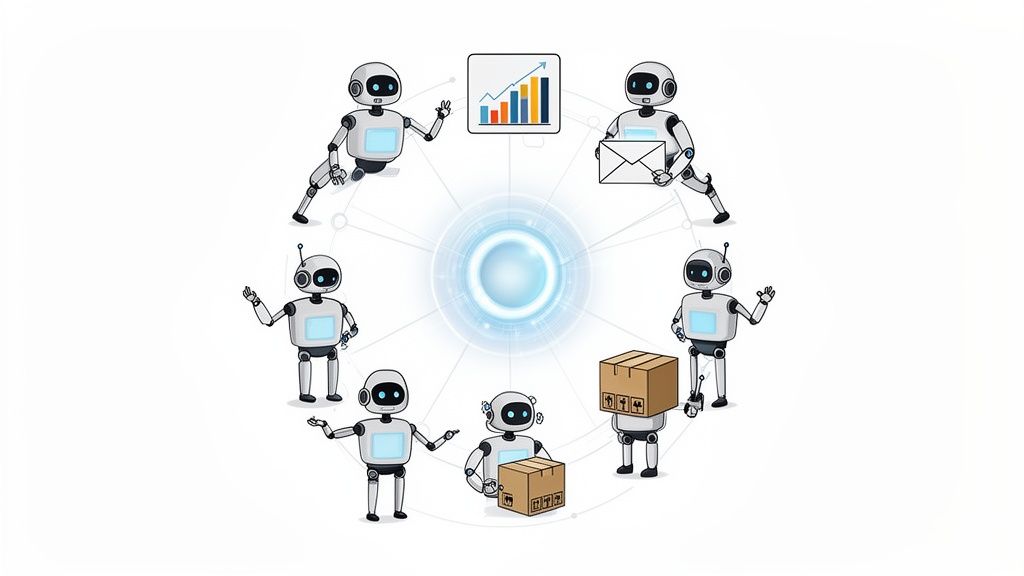
Think of a multi-agent system like an elite project team. You wouldn't ask one generalist to do everything. Instead, you have specialists. One agent might be an expert at scraping market data. Another excels at optimizing ad spend. A third is a pro at personalizing customer outreach. They aren't just siloed workers; they communicate, negotiate, and coordinate their actions to drive a collective outcome, like boosting qualified leads or slashing operational costs.
This is a world away from traditional, monolithic AI. A single, all-knowing AI is like a powerful central brain trying to solve a problem from the top down. A multi-agent system is more like a decentralized network of brains, each contributing its unique perspective and skills. It’s the difference between a lone genius and a high-performing team.
Impact Opportunity: The real edge of Multi-Agent Systems is their ability to thrive in dynamic, messy environments. They can adapt to sudden changes, break down huge problems into smaller, manageable tasks, and run processes in parallel far more efficiently than any single AI could.
To really see what makes MAS different, let’s compare it directly to the monolithic AI models we’re more familiar with.
Multi-Agent Systems vs. Traditional AI at a Glance
| Attribute | Traditional AI (Monolithic) | Multi-Agent Systems (MAS) |
|---|---|---|
| Architecture | Centralized, single model | Decentralized network of agents |
| Problem-Solving | Top-down, complete approach | Bottom-up, collaborative approach |
| Scalability | Hard to scale; requires retraining the entire model | Highly scalable; add new agents for new tasks |
| Adaptability | Rigid; struggles with unexpected changes | Flexible; agents adapt to new information in real-time |
| Task Handling | Best for single, well-defined problems | Ideal for complex, multi-faceted challenges |
| Resilience | Single point of failure | strong; failure of one agent doesn't stop the system |
This table makes it clear: while traditional AI is powerful for specific tasks, MAS offers a more flexible and resilient framework for tackling the complex, interconnected problems that modern businesses face every day.
The power of this technology is that these agents can work together without a human constantly pulling the strings. Because MAS is built on many autonomous parts working together, a good primer on understanding distributed systems can give you great context for how these agents coordinate across a network.
Ultimately, bringing a multi-agent system into your business isn’t just about buying a new tool—it's about building an entire ecosystem. You're creating an adaptable, intelligent workforce that can grow with you, automate sophisticated go-to-market strategies, and fine-tune your operations for real, measurable growth.
What an Autonomous Workforce Actually Does for Your Bottom Line

While the tech behind Multi-Agent Systems for Enterprise is impressive, what really matters are the measurable business results. Deploying an autonomous workforce is a strategic move that directly impacts revenue, customer experience, and operational agility. The focus shifts from merely completing manual tasks to achieving major business goals.
And this shift is happening fast. A recent industry survey found that over 25% of companies are already seeing value in just three months, with employee satisfaction jumping by nearly 90%. The trend is toward creating entire ecosystems of agents that are completely changing how work gets done.
Key Takeaways
- Faster Revenue Cycles: Autonomous agents shrink the time it takes to get from lead to a closed deal by automating qualification, personalization, and follow-ups at a scale humans just can't match.
- Big Gains in Efficiency: By taking over complex, coordinated tasks, these systems free up your human teams to think about strategy and build real relationships with high-value customers.
- Better Customer Journeys: Agents collaborate to personalize every single touchpoint, from the first marketing email to the final support ticket, making the entire experience feel connected and seamless.
- Smarter, Faster Decisions: An autonomous workforce can pull in data, analyze it, and act on it in real time, letting you pivot and adapt to market shifts on the fly.
How Agent Teams Optimize Revenue Operations
In the B2B world, speed and a personal touch are everything. A multi-agent system can take a slow, clunky sales process and turn it into a high-octane revenue machine. Think of it like a team of digital specialists, all working in perfect sync right inside your CRM.
Practical Example: B2B Lead Acceleration
A B2B tech firm deploys a multi-agent system to handle the top of their sales funnel.
- Agent 1 (Researcher): This agent constantly scans industry news, social media, and company announcements to find target accounts that are showing signs they’re ready to buy.
- Agent 2 (Qualifier): It takes the accounts found by the researcher and checks them against the company's Ideal Customer Profile (ICP). If it's a match, it automatically fills out the CRM record with all the important data.
- Agent 3 (Personalizer): Now, this agent drafts custom outreach emails for every qualified lead, mentioning their specific pain points or recent company news to make the message hit home.
- Agent 4 (Scheduler): Once a lead responds with interest, this agent taps into the sales reps' calendars and automatically books a meeting.
Impact Opportunity: This coordinated digital team results in a 69% faster lead-to-appointment time. It also slashes the manual research and data entry that sales teams hate. The system doesn't just speed up the pipeline; it makes every single interaction better. You can see more on how this works in our guide to AI-powered lead generation.
Practical Example: E-commerce Promotion Coordination
An online retailer is gearing up for a huge holiday sale. They use a multi-agent system to juggle all the moving parts—maximizing sales without killing their profit margins or frustrating customers.
- The Inventory Agent: Keeps a live watch on stock levels across every single warehouse.
- The Pricing Agent: Adjusts product prices based on what competitors are doing, what customers are buying, and how much stock is left.
- The Marketing Agent: Pushes targeted ad campaigns for the hottest items, automatically shifting budget away from products that aren't selling.
- The Logistics Agent: Works with the inventory agent to prioritize shipping for high-demand products, making sure customers get their orders on time.
Impact Opportunity: This interconnected system ensures marketing, inventory, and pricing are always synchronized. No more running out of stock on your bestsellers or wasting ad spend on duds. The result is a much smoother, more profitable sales event, with optimized margins and higher customer satisfaction.
How Real Companies Win with Multi-Agent Systems
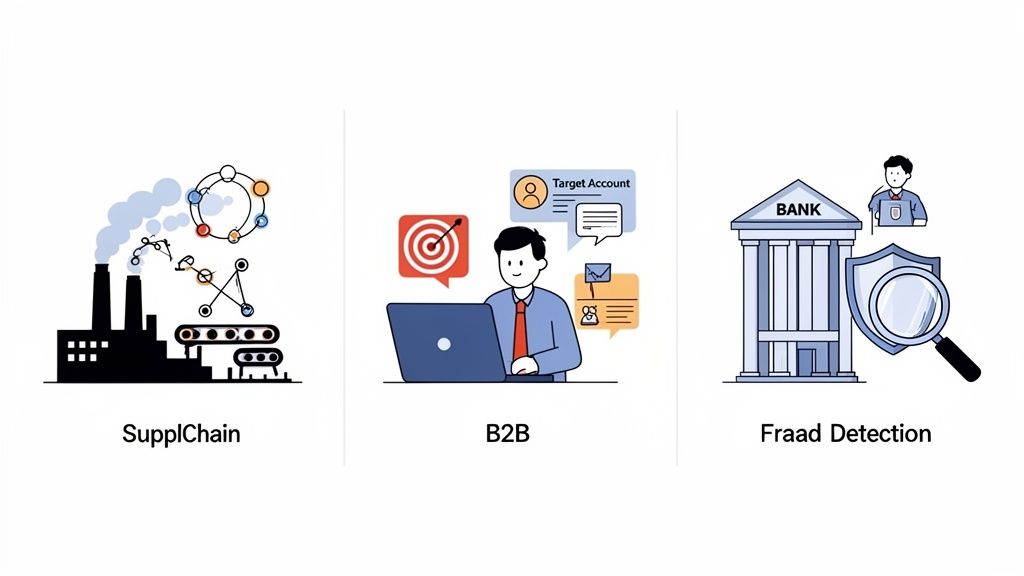
The theory behind Multi-Agent Systems for Enterprise is compelling, but the real value is demonstrated when they are put to work. Across industries, businesses are deploying these autonomous teams to solve stubborn operational bottlenecks and unlock new avenues for growth. These are practical solutions delivering measurable results today.
Adoption is picking up steam as leaders see what's possible. Data from agentic AI statistics at multimodal.dev shows the focus is quickly shifting to multi-agent setups to tackle complex work in data management, customer support, and operations—all mission-critical areas for any manufacturer or B2B company.
Key Takeaways
- Manufacturing Resilience: Multi-agent systems can build dynamic, self-healing supply chains that react to disruptions in real-time, sidestepping costly delays and production shutdowns.
- B2B Marketing Precision: Autonomous agents execute hyper-personalized Account-Based Marketing (ABM) campaigns at scale, coordinating research, content, and outreach to drive up conversion rates.
- Financial Services Security: In finance, agent teams work around the clock to spot fraudulent activity and automate customer service, boosting both security and the user experience.
Practical Example: Transforming Manufacturing with a Dynamic Supply Chain
For any manufacturer, a single hiccup—a delayed shipment, a supplier outage—can bring production to a grinding halt. A multi-agent system transforms this rigid, fragile process into a responsive, intelligent network that can think on its feet.
- A Monitoring Agent constantly scans global logistics data and news, flagging a port closure within minutes of it happening.
- It instantly alerts the Procurement Agent, which accesses a pre-vetted list of alternate suppliers and negotiates new pricing in real-time.
- At the same time, a Logistics Agent calculates the most efficient new shipping routes and schedules to keep the delay to an absolute minimum.
Impact Opportunity: The entire disruption is contained and resolved in under two hours, with almost no impact on the production schedule. The system doesn't just react faster; it optimizes the solution for both cost and speed, turning a potential crisis into a minor course correction.
Practical Example: Powering B2B Growth with an ABM Engine
In the B2B world, personalization wins deals, but scaling it is a massive challenge. Multi-agent systems can run a sophisticated ABM strategy that treats every high-value account like it's your only one.
- Research Agents dig in and build deep profiles on target accounts, identifying key decision-makers, their recent business challenges, and tell-tale buying signals.
- Content Agents take that research and personalize everything—case studies, blog posts, and email copy—to align the message with each account's specific pain points.
- An Orchestration Agent coordinates the entire outreach sequence across email, LinkedIn, and targeted ads, making sure the experience is consistent, timely, and relevant.
Impact Opportunity: This coordinated, autonomous effort ensures every touchpoint feels valuable, dramatically increasing the odds of booking a meeting and closing a deal. The system handles all the heavy lifting, freeing up the human team to focus on what they do best: building relationships.
Integrating Multi-Agent Systems With Your Tech Stack
Bringing new technology into your business shouldn't mean you have to rip out everything you’ve already built. The real power of Multi-Agent Systems for Enterprise is realized when they plug into your existing tools, turning your current tech stack into a smarter, more autonomous engine for growth. This is all about enhancement, not replacement.
Think of your technology ecosystem as a digital nervous system. Your CRM—whether it’s Salesforce, HubSpot, or something else—is the backbone. The multi-agent system then acts like a network of specialized nerves, connecting to that backbone to carry out complex tasks automatically. This integration lets agents pull data from your core systems and push actions back into them, creating a closed-loop system that’s always learning and improving.
Key Takeaways
- Enhance, Don't Rip and Replace: Multi-agent systems are made to work with your current tools, boosting their capabilities instead of forcing you into a costly and disruptive migration.
- Your CRM is the Core: Treat your CRM as the single source of truth. Agents should read from it and write back to it, keeping all your data consistent and your processes clean.
- Start with Specific Workflows: Kick things off by integrating agents into well-defined, high-impact processes. Think lead scoring or customer support ticketing—quick wins that prove the value right away.
- APIs are the Connective Tissue: A smooth integration hinges on solid APIs. They’re what allow for that seamless conversation between your agents and your other enterprise apps.
Practical Example: Common Integration Patterns for Your Business
Hooking up an autonomous workforce to your tech stack usually follows a few proven patterns. The most direct and powerful strategy is a direct API integration, where agents get secure access to read and write data in your core platforms.
- Lead Scoring Agent with Salesforce: An agent connects directly to your Salesforce API. It grabs new lead data, enriches it with outside info (like company size or industry), scores the lead based on your ideal customer profile, and then pushes the new score and status right back into the Salesforce record.
- Customer Support Agent with Zendesk: A support agent monitors incoming tickets in Zendesk. It can handle common questions on its own by pulling from your knowledge base. For trickier issues, it escalates by creating a high-priority ticket and assigning it to the right human agent—complete with a full summary.
- Account Research Agent with HubSpot: For an ABM campaign, a research agent connects to HubSpot to get a list of target accounts. It then scours the web for buying signals—like a new funding round or executive hire—and updates the account records in HubSpot with fresh insights for the sales team to use.
Impact Opportunity: This level of integration transforms your CRM from a passive database into an active, intelligent system. Instead of your team manually updating records all day, the system updates itself. This frees up your people to focus on strategic, high-value work that actually builds customer relationships.
Turning Your Stack Into a Scalable Revenue System
The goal is to build a system that drives revenue without constantly needing more people to run it. Integrating agents directly with your CRM and other GTM tools is how you get there. This approach is the heart of a strong AI enablement strategy because it makes sure technology serves your business processes—not the other way around. You can explore our services for AI enablement for your business to learn how to build this foundation.
When you connect specialized agents to your core platforms, you create a scalable system where technology handles the repetitive, data-heavy lifting. This lets your human team operate at a much higher, more strategic level. It’s how you innovate without blowing up your business: you make the tools you already have work a whole lot smarter.
Your Roadmap to Implementing Multi-Agent Systems
Taking an autonomous workforce from a compelling concept to a real-world asset demands a clear, strategic plan. Rolling out multi-agent systems for enterprise isn’t a one-and-done event; it's a journey. The key is to start small, prove the value, and then scale intelligently. This roadmap breaks it down into four distinct stages, designed to de-risk the investment and build momentum for a much bigger transformation.
Key Takeaways
- Start with a Focused Pilot: Don't try to boil the ocean. Find one high-impact, low-complexity problem and solve it first. Proving ROI on a smaller scale is the best way to get buy-in for bigger projects.
- Measure Business Outcomes: Success isn't just about the tech. You have to track real business metrics, like reduced manual effort, a lower cost per lead, or faster response times. This is how you show undeniable value.
- Plan for Scalability: Design your first project with the future in mind. Pick partners and platforms that can grow with you, from a single workflow to an integrated system across multiple business functions.
- Balance Build vs. Buy: Think carefully about whether to build a custom solution or partner with an expert. The right call depends on your team's skills, your timeline, and the problem you're trying to solve.
Stage 1: Identify High-Impact Opportunities
First things first: pinpoint where a multi-agent system can deliver the biggest, most immediate value. It’s tempting to want to fix everything at once. Resist that urge. Look for processes that are repetitive, rule-based, and eating up your team's time.
Revenue operations and customer service are often the best places to start. Think about automating lead qualification or the first tier of customer support—these are perfect candidates. Success here is easy to measure and ties directly to business growth. Define what a win looks like right from the beginning. Set clear goals, like a 20% reduction in manual data entry for the sales team or a 30% faster initial response to customer inquiries.
Stage 2: Launch a Pilot to Prove ROI
Once you’ve found your opportunity, it’s time to launch a pilot project. The goal here is simple: get a quick, undeniable win. This isn't the time for a massive, multi-year overhaul. It's about proving the concept works and building confidence across the company. Scope your pilot for a fixed period, usually 60-90 days. During this time, deploy a small team of agents to tackle the specific problem you identified in stage one. And while it’s running, track those metrics you defined earlier—relentlessly.
Impact Opportunity: A successful pilot does more than just validate the technology; it becomes a powerful internal case study. When you can show executives that a targeted multi-agent system cut manual work by 58% or accelerated lead-to-appointment times by 69%, you create the political capital needed to scale your efforts.
This diagram shows the basic flow of how an agent connects to your existing data to get things done.
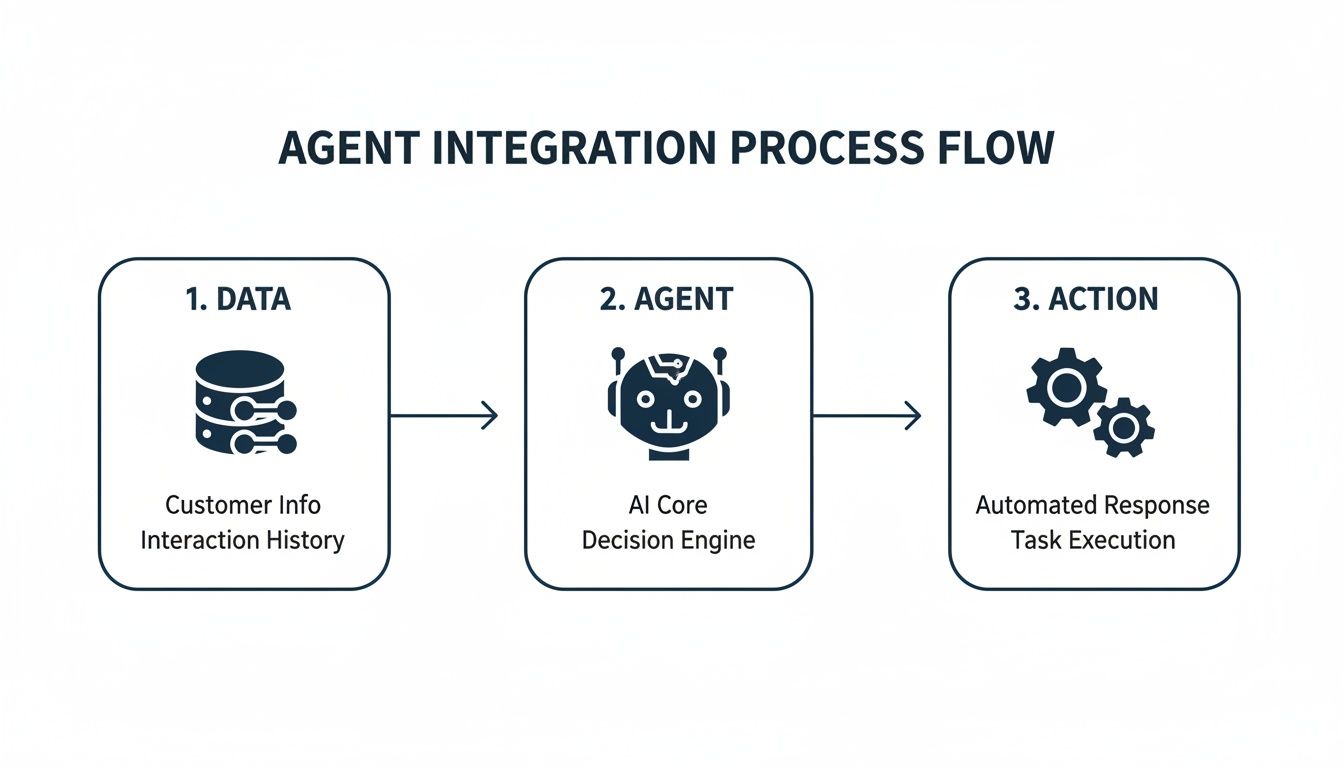
As you can see, agents act as an intelligent bridge between your data sources (like a CRM) and the actual execution of business tasks.
Stage 3: Scale and Integrate Across Functions
With a successful pilot under your belt, it's time to think bigger. This stage is all about expanding from a single workflow to broader, cross-functional processes. You could add more agents to handle related tasks or connect agent teams from different departments, like sales and marketing. For instance, a system that only qualified leads could be expanded to also manage personalized email nurture campaigns and even coordinate ad spend. This kind of integration creates a much more powerful, cohesive system that optimizes a bigger piece of the customer journey.
A critical choice you'll face here is whether to build a custom system in-house or buy a solution from a specialized partner. Building gives you total control but demands serious technical expertise and resources. Buying or partnering gets you up and running faster and lets you tap into external expertise, so your team can focus on results, not infrastructure.
Stage 4: Govern and Continuously Optimize
Finally, as multi-agent systems become a core part of your operations, you need a strong governance framework. This means setting clear rules for how agents operate, ensuring data is secure, and keeping human oversight in the right places. This stage is also about constant improvement. Your business is always changing, and your autonomous workforce needs to adapt with it. Regularly review agent performance against your KPIs and look for ways to optimize.
Don’t think of your multi-agent system as a static tool. Treat it as a dynamic, evolving part of your team—one that gets smarter and more effective over time.
Governing Your New Autonomous Workforce
When you deploy a team of autonomous AI agents, you’re unleashing incredible power. But it begs a question every leader should be asking: who’s actually in charge? Giving algorithms the authority to make decisions demands a new kind of oversight—establishing the same clear corporate policies and compliance rules for your agents that you have for your human team.
Treating governance as an afterthought is a recipe for operational chaos. Think of it as building the foundational operating system for your multi-agent systems for enterprise. This is where you define the rules of engagement, data handling protocols, and the hard boundaries your agents must operate within.
Key Takeaways
- Establish Clear Guardrails: Define exactly what agents can and cannot do. This means setting strict permissions, access controls, and operational limits to prevent them from going off-script.
- Prioritize Data Security: Lock down how agents access, process, and store sensitive company and customer data. Full compliance with privacy regulations isn't optional.
- Maintain Human Oversight: Always keep a "human-in-the-loop" for critical decisions. A person must be able to review, approve, or halt an agent's actions when the stakes are high.
- Create an Audit Trail: Log every single action taken by every agent. This transparency is your lifeline for troubleshooting, accountability, and sailing through compliance audits.
Building a strong Governance Framework
A solid governance structure is your best defense against risk and your biggest enabler of performance. Comprehensive Artificial Intelligence governance frameworks are non-negotiable for managing these systems responsibly and making sure they stick to your business goals.
Your framework needs to cover a few core areas:
- Rules of Engagement: Be specific about the conditions that allow an agent to act. For instance, an agent can automatically resolve customer service tickets under $50, but anything over that gets flagged for human review.
- Data Privacy Protocols: Clearly map out what data an agent can touch. An agent personalizing marketing emails has no business accessing sensitive financial records. These data silos are a hard line you don't cross.
- Escalation Paths: When an agent hits a wall, what happens? You need a crystal-clear procedure for who gets alerted and what information they need for a quick, effective human intervention.
The Human-in-the-Loop Safeguard
The single most important piece of governing these systems is maintaining human-in-the-loop (HITL) oversight. This model is simple: agents do the heavy lifting, but a human expert always has the final say on key decisions. It’s the perfect blend of automation and accountability.
Impact Opportunity: HITL isn’t a bottleneck; it’s a strategic control point. It lets you tap into the speed and scale of AI without giving up final judgment, especially in sensitive areas like financial transactions or high-stakes customer interactions. To dig deeper into this mindset, see our insights on how AI-enabled leaders are growing differently by mastering their tech.
A well-governed autonomous workforce doesn't replace your team. It becomes a powerful extension of it, operating with the same integrity and purpose you expect from everyone else.
Common Questions About Multi-Agent Systems
When leaders start exploring multi-agent systems, a few key questions always come up. Here are the answers you need to move forward with confidence.
Key Takeaways
- Measure ROI with the Right KPIs: Look beyond just cost savings. Track direct financial gains like lower Cost Per Lead (CPL) and indirect wins like faster decision-making to show the full business impact.
- Focus on Business Skills, Not Just Tech: Your team needs to understand the business problem and desired outcome. You can lean on a strategic partner for the technical side, letting your team focus on driving growth.
- Start Small with a Pilot: Pick a high-impact, low-risk problem to solve first. Set clear success metrics from day one and create a tight feedback loop to build buy-in across the organization.
How Do We Measure the ROI of a Multi-Agent System?
Measuring the return on an autonomous workforce means looking at the whole picture, not just the obvious cost savings. You have to track both direct financial wins and the less tangible strategic advantages.
Impact Opportunity: You can point to a 25% reduction in Cost Per Lead (CPL) as a direct, hard-number win from an automated sales team. But the indirect ROI—like a 40% faster decision-making cycle because your agents deliver real-time analysis—is just as valuable. Tie your KPIs directly to business goals, such as a 58% reduction in manual data entry or a measurable jump in customer satisfaction scores.
What Skills Does My Team Need to Manage These Systems?
You don't need a team of AI developers, but you do need people with sharp business sense. The most important skill isn't coding; it's the ability to clearly define a business problem and what a successful outcome looks like. A good strategic partner can handle the heavy technical lifting. This frees up your team to focus on what they do best: using the system’s output to make smarter decisions and drive growth.
How Do We Get Started with a Pilot Project?
A pilot is the best way to prove the value of multi-agent systems. The trick is to start smart. Pick a business problem that’s painful enough to matter but not so complex that you get stuck. Before you even begin, define what success looks like. Is it reducing a specific process time by 30% within 60 days? Write it down. Clear goals prevent a pilot from turning into a science project. Finally, make sure the project has a quick feedback loop. You want to show tangible results fast to build the momentum you'll need for a broader rollout.
At Prometheus Agency, we help you turn your existing tech into a scalable revenue system with a clear, actionable AI roadmap. We focus on business outcomes, not just tooling, to build durable growth.
Schedule your complimentary Growth Audit and AI strategy session