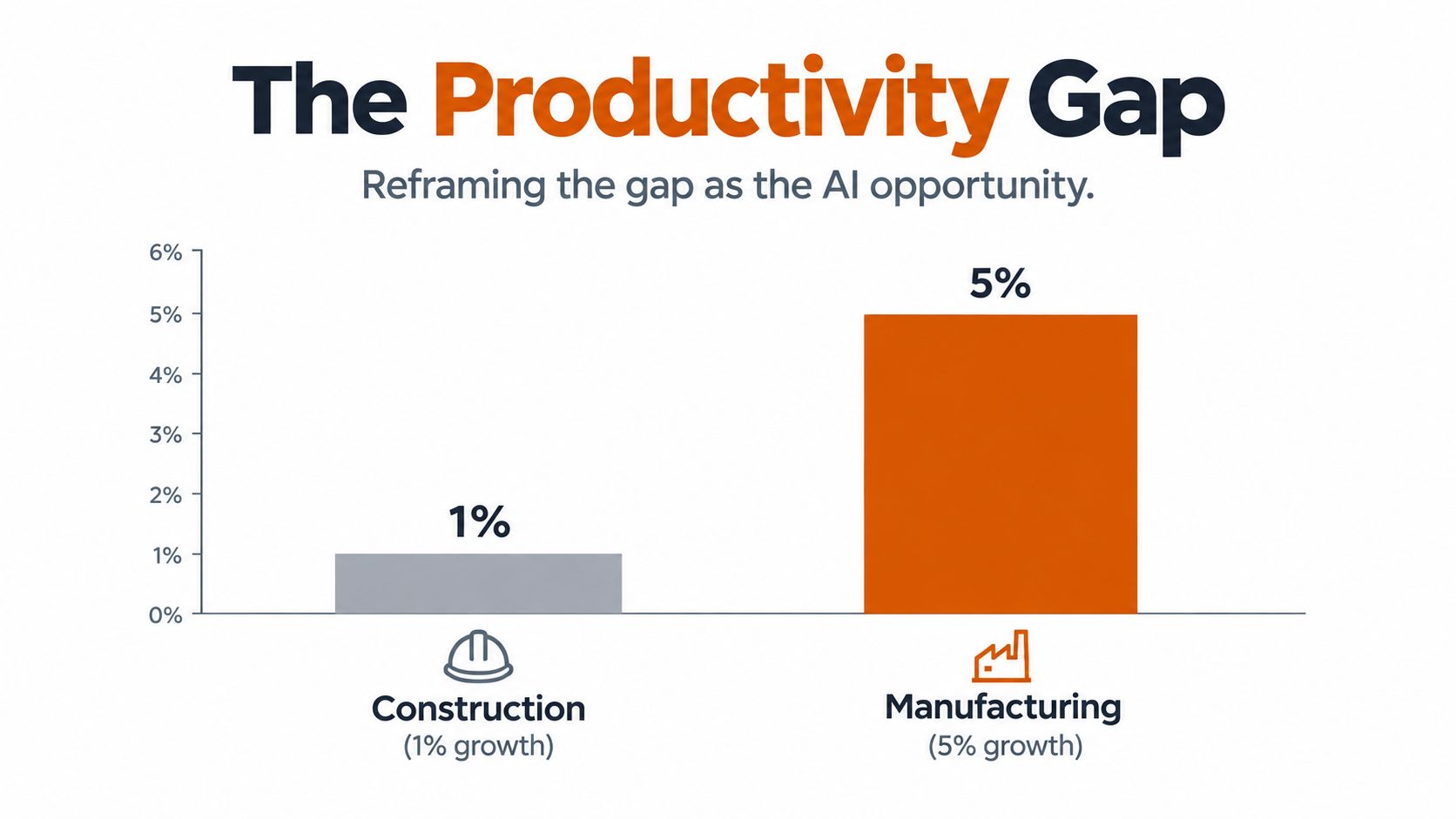
Construction productivity increased by only 10% between 2000 and 2022, while manufacturing productivity rose by 90% over the same period, according to McKinsey's analysis of AI in architecture, engineering, and construction. That gap is the underlying reason to learn how to use AI in construction. The opportunity isn't a flashy robot or another chatbot. It's the disciplined removal of repetitive information work that slows estimating, billing, coordination, safety follow-up, and project reporting.
Most failed pilots start with a tool and search for a problem afterward. That reverses the order. A contractor should begin with a measurable workflow, identify the systems and data that support it, assign an accountable owner, and then choose the simplest AI capability that can improve the outcome without weakening human judgment.
Key Takeaways
- Start with a business loss, not an AI feature. Choose a workflow tied to cycle time, margin, schedule performance, rework, or compliance.
- Use the existing technology stack. AI should feed the ERP, BIM environment, project-management platform, or field workflow your teams already use.
- Prefer narrow pilots. Document review, estimating support, change-order detection, and equipment utilization are easier to validate than full schedule automation.
- Keep people accountable. AI can classify, summarize, compare, and flag. It shouldn't make safety-critical, contractual, payment, or technical decisions alone.
- Scale only with evidence. A pilot needs a baseline, an owner, an adoption threshold, and a clear scale-or-stop decision.
Why AI in Construction Starts With the Productivity Gap
Construction doesn't have an AI problem first. It has a productivity and information-flow problem. McKinsey found that global construction productivity grew by 10% between 2000 and 2022, equivalent to approximately 0.4% per year, while manufacturing productivity increased by 90%, or about 3.0% annually over the same period. The contrast makes a useful point: construction doesn't need AI everywhere. It needs AI where fragmented information and manual administration create measurable drag.
McKinsey mapped 150 workflows across 25 architecture, engineering, and construction domains and estimated that AI could automate approximately 39% of nonphysical work in construction, compared with 50% in architecture and engineering. The practical applications are not speculative science fiction. They include document and data entry, invoicing, equipment inspection, design coordination, feasibility analysis, estimating, scheduling, and project reporting.
The first target is information friction
A project executive rarely loses margin because a language model failed to produce an impressive paragraph. Margin leaks when an estimator searches through old bid files, when a change order sits in an inbox, when an invoice doesn't match contract terms, or when a project team spends too long assembling a status report from disconnected systems.
That makes the first AI question operational: which recurring workflow creates visible loss, and what number proves it? The answer might be estimate preparation time, unresolved change-order value, invoice-processing cycle time, schedule variance, or rework cost. If nobody tracks the baseline, the company isn't ready to prove that AI helped.
Practical rule: Don't approve an AI pilot until one executive can name the workflow owner, the baseline metric, and the decision the output will change.
The sequence should be simple. Identify a workflow with quantifiable loss. Confirm that the required data is accessible and usable. Select the least complicated AI capability that can move the metric. Then run it beside the current process long enough to test accuracy, adoption, and business impact.
This is why AI adoption in construction is primarily a systems-and-change problem, not a model problem. A model connected to clean project data can support a useful decision. The same model connected to incomplete drawings, inconsistent cost codes, and stale schedules will generate confident noise. No software vendor can solve an ownership gap inside the contractor.
Picking the First Use Case Worth Your Time
The first use case should survive four tests. It must connect to a business outcome leadership already tracks, rely on data the company already collects, fail visibly enough for a human to catch the error, and fit inside a contained pilot with a clear decision date. If it fails any of those tests, put it aside.
Estimating is often a better starting point than field analytics because bid libraries, plan sets, quantities, and cost records are easier to retrieve and compare than inconsistent jobsite sensor streams. A controlled estimating workflow might use AI to extract quantities, identify missing scope, compare a new plan set with prior bids, or flag unusual assumptions for an estimator. Teams evaluating specialist options can review resources such as Exayard AI construction estimating, while the broader prioritization logic in this AI use case prioritization framework can help executives compare candidates consistently.
Change-order review is another strong candidate. An AI system can classify incoming documents, link them to the relevant contract or drawing, identify potential scope changes, and route the package to the right reviewer. It shouldn't approve entitlement or commit the company to a price. Its job is to shorten discovery and improve consistency.
Invoice and subcontractor billing reconciliation also has a useful shape. The system can compare an invoice with contract terms, approved quantities, payment history, and supporting records, then flag exceptions for the commercial team. The human reviewer still owns the payment decision.
Use a scorecard, not enthusiasm
Avoid vanity use cases such as generating alternative schedules without a baseline, producing attractive dashboards nobody uses, or deploying a general chatbot without a defined workflow. Score every candidate against the same questions before procurement begins.
| Criteria | Question to Answer | Weight |
|---|---|---|
| Business outcome | Which tracked result should improve, such as review time, estimate variance, or payment-cycle time? | High |
| Data availability | Does the firm already collect the records needed, with usable permissions and consistent fields? | High |
| Visibility of failure | Will a reviewer quickly detect an incorrect classification, extraction, or recommendation? | High |
| Workflow ownership | Can one named estimator, commercial lead, PM, or executive own the outcome? | High |
| Integration effort | Can the output enter an existing system of record instead of creating another destination? | High |
| Pilot containment | Can the firm test the workflow without changing every project or replacing core software? | Medium |
| Adoption likelihood | Will the people doing the work use the output during their existing routine? | High |
The winning use case isn't necessarily the one with the most advanced model. It's the one where the company can measure the current process, intervene when the output is wrong, and connect improvement to a business result.
Assessing Data, Systems, and Digital Readiness
AI can't compensate for records that the business can't find, trust, or connect. Deloitte's survey of 954 construction and engineering businesses across Australia, Hong Kong, India, Japan, Singapore, and Vietnam found that 46% used artificial-intelligence or machine-learning tools in 2026, while 56% used data analytics, 50% used construction-management cloud software, and 47% used mobile applications. The same research found that fewer than half reported that on-site teams mostly had access to real-time project data, while one-quarter still relied mainly on paper-based systems. Deloitte's construction digital adoption research shows why a chatbot pilot can't substitute for a digital foundation.
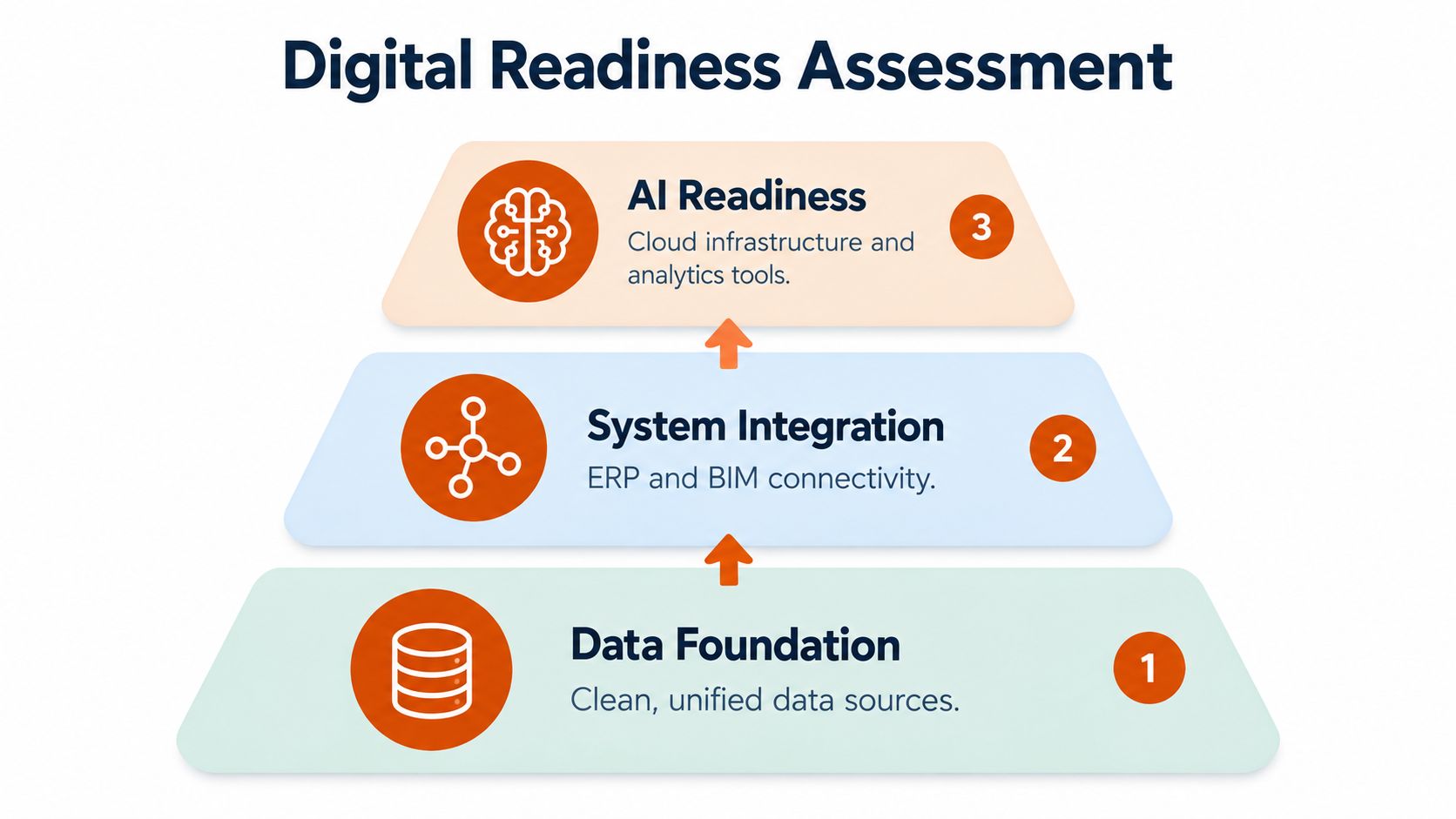
Only 16% of surveyed businesses had reached an advanced level of digital capability, according to Deloitte. That maturity gap matters because AI needs consistent records, connected systems, field participation, and governance. Before selecting a model, assess four layers: structured ERP and project data, document and drawing repositories, site-level photos and telemetry, and integration across estimating, project management, BIM, accounting, and field tools.
A readiness rubric for mid-market contractors
Level 1, paper-dependent. Core records live in paper files, email threads, spreadsheets, or disconnected local folders. The firm should prioritize digitization, naming conventions, permissions, and a reliable document repository before buying AI.
Level 3, partially digitized. Teams use cloud applications, but estimating, ERP, BIM, project management, and field tools remain siloed. This level can support tightly bounded document classification, search, reporting assistance, or estimating review, provided the source records are reliable.
Level 5, cloud-native and interoperable. Systems exchange defined records through stable integrations, ownership is clear, and teams can trace an output back to its source. This environment can support connected forecasting, progress analysis, exception management, and more advanced computer vision.
The minimum bar isn't “every process must be digital.” It is narrower. The records required for one selected workflow must be accessible, permissioned, sufficiently complete, and connected to the place where the team acts. A contractor at Level 1 shouldn't fund a predictive model for field productivity. It should first make daily reports, cost codes, schedules, and approvals usable.
The right sequence is digitize, connect, govern, then automate.
Use the AI data readiness assessment to examine whether the proposed use case has a trustworthy data path. Most mid-market firms should spend more effort configuring core platforms and cleaning handoffs before they spend more on custom models.
Running a Computer Vision Pilot on a Real Site
Computer vision deserves a stricter operating method than a conference demonstration. A model that identifies PPE or hazards in curated footage isn't automatically reliable across changing weather, camera angles, occlusion, trades, and work sequences. A 2025 ITcon study used 55,594 images across 28 OSHA-related categories and reported 0.89 precision with an mAP@0.5:0.95 of 0.45, which illustrates both the scale of data involved and the difference between benchmark performance and field reliability. Review the ITcon computer-vision safety study before setting expectations.
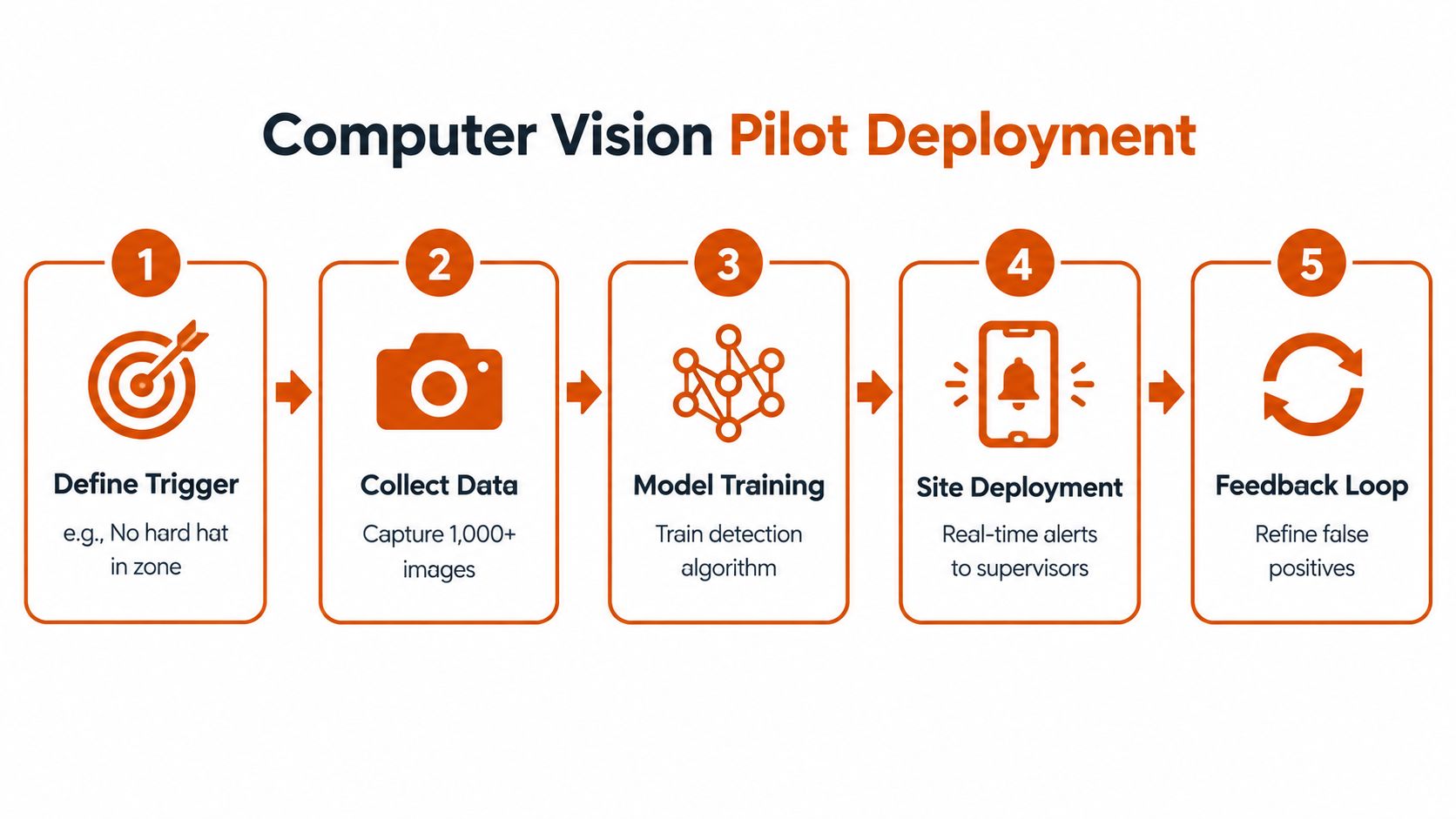
Five stages for a controlled deployment
Define one site outcome. Choose a trigger such as a worker entering an exclusion zone without a hard hat. Define what supervisors will do when the system flags it, and set an acceptance threshold before any footage is reviewed.
Build representative training data. Collect labeled images or video from the actual project environment. Include different trades, lighting conditions, weather, camera positions, and levels of occlusion. Randomly splitting frames from one camera feed can make the model look better than it performs on a different site.
Validate against human review. Use separate site-level test data, not just adjacent frames from the training feed. Measure precision, recall, false-alert rate, response time, and incident trends. Supervisors should retain decision authority during the shadow pilot.
Use existing communication channels. Route confirmed alerts through the project-management workflow, such as Procore, or through an established notification channel. Don't force foremen to open a new dashboard for every signal. A human checkpoint should prevent unverified alerts from triggering discipline or escalation.
Measure corrective action. Detection count is a weak outcome. Track the time from a confirmed alert to corrective action, whether the response occurred, and whether the safety workflow improved. Revalidate the model after camera relocation, major weather changes, new PPE types, or changed work sequencing.
The common failure isn't always the algorithm. Camera coverage gaps, poor lighting, alert fatigue, unclear worker consultation, and weak supervisor adoption can sink a technically competent pilot. Safety decisions also carry legal and ethical consequences, so automated alerts shouldn't become disciplinary evidence without human verification.
For the operational handoff from experimentation to production, use an AI pilot to production checklist. It should include a kill criterion. If supervisors won't use the output or the false-alert burden overwhelms the workflow, stop the pilot, diagnose the operating failure, and avoid expanding it solely because the vendor has already been paid.
Piloting Schedule and Productivity Use Cases Without Overreach
Full schedule automation is usually too broad for a first productivity pilot. A planner's schedule contains contractual logic, weather dependencies, procurement constraints, subcontractor commitments, safety requirements, and tacit knowledge that may never appear in the schedule file. A system that generates a plausible sequence can still miss the reason a superintendent rejected it.
Start with a bounded signal instead. Activity recognition can classify a short video clip as a concrete pour, rebar tying, or idle time. Equipment-utilization tracking can show when a machine is available, active, or waiting. Installed-quantity tracking can compare observed progress with a work package. Each output is interpretable and can feed an existing daily log or look-ahead meeting.
A reviewed construction study reported activity-recognition accuracy of up to 88%, while other algorithms achieved approximately 85% accuracy with faster feedback, according to a systematic review of visual computing in construction. Those findings are promising, not a guarantee of return on investment. The review also identified persistent challenges around data quality, interoperability, validation, and operational adoption.
| Dimension | Narrow Pilot, Activity Recognition | Broad Pilot, Full Schedule Automation |
|---|---|---|
| Scope | One activity, asset class, or work package | The project schedule and its dependencies |
| Output | A classified, auditable signal | A generated or substantially revised plan |
| Risk | Contained and easier to review | High, because missed constraints can affect commitments |
| Integration | Daily logs, BIM, or look-ahead workflow | Scheduling, ERP, procurement, field, and contract systems |
| Time-to-value | Faster, if cameras and labels are available | Slower, because the data and approval surface is wider |
| Best maturity fit | Digitized project data with an engaged superintendent | Interoperable systems and mature planning governance |
The practical example is straightforward. Connect site video, BIM or 4D schedule data, equipment telemetry, and supervisor confirmations. Use a controlled activity taxonomy, validate on projects excluded from training, and display the result in the daily planning routine. Measure manual measurement hours, classification quality, schedule variance, time-to-detection, and whether the team acted on the signal.
If a planner can't explain the model's output to a client in five minutes, the pilot is too large.
Integration, Governance, and the Operating Model That Actually Scales
Adding more AI tools can make adoption worse. Each model creates another integration surface, another owner gap, another permission decision, and another training burden for people who already have to deliver the project. A contractor doesn't need an AI collection. It needs a small number of dependable workflows that fit the way work is approved and recorded.
RICS research found that 45% of construction organizations reported no AI implementation, 34% were in early pilots, 12% used AI regularly in selected processes, and 1.5% used it across multiple processes. The reported blockers included skilled-personnel shortages at 46%, system-integration challenges at 37%, and poor data quality at 30%, as documented in the RICS artificial intelligence in construction report. The pattern is clear. Scaling fails less often because the model is unavailable than because the operating model is missing.
Integration belongs to the system owner
Every AI pilot should land in an existing system of record. Estimating output belongs in the estimating or ERP environment. Document classifications should update the project-management or document repository. BIM and field observations should connect through an approved project-data workflow.
A middleware layer or integration platform should own the data contracts, not the model vendor. Define which fields enter the model, what the output means, who can read it, how long it is retained, and what happens when the source record changes. Without that contract, the pilot creates a parallel truth that eventually conflicts with the project record.
One accountable owner beats a committee
Assign one accountable role per use case, usually a superintendent, project executive, commercial lead, or operations leader with responsibility for the relevant result. That person should review the KPI tied to the model, approve changes to the workflow, and decide whether the output is useful enough to scale.
An AI steering committee can set guardrails, but it shouldn't become the place where operational accountability goes to disappear. Quarterly governance meetings can't replace a daily planning decision or a timely review of an incorrect invoice flag.
Adoption is a go-live requirement
Budget field time for training. Shadow supervisors during the initial deployment. Give users a way to report false positives, missing records, and confusing recommendations. If the people responsible for acting on the output don't adopt it, the pilot hasn't gone live, regardless of whether the API is functioning.
| Role | Owned Artifact | Review Cadence |
|---|---|---|
| Operations owner | Business KPI, workflow decision, scale-or-stop recommendation | Weekly during pilot |
| Data owner | Source definitions, permissions, data-quality exceptions | Weekly during pilot, then monthly |
| System owner | Integration, data contract, error handling, audit trail | At deployment and after material changes |
| Field or project supervisor | Human review, exception feedback, corrective action | Daily or per workflow event |
| Executive sponsor | Funding, risk tolerance, cross-functional escalation | At pilot gates |
The risk controls must match the decision. Low-risk uses include searching specifications, summarizing meeting records, and drafting routine communications. High-consequence uses include safety alerts, bid commitments, payment decisions, contractual interpretation, and schedule changes that affect claims. For those uses, require source traceability, permission controls, retention rules, confidence thresholds, human approval, incident logging, and periodic error testing.
A 2025 systematic review identified 49 critical AI risks in construction across data, technical, knowledge, management, financial, and legal dimensions. Industry survey results also identified data privacy and security at 62%, insufficient internal expertise at 58%, and limited or poor-quality data at 56% as adoption barriers, according to the systematic review of AI risks in construction. A smaller deployment with a clean audit trail will usually create more durable value than a broad rollout nobody can govern.
Firms pulling ahead treat AI as a workflow change with a software component. They don't treat workflow change as a side effect of purchasing software. The operating model is the moat, not the model.
KPIs, Pitfalls, and a Scale-or-Stop Checklist
AI value should appear in the operating numbers, not in a product demo. Track the financial result and the behavior that produces it. For estimating, that may mean estimate variance and bid hit rate. For document review, it may mean review cycle time and missed obligations. For safety prediction, it includes false-positive rate, corrective-action time, and verified compliance trends.
Useful construction KPIs include:
- Estimate variance: Compare predicted or reviewed quantities and costs with the approved baseline and final outcome.
- Change-order review hours: Record the manual time required to identify, classify, route, and review change packages.
- Safety-prediction quality: Track false alerts alongside response time. A high alert count isn't a safety result.
- Schedule slippage: Compare planned and observed progress at the work-package level.
- Rework cost: Link detected issues to actual corrective work and commercial impact.
- Field adoption: Measure whether the intended users open, confirm, reject, or act on the output.
Autodesk's 2025 research surveyed 5,594 industry leaders, futurists, and experts across several industries. Only 40% said their organizations were approaching or had achieved their AI goals, down from 56% the previous year. In construction, 47% of leaders identified finding appropriate AI use cases as a major or moderate concern, while 32% reported approaching or reaching their AI goals, according to Autodesk's 2025 State of Design and Make research. More than 76% of leaders were increasing AI investment, which makes disciplined measurement more important, not less.
Five failure modes to remove early
- Scope creep: The team adds adjacent workflows before proving the first one.
- Vanity dashboards: Leaders see activity counts but can't connect them to cost, time, quality, or safety outcomes.
- Vendor lock-in: The model vendor controls data definitions, integrations, and the only path to change.
- Unowned data contracts: Nobody is responsible for source quality, permissions, retention, or output interpretation.
- Innovation-lab purgatory: The pilot works in a demonstration environment but never enters the daily project workflow.
Use this scale-or-stop checklist at the pilot gate:
- ROI: Did the workflow improve the pre-agreed business metric?
- Integration: Does the output land in the existing system of record?
- Accuracy: Are precision, recall, false-alert rate, or classification quality within the approved threshold?
- Adoption: Do the named users act on the output without constant intervention?
- Governance: Can the team trace recommendations to source records and audit decisions?
- Ownership: Does one accountable leader support expansion?
- Risk: Have privacy, legal, safety, and contractual controls been tested?
- Repeatability: Can the process work on another project without rebuilding the entire pipeline?
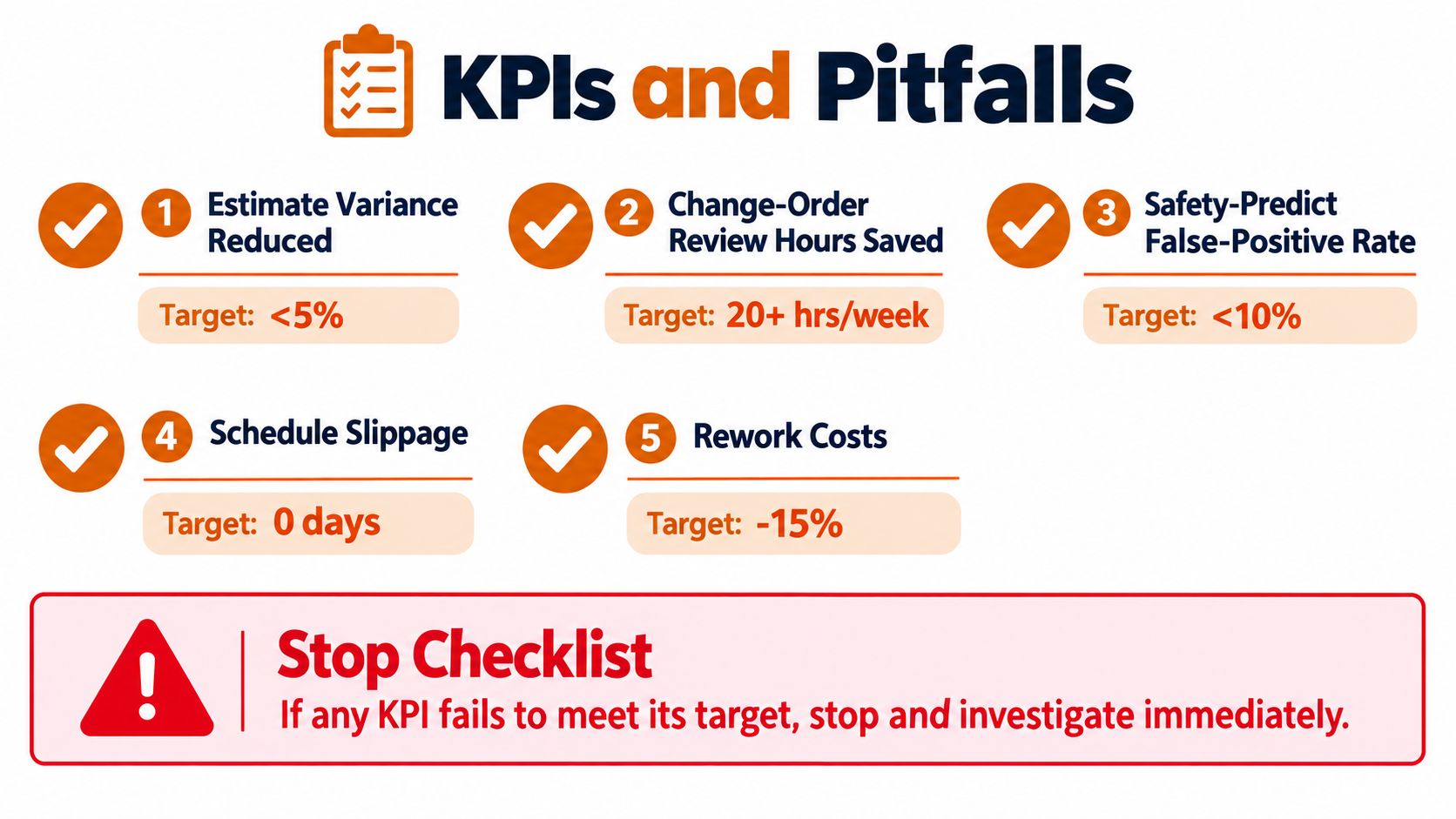
The right decision isn't always scale. Stopping a weak pilot protects capital, attention, and trust. Construction companies should choose auditable, narrow scope over flashy, broad scope every time, then expand only when the workflow, data, integration, and people are ready.
Prometheus Agency helps construction teams assess AI readiness, prioritize practical opportunities, connect project and field data, and move a high-priority application from pilot to production adoption. Visit Prometheus Agency to request a complimentary Growth Audit and AI strategy session focused on a measurable workflow, clear ownership, and an implementation path your teams can use.