If you're trying to lower your customer acquisition cost, the first step is to stop chasing sheer volume and start focusing on efficiency. It’s a complete mindset shift.
Instead of just pouring more money into ads, you have to get clinical. This means digging into your marketing funnel to find where it's leaking, getting smarter with your targeting and channel mix, and investing in the customers you’ve already won. When you prioritize efficiency and lifetime value, you're not just buying customers—you're building a truly sustainable growth engine.
Why Is It So Expensive to Get New Customers?
Does it feel like acquiring a new customer is harder and more expensive than ever? You're not imagining things.
The old playbooks just aren't working anymore. Many businesses are watching their marketing budgets balloon without seeing a real jump in profitable growth. This isn't happening in a vacuum; it’s a market-wide shakedown, driven by a few key forces that have completely rewritten the rules of customer acquisition.
The Forces Driving Up Your CAC
So, what's really going on? Two main culprits are at play: suffocating competition and market saturation.
Every single digital channel, from your social feeds to Google search results, is infinitely more crowded than it was a few years ago. This directly jacks up advertising costs as more and more businesses bid for the exact same ad space and eyeballs. It’s a classic supply-and-demand squeeze, and the cost to reach a potential customer just keeps climbing.
In this environment, winging it is a recipe for disaster. To get a handle on spiraling acquisition costs, you need a clear strategy. You can dig deeper into some founder-tested tactics to reduce customer acquisition cost to get a head start.
The Real Cost of Inefficient Acquisition
The financial damage from these trends is staggering.
Between 2013 and 2025, the average loss per new customer is projected to leap from $9 to $29. That's a gut-wrenching 222% spike. This isn't just inflation; it’s a clear sign of growing inefficiency, where huge marketing spends fail to create profitable, long-term customer relationships. You can find more of these eye-opening customer acquisition cost statistics on amraandelma.com.
Key Takeaways
Rising Customer Acquisition Cost (CAC) is a universal problem fueled by intense competition and ad saturation. The only way out is to shift your strategy from a broad, volume-based approach to one that's built on efficiency, laser-sharp targeting, and retention. This guide is your playbook for finding and fixing what’s really driving up your CAC.
Practical Example:
A B2C e-commerce brand noticed their CAC climbing 20% year-over-year. Their initial reaction was to increase the ad budget to maintain growth. Instead, they audited their funnel and discovered a massive 70% drop-off right on the checkout page. By focusing all their energy on fixing that one leak with conversion rate optimization tactics—like simplifying the form and adding trust badges—they slashed their CAC by 15% without spending a single extra dollar on ads.
Impact Opportunity:
Changing your perspective from "How do we get more customers?" to "How do we acquire the right customers more efficiently?" is a game-changer. This strategic shift can fundamentally alter your company's profitability and set you up for scalable, long-term growth by turning a cost center into a predictable revenue engine.
Diagnosing Your Funnel for Cost Leaks
Before you can fix a leaky bucket, you have to find the holes. This sounds obvious, but many teams try to lower customer acquisition cost by just throwing more money at what they think is working.
That’s like driving with a blindfold on.
The diagnostic phase is where you get clinical with your data to pinpoint exactly where you're losing potential customers and wasting cash. It all starts with calculating your Customer Acquisition Cost (CAC), but the real magic is in the segmentation. A single, blended CAC for your entire business is a vanity metric. What you really need to know is your CAC per channel, per campaign, and even per customer persona. That's how you uncover which efforts are actually profitable and which are just a drain on the budget.
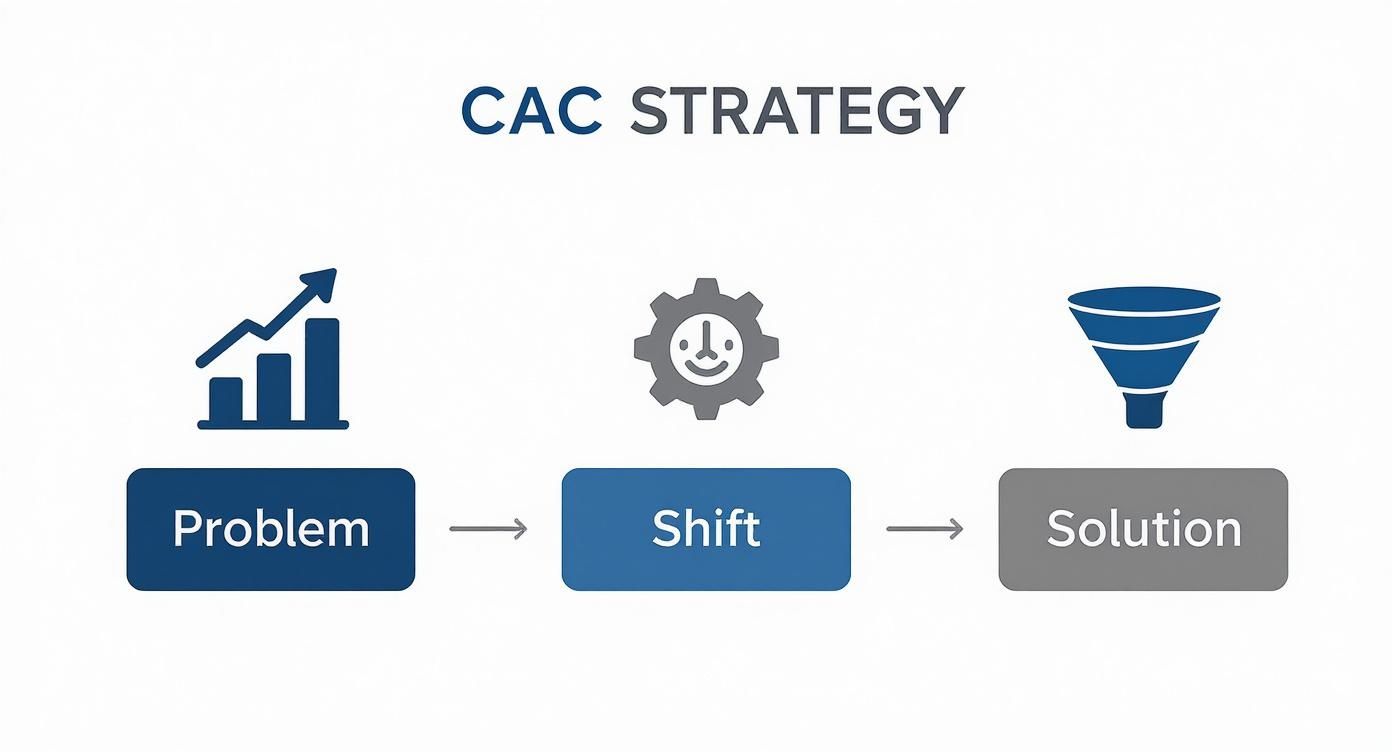
This is a fundamental shift from guesswork to data-driven strategy. It’s about moving from reacting to problems to proactively solving them.
Setting Up Your Diagnostic Toolkit
To get this kind of granular view, your tools need to be talking to each other. Your core toolkit is your web analytics platform (like Google Analytics 4) and your Customer Relationship Management (CRM) software.
The goal is to build a closed-loop reporting system. This lets you trace the entire customer journey, from that first ad click you see in GA4 all the way to the final sale getting logged in your CRM.
Practical Example: A SaaS company can set up GA4 to track "Trial Sign-up" events. By integrating GA4 with their CRM, they can then see which of those sign-ups actually become paying customers. This simple connection shows them not just the cost per trial, but the true cost to acquire a paying customer from their LinkedIn Ads versus their Google Ads. Suddenly, it’s crystal clear which channel is delivering real, long-term value.
Getting attribution right is foundational. If your data is messy, every decision you make is built on a shaky foundation. If you have any doubts, it might be time to review the importance of conducting a CRM audit to make sure your data is clean and reliable.
Analyzing Conversion Rates at Every Stage
Once your tracking is solid, the real fun begins. You need to map out every single step in your customer journey and measure the conversion rate between each one. This micro-analysis is how you find the leaks.
A typical B2B funnel might look something like this:
- Ad Impression to Ad Click: (Click-Through Rate or CTR)
- Ad Click to Landing Page Visit: (Watch for a high Bounce Rate)
- Landing Page Visit to Lead Form Submission: (Landing Page Conversion Rate)
- Lead to Marketing Qualified Lead (MQL): (Lead Quality Rate)
- MQL to Sales Qualified Lead (SQL): (Sales Acceptance Rate)
- SQL to Closed-Won Deal: (Sales Close Rate)
Calculating the percentage of people who drop off at each stage immediately highlights your biggest problem areas. A killer CTR but a terrible landing page conversion rate? That points to a major disconnect between your ad and your offer. A ton of MQLs but a low SQL rate? That screams misalignment between marketing and sales.
To put this into practice, here’s a checklist you can use to methodically inspect your own funnel.
CAC Diagnostic Checklist by Funnel Stage
This checklist will help you systematically identify potential cost leaks at each stage of the customer journey, from initial awareness to final conversion.
| Funnel Stage | Key Metric to Analyze | Common Leakage Signs | Diagnostic Question |
|---|---|---|---|
| Top of Funnel (ToFu) | Click-Through Rate (CTR) | Low CTR on ads despite high impressions. | Is our ad creative and copy compelling enough to stop the scroll? |
| Top of Funnel (ToFu) | Cost Per Click (CPC) | Consistently rising CPC on a specific channel. | Is our audience targeting too broad or is ad fatigue setting in? |
| Middle of Funnel (MoFu) | Landing Page Conversion Rate | High traffic to the landing page but few form submissions. | Is the offer clear? Is the form too long? Does the page load quickly? |
| Middle of Funnel (MoFu) | Lead to MQL Rate | High number of leads, but few meet qualification criteria. | Are we attracting the right audience? Are our lead magnets too generic? |
| Bottom of Funnel (BoFu) | MQL to SQL Rate | Marketing passes leads, but sales rejects most of them. | Do marketing and sales agree on the definition of a "qualified" lead? |
| Bottom of Funnel (BoFu) | Sales Cycle Length | Deals are taking longer and longer to close. | Is there friction in the sales process? Is our follow-up effective? |
| Bottom of Funnel (BoFu) | SQL to Close Rate | Qualified leads are stalling and not converting to customers. | Is our pricing clear? Are we effectively demonstrating value and ROI? |
Impact Opportunity: A thorough funnel diagnosis often reveals that your most expensive "problem" isn't a lack of leads. It's usually a conversion issue you can fix for a fraction of the cost of pouring more money into ads. Finding and plugging just one of these leaks can have a massive and immediate impact on your overall CAC.
Optimizing Your Channel Mix and Targeting
Alright, you've diagnosed your funnel. The next move is to get brutally honest about where your money is actually going.
It’s easy to fall into the "spray and pray" trap, scattering your marketing budget across a dozen channels and just hoping something hits. But hope isn't a strategy. It's a gamble that almost always inflates your customer acquisition cost.
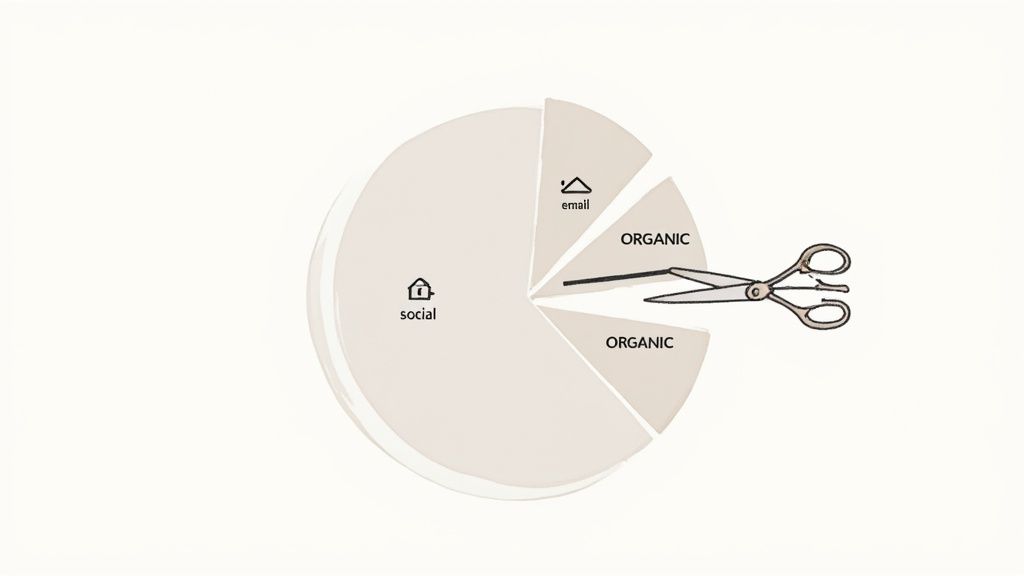
To really drive down your CAC, you have to be ruthless with your channel mix. This means making deliberate, data-backed decisions to stop funding the underperformers and double down on the channels that actually deliver profitable growth.
Conducting a Strategic Channel Audit
A channel audit is your first line of defense against wasted spend. The idea is to methodically evaluate every single marketing channel—from paid social to organic search—based on its true cost and return.
You have to look past vanity metrics like impressions and clicks. What really matters is the cost to acquire a valuable, paying customer.
Start by pulling segmented CAC data for every channel. You might find that Facebook Ads bring in a ton of leads, but they rarely convert into high-LTV customers. On the flip side, maybe your SEO efforts generate fewer leads, but they close at a much higher rate and result in a dramatically lower CAC.
This isn't just about cutting channels. It’s about reallocating resources intelligently. By pausing spend on a low-performer, you free up cash to amplify your proven winners.
Blending Paid and Organic for Sustainable Growth
One of the most powerful ways to lower your CAC is to build a symbiotic relationship between your paid and organic strategies. Relying only on paid ads is a fast track to unsustainable costs, especially as platforms get more crowded and competitive.
Smart companies aim for a Customer Lifetime Value (CLV) to CAC ratio of at least 3:1. That’s the benchmark for long-term profitability. Getting there means adopting a multi-channel, data-driven strategy.
A great example of this collaboration is using your paid search insights to fuel your SEO content strategy.
- PPC for Keyword Discovery: Your Google Ads campaigns are a goldmine of data on high-intent keywords that actually convert. Use that intel to decide which topics to target with your long-form blog posts and landing pages.
- Ad Copy as a Testing Ground: Test different headlines and value props in your ads. The winning copy can then be repurposed for your organic page titles and meta descriptions to boost click-through rates from search results.
- Remarketing for Organic Visitors: Someone finds you through organic search but isn't ready to buy. No problem. Capture that audience and use targeted remarketing ads to nudge them toward a conversion, shortening the sales cycle.
This integrated approach makes every dollar work harder. Your paid efforts deliver immediate results and valuable data, while your organic strategy builds a long-term, low-cost acquisition engine. If you're looking to dial this in, learning more about a cohesive paid media strategy can provide a clearer roadmap.
Key Takeaway
Audit your marketing channels relentlessly to cut budget drains and reallocate funds to proven performers. A strategic blend of paid and organic efforts creates a powerful, cost-effective growth engine that lowers your CAC over time.
Refining Your Audience Targeting
The final piece of the puzzle is making sure you're talking to the right people. Even the best channel mix will fail if your targeting is off. Hyper-specific audience targeting is your single most potent weapon against wasted ad spend.
This means going way beyond basic demographics. You need to build a data-driven Ideal Customer Profile (ICP) based on the real attributes of your best existing customers. Look at their firmographics (for B2B), behaviors, and psychographics. What are their biggest pain points? Where do they hang out online?
Once you have a crystal-clear ICP, you can use platform tools to reach them with precision.
- Lookalike Audiences: Upload a list of your best customers to platforms like LinkedIn or Facebook to find new users with similar traits. Don't stop there—create different lookalikes based on specific segments, like your high-LTV customers or those who bought a certain product.
- Negative Keywords and Exclusions: This is where you can see an immediate impact. Actively exclude search terms and audiences that have nothing to do with your business. For instance, if you sell high-end running shoes, you should use negative keywords to block searches for "cheap running shoes" or "discount sneakers." This simple move can instantly improve your ad relevance and slash wasted clicks.
Practical Example:
A B2B software company was selling a premium project management tool. They were targeting anyone with "Project Manager" in their job title, and their CAC was through the roof. After analyzing their best customers, they refined their ICP to "Project Managers in construction companies with 50-200 employees." They used this to narrow their LinkedIn Ads targeting and saw a 40% reduction in their cost per qualified lead.
By focusing your budget on fewer, better channels and targeting only your most ideal customers, you can dramatically lower your CAC—and often improve the overall quality of the customers you acquire.
Improving Conversion Rates and Creative Performance
Getting someone to click your ad is only half the battle. Now you have to convince them to stick around and actually do something. This is where so many companies watch their customer acquisition costs balloon—qualified traffic hits a wall of friction on a clunky landing page or gets turned off by uninspired creative.
Improving your conversion rates is the ultimate force multiplier. When you make every ad dollar work harder, you can bring in more customers without spending a penny more on ads. It all boils down to a systematic process of testing and refining, turning your ads and landing pages into a well-oiled conversion machine.
Achieving Message-Market Match
The most common killer of conversion rates? A glaring disconnect between your ad and your landing page. This is all about message-market match.
Think about it from the user's perspective. They click an ad promising a specific solution. The landing page they land on must immediately echo and expand on that exact promise.
Any dissonance—a different headline, a confusing offer, or a cluttered design—creates friction and kills trust. A user who feels like they've been misled, even slightly, will bounce in a heartbeat. And that wasted click drives your CAC right up.
A seamless experience is non-negotiable. The visuals, tone, and core value prop have to be perfectly consistent from the first touchpoint to the final call-to-action.
A Playbook for Conversion Rate Optimization
Conversion rate optimization (CRO) isn't about guesswork; it's a methodical way to increase the percentage of visitors who take the action you want. Instead of throwing random changes at the wall, you'll use data to form hypotheses and run controlled experiments.
Start by focusing your efforts on these high-impact areas:
- Headlines and Subheadings: Does your headline scream the primary benefit? Is it punchy, clear, and compelling?
- Call-to-Action (CTA): Test everything. The button copy ("Get a Free Demo" vs. "See Pricing"), the color, the placement. Your CTA should be impossible to miss.
- Form Fields: Only ask for what you absolutely need. Every extra field you add can tank your conversion rate by up to 11%.
- Page Layout and Mobile Experience: More than half of all web traffic is mobile. Your page must be flawless on a small screen. Make sure text is readable and buttons are easy to tap.
Practical Example: A software company tested a single headline. Their original was a bland, product-focused line: "The Best Project Management Software." They ran it against a new, benefit-driven headline: "Finish Your Projects 2 Weeks Faster." The result? The new headline drove a 22% lift in trial sign-ups. That directly lowered their cost per lead without touching their ad spend.
Systematically Testing Ad Creative
Just like you test your landing pages, you need to apply the same rigor to your ad creative. Your ads are the front door to your funnel, and better creative has a massive impact on CAC.
Build a testing framework that isolates one variable at a time. Don't change the image, headline, and body copy all at once. Test one element at a time so you actually know what's driving performance.
Zero in on what really resonates with your audience:
- Copy Variations: Test different hooks. Does a pain-point approach ("Tired of messy spreadsheets?") work better than a benefit-driven one ("Organize your entire workflow in minutes")?
- Visuals: Test different images and videos. For a B2B audience, does a screenshot of the software interface outperform a stock photo of a team meeting?
- Formats: Pit a short, punchy video against a static image or a carousel ad. Different platforms and audiences have different tastes.
Key Takeaways
Systematic A/B testing of your landing pages and ad creative is the most reliable way to get small wins that compound over time. Always make sure your ad's promise perfectly matches your landing page's content to maintain trust and momentum. Small, data-backed tweaks to CTAs, headlines, and forms can have a huge impact on your conversion rates and overall CAC.
Impact Opportunity: When you optimize every conversion point in your funnel, you make every single ad dollar work harder. You’re essentially acquiring more customers from the exact same budget, creating a far more efficient and scalable growth engine.
Using Retention to Lower Lifetime Acquisition Cost
Who's the cheapest customer to acquire? The one you already have. It sounds simple, but it's a truth many businesses forget when they get too wrapped up in top-of-funnel metrics.
We often overlook the single most powerful lever for making every acquisition dollar work harder: retention.
When you shift your focus from the initial Customer Acquisition Cost (CAC) to the entire Customer Lifetime Value (LTV), the whole growth equation changes. Instead of pouring money into a leaky bucket, you focus on keeping the customers you’ve already paid for and getting more value from them over time. This is how you fundamentally lower your effective lifetime acquisition cost.
The Power of the LTV to CAC Ratio
The relationship between what you spend to get a customer and what they're ultimately worth to your business is the most critical indicator of a healthy, scalable model. We measure this with the LTV:CAC ratio.
The formula is dead simple: divide your Customer Lifetime Value by your Customer Acquisition Cost. While every business is different, a ratio of 3:1 or higher is widely seen as the gold standard. For every dollar you spend to bring someone in, you should be getting at least three dollars back over their lifetime.
If your ratio is dipping below 3:1, you’re likely overspending for the value you're getting back, which puts your profitability at serious risk. On the flip side, a much higher ratio might mean you're underspending on growth and could be more aggressive.
Key Takeaway
Your LTV:CAC ratio gives you a complete picture of profitability that CAC alone can't. A 3:1 ratio isn't just a number—it's the clearest sign of a sustainable and efficient business.
Actionable Strategies to Boost Retention and LTV
Increasing LTV doesn’t require massive, expensive initiatives. It’s about systematically removing friction and adding value at just the right moments in the customer journey.
Start by zeroing in on these high-impact areas:
- Build a Frictionless Onboarding Process: The first 90 days are everything. Your one job is to get new customers to their "aha!" moment as fast as possible. Use clear setup instructions, in-app tutorials, and proactive check-in emails to make sure they feel the value right away.
- Create a Simple Loyalty Program: You don't need a convoluted points system. For example, a subscription box service could offer a free box after every six months. Rewards like this encourage long-term commitment and make customers feel seen.
- Use Email Marketing for Strategic Upsells: Once a customer is happy with your core offering, that's your cue. Use targeted email campaigns to introduce them to complementary features or premium tiers. This not only increases their LTV but also deepens their engagement with your brand.
Turning Customer Feedback into a Retention Tool
One of the most underused retention strategies is just listening to your customers. When you build a better product they don't want to leave—based on what they've told you—they become invested in your success.
Actively collect feedback through surveys, support tickets, and review sites. But here's the crucial part: close the loop. When you implement a change based on feedback, tell the users who suggested it. This builds an incredible amount of goodwill and turns customers into genuine advocates.
By listening, you don't just improve your product; you get early warnings about potential churn risks. Understanding why customers might leave lets you get ahead of the problem. For a more sophisticated approach, you can explore how predictive churn modelling helps identify at-risk customers long before they hit the cancel button.
Impact Opportunity: When you shift your company's focus from short-term acquisition to long-term relationships, you build a powerful, sustainable engine for growth. Every single improvement in retention directly boosts the ROI of your initial acquisition spend, making it one of the most effective ways to lower your CAC for the long haul.
Common Questions About Reducing CAC
Even with a solid playbook, turning strategy into action always brings up new questions. Let's dig into some of the most common hurdles teams face when they get serious about lowering their customer acquisition cost. The goal here is to give you clear, no-fluff answers that help you move forward with confidence.
Where Do I Start If I Have a Small Budget?
This is the question I hear most often, and the answer is refreshingly simple: focus on one high-impact area. You don't need a huge budget or a complex tech stack to get started. The trick is to put your limited resources where they'll make the biggest splash.
For most businesses just starting this journey, the best place to begin is landing page conversion rate optimization (CRO). Why? Because improving your conversion rate makes every single dollar you’re already spending on ads work harder. You're getting more customers without increasing your ad spend.
Practical Example: A startup operating on a limited budget couldn't afford pricey A/B testing tools. So, they used the free version of Google Analytics to find their highest-traffic landing page that had the worst conversion rate. They then tested two different headlines by running one for a week, measuring results, then running the other for a week. This simple, zero-cost experiment led to a headline that boosted sign-ups by 15%. It's proof that you can make a real dent with what you have.
What Are the Essential Tools I Absolutely Need?
While you can definitely bootstrap it at first, a few core tools will speed things up and give you the data you need to make smarter decisions. Think of this as your foundational toolkit.
These are the non-negotiables:
- A Web Analytics Platform: This is your source of truth. Google Analytics 4 is a powerful, free option that tracks everything from traffic sources to on-page actions.
- A Customer Relationship Management (CRM) System: A CRM like HubSpot or Salesforce is critical for tracking leads through your sales process. It's how you connect marketing spend to actual revenue and calculate a true CAC.
- A/B Testing Software: To run proper CRO experiments, you'll want a tool that can split traffic and measure results accurately. Platforms like Google Optimize (though sunsetting) or paid options often have free or low-cost starter plans.
Of course, understanding your current CAC is step one. To get an accurate read on your marketing ROI and forecast growth, a dedicated customer acquisition cost calculator can be a huge help in tying all these data points together.
How Long Does It Take to See Results?
Reducing CAC is a long game, not an overnight fix. While some tweaks deliver quick wins, the most meaningful and lasting reductions come from consistent, iterative improvements over time.
Here's a realistic timeline for what to expect:
- Short-Term (Weeks): Things like adding negative keywords to an ad campaign or A/B testing a call-to-action on a high-traffic page can show a measurable impact pretty quickly, often within a few weeks.
- Medium-Term (Months): Building out organic channels like SEO or refining your lead nurturing sequences takes longer. These efforts usually start to move the needle on your blended CAC within one or two quarters.
- Long-Term (Yearly): Strategies centered on customer retention and increasing LTV have the most profound effect on your effective acquisition cost. Building a strong brand and a loyal customer base is an investment that compounds over years.
Key Takeaway
The real measure of success isn't a single dip in your CAC. It's a consistent downward trend over several months, paired with a steadily increasing LTV:CAC ratio. That’s the sign of a truly healthy and sustainable growth engine.
Impact Opportunity: Answering these questions helps turn theory into practice. By starting small, using the right tools, and setting realistic expectations, any team can begin to systematically lower their customer acquisition cost and build a more profitable business.
Ready to stop guessing and start building a scalable revenue system? Prometheus Agency is an AI transformation partner that helps growth leaders integrate technology, process, and strategy across the entire customer journey. Tame your tech stack and build durable growth by starting with our complimentary Growth Audit and AI strategy session.