Thinking about bringing AI into your business? It's not about chasing the latest shiny object. The real wins come from a clear, methodical approach: figure out if you're ready, pick one high-impact problem to solve, run a tight pilot program, and then think about scaling.
From the very beginning, this process is about solving a specific, measurable business problem, not just implementing technology for technology's sake.
Key Takeaways
- Start with Assessment: Before investing in any AI technology, perform an honest assessment of your organization's data maturity, technical infrastructure, and team skills.
- Focus on a Problem, Not Tech: The most successful AI implementations begin by identifying a high-impact business problem, not by choosing a technology and searching for a use case.
- Pilot Programs are Crucial: A well-defined, small-scale pilot program is the best way to prove value, manage risk, and build internal support before a full-scale rollout.
- Integration is Key: AI delivers maximum value when it is deeply integrated with your existing business systems, such as your CRM and ERP, to create a cohesive data ecosystem.
- Change Management Drives Adoption: The human element is critical. Success depends on clear communication, role-specific training, and building a culture of internal champions to drive adoption.
Where to Start Your AI Implementation
Jumping into AI can feel like a huge undertaking, but it really boils down to a repeatable process. True success isn’t about adopting every new tool that comes along. It's about a focused strategy that ties technology directly to a tangible business outcome, whether that's cutting costs, boosting revenue, or making your team more efficient.
The whole journey kicks off with an honest look in the mirror. You have to ask some tough questions about where your organization really stands before you even think about spending money. This initial assessment gives you a solid foundation and keeps you focused on what actually matters.
This simple flow nails the core phases of getting started. It’s all about assessing, identifying, and then planning.
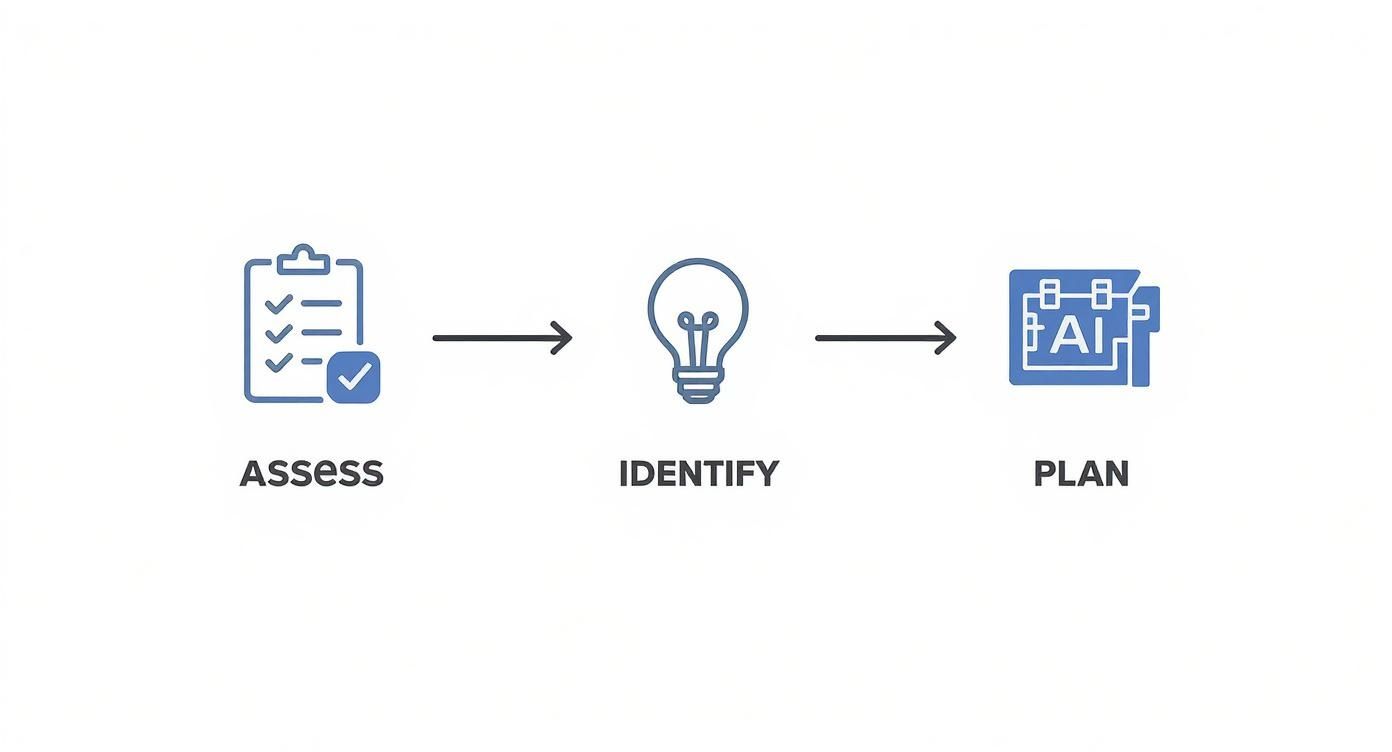
As you can see, a successful AI journey starts with an internal gut check and a strategic hunt for opportunities—long before any real planning begins.
How Ready Is Your Organization, Really?
Before you get wrapped up in complex projects, you need to get a real sense of your company's preparedness. Sure, enterprise AI adoption is common—78% of organizations are using it in at least one part of their business. But here's the catch: many of those projects fizzle out and fail to deliver.
The companies that get it right are the ones that invest just as much in their people and processes as they do in the tech itself. It’s also critical to think about legal and ethical guardrails from day one. Navigating the rules of the road is key, and resources like a practical guide to AI GDPR compliance are invaluable for getting it right.
To help you get started, here’s a quick checklist to see where you stand.
AI Implementation Readiness Checklist
This table breaks down the core areas you need to evaluate. Be honest with your answers—it will save you a ton of headaches later.
| Assessment Area | Key Question to Answer | Success Indicator |
|---|---|---|
| Data Maturity | Do we have clean, accessible, and relevant data to train AI models? | Data is organized, centralized, and quality-controlled. |
| Technical Infrastructure | Are our current systems capable of supporting AI integrations? | We have scalable cloud infrastructure or modern on-premise systems. |
| Team Skillset | Does our team have the right skills, or will we need to train or hire? | Key team members have data science/analytics skills or a plan is in place. |
| Business Alignment | Is there a clear business problem that AI can solve with a measurable impact? | Leadership agrees on a specific, high-value use case. |
Running through these questions gives you a clear, unbiased picture of your starting point.
Pinpoint Your High-Impact Opportunity
Once you have a handle on your readiness, it's time to zero in on where AI can make the biggest splash. The sweet spot is finding a balance between high business value and something that’s actually achievable. Don't start with a moonshot project. Look for a nagging pain point that a targeted AI solution can fix.
Impact Opportunity:
Implementing AI for predictive maintenance in manufacturing can reduce equipment downtime by up to 50% and cut maintenance costs by 40%, directly boosting operational efficiency and profitability.
Practical Example:
A mid-sized logistics company used AI to analyze its delivery routes, driver schedules, and real-time traffic data. The system identified inefficiencies that were invisible to human planners, resulting in a 15% reduction in fuel costs and a 20% increase in on-time deliveries within the first quarter.
Key Takeaway: A winning AI strategy doesn't start with the technology. It starts with a deep understanding of a business problem and a realistic view of your ability to solve it. Focus on a tangible outcome, and your first project will build the momentum you need for everything that follows.
To get a more tailored view of your company’s specific strengths and weaknesses, you can measure your AI Quotient. This kind of self-assessment ensures you’re not just building on sand, but on a solid foundation.
Finding and Prioritizing High-Impact AI Use Cases
Here’s a hard truth: the single biggest difference between a stalled AI pilot and a significant success is picking the right problem to solve first. Forget about chasing vague, ambitious goals. The fastest way to get AI working for your business is to pinpoint and prioritize the use cases with the highest potential for a clear, undeniable return.
This whole process kicks off with a simple internal audit. Look at your workflows, your data sources, and most importantly, your team's biggest headaches. Where are the bottlenecks? What repetitive tasks are eating up everyone's time? What critical business questions are you flying blind on because you just don't have the resources to answer them? This is where you'll find the most fertile ground for AI.
Impact Opportunity:
Retailers using AI for inventory forecasting can slash waste by over 10% and reduce out-of-stock incidents by up to 50%, significantly improving both margins and customer satisfaction.
Identify Your Top Opportunities
Get your department leaders in a room—sales, marketing, ops, finance, everyone. Ask them to just list their biggest operational headaches. You’re hunting for processes that are either painfully repetitive, drowning in data, or just plain prone to human error.
Another great way to spot opportunities is to think about how AI can make your core business more resilient. How can it help you withstand disruption? Exploring how to apply AI in operational resilience can uncover some excellent ideas for protecting and growing your operations.
Look for chances to make a difference across the board:
- Marketing and Sales: Is your team buried in manually scoring leads? AI can handle that, letting them focus on the prospects who are actually ready to talk. We’ve seen companies get huge wins finding customers more efficiently this way, something we cover in our guide to AI-powered lead generation.
- Customer Service: Are your agents answering the same five questions a hundred times a day? A smart chatbot can take on those Tier 1 inquiries, slashing wait times and making customers happier.
- Operations: Are you constantly guessing about your supply chain? AI can chew through historical data and external signals to forecast demand and keep you from running out of stock.
Score and Prioritize Your Use Cases
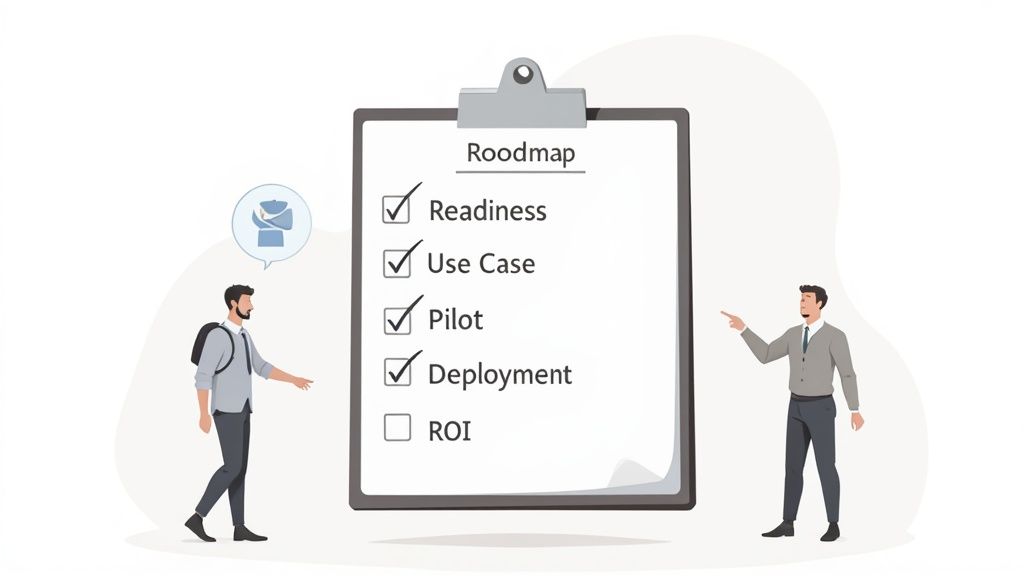
Once you have a long list of ideas, you need a way to sort the quick wins from the moonshots. A simple scoring matrix is one of the best tools for this. It takes the guesswork out of it and helps you objectively weigh each idea based on its potential impact versus how hard it will be to pull off.
Just create a simple grid. For each potential project, rate it on a scale of 1 to 5 for two things:
- Business Impact: How much will this actually move the needle on revenue, cost savings, or customer happiness? A high score (5) means it's a potential game-changer.
- Implementation Complexity: How tough will this be to execute? Think about your data, the tech you'll need, and whether you need to hire a specialist. A low score (1) means it's a relatively easy lift.
This exercise forces you to get real about the value and feasibility of every idea on the table.
Key Takeaway: The sweet spot for your first AI projects is that "High Impact, Low Complexity" quadrant. These are your quick wins. They deliver measurable results fast, without a massive upfront investment, and build the momentum you need for the bigger projects later.
Practical Example: An E-commerce Company
Let's say an online retailer brainstorms three potential AI projects: a personalized product recommendation engine, an automated inventory management system, and an AI-driven customer service chatbot.
They run each one through the scoring matrix and get this:
| Use Case | Business Impact (1-5) | Implementation Complexity (1-5) | Priority Score (Impact - Complexity) |
|---|---|---|---|
| Recommendation Engine | 4 | 4 | 0 |
| Inventory Management | 5 | 5 | 0 |
| Customer Chatbot | 3 | 1 | 2 |
Right away, the chatbot is the clear winner for a first project. Sure, the other ideas could have a bigger impact down the line, but their complexity makes them risky starting points. The chatbot is a quick win. It can prove the value of AI, build internal support, and set the stage for more ambitious projects. This kind of structured approach is how you set your first AI project up for a measurable victory.
Launching Your First AI Pilot Program
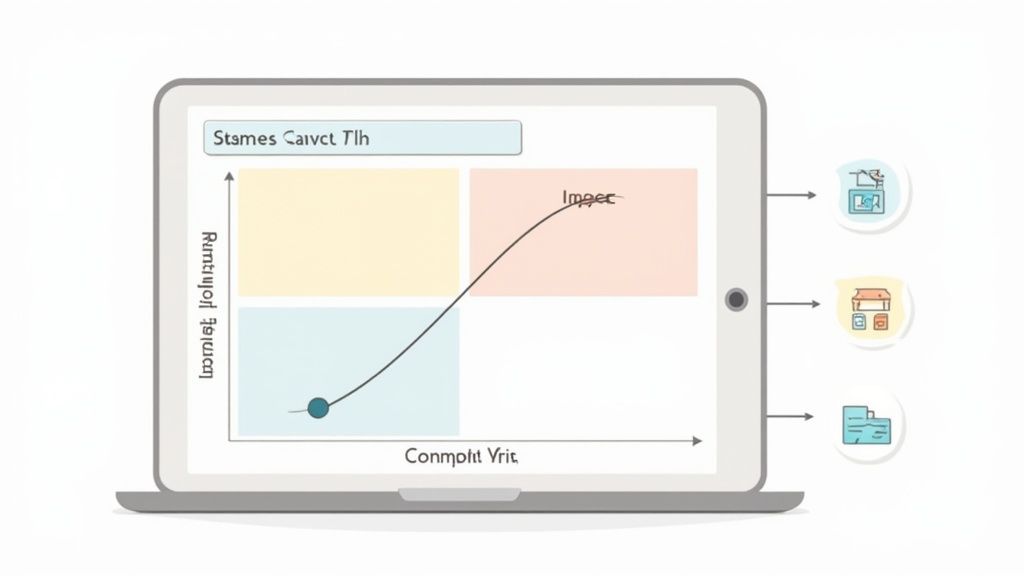
You’ve pinpointed a high-impact use case. Now it’s time to move from the whiteboard to the real world. A pilot program is your bridge from a promising idea to a scalable, value-driving solution. This is where you prove the business case in a controlled, low-risk environment and turn that theoretical ROI into actual results.
The secret to a successful pilot is to think small and specific. Fight the urge to solve every problem at once. Instead, carve out a narrow, manageable scope that lets you test your hypothesis, gather clean data, and show a tangible win quickly.
A well-designed pilot isn't a massive, open-ended project; it's a controlled experiment.
Defining Clear Success Metrics
Before a single line of code gets written or a new tool is purchased, you have to define what success looks like in concrete, quantifiable terms. Vague goals like “improve efficiency” are useless here. You need hard numbers that leave zero room for debate.
Clear metrics do more than just prove the project's value; they become the north star that keeps the team focused on the outcomes that matter.
Practical Example:
A SaaS company wanted to improve its lead qualification process. Instead of a vague goal, they set a specific KPI for their AI pilot: "Increase the marketing-qualified lead (MQL) to sales-qualified lead (SQL) conversion rate by 25% within 60 days by implementing an AI-powered lead scoring model." This clarity focused the team and made success easy to measure.
This level of specificity is non-negotiable. It’s the only way you’ll be able to objectively say, "Yes, this worked, and it deserves more investment."
Assembling Your Pilot Team and Timeline
You don’t need an army for a pilot program. In fact, a small, cross-functional group is almost always better. An agile team like this can move quickly, communicate without friction, and adapt on the fly as they learn.
Your core pilot team should include:
- Project Lead: The person who owns the project, keeps the timeline on track, and communicates with stakeholders.
- Technical Expert: An engineer or data scientist who can handle the technical lift, whether they're in-house or an external partner.
- Business Process Owner: A subject matter expert from the department being impacted—like a sales manager for a lead-scoring pilot.
- End-User Champion: An enthusiastic team member who will actually use the tool daily and provide candid, real-world feedback.
A typical pilot should run for a set period, usually 60 to 90 days. That’s long enough to get meaningful data but short enough to keep the momentum and sense of urgency high. Getting this structure right is a huge part of effective AI enablement services, which are all about building the internal muscle for success.
Sample AI Pilot Project Plan
| Phase (e.g., Week 1-2) | Key Activities | Primary Metric/KPI | Stakeholder Update Point |
|---|---|---|---|
| Weeks 1-2: Setup & Alignment | Finalize scope, define KPIs, assemble team, configure tech environment. | Project kickoff complete, all roles assigned. | Initial kickoff meeting with all stakeholders. |
| Weeks 3-6: Implementation & Testing | Integrate AI tool, train model on initial data set, conduct internal UAT. | 95% of core features are functional in the test environment. | Bi-weekly email update on technical progress. |
| Weeks 7-10: Live Pilot & Data Collection | Go live with the end-user group, collect performance data, gather feedback. | Achieve 50% of the target KPI improvement by week 10. | Mid-pilot review meeting with project team and sponsor. |
| Weeks 11-12: Analysis & Reporting | Analyze KPI data and user feedback, build the business case for a full rollout. | Final report showing measured ROI and user testimonials. | Final presentation to leadership with recommendations. |
This kind of structured plan keeps everyone on the same page and ensures the pilot stays focused on delivering measurable outcomes.
Impact Opportunity:
While over half of generative AI budgets are currently spent on sales and marketing, research shows the largest ROI often comes from automating internal, back-office operations. A successful pilot in an area like finance or HR can slash costs dramatically and fund more ambitious, customer-facing projects.
Key Takeaway: A pilot is a learning exercise designed to validate an AI use case. Its primary goals are to measure impact against predefined KPIs, gather user feedback for refinement, and build a compelling business case for a full-scale rollout.
By keeping your scope tight and your goals crystal clear, you create a controlled environment where you can test, learn, and prove the value of AI. A successful pilot builds incredible internal momentum and gives you the hard data needed to justify a broader investment.
Integrating AI with Existing Technology and Data
Your AI initiative doesn't exist in a bubble. Its real power gets unlocked when it’s woven into the core systems you already depend on—your CRM, ERP, and marketing automation platforms. This is where the magic happens, turning disconnected data points into an intelligent, cohesive ecosystem that actually drives business outcomes.
Think of it this way: an AI model is like a brilliant analyst. But if that analyst is locked in a room with no information, they can't offer any insights. It needs access to your customer history from the CRM and your sales data from the ERP to do its job. Getting these systems talking to each other is the technical backbone of any successful AI implementation.
This is how abstract data becomes actionable intelligence that directly impacts your bottom line.
Choosing Your Integration Pathway
Connecting AI to your existing tech stack isn't a one-size-fits-all affair. The path you take really depends on your current infrastructure, your team's technical chops, and the specific AI tools you've picked for your pilot.
Generally, you'll find yourself looking at three common routes:
- Native Connectors: Many modern AI platforms and business apps come with built-in integrations for popular software like Salesforce, HubSpot, or NetSuite. This is often the simplest and fastest route, requiring little to no custom coding.
- APIs (Application Programming Interfaces): APIs are the universal translators of the software world, acting as a bridge that lets different applications talk to each other. Your development team can use APIs to build custom connections that shuttle data back and forth between your systems and the AI.
- Middleware Platforms: Tools known as Integration Platform as a Service (iPaaS) act as a central hub for connecting multiple applications. They offer pre-built connectors and visual workflows that can simplify even complex integrations, often without needing deep coding knowledge.
The choice you make here will directly impact the project's timeline and budget. If you can, start with native connectors. It’s a smart way to get your pilot up and running faster and prove its value early on.
The Critical Role of Data Governance
Before you plug anything in, we need to talk about the single most important element of any AI project: your data.
Clean, well-structured, and accessible data is the lifeblood of a successful implementation. Period. An AI model trained on messy, incomplete, or biased data will only spit out flawed, unreliable results. Garbage in, garbage out.
This is where data governance comes into play. It's the framework of rules and processes that ensures your data is accurate, secure, and handled responsibly. This isn't just an IT checklist; it's a core business function that prevents costly mistakes and builds a trustworthy foundation for your entire AI strategy.
Key Takeaway: A strong data governance policy isn't about restriction; it's about enablement. It gives your AI the high-quality fuel it needs to generate reliable insights while ensuring you remain compliant and secure.
Kick things off with a thorough data audit. Map out where your critical data lives, who has access to it, and what kind of shape it's in. This first step will shine a light on the data quality issues you need to tackle before you ever let an AI model near it.
Practical Examples of Integrated AI
When your systems are connected and your data is clean, the impact is immediate and tangible. Industries with high AI exposure are already seeing three times higher revenue growth per worker compared to sectors that are slower to adopt. Retail is a standout example, with 69% of retailers using AI reporting it has helped them grow revenue. You can dig into more insights on how top companies are using AI at ExplodingTopics.com.
So, what does this actually look like in the real world?
- Personalized Marketing: An AI model integrates with your CRM to analyze a customer's purchase history and browsing behavior. It then automatically triggers a personalized email campaign through your marketing platform, featuring products they are highly likely to buy.
- Demand Forecasting: The AI connects to your ERP, pulling historical sales data and blending it with external market trend data. This allows it to generate a highly accurate forecast, helping you optimize inventory and avoid costly stockouts or overstocks.
These examples show that a well-integrated AI doesn't just add a new feature—it amplifies the value of the technology you already own.
Driving Adoption Through Effective Change Management
Let's be honest. The most powerful AI tool on the planet is just expensive shelfware if your team refuses to use it. Once the technical side is buttoned up, the real work begins: the human element.
Your project's success hinges entirely on your team's willingness to embrace new ways of working. This isn’t something you can announce in a company-wide memo and hope for the best. It requires a thoughtful, deliberate change management strategy.
This is all about building genuine buy-in from the ground up. You need to turn skepticism into curiosity and quiet resistance into vocal advocacy. That means tackling the unspoken fears head-on and framing this new tech as a powerful assistant, not a replacement.
Communicating the “Why” Behind the Change
Your first move is to craft a clear, compelling story. Your people need to understand why this is happening and, more critically, what’s in it for them. Vague promises about "improving efficiency" will fall on deaf ears.
You have to get specific. Frame the AI as a direct solution to their daily headaches.
Instead of saying it will "improve sales," show them how it will "eliminate three hours of mind-numbing data entry each week, so you can spend more time actually building relationships with key clients." That direct line to personal benefit is what gets people to lean in and listen.
Key Takeaway: The story you tell can't be a top-down mandate. It has to be a bottom-up empowerment narrative. Focus on how the AI makes each person better at their job by removing the tedious parts and freeing them up for more valuable, interesting work.
Developing Targeted Training Programs
A one-size-fits-all training webinar is a recipe for disengagement. Different teams interact with technology in completely different ways, and your training needs to reflect that reality.
Segment your training based on roles and what they actually need to know:
- Executive Leadership: Give them high-level dashboard training focused on strategic insights and KPIs. Show them how the AI delivers the intelligence they need to make smarter, faster decisions.
- Front-Line Staff: Run hands-on, interactive workshops that guide them through the exact new workflows. Create a sandbox environment where they can practice, click around, and ask questions without fear of breaking anything.
- Department Managers: Don't just teach them how to use the tool. Train them on how to coach their teams through the transition, spot adoption issues, and track progress.
This tailored approach ensures everyone gets relevant information in a way that makes sense for their role, which makes a world of difference in comprehension and long-term retention.
building a Culture of AI Champions
You can't—and shouldn't—do this alone. One of the best strategies for driving adoption is to identify and enable a handful of internal AI Champions. These are the enthusiastic early adopters, the folks who naturally get excited about new tech and are already respected by their peers.
Give these champions early access and extra training. Make their role official and enable them to be the go-to resource for their colleagues. They can offer peer-to-peer support, share their own success stories in team meetings, and provide you with invaluable, on-the-ground feedback.
Impact Opportunity:
A solid AI Champions program can accelerate company-wide adoption by as much as 30-40%. These internal advocates build grassroots momentum and create social proof that the tool is actually worth learning—something a top-down directive could never achieve.
Practical Example:
A mid-sized manufacturing firm was rolling out a predictive maintenance AI on the factory floor. They were met with skepticism. They identified two senior technicians everyone trusted and made them champions. By letting them lead small-group training sessions and share weekly "quick wins" from the AI, they turned that skepticism into a friendly competition to see which shift could prevent the most downtime.
At the end of the day, a successful AI implementation is a change management project first and a technology project second. If you focus on clear communication, tailored training, and peer-led advocacy, you build a culture where people feel enabled by AI. That's when your investment starts paying real dividends.
Common Questions on AI Implementation
Even with the best roadmap, you’re going to have questions. Let’s tackle some of the most common ones we hear from leaders about the real-world nuts and bolts of AI implementation—cost, risk, and timelines.
How Much Does AI Cost for a Small Business?
The cost of getting started with AI can vary wildly, but you don’t need a massive budget. It all comes down to matching the solution to the scale of the problem you're trying to solve.
For most small businesses, the easiest on-ramp is using existing AI-powered Software-as-a-Service (SaaS) tools. Think about the platforms you already use—CRMs, email marketing tools, or customer support software. Many now have powerful AI features built right in. These subscriptions can run anywhere from $50 to a few hundred dollars a month per user, making it a low-risk way to get your feet wet.
If you’re ready for a more focused project, like a pilot for a customer service chatbot, you’re probably looking at a one-time project cost between $5,000 and $25,000. That typically covers the initial setup, some basic customization, and a limited rollout to prove it works before you go all-in.
Key Takeaway: Don't boil the ocean. Find one specific, high-value problem that an off-the-shelf tool can solve. Proving ROI on a small scale is the best way to get buy-in for bigger, more strategic AI investments later.
Building a completely custom AI solution from scratch is where things get expensive. Costs here often start in the high tens of thousands and can easily climb into six figures. This path demands specialized talent, serious data infrastructure, and a budget for ongoing maintenance.
What Are the Biggest Risks I Should Watch Out For?
AI has incredible upside, but ignoring the risks is a recipe for failure. Most of the challenges fall into three buckets. If you understand them, you can build a strategy to get ahead of them.
- Data Risk: This is the big one. It covers everything from poor-quality data creating biased or incorrect AI outputs to the constant threat of privacy and security breaches. If your data is a mess, your AI will be, too.
- Operational Risk: This happens when a perfectly good AI model fails in the real world, causing chaos for your business or costing you money. It also includes the danger of becoming too dependent on a "black box" AI where you have no idea how it's making decisions.
- Adoption Risk: This is all about people. You can build the most brilliant tool in the world, but if your team resists using it, the project is a failure. Period. A shiny new AI tool that no one uses delivers a negative ROI every single time.
To get ahead of these risks, you have to be proactive. That means having solid data governance, running rigorous pilot tests in controlled environments, communicating the "why" behind the change, and providing targeted, role-specific training.
How Long Until I See a Return on Investment?
How quickly you see a return (ROI) is tied directly to the project's scope. Not every AI project is a multi-year slog; some can deliver value incredibly fast.
For smaller projects using existing software—like automating a marketing workflow or rolling out an AI-powered helpdesk tool—you can often see a measurable return in just 3 to 6 months. This ROI might show up as a jump in team efficiency, better lead conversion rates, or higher customer satisfaction scores.
For bigger, more complex initiatives, like building a custom predictive model for your supply chain, the timeline is longer. These projects often take 6-12 months just for development and integration. After that, you'll likely need another 6-18 months of real-world use to gather enough data to prove a clear financial return.
The smartest move? Start with pilots that have short ROI horizons. Quick wins build momentum, create internal champions, and get you the leadership buy-in you need for the bigger, significant projects down the line.
Ready to move from theory to action? Prometheus Agency is an AI transformation partner that helps growth leaders turn their existing tech stacks into scalable revenue systems. We combine AI enablement with expert CRM implementation and go-to-market strategy to deliver clear, actionable roadmaps.
Start your journey with a complimentary Growth Audit and AI strategy session. Tame your technology and build durable growth systems with us.