So, what exactly is Generative AI Strategic Advisory?
Think of it as the essential bridge connecting the raw power of AI with tangible business results. This isn't about just buying the latest software. It's about bringing in an expert guide to help you navigate a complex and rapidly changing market. A strategic advisory aligns every AI initiative directly with your core business goals, making sure each step drives scalable revenue and real operational efficiency.
Understanding Generative AI Strategic Advisory
Many business leaders see Generative AI as a powerful new tool—and they're right. But treating it like just another piece of tech for the IT department to install is a huge misstep. That approach almost always leads to a collection of scattered, disconnected experiments that burn through cash without creating any measurable value.
Generative AI Strategic Advisory flips the script. It moves the focus from technology to outcomes. It’s a specialized service designed to help you build a cohesive, business-first AI adoption plan. The ultimate goal is to tie every AI project directly to a key business objective, whether that's boosting qualified leads, shortening the sales cycle, or slashing operational costs.
Key Takeaways
- Strategy Over Tools: A strategic advisory always puts business outcomes ahead of the technology itself.
- Beyond Technical Setup: The service goes way beyond just implementation, covering roadmap creation, change management, and measuring ROI.
- Risk Mitigation: A strategic approach helps you sidestep common pitfalls like wasted resources, data security issues, and failed pilot projects.
- Competitive Edge: It helps you move from random acts of AI to a coordinated strategy that drives measurable growth and efficiency.
The Role of an AI Strategy Guide
Imagine your advisor is an expedition guide for your business. You have the map—the AI technology itself—but the guide has intimate knowledge of the terrain. They know the best routes to your destination, can spot hidden dangers like data privacy risks or messy integration challenges, and will chart the most efficient path to get you where you want to go.
Without that kind of guidance, companies often stumble into predictable traps:
- Wasted Investment: Pouring money into shiny AI tools that don’t solve an actual business problem.
- Siloed Efforts: Departments run their own AI projects without a central strategy, leading to duplicated work and systems that can't talk to each other.
- Missed Opportunities: Failing to spot the highest-impact use cases that could deliver a true competitive advantage.
Strategic Advisory vs Technical Implementation
It's crucial to understand the difference between high-level strategy and ground-level technical work. One informs the why and what; the other handles the how. Focusing only on implementation without a solid strategy is like building a house without a blueprint.
| Focus Area | Generative AI Strategic Advisory | Technical Implementation Only |
|---|---|---|
| Primary Goal | Define why and what to do with AI to achieve business goals. | Build and deploy the AI solution. |
| Key Questions | "Which business problem offers the highest ROI for an AI solution?" | "How do we build this specific AI model or workflow?" |
| Outputs | Business case, strategic roadmap, risk analysis, ROI projections. | Functional code, deployed models, technical documentation. |
| Focus | Business value, competitive advantage, and organizational readiness. | System architecture, data pipelines, and model performance. |
| Success Metric | Measurable impact on revenue, cost savings, or efficiency. | Successful deployment and technical uptime. |
A strategic partner ensures your technical efforts are aimed at the right targets from day one. This distinction is the difference between a successful AI-driven initiative and an expensive science project.
The need for a clear strategy is amplified by the market’s insane growth. The generative AI market is projected to explode from USD 90.90 billion in 2025 to a mind-boggling USD 669.50 billion by 2032, thanks to a compound annual growth rate (CAGR) of 33.0%. This meteoric rise isn’t just hype; it’s a clear signal that leaders need to get serious about integrating AI strategically.
A strategic advisory doesn't just ask, "What cool things can we do with AI?" Instead, it starts with, "What's our biggest business challenge, and how can AI solve it?" That fundamental shift in perspective is what separates a science project from a profit center.
This disciplined approach gets your organization ready for what’s next. It starts by assessing your team’s readiness—something you can start exploring by understanding your organization's AI Quotient. To really make these models work for you, it’s also critical to have a deep understanding prompt engineering.
Ultimately, a strategic partner helps you build a sustainable framework for continuous innovation, turning AI from a buzzword into a core driver of your company’s success.
The Four Phases of an AI Advisory Engagement
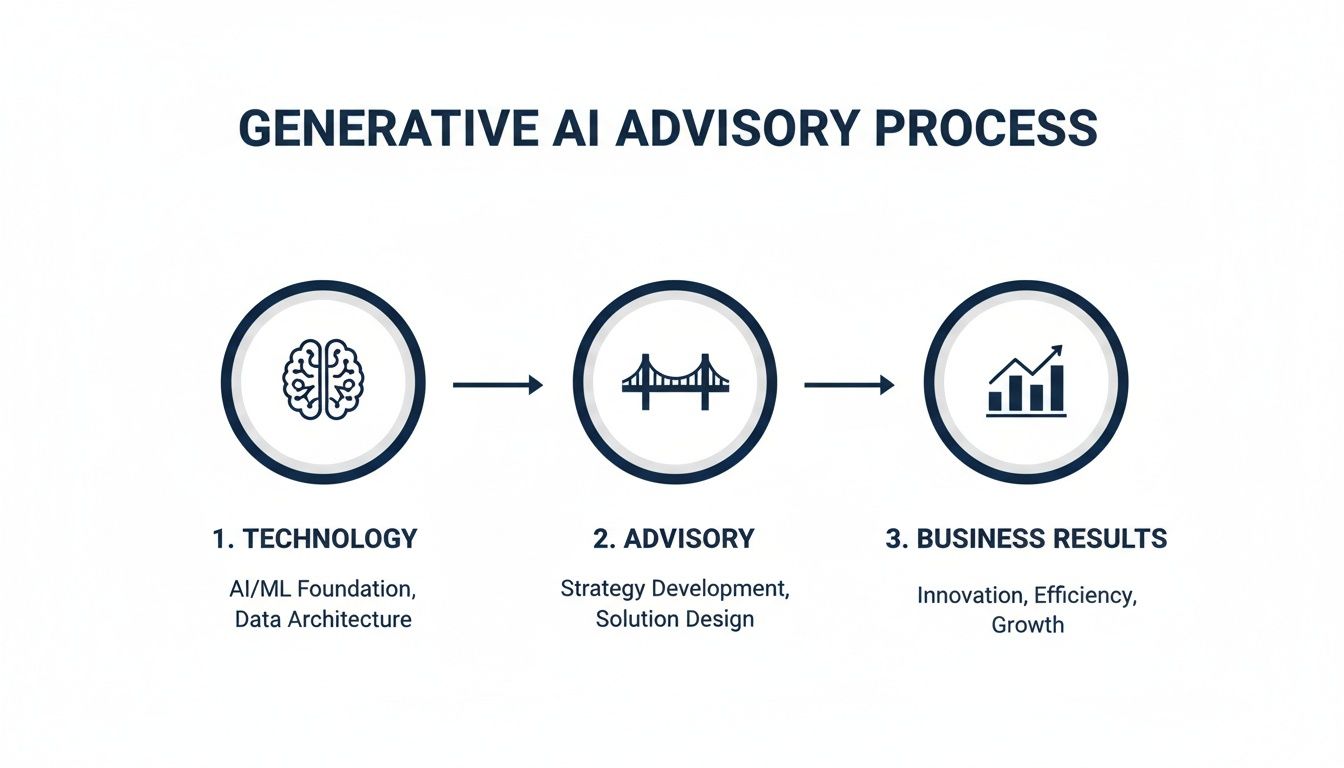
A smart Generative AI advisory engagement isn't a one-off project; it's a structured journey. It’s designed to methodically turn a high-level vision into real-world business results. The process unfolds across four clear phases, with each one building on the last to make sure every action is tied directly to business value and a measurable return on investment.
This process flow shows how advisory acts as the critical bridge, translating raw technology into tangible business outcomes.
Key Takeaways
- Structured Journey: A successful engagement follows a methodical four-phase process from discovery to scaled transformation.
- De-Risk Investment: The pilot phase proves ROI on a small scale before committing to a larger, company-wide rollout.
- Human-Centric: The final phase focuses heavily on change management and team training to ensure successful adoption.
- Business First: The entire process is designed to connect technology directly to measurable business outcomes like revenue growth and operational efficiency.
Phase 1: Assessment and Discovery
The journey starts with a deep-dive analysis of your organization. An advisory partner’s first move is to truly understand your unique business market—your go-to-market strategy, your day-to-day operational workflows, and the tech stack you already have. This is far more than a surface-level review; it’s a comprehensive Growth Audit.
During this phase, the advisor’s main goal is to pinpoint the areas where AI can make the biggest difference. They’ll dig into your processes to find revenue friction points or operational bottlenecks that are perfect candidates for an AI-driven solution. This initial assessment is critical for avoiding a common trap: wasting resources by applying AI to low-value problems.
A proper discovery phase ensures your strategy is built on the solid ground of business reality, not just technological hype. It answers the most important question first: "Where will AI create the most significant, measurable value for this company?"
Phase 2: Pilot Program and ROI Proof
Once the high-impact opportunities are locked in, the next step is to prove the concept with a targeted pilot program. This phase is all about demonstrating value quickly and de-risking a larger investment. Instead of trying to boil the ocean with a massive, company-wide overhaul, the focus narrows to a single, well-defined business problem.
Practical Example:
A pilot might involve building an AI-powered tool to automate lead qualification for your sales team. The project is designed to be small, fast, and intensely focused on generating results you can actually measure, such as a 20% increase in marketing qualified leads (MQLs) within 60 days.
Impact Opportunity:
Success in the pilot phase provides the hard data and internal buy-in you need to justify a broader rollout. It proves the ROI before you commit significant resources.
Key objectives of a pilot program include:
- Validating the solution: Confirming that the proposed AI application really does solve the targeted business problem.
- Measuring initial ROI: Gathering concrete data on improvements, like a 40% reduction in time spent on manual data entry or a 15% increase in lead conversion rates.
- Building momentum: showing an early win gets stakeholders excited and supportive of a larger transformation.
Phase 3: Building the Strategic Roadmap
With a successful pilot in the books, the engagement shifts to long-term planning. The strategic roadmap is a detailed, multi-year plan that outlines the entire AI transformation journey. It maps out timelines, resource needs (both people and budget), technology dependencies, and clear success metrics for every stage.
This roadmap is much more than a project plan. It's a strategic document that aligns all your AI initiatives with your bigger business goals, ensuring each project builds on the last. It takes into account your organization's readiness, identifies skills your teams will need to develop, and charts a course for scaling solutions from one department to the whole enterprise.
Phase 4: Scaled Adoption and Transformation
The final phase is where the strategy becomes a living, breathing part of your company's operational DNA. This stage is all about scaling the proven AI solutions across the organization and, just as importantly, managing the human side of change. Effective Generative AI Strategic Advisory goes far beyond just deploying technology.
This involves several critical activities:
- Change Management: Communicating the vision clearly, addressing employee concerns head-on, and building a culture where AI is seen as a collaborative tool, not a threat.
- Team Training: Equipping your staff with the skills and knowledge they need to work confidently and effectively with the new AI systems and processes.
- Continuous Optimization: Monitoring performance, gathering feedback from users, and constantly improving the AI models and workflows to make sure they keep delivering maximum value.
This structured, four-phase approach turns AI from an abstract idea into a powerful, integrated engine for durable growth, ensuring your investment delivers a lasting competitive advantage.
Finding High-Impact AI Opportunities in Your Business
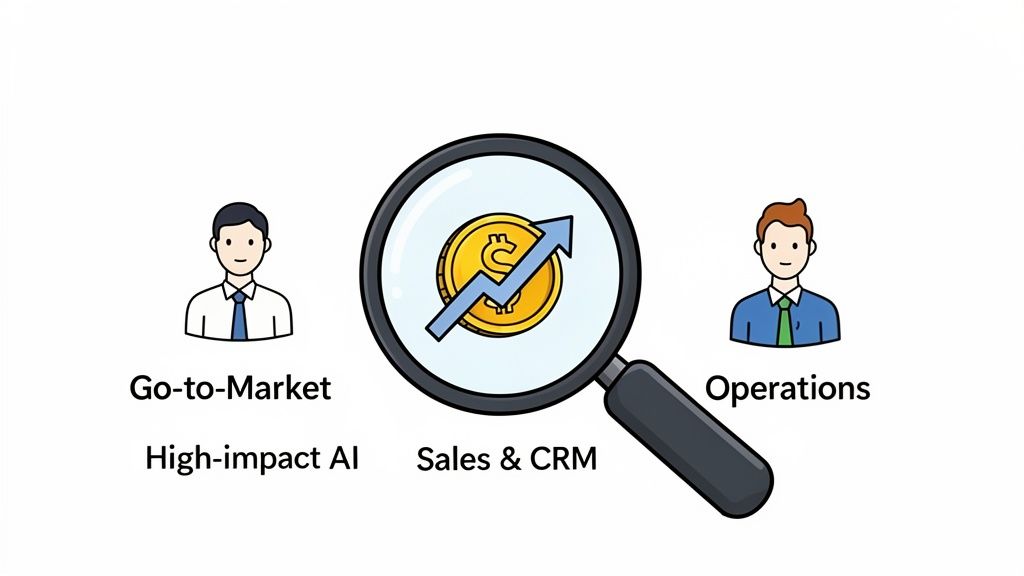
The smartest AI strategies have nothing to do with chasing the latest tech trend. They start by solving real, expensive business problems. A proper Generative AI Strategic Advisory engagement gives you a practical map to find where AI can make the biggest difference, making sure every dollar you spend is tied directly to your P&L.
This problem-first mindset cuts through the noise of generic use cases and hones in on the specific points of friction that hurt B2B and middle-market companies the most. It's about finding where you're losing money or where your teams are bogged down by inefficiency. That way, your AI investments become targeted solutions, not just shiny experiments.
Key Takeaways
- Problem-First Mindset: Don't start with the tech. Start with a clear business problem, like revenue friction or an operational bottleneck that’s costing you money.
- Targeted Applications: Generic ideas are useless. Zero in on specific pain points within your go-to-market, sales, and operations to get the best results.
- Connect to the P&L: Every single AI project must have a clear line to a financial outcome—more leads, faster sales cycles, or less manual work.
Go-to-Market Strategy
Your go-to-market (GTM) strategy is fertile ground for high-impact AI wins. So many B2B companies fight an uphill battle to generate a steady stream of qualified leads or personalize their outreach without hiring an army of marketers. Generative AI can fix that by building a smarter, more efficient GTM engine.
Impact Opportunity:
One of the most powerful moves is to build an AI-powered account-based marketing (ABM) engine. This kind of system can sift through massive datasets to pinpoint your ideal customers, craft personalized messages for each account, and even automate outreach across different channels.
Practical Example:
A software company can use a generative AI platform to analyze its ideal customer profile (ICP) and scan public data sources (like LinkedIn and industry news) to identify 500 new target accounts. The same platform then generates personalized outreach emails for key decision-makers at each account, referencing their company's recent achievements. The result? A huge jump in qualified leads without a corresponding jump in your team's workload. You can learn more in our guide to AI-powered lead generation.
Sales and CRM Optimization
The sales process is so often choked by admin work that keeps reps from what they do best: selling. From mind-numbing data entry into the CRM to drafting endless follow-up emails, these tasks eat up precious time and drag down the entire sales cycle.
Impact Opportunity:
A Generative AI Strategic Advisory engagement will almost always flag CRM optimization as a quick win. Imagine an AI assistant built right into your CRM that automates data entry, whips up call summaries, and drafts personalized follow-up sequences. It doesn't just shorten the sales cycle; it cleans up your data, giving leadership a much clearer picture of the pipeline.
Practical Example:
A manufacturing company’s sales team was losing over 30% of their week to manually updating the CRM after client calls. An AI tool was brought in to automatically transcribe and summarize every call, pulling out key action items and updating the CRM instantly. This gave each sales rep nearly a full day back every week to focus on closing deals.
The goal isn't just to make the sales process faster; it's to make it smarter. By automating low-value tasks, you enable your team to focus on high-value, relationship-building activities that drive revenue.
Understanding the potential returns is crucial, which is why exploring the benefits of AI-driven SEO strategies can shed light on another critical GTM function.
Operations and Process Automation
Beyond the customer-facing side of the business, operational drag can be a silent profit killer. Repetitive, manual tasks in finance, HR, and other internal functions are often just accepted as the "cost of doing business." But they're actually a massive opportunity for AI to step in and make a difference.
The focus here is on spotting and automating workflows that are both time-consuming and rules-based. This gets your team out of the weeds and frees them up to handle the strategic, creative, and problem-solving work that AI can’t touch. By surgically targeting these bottlenecks, you can unlock huge productivity gains across the entire organization.
Generative AI Use Cases by Business Function
| Business Function | Practical Application Example | Potential Business Impact |
|---|---|---|
| Sales | An AI co-pilot in the CRM that auto-generates call summaries, updates deal stages, and drafts personalized follow-up emails. | 30%+ reduction in time spent on administrative tasks; 10-15% shorter sales cycles by accelerating follow-up and improving data accuracy for forecasting. |
| Marketing | AI-powered content engine that generates targeted blog posts, social media copy, and ad variations based on ideal customer profiles. | 50%+ increase in content production velocity; 20% higher engagement rates from more personalized messaging; significant reduction in creative agency or freelance writer costs. |
| Customer Support | AI chatbot trained on company knowledge bases to instantly answer 80% of common customer questions and escalate complex issues. | 40-60% reduction in ticket resolution time; improved customer satisfaction (CSAT) scores; allows human agents to focus on high-value, complex problem-solving. |
| Operations/HR | Automated system for screening resumes, scheduling interviews, and handling initial onboarding paperwork and communications. | 75% faster time-to-hire by eliminating manual screening bottlenecks; improved candidate experience; frees up HR staff to focus on culture, training, and strategic talent acquisition. |
| Finance | AI tools that automate invoice processing, expense report reconciliation, and generate initial drafts of financial summaries. | 90% reduction in manual data entry errors for invoices and expenses; month-end closing processes accelerated by 3-5 days; analysts can focus on strategic financial planning instead of data wrangling. |
Each of these applications moves AI from a theoretical concept to a practical tool that directly impacts efficiency, cost, and revenue. The key is to find the right starting point for your business.
How to Measure ROI on AI Initiatives
To get executive buy-in for any major investment, you have to prove it’ll deliver a clear return. Generative AI is no different. It’s tempting to track vanity metrics like "AI usage," but that won’t impress the CFO. You need to focus on tangible business outcomes that directly impact the bottom line.
This is where a Generative AI Strategic Advisory partner is invaluable. They help you define the right key performance indicators (KPIs) from day one, making sure every action is tracked against real business value. It’s how you turn your AI program from an experimental cost center into a documented profit driver.
Key Takeaways
- Go Beyond Vanity Metrics: Ditch simple adoption rates. Focus on hard numbers like cost reduction, revenue growth, and strategic market positioning.
- Define KPIs Early: A good partner helps establish success metrics before the project kicks off, ensuring everything is measurable from the start.
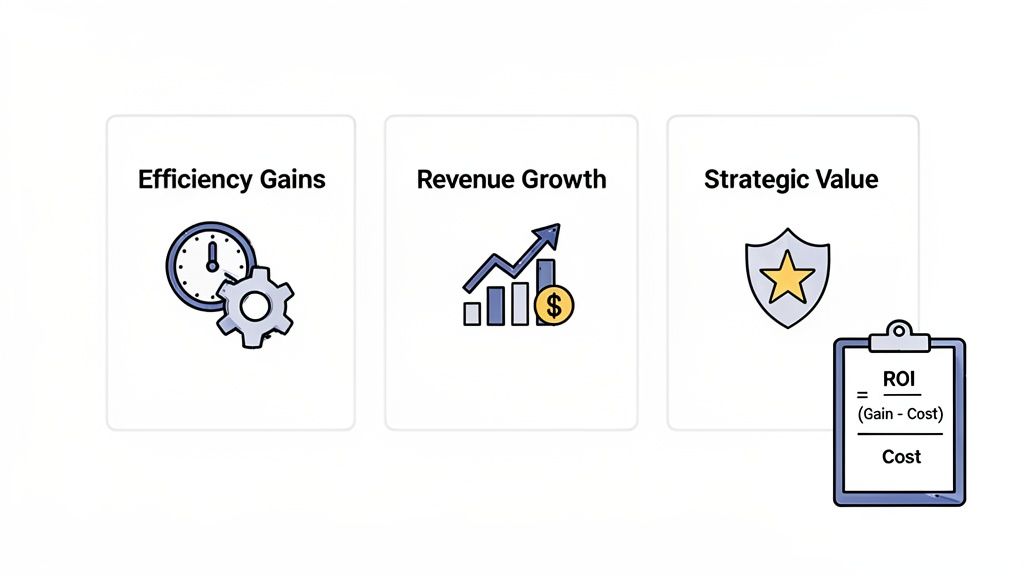
- Categorize Your Returns: Group metrics into Efficiency Gains, Revenue Growth, and Strategic Value to paint a full picture of AI’s total impact.
Tracking Efficiency Gains
The most direct way to see AI's impact is through operational efficiency. These are the "hard cost" savings that are easiest to quantify and report back to leadership. The goal here is to find and automate the repetitive, low-value tasks that eat up your team's time and your company's budget.
Practical Example:
A finance department implements an AI tool to automate invoice processing. By tracking the number of hours previously spent on manual data entry and error correction, they calculate that the tool saves 80 person-hours per month. At an average hourly rate of $50, this represents a direct cost saving of $4,000 per month.
- Reduced Manual Hours: Track the time saved on tasks like data entry, report generation, or initial customer support chats. If an AI tool saves your sales team 5 hours per week on CRM updates, that's a direct, measurable productivity gain.
- Lower Cost-Per-Lead: By using AI to sharpen ad targeting and automate outreach, you can dramatically lower what you spend to acquire each new qualified lead.
- Faster Ticket Resolution: Measure the average time it takes your support team to close a customer ticket before and after implementing an AI assistant.
Measuring Revenue Growth
Saving money is great, but making money is better. Measuring AI's contribution to top-line growth provides a powerful argument for continued investment. These are the metrics that connect your AI initiatives directly to sales and marketing performance.
Impact Opportunity:
A well-designed AI-powered sales or marketing engine can dramatically shorten the customer journey. By automating personalization and lead nurturing at scale, you can accelerate how quickly a prospect moves from initial interest to a closed deal.
Here are a few practical examples:
- Higher Lead Conversion Rates: An AI system that personalizes email campaigns can create a measurable lift in how many prospects turn into qualified leads.
- Shorter Sales Cycles: AI assistants that give sales reps instant access to product info and competitive insights can cut the average time to close a deal by 10-20%.
- Increased Customer Lifetime Value (CLV): AI-driven personalization can boost customer retention and spot upselling opportunities, directly growing CLV.
Assessing Strategic Value
Some of the biggest returns from Generative AI are less direct but no less important. Strategic value captures the long-term competitive advantages that AI creates, which often show up as a stronger market position and greater customer loyalty.
While harder to nail down with a simple formula, these strategic gains are often what separate market leaders from the laggards. They represent AI’s ability to build a more resilient and agile business.
Metrics in this category include:
- Improved Customer Satisfaction (CSAT): By providing faster, more accurate support, AI can directly improve how customers feel about your brand.
- Faster Time-to-Market: Use AI to accelerate product development or content creation, letting you launch new campaigns or features ahead of competitors.
- Enhanced Competitive Advantage: This can be measured through gains in market share or positive shifts in brand sentiment analysis.
The potential here is enormous. Research suggests generative AI could create USD 434 billion in annual enterprise value by 2030, with marketing applications driving much of the early adoption. This highlights why you need to measure ROI not just in immediate cost savings but in long-term revenue and market share growth.
You can learn more about the potential of generative AI in the enterprise market from recent industry analysis.
Choosing the Right Generative AI Advisory Partner
Picking the right partner is probably the single most important decision you'll make on your AI journey. A great advisor fast-tracks your success. The wrong one burns through your budget, wastes your time, and leaves you with stalled projects. The market is noisy, so you need a sharp, business-first lens to cut through it.
The ideal partner for Generative AI Strategic Advisory is obsessed with your business outcomes. They aren't there to push a specific piece of software or a cookie-cutter solution. They start by digging deep into your go-to-market challenges, operational roadblocks, and growth goals. Every recommendation has to be tied directly to your P&L.
Key Takeaways
- Business-First Focus: The best partners are obsessed with your business goals, not just their technology stack.
- Proven Results: Demand to see case studies with measurable outcomes, like increased lead generation or reduced operational costs.
- Partnership Mindset: Look for a firm that acts as a long-term partner committed to your success, not a short-term vendor.
- Ask Tough Questions: A solid vetting process is critical to finding a partner who can truly deliver strategic value.
Look for a Proven Track Record
Plenty of people can talk about AI theory. Far fewer have a history of real-world success. You want an advisory firm that can point to hundreds of projects and show you the receipts. Ask for clear case studies and client testimonials that show tangible results—doubled qualified leads, massive cost savings, or a shorter sales cycle.
This kind of experience is your best insurance policy against common mistakes. A seasoned partner has already run into the technical and organizational hurdles you're about to face. They can guide you around them instead of learning on your dime. Their expertise needs to be a blend of deep AI know-how and a sharp, strategic understanding of your industry.
Prioritize a Partnership Model
The best advisory relationships are true partnerships, not just vendor transactions. Look for a firm with a "skin-in-the-game" mindset, one that aligns their success directly with yours. This turns a short-term project into a long-term commitment to your growth.
This is especially true for middle-market companies, which are jumping into AI at a breakneck pace. Adoption in this segment is expected to hit 91% in 2025, but huge expertise gaps are holding them back. In fact, 70% of these firms know they need external strategic advice to get it right, and 47% are already budgeting for AI consulting to make sure the transition sticks. You can find more on the rise of AI adoption in the middle market on gminsights.com.
Critical Questions to Ask Potential Partners
To properly vet a potential Generative AI Strategic Advisory partner, you have to ask the tough questions. Their answers will tell you everything you need to know about their experience, their strategic focus, and whether they're built to be a real partner.
Here’s a quick checklist to guide your conversations:
- Business Focus: How do you measure a successful project? Show me a case study where you directly tied an AI initiative to a client's revenue.
- Strategic Depth: How will you help us find the highest-impact AI opportunities in our current operations and go-to-market strategy?
- Technical Expertise: What's your team's hands-on experience with the technologies already in our stack?
- Partnership and Adoption: How do you handle change management and team training? We need our people to actually use these new systems. A partner can guide you through this with a comprehensive plan, like our AI enablement services.
The right partner doesn’t just build you a tool; they build your team’s capability. Their ultimate goal should be to make your organization self-sufficient and continuously innovative long after the initial engagement ends.
Stick to these criteria—a sharp business focus, proven success, a partnership model, and a tough vetting process. It’s how you find an advisory firm that won't just deliver a project, but will help you build a lasting competitive edge.
Your AI Transformation Starts Here
The journey into AI-driven growth starts with one clear, strategic step. It’s not enough to just want to adopt new technology; moving from thinking about it to actually doing it requires a real plan. The most successful AI initiatives I've seen are always built on a solid foundation, beginning with a full-scale audit of your current capabilities. This gives you an honest baseline for what’s possible.
This first step is non-negotiable.
Without a deep understanding of your starting point—your data readiness, team skills, and existing tech stack—any AI strategy is just a shot in the dark. A proper audit highlights both your strengths and your critical gaps, painting a realistic picture of the road ahead. It’s the difference between building on solid rock versus shifting sand.
The biggest mistake I see leaders make is treating Generative AI as a destination. It's a journey of continuous improvement, and the first step is knowing exactly where you are on the map.
Creating Your Action Plan
Once you have that clear baseline, the next move is to build a phased roadmap. This approach is all about delivering early, measurable wins to build momentum and get stakeholders excited about the long-term vision. It helps you sidestep the common pitfall of trying a massive, high-risk overhaul right out of the gate.
Impact Opportunity:
A phased roadmap de-risks your investment by zeroing in on high-impact, low-complexity pilot projects first. For example, an initial project might automate a single, painfully time-consuming sales task, proving ROI in weeks, not years. That single success provides the business case you need to tackle more ambitious projects down the line.
Here’s a practical checklist to guide your first moves:
- Identify High-Impact Opportunities: Pinpoint one or two specific business problems where AI can deliver a quick, measurable win, like cutting down manual data entry or speeding up lead qualification.
- Select the Right Partner: Choose an advisory firm that’s obsessed with your business outcomes, not just their own toolset. Check their track record and make sure they operate like a true partner.
- Define Success Metrics: Before you launch a pilot, get crystal clear on your KPIs. Focus on metrics that actually matter to the bottom line, such as cost reduction, shorter sales cycles, or increased conversion rates.
- Launch a Focused Pilot: Run a small-scale project to prove the concept and generate tangible results. Use this early win to build support for wider adoption.
Key Takeaways
- Start with an Audit: A thorough assessment of where you are today is the essential first step to building a successful AI strategy.
- Build a Phased Roadmap: Prioritize quick wins through focused pilot projects. This demonstrates value and builds the momentum you need to keep going.
- Action Over Analysis: Planning is critical, but the window to build a competitive advantage is closing. The key is to move from endless analysis to structured action.
- Focus on Business Value: Every single step of your AI journey must be tied directly to solving a real business problem and delivering a measurable return on investment.
The opportunity to redefine your operations and your entire go-to-market strategy is massive. By taking these practical first steps, you can move from just thinking about Generative AI to actively unlocking its full potential for your business. The time to start is now.
Your AI Advisory Questions, Answered
Jumping into a new strategic investment always raises a few practical questions. Let's get straight to the ones we hear most often from executives considering a Generative AI advisory engagement.
Key Takeaways
- Time-to-Value: A typical strategic advisory engagement is designed to deliver a validated pilot and a clear roadmap in 90-120 days.
- Internal Needs: Success requires a dedicated executive sponsor and access to subject matter experts, not a pre-existing team of AI engineers.
- Size Doesn't Matter: The service is ideal for ambitious companies with scaling challenges, making middle-market firms prime candidates for rapid ROI.
- Future-Proofing: A strong strategy is a living framework focused on continuous improvement and internal capability-building, not a static document.
How Long Does This Actually Take?
From our initial Growth Audit to a validated pilot and a strategic roadmap you can actually use, a typical engagement runs between 90 to 120 days. We designed this timeline specifically to deliver a tangible return and a clear path forward without getting stuck in a cycle of endless analysis.
The whole point is to move from assessment to action, fast. This approach ensures the first phase delivers a provable win, which builds the business case and momentum you need for a bigger, long-term shift.
What Do We Need to Have in Place Internally?
To get the most out of our partnership, you’ll need a dedicated internal champion. This is usually an executive sponsor who has the authority to clear roadblocks and get stakeholders aligned. You’ll also need to give us access to subject matter experts from the relevant departments (like sales or marketing) who can share how things really work day-to-day.
Impact Opportunity:
You don't need a full team of AI experts on standby, but it's a huge plus to have someone on your team who is technically curious and can liaise with your IT department. This makes integrating pilot programs into your existing tech stack a much smoother process.
Is Our Company Too Small for This?
Ambition matters more than size. Generative AI Strategic Advisory delivers the most value to businesses that are running into complex operational or go-to-market hurdles, regardless of their headcount. If you have established processes and a real drive to scale more efficiently, you're a perfect fit.
It's a common myth that AI strategy is only for massive enterprises. The truth is, middle-market companies often see the fastest and most dramatic returns because they're agile enough to implement changes quickly.
How Do You Make Sure the Strategy Doesn't Become Obsolete?
An effective AI strategy isn't a static document we hand you—it’s a living framework built for change. A huge part of our job is to build a system for continuous improvement, not just a one-time plan. We accomplish this through quarterly reviews and a heavy focus on building up your own team’s internal skills.
Practical Example:
The strategic roadmap includes a "technology watch" component, where the advisory partner helps your team evaluate a new AI tool every quarter against a specific business problem. This builds a repeatable process for innovation, ensuring the strategy evolves with the market instead of becoming outdated.
Ready to move from thinking about it to doing something about it? The expert team at Prometheus Agency can help you pinpoint the highest-impact AI opportunities in your business and build a roadmap for scalable growth. Start with our complimentary Growth Audit to get a clear, data-driven picture of your potential. Learn more at https://prometheusagency.co.