Effective demand generation strategies aren't just about finding customers; they're about creating them. This is a holistic approach designed to build genuine awareness and deep-seated interest in what you offer. Unlike tactics that simply capture people who are already looking to buy, demand generation aims to build the entire market, nurturing future customers long before they even think about making a purchase. It’s how you build a consistent, predictable flow of high-quality opportunities for your sales team.
What Is Demand Generation and Why It Matters Now
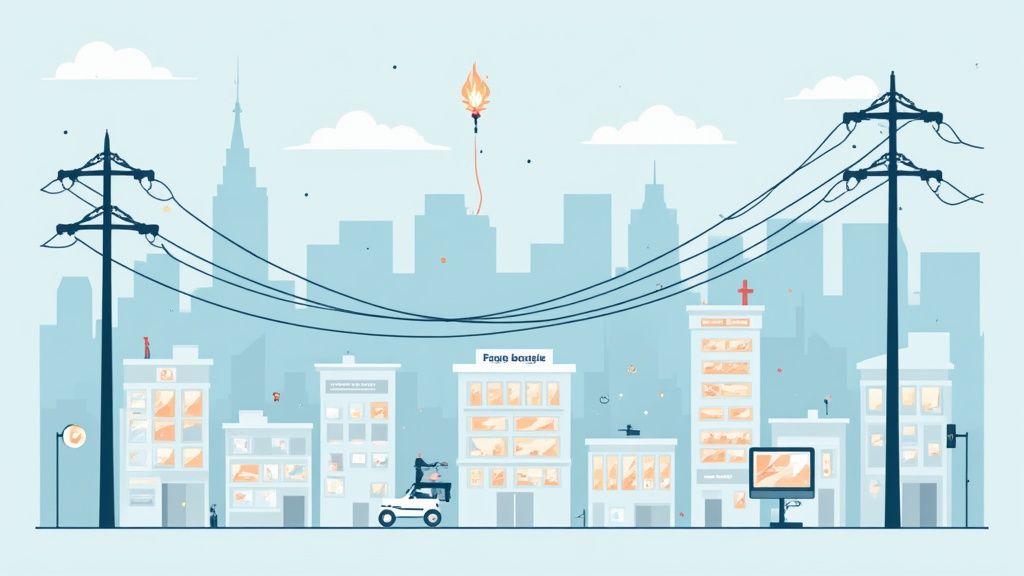
Imagine your company's growth is like building a city. You could send crews out every day looking for individual homeowners whose lights just went out. That's a lot like traditional lead generation—it’s reactive, solving an immediate, isolated problem. You find someone with a need, and you fill it.
Demand generation, on the other hand, is like building the city's entire power grid. It’s a long-term, strategic investment that doesn't just fix one person's outage. It creates a reliable, always-on system that powers the whole community, making energy so accessible that when someone needs it, they instinctively plug into the grid you built.
This is the very essence of modern marketing. You’re building an ecosystem where your brand becomes the default choice. Instead of fighting over the 5% of your market actively buying right now, you’re educating and building trust with the other 95% who will become buyers down the road.
Key Takeaways
- Create, Don't Just Capture: Demand generation is about building the market for your solution, not just finding people already looking to buy.
- Focus on the 95%: The goal is to educate and build trust with the vast majority of your market who aren't ready to buy today but will be in the future.
- Build a Strategic Asset: A strong demand generation program creates a predictable revenue pipeline, lowers customer acquisition costs, and establishes brand authority.
- It Powers Lead Generation: By creating awareness and interest, demand generation makes your lead generation efforts more effective and efficient.
The Strategic Shift: From Chasing to Attracting
The real goal of demand generation is to make your brand synonymous with the solution to a specific problem. It's a proactive game focused on education, building brand affinity, and cementing your authority in the market.
This means you stop just selling a product and start shaping your audience's perspective. You deliver value upfront, becoming a trusted resource long before a sales call is even on the table.
This strategic pivot pays off in several key ways:
- Creates a Predictable Revenue Pipeline: By consistently warming up the market, you build a reliable flow of informed, high-intent prospects.
- Builds Brand Authority: Your company becomes the go-to expert in its field, attracting customers organically.
- Lowers Customer Acquisition Costs: Attracting inbound interest is almost always more cost-effective than chasing outbound leads.
- Shortens Sales Cycles: Prospects enter the sales process already educated and familiar with your brand's value.
Demand Generation vs Lead Generation Demand generation is a long-term strategy focused on building awareness and interest across your entire target market. It shifts the focus from capturing existing demand (lead generation) to creating new demand, positioning your brand as the industry leader and ensuring a sustainable pipeline of future customers.
Demand Generation vs Lead Generation A Strategic Comparison
To really nail down the difference, it's helpful to see them side-by-side. While they're both essential, they play very different roles in your overall growth strategy. One builds the audience; the other converts it.
| Attribute | Demand Generation | Lead Generation |
|---|---|---|
| Primary Goal | Create awareness and educate the market. | Capture contact information from interested prospects. |
| Focus | Top-of-funnel (educating the 95%). | Mid-to-bottom-of-funnel (engaging the 5%). |
| Key Tactics | Blogs, podcasts, webinars, social media, SEO. | Gated content, forms, free trials, demo requests. |
| Metrics | Website traffic, brand mentions, engagement, reach. | Cost per lead (CPL), conversion rates, MQLs. |
| Timeframe | Long-term, continuous effort. | Short-term, campaign-based results. |
Ultimately, a strong demand generation engine makes lead generation easier and more effective. You're not just finding leads; you're creating an environment where high-quality leads come to you.
Practical Examples
A SaaS company that sells project management software wants to grow its market share.
- Lead Generation Tactic: Run a Google Ad campaign with the keyword "best project management software" that links to a free trial sign-up page. This targets the 5% actively looking to buy.
- Demand Generation Strategy: Create a free webinar series on "How to Improve Team Productivity," publish a definitive guide on "Choosing the Right Project Management Methodology," and run a podcast featuring interviews with successful project managers. This educates the 95%, making their brand the trusted authority when a need arises.
Impact Opportunity
Adopting a robust demand generation strategy transforms your entire go-to-market motion from reactive to proactive. You stop chasing prospects who may or may not be a good fit and start attracting ideal customers who already see you as the premier solution. This creates a powerful competitive advantage, making your brand the one customers seek out first.
To really dig into the foundational concepts, it's worth exploring broader guides on how to generate leads and drive sustainable growth.
Building Your Foundation with Content-Led Strategies
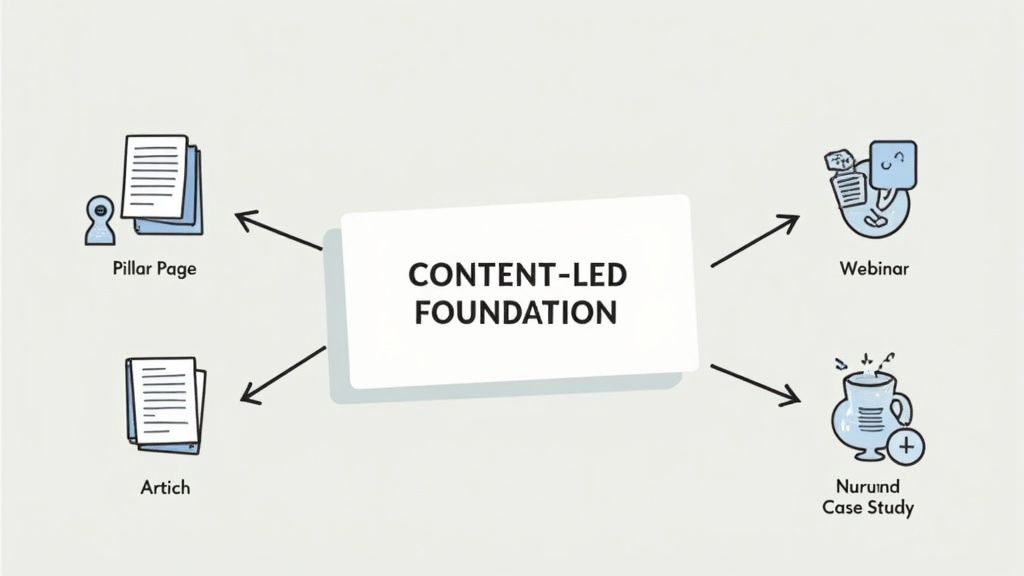
If demand generation is your company’s power grid, then great content is the high-voltage line carrying the energy. At its core, a content-led strategy is about one simple shift: from selling to helping. It's how you build trust and establish authority long before a potential customer is even thinking about making a purchase.
Instead of interrupting people with ads, you’re creating resources they actually want to find. These assets—from insightful articles to in-depth webinars—tackle their pain points, answer their questions, and teach them how to solve their biggest headaches. This is how you attract the right audience and become their go-to resource.
The goal? Be so consistently helpful that when they finally decide they need a solution, your brand is the first one that comes to mind. This approach builds a powerful marketing engine that pulls in high-quality, organic interest from your ideal customers.
Key Takeaways
- Content builds trust before the sale: Give away value without asking for anything in return. It establishes your credibility and creates a positive connection to your brand.
- It creates long-term assets: A paid ad dies the moment you stop paying. A great piece of content can drive traffic and interest for years.
- Content fuels all other channels: Your articles, guides, and videos are the ammunition for social media, email campaigns, and even your sales team's outreach.
- It establishes topical authority: A deep library of content proves you know your stuff, helping you dominate search rankings and become a recognized leader in your space.
Adopting the Pillar Page and Topic Cluster Model
One of the most powerful demand generation strategies you can use for content is the "pillar page" and "topic cluster" model. Think of it as creating your own digital library on a specific subject, making your website the definitive resource for anyone interested in it.
The pillar page is your cornerstone—a comprehensive, long-form guide that covers a broad topic from top to bottom (like "The Complete Guide to ABM Strategy"). This page is the central hub.
Supporting that pillar are multiple "topic cluster" articles. These are shorter, more focused pieces that dive deep into specific sub-topics you touched on in the pillar page (like "How to Identify Your Target Accounts" or "Measuring ABM Campaign Success"). Every cluster article links back to the main pillar page, creating a powerful web of internal links that signals your deep expertise to search engines.
By organizing your content this way, you're not just writing random articles. You're building a strategic web of information that answers every potential question your audience might have. This model is exceptionally good at capturing organic search traffic and cementing your brand as a true thought leader.
The Quantifiable Impact of Scaled Content
Investing in a deep content library isn't just a "nice to have"—it delivers hard, measurable results. The data is clear: businesses with extensive content generate far more leads. For example, businesses that have 401–1,000 pages on their website get roughly 600% more leads than sites with only 51–100 pages. This shows a direct line between the depth of your content and your ability to capture organic interest. And with organic search still a top lead source for most marketers, that impact is massive. You can find more insights on these content statistics at Salesgenie.
Practical Examples of a Multi-Layered Content Strategy
A winning content program meets buyers at every stage of their journey, guiding them from initial awareness all the way to a final decision.
Here’s what that looks like in the real world:
- Awareness Stage: At the top of the funnel, your content needs to be purely educational and problem-focused. No product pitches.
- Practical Example: A cybersecurity firm could create blog posts like "Top 5 Data Security Risks for Small Businesses" or a podcast series interviewing industry experts on emerging threats.
- Consideration Stage: Once someone understands their problem, they start researching solutions. Your content should now help them evaluate their options.
- Practical Example: The same firm could host a webinar comparing different security frameworks or publish a detailed guide on "How to Choose the Right Endpoint Protection Platform."
- Decision Stage: At the bottom of the funnel, your content should make it clear why your solution is the best choice.
- Practical Example: This is the perfect time for compelling case studies that show how you solved a similar company's problem, detailed product demo videos, and transparent pricing pages.
Impact Opportunity: Building a Lasting Asset
The real power of a content-led strategy is that you’re creating a durable, appreciating marketing asset. Every article, guide, and video you publish adds to a library of resources that works for you 24/7 to attract, educate, and convert your ideal customers. You’re building a system that doesn't just generate demand today—it builds a foundation for predictable, sustainable growth for years to come.
Going After High-Value Accounts with a Multichannel Playbook
While broad, content-driven strategies are great for building awareness, the real game-changer in demand generation is precision. This is where you stop casting a wide net and start spearfishing—focusing your energy on the high-value accounts that can actually move the needle for your business. This highly focused approach is what we call Account-Based Marketing (ABM).
Instead of broadcasting a message to everyone, ABM treats individual accounts as their own unique markets. It’s all about creating coordinated, personalized campaigns—or "plays"—that hit key decision-makers across multiple channels. The goal isn't just to get more leads; it's to win the right accounts.
Key Takeaways
- Go for quality, not quantity: ABM intentionally focuses your marketing and sales firepower on a handpicked list of best-fit accounts with high revenue potential.
- Alignment is everything: This only works if sales and marketing are in lockstep, from identifying the right accounts to running coordinated plays together.
- Personalization is mandatory: Generic messaging won't cut it. Every single touchpoint, whether it's an email or a LinkedIn ad, has to speak directly to the target account's specific problems.
- Orchestrate across channels: A winning ABM play surrounds the buying committee on multiple fronts, creating a consistent message that’s impossible to ignore.
This visual from HubSpot shows the ABM process in a nutshell, from identifying accounts to running personalized campaigns.
Notice how it’s a cycle. ABM isn't a one-and-done campaign. It's a continuous strategy of identifying, engaging, and growing relationships with the accounts that matter most.
Practical Examples: Running a Multichannel ABM Play
Think of a great ABM play like a well-rehearsed band. Every instrument—email, social media, events, even direct mail—has its part to play at just the right moment. The result is a cohesive experience for your target account. The modern B2B buying journey is complex, with bigger buying committees, and you need a sustained, multichannel effort to break through all the noise.
It now takes 6–10+ touches across three to six different channels for a B2B buyer to even consider converting. This kind of sustained, personal engagement doesn't just improve win rates; it forces you to concentrate your resources on fewer, higher-value targets. Companies that get this right see much bigger deal sizes and better conversion rates, but it comes at a cost—they often need to put 20–40% more resources into account research and personalization. You can dig deeper into how multichannel ABM is changing the game on my-outreach.com.
A Multichannel Play in Action
Let's say you're targeting a large manufacturing company that's struggling with supply chain issues. Here’s what a coordinated play might look like:
- The Intel Phase (Marketing & Sales): The team gets together and IDs the key players on LinkedIn: the VP of Operations, the Director of Logistics, and the CFO.
- Air Cover with Ads (Marketing): Personalized LinkedIn ads go live, targeting those three people with a case study about how a similar company fixed its supply chain.
- The Spearpoint Email (Sales): A sales rep sends a hyper-personalized email to the VP of Operations, mentioning a recent company announcement and tying it directly to the case study.
- The Value-Add (Marketing): At the same time, the Director of Logistics gets an invite to an exclusive webinar on "The Future of Smart Manufacturing and Logistics."
- Executive Connection (Sales): Once they see engagement, the sales team works to set up a small, private virtual roundtable for the CFO and other execs, led by a subject matter expert.
Each step builds on the last. You’re creating an impression that you truly get their business in a way no generic campaign ever could.
Impact Opportunity
Shifting your resources to targeted, multichannel demand generation strategies like ABM has a massive impact. When you focus your firepower on accounts with the greatest potential, you see a huge jump in average deal size, shorter sales cycles, and much higher win rates. You stop wasting your budget on low-quality leads and start investing in real relationships with the accounts that will actually grow your business.
Amplifying Your Reach with AI and Automation
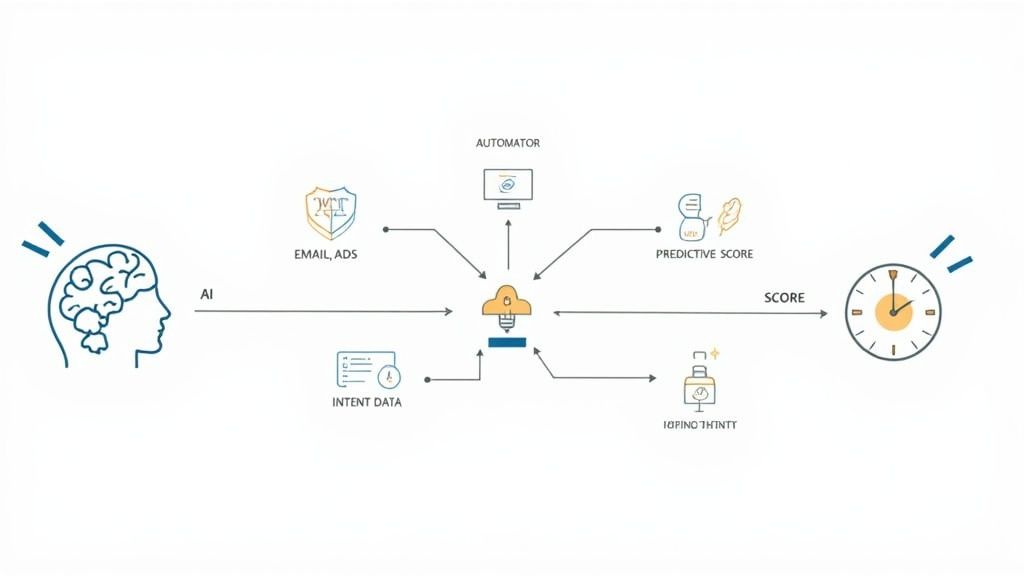
While smart content and targeted campaigns lay the groundwork, technology is the force multiplier that takes your demand generation strategies from a manual slog to intelligent, automated execution. AI and automation aren't just about speed. They're about being smarter, adding a layer of personalization and foresight that’s simply impossible for humans to achieve at scale.
These tools let you graduate from old-school, rules-based marketing. Forget blasting the same message to everyone. Now, you can deliver precisely the right content to the right person at the exact moment they need it, creating a buyer experience that feels genuinely helpful and relevant.
Key Takeaways
- Automation enables personalization at scale: It’s how you create unique customer journeys for thousands of prospects without hiring an army.
- AI uncovers hidden buying signals: Predictive models dig through mountains of data to find accounts ready to buy—often before they even contact you.
- Technology is about intelligence, not just efficiency: The real win is using data to make smarter decisions and point your sales team toward the hottest opportunities.
- Intent data reveals who's in-market now: Tracking online research helps you find accounts actively looking for solutions like yours.
Practical Examples: Intelligent Lead Nurturing Workflows
One of the biggest mistakes is treating every new contact the same way. Intelligent lead nurturing uses automation to build dynamic communication paths based on what a prospect actually does. Think of it as a digital guide, escorting each person on their unique buying journey.
For instance, a prospect downloads a whitepaper on supply chain logistics. An automated workflow immediately sends a follow-up email with a related case study. If they click through and then visit your pricing page, the system can flag that lead as "warm" and alert a sales rep.
This approach keeps your communication relevant. You're not just sending another generic newsletter; you're delivering real value at every turn, building trust and gently guiding prospects toward a decision. To see this in action, check out our guide on AI-powered lead generation.
Practical Example: A Dynamic Nurturing Workflow Imagine a SaaS company that sells financial planning software. A new prospect signs up for a webinar.
- Immediate Follow-up: The system instantly sends a "thank you" email with a link to the webinar recording.
- Behavioral Trigger: Three days later, it notices they watched 75% of the recording. This triggers a second email with a blog post on "Advanced Forecasting Techniques."
- High-Intent Signal: The prospect clicks the link and also browses the product features page. This action adds 20 points to their lead score.
- Sales Alert: Once their score hits a certain threshold (say, 50 points), the system automatically creates a task in the CRM for a sales rep to make a personal call, armed with the prospect's full engagement history.
Unlocking Potential with AI-Powered Predictive Scoring
Traditional lead scoring is often too simplistic, assigning points for a job title or a single page view. AI-powered predictive scoring is in a different league entirely. It crunches historical data from your best customers to find the complex patterns that actually correlate with a closed deal.
The model might discover that prospects who download two specific guides and visit the pricing page on a Tuesday are 80% more likely to become customers. It then uses that insight to score new leads in real-time, letting your sales team focus only on the opportunities with the highest chance of closing.
This shift toward intelligent automation is changing the game. Reports show that around 39% of marketers see marketing automation as a top priority for ramping up demand. By adding AI-driven predictive analytics, companies are seeing a measurable jump in pipeline velocity. They can focus sales on the best-fit leads, which naturally improves conversion rates over older, rules-based systems.
Impact Opportunity
When you weave AI and automation into your demand generation, you create a powerful efficiency loop. It drastically cuts down on the manual work of qualifying and nurturing leads, freeing your team to focus on high-impact strategic initiatives. The result? A significant drop in customer acquisition costs (CAC) and a faster, more predictable sales cycle that turns your marketing function into a well-oiled revenue machine.
Measuring Success and Proving Your ROI
A brilliant demand generation strategy is only as good as the results it produces. To get the C-suite on board and lock in next year's budget, you have to move past surface-level vanity metrics. Clicks and impressions are nice, but they don't pay the bills.
Proving success means tying your marketing activities directly to the outcomes that matter: revenue and growth. It's a fundamental shift from measuring activity to measuring impact. Instead of just reporting how many people saw your content, you need to show exactly how that content influenced the pipeline and helped close deals.
This is how marketing finally earns its seat at the revenue table.
Key Takeaways
- Speak the C-suite's language: Leaders care about Customer Acquisition Cost (CAC), Lifetime Value (LTV), and pipeline velocity—not just website traffic.
- Attribution is non-negotiable: You need a system that accurately credits revenue back to the marketing touchpoints that drove the deal forward.
- ROI is your proof: Frame your results in financial terms to show marketing’s direct contribution to the bottom line.
- Let the data tell the story: Your CRM and marketing automation platform are your best friends for tracking every interaction and building a clear narrative of how demand generation fuels growth.
Moving Beyond Vanity Metrics
The first step in proving your worth is tracking the KPIs that actually matter to the business. While top-of-funnel numbers have their place, the real story is told through metrics that reflect financial health and sales efficiency. To show the value of your demand generation work, it's essential to learn how to calculate ROI accurately.
So, what should you be tracking?
- Customer Acquisition Cost (CAC): This is the total cost of your sales and marketing efforts divided by the number of new customers you brought in over a specific period. A falling CAC means your demand gen engine is getting more efficient.
- Customer Lifetime Value (LTV): This metric forecasts the total revenue you can expect from a single customer over their entire relationship with your company. A healthy LTV-to-CAC ratio—ideally 3:1 or higher—proves you’re acquiring profitable customers, not just expensive ones.
- Pipeline Velocity: This measures how fast deals move through your sales funnel. Great demand generation strategies create educated buyers who are ready to talk, which almost always speeds up the sales cycle.
By focusing on these metrics, you change the conversation from "marketing is a cost center" to "marketing is a revenue driver." You can walk into any meeting and confidently show that for every dollar you invest, the company gets multiple dollars back in profitable, long-term customer relationships.
Practical Examples for Proving ROI
Okay, theory is great, but how do you actually do this? Proving your return on investment requires a clear system for tracking and attribution. It’s not enough to just run campaigns; you have to connect them to sales outcomes right inside your CRM.
Let's walk through a real-world example.
Imagine you run a webinar that costs $5,000 to produce and promote. Using your marketing automation platform, you track everyone who registers and attends.
- Tagging on Entry: The moment someone registers, they are tagged in your CRM with the campaign name "Q3 Webinar."
- Tracking Nurture: Over the next few weeks, attendees get follow-up content. Every click and open is tracked on their contact record.
- Creating the Opportunity: A sales rep opens an opportunity with a contact who attended the webinar. Your CRM should automatically link the "Q3 Webinar" campaign to that opportunity.
- Closing the Loop: When that opportunity closes for $50,000, you can directly attribute that revenue to the webinar, proving a clean 10x ROI.
Measuring What Matters: KPIs for Demand Generation
To really dial in your strategy, you need to connect the right metrics to the right activities. The KPIs you use to measure the success of an SEO-driven blog post will be different from those for a high-touch ABM campaign.
The table below breaks down the key demand generation metrics and what they tell you about your performance.
Key Demand Generation KPIs and What They Measure
| Metric (KPI) | What It Measures | Why It's Important |
|---|---|---|
| Marketing Qualified Leads (MQLs) | The number of leads who have shown enough interest to be passed to sales. | Indicates top-of-funnel health and the effectiveness of your content and offers. |
| Sales Qualified Leads (SQLs) | The number of MQLs that the sales team has accepted as legitimate prospects. | Measures the quality of your leads and the alignment between marketing and sales. |
| Pipeline Velocity | The speed at which leads move through the sales funnel from first touch to closed deal. | Faster velocity means a more efficient sales cycle and quicker revenue recognition. |
| Customer Acquisition Cost (CAC) | The total cost of sales and marketing to acquire one new customer. | A core efficiency metric. A lower CAC means a more profitable growth engine. |
| Customer Lifetime Value (LTV) | The total predicted revenue a single customer will generate over their entire relationship. | Puts acquisition costs into perspective and ensures you're acquiring valuable customers. |
| LTV:CAC Ratio | The ratio of Customer Lifetime Value to Customer Acquisition Cost. | A critical indicator of long-term business health. Aim for 3:1 or higher. |
| Marketing Sourced Pipeline | The value of all sales opportunities that originated from marketing's efforts. | Directly shows marketing's contribution to the sales pipeline. |
| Marketing Influenced Revenue | The total revenue from deals where marketing had at least one touchpoint. | Demonstrates marketing's broader impact on the entire customer journey. |
By setting up a disciplined measurement framework like this, you empower your team to confidently prove marketing's contribution. This not only justifies your current budget but builds an undeniable case for future investment in the strategies that drive real, measurable growth.
And as you get more advanced, you'll want to understand customer behavior on an even deeper level. That's where techniques like using predictive churn modelling can provide powerful insights into long-term value and retention.
Your Demand Generation Implementation Roadmap
Great ideas are one thing, but turning them into a revenue-generating machine takes a clear, deliberate plan. An implementation roadmap for your demand generation strategies is how you get there. It’s not just a checklist; it's a phased approach that prevents you from wasting time and money by building a solid foundation first.
Think of it as a journey, moving from deep audience understanding to launching smart campaigns, and finally, to optimizing everything based on what the data tells you. You have to nail down who you're talking to before you can build campaigns that actually connect and drive growth.
Key Takeaways
- Foundation First: Real success starts with a rock-solid understanding of your Ideal Customer Profile (ICP) and their buying journey.
- Phased Rollout: Don't go all-in at once. Launch a few initial campaigns to get baseline data before you scale your spending.
- Data-Driven Refinement: Let performance metrics guide you. Continuously iterate and improve your strategy based on real results.
- Patience is Key: Demand generation is a long-term play; focus on building a sustainable system rather than chasing quick, unsustainable wins.
The Four Phases of Implementation
A smart rollout follows a logical sequence from strategy to optimization. By breaking the process down into distinct phases, you ensure each step builds on the last, creating a demand engine that’s both resilient and effective.
Phase 1: Foundation (Weeks 1-4)
This is where all the critical upfront work happens. The first four weeks are all about deep research and getting everyone on the same page. You need to define your ICP, map out the entire buyer's journey for each key persona, and agree on your core messaging.
A huge piece of this is auditing your tech stack. Does your CRM actually support your goals? It’s a good time to make sure it’s configured correctly. You can learn more about what a CRM system really does for your sales team to make sure you're set up for success.
Phase 2: Campaign Launch (Weeks 5-8)
With your foundation set, it’s time to launch two or three pilot campaigns. Pick the channels where you know your ICP spends their time—maybe that’s a content-heavy SEO initiative paired with a targeted LinkedIn ad campaign. The goal here isn't perfection right out of the gate. It's about gathering that crucial initial performance data.
Phase 3: Measurement and Analysis (Weeks 9-12)
Now, you get to dig into the numbers from your pilot campaigns. Start tracking key metrics like engagement rates, cost per lead, and, most importantly, early pipeline influence. This is where you figure out what worked, what fell flat, and start to understand why.
Phase 4: Optimization and Scale (Ongoing)
This is the fun part. Armed with insights from your analysis, you can start making smart moves. Double down on the channels that are performing, pull budget from the ones that aren't, and begin testing new tactics to scale the whole program. This phase never really ends—it’s a continuous loop of testing, learning, and growing.
Practical Examples of a Phased Rollout
Let's say a B2B software company wants to launch a new demand generation program.
- Phase 1 (Foundation): They spend the first month interviewing their top 10 customers to refine their ICP and personas. They create a detailed journey map showing every touchpoint from awareness to purchase.
- Phase 2 (Launch): They launch two pilot campaigns: a series of pillar pages and cluster content focused on a core pain point, and a targeted LinkedIn ad campaign aimed at their newly defined ICP.
- Phase 3 (Analysis): After a month, they see the content is driving significant organic traffic but low MQLs, while the LinkedIn campaign has a high CPL but the leads are high-quality.
- Phase 4 (Optimize): They add clearer CTAs to their blog posts to improve conversions and refine the targeting on their LinkedIn ads to lower CPL, reallocating some budget from less effective ad creative.
Impact Opportunity
Following a structured implementation roadmap de-risks your investment in demand generation. Instead of making big, speculative bets, you build a system brick by brick, validating each step with real data. This methodical approach ensures you build a predictable, scalable, and highly effective revenue engine that supports long-term growth.
Got Questions About Demand Generation? We've Got Answers.
It's natural to have questions when you're digging into a topic like demand generation. Let's clear up a few of the most common ones so you can move forward with confidence.
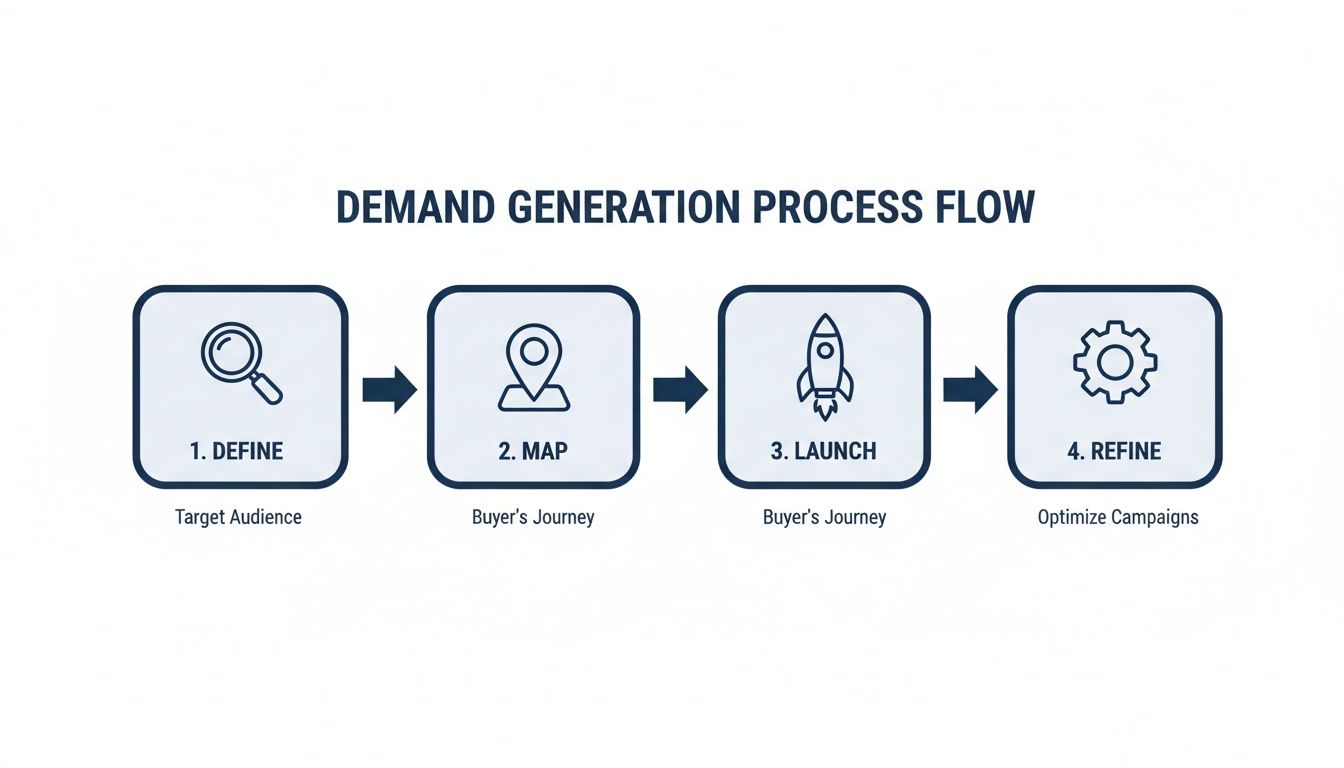
This diagram gives you a bird's-eye view of the whole process. Notice it's a loop—because great demand gen isn't a one-and-done project. It's a constant cycle of learning, testing, and getting better.
Demand Generation vs. Inbound Marketing: What's the Real Difference?
It’s easy to mix these two up, but they aren't the same thing. Think of it like this: inbound marketing is a tactic—a very important one—focused on pulling customers in with great content like blog posts and SEO.
Demand generation is the overarching strategy. It includes all your inbound efforts but also folds in outbound moves like account-based marketing (ABM), paid ads, and live events to create interest across your entire market. Inbound attracts, while demand gen creates and captures.
How Can Small Businesses Get Started on a Shoestring Budget?
If you're a smaller team, the name of the game is focus. Don't try to boil the ocean. Instead, pick one or two channels where your Ideal Customer Profile (ICP) hangs out and go all-in there.
Here's how to make it work:
- Start with your content. Write a few incredibly helpful, in-depth blog posts that solve a real, nagging problem for your audience. This is the cheapest, highest-impact place to begin.
- Get social (organically). Use a platform like LinkedIn to share what you’ve written. More importantly, jump into conversations and offer real value. You'll build authority without spending a dime on ads.
- Pick one metric that matters. Don't drown in data. Just track one key number, like Marketing Qualified Leads (MQLs), to keep things simple and know if you're on the right track.
For example, a small B2B consultant could write the definitive guide on a common industry headache. Then, they could chop that guide into bite-sized posts for LinkedIn and engage with every single person who comments. That's how you build a following and prove you know your stuff.
What's the Single Most Important First Step?
Before you do anything else, define your Ideal Customer Profile (ICP). Seriously. If you don't know exactly who you're talking to, every dollar you spend and every word you write is a shot in the dark.
Before a single blog post is written or an ad campaign goes live, you have to know who your best customers are. What keeps them up at night? Where do they go for answers? Getting this foundation right ensures every bit of effort is aimed at attracting the right people from day one.
A rock-solid ICP acts as the North Star for all your demand generation strategies. It helps you craft messaging that connects on a deeper level, which means better engagement, higher-quality leads, and a much healthier return on your investment.
Ready to turn your tech stack into a scalable revenue system? Prometheus Agency is an AI transformation partner that helps growth leaders build durable growth systems. Book your complimentary Growth Audit and AI strategy session.