Think of a C-Suite AI Enablement Program less as a technical training course and more as a strategic realignment for your entire leadership team. It’s designed to arm senior executives with the right frameworks and knowledge to steer the company through its AI integration. This isn’t about learning to code; it’s about tying AI directly to core business outcomes, building smart governance, and championing the new way of working from the very top.
Make no mistake: this is not another IT project. It’s a fundamental business shift.
Key Takeaways
- Strategic, Not Technical: The goal is to align AI with business goals, not to teach executives how to code.
- Leadership-Driven: Successful AI integration requires active sponsorship and understanding from the C-suite.
- Business Realignment: AI enablement is a fundamental shift in how the business operates, not just an IT project.
The Executive Imperative For AI Enablement

Artificial intelligence is moving too fast to be handed off to the tech department and forgotten. Its power to reshape entire markets, automate deeply complex work, and open up brand-new revenue streams makes it a core C-suite responsibility. For B2B leaders in the middle market, ignoring this reality is a direct threat to staying competitive.
Just as a ship’s captain has to learn to navigate by new stars, modern executives must personally grasp the principles of AI to guide their organizations. That hands-on leadership is what’s needed to frame AI not as a disjointed collection of tech experiments, but as a single, cohesive strategy for growth.
Why Top-Down Leadership Matters
True AI transformation has less to do with algorithms and more to do with strategy, people, and process. Without clear direction from the top, AI initiatives often fizzle out as isolated experiments that never scale or deliver any real business value. C-Suite AI Enablement Programs are the bridge that connects AI's potential to tangible results.
Here’s why executive leadership is non-negotiable:
- Strategic Alignment: C-suite involvement ensures every AI project is directly linked to P&L goals and the company's grand strategy, preventing expensive detours.
- Risk Mitigation: Executive oversight is vital for setting ethical guardrails and solid data governance, protecting the company from serious reputational and financial blowback.
- Cultural Adoption: When leaders actively champion AI, it sends a clear signal of its importance to everyone, speeding up adoption and cutting down on internal resistance.
The real goal of an enablement program is to raise the entire organization's AI Quotient, and that has to start at the top. It turns executives from passive observers into active, informed architects of their company's future.
The Widening Executive AI Gap
The need for this kind of leadership is glaring when you look at the gap between awareness and actual readiness. Enterprise spending on generative AI is expected to hit $37 billion in 2025—a staggering jump from $11.5 billion in 2024.
At the same time, a recent survey found that while 82% of leaders believe strong AI knowledge is essential for the future C-suite, only 41% feel confident in their own understanding. This disconnect screams for structured C-Suite AI Enablement Programs.
Impact Opportunity
This top-down approach makes sure that every single AI initiative has clear business goals from day one. To drive home the case for this investment, it helps to understand the wider benefits of AI in marketing. A properly enabled leadership team can guide the creation of an AI-powered lead scoring model that doesn't just find prospects, but aligns the marketing and sales teams around the most profitable opportunities—directly boosting the bottom line.
So, What Exactly Is a C-Suite AI Enablement Program?
Let's cut through the noise. A true C-Suite AI Enablement Program isn't about one-off workshops or cramming buzzwords. It's a structured, ongoing initiative designed to give senior leaders the strategic mindset, operational frameworks, and governance they need to actually lead an AI-driven business. This is about building a permanent capability at the top.
The goal is to pull AI out of the IT silo and place it at the heart of your business strategy. A successful program makes sure every executive can confidently answer the tough questions: How will this AI project actually move the P&L? Is our data infrastructure even ready for this? What ethical lines do we need to draw? This is the kind of clarity that separates a half-baked effort from a program that delivers real value.
The Pillars of a Program That Actually Works
A strong AI enablement program is built on a few critical pillars. Think of them as interconnected parts of a system that drives adoption, manages risk, and ties technology directly to business goals. If you ignore one, the whole thing can wobble and fall.
Here are the non-negotiables:
- Strategic P&L Alignment: Every single AI initiative needs a clear line back to a core financial goal, whether that’s growing revenue, slashing customer acquisition costs, or making operations more efficient. No exceptions.
- Operational and Data Readiness: This means taking a hard, honest look at your current data quality, infrastructure, and internal processes. Can they actually support what you want to build?
- strong Governance and Ethics: You absolutely need a clear framework for using AI responsibly. This includes rules for data privacy, model transparency, and who's accountable for decisions. It’s not optional.
- building an AI-Native Culture: The program has to champion a culture where data-driven experiments are encouraged and AI is seen as a tool that helps smart people, not just a replacement for them.
A C-Suite AI Enablement Program is really about creating a shared language and a unified vision for AI across the leadership team. When the CFO, CMO, and COO all get how AI creates value in their worlds, the entire organization can finally move forward with speed and confidence.
From One-Off Workshops to Real Strategic Enablement
A lot of companies mistake a simple "AI workshop" for a genuine enablement program. The difference is night and day, and it has huge implications for your long-term results. A workshop might spark a little excitement, but a full-blown program builds lasting organizational muscle and drives real change. To truly get a handle on what this requires, it helps to understand the underlying infrastructure, as outlined in this complete guide to AI employee training platforms.
This distinction is crucial when you're trying to justify the investment. A one-day session gives people awareness. A structured program gives them capability.
Practical Example
- Workshop Outcome: The sales team learns about some new AI prospecting tools. But with no process for plugging them into the CRM, adoption fizzles out within weeks.
- Enablement Program Outcome: The CRO sponsors a pilot to integrate an AI lead-scoring model directly into the CRM. It's backed by new workflows and proper training, leading to a 25% jump in sales-qualified leads.
The Difference Between a Workshop and a Program
The table below breaks down the stark contrast between a typical AI workshop and a serious, strategic enablement program. It’s the difference between a quick sugar rush and building a healthy, high-performance engine for growth.
| Attribute | Typical AI Workshop | Comprehensive AI Enablement Program |
|---|---|---|
| Duration | A few hours to a single day | A multi-month, continuous initiative |
| Focus | General AI awareness and tool demonstrations | Strategic alignment, governance, and business-case development |
| Audience | Broad, often mid-level managers | C-suite and their direct reports |
| Outcome | Temporary excitement and isolated ideas | A prioritized roadmap of ROI-focused AI pilots |
| Commitment | Minimal, low-cost event | Significant strategic and financial investment |
| Business Impact | Often negligible or unmeasured | Directly tied to key performance indicators and P&L goals |
Ultimately, the most powerful thing a true enablement program does is de-risk your AI investments. By arming your leaders with the right evaluation frameworks, it ensures you’re betting on projects with the highest odds of success and the clearest path to a real business outcome.
Your AI Enablement Roadmap From Pilot to Scale
A real C-Suite AI Enablement Program isn't about theory—it’s about structured execution. You need a clear, phased roadmap to guide your company from early experiments to enterprise-wide impact. This isn't a sprint. It's a deliberate journey designed to build momentum, prove value, and manage change without overwhelming your teams.
A solid roadmap is what turns AI from an abstract idea into a tangible business asset. It gives you a framework for de-risking your investment by starting small, scoring clear wins, and then scaling what actually works. For middle-market B2B companies, this methodical approach is everything. It ensures your resources go toward initiatives with the highest chance of paying off.
The diagram below outlines those crucial early phases, focusing on aligning your strategy with real business needs, taking stock of what you have, and setting up the right governance from day one.
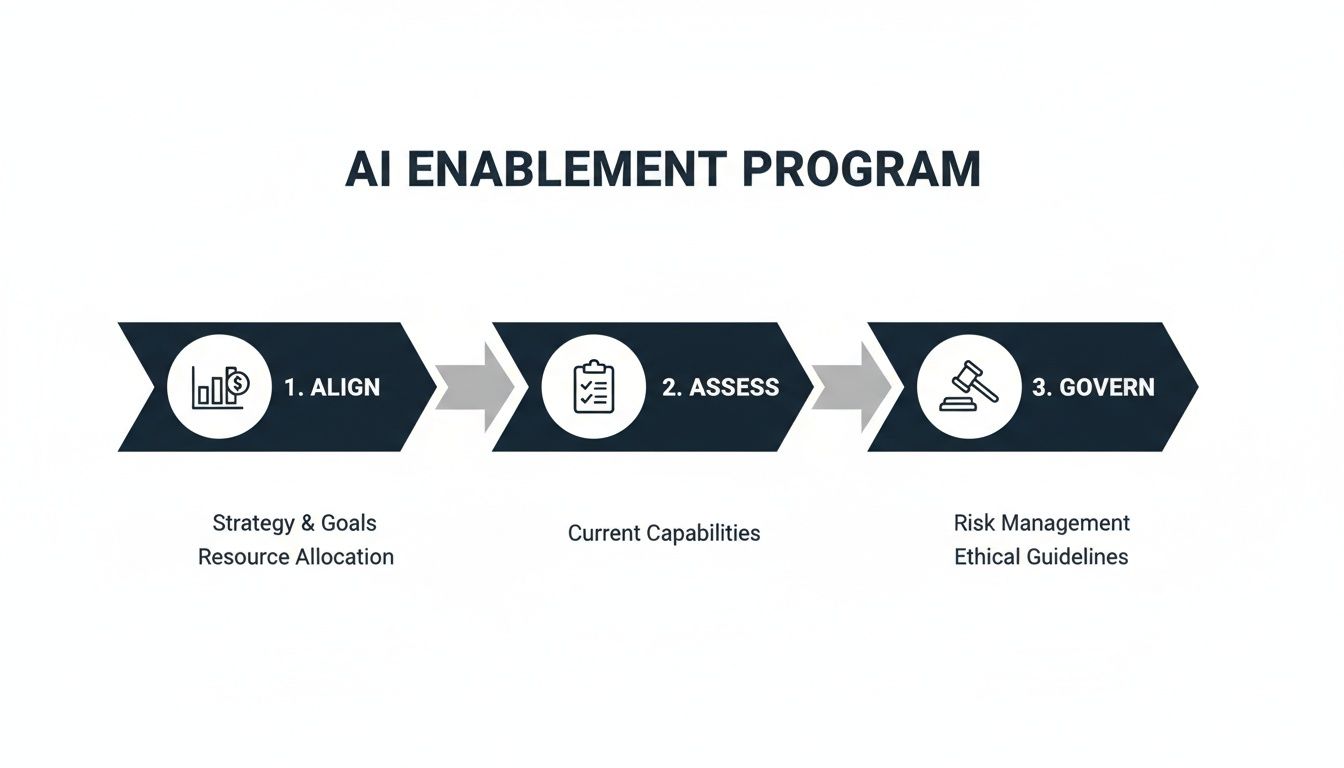
As you can see, before a single piece of tech is rolled out, leadership has to get on the same page about P&L goals, assess current capabilities, and design the guardrails that will guide the whole process.
Stage 1: Foundational Audit and Pilot Selection
First things first: you need a baseline. Before you can build anything, you have to know what your foundation looks like. This means a full audit of your data infrastructure, your current tech stack, and the skills your people already have. The goal is to spot your strengths and, more importantly, the gaps that could derail AI adoption down the road.
Once you have a clear picture, you can pick a high-impact, low-risk pilot project. The perfect pilot solves a specific, painful business problem and has a clear, straight line to demonstrating ROI. Forget the "moonshot" projects for now. You're looking for a quick, measurable win that builds confidence and gets people excited.
Stage 2: Executive Immersion and Governance Design
With a pilot project in hand, the focus shifts to getting your leadership team on board—and really on board. This stage is all about hands-on immersion sessions where executives get to play with AI tools relevant to their own departments. This isn’t a boring lecture; it’s a practical workshop meant to make AI feel real and demystify how it applies to the business.
At the same time, you need to form an AI steering committee. This should be a cross-functional group with leaders from IT, finance, operations, and marketing. Their job is to create the governance framework—setting ethical guidelines, defining data usage policies, and deciding on the KPIs that will measure the pilot's success.
Stage 3: Scaled Implementation and Change Management
Okay, the pilot was a success. Now it’s time to scale. This stage is all about taking the lessons you learned from that first project and building a plan for a wider rollout. This requires a formal change management strategy to explain the "why" behind the new tools and processes to the entire organization.
Key moves in this phase include:
- Developing Internal Champions: Find the employees who are genuinely excited about AI and enable them to be advocates among their peers.
- Creating Training Materials: Build simple, accessible training guides and workflows to help teams fit new AI tools into their day-to-day work.
- Communicating Wins: Regularly share the positive results from the pilot and later rollouts to remind everyone of the value these initiatives are bringing.
The jump from a single successful pilot to enterprise-wide adoption is where most AI transformations stumble. You absolutely need strong communication and a clear implementation plan to bridge that gap.
The numbers back this up. In 2025, 78% of organizations are using AI in at least one business function. Yet, a tiny 7% of firms manage to scale AI to more than half of their workforce. That's a huge divide, and structured roadmaps are designed to close it. You can discover more insights about AI adoption trends on aristeksystems.com.
Stage 4: Continuous Optimization and Strategic Integration
The final stage is about weaving AI into the very fabric of your strategic planning. AI enablement isn't a one-and-done project. It’s a continuous loop of learning, adapting, and optimizing. The AI steering committee should meet regularly to review performance, spot new opportunities, and tweak the roadmap as business priorities shift.
This is what ensures AI stays locked in with your long-term growth goals. By constantly looking for new ways to apply AI to business challenges, you build a competitive advantage that lasts. For leaders looking to build this kind of capability, a professional partnership can provide the needed structure and expertise; you can learn more about how a dedicated partner can help with AI enablement and transformation.
Practical Example
A national pest-control company realized their process for scheduling appointments from new leads was painfully slow and manual. For their pilot, they implemented an AI-powered lookup tool right inside their CRM. This small-scale project led to a 69% faster lead-to-appointment time. The ROI was undeniable, and it built massive support for scaling AI across other parts of the business.
Solving the People Problem of AI Adoption

An AI strategy, no matter how brilliant, is just a document until your people actually use the tools. This is where most initiatives hit a wall. The tech works, but the team resists—not because they’re irrational, but because they’re human. They fear the unknown, dread having their routines upended, and don’t see how this new thing helps them.
This tension creates what experts call the 'paradox of adoption,' a scenario where C-suite ambition is completely disconnected from frontline reality. It's the gap where AI investments go to die. Closing it demands a deliberate, human-first change management plan driven from the very top.
Think of it like building a new superhighway. The engineering can be perfect, but its value is zero if nobody knows how to drive on it, where the on-ramps are, or why it’s better than the old, familiar roads. Your AI enablement program has to treat employee adoption with the same seriousness as the technology itself.
Key Takeaways
- Adoption is the Real ROI: Technology is just a sunk cost until people use it to move the needle on business outcomes.
- Top-Down Communication is Everything: The C-suite must consistently hammer home the "why" behind AI, focusing on how it helps employees, not just the bottom line.
- Champions Build Momentum: You need to enable internal advocates at the team level to build grassroots support and trust.
- Incentives Drive Behavior: People do what they're measured on. If your KPIs don't change with new AI workflows, adoption will stall.
The Paradox of Adoption in Action
This disconnect isn't just a theory; the data backs it up. While 70% of companies say AI is central to their strategy, a measly 30-40% of target users have meaningfully adopted new AI-driven workflows. Even worse, only 7% manage to scale that adoption to more than half their people. These numbers expose a massive failure in change management that has to be fixed. You can dig into the full research about these AI adoption findings to see just how big the challenge is.
An enablement program's primary job is to cascade from the C-suite to the front lines. It has to translate high-level strategy into a clear, simple message for every employee: "This tool will kill your manual grunt work and help you win."
Building Your Change Management Playbook
Getting people on board requires a concrete plan, not just another memo from HR. Your C-Suite AI Enablement Program must include specific tactics to manage the human side of this shift, turning skepticism into genuine advocacy.
1. Lead with Executive Communication
The CEO and the rest of the leadership team have to be the chief messengers. They need to relentlessly explain how AI fits the company's vision and—most importantly—how it will make employees' jobs better, not redundant. This can't be a one-and-done announcement; it needs to be consistent, transparent, and repeated across every channel.
Practical Example
The CEO of a mid-market manufacturing firm held a company-wide town hall to roll out an AI-powered inventory system. She didn't talk about EBITDA. She focused her entire message on how it would eliminate tedious manual stock counts, freeing up warehouse staff for higher-value tasks like quality control. She hit their job security fears head-on.
2. Create and enable AI Champions
In every department, you have people who are excited about new tech. Find them. Formally designate them as AI Champions. Give them early access to the tools, extra training, and a stage to share their wins with their peers. These grassroots advocates are far more persuasive than any top-down directive.
3. Align Incentives and Performance Metrics
This one is simple. If you give a sales rep an AI tool to prioritize leads but keep rewarding them solely on call volume, they will ignore the tool and keep dialing. Performance reviews, bonus structures, and KPIs must be updated to reward the new behaviors you want to see.
Practical Example
A B2B services firm rolled out an AI tool for drafting proposals. To force adoption, they added a new KPI to the sales team's bonus plan: "AI-Assisted Proposal Win Rate." Suddenly, everyone wanted to learn the new workflow.
Impact Opportunity
A well-executed change management plan turns adoption from a hurdle into a competitive edge. When employees actually understand and embrace new tools, the return on your tech investment shows up much faster. Successfully driving adoption of an AI-powered CRM assistant can cut time spent on data entry by 50%. That frees up dozens of hours per sales rep every month to focus on what matters: building relationships and closing deals.
Measuring the ROI of Your AI Initiatives
Ultimately, any C-Suite AI Enablement Program has to answer the most fundamental executive question: “How do we know this is actually working?” Moving from a strategic roadmap to real-world results demands a clear, disciplined way to measure success.
This isn’t just about tracking who’s using a new piece of software. It’s about drawing a straight line from every single AI initiative directly to a core business outcome.
You need a balanced mix of metrics to tell the whole story. This means looking at leading indicators—the early signals that your enablement program is gaining traction—and lagging indicators, which are the hard financial and operational results from the AI projects themselves. Without both, you’re just guessing.
Defining Your Leading Indicators
Think of leading indicators as your early warning system. They measure the health and momentum of the enablement program itself, giving you a preview of future success. They're the gauges on the dashboard, showing you if you have enough fuel to get where you're going.
These metrics track how bought-in and prepared your leadership team is.
- C-Suite Confidence Scores: Are executives just nodding along, or do they genuinely get it? Regular surveys on their understanding of AI and confidence in its application will tell you if the program is sinking in.
- Pilot Launch Rate: You need to see a steady flow of approved, ROI-focused AI pilots each quarter. This is proof that ideas are turning into action.
- Cross-Functional Participation: Is it just the tech team showing up? Measure the involvement of leaders from finance, marketing, and operations in your AI steering meetings. Broad participation is a sign of a healthy program.
When these numbers are moving in the right direction, you know you're building the foundation for real, tangible change.
An AI initiative without a clear tie to ROI is just an expensive science project. A solid measurement framework makes every dollar invested in technology accountable to a specific, quantifiable business outcome.
Tracking Your Lagging Indicators for Business Impact
While leading indicators track your progress, lagging indicators measure your results. These are the numbers that show up on the P&L statement and prove the program’s real worth. They answer the "so what?" question by connecting AI adoption to concrete improvements.
Your lagging indicators should be tied directly to the goals of your AI pilots.
- Revenue Growth from AI Strategies: Can you isolate revenue streams directly impacted by a new AI tool? A classic example is a jump in qualified leads from an AI-powered scoring model.
- Cost Reduction from Automation: This is about quantifying the savings from automating manual work. Think fewer labor hours, lower operational overhead, or faster processing times.
- Improved Customer Metrics: Track what happens to figures like Customer Satisfaction (CSAT) or Net Promoter Score (NPS) after you introduce AI into customer service workflows.
Below is a table outlining some of the most critical KPIs for both categories.
Key Performance Indicators for C-Suite AI Programs
This table breaks down both leading and lagging indicators to provide a complete framework for measuring the ROI of AI enablement and the initiatives that follow.
| KPI Category | Metric Example | Business Impact |
|---|---|---|
| Leading Indicator | C-Suite Confidence Score | Measures executive buy-in and readiness to sponsor AI projects. |
| Leading Indicator | Pilot Launch Rate | Shows that enablement is translating into tangible action and experimentation. |
| Leading Indicator | Cross-Functional Participation | Indicates broad organizational alignment and shared ownership of AI goals. |
| Lagging Indicator | Revenue Growth from AI | Directly connects AI tools to top-line growth and market share gains. |
| Lagging Indicator | Cost Reduction from Automation | Proves efficiency gains and frees up capital for other investments. |
| Lagging Indicator | Customer Lifetime Value (CLV) | Links AI-driven improvements in experience and retention to long-term profitability. |
By tracking a mix of these KPIs, you create a narrative that resonates with the entire executive team—from the CMO to the CFO.
Impact Opportunity
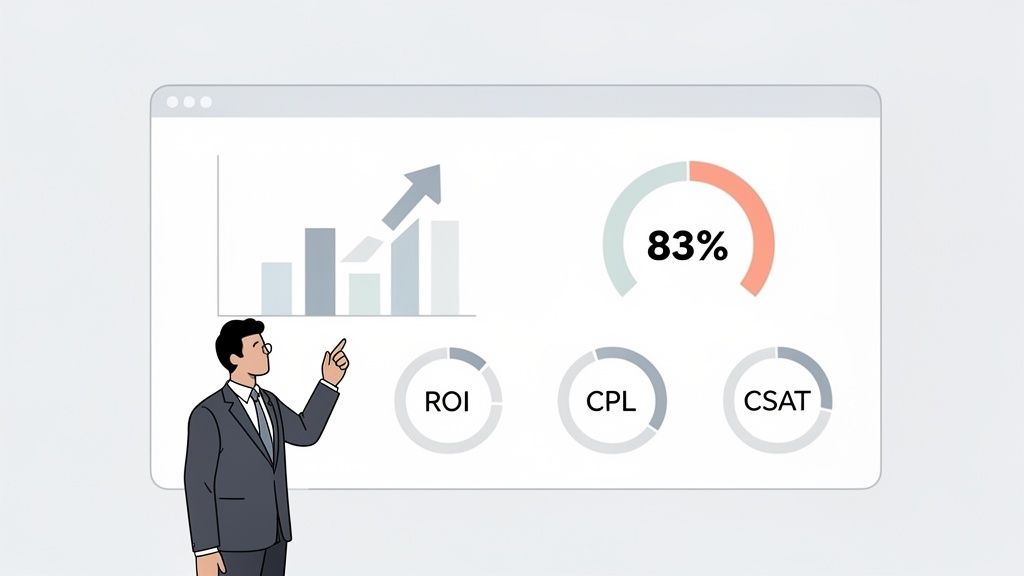
Tying these metrics together creates a powerful story. For instance, a community bank recently used an AI-driven marketing campaign to get smarter with its ad spend. This wasn't just a technical exercise; the team measured its impact on one core metric: the cost-per-lead (CPL) for new deposit accounts. The result was a staggering 83% reduction in CPL. That’s a number the CFO can immediately understand and value. It shows how a well-measured initiative in AI-powered lead generation can produce undeniable financial returns. This direct link between an AI tool and a core financial outcome is the gold standard for proving ROI.
Avoiding Common AI Enablement Pitfalls
Even the most well-funded AI programs can fizzle out. Why? Because the path to success is littered with common, yet completely avoidable, mistakes. Knowing where the landmines are is the first step to sidestepping them and steering your initiative toward real, sustainable business growth.
The first misstep is usually the most fundamental. Too many companies treat AI like just another IT project, handing it off to the tech team and hoping for the best. This is a guaranteed recipe for failure. It isolates AI from the business strategy and completely misses its potential to reshape how your core operations, marketing, and sales teams actually work.
Without genuine, cross-functional ownership, AI initiatives simply never get the traction they need to make a difference.
The Dangers of a Tech-First Approach
When AI lives exclusively in the IT department, it's measured by technical stats like processing speed or model accuracy, not business impact. This creates a massive disconnect—you end up with "solutions" desperately looking for a problem to solve. The result? Expensive, powerful tools that nobody uses because they don't fix a real-world pain point for your team.
A successful program needs a business-led steering committee from day one.
An AI initiative that can’t be explained in terms of P&L impact is an expensive hobby, not a strategic investment. The program must be owned by the leaders who own the business outcomes.
The Bottom Line on Pitfalls
- Treat AI as Business Transformation: Frame every initiative around a specific business problem, not a shiny new technological capability.
- Don't Shoot for the Moon (Yet): Start with small, focused pilots that deliver a clear ROI. These quick wins build confidence and momentum for bigger projects down the road.
- Get Your Data House in Order: Clean, accessible, and well-governed data is the fuel for any AI project. Neglecting this foundation is like trying to build a skyscraper on sand. It will fail.
- Constantly Communicate the 'Why': People need to understand how AI helps them and the business. A clear story is your best tool for overcoming resistance and getting people on board.
Common Failure Points and How to Fix Them
Navigating your AI journey means being brutally honest about what's working and what isn't. When you spot these common traps, you have to correct course—fast. Each one is a critical failure point that can derail even the most promising C-Suite AI enablement program.
Practical Examples
The "Moonshot Project" Problem: A mid-market manufacturer tries to build a fully autonomous factory floor as its very first AI project. The sheer complexity and cost cause it to collapse within a year, poisoning the well for any future AI discussions.
- The Fix: Pilot First, Then Scale: They should have started with an AI-powered predictive maintenance tool for a single, critical machine. This small, measurable win would have proven the ROI and built the internal support needed for more ambitious goals.
The "Data Neglect" Problem: A B2B services firm invests in a sophisticated AI lead-scoring model but feeds it incomplete and messy data from their CRM. The model spits out unreliable recommendations, and the sales team quickly dismisses it as useless.
- The Fix: Govern Your Data: Before anything else, the firm should have launched a data-cleansing and governance project. This means ensuring all customer data meets strict quality standards before you even think about building an AI model on top of it. This foundational work is completely non-negotiable.
Your Questions Answered: Making Sense of AI Enablement
When leaders start exploring C-Suite AI Enablement, the questions are usually practical. How much will this cost? When do we see a return? And where on earth do we even begin?
Let's cut through the noise and get straight to the answers you need to build a solid business case for moving forward.
Key Takeaways
- Investment is tied to value. The cost of an AI program isn’t a mystery box. It’s directly linked to the scope and the specific business outcomes you’re aiming for.
- Results don’t take years. A smartly chosen pilot project can deliver measurable ROI in as little as 90-120 days. This is about getting quick wins to build momentum.
- Start with the pain. Don't start with the tech. The best place to kick things off is a specific, nagging problem that’s already hitting your P&L.
How Much Should We Budget for an Enablement Program?
There’s no magic number here. The investment depends entirely on where your company is today and where you want to go. A program could be a focused immersion series for your leadership team, or it could be a multi-year partnership designed for a complete operational overhaul.
The right way to think about it isn't as a cost, but as an investment. Frame it against the financial results you expect, like a targeted drop in customer acquisition cost or a measurable jump in sales team efficiency.
What’s a Realistic Timeline for Seeing ROI?
You don't need to wait a year or more to know if this is working. A well-designed program will always prioritize a high-impact, low-risk pilot project right out of the gate.
The whole point of an initial pilot is to score a clear, undeniable win that gets everyone excited. A successful pilot can show you real ROI—like a quantifiable drop in your cost-per-lead or a faster sales cycle—in a single business quarter.
Where Should a Middle-Market Company Start?
The best starting point is a real-world business problem, not some vague desire to "do AI." Find a significant bottleneck in your operations or a key P&L metric that you're determined to improve.
Practical Example
Instead of a broad goal like, “We need to implement AI in sales,” get specific. A much better starting point is, “Our sales team is burning too much time on manual lead research, which is killing our outreach volume.” This specific pain point leads directly to a focused pilot—like deploying an AI tool that automates prospect research and enriches your CRM data. The impact is direct, clear, and easy to measure in team productivity.
Ready to build an actionable AI roadmap that delivers real business results? Prometheus Agency partners with B2B growth leaders to turn technology into a scalable revenue system. Start with a complimentary Growth Audit and AI strategy session to identify your highest-impact opportunities. Learn more and book your session at https://prometheusagency.co.