An effective artificial intelligence business strategy isn't just a tech project—it's a core driver of your business. It connects specific AI initiatives to measurable goals like revenue growth, operational efficiency, and a stronger competitive edge. The whole point is making sure the technology serves the bottom line.
Key Takeaways
- An AI strategy must be directly linked to business goals like revenue and efficiency.
- The focus should shift from experimental AI to a unified plan that delivers measurable results.
- Successful implementation requires aligning technology, data, and people.
Moving Beyond AI Hype to Practical Strategy
The conversation around AI is no longer about if, but how. Forget chasing the latest shiny trend. It's time to build a real artificial intelligence business strategy that delivers tangible results. That means shifting from scattered experiments to a unified plan that guides how you invest, who you hire, and how you operate.
To get past the hype, you have to start with a clear understanding what AI in business truly entails. This foundational knowledge is what lets you align the tech with your actual business goals. The most successful companies aren't just measuring tech adoption; they're measuring success in dollars and efficiency gains.
The Accelerating Pace of Adoption
Artificial intelligence has quickly become a cornerstone of business strategy everywhere. Adoption rates are soaring. In fact, the AI Index Report from Stanford HAI found that 78% of organizations now use AI—a huge leap from just 55% the previous year. This surge shows a major strategic shift as companies recognize AI's power to drive real innovation and efficiency.
This journey from initial excitement to strategic implementation is where the real work happens.
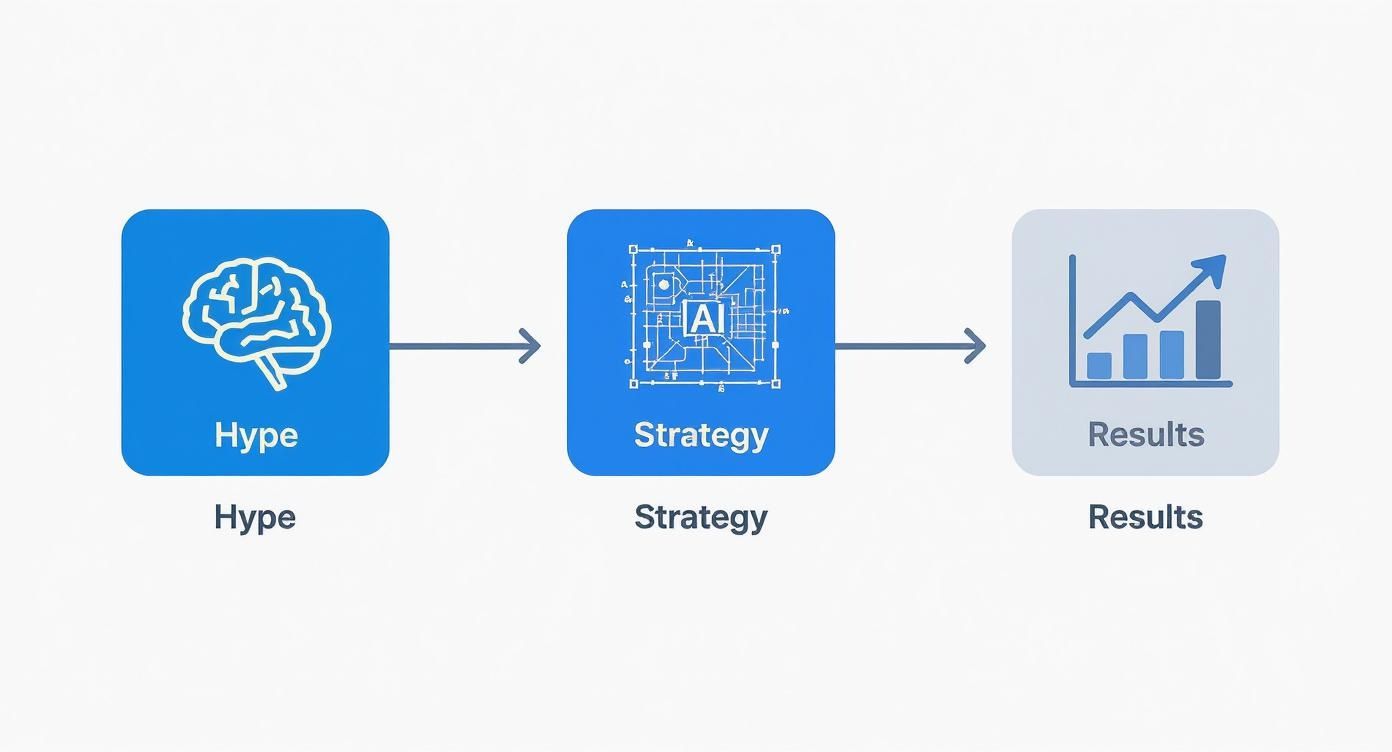
The key insight here is that a formal strategy is the bridge between the buzz and the business results. Without it, you’re just experimenting.
Core Pillars of a Modern AI Strategy
A durable strategy is all about integration and impact, not just standalone tools. It's about solving the real-world headaches your teams face every day. Any successful approach has to include these pillars:
- Business Alignment: Every AI project needs to be tied directly to a specific business problem. Are you trying to reduce customer churn? Accelerate the sales cycle? Be specific.
- Data Readiness: Let's be blunt: your AI is only as good as your data. A huge part of your strategy involves assessing—and improving—your data quality, accessibility, and governance.
- Organizational Enablement: This isn’t just about technology; it’s about people. Success demands a cultural shift. That means upskilling your teams and building a data-first mindset. A good starting point is to evaluate your team's AI Quotient.
Key Takeaway
A real AI strategy isn't a separate tech initiative; it's woven into your overall business plan. It focuses on solving high-value problems and gives your teams better tools and insights right where they work. The goal is to make AI feel invisible yet indispensable.
Identifying High-Impact AI Opportunities
Before you spend a single dollar or dedicate one hour to development, your AI strategy needs a crystal-clear target. Just “doing AI” is a fantastic way to waste resources. The real win comes from mapping AI capabilities directly to your most pressing business problems, making sure every move is designed for maximum impact.
This all starts with an honest look at your company's AI readiness. It’s not just about the tech—it’s a complete review of your data, your people, and your culture. Are your datasets clean, accessible, and actually useful? Do you have the talent in-house to run a project, or will you need to find a partner? And maybe most importantly, is your company culture ready to truly embrace data-driven change?
If you skip this foundational assessment, even the most brilliant AI project can fizzle out before it even gets off the ground.
From Business Problems To AI Solutions
The most effective way to find high-impact opportunities is to work backward from your biggest headaches. Don't ask, "What cool things can we do with AI?" Instead, ask, "Where are our biggest operational bottlenecks, revenue leaks, or points of customer friction?" This simple shift reframes the entire conversation around creating real value.
Think about the core functions of your business and where the inefficiencies are hiding.
- Practical Example (Marketing and Sales): Your reps are wasting time chasing unqualified leads. An AI-powered lead scoring model can predict which prospects are most likely to buy, focusing effort where it counts.
- Practical Example (Operations): Your supply chain is plagued by delays. AI-driven demand forecasting can anticipate inventory needs, reducing stockouts and overstocking.
- Practical Example (Customer Service): Support agents are bogged down by repetitive questions. An AI chatbot can handle Tier 1 inquiries, freeing up humans for complex issues.
Every one of these pain points is a potential goldmine for a high-impact AI project.
Key Takeaway
The best AI opportunities aren't discovered by chasing the latest tech trends. They’re found by digging into the biggest sources of friction or missed revenue in your business and applying AI as a laser-focused solution.
Practical Examples Of High-Impact AI
Let's get out of the clouds and into the real world. A strong AI strategy is built on practical applications that deliver results you can actually measure.
Practical Example 1: Customer Service Automation
A mid-sized SaaS company noticed its support team was spending over 60% of its time answering the same ten questions. They rolled out an AI-powered chatbot that was plugged directly into their knowledge base.
- Impact Opportunity: Within three months, the chatbot was successfully resolving 40% of all incoming support tickets on its own. This freed up human agents to tackle the complex, high-value customer issues, which cut resolution times for difficult problems by 30% and gave customer satisfaction a healthy boost.

Practical Example 2: Sales Process Acceleration
A B2B manufacturing firm was struggling with a painfully long sales cycle. Their reps just couldn't tell which leads were hot and which were not. So, they implemented a predictive lead scoring model right inside their CRM. The AI chewed through historical data—things like company size, industry, and website activity—to score new leads in real time. For more on this, check out our guide on AI-powered lead generation strategies.
- Impact Opportunity: Reps could now focus their energy on the top 10% of leads, which led to a 22% increase in meetings booked with qualified prospects. Even better, the sales cycle for these high-priority leads shrank by an average of 15 days.
Building a Prioritized Portfolio
Once you've brainstormed a list of potential use cases, you have to prioritize. A simple but incredibly effective way to do this is with a prioritization matrix. You're basically weighing the potential business impact of each idea against how feasible it is to implement. Feasibility isn't just about tech; it includes data availability, complexity, and of course, the investment required.
AI Opportunity Prioritization Matrix
Use this framework to evaluate potential AI projects based on their business impact and the feasibility of implementation.
| AI Opportunity Area | Potential Business Impact (High/Med/Low) | Implementation Feasibility (High/Med/Low) | Example Use Case | Key Takeaway |
|---|---|---|---|---|
| Predictive Lead Scoring | High | High | Score inbound leads in the CRM to focus sales efforts on high-probability prospects. | A classic "quick win" that delivers measurable ROI by improving sales efficiency. |
| Chatbot for Tier-1 Support | Medium | High | Automate answers to common customer questions via a website chatbot. | Frees up human agents for complex issues, improving both efficiency and customer satisfaction. |
| Dynamic Pricing Engine | High | Low | Use real-time market data and competitor pricing to adjust product prices automatically. | High potential for revenue lift, but technically complex and requires significant data infrastructure. |
| Content Personalization | Medium | Medium | Tailor website content and email campaigns based on user behavior and past purchases. | Increases engagement and conversion rates, but requires clean data and marketing automation integration. |
Your goal is to build a balanced portfolio of AI projects. Start with the "quick wins"—those high-impact, high-feasibility projects. Nailing these early successes is critical. It builds momentum, proves the value of AI to skeptical stakeholders, and helps you secure the buy-in needed for the bigger, more ambitious initiatives that will truly define your company's future.
Embedding AI Into Daily Workflows
The best AI strategy is the one your team doesn't even notice. When artificial intelligence simply becomes part of the daily rhythm, adoption skyrockets, and you start seeing genuine productivity gains. The goal isn't to force your people to learn a dozen new apps; it's to weave intelligence directly into the tools they already live in, like their CRM or ERP.
This approach is all about reducing friction. Instead of making your team toggle between different platforms, you deliver AI-powered insights right where they’re already working. That subtle shift is the difference between AI feeling like a chore and AI becoming an indispensable assistant.

This move toward seamless integration is already defining how modern businesses work. We're seeing a clear preference for embedding AI into existing workflows rather than bolting on separate applications. In fact, data shows that 82% of professionals now use AI tools directly in their inbox every day, with 69% using them in messaging platforms and 67% in smart calendars. As you can learn more about AI adoption trends, it’s clear the strategic momentum is toward making AI a quiet but powerful partner inside familiar tools.
Prioritizing Integration Over Standalone Tools
Think about a typical day for one of your sales reps. Their entire world revolves around the CRM—it’s where they manage their pipeline, log calls, and track deals. Now, imagine you introduce a separate, standalone AI tool for lead scoring.
To use it, the rep has to export a list from the CRM, upload it to the new tool, wait for the analysis, and then manually bring those insights back into the CRM to decide who to call next. It’s a clunky, multi-step process that adds work instead of removing it. It breaks their flow and quickly becomes an obstacle.
Now, contrast that with an embedded approach that integrates the same AI model directly into the CRM.
- Practical Example: A lead scoring model runs silently in the background of your CRM. When a new lead comes in, the AI automatically analyzes it against historical data and assigns a score—"Hot," "Warm," or "Cold"—that appears right next to the contact's name. The rep doesn't have to do anything extra; the insight is just there, guiding their next action.
This is the heart of a successful AI integration strategy. The AI should enhance the existing process, not replace it with a complicated new one.
Technical Paths to Seamless Integration
Making AI feel invisible requires a thoughtful technical approach. Your strategy for embedding AI into daily workflows will generally follow one of two paths.
1. using Native AI in Existing Platforms
Many of the major software platforms—think Salesforce, HubSpot, or Microsoft Dynamics—are rolling out powerful native AI features. This is often the path of least resistance.
- Impact Opportunity: These features are designed to work perfectly within the platform's ecosystem. For example, using a CRM's built-in AI for email sentiment analysis provides immediate value without any complex integration projects. The data is already there; the feature is just a switch-flip away.
2. Custom Integration via APIs
For more specialized needs, you might use a third-party AI model or even build your own. The key is connecting it to your core systems through an Application Programming Interface (API). Think of an API as a secure bridge that allows different software systems to talk to each other.
- Impact Opportunity: This route gives you maximum flexibility. Imagine a logistics company with a custom-built routing algorithm. Using an API, they can feed real-time job data from their ERP directly to the AI model and then push the optimized routes back into the dispatchers' dashboards automatically.
Key Takeaway
The goal is to make AI a natural extension of your team's existing habits. Success isn't measured by how many AI tools you have, but by how invisibly and effectively those tools boost productivity within the software your team already uses every single day.
Designing a Winning AI Pilot Program
Think of a pilot program as the bridge from a great idea to a proven success story. This is where your AI strategy meets the real world, turning a high-potential concept into something that actually generates value. Instead of going for a massive, high-risk launch, a pilot lets you test, learn, and prove ROI in a controlled, low-stakes environment.
This approach does two things really well: it minimizes risk and builds undeniable momentum. A successful pilot silences skeptics with cold, hard data, making it far easier to get the executive buy-in you need for a full-scale rollout. It’s your chance to show, not just tell, how AI can solve a real business problem.

Defining a Laser-Focused Scope
The single biggest mistake I see in pilot design is trying to boil the ocean. A winning pilot is ruthlessly focused on solving one specific, high-value problem. Vague goals like "improve efficiency" are doomed from the start because you can't measure them.
Your scope needs to be narrow and deep. Instead of "using AI for marketing," a much stronger pilot would be, "deploy a predictive model to score inbound leads in our CRM to lift the sales team's MQL-to-SQL conversion rate." That level of specificity is non-negotiable.
Key Takeaway
Define your pilot's success with a single, compelling metric that resonates with leadership. A goal like "reduce customer onboarding time by 25%" is far more powerful than a generic objective. This sharp focus makes it easy to declare victory and justify further investment.
To nail down your scope, get a cross-functional team in the room from day one. You need someone from the business unit that owns the problem, someone from IT or data who can handle the tech, and the end-users who will actually use the tool. This collaboration ensures the pilot is technically feasible and solves the real business need, not just a perceived one.
Setting Concrete KPIs and a 90-Day Timeline
With a tight scope, you can finally set Key Performance Indicators (KPIs) that directly measure the pilot's impact. These numbers are the foundation of your business case for scaling up.
Your KPIs should cover a few key areas:
- Business Outcome Metrics: This is the big one. Think reduction in lead response time, increase in customer satisfaction scores, or a decrease in operational costs.
- Adoption Metrics: Is anyone actually using it? Track things like daily active users or the percentage of tasks completed with the new AI tool.
- Model Performance Metrics: If it's a technical model, keep an eye on prediction accuracy or false positive rates.
A Sample 90-Day Pilot Timeline
A focused pilot can deliver results fast. Here’s a sample timeline to help you build that proof of ROI quickly.
| Phase | Timeline | Key Activities | Why It Matters |
|---|---|---|---|
| Foundation | Days 1-30 | Finalize scope, define KPIs, assemble the team, secure data access, and complete initial model training or tool configuration. | A solid foundation prevents delays. Clear goals and ready data are critical for a fast start. |
| Deployment & Feedback | Days 31-60 | Deploy the pilot to a small user group. Set up a tight feedback loop (like weekly check-ins) to gather insights and make quick adjustments. | Iterating based on real-world feedback is the fastest way to build something people will actually use and love. |
| Measurement & Reporting | Days 61-90 | Measure performance against your starting KPIs. Analyze the results, document the wins, and build the business case for a wider rollout. | This is where you build undeniable proof of ROI. Strong, data-backed results make the decision to scale an easy one for leadership. |
Driving Adoption with Change Management
The tech is only half the battle. If your team doesn't understand, trust, or feel comfortable with the new AI tool, it will fail—period. A simple change management plan makes sure your people are excited and prepared, not just trained.
Your plan should answer three critical questions for your team:
- What is changing? Be crystal clear about the specific process being updated.
- Why is it changing? Explain the business problem the pilot solves and how it helps the company.
- What's in it for me? This is the most important part. Show them how the AI will eliminate tedious work, deliver better insights, or help them hit their goals more easily.
By focusing on the human side of the rollout, you turn your team from passive users into active champions. That internal advocacy is invaluable when it's time to take your successful pilot company-wide.
Scaling AI with Strong Governance
Moving an AI strategy from a successful pilot to an enterprise-wide capability is a massive leap. It’s not just about getting a bigger budget; it requires a serious plan for scale and deliberate oversight. This is exactly where so many promising AI initiatives fall apart—they lack a clear framework for growth and governance.
Scaling AI properly means standardizing your tech and processes. You need a repeatable playbook so every new AI project doesn't have to start from scratch. This consistency stops siloed "AI islands" from popping up across the company and makes sure every initiative actually supports core business goals.
Building Your AI Center of Excellence
A critical piece of any scalable strategy is establishing an AI Center of Excellence (CoE). Don't think of this as a rigid gatekeeper. Instead, picture it as a central hub for expertise and support. The CoE is there to set best practices, vet new tools, and offer guidance to business units looking to kick off their own AI projects.
This centralized team makes sure knowledge is shared, not hoarded. When one team has a breakthrough, the CoE helps document those learnings and spread them across the entire company. As AI becomes more embedded in your operations, you need leaders who can manage this new market—you can explore our insights on how AI-enabled leaders are growing differently.
Key Takeaway
Scaling AI isn't just a technical challenge; it's an organizational one. A Center of Excellence acts as a force multiplier, ensuring that standards, knowledge, and strategic alignment are maintained as AI initiatives spread throughout the business. This prevents chaos and maximizes the collective impact of your investments.
The CoE’s job is to enable, not control. They provide the guardrails that let teams experiment safely and effectively. This structure builds confidence and speeds up adoption, turning isolated wins into a true enterprise capability.
The Foundation of Trust: AI Governance and Ethics
As AI’s influence grows, so does the responsibility to manage it ethically. Strong governance isn’t just about dodging legal trouble; it’s the bedrock for building lasting trust with your customers and enabling your teams. A well-defined ethics framework is non-negotiable for any mature AI strategy.
This framework needs to tackle the tough issues head-on. Key areas of focus include:
- Data Privacy: Making sure customer and company data is handled securely and only used for its intended purpose.
- Model Transparency: Keeping the ability to explain how AI models reach their conclusions, especially for high-stakes decisions.
- Bias Mitigation: Actively monitoring and correcting for biases in data and algorithms that could lead to unfair outcomes.
Organizations that nail this see real benefits. In fact, companies with mature AI governance report a 28% increase in staff using AI solutions and are far more likely to deploy AI across multiple business areas. The trend is clear: 77% of companies now see AI compliance as a top priority, showing the shift from simple adoption to responsible operationalization.
Implementing a Responsible AI Committee
To put these principles into practice, you need to form a cross-functional Responsible AI Committee. This group should be tasked with overseeing AI-related risks and ensuring compliance with both internal policies and external regulations.
- Practical Example: A financial services firm creates a committee with members from legal, data science, and business operations. Before launching a new AI-powered loan approval model, the committee reviews it for potential demographic bias and ensures its decision-making logic is explainable to meet regulatory standards.
- Impact Opportunity: A proactive governance committee transforms risk management from a reactive checklist into a strategic advantage. By building a reputation for responsible AI use, you strengthen your brand, deepen customer trust, and attract top talent who want to work for an ethical organization. This isn't a cost center; it's an investment in your company's long-term credibility and success.
Your AI Strategy Questions, Answered
Even the most buttoned-up AI strategy will spark questions. That’s a good thing. It means people are engaged. Navigating those conversations is part of the process, and this section is designed to give you clear, straightforward answers to the questions leaders ask most often.
How Do We Actually Calculate the ROI of an AI Project?
This is the big one. To get buy-in, you have to frame the Return on Investment for any AI initiative in a way that goes beyond just saving a few bucks. I always recommend breaking it down into three distinct value buckets.
First, you have cost reduction. This is the easiest to measure and explain. Think about automating tedious, repetitive tasks or using AI to optimize a complex supply chain and slash waste. A simple way to quantify this is to calculate the employee hours saved on a specific task, then multiply that by your average loaded cost per employee. It’s tangible and hard to argue with.
Next up is revenue growth. AI can directly boost your top line, whether it’s by using predictive models to score leads more accurately (improving conversion rates) or deploying hyper-personalization to increase customer lifetime value. You can also drive more upsells and cross-sells with smarter recommendation engines. The key here is to measure the lift against a control group that isn't using the AI tool.
Key Takeaway
A rock-solid AI ROI calculation blends the hard numbers from cost reduction and revenue growth with the strategic value of risk mitigation. This trifecta gives stakeholders the full picture—both immediate financial gains and long-term business resilience.
Finally, and this is the one people often forget, is risk mitigation. Don’t overlook this—it can be incredibly valuable. An enhanced fraud detection system can prevent millions in financial losses. Better compliance monitoring can help you sidestep crippling regulatory fines. Putting a number on the potential cost of a risk that you avoided is a powerful part of any ROI discussion.
What Are the Biggest Mistakes to Avoid in an AI Strategy?
The single biggest mistake I see is when leaders treat AI as a pure technology project instead of a core business initiative. It’s a classic error. You end up with a technically impressive model that solves absolutely no real-world business problems. It's a fantastic way to waste a lot of money and time.
Another massive pitfall is ignoring data hygiene. AI models are only as good as the data they eat. The old "garbage in, garbage out" mantra has never been more relevant. If you don't invest in clean, accessible, and relevant data from the start, you’re setting yourself up for inaccurate, unreliable, and ultimately useless results.
- Impact Opportunity: Side-stepping these common mistakes puts you on the fast track to creating real value. When you start with a business problem, obsess over data quality, and manage the human side of the equation, you build a foundation for AI initiatives that deliver real results and get people excited to use them.
Lastly, way too many leaders underestimate change management. You can’t just drop a new tool on your team and expect them to use it. If you don't get employee buy-in, provide solid training, and clearly communicate "what's in it for them," the project is almost guaranteed to fail. People naturally resist what they don’t understand or see value in.
One final piece of advice: don't try to boil the ocean. Start with a tightly focused pilot program aimed at a single, high-value problem. This lets you prove the concept, build momentum, and get your stakeholders on board before you try to scale your AI strategy across the entire organization.
What Roles Are Essential for a Successful AI Team?
Building a high-impact AI team isn't just about hiring a bunch of coders. It's about assembling a cross-functional group that blends deep business sense with serious technical chops. Each role is a critical piece of the puzzle.
You absolutely must have a Business Strategist or Product Manager. This person is the translator—the bridge between the business stakeholders and the tech team. They live and breathe the commercial problem you’re trying to solve and are responsible for defining what success looks like in business terms.
The technical core of the team includes:
- Data Scientists: These are your model builders. They design, construct, and test the machine learning models that do the heavy lifting.
- ML Engineers: They’re the ones who take a data scientist's model and make it enterprise-ready, ensuring it can run reliably and at scale in the real world.
- Data Engineers: These are the unsung heroes. They build and maintain the data pipelines that feed the entire system. Without them, nothing works. Period.
In today's environment, an AI Ethicist or Governance Lead is becoming essential. This role helps you navigate the thorny issues of fairness, transparency, and regulation, ensuring your AI is used responsibly. And never, ever forget a Change Management Lead—this is your secret weapon for driving user adoption and making sure the solution actually gets used. On smaller teams, people might wear multiple hats, but all of these functions have to be covered.
As you work through your own strategic planning, it can also be helpful to explore these 10 crucial questions for artificial intelligence to get you thinking more deeply about capabilities and applications.