You're sitting in an executive meeting where everyone agrees AI matters, but nobody can answer the questions that determine whether it deserves investment. Which workflow comes first? What data can the system access? Who approves the output? What would make the pilot worth scaling, and who has the authority to stop it?
That's the core problem with AI training for executives. Leaders don't need another tour of chatbot features. They need the judgment to prioritize use cases, challenge vendor claims, set guardrails, and turn experimentation into accountable operating practice. The market is already moving in that direction. A 2025 survey found that 62% of corporate leaders had attended AI training, up from 42% in 2024, yet fewer than half, 47%, said their companies offered leadership-specific AI training. The same survey reported that 31% of firms provided only occasional AI training or none at all (BusinessWire's survey coverage).
Why Most Executive AI Training Programs Fail
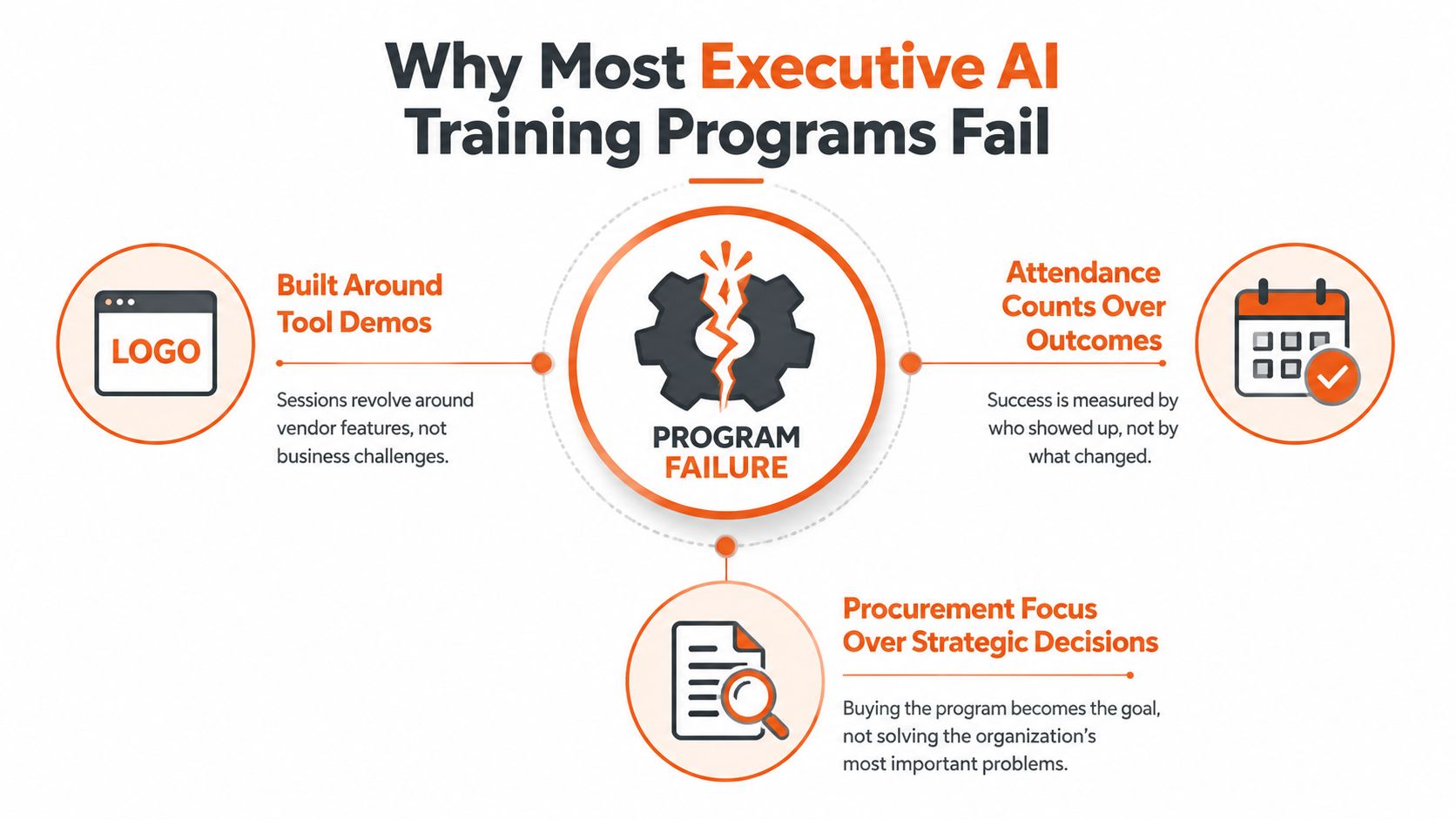
The most common failure is simple: executive programs focus on tools instead of decisions. Leaders watch vendor demos, complete “AI literacy” modules, and leave with a longer list of platforms but no sharper view of what the business should fund, reject, or govern.
That design problem has predictable causes. Procurement often defaults to generic awareness content. L&D teams borrow technical curricula built for engineers. Chief of staff teams mistake exposure for capability because attendance is easy to report. The result is a polished learning experience that never changes how the executive committee allocates capital or challenges risk.
The Boardroom Cost of Tool-First Training
A confident executive may approve a pilot without defining a baseline, success threshold, data boundary, or owner. The team then produces an impressive demonstration that doesn't survive contact with the workflow. When the expected value fails to appear, the organization reduces future investment and the board becomes more skeptical of the next proposal.
The evidence points to a capability gap, not a lack of interest. McKinsey reported that 48% of workers identified formal generative-AI training from their organization as the most valuable support for using gen AI at work, ahead of workflow integration at 45% and tool access at 41% (McKinsey findings summarized by Wire19). Another McKinsey workplace finding reported that 92% of companies planned to increase AI investments over the next three years, while only 1% of leaders considered their organizations mature in AI deployment, as covered in the same source.
Practical rule: If training doesn't improve a real investment, governance, or prioritization decision, it isn't executive enablement. It's product orientation.
A decision-first model starts with an AI-readiness assessment that identifies operating friction, data constraints, decision rights, and priority workflows. A practical AI readiness assessment gives the sponsor a baseline before anyone selects a course or vendor. Leaders who also need to connect development spending to leadership performance can use an executive coaching ROI for senior leaders resource as a useful reference point.
The structural fix is clear: define objectives, build a role-specific curriculum, choose a delivery format that fits the cohort, align stakeholders, measure behavior, and roll out training alongside live pilots.
Setting Executive Learning Objectives That Stick
Learning objectives should function as a contract between the executive sponsor and the program team. They specify which business result matters, which decision must improve, and what evidence will prove that leaders changed how they operate.
Start with the business outcome, not the lesson plan. A CEO might want AI-enabled revenue offers, a COO might want cost removed from a named process, and a board might want lower exposure in a flagged model use case. Each outcome requires different executive behavior.
Work backward from the decision
Use three objective categories:
- Strategic objectives: The CEO can explain where AI strengthens the company's advantage, which assumptions support that view, and which investments should wait.
- Operational objectives: Functional leaders can evaluate a workflow, approve a contained pilot, set a baseline, and stop the initiative when evidence fails.
- Governance objectives: Directors and executives can challenge data provenance, oversight, bias exposure, vendor controls, and escalation responsibilities before deployment.
Weak objectives describe familiarity. “Executives will understand AI” is too broad to guide a decision. “Leaders will learn prompt engineering” may be useful for personal fluency, but it doesn't establish whether the company should buy a system, redesign a process, or prohibit a use case.
Strong objectives describe observable action. “The CEO will sponsor two qualified pilots with measurable ROI within two quarters” gives the team something to design around. “The board will challenge a proposed deployment using a documented data, risk, and oversight checklist” is equally concrete.
| Category | Weak Objective | Strong Objective |
|---|---|---|
| Strategic | Understand how AI affects the industry | Articulate where AI can compound competitive advantage and identify the investment thesis |
| Operational | Learn how to evaluate AI tools | Score a live workflow, select a contained pilot, and approve evidence-based go or no-go criteria |
| Governance | Become familiar with responsible AI | Challenge data access, model risk, regulatory exposure, approval rights, and escalation paths before deployment |
Give the objective an owner
Assign one named sponsor, not a committee. The sponsor should approve the objectives, attend the review cadence, and resolve conflicts between speed and control. Set a recurring executive review where leaders examine pilot evidence against the original objectives.
Refuse to ship training without this agreement. Attendance can create the appearance of progress while leaving the actual decision unchanged. The sponsor should be able to answer, in plain language, what leaders will do differently after the program and which business result that behavior supports.
Building an Executive AI Curriculum
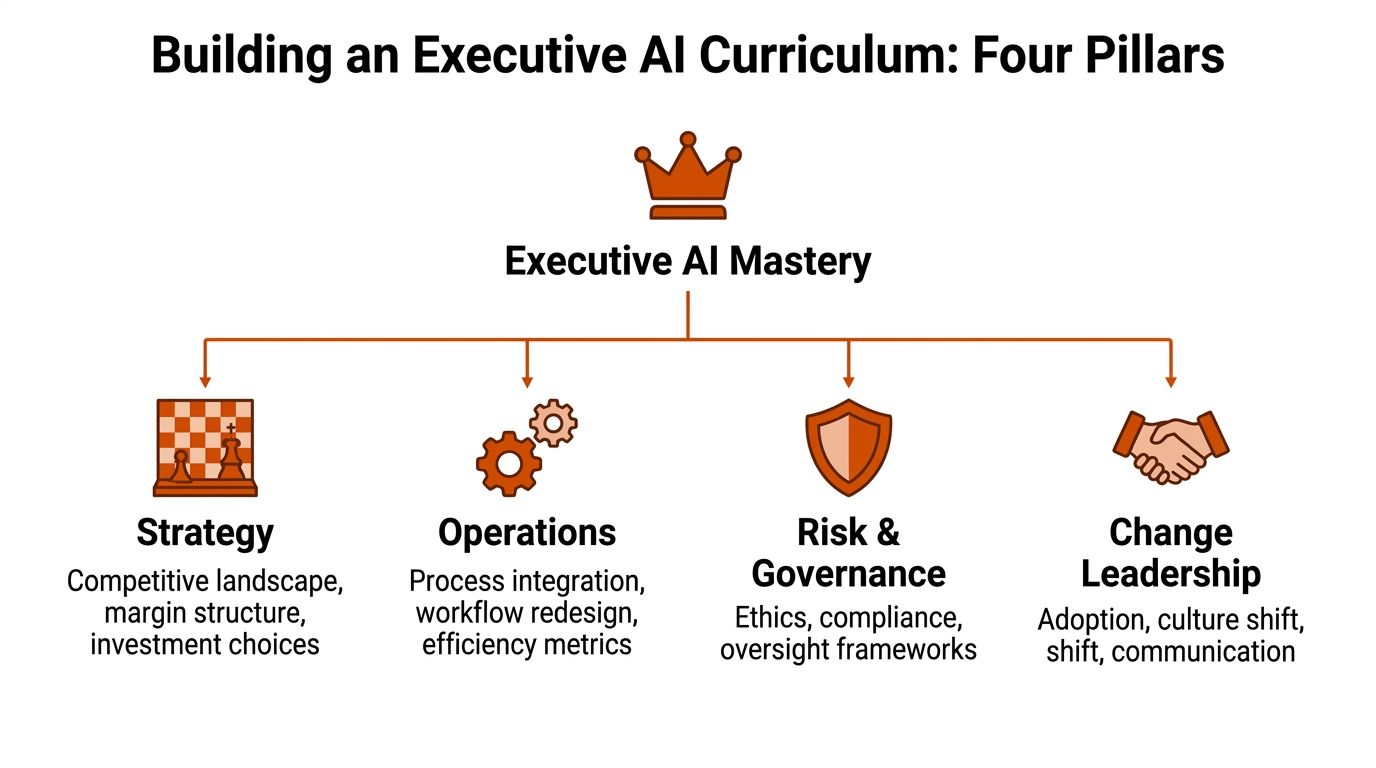
An executive curriculum should teach leaders to make four decisions: where to compete, what to change, what to control, and how to prove value. Technical depth has a place, but model architecture shouldn't displace judgment about capital, accountability, and workflow design.
Strategy
Executives need a working view of the competitive environment, margin structure, and investment choices. A useful module asks leaders to pressure-test an AI thesis: Which customer problem changes? Which cost or revenue mechanism creates value? What capability must the organization own rather than rent?
Cut broad technology surveys that name every emerging platform. Keep competitive scenario work, investment trade-offs, and decision simulations tied to the company's actual market.
Use cases
Use cases deserve portfolio discipline. Classify opportunities as core, adjacent, or radical, then fund them in that order unless a strategic reason justifies a different sequence. Core opportunities improve an existing workflow. Adjacent opportunities extend a known capability into a nearby process or customer need. Radical opportunities alter how the business creates or captures value.
Executives should map friction before selecting software. Ask where work stalls, where handoffs create delay, where employees repeat judgment-heavy tasks, and where better information could improve decisions. Cut generic tool demonstrations that don't connect to a named workflow, owner, baseline, and decision threshold.
Risk and governance
This pillar covers data lineage, model risk, regulatory exposure, privacy, bias, and incident escalation. Leaders should understand how the EU AI Act, sector regulators, contractual obligations, and internal policies affect a proposed use case. They also need a clear path for reporting an incident and deciding whether to pause, remediate, or retire a system.
Don't reduce governance to a checklist that nobody owns. Define data boundaries, approval rights, retention rules, monitoring responsibilities, and escalation paths before a pilot expands.
Metrics and ROI
Executives need metrics that distinguish adoption from activity. Use time-to-decision, pilot conversion, revenue attribution, cost attribution, error reduction, and workflow completion quality. Avoid logins, course completion, and satisfaction scores as primary evidence.
Sequence metrics and strategy before use cases. That order prevents vendor pitches from defining the opportunity. HR and enablement teams can pair this work with an organizational learning guide for HR to connect leadership development with broader workforce capability. A focused executive AI coaching and literacy framework can also help translate the pillars into role-specific practice.
Choosing Delivery Formats That Fit the Cohort
Format is a retention-versus-revenue decision, not a matter of vendor taste. The right choice depends on executive seniority, the behavior you need to change, the availability of a live workflow, and the amount of coaching the sponsor can support.
A half-day immersion works when leaders need shared language and direct experience with real company documents. It creates energy quickly, but the learning can fade if no decision follows. One-on-one coaching changes individual behavior more profoundly, especially for CEOs, board members, and functional leaders with distinct responsibilities. It also demands more time and budget.
Live pilots tied to a real P&L line item usually start slowly because the team must establish data access, ownership, baselines, and governance. They produce the strongest evidence because the executive learns while making an actual business decision. Peer cohorts, ideally composed of 6 to 10 executives from non-competing firms, work well for sharing governance playbooks and challenging assumptions without exposing competitive information.
The cost bands below are qualitative by design. Pricing varies by provider, preparation, data access, coaching intensity, and pilot scope.
| Format | Cost per Executive | Retention at 90 Days | Behavior Change | Best Use |
|---|---|---|---|---|
| Immersive half-day workshop | Low to moderate | Low unless paired with action | Shared vocabulary and initial judgment | Aligning a leadership team before a pilot |
| One-on-one executive coaching | High | High with sponsor follow-through | Personal decision habits and visible AI use | CEO, director, or functional-leader behavior change |
| Live pilot tied to a P&L line item | Moderate to high | High because work continues after training | Workflow redesign, prioritization, and accountability | Proving value in a contained business process |
| Peer cohort | Moderate | Moderate to high with recurring sessions | Governance practices and cross-company challenge | Building shared playbooks among non-competing leaders |
The format can't compensate for an absent decision. Design around the work executives must do, then choose the learning mechanism.
Skip a workshop if the team already agrees on the use case and needs execution support. Skip coaching if the issue is cross-functional governance. Skip a peer cohort if confidentiality prevents honest discussion. If the cohort can't name a live decision it will make within 90 days, no format will save the program.
Aligning the Board, the C-Suite, and the Frontline
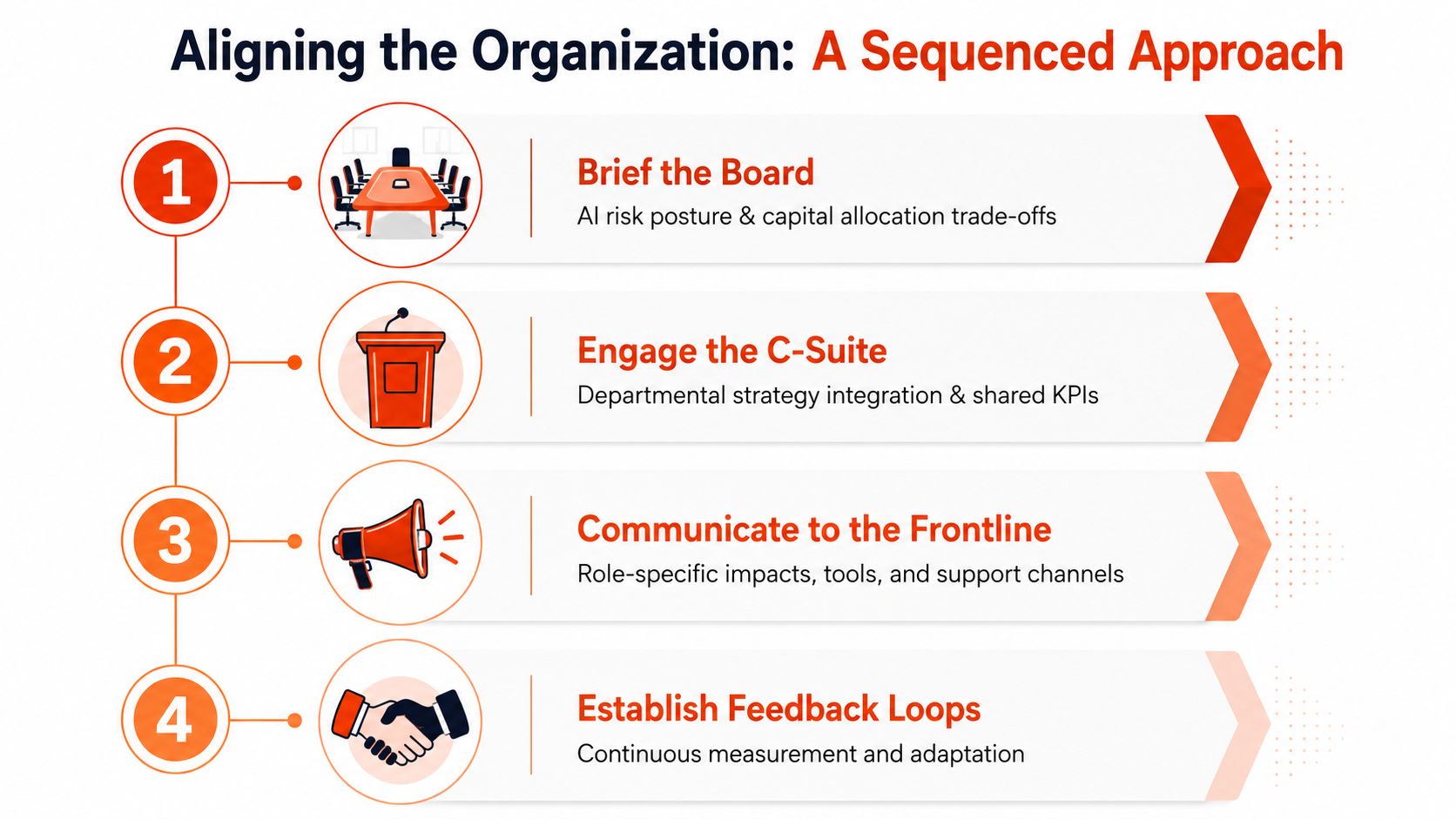
Alignment should happen in sequence. A single kickoff meeting often produces agreement without ownership, and each layer then interprets AI differently.
Start with the board
Before announcing training, give directors a one-page memo covering AI risk posture, capital allocation trade-offs, priority use cases, and unresolved questions. The artifact that moves the board is a risk appetite statement. Without it, directors may either overreact to isolated incidents or approve expansion without understanding the control environment.
The failure mode here is governance by surprise. The board hears about AI only after a vendor is selected or a risk event occurs. A short, decision-oriented memo gives directors a basis for challenging assumptions early.
Put the CEO on record
The CEO should publicly sponsor the program, name the first use case, and reserve a quarterly review slot. If the CEO delegates all visible ownership to IT, other executives will treat the program as a technology initiative rather than a business priority.
The CEO's artifact is a named-use-case charter. It states the problem, sponsor, baseline, guardrails, success criteria, and next decision date.
Give functional leaders one operating language
Bring the CFO, CIO, CHRO, COO, legal lead, and relevant business owners through a shared governance session. They should leave with a common vocabulary and a RACI for decisions about data, procurement, deployment, monitoring, and escalation.
Their failure mode is functional fragmentation. Finance measures value, IT manages access, HR worries about workforce impact, and operations owns the workflow, but nobody owns the complete decision. The RACI makes the handoffs explicit.
Translate executive choices for managers
Frontline teams don't need the same strategy briefing as the board. They need to know what changes in their roles, which tools are approved, what work remains human-owned, and where to raise concerns.
Give managers a manager FAQ with role-specific examples, approved workflows, escalation contacts, and expectations for feedback. The frontline failure mode is silent resistance. Employees often stop using a new process when leaders haven't explained why it exists or how performance will be judged.
Measuring Adoption Beyond Attendance
Attendance records participation. It does not show whether an executive makes a better decision afterward. In the same enterprise survey, 21% of companies used formal assessments to evaluate AI effectiveness, while 77% of enterprise leaders said AI skills were urgent and 63% viewed AI literacy as mandatory or a valuable workforce asset (enterprise survey findings). Treat those findings as a governance warning: demand for capability is ahead of measurement discipline.
Measure adoption across three layers:
- Knowledge retention: Use scenario-based assessments at 30 and 90 days. Ask an executive to review a vendor proposal, identify missing controls, and recommend a decision. Vocabulary quizzes do not test judgment.
- Decision quality: Track which AI-informed decisions reach the executive committee, what evidence leaders cite, and whether they apply the agreed prioritization and governance framework under challenge.
- Pipeline impact: Maintain a scored pilot register. Rate each initiative on revenue exposure, risk reduction, time-to-decision, workflow friction, ownership, and evidence quality.
Build the dashboard around decisions
A practical executive dashboard can include:
| KPI | What it reveals |
|---|---|
| Decisions influenced | Whether AI enters strategic and operating discussions |
| Pilots funded | Whether leaders convert evaluation into controlled action |
| Risk events avoided | Whether governance changes choices before harm occurs |
| Hours saved per executive per quarter | Whether personal workflows become more efficient |
| AI spend as a share of digital spend | Whether investment matches the approved portfolio |
Numbers need context. More funded pilots may show momentum, or weak screening. Faster decisions matter only when decision quality and risk controls remain acceptable.
The CEO should review this dashboard with pilot sponsors, not delegate it to the learning team. Ask which behavior changed, which decision improved, and what evidence justifies the next investment. Use the AI ROI measurement framework to connect learning evidence with business evidence.
Measurement standard: Score the executive's judgment under realistic conditions, then connect that judgment to a business decision.
Ownership determines whether the metrics lead to action. Business leaders should own outcomes, technical teams should support safe implementation, and HR or L&D should coordinate the learning system. If one group owns attendance while another owns pilot results, the program will optimize participation instead of adoption.
Behavior change takes time to surface. Treat anything shorter than a 90-day measurement window as directional noise. Review results at that point, then adjust sponsorship, pilot selection, or training based on observed decisions rather than completion records.
A Realistic 90-Day and 6-Month Rollout Plan
A Chief of Staff or enablement lead should be able to place this plan on the CEO's calendar immediately.
Weeks 1 to 2
Define the strategic, operational, and governance objectives. Name the executive sponsor, brief the board, and agree on the risk appetite statement. Collect a use case intake form from each participating function and create a vendor scorecard covering business fit, data handling, security, integration, explainability, support, and exit terms.
Owner: CEO sponsor with Chief of Staff.
Output: Signed objectives, board memo, risk appetite statement, use case intake form, and vendor scorecard.
Weeks 3 to 6
Run a diagnostic workshop using real workflows and executive documents. Map friction, identify decision bottlenecks, and select two pilot use cases against agreed criteria. Make each sponsor state the baseline, desired outcome, approval rights, data boundaries, and stop conditions.
Owner: Enablement lead with functional sponsors, CIO, legal, and risk.
Output: Decision memo and pilot scorecards.
Weeks 7 to 12
Launch the pilots with coached executive sponsors. Hold monthly executive office hours to resolve blockers, review evidence, and update the decision log. Give the board a quarterly AI update that covers portfolio status, risk posture, spend, and next decisions.
Owner: Pilot owners with the executive sponsor.
Output: Early evidence, governance decisions, and a documented go, pause, or stop recommendation.
Months 4 to 6
Layer in the deeper curriculum: strategy pressure-testing, workflow redesign, vendor interrogation, governance simulations, and metrics reviews. Add peer sessions where executives compare decision patterns and refine the governance playbook. Run a mid-program retrospective that asks what changed, what stalled, and which objective needs revision.
A six-month plan should also establish a repeatable operating rhythm:
- Monthly office hours: Resolve live barriers and review pilot evidence.
- Quarterly board updates: Revisit capital allocation, risk appetite, and portfolio decisions.
- Mid-program retrospective: Test whether training is changing behavior or merely producing activity.
- Renewal review: Continue funding only when the program has evidence of decision quality, workflow impact, and accountable ownership.
Monday-morning checklist
- Curriculum sign-off from the named executive sponsor
- Pilot selection criteria approved by business, technology, and risk owners
- KPI tree linking learning behavior to business outcomes
- Board, C-suite, manager, and frontline communication cadence
- Vendor scorecard completed before procurement approval
- Decision memo and pilot scorecard assigned to owners
- Renewal trigger tied to evidence, not attendance
Prometheus Agency helps executive teams connect AI enablement with workflow priorities, governance, CRM implementation, and go-to-market execution. If your leadership team needs to select pilots, define decision rights, and build an accountable adoption plan, visit Prometheus Agency to start a practical AI strategy conversation.