Only 13% of organizations were classified as fully ready to capture AI's potential in Cisco's 2024 AI Readiness Index, down from 14% the previous year, even as 98% of leaders said the urgency to deploy AI had increased and 85% believed they had less than 18 months to act. The message for B2B leaders is uncomfortable but useful: AI readiness isn't a question of whether your company has bought a model, connected a chatbot, or launched a pilot. It's whether the business can turn a valuable use case into a governed, measurable, repeatable operating capability.
A practical AI readiness assessment should expose that capability gap, assign it to accountable owners, and convert the lowest-scoring dimensions into a focused 90-day remediation sprint. The objective isn't a decorative maturity label. It's a decision tool that tells leadership what to fix, who owns the fix, what evidence proves progress, and which AI initiatives deserve funding.
Why Most AI Readiness Conversations Miss the Real Gap
Most readiness conversations begin in the wrong place. Executives ask which large language model to select, whether the company should use a hosted platform, or how many employees have access to generative AI. Those questions matter later. They don't establish whether the organization can safely integrate AI into revenue-generating workflows.
Cisco's 2024 benchmark makes the gap visible. Its double-blind survey covered 7,985 senior business leaders across 30 markets and evaluated readiness across 49 metrics spanning strategy, infrastructure, data, governance, talent, and culture. Only 13% of organizations were fully ready, while 98% reported increased urgency and 85% believed they had less than 18 months to act (Cisco's 2024 AI Readiness Index findings).
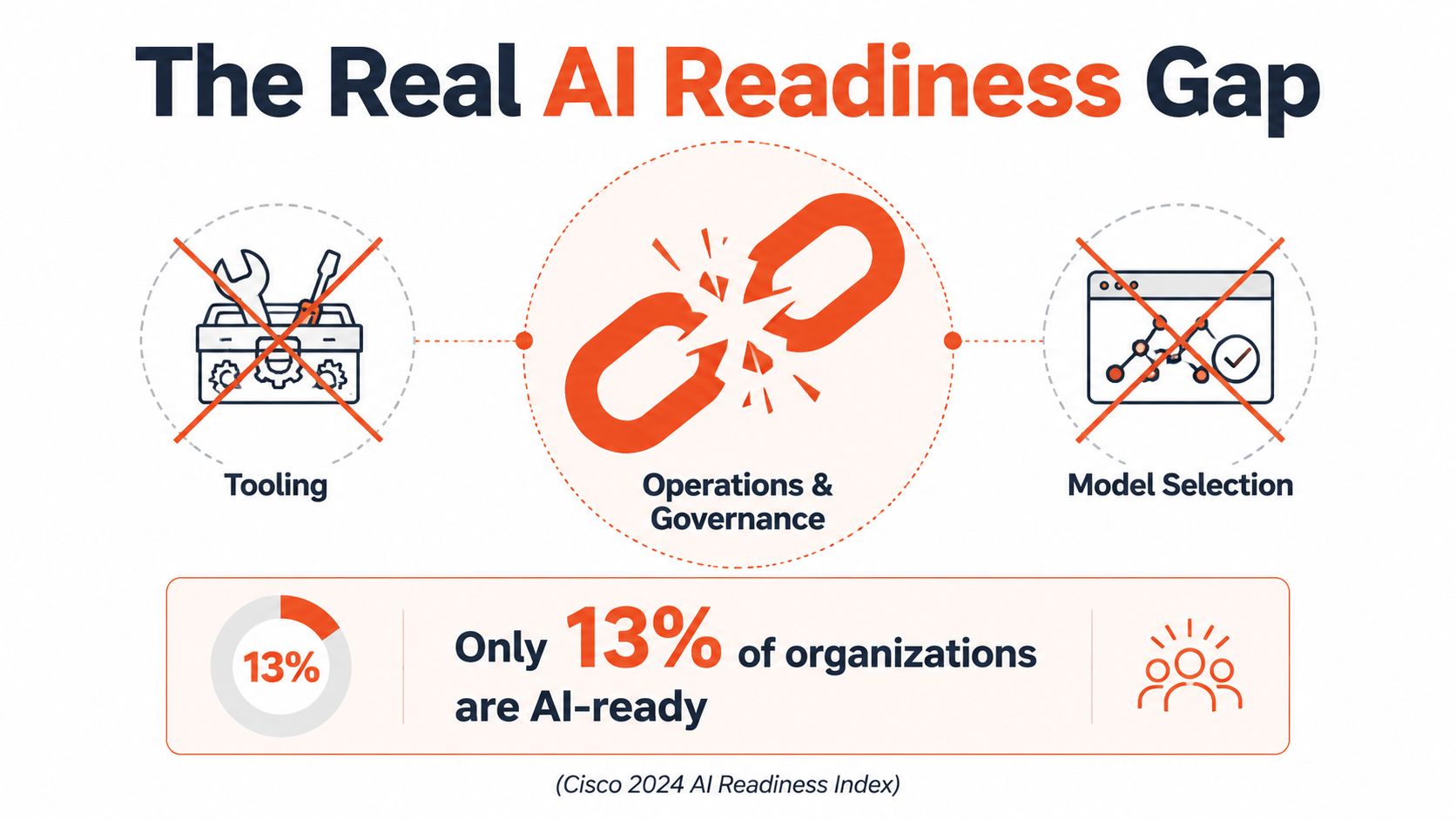
The Three Blind Spots
A self-survey often asks whether data exists and whether teams can access AI tools. A useful diagnostic asks whether the organization can operate those tools under real commercial and regulatory conditions.
- Workflow instrumentation: Can the business observe the process AI is expected to improve? If lead routing, account research, forecasting, or service triage isn't measured consistently, the team can't prove whether AI changed the outcome.
- Executive ownership: Which executive owns the result, not merely the implementation? A CIO may own a platform, but the CRO, COO, or business-unit leader must own the commercial or operational outcome.
- Deferred remediation cost: What happens if the organization postpones identity resolution, access controls, policy design, or process standardization? Delayed foundational work tends to reappear as failed pilots, manual review, and stalled production decisions.
Cisco's distribution reinforces that readiness is uneven. 33% of respondents were Chasers, 51% were Followers, and 3% were Laggards, while average readiness scores ranged from 93 for Pacesetters to 25 for Laggards. Strategy was the strongest pillar, with 76% benchmarked as Pacesetters or Chasers, yet only 66% said boards were receptive and 75% said leadership teams were receptive, both down from 82% the prior year (Cisco's detailed readiness framework).
Practical rule: Treat readiness as an operating diagnosis. A vendor questionnaire can reveal interest, but only evidence, owners, and remediation milestones reveal capability.
Leaders who want a deeper governance perspective should also read why AI transformation is a governance problem. The central point is simple. Tools create possibilities. Operating discipline determines whether those possibilities survive contact with the business.
What AI Readiness Actually Means for a B2B Operating Model
For a B2B company, AI readiness means the measurable ability to identify, prioritize, fund, build, govern, and scale AI use cases that improve revenue, margin, customer experience, or operating capacity. That definition forces a connection between the AI portfolio and the operating model. A use case isn't ready because a team can demonstrate it. It's ready when the company knows who owns it, what data supports it, how risk is controlled, and how performance will be measured after launch.
The six dimensions below map directly to an executive structure. Each one needs an owner, evidence, and a clear distinction between a process that exists on paper and one that works repeatedly.
The evidence leaders should request
| Dimension | Owner | Evidence Required | Signal of Readiness |
|---|---|---|---|
| Strategy and Use-Case Pipeline | CRO or COO | Prioritized use-case register, business cases, KPI definitions, funding decisions | The organization ranks use cases by business value, feasibility, risk, and accountable outcome |
| Data Foundations and Stewardship | CDO or CTO | Data catalog, lineage records, quality reports, stewardship assignments, access rules | Critical data is discoverable, governed, traceable, and fit for the intended workflow |
| Technology and Platform | CIO | Architecture diagrams, integration map, environment controls, monitoring plan, vendor assessments | Teams can deploy, monitor, secure, and integrate AI without creating isolated technical debt |
| Talent and Operating Model | CHRO | Skills inventory, role definitions, training plan, delivery model, hiring or partner strategy | Teams know who builds, approves, operates, and improves each AI capability |
| Governance, Risk and Compliance | CISO or General Counsel | AI policy, risk register, review process, model cards, incident procedure, contract controls | The company can classify use cases, approve them proportionately, and respond when performance or compliance changes |
| Adoption and Change Management | COO or CMO | Workflow maps, enablement plan, adoption measures, feedback logs, communications plan | Users incorporate AI into defined work rather than treating it as an optional experiment |
The distinction between a low and high score is operational. A score of 2 might mean a sales team has identified several promising use cases and has informal data access. A score of 4 means the company has a ranked portfolio, approved funding, documented data ownership, repeatable delivery controls, and a measurement loop.
The OECD company assessment uses five related themes, AI opportunity identification, human capacity, data for AI, digital infrastructure, and responsible AI governance, and maps organizations across five maturity levels from AI Unaware to AI Practitioner (OECD AI readiness assessment). That model is useful as a cross-check, especially when a B2B scorecard needs to connect business opportunity with people, infrastructure, and responsible use.
The operating model should also reflect how teams learn. For example, leaders can use scaling podcasts with AI as one input into executive education, but content consumption isn't a substitute for skills evidence. The assessment should show whether managers can redesign workflows, whether subject-matter experts participate in validation, and whether users have a safe channel to report failures.
The Six-Dimension Scoring Model That Makes Readiness Auditable
A readiness score becomes useful when another executive can inspect the underlying answers and understand why the organization received its result. The model here uses five to seven questions per dimension, with every question scored from 0 to 5. The weights reflect likely business impact: Strategy 25%, Data 20%, Technology 15%, Talent 15%, Governance 15%, and Adoption 10%.
These weights aren't universal. A regulated business may increase Governance. A data-rich software company may place more emphasis on Data. The important discipline is to declare the weighting logic before interviews begin, rather than adjusting it to produce a more flattering result.
Use a consistent maturity anchor
| Score | Maturity Anchor | Definition |
|---|---|---|
| 0 | Not started | No defined capability, owner, evidence, or active work |
| 1 | Ad hoc | Isolated activity depends on individuals and lacks repeatability |
| 2 | Defined | A documented approach exists, but execution is inconsistent |
| 3 | Repeatable | Teams follow a working process with recurring evidence |
| 4 | Managed | Leaders monitor performance, risk, adoption, and exceptions |
| 5 | Optimized | The capability is continuously improved using measured outcomes |
The OECD approach also uses a 1-to-5 scoring method across its five major criteria, with the qualitative outcome determined by score thresholds (OECD scoring methodology). The difference in starting point doesn't undermine the enterprise model above. It highlights why the assessment must document its own rubric and avoid mixing scales without explanation.
Roll the answers into one index
For each dimension, calculate the average question score, divide by 5, and multiply by that dimension's weight. Then add the weighted results and multiply the total by 100. The result is a 0 to 100 readiness index, supported by dimension scores and question-level evidence.
For example, if Strategy averages 3.2, its normalized contribution is calculated against the 25% Strategy weight. The scorecard should retain the interview note, requested artifact, assessor, date, and rationale behind every answer. A summary score without that appendix is an opinion dressed as precision.
PwC's enterprise assessment demonstrates the value of traceability by operationalizing diagnostic questions on a 0 to 5 scale, with 1,425 total possible points in one variant and a traceable 0 to 100 readiness score in another (UNESCO AI Readiness Assessment Methodology). The exact point architecture can vary, but the principle doesn't. Leaders need to see which questions drove the result and which owner can change them.
Calibration matters: Have two assessors independently score a sample of evidence, discuss differences, and record the resolution rule. Recalibrate the rubric quarterly, especially after a pilot exposes assumptions the original interviews missed.
For risk controls, align the Governance dimension with the NIST AI Risk Management Framework. Its voluntary structure centers on Govern, Map, Measure, and Manage, which gives teams a practical way to connect policy with system design, evaluation, and response (NIST AI Risk Management Framework). A readiness index should never hide risk behind a strong average. Report the overall score, each dimension, and any critical control that requires immediate attention.
Running the Diagnostic Checklist in Six to Ten Weeks
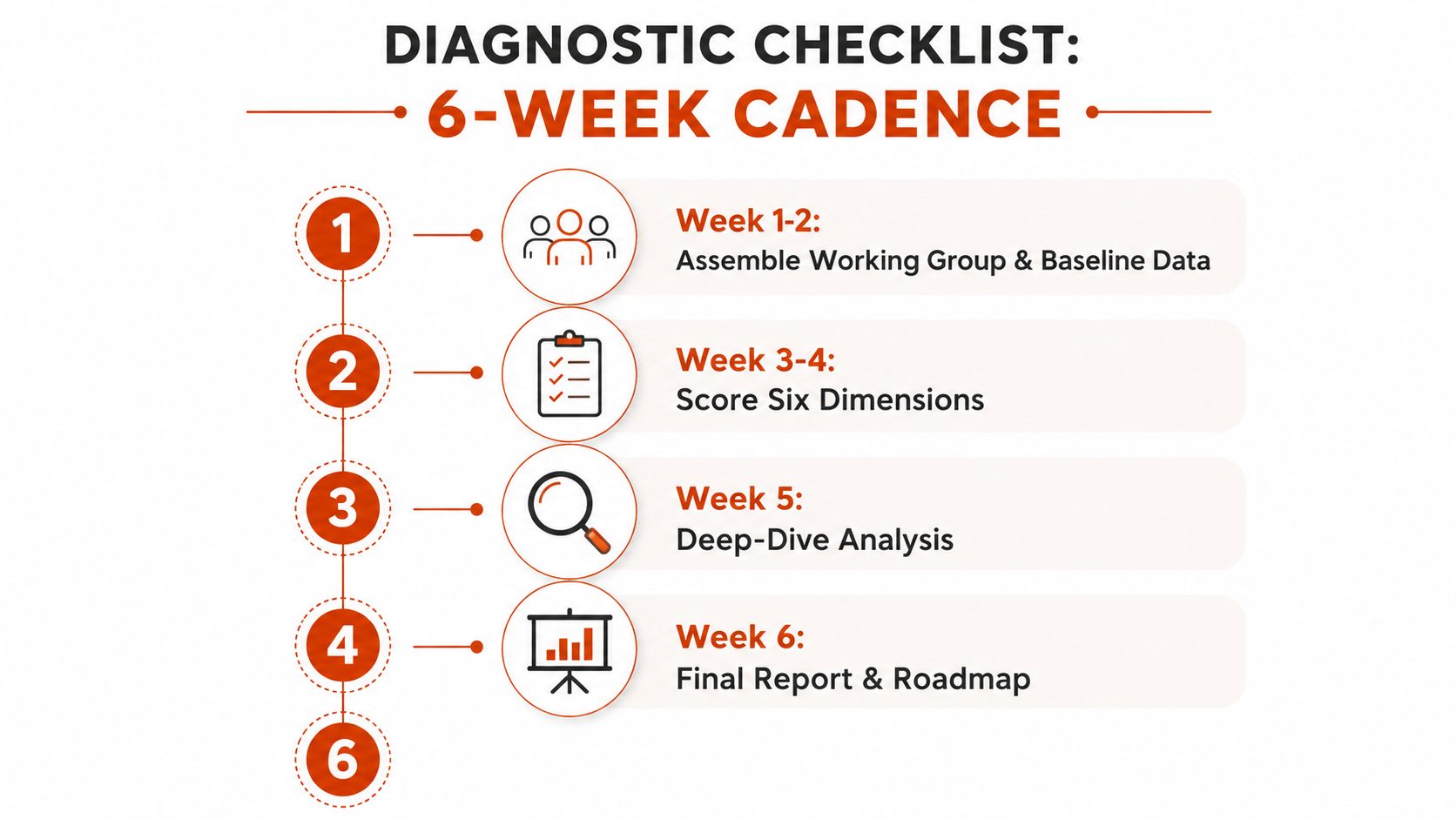
A defensible baseline needs enough time for evidence collection, cross-functional challenge, and executive reconciliation. The Paris21 SPEEDometer is designed as a five-domain self-assessment completed in about six to ten weeks, producing an actionable baseline for leadership decisions (UNESCO AI readiness methodology). An enterprise team can use the same cadence while adapting the domains to its commercial operating model.
Build the working rhythm
Weeks 1–2, assemble and baseline. The executive sponsor appoints a diagnostic lead and the six dimension owners. The team maps critical workflows, inventories data sources, records current AI use, and identifies the business KPIs that future pilots must influence.
Weeks 3–4, collect and score. Run structured interviews with sales, marketing, operations, IT, security, legal, HR, and frontline users. Request a one-page evidence pack for each dimension. Score each question independently before the working group discusses the result.
Weeks 5–6, reconcile and pressure-test. The sponsor chairs a scoring session. Challenge optimistic answers, inspect data and infrastructure rows in detail, and mark any score supported only by verbal assurance. The output is a preliminary index and a list of disputed or missing evidence.
Weeks 7–8, write the baseline. Produce the index report, dimension heat map, question-level appendix, risk register, and remediation hypothesis. Each proposed action should name an owner and an observable exit condition.
Weeks 9–10, decide and commit. Socialize the findings with the leadership team, approve the 90-day backlog, assign capacity, and decide which pilots proceed, pause, or require foundational work first.
Use questions that force evidence
Ask the Strategy owner which use cases have a quantified business hypothesis and who owns the outcome. Ask the Data owner which sources are authoritative, how lineage is tracked, and what sensitive fields require restricted access. Ask Technology whether the architecture supports integration, monitoring, rollback, and vendor substitution.
For Talent and Adoption, examine role definitions, training records, workflow maps, and user feedback. For Governance, request the AI policy, governance charter, model cards, review records, risk register, and incident process. Also request pipeline reports, CRM field definitions, access-control documentation, and examples of previous approval decisions.
The facilitator should circulate an evidence request before interviews, hold short owner check-ins during collection, and maintain a decision log. That cadence prevents the assessment from becoming a series of disconnected conversations.
A practical diagnostic can also use an external reference point. The World Bank's 2025 Digital Progress and Trends Report frames readiness through connectivity, compute, context, and competency, a useful reminder for distributed or cross-border businesses. The first constraint may be skills, infrastructure, standards, or local data context, not model selection.
What Changes When Readiness Translates Into Execution
The scorecard matters only when it changes operating behavior. In Prometheus case material, one mid-market B2B operator found that its growth constraint sat in data and workflow maturity. After rebuilding the operating system around an omni-channel account-based marketing engine, the company doubled qualified leads within a quarter while entering the U.S. market.
A separate community bank engagement focused on full-funnel paid media, CRM enrichment, and conversion tracking. The reported outcome was an 83% reduction in cost per lead and $5.9 million in new deposits, as documented in the publisher's case material. A national pest-control brand prioritized CRM workflow integration and inbound intent handling, then used an in-CRM lookup tool to produce a 69% faster lead-to-appointment time.
| Case | Weakest Dimensions | Remediation Focus | Outcome |
|---|---|---|---|
| Niche SaaS entering the U.S. market | Data Foundations, Strategy, Adoption | Omni-channel account-based marketing engine and qualified-lead workflow | Qualified leads doubled within a quarter |
| Community bank | Data Foundations, Technology, Measurement | Full-funnel paid media, CRM enrichment, and conversion tracking | 83% lower cost per lead and $5.9 million in new deposits |
| National pest-control brand | Technology, Workflow Adoption, Strategy | In-CRM lookup tool and intent-led routing | Lead-to-appointment time became 69% faster |
These examples show why the assessment should connect each remediation item to a leading indicator. For a demand-generation workflow, monitor data completeness, account coverage, routing latency, qualification rate, and sales acceptance. For an AI-assisted SDR layer, watch response time, human review rates, meeting quality, and disposition accuracy.
Impact opportunity: The fastest path to value is usually not a broad AI rollout. It's a narrow workflow with clean ownership, measurable friction, and enough operational volume to expose whether the new process works.
The trade-off is deliberate focus. A company may have many attractive ideas, but shipping one governed workflow with a credible baseline teaches more than running disconnected demonstrations across every department. The scorecard identifies where to start. Execution proves whether the diagnosis was honest.
A Prioritized 90-Day Remediation Roadmap and Common Pitfalls
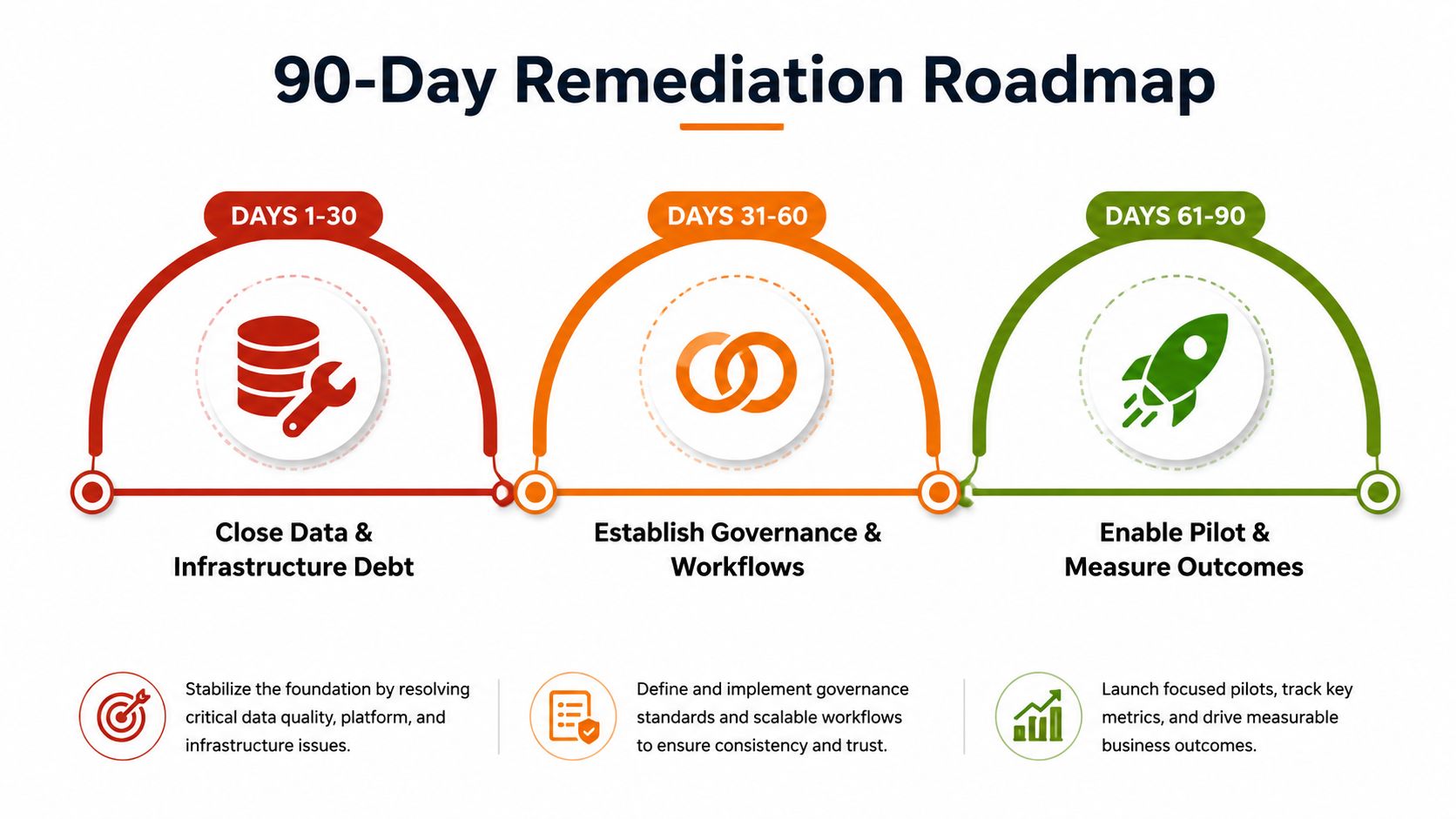
The remediation plan should begin with the two lowest-scoring dimensions, not with the most fashionable use case. Divide the work into three 30-day arcs, give every milestone a business owner, and require an artifact that proves completion.
Days 1–30, close foundational debt
The CDO or CTO owns data and infrastructure remediation. Clean priority CRM fields, resolve identity conflicts, document authoritative sources, review access controls, and map the data flows supporting the selected workflows. The exit criteria are an approved source inventory, named data stewards, documented lineage for critical fields, and a confirmed technical path for the pilot.
Days 31–60, establish control
The CISO, General Counsel, and executive sponsor establish the lightweight AI policy, use-case classification process, model-risk register, review cadence, and incident path. The exit artifact is an approved governance charter with decision rights, review thresholds, vendor requirements, and a named operational owner.
Days 61–90, ship and measure
The business owner and CIO launch two pilot workflows tied to revenue or operating KPIs. Instrument leading indicators, establish human review, document exceptions, and define the scale or stop decision. The exit package should include pilot results, user feedback, risk observations, cost assumptions, and a recommendation for production, redesign, or termination.
Common failure patterns are predictable:
- Data becomes an IT ticket: Assign stewardship to the business teams that understand the meaning and consequences of the data, with technology responsible for enabling quality and access.
- Pilots lack kill criteria: Define unacceptable error, risk, adoption, or economics before launch. Otherwise, enthusiasm keeps weak workflows alive.
- Tool breadth replaces workflow depth: A larger software footprint doesn't fix broken routing, unclear approvals, or missing measurement.
- The sponsor arrives late: Executive ownership must exist before the pilot starts, not after results disappoint.
For teams moving from experimentation to production, a pilot-to-production checklist can complement the scorecard. The roadmap and the pitfalls reinforce the same principle. Every unresolved gap needs an owner, every owner needs an exit condition, and every pilot needs a decision rule.
Key Takeaways and Where to Start This Quarter
An effective AI readiness assessment produces three management artifacts: a scored scorecard, a prioritized remediation backlog, and an ROI baseline for the workflows under consideration. It shouldn't end as a slide that labels the company emerging, advancing, or mature without showing the evidence behind the judgment.
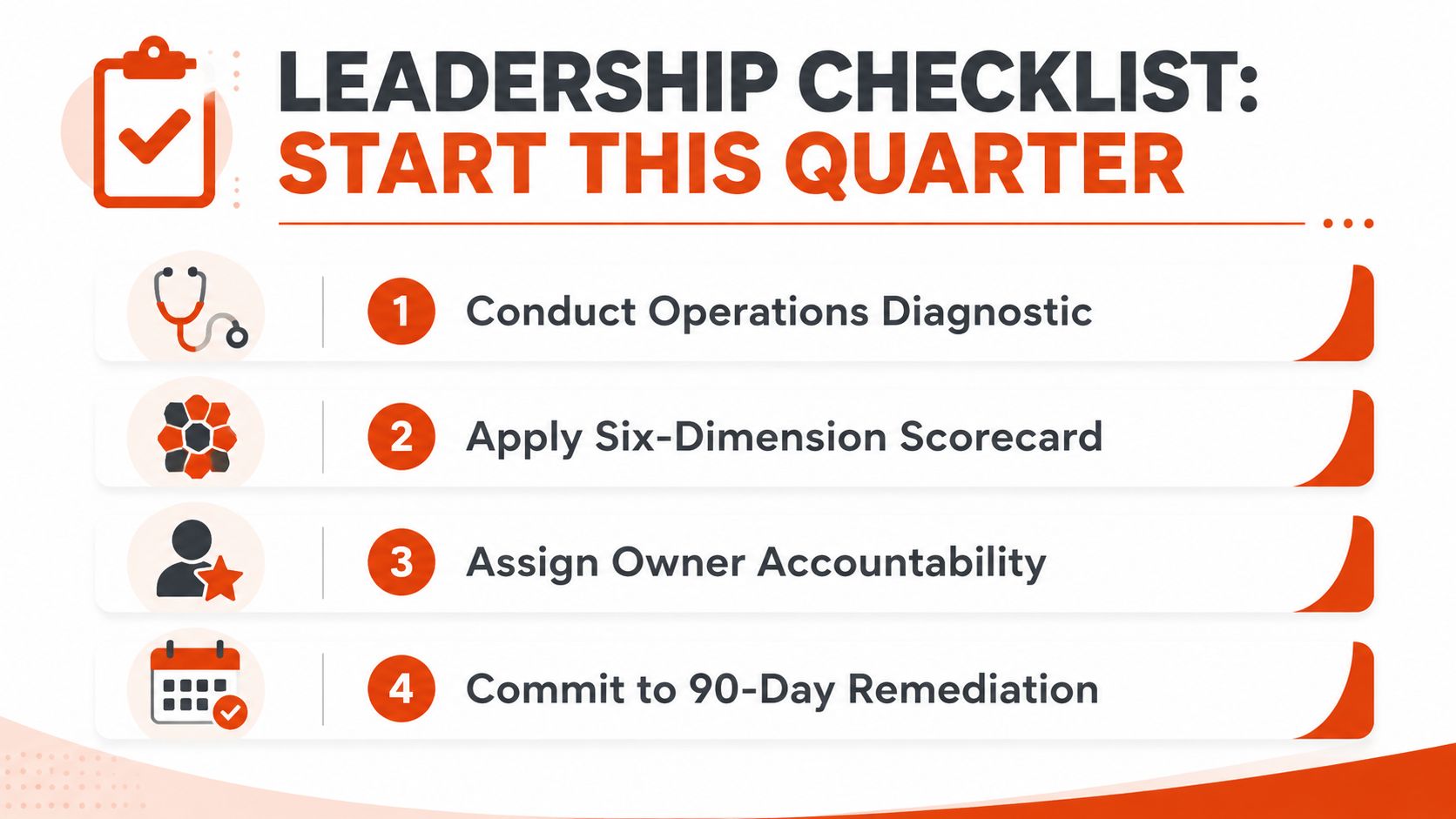
The leadership checklist
- Start with operations. Select workflows where AI could affect revenue, margin, service quality, or cycle time. Document the baseline before changing the process.
- Score six dimensions. Evaluate Strategy, Data, Technology, Talent, Governance, and Adoption using the same maturity anchors and retain question-level evidence.
- Assign accountable owners. Name the executive who owns the outcome, the functional owner who manages remediation, and the technical owner who enables delivery.
- Commit to 90 days. Choose the two lowest-scoring dimensions, convert them into milestones, and bring unresolved risks to the operating committee.
Within 10 business days, the sponsor should confirm the owners, approve the evidence request, and select the first workflows for assessment. During the quarter, leadership should review the readiness index, the remediation backlog, and the ROI baseline together. The key decision isn't whether the organization is “ready” in the abstract. It's whether the next investment addresses the binding constraint.
Teams that need an external starting point can use Prometheus Agency's AI Quotient Assessment or AI Readiness Assessment to examine readiness across areas such as technology infrastructure, data quality and governance, workforce skills, process optimization, and organizational alignment. The important outcome is a decision-ready baseline, followed by accountable execution.
Prometheus Agency helps B2B growth leaders assess AI readiness, improve CRM and go-to-market operations, and turn the findings into governed pilots with clear owners and timelines. Visit Prometheus Agency to request a complimentary Growth Audit and AI strategy session, and bring your two lowest-scoring dimensions to the conversation.