McKinsey's 2025 global survey found that 71% of organizations regularly used generative AI in at least one business function, up from 65% previously, yet more than 80% reported no tangible enterprise-level EBIT impact. Only 39% attributed any EBIT impact to AI, and most of those respondents said the contribution was below 5% of organizational EBIT. McKinsey's 2025 State of AI research exposes the planning trap: adoption can rise while financial results remain flat.
An AI strategy roadmap shouldn't be a calendar of software deployments. It should be a stage-gate investment plan that connects a small number of business problems to owners, baselines, controls, and measurable operating-model change. The question isn't which AI tool your company should buy next. It's which workflow should change, who owns the result, and what evidence earns the next investment.
Why Most AI Roadmaps Fail Before They Start
Most AI roadmaps fail at the investment decision, before deployment begins. Executives approve a chatbot, copilot, or model experiment because it is visible and easy to launch, then treat usage as proof of progress. Adoption alone says nothing about conversion, cost, risk, or decision quality. A roadmap needs gates that connect each release of funding to measurable operating-model change.
A chatbot launched for customer support illustrates the problem. The team monitored conversations and user activity, but it had no baseline for resolution time, no agreed quality threshold, and no stop condition if escalation rates rose. The pilot generated usage data, not a credible case for scale.
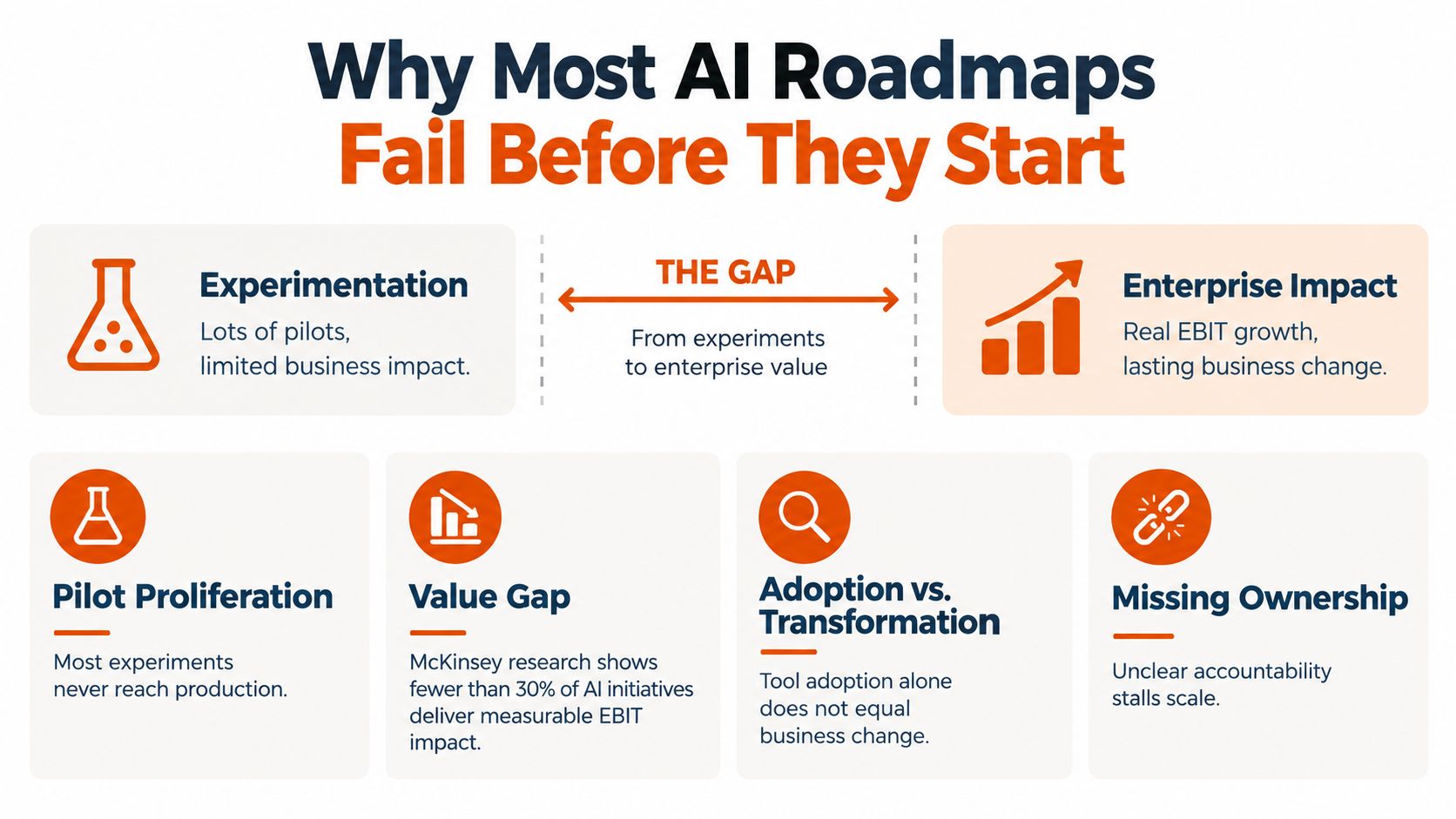
Adoption is a Planning Input, Not a Strategy
Reject four artifacts from the roadmap:
- A tooling calendar: “Deploy platform A, then assistant B, then model C” describes purchasing sequence, not business value.
- A vendor wishlist: A long product list can conceal the absence of a prioritized operating problem.
- A pilot graveyard: Experiments without owners, baselines, or stop conditions consume attention without producing investment evidence.
- A compliance afterthought: Governance added after deployment forces expensive redesign and delays adoption.
The roadmap should treat governance and measurement as gates. Before a pilot starts, assign a business owner, document the current performance baseline, define acceptable risk, and specify the evidence required for the next stage. A pilot that cannot meet those conditions should not receive more funding, regardless of user enthusiasm.
Practical rule: Every roadmap item needs a business outcome, a named owner, a baseline, a risk decision, and a gate for additional funding.
Use an AI readiness assessment to score the organization before selecting tools. Fund only use cases that can pass review across outcomes, prioritization, measurement, and governance. This approach turns the roadmap into a controlled investment system rather than a catalogue of experiments.
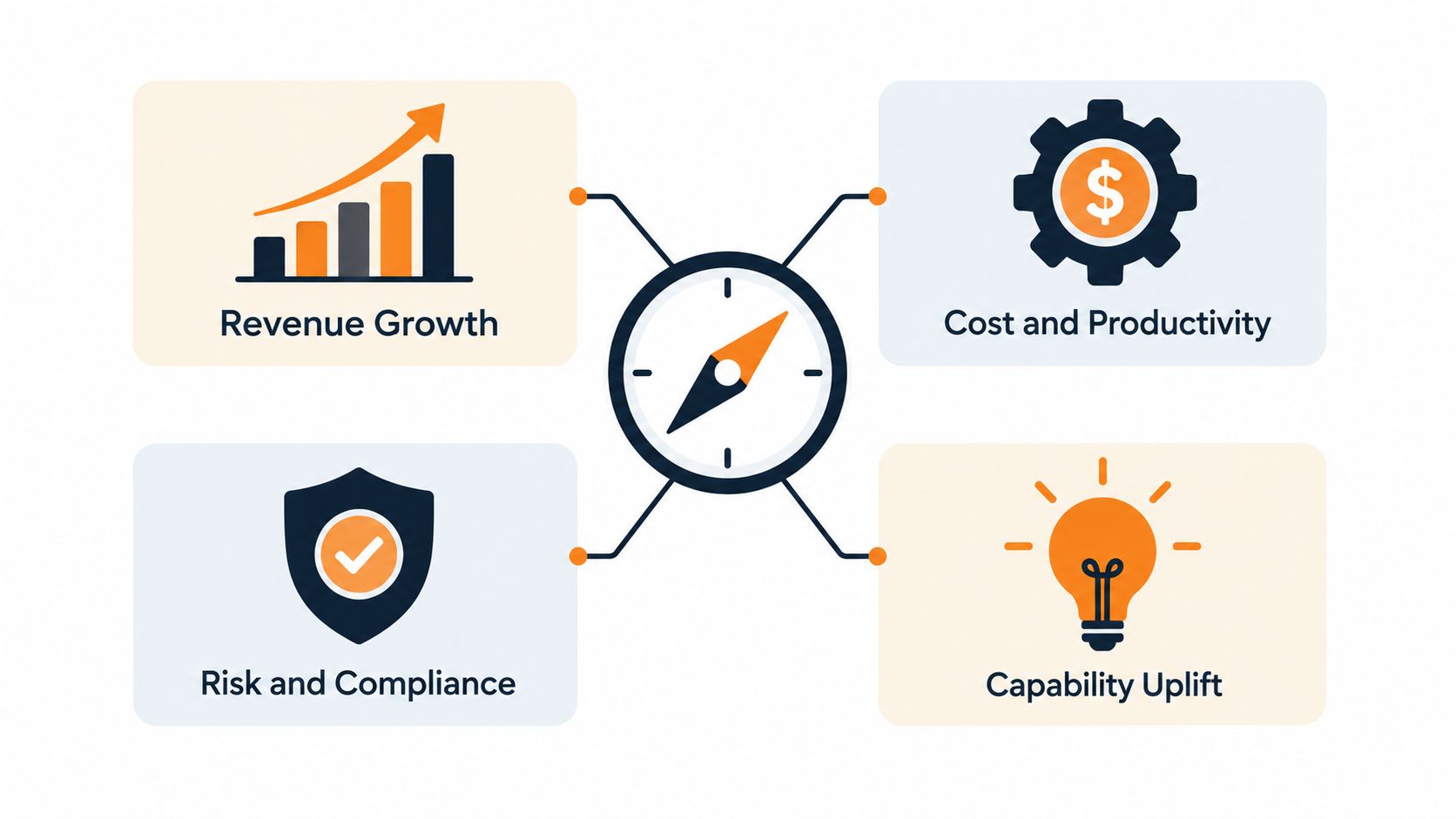
The Four Business Outcomes Every Roadmap Must Anchor To
An AI initiative earns a place on the roadmap only when it advances a business outcome that an executive already owns. This prevents technology teams from carrying the entire burden of proving value and stops steering committees from approving projects because they sound new and exciting.
Revenue growth
The Chief Revenue Officer or equivalent should own initiatives that improve pipeline quality, conversion, expansion, or customer retention. The KPI might be qualified pipeline coverage, lead-to-opportunity conversion, quoting cycle time, or revenue per seller.
For example, a B2B company could prioritize AI-assisted lead qualification only if sales leadership agrees on the current qualification baseline and defines how improved routing will affect pipeline progression. A generic content generator doesn't belong in this category unless someone can explain how it changes a revenue workflow.
Cost and productivity
The Chief Operating Officer or functional leader owns this outcome. The KPI might be cost per transaction, cycle time, service capacity, or error-related rework.
A manufacturer could evaluate an AI assistant for service triage because it changes how technicians find information and prioritize work. The investment case should include the existing process cost and a clear view of where human review remains necessary. Hours saved aren't automatically financial savings. The team must show how capacity will be redeployed or expense reduced.
Risk and compliance
The General Counsel, Chief Risk Officer, or Chief Information Security Officer should own this lens. Useful KPIs include unresolved incidents, review completion, policy exceptions, audit evidence, or error severity.
A customer-facing assistant may be strategically valuable but still fail this gate if the company can't document data access, human oversight, disclosure, and incident response. Risk isn't a reason to stop every initiative. It's a reason to set the operating conditions before deployment.
Capability uplift
The Chief People Officer, Chief Information Officer, or transformation leader owns capability uplift. The KPI might track workflow adoption, employee proficiency, data quality, or the percentage of decisions supported by a governed process.
This lens matters when the immediate financial return is indirect. A data cleanup program may enable several future use cases without producing direct revenue on its own. Treat it as an enabling investment, not as a falsely precise ROI claim.
Ask one question in every roadmap review: Which outcome moves, who owns it, and what evidence will prove movement?
The Four Controlled Stages From Pilot to Scale
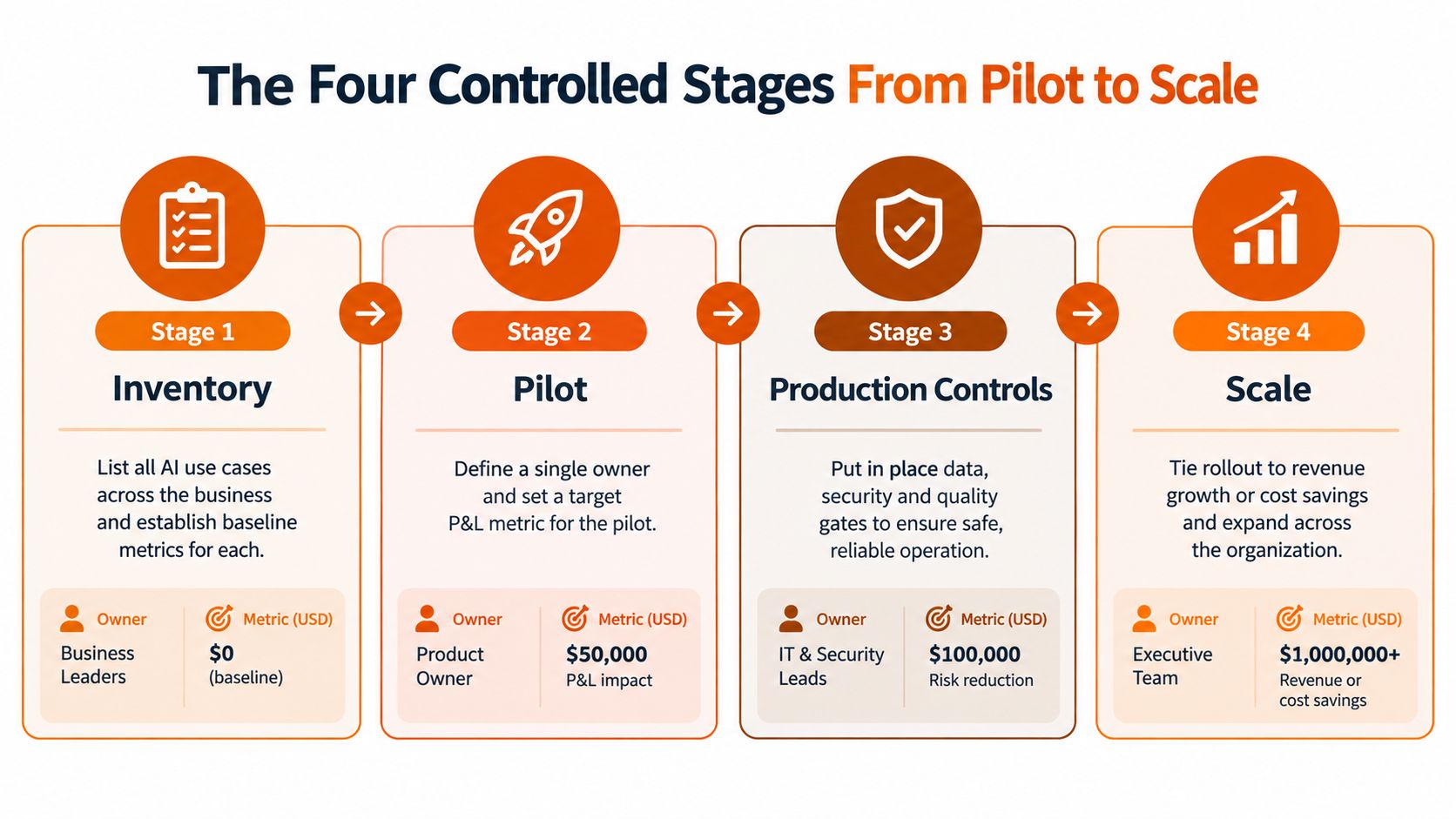
A credible AI strategy roadmap moves through four controlled stages: inventory, pilot, production controls, and scale. Each stage answers a different investment question. Skipping one creates false confidence.
Stage one, inventory
Start by listing proposed use cases and scoring them by business value, data readiness, risk, and implementation effort. Record the process owner, affected users, source systems, decision points, dependencies, and current baseline. Don't approve a pilot because an executive is enthusiastic. Approve it because the use case has a defensible path to value.
Stage two, pilot
Run a narrowly scoped pilot with one owner, one workflow, one adoption target, and one P&L metric. Define the counterfactual baseline before changing the process. If the pilot concerns lead qualification, document the current routing logic, qualification quality, cycle time, and downstream pipeline behavior.
The gate is evidence of value and user adoption under controlled conditions. A technically accurate model that nobody uses has failed. A popular workflow that creates unacceptable errors has also failed.
Stage three, production controls
Many teams cut corners at this stage. Before expansion, establish data-access rules, evaluation procedures, monitoring, human oversight, security controls, and incident response. Production readiness isn't a documentation exercise. It determines whether the workflow can operate safely when data changes, users behave unpredictably, or the model produces an exception.
Stage four, scale
Scale only when the pilot demonstrates repeatable value across users and workflows. Expansion should include a documented deployment pattern, accountable local owners, measurement continuity, and funding for process changes.
A mid-market B2B team might spend the first phase cataloging lead-routing problems, then run a limited qualification pilot, add CRM controls and review rules before production, and expand to additional segments only after the workflow performs consistently. The sequence can fit a roughly six-month transformation window, but the gate evidence matters more than the calendar.
For a deeper operating view, use this guide to scale AI from pilot to production.
The investment logic is simple. Inventory creates focus, pilots create evidence, production controls protect the workflow, and scale converts evidence into repeatable business value.
Prioritization Criteria That Survive a Real Review Meeting
Executive enthusiasm is a weak prioritization system. It rewards visible tools, polished demos, and urgent anecdotes. A steering committee needs a shared scorecard that exposes trade-offs and ties funding to measurable operating-model change.
The opportunity set is expanding faster than most organizations can govern it. Use the scorecard below to decide which ideas deserve investment, which require preparation, and which should stop before a pilot.
Score the four lenses
Business value asks whether the use case can change revenue, cost, risk, or organizational capability in a way leadership can defend.
Data readiness asks whether the required data exists, is accessible, reliable enough for the decision, and lawful to use. Poor data should trigger a remediation gate, not automatic approval or rejection.
Risk profile asks what happens when the system is wrong, manipulated, unavailable, or used outside its intended purpose. High-risk cases need stronger controls before they receive scale funding.
Implementation effort covers integration, workflow redesign, training, change management, monitoring, and ongoing ownership. The model build is only one part of the investment.
| Priority Quadrant | Business Value | Data Readiness | Risk Profile | Example Use Case |
|---|---|---|---|---|
| Fast value | High | High | Low | Internal sales knowledge retrieval |
| Strategic build | High | Low or partial | Moderate | Forecast support tied to fragmented CRM data |
| Controlled experiment | Uncertain | High | Moderate | Service triage recommendation with human review |
| Defer or redesign | Low or unclear | Low | High | Autonomous customer decisioning without audit evidence |
Run a one-hour workshop with a qualitative score. Require written evidence for every high rating. Treat the result as an investment gate, not a ranking exercise. A use case with high value and weak data readiness can proceed only if the remediation work has an owner, a budget, and a measurable exit condition.
The tie-breaker is not “Which project has the loudest sponsor?” Ask, “Which use case, if successful, makes the next two possible?”
Favor use cases that create reusable workflow patterns, improve trusted data foundations, or generate learning that strengthens the wider portfolio. Defer attractive demos that lack accountable ownership, measurable outcomes, or a credible path through governance.
Measuring Value When Attribution Is Hard
AI value rarely arrives as a clean before-and-after number. A new system may improve data quality, change team behavior, remove manual work, and alter a process at the same time. Deloitte's 2025 survey of 1,854 executives in Europe and the Middle East found that AI value is often intertwined with data-quality improvements, team redesign, and process changes, while one in four respondents cited inadequate infrastructure and data as a barrier to ROI. Deloitte's analysis of AI ROI supports a more honest measurement model.
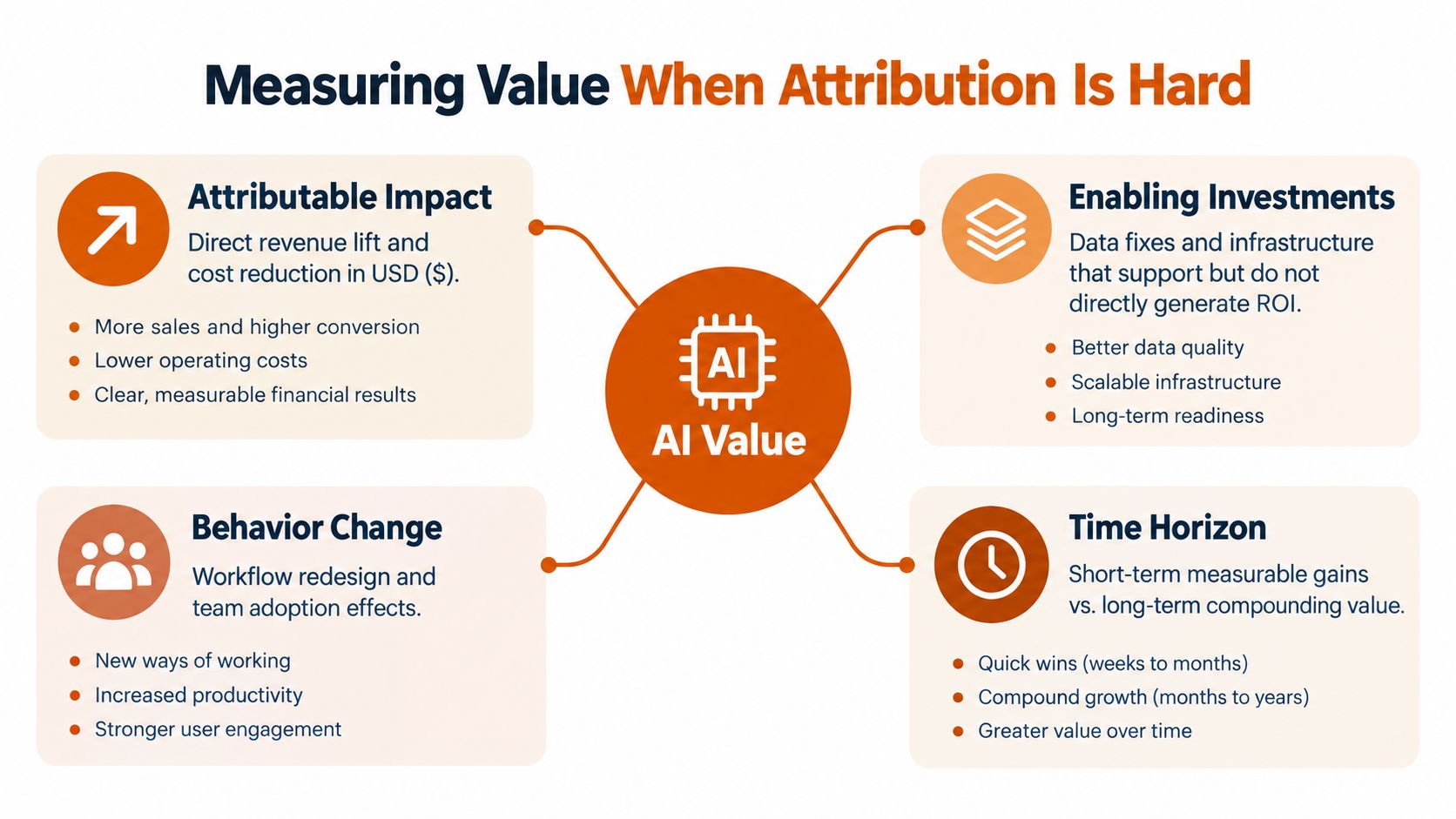
Separate impact from enablement
Attributable impact is the portion you can reasonably connect to the redesigned workflow, such as lower cost per transaction, faster cycle time, improved conversion, or reduced error severity.
Enabling investment includes data fixes, integrations, infrastructure, training, and operating-model work that supports future value but shouldn't be mislabeled as immediate ROI.
Behavior change measures whether users adopt the new process, follow review rules, and act on system recommendations.
Time horizon distinguishes immediate operational movement from capability that compounds over later roadmap stages.
A B2B growth team may not see booked revenue immediately after improving lead qualification. It can still measure speed-to-lead, qualification agreement, override rates, pipeline coverage, and progression into opportunities. Those indicators reveal whether the workflow is moving in the right direction before revenue attribution becomes available.
Instrument the pilot from week one
Track a small set of operational measures:
- Cycle time: How long the process takes before and after the intervention.
- Override rate: How often qualified users reject or change the system's recommendation.
- Error severity: Whether mistakes are cosmetic, operationally costly, or consequential.
- Cost per transaction: The cost of running the process, including human review and system usage.
- Adoption: Whether the intended users use the workflow consistently.
- Fairness signals: Whether outcomes differ materially across relevant groups.
- Security events: Whether the system creates access, privacy, or misuse incidents.
- Realized business impact: Revenue, cost, risk, or capability movement supported by evidence.
Assign a measurement lead before launch. That person owns the dashboard, the baseline, the decision log, and the recommendation to stop, redesign, or scale.
Embedding Governance and Compliance Into the Roadmap
Governance belongs inside every stage gate. The National Institute of Standards and Technology's voluntary AI Risk Management Framework 1.0, released on January 26, 2023, organizes risk management around four functions: GOVERN, MAP, MEASURE, and MANAGE. NIST's AI RMF roadmap gives executives a lifecycle structure without prescribing a specific technology or implementation model.
Turn NIST functions into gates
GOVERN assigns accountability, policies, decision rights, and escalation paths before a use case enters the pilot queue.
MAP records intended use, stakeholders, system context, foreseeable misuse, data sources, and risk exposure during inventory and pilot design.
MEASURE tests performance, reliability, security, fairness, human-AI configuration, and social impact throughout the lifecycle.
MANAGE prioritizes risks, applies controls, records incidents, and decides whether the system can continue, change, or stop.
NIST's Generative AI Profile, released on July 26, 2024, provides a cross-sector companion for identifying generative-AI-specific risks. Put each use case in a register with its business owner, model and data sources, intended users, misuse scenarios, privacy and security risks, testing evidence, oversight requirements, and post-launch monitoring.
Put compliance dates on the critical path
The EU AI Act requires a dated workstream, including for organizations outside Europe when their systems or outputs involve the EU market. Its prohibitions, definitions, and AI-literacy provisions became applicable on 2 February 2025. Governance rules and general-purpose AI obligations began on 2 August 2025. Transparency requirements under Article 50 and enforcement for applicable rules begin on 2 August 2026. High-risk obligations for Annex III systems are scheduled to begin on 2 December 2027, while high-risk systems embedded in regulated products under Annex I are scheduled to face obligations from 2 August 2028. The EU AI Act implementation timeline should determine roadmap sequencing.
A manufacturer using an AI assistant to draft customer-facing content should establish disclosure controls before the August 2026 transparency milestone. The roadmap should identify who approves output, how generated content is marked, what data the assistant can access, and how incidents are escalated. A practical AI governance checklist for mid-market companies can support that control design. Each gate should require evidence that these controls work before the use case advances.
Your 90-Day AI Strategy Roadmap Starter Plan
Start with a governance meeting, not a software demonstration. The first 90 days should produce investment evidence, not a collection of disconnected experiments.
Days one through 30
In the first week, select the business outcomes and assign executive owners. During weeks two through four, build the use-case inventory and score every candidate against business value, data readiness, risk, and implementation effort.
Reject any proposal without a named owner, baseline metric, intended users, and stop condition. Use a simple register that captures dependencies and the decision required at the next gate.
Days 31 through 60
Run two narrowly scoped pilots. Each pilot needs a counterfactual baseline, an adoption target, a P&L metric, and a measurement lead. Keep the workflow small enough to observe directly, but real enough to expose data, integration, and behavior problems.
A product leader who needs a complementary planning reference can review this practical product roadmap guide, then adapt the same discipline to AI investment gates rather than feature sequencing.
Days 61 through 90
Document production controls for data access, evaluation, monitoring, human oversight, and incident response. Review pilot evidence, separate attributable impact from enabling investment, and approve only the next gate that the evidence supports.
A useful steering committee dashboard should show:
- Owner status: Whether every initiative has accountable business and technical owners.
- Baseline status: Whether measurement exists before rollout.
- Control status: Whether governance and compliance requirements are complete.
- Adoption status: Whether intended users follow the redesigned workflow.
- Gate recommendation: Stop, redesign, continue, or scale.
An AI strategy roadmap is an investment plan, not a tool calendar. Prometheus Agency's fixed-fee AI Strategy Engagement maps operations, prioritizes opportunities, validates a priority with a lightweight proof of concept, and delivers a fundable implementation sequence with owners, dependencies, data requirements, business cases, and decision gates.
Prometheus Agency helps growth leaders connect AI enablement, CRM optimization, and go-to-market strategy to measurable operating-model change. Start with a complimentary Growth Audit and AI strategy session by visiting Prometheus Agency, and leave with a clearer path from pilot evidence to accountable scale.