An AI strategy for companies under 500 employees isn't a "nice-to-have" anymore. It's a core part of staying competitive and growing. We're talking about finding high-impact, low-cost ways to automate tedious work, sharpen your marketing, and deliver better customer service. This isn't about massive budgets; it's about smart, focused implementation that generates real, immediate value.
Key Takeaways
- Focus on Problems, Not Tools: A successful AI strategy for a smaller company starts by identifying specific, high-friction business problems in sales, marketing, or operations.
- Start Small with Pilots: Avoid large-scale overhauls. Instead, run small, measurable pilot projects to prove ROI and build internal momentum quickly.
- Integrate with Existing Tech: The real power of AI is unlocked when it's woven into your existing systems, especially your CRM, to enhance workflows you already use.
- Prioritize People and Adoption: Technology is only half the battle. A clear communication and change management plan is critical to ensure your team actually uses the new tools.
Why Your Business Needs an AI Strategy Now
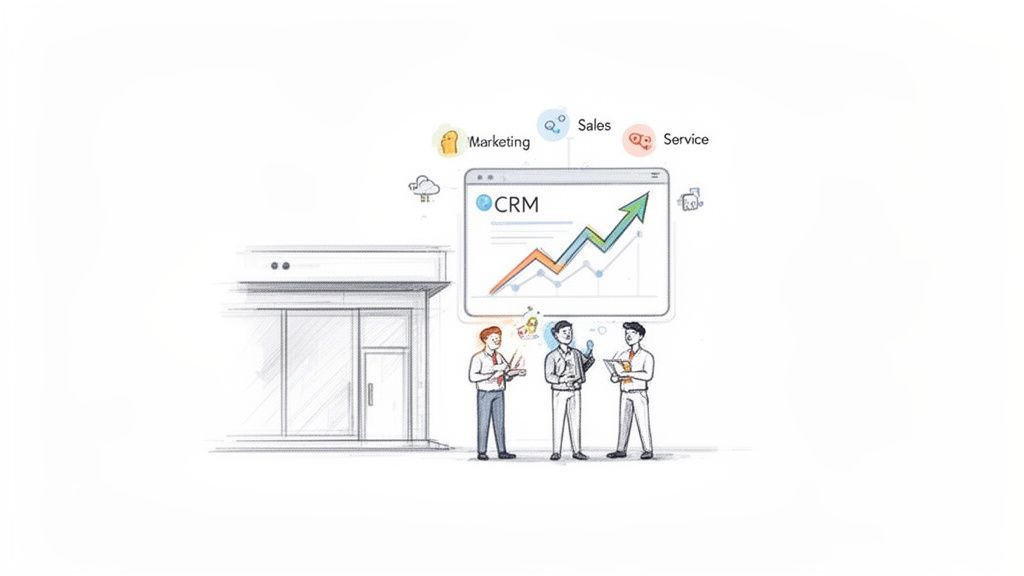
The conversation around Artificial Intelligence has moved from sci-fi to the C-suite, especially for nimble businesses. For companies with fewer than 500 people, AI is a huge opportunity to punch way above your weight class. It’s the kind of tool that can level the playing field against bigger competitors who are often stuck in bureaucratic mud.
A smart AI strategy isn’t about chasing every shiny new tool that pops up. It's about fundamentally rethinking your core processes across sales, marketing, and service to find new levels of efficiency. The goal is simple: cut through the hype and focus on what actually moves the needle.
Moving Beyond Basic Use Cases
Many business leaders think of AI as a simple task-doer—something to summarize meeting notes or draft a quick email. Those things are useful, but that's just scratching the surface. The real magic happens when you treat AI as a strategic partner to solve complex problems that directly hit your bottom line.
Think about the daily friction points in your business. Where do your teams burn the most hours on manual, repetitive work? Where are the blind spots in understanding your customers? Those are your starting points.
Practical Examples
- Sales Acceleration: An AI-powered tool plugged into your CRM automatically enriches new lead profiles. It pulls in company data, social media activity, and recent news mentions in seconds. This eliminates manual research time and gives your sales team the context they need for a meaningful first conversation.
- Marketing Precision: AI algorithms can analyze customer data to pinpoint your most profitable segments. This lets you build hyper-targeted campaigns that resonate, boosting conversion rates and stopping wasteful ad spend.
- Service Efficiency: An internal AI chatbot, trained on your company’s knowledge base, can give instant, accurate answers to common employee questions—from HR policies to IT troubleshooting. This frees up your support staff to handle more complex issues.
This is how you turn AI from a cool toy into a core part of your growth engine. It’s all about solving real business challenges, not just adopting tech for the sake of it.
The Accelerating Pace of Adoption
If you're still on the fence, look at what your peers are doing. The trend is crystal clear: businesses that wait are going to get left behind. The latest data paints a pretty dramatic picture.
Impact Opportunity
Recent small business AI adoption statistics from the U.S. Chamber of Commerce show that 58% of small businesses now use generative AI—more than double the 23% from the previous year. And, an overwhelming 96% of SMB owners are planning to adopt emerging technologies like AI, signaling a huge wave of optimism.
The data sends a clear message. It's no longer a question of if you should adopt AI, but how—and how quickly. Building a thoughtful AI strategy is your first, most critical step.
Key Takeaway: For a company under 500 employees, your AI strategy should zero in on solving specific business problems, not just adopting trendy tools. Target high-impact, low-effort wins in sales, marketing, and operations to build momentum and prove ROI fast.
Finding Your First High-Impact AI Wins
The secret to a smart AI strategy for companies under 500 employees is to forget about boiling the ocean. Don't think in terms of a massive, company-wide overhaul. The real goal is to score small, strategic victories that build momentum and prove the concept.
We're looking for specific, high-impact use cases that deliver measurable returns, fast. This is how you win over skeptical stakeholders and get your teams excited. It’s all about finding the low-hanging fruit—those daily friction points that, once you smooth them over with an AI solution, make a tangible difference in everyone's day.
Mapping Challenges to AI Solutions
Start by looking at your core business processes. Where are the real bottlenecks? What are the repetitive, mind-numbing tasks that eat up your team's valuable time? Forget about the AI tools for a minute; just think about the business problems.
A great way to start is by crowdsourcing pain points from each department:
Practical Examples
- Sales Team Friction: Are reps spending more time on pre-call research than on selling? Is lead follow-up slow? Is lead qualification inconsistent?
- Marketing Inefficiencies: Is personalizing campaigns at scale a nightmare? Are you guessing which channels deliver the best ROI? Does it take forever to create new content?
- Operational Headaches: Think about manual data entry from invoices, clunky internal knowledge bases, or long delays in customer support responses.
Once you have a list of real-world challenges, you can start mapping them to actual AI solutions. This completely reframes the conversation. You’re no longer saying, "We need AI." You're saying, "We need to solve this specific problem, and it turns out AI is the best way to do it."
Key Takeaway: The most effective AI projects don't start with a cool piece of tech. They start with a well-defined business problem. Find a significant pain point and work backward to find the tool that solves it. That’s how you guarantee a clear path to ROI.
Real-World Examples of Quick Wins
Let's make this concrete. A classic challenge for any growing sales team is the sheer volume of manual work needed just to qualify and research new leads. This is a perfect candidate for a first AI project.
Impact Opportunity
Take a national pest-control brand we worked with. They were struggling with slow lead-to-appointment times, which was killing their conversion rates. By plugging a simple AI-powered lookup tool directly into their CRM, they could instantly enrich every new lead with property details and service history.
It was a small change, but it allowed their team to provide faster, more accurate quotes on the spot. The result? A 69% faster lead-to-appointment time.
Another popular first project is learning how to build an AI chatbot for customer service or even internal use. Imagine an internal bot trained on your HR policies. It can instantly answer employee questions about benefits or time off, freeing up your HR team from answering the same five questions over and over.
The common thread here is impact and simplicity. These are focused, surgical solutions that fix a specific, costly problem and deliver value within weeks or months. For a deeper dive on using AI to fill your pipeline, check out our guide on AI-powered lead generation.
Designing and Measuring Your First AI Pilot
Turning a promising idea into something that actually drives revenue takes a real plan. Your first AI pilot is the proving ground—it's where you show real value and build the case for putting more money behind the effort down the road. For any company with under 500 employees, a solid AI strategy absolutely depends on getting this first step right.
The goal here isn't perfection. It's progress. Think of a well-designed pilot as a controlled experiment. You get to test your theory on a small scale, collect hard data, and learn what works without betting the farm.
Defining a Narrow and Achievable Scope
The single biggest mistake leaders make is trying to do too much, too soon. A successful pilot needs an incredibly narrow scope. Your one and only goal should be to solve one specific, high-friction problem for a small, well-defined group of users.
Practical Example
Instead of a vague goal like "improving sales productivity," a much better pilot scope is "reducing manual research time for our three-person account executive team by 75%." That kind of specificity is everything because it makes success dead simple to define and measure.
This flowchart maps out how to connect a real business challenge to a measurable AI solution, which is the heart of any pilot project that actually goes somewhere.
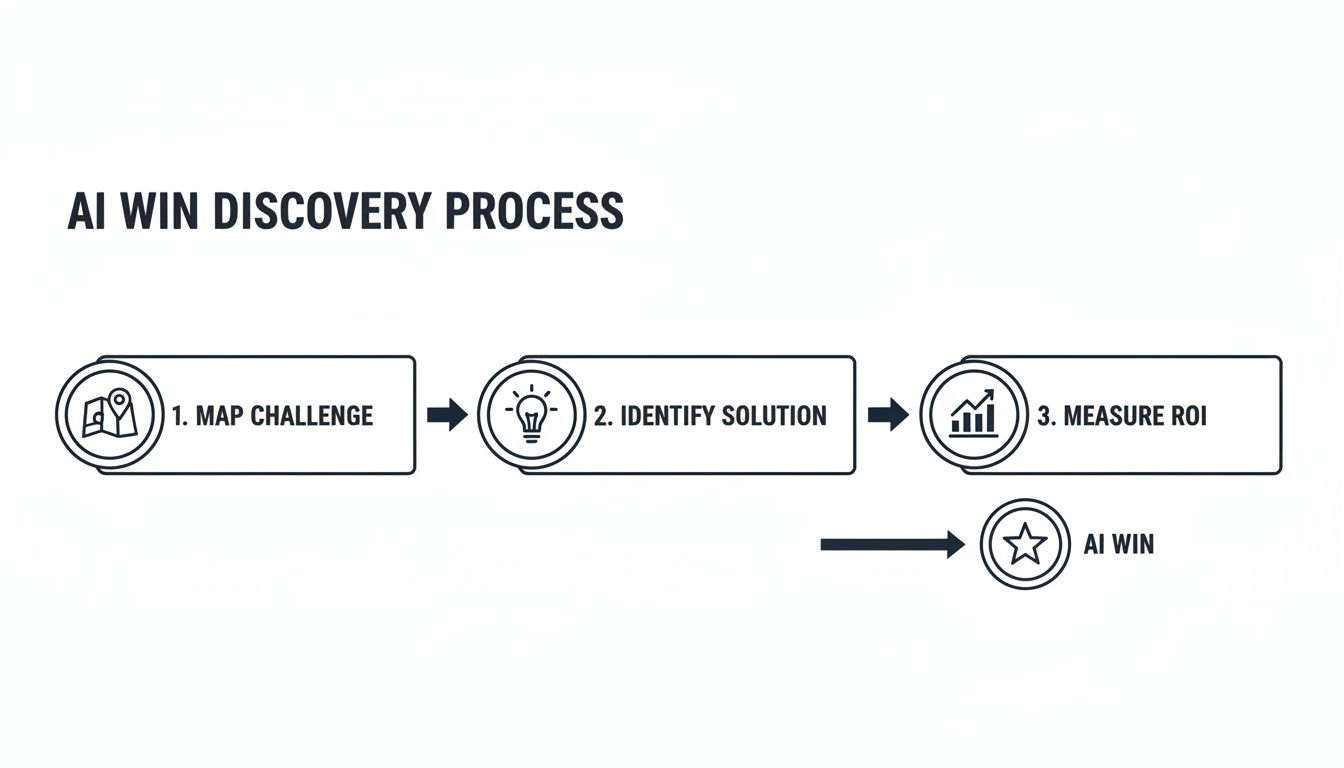
When you clearly name the problem, pick the right tool for that problem, and focus on a specific return on investment, you create a straight line to proving value.
Assembling Your Internal Dream Team
Good news: you don't need a huge team for a pilot. In fact, a small, nimble group is far better. Your ideal pilot team has just three key players:
- The Champion: A leader (that's probably you) who can clear roadblocks and remind everyone why this matters.
- The Power User: Someone from the trenches—like a top-performing sales rep—who will actually use the tool and give you honest, ground-level feedback.
- The Technical Lead: The person who knows your current tech stack inside and out (like your CRM admin) and can figure out if and how a new tool will integrate.
This small crew can move fast, make decisions without endless meetings, and give you direct, unfiltered feedback on what’s working and what isn’t. If you're wondering about your team's overall readiness, you might find our guide on understanding your company's AI Quotient helpful.
Establishing Crystal-Clear KPIs Before You Start
How will you know if this whole thing was a success? You have to define your key performance indicators (KPIs) before a single dollar is spent. These metrics can't be fluffy; they need to be tangible and tied directly to the business problem you're solving.
Vague goals like "increase efficiency" are totally useless. You have to get specific.
Practical Example
Imagine a marketing team piloting an AI tool to help write blog posts because their biggest bottleneck is just getting a first draft done.
Here’s how they could frame their pilot KPIs:
- Primary Metric (Efficiency): Reduce the time to create a first draft of a 1,500-word blog post from 8 hours down to 2 hours.
- Secondary Metric (Cost): Decrease reliance on freelance writers, leading to a $500 per article cost saving.
- Tertiary Metric (Quality): Ensure the average time-on-page for AI-assisted articles is the same or better than their manually written baseline.
These aren't just numbers; they tell a compelling story of business impact. After a 30- or 60-day pilot, you can walk these results into a leadership meeting and make the decision to scale up a logical, data-driven no-brainer.
Key Takeaway: Success metrics must be framed in the language of business outcomes, not tech features. Link every KPI back to time saved, money earned, or costs cut to build a powerful business case that leadership understands.
Weaving AI Into Your Tech Stack
An AI tool that doesn't talk to your other systems is just a shiny object. The real power comes alive when new capabilities are woven directly into the technology you already rely on—especially your Customer Relationship Management (CRM) platform.
This is where the magic happens, turning abstract data into tangible business outcomes.
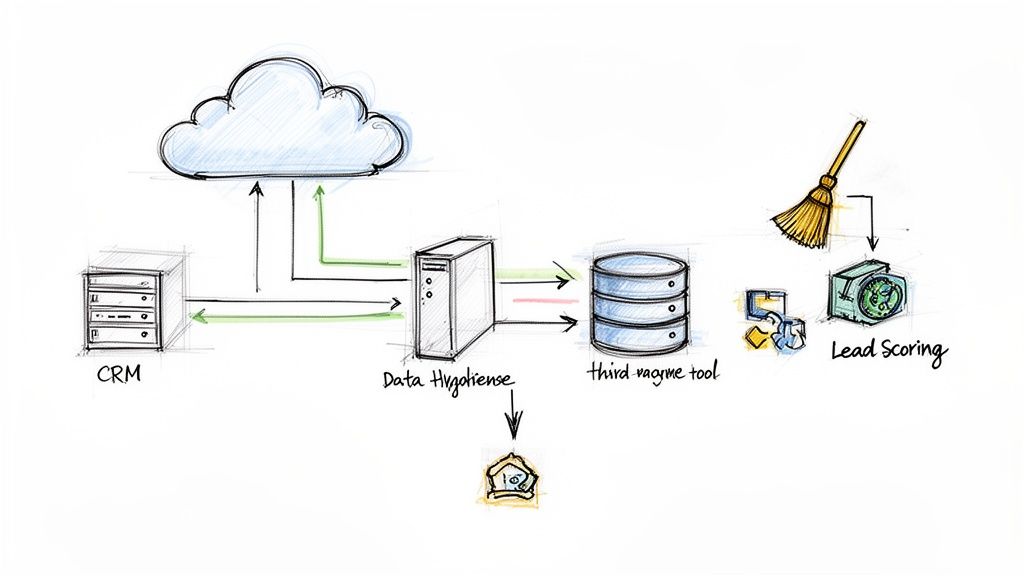
The process is less about a massive technical overhaul and more about building smart, stable bridges between your systems. You want a seamless flow of information that enables your team, not one that creates more headaches. A solid integration ensures your AI tools have the clean, reliable data they need to actually work.
Is Your CRM Ready for AI?
Before you plug anything in, you need to take an honest look at your core systems. Your CRM is the heart of your customer data, so its ability to connect with other tools is non-negotiable. Most modern CRMs are built for this, but it’s something you have to verify.
Start by asking a few key questions:
- Does our CRM have a strong API? An Application Programming Interface (API) is the digital doorway that lets different software communicate. A well-documented, flexible API is absolutely essential.
- Are there native integrations? Many popular AI tools offer pre-built connectors for major CRM platforms like HubSpot or Salesforce. These "plug-and-play" options can save a ton of time and money.
- What are our data access limits? You need to understand any restrictions on how often you can pull data or the volume of information you can sync. This will dictate which AI tools are even a possibility.
Getting clear answers here sets the stage for a smooth integration. It helps you avoid the classic pitfall of picking an exciting AI tool only to find out it’s incompatible with your most critical tech.
The Make-or-Break Role of Data Hygiene
The single most common reason AI projects fail is bad data. An AI algorithm is only as good as the information it's fed. If your CRM is a graveyard of duplicate contacts, outdated info, and inconsistent formatting, your results will be unreliable at best.
Key Takeaway: Think of data hygiene as the foundation of your AI house. If the foundation is cracked, everything you build on top of it will be unstable. Prioritizing clean data isn't just a best practice; it's a prerequisite for getting any real value from AI.
Cleaning up your data doesn't have to be a monumental task. You can start small by focusing only on the specific data points your first AI pilot will use.
Practical Example
Imagine you're implementing an AI-powered lead scoring tool. Its job is to analyze new leads and predict which ones are most likely to close, helping your sales team focus their energy. For this tool to work, it needs clean data fields like Job Title, Company Size, Industry, and Lead Source. Before you launch the pilot, your first step is to run a data cleanup focused only on these four fields for incoming leads. It’s a targeted approach that’s far more manageable than trying to clean your entire database at once.
Keeping Data Clean as It Flows
Once your data is clean, you have to keep it that way. This means setting up clear rules and processes for how data moves between your systems. Creating a simple data map is a great way to visualize these connections and spot potential points of failure before they happen.
Impact Opportunity
A mid-sized manufacturing firm wanted to use an AI tool to predict customer churn. They connected it to their CRM and ERP system, but the initial predictions were nonsensical. The problem was a simple data mismatch. Their CRM used the term "Active Client," while their ERP used "Current Customer." The AI couldn't reconcile the two, leading to completely flawed analysis. By creating a unified data dictionary and standardizing these key terms, they were finally able to get accurate, actionable predictions that ended up saving several key accounts.
This highlights why a thoughtful integration plan is so crucial. The technical side of connecting systems is often the easy part; the real work lies in ensuring the data flowing between them is consistent and ready for analysis. For a deeper look at building these connected systems, our insights on AI enablement services offer a more structured approach.
Driving Team Adoption and Managing Change

Here's a truth that trips up a lot of leaders: getting a new AI tool up and running is the easy part. The real work—and the part that actually determines if you see any ROI—is getting your team to use it consistently. A smart ai strategy for companies under 500 employees has to be just as much about people as it is about platforms.
It’s a common blind spot. You’ve built a rock-solid business case, but adoption stalls out. This is why a solid change management plan is necessary to flip the script from skepticism to genuine buy-in.
Communicating the Personal Win
Resistance to new tech almost always comes down to one thing: fear. People worry AI is here to replace them, or at the very least, to make their jobs more complicated. Your first move is to get ahead of that narrative and reframe it.
You have to position every new tool as a "co-pilot," not a replacement. Its job is to take the most tedious, mind-numbing tasks off their plate. The message has to be dialed into the "what's in it for me?" frequency for every single role.
Practical Examples
- For your sales reps: "This new tool handles all your pre-call research and logs your CRM notes automatically. That’s five hours back in your week to do what you do best—talk to customers and close deals."
- For your marketers: "This AI will analyze campaign data in real-time and show you exactly what’s working, so you can put your budget where it will actually drive results."
- For your customer service team: "We’re launching an internal bot to handle the same 20 questions you get all day. This frees you up to tackle the tough, high-value problems where your expertise really shines."
This isn't about replacing human judgment; it's about amplifying it. The tool becomes a personal assistant, not a threat.
Key Takeaway: Successful AI adoption is a communication challenge, not a technical one. You have to frame every new tool around its direct, personal benefit to the user. Show them how it eliminates grunt work so they can focus on the strategic, fulfilling parts of their jobs.
Identifying and enabling Champions
You can't force adoption from the top down. It just doesn't work. What you need are allies on the ground floor who can build momentum from within.
Look around. In every team, there are a few people who are naturally curious and tech-savvy. They’re the ones who are already playing with new apps on their own time.
These are your champions. Pull them into the pilot process early on. Give them a bit of extra training and make it clear they’re the go-to experts for their peers. When a skeptical employee sees a respected teammate using a new tool effectively, their mindset shifts. That kind of peer-to-peer validation is infinitely more powerful than any corporate memo. As you navigate these shifts, it’s worth digging into guides on Mastering Change Management in Technology for deeper strategies.
Building a Simple Training and Feedback Loop
Forget the two-hour, one-and-done training lecture. For smaller, agile companies, a series of short, focused, hands-on sessions is far more effective. Pick one or two core workflows and get people using the tool right away.
Impact Opportunity
A 150-person logistics company rolled out an AI-powered routing tool. At first, adoption was terrible because drivers found it confusing. Instead of scrapping it, they launched a 15-minute weekly "Tips & Tricks" huddle. Each week, they’d highlight one new feature and have a top-performing driver show exactly how they used it to save time on a route. They also set up a simple Slack channel for questions and feedback. Within a month, usage had tripled. Why? The training was relevant, peer-driven, and continuous.
This approach creates a powerful feedback loop. You can spot friction points immediately and adjust, which shows your team you're actually listening. It makes them partners in the rollout, not just people being told what to do.
Scaling Your AI Strategy From Pilot to Permanent
A successful pilot isn’t the finish line; it’s the starting gun. The whole point is to arm yourself with hard data and rally internal champions to make the case for a bigger, permanent role for AI in your business. This is where your AI strategy for companies under 500 employees pivots from a neat experiment into a real part of your growth engine.
Moving from a single-point solution to a company-wide capability takes a deliberate, step-by-step approach. You have to build on your early wins, sidestep the common scaling mistakes, and start weaving AI into the very fabric of your company.
From Pilot Data to Business Case
First things first: you need to turn your pilot's results into a story that gets leadership excited. The KPIs you set up are your raw ingredients, but you need to cook them into a compelling narrative about business impact. Frame every outcome in terms of tangible value.
Practical Example
Don't just say, "the AI tool reduced manual data entry." Frame it like this: "Our sales team got back 50 collective hours last month. They used that time for direct selling, which helped grow our qualified pipeline by 10%."
This simple reframing shifts the conversation from a tool's features to a strategic decision about where to invest for a real competitive advantage.
Key Takeaway: Think of your pilot's final report as a sales document. Its only job is to sell the future of AI in your company. Lead with the outcomes—time saved, costs cut, revenue generated—and build a case for more investment that’s impossible to ignore.
Creating a Phased Rollout Plan
Trying to deploy AI everywhere at once is a classic recipe for disaster. A phased rollout lets you manage the change, listen to feedback, and prove value at every single stage. Look at what worked in the pilot and identify the next logical departments or use cases for expansion.
Impact Opportunity
A 200-employee distribution company ran a pilot with an AI tool to optimize inventory forecasting for one product line. They cut stockouts by 30%. Huge win. Their phased plan looked something like this:
- Phase 1 (Q1): Expand the forecasting tool to their three highest-volume product lines.
- Phase 2 (Q2): Connect the AI to their procurement software to automate reordering for those specific lines.
- Phase 3 (Q3): Roll out the fully integrated solution across all remaining product categories.
This methodical approach keeps each step manageable and builds on the success of the last one. It minimizes disruption and gets more people on board along the way.
Establishing Light Governance
As you scale, you'll need a lightweight framework to guide decisions without drowning everyone in bureaucracy. For a company your size, a small, cross-functional "AI council" is usually more than enough. Pull together a few leaders from IT, operations, and a key business unit. Have them meet quarterly to review AI performance, prioritize new ideas based on business needs, and ensure data security standards are being met. This simple structure provides just enough oversight to keep your AI strategy tied to company goals and prevents disconnected, "shadow AI" initiatives.
Common Questions Answered
How Much Should We Budget For An AI Strategy?
There’s no magic number here. For a company with under 500 employees, a great starting point is a pilot project using an off-the-shelf tool. This could run anywhere from a few hundred to a few thousand dollars a month. The whole point is to generate a clear, measurable return that funds whatever comes next. Steer clear of huge upfront investments and instead, let proven results drive your budget.
Key Takeaway: Start small with subscription-based AI tools for one specific pilot. A successful test run will generate the ROI you need to justify a larger budget, proving the value with minimal risk.
What Are The Biggest Risks Of AI For A Smaller Company?
The biggest risks are strategic, not technical. The most common stumbles include:
- Getting distracted by new technology instead of solving a real business problem.
- Feeding the system bad data, which leads to flawed outcomes ("garbage in, garbage out").
- Failing to plan for the human side of change, leading to low team adoption.
The best way to sidestep these issues is to tie every single AI initiative to a clear business outcome from day one.
Do We Need To Hire Data Scientists To Implement AI?
Not for your first steps. The market is full of powerful, user-friendly AI software that plugs right into systems you already use, like your CRM. For smaller businesses, the smartest move is to buy these ready-made solutions for high-impact uses like lead scoring or marketing automation. Don't even think about trying to build custom models from scratch—at least not yet.
Ready to build an AI strategy that actually drives revenue? The team at Prometheus Agency helps B2B leaders turn their existing tech into a scalable growth engine, starting with a complimentary Growth Audit. Book your AI strategy session today.