The growth executive's deck is full of AI pilots. Marketing has a content assistant, sales has a call summarizer, and service is testing a chatbot. Finance asks the obvious question: which initiative changed revenue, cost, or margin? Nobody can answer because the pilots started without a baseline, an accountable owner, or a rule for deciding what happens next.
That challenge in AI strategy for business is significant. Companies don't need a longer list of tools. They need an operating model that turns selected workflows into measurable outcomes, while making clear where AI can recommend, act, or must escalate to a person.
Why Most AI Strategies Stall Before They Start
A crowded pilot portfolio can look like progress in a board presentation. It isn't progress if each project has a different owner, no shared measure of success, and no plan to change the work around the technology.
McKinsey's 2025 global survey found that 88% of respondents said their organizations regularly used AI in at least one business function, yet only 39% reported any enterprise-level EBIT impact. Most of those who saw an impact said AI contributed less than 5% of EBIT. Adoption is widespread; material financial impact is not. McKinsey's 2025 State of AI survey makes the distinction executives need to keep in view: usage measures deployment, while EBIT measures business results.
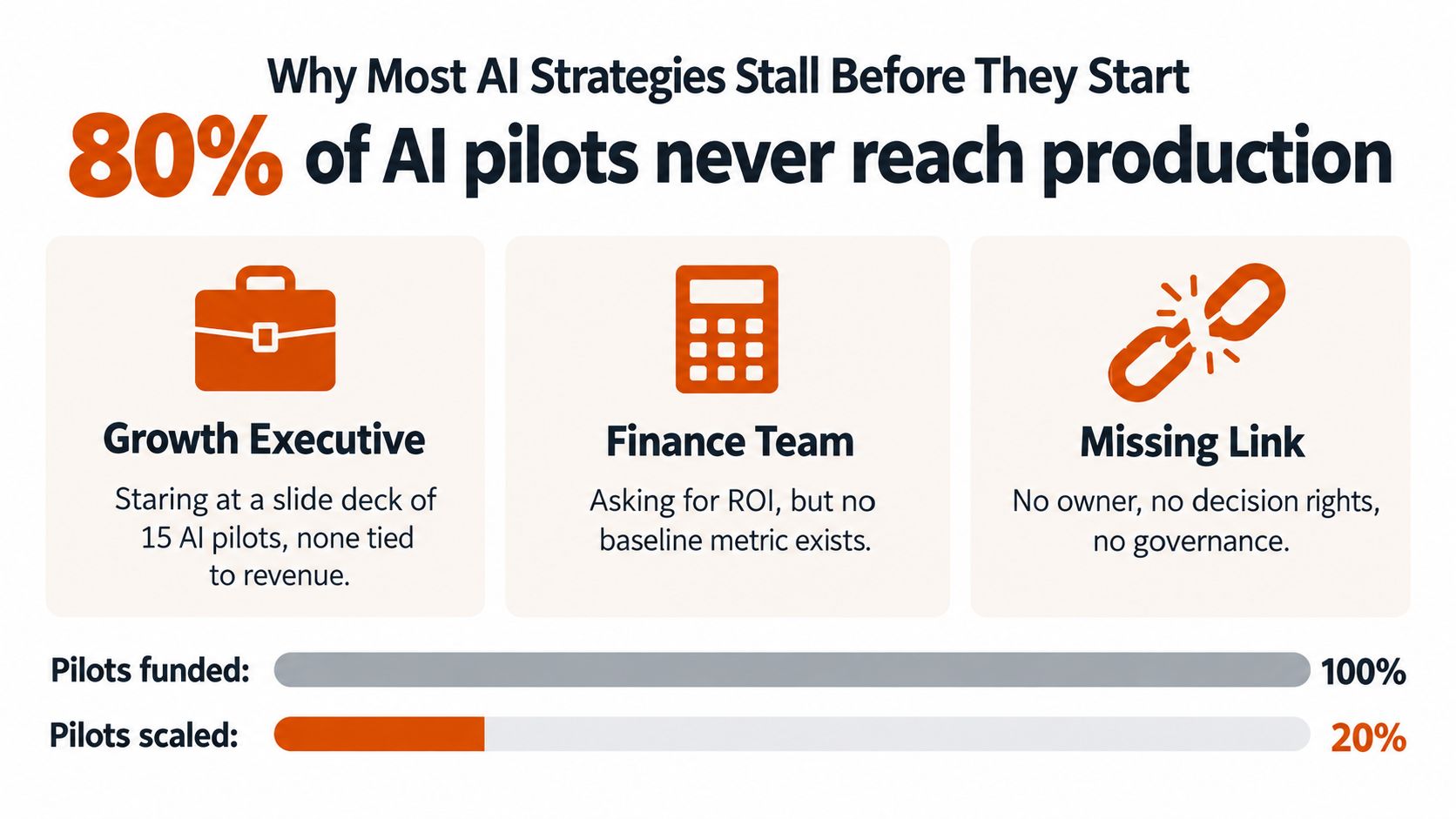
The infographic's 80% headline and its example of 15 pilots are not evidence to use as company-wide benchmarks. They illustrate a familiar failure pattern: pilots disconnected from a revenue target, a finance-approved baseline, or a defined decision about scaling. The verified survey data is enough to make the point. A company can use AI in several functions and still struggle to translate that activity into enterprise financial impact.
Make the Missing Link Explicit
When a pilot stalls, leaders often blame the model. In practice, the missing pieces are more often operational: no one owns the outcome, teams haven't redesigned the workflow, or the company can't tell whether the system improved performance. If a sales assistant drafts outreach, for example, message volume alone doesn't show whether the work helped move qualified prospects toward opportunity.
The fix is to treat AI as an operating-model choice, not a tooling choice. Start with a business problem, identify the workflow where it occurs, set a baseline, and name an owner who can make a scale-or-stop decision. Then define the risk boundaries and the employee responsibilities before the system touches customer-facing work.
Boardroom test: If the finance team can't connect a pilot to a baseline metric and an accountable owner, the business hasn't made a case for scaling it.
What an AI Strategy Actually Is
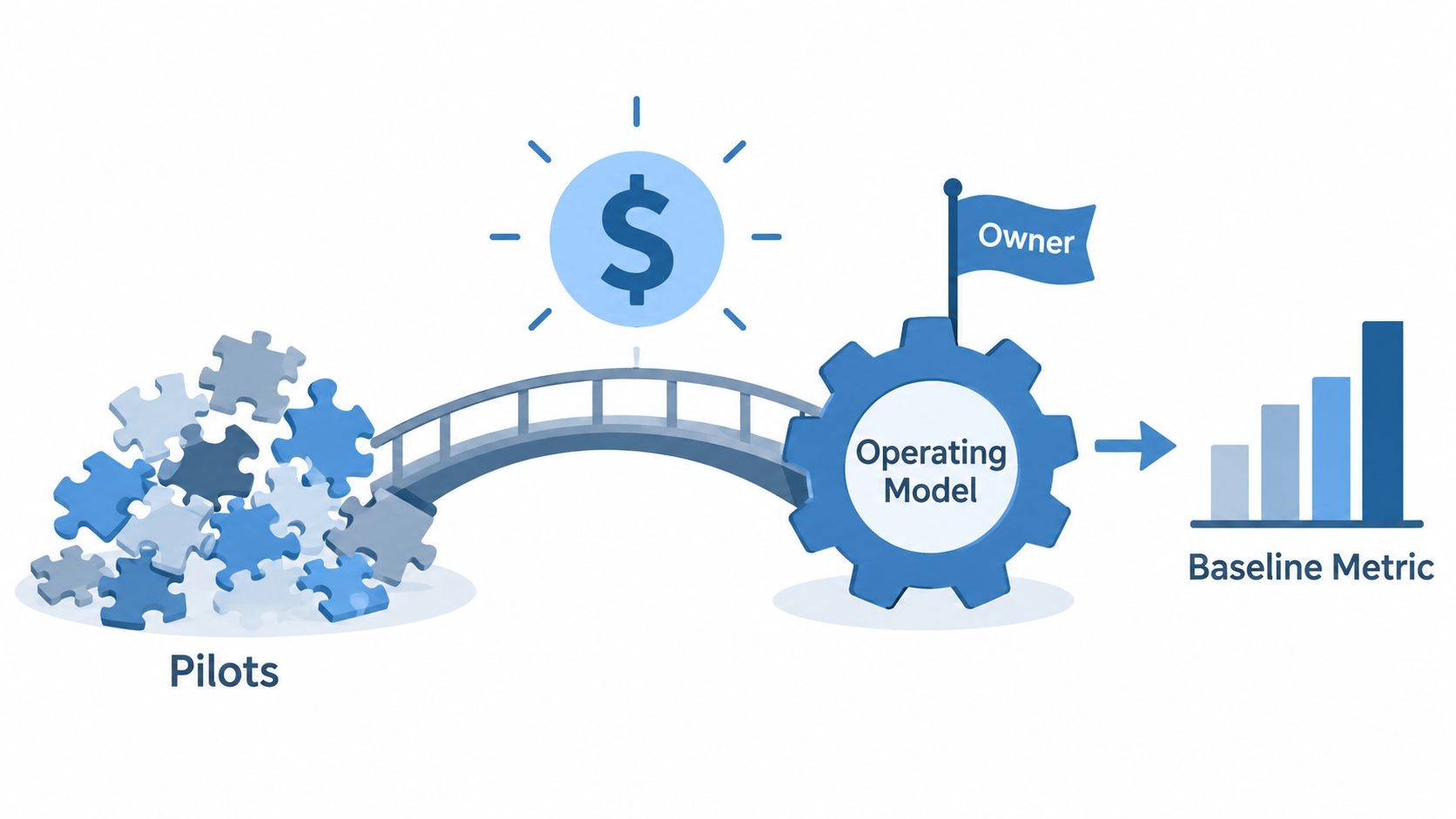
An AI strategy is a finance-ready operating model. It connects each initiative to a business outcome, a baseline metric, an accountable owner, a measurement window, and a scale-or-stop threshold. A list of vendors and experiments doesn't meet that standard. Neither does a policy document that describes acceptable AI use but says nothing about how the company will create and measure value.
The investment context reinforces why leaders need this discipline. Stanford University's 2025 AI Index reports that 78% of surveyed organizations used AI in 2024, up from 55% in 2023. It also reports that global private investment in generative AI reached $33.9 billion in 2024, an 18.7% increase from 2023 and more than 8.5 times the 2022 level. Stanford's 2025 AI Index shows the scale of adoption and investment, but neither investment nor use proves that a specific company's AI program is producing returns.
Four commitments make the strategy concrete
A durable strategy makes four commitments. Outcomes define the business result, such as better lead-to-opportunity conversion or lower service cost per case. Capabilities cover the data, integrations, systems, and expertise needed to make the workflow work. Governance sets boundaries, owners, and controls. Adoption defines how employees will use the system in their daily work and how leaders will know whether it has become part of the process.
Think of the strategy as a sales playbook, not a software procurement plan. A playbook says who qualifies a lead, when a seller follows up, how exceptions get handled, and what success looks like. Buying a CRM doesn't create that discipline by itself; buying AI won't either.
For leaders who need a structured way to connect investment decisions to enterprise implementation, this overview can help them operationalize AI investment. Use resources like it to sharpen the operating model, then make your own commitments explicit: which workflow changes, who owns the result, and what evidence earns the next investment.
Mapping Value and Assessing Capability
Don't start by asking which AI product to buy. Start with the workflow that matters to revenue, cost, risk, or customer experience, and identify a baseline that already exists or can be reliably established. A use case without a measurable handoff to an outcome is a weak candidate, even if the demo is impressive.
In CRM, a team might target lead-to-opportunity conversion by helping reps prioritize and follow up on qualified prospects. In marketing, AI might support campaign analysis or content workflows, but the relevant measure should reflect business performance, not how many assets the system generates. In service, a team could explore support deflection or case summarization, provided it also tracks whether customers get accurate help and whether agents can resolve exceptions.
Match the opportunity to what the business can support
Value alone isn't enough. Assess data readiness, integration maturity, available talent, and executive sponsorship. A churn prediction use case depends on trustworthy customer and product data, while a sales-call summarizer needs access to the right call records and a process for getting useful notes into the CRM. If the required information is fragmented or the workflow has no clear owner, the team should fix those constraints before funding a larger deployment.
Use this table to turn promising ideas into testable candidates:
| Business Function | Representative AI Use Case | Baseline Metric | Data Dependency |
|---|---|---|---|
| Sales and CRM | Lead prioritization or call summarization | Lead-to-opportunity conversion or sales-cycle duration | CRM history, lead status, and interaction records |
| Marketing | Campaign analysis or content support | Campaign contribution to qualified pipeline | Campaign, audience, and pipeline data |
| Service | Case summarization or support deflection | Service cost per case and resolution quality | Case records, knowledge content, and escalation outcomes |
| Revenue operations | Forecast support | Forecast accuracy | CRM pipeline stages, history, and definitions |
Pressure-test the shortlist with RevOps and data teams. Ask where the baseline comes from, whether the source data reflects how the business works, which system must receive the AI output, and who will handle exceptions. A focused AI readiness assessment can help teams surface these constraints before they mistake a data or process problem for a model problem.
Choose opportunities where business value and capability overlap. A high-value workflow with poor data may need foundational work first; a capable team with no clear financial outcome shouldn't build a pilot just because implementation is easy.
Quick-Win Pilots Versus Full Transformation
A quick-win pilot tests one workflow with one team against one metric, within a defined period. A transformation program changes how multiple functions work together, embeds AI into CRM and operational systems, and assigns shared ownership across teams. The pilot learns whether a specific intervention works. Transformation changes the process so a proven intervention can become part of normal operations.
Forrester reported that more than 70% of surveyed organizations had generative or predictive AI in production, yet few were measuring its financial impact or investing for long-term transformation. That finding, reported in Forrester's State of AI 2025, is a warning against treating “in production” as proof of value. A system can be live while its financial contribution remains unclear.
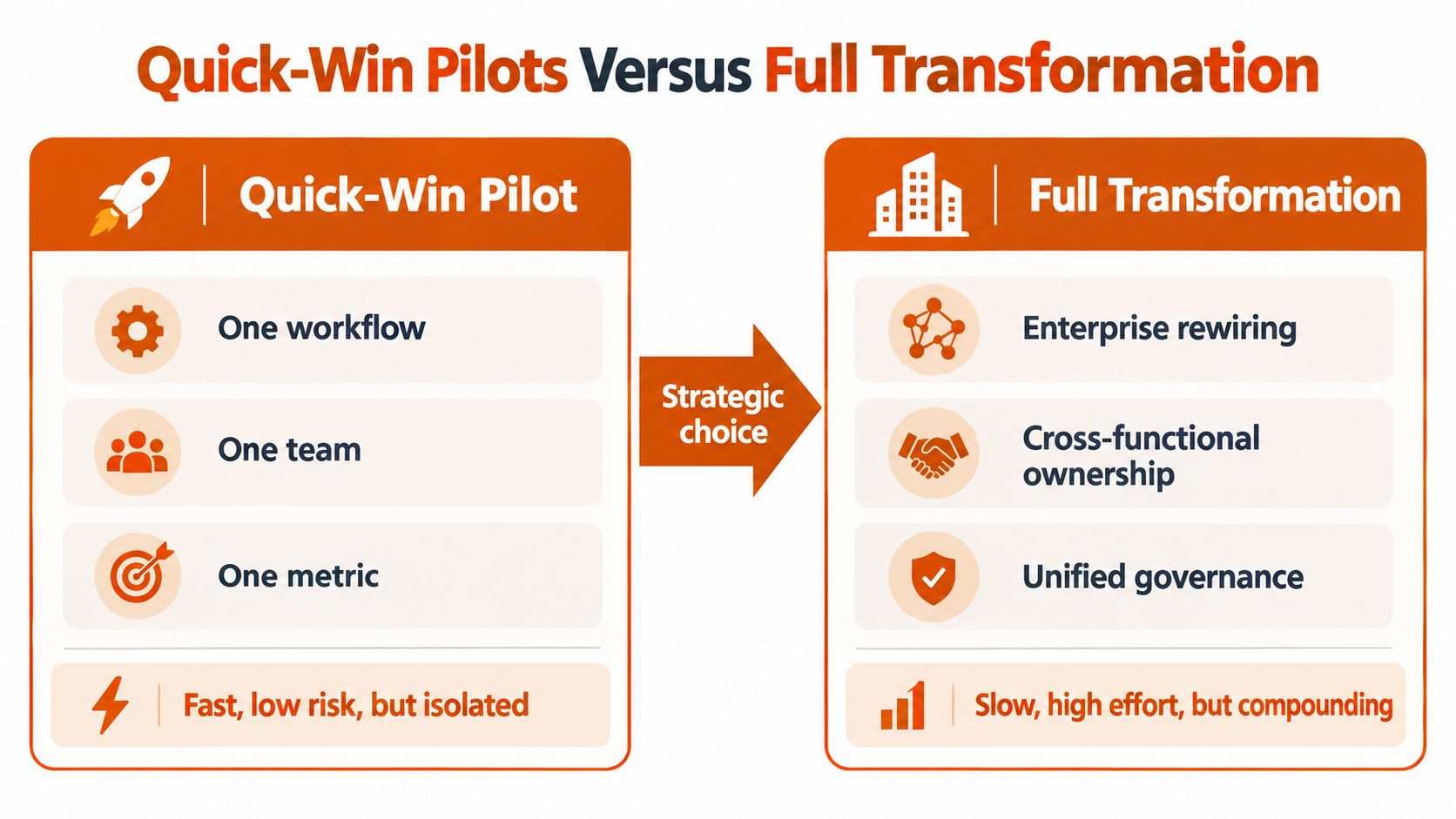
The trade-off is straightforward. Pilots are easier to contain, but they can stay isolated. Transformation takes more coordination and organizational effort, but it can connect workflows across teams rather than leaving each group with its own tool and process.
Fund evidence before expansion
A staged funding model avoids the false choice between endless experimentation and a premature enterprise rollout. Give a pilot a clear scope, an owner, a baseline, and a decision gate. If it meets the agreed business, quality, and adoption criteria, fund the work needed to integrate and scale it. If it doesn't, stop or redesign the workflow rather than protecting the project because its demo looked polished.
Promote a pilot when the result is measurable, employees use it in the intended process, exceptions can be managed, and the implementation costs are understood. Kill or revise it when the baseline is missing, the output needs constant manual correction, the workflow depends on unreliable data, or the team can't explain how the system fails.
That doesn't mean every initiative must prove an immediate revenue lift. Some work builds an essential capability. But leaders should name it as foundational work, explain what it enables, and make the next decision explicit. Teams moving from controlled tests toward deployment can use this pilot-to-production guide to keep that transition tied to operational readiness rather than enthusiasm.
Data, Tooling, and Integration Essentials
AI inherits the strengths and weaknesses of the workflow and information it touches. If CRM records are incomplete, customer identities are duplicated, or permission rules are unclear, a more capable model won't repair the underlying operating problem. For growth and service use cases, data quality is a business control, not a back-office cleanup task.
Give the operations lead a sequence, not a shopping list:
- Clean the source: Confirm that customer, account, opportunity, and case records are consistent enough for the intended workflow.
- Set access boundaries: Define which data the system may use and whether each user or process has permission to see it.
- Design the integration: Decide where outputs go, which systems remain authoritative, and how employees correct errors.
- Test the workflow: Evaluate accuracy, drift, latency, and cost per transaction alongside quality and adoption.
Buy for common work, build for differentiation
A vendor's feature count is a poor substitute for fit. Compare off-the-shelf tools with custom development based on workflow specificity, integration effort, data constraints, support, and the cost of maintaining the solution. Buying can make sense for a standard task; building may be justified when proprietary data or a distinctive process is central to the business. Many organizations will use both, but the reason for each choice should be clear.
Ask vendors for documentation about capabilities and limitations, evaluation evidence, data-use terms, incident handling, and commitments to notify customers about material changes. A model that writes fluent answers but can't show where its response came from may be unsuitable for a customer-facing workflow.
Snowflake's 2025 research found that two-thirds of respondents were beginning to quantify generative-AI ROI and reported an average return of $1.41 for every dollar spent. Treat that self-reported result as a reason to measure carefully, not as a return your company should expect. Before procurement, calculate your own baseline, implementation costs, change-management needs, and measurement plan. A tool earns its place when it fits the workflow and supports a result the business can verify.
Governance, Decision Rights, and Change Management
Governance works when it tells people who can do what, under which conditions, and who takes over when the system reaches a boundary. A useful decision-rights architecture separates three actions: recommend, execute, and never. In a CRM workflow, AI might recommend which lead a rep should contact next. It could execute a routine record update within defined permissions. It should not make a consequential customer decision that the business has reserved for a human.
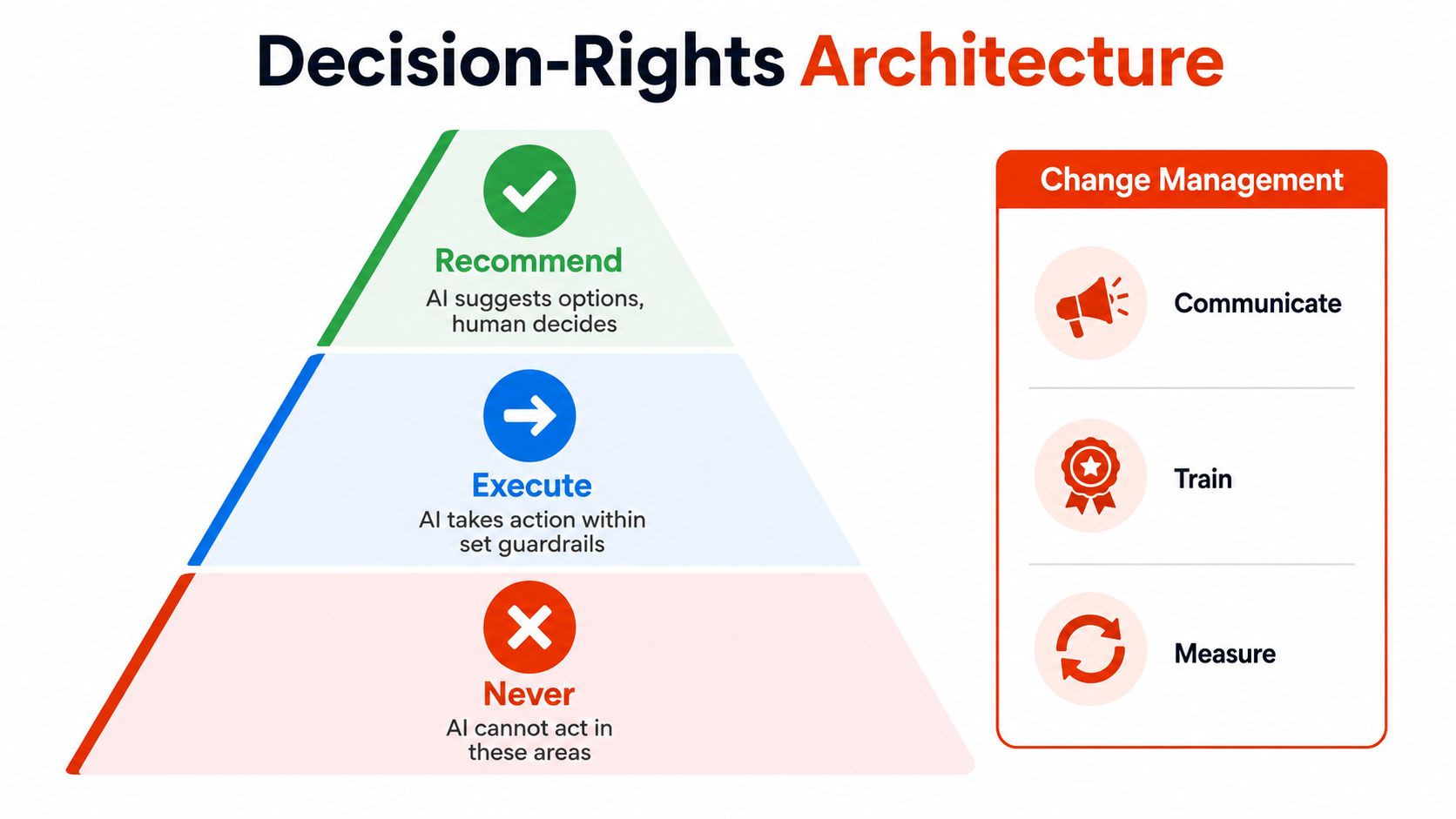
The same logic applies to marketing and service. A system may recommend a campaign segment, execute an approved routine action, or escalate when data quality falls below the accepted threshold. A service assistant may draft a response for an agent, but cases that carry heightened customer or business risk should go to a person. Set those boundaries by workflow, not with a company-wide statement that AI is “approved.”
Put governance into the lifecycle
NIST's AI Risk Management Framework organizes the work around govern, map, measure, and manage. It calls for documenting legal requirements, assigning roles and responsibilities, defining evaluation metrics, and determining whether a system achieves its stated objectives. NIST's AI RMF guidance gives leaders a practical vocabulary for putting those controls into operation.
For each workflow, name the business owner, define acceptable error and review conditions, record how outputs are logged, and establish an escalation and rollback path. Monitor performance and exceptions in operation. Reassess controls when a system, workflow, or data source changes materially. Teams designing controls for systems that can take action may also find this guide to governing AI agents useful as a reference point.
Change management is part of the same control system. Employees need to know when to use AI, when to challenge it, and how to report a failure. Managers should reinforce the changed workflow, not merely announce a new tool. Track whether teams adopt the intended process, whether they override outputs, and whether customers experience better or worse service. Governance without employee participation becomes paperwork; adoption without clear responsibility becomes unmanaged risk. This perspective on AI transformation and governance can help leadership teams frame the organizational work behind implementation.
Why Staged Autonomy Beats Bigger Models
Model sophistication is only one design choice. The more consequential decision is how much authority the system gets inside a particular workflow, and whether the business can catch and reverse a mistake. Increase autonomy only when the data is reliable, the process is mature, and exceptions have a clear owner.
EY's 2025 survey of 500 senior decision-makers found that only 14% reported agentic AI as fully implemented, despite approximately 34% having started implementation. That gap points to a practical lesson: starting an agentic initiative is not the same as being ready to let a system act across business processes.
Test reversibility before granting authority
Consider manufacturing quality control. An AI system might first flag a potential defect for an inspector to review. If the inspection process is reliable and the team can trace outcomes, it may later support a controlled action, such as routing a flagged item for additional inspection. The escalation path should remain clear when the system is uncertain or the input is incomplete.
In CRM-driven service, an AI assistant might recommend a reply based on approved knowledge, while an agent reviews and sends it. A later stage could allow the system to handle a routine response within defined boundaries, with unusual or sensitive cases escalated. The decision to advance depends on evidence from that workflow, not on how capable the model appears in a product demo.
Ask four questions before increasing autonomy. Can the team identify the system's failure mode? Can it reverse an action? Does a named person own exceptions? Can the business tell whether the automated step improved the process? If the answer is no, keep the system in a recommendation or human-review role. A smaller, tightly integrated system that fits a mature workflow can be more useful than a more powerful model dropped into a process nobody has redesigned.
A 90-Day AI Strategy Roadmap
The first stretch of an AI strategy should produce decisions and working artifacts, not a longer presentation. Assign a business sponsor, a workflow owner, a technical lead, and a governance contact. Make each person accountable for a deliverable the rest of the team can use.
First phase
Start by mapping candidate workflows across sales, marketing, service, and operations. Rank them by potential value and readiness, then select a short list for leadership review. For each candidate, document the baseline metric, data sources, accountable owner, intended users, risks, and proposed scale-or-stop rule. Stand up a governance group that can make decisions rather than review documents.
Second phase
Select a contained pilot and prepare the workflow before deployment. The business owner confirms the baseline and success criteria; the technical lead checks data access, integration, and system behavior; the governance contact defines review points, escalation, and documentation. Produce a pilot brief, an integration plan, a risk record, and a measurement plan. Teams that need a complementary perspective on sequencing AI change can consult this AI digital transformation roadmap for SMEs.
Third phase
Run the pilot with the intended users, monitor quality and adoption, and compare results against the agreed baseline. At the end, the sponsor decides whether to scale, revise, or stop. Capture the decision and its evidence, including implementation effort, employee feedback, exception patterns, and remaining risks.
The regulatory workstream belongs in this plan from the start. The EU AI Act Service Desk confirms that rules concerning prohibited AI practices, certain transparency requirements, and general-purpose AI models become enforceable on August 2, 2026. Providers of systems already on the market have until December 2, 2026 to comply with certain marking and detection obligations under Article 50(2). Review the EU AI Act enforcement timeline, inventory relevant systems, assign owners, and identify which obligations may apply before procurement or deployment decisions lock in.
Give your leadership team a concrete checklist: a named owner for every priority use case, a defensible baseline, a documented decision-rights boundary, a plan for employee adoption, and an explicit scale-or-stop rule. The strategy is finance-ready when those commitments connect each investment to the work it changes and the outcome the company intends to measure.
Prometheus Agency helps growth leaders connect AI enablement, CRM implementation, and go-to-market strategy to measurable business outcomes. If your team needs a prioritized opportunity assessment, accountable implementation plan, or a pilot designed to prove value before scaling, start a conversation with Prometheus Agency.