Only 5% of manufacturers in a historical U.S. survey had mapped their AI opportunities and were developing a strategy for obtaining the necessary data, while 56% had no plans to do so, according to an OECD review of AI in manufacturing. That finding reframes the buying decision: the first problem isn't choosing an algorithm. It's deciding which operating problem deserves investment, whether the data supports it, and who will act on the result.
For a COO, AI deserves the same scrutiny as any production investment. You need a credible return, a workable implementation plan, and employees who can use the system without creating another layer of administrative work.
What AI Solutions for Manufacturing Include
AI solutions for manufacturing are connected operational systems that turn industrial data into predictions, recommendations, and actions. They're not a single software purchase, and a dashboard displaying a prediction alone doesn't make them useful.
Think of the factory as a nervous system. Sensors act as nerve endings, reporting changes in equipment and production conditions. AI interprets those signals, while work orders, inspection routines, and planning workflows provide the response.
A useful buying question follows: What changes after the system detects something? If nobody owns the next action, you've purchased an observation tool rather than an operating improvement.
Follow the Complete Decision Chain
Consider a proposed maintenance application. The complete solution needs more than a model that identifies unusual vibration. It needs a reliable asset identity, usable maintenance history, an assigned reviewer, and a way to record what the technician finds.
The same logic applies beyond equipment:
- Quality decisions: Connect inspection findings to the relevant product, process conditions, and corrective action.
- Planning decisions: Connect recommendations to material availability, machine capacity, and customer commitments.
- Commercial decisions: Connect production constraints to quoting, delivery promises, and service communication.
These are proposed operating requirements, not reasons to replace every existing system. Start by asking which missing connection prevents people from making a better decision today.
Buy operating maturity, not a demonstration
My recommendation is to judge readiness through evidence: can your team trace an input, explain a recommendation, assign an action, and verify the outcome? A polished demonstration doesn't answer those questions.
For middle-market executives, the business case matters more than a lab experiment. A narrow application with an accountable process owner is a more defensible starting point than an ambitious platform with no agreed measure of success.
Key Takeaways: Choose a costly operating problem, identify the data needed to address it, define how employees will respond, and agree on financial evidence before selecting technology. The buying decision should cover ROI and frontline readiness together.
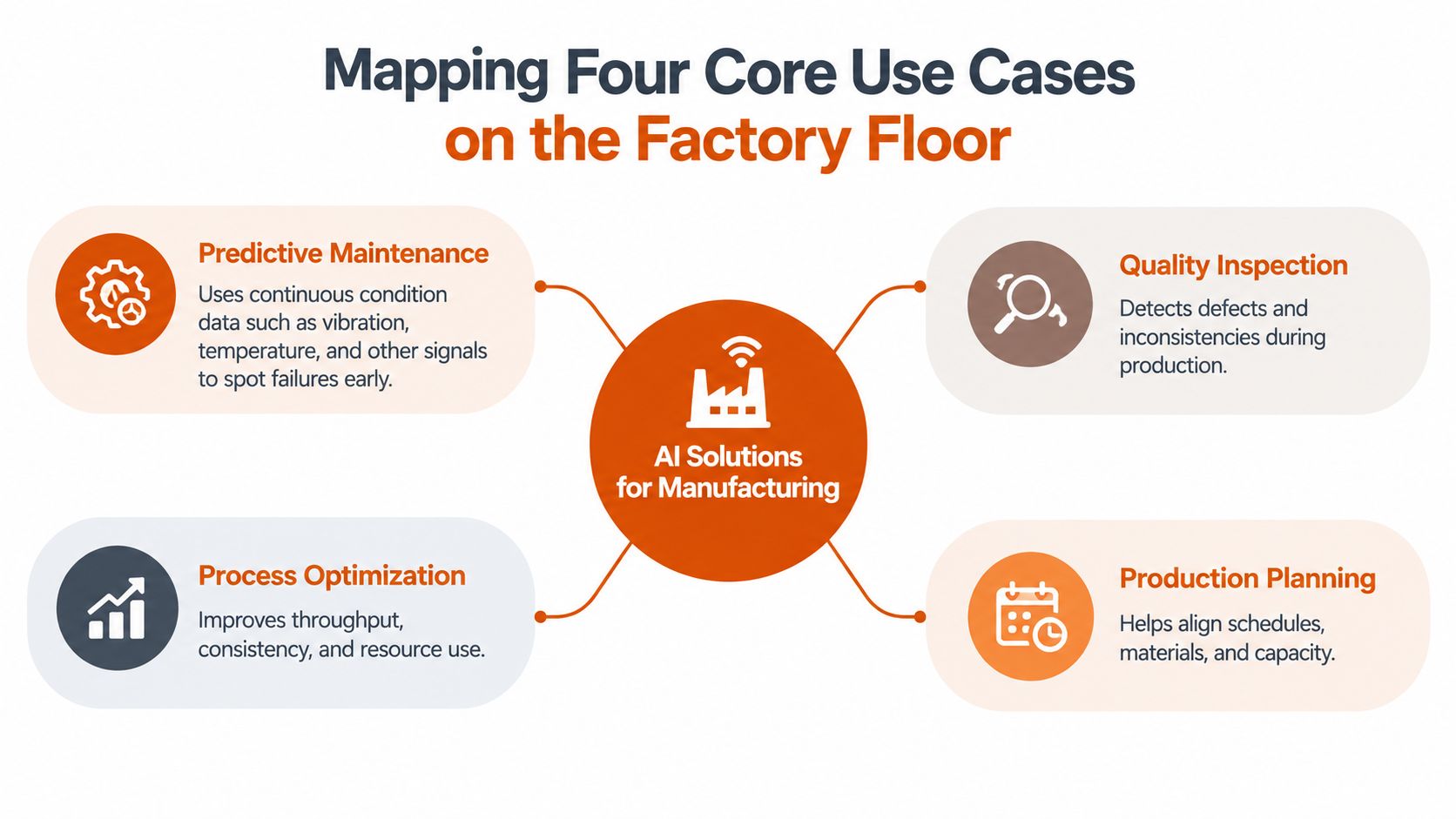
Mapping Four Core Use Cases on the Factory Floor
Executive enthusiasm doesn't tell you where to start. A World Economic Forum survey on industrial AI found that 89% of executives considered AI essential to operations and planned to incorporate it into production, while quality control was the most common application, used by approximately one-quarter of respondents.
The practical task is to connect applications through a shared data foundation, rather than create separate islands of intelligence.
Maintenance and quality protect the production process
Predictive maintenance interprets equipment condition. Vibration, temperature, current, pressure, or acoustic signals become useful when they're connected to asset history and maintenance records. NIST describes using sensor or continuous-monitoring data to predict failures, potentially generate preventive-maintenance work orders, and update models using evidence from completed maintenance in its manufacturing predictive-AI outline.
In the nervous-system analogy, detecting abnormal equipment behavior is the signal; arranging an appropriate intervention is the response. A warning that arrives too late to organize parts or labor has limited operational value.
Quality inspection and process optimization address the product and the conditions producing it. For evaluation, ask whether the proposed application merely flags a finished defect or supports an earlier intervention. Require the vendor to identify which inspection records, images, material attributes, and machine settings it needs.
Planning and automation connect decisions to execution
Supply-chain optimization brings demand planning, inventory alerts, and production scheduling into the operating picture. Before evaluating a recommendation, assemble the information a planner would need to challenge it: demand history, inventory status, material constraints, and available capacity.
Robotics and automation provide another foundation. The International Federation of Robotics reported 4,281,585 industrial robots operating worldwide in 2023, a 10% annual increase, illustrating the installed automation base beneath emerging AI applications in its industrial robotics reporting.
For a buying workshop, map the dependencies explicitly:
- Maintenance to scheduling: Who revises the plan when an asset needs attention?
- Quality to process control: Who authorizes an adjustment after a defect signal?
- Planning to execution: Who resolves a recommendation that conflicts with actual plant conditions?
Receiving operations offer a related evaluation opportunity. If identifying arriving vehicles is a workflow problem, explore automated truck recognition from Faberwork LLC as a resource for considering visual identification requirements.
Don't assume every connection needs AI. Use AI where prediction or interpretation adds value, and retain straightforward rules where the decision is already clear.
Measuring ROI and the KPIs That Prove Value
A successful demonstration isn't proof of an economic return. Only 49% of surveyed manufacturers rigorously measure AI ROI, while 27% identify unclear ROI as a barrier, according to Assembly's reporting on manufacturing AI measurement.
Before launch, have finance and operations agree on the cost being addressed. Specify the asset, product family, shift conditions, accounting treatment, and comparison period. Record changes in staffing, maintenance practices, demand, and product mix so the team doesn't automatically credit AI for every improvement.
KPI Pairs for Each Core Use Case
| Use case | Operational KPI | Financial KPI |
|---|---|---|
| Predictive maintenance | Unplanned downtime, emergency work orders | Maintenance expense, recoverable contribution margin |
| Quality inspection | First-pass yield, scrap and rework | Scrap expense, rework cost, quality-related claims |
| Process optimization and automation | Cycle time, throughput | Conversion cost, unit cost |
| Production and supply planning | Forecast accuracy, schedule adherence, inventory availability | Inventory carrying cost, expedite expense |
| Quoting and commercial workflows | Quote turnaround, lead-to-order conversion | Quoting labor cost, contribution margin from attributable orders |
Treat these as proposed measurement pairs, not guaranteed outcomes. An operational metric should explain why the financial result changed.
Value the constraint, not just the saved hours
For avoided downtime, begin with productive time recovered. Then ask whether the plant had demand, materials, labor, and downstream capacity to turn that time into additional saleable output.
If it did, finance can assess the recoverable contribution margin. If it didn't, examine documented benefits such as avoided overtime or reduced emergency maintenance. Don't multiply every recovered hour by an optimistic revenue rate.
A recovered machine hour isn't automatically a recovered sale. Finance should recognize the benefit the plant could actually realize.
Faster quoting needs similar discipline. Measure administrative effort separately from additional orders, and investigate whether quote speed influenced conversion rather than assuming causation. Better forecast accuracy should connect to a decision, such as changed inventory purchasing or fewer expedites, before it becomes a financial benefit.
Use a comparable untreated asset or process where practical, and document any limitations in the comparison. Include integration, training, support, and ongoing review in the cost model; otherwise, the pilot can appear profitable while the operating program isn't.
Impact opportunity: Track production and commercial measures together. Your AI ROI evaluation should connect plant improvements with delivery reliability, quoting performance, and lead-to-order conversion without counting the same benefit twice.
Building a Pilot-to-Scale Roadmap for Manufacturing AI
A metals producer confronting recurring furnace failures offers a useful example of a bounded business case. The World Economic Forum describes how AI-driven predictive maintenance helped it reduce downtime by 42% and conversion costs by 20% within six months, before expanding the approach into logistics and energy systems in its industrial transformation case discussion.
Those results aren't a forecast for your plant. They illustrate a sensible sequence: address a known operating problem, verify the outcome, and expand only after the evidence supports it.
Establish gates before committing more resources
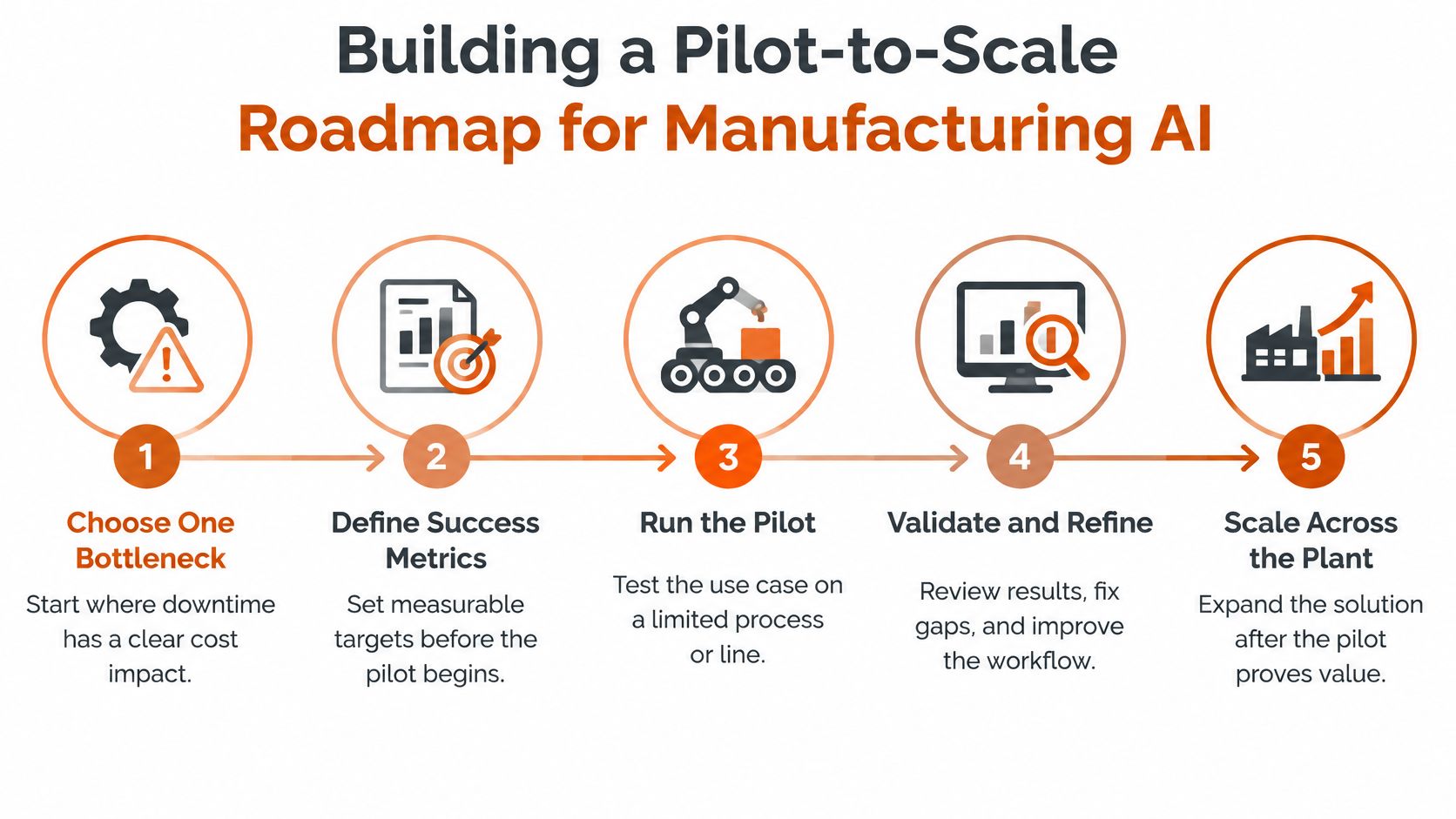
Choose one bottleneck. Select an asset or process whose failures create a recognizable business cost. Name the operating sponsor and the employee responsible for responding to recommendations. The gate is ownership: don't proceed if nobody can authorize the necessary action.
Baseline failures and conversion expense. Assemble event histories, production records, and relevant costs. Check timestamps, asset identifiers, missing readings, and failure descriptions before treating the dataset as usable. The gate is data readiness, including whether historical events can be classified meaningfully.
Run a time-boxed pilot. Define the scope, success criteria, review dates, and permitted actions before activation. Set human approval thresholds, particularly where recommendations could affect safety, quality, or customer commitments. The gate is controlled operation, not merely a functioning model.
Validate and refine. Compare false alarms, missed failures, warning time, emergency work orders, and downtime against the pre-AI baseline. Review precision and recall separately for critical failure classes, rather than hiding consequential misses inside an overall accuracy score. The gate is operational usefulness supported by financial evidence.
Scale to adjacent assets. Test whether the next asset has comparable failure modes, data quality, and response capacity. Update the business case for additional integration and support. The gate is a fresh approval decision, not an automatic rollout.
Plan for the disappointing pilot
Some pilots should stop. If technicians can't verify the alerts, the warning arrives too late, or the economic benefit doesn't cover the ongoing cost, expanding the deployment won't resolve the underlying problem.
A technically promising pilot may instead need a narrower scope. Separate a data defect from a model defect and a workflow failure from both. Each requires a different remedy.
Scale rule: Transfer what you've validated, not everything you installed. Recheck the economics and operating conditions at each new asset or site.
Use an AI pilot-to-production checklist to document the evidence, unresolved risks, and accountable owner at every approval point. A stop decision made from sound evidence is better than an expansion justified by enthusiasm.
Choosing Vendors and Technology Without Buying Hype
The most useful vendor demonstration is a contested decision. Give the supplier a representative operating scenario, ask for a recommendation, and have your maintenance, production, IT, and finance teams challenge it.
Can the vendor show the inputs? Can employees identify uncertainty? Can your team reconstruct who approved the resulting action? These are stronger selection questions than whether the interface looks impressive.
Compare the buying paths
| Buying path | Appropriate evaluation context | Main trade-off |
|---|---|---|
| Packaged predictive-maintenance module | A bounded asset-health problem with an established maintenance workflow | Assess fit against your actual failure modes and integration requirements |
| Build on existing automation platforms | A plant seeking to extend its current controls and data environment | Weigh reuse of existing infrastructure against platform dependence and customization |
| Transformation advisor | A program crossing operations, CRM, service, and commercial processes | Confirm responsibility for technical delivery, process change, and benefits validation |
For the advisory path, Prometheus Agency is one option combining AI enablement, CRM implementation and optimization, and go-to-market strategy. Its stated approach prioritizes business outcomes over tooling through roadmaps with timelines and accountability, beginning with a complimentary Growth Audit and AI strategy session.
An advisor shouldn't substitute for specialist equipment knowledge. Clarify which party validates the industrial application, which party integrates business systems, and who owns the result after launch.
Pressure-test the technical and commercial offer
Require evidence of connectivity to existing machines and to ERP, manufacturing execution systems, CRM, and service platforms. Ask suppliers to demonstrate the required connection rather than describing it as available.
For digital twins, don't mistake a visual model for a validated operating model. NIST emphasizes verification, validation, uncertainty quantification, and interoperability in its digital-twin research for advanced manufacturing. Ask how predictions will be checked against independent production measurements and what happens when the model's uncertainty is too high.
Your commercial assessment should include:
- Full ownership cost: Sensors, integration, licenses, training, support, model monitoring, and internal labor.
- Traceability: Accessible records of inputs, recommendations, approvals, and subsequent changes.
- Comparable references: Plants with relevant equipment, operating constraints, and implementation scope.
- Exit arrangements: Data access, configuration documentation, and responsibilities when the engagement ends.
Use a consistent AI vendor evaluation framework across proposals. Make vendors answer the same operational questions so your team compares evidence rather than presentation styles.
Integrating AI and Managing Change on the Plant Floor
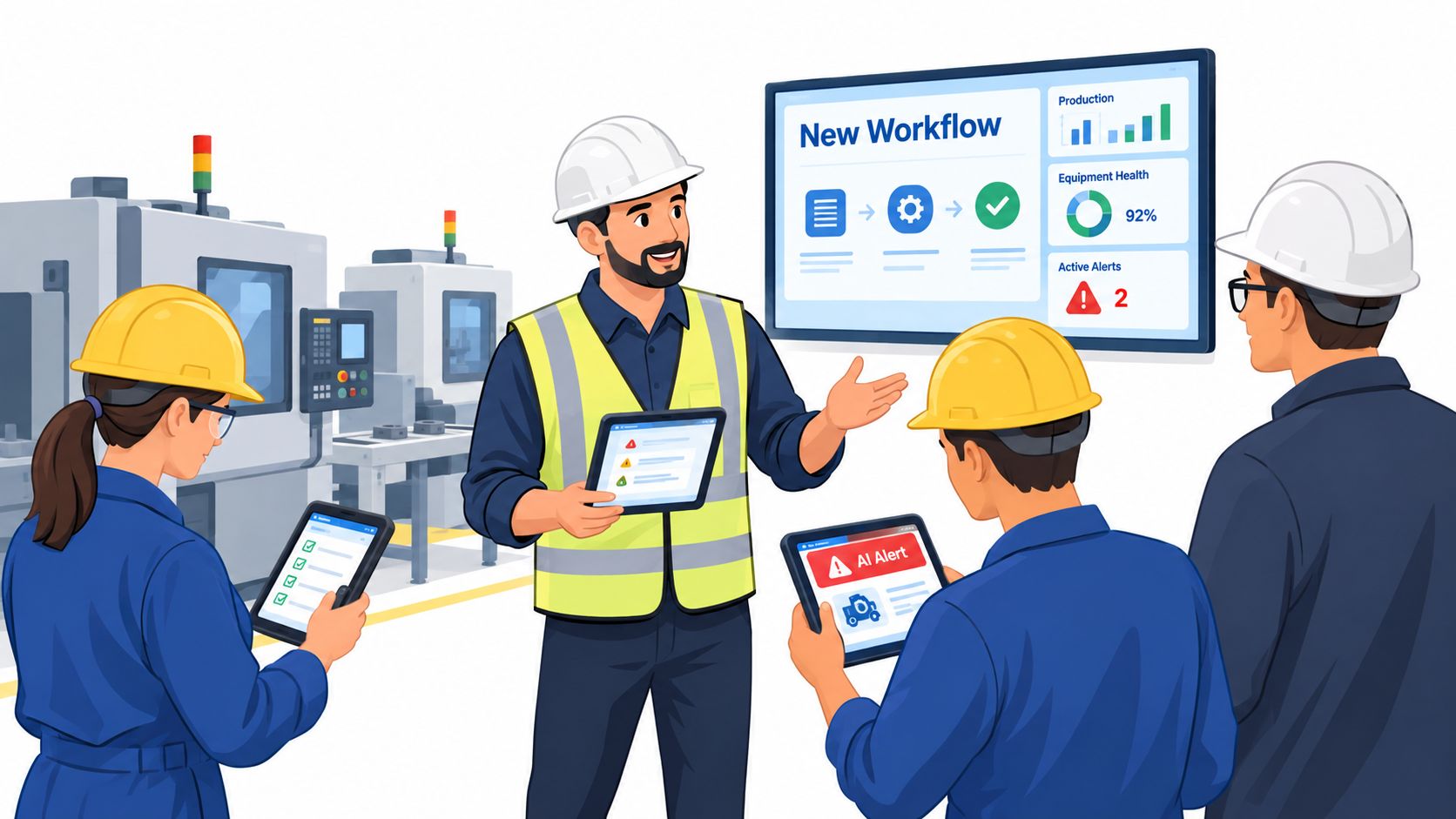
A model can be accurate and still fail on Tuesday morning because the line lead does not trust it, the technician cannot tell which alert matters first, or the planner sees a recommendation that ignores a tooling constraint. Treat adoption as part of the system design. The technology works like a new shift lead: it can spot patterns quickly, but it still needs authority limits, clear handoffs, and a way to be challenged by people who know the equipment.
Treat objections as operating evidence
When employees push back, ask for the case behind the objection. Which recommendation conflicted with machine behavior? Which alert arrived without enough context to act? Which record was already wrong before the model used it? Those answers usually point to a fixable input, a missing approval step, or a workflow that adds work instead of removing it.
Then design enablement around the decision each role must make:
- Supervisors: Practice prioritizing competing alerts and escalating unresolved risks.
- Technicians: Review supporting evidence, record findings, and challenge recommendations.
- Planners: Test capacity conflicts and decide when to revise schedules.
- Sales and service teams: Learn which production signals justify changing a customer commitment.
Keep the scoreboard tied to the buying decision. Before launch, agree on the baseline, the owner, and the after-action review that will show whether scrap, downtime, changeover time, schedule misses, or promise-date revisions moved. A pilot earns scale when the people closest to the work can explain what changed, why it changed, and what happens when the model is wrong.
For broader rollout design, use AI change planning for enterprise teams as a prompt for assigning ownership, sequencing communication, and deciding where managers must stay in the loop.
Use the following video as a discussion prompt, then ask employees to identify the handoffs that would matter in their own workflow.
Standardize accountability while preserving local knowledge
Write approval thresholds into operating procedures. Specify which recommendations require review, who can override them, and what employees should do when data is missing or systems are unavailable. An exception needs an owner and a route to resolution, not another unattended notification.
Assign data ownership with the same precision. Maintenance should know who corrects an asset record. Planning should know who resolves a capacity discrepancy. Commercial teams should know who approves a revised delivery promise. If three functions can edit the same field, name the function that answers for its quality.
Close the feedback loop by recording what happened after an intervention and returning relevant findings to the people maintaining the model and workflow. Keep plant-floor and commercial records aligned so employees aren't working from conflicting versions of the same event.
Across sites, standardize definitions, approval records, and escalation expectations. Preserve documented local differences in equipment behavior, materials, and operating limits. Consistency should make local knowledge visible, not erase it.
Real-World Examples and Your Next Step
Practical examples of targeted intervention
Quality-control cases show why a narrowly defined application can be more useful than a broad AI ambition. A machine-learning control system for sheet-metal forming adjusted production parameters in real time and reduced material costs by 12.5%. A decision-tree model detected clinching failures associated with sheet-thickness variation and reduced defect rates by 66%, while a plastic-injection application improved cycle time by 18%, as described in the World Economic Forum's factory-floor AI examples.
These were different interventions with different measures of success. The lesson isn't to copy the reported percentage into your forecast. Identify the process variable your team can influence and the cost that should change if the intervention works.
Impact opportunity across a production line
Integrated programs offer a broader comparison. One factory increased output by 140% after deploying smart robotics, AI-powered process controls, and predictive-maintenance algorithms; a separate transformation reduced quality non-conformance by 56%, according to the World Economic Forum's advanced-manufacturing report. Those are program-level outcomes, not evidence that an isolated AI tool will deliver the same result.
For a middle-market manufacturer, the immediate action is simpler: prepare a proposed 90-day pilot scope around a single bottleneck. Treat that duration as a planning proposal, not a promised payback period, and bring baseline KPIs, known data gaps, and an accountable operating sponsor.
Prometheus Agency offers AI enablement, CRM optimization, and go-to-market support to connect operational initiatives with measurable business outcomes. Visit Prometheus Agency to book a complimentary Growth Audit and AI strategy session, bringing your bottleneck, baseline measures, and proposed pilot scope for review.