The most popular advice about AI manufacturing solutions is also the least complete: start with a pilot on the factory floor, prove a productivity gain, then expand. That approach can produce a useful demonstration, but it often creates an isolated success that never changes the economics of the wider business. A model that predicts a machine failure is valuable. A model that also helps sales promise realistic delivery dates, gives account teams an early warning about service risk, and feeds reliable information into the CRM is far more valuable.
Manufacturers are moving beyond curiosity, but adoption remains uneven. Auburn University's SMART Manufacturing Adoption Study 2025 found that active AI use rose from 2% in 2022 to 11% in 2025, while the awareness stage fell from 47% to 22%. Yet 56% of respondents were still in the awareness or researching stages in 2025. The implication is clear: AI has entered manufacturing, but most companies haven't yet built the operating model required to scale it.
Redefining AI Manufacturing Solutions for Enterprise Growth
AI in manufacturing isn't purely a tooling problem. It's an enterprise coordination problem involving operations, engineering, supply chain, customer service, sales, finance, and executive leadership.
A narrow implementation treats AI as a system attached to a machine. A growth-oriented implementation treats AI as a decision layer that connects production reality with commercial commitments. The difference matters because manufacturers don't earn revenue from uptime alone. They earn revenue when reliable production supports accurate quotes, dependable delivery, consistent quality, repeat orders, and stronger customer relationships.
The market signal reinforces that urgency. The AI in manufacturing market report from The Business Research Company estimates a global market of $5.79 billion or $5.96 billion in 2025, depending on the market definition used, with projections ranging from $33.31 billion by 2030 to $161.65 billion by 2035. Those projections indicate strong commercial interest, but market growth alone doesn't create business value. Manufacturers still need to connect investments to measurable operating and revenue outcomes.
The pilot trap
An isolated pilot usually has a small scope, a willing local champion, and a technical success criterion. The team may show that a model can identify an anomaly, classify a defect, or forecast demand. That proves feasibility, but it doesn't answer the harder questions:
- Who owns the decision: Does a maintenance manager act on the alert, or does it remain in a dashboard?
- Where does the data go: Can production, inventory, service, and sales teams access the same trusted signal?
- What changes operationally: Does the alert alter scheduling, procurement, customer communication, or account planning?
- How does the system travel: Can another site use the same data model, governance rules, and workflow?
A pilot that can't answer those questions is a technology experiment, not an enterprise capability.
Practical rule: Define the downstream business action before selecting the model. If no team is accountable for acting on the output, the use case isn't ready for scale.
From cost reduction to revenue reliability
The strongest AI manufacturing solutions connect three layers. The first is operational intelligence, including machine condition, quality data, production schedules, inventory, and supplier signals. The second is workflow orchestration, which turns predictions into maintenance work orders, exception handling, production changes, or escalation paths. The third is commercial activation, where approved insights update the CRM, customer portal, account plan, quote, forecast, or service workflow.
That architecture turns a factory event into a business response. A quality deviation can trigger an internal investigation, a customer communication plan, and a service-risk task. A production forecast can inform sales availability. A supply disruption can change promised dates before a customer learns about it through a missed shipment.
This is why AI shouldn't sit in an isolated analytics environment. It needs governed connections to ERP, manufacturing execution systems, IoT platforms, data warehouses, service tools, and CRM. The model is only one component. The value comes from the chain between signal, decision, action, and commercial result.
High-Impact Use Cases on the Factory Floor
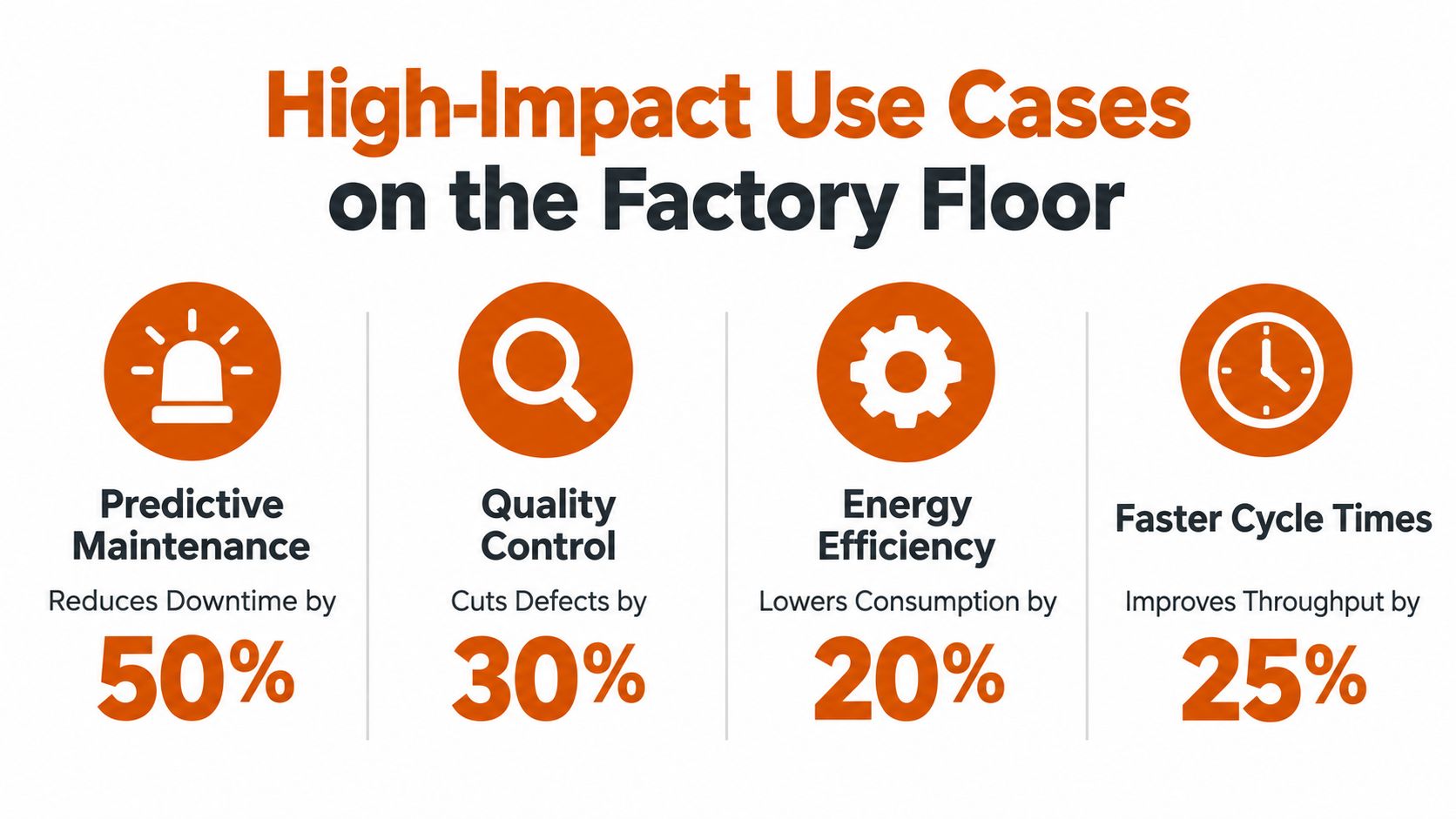
Factory-floor use cases remain the right starting point, provided leaders choose problems with a clear operational owner and a measurable consequence. The most practical applications tend to sit close to downtime, defects, material flow, and cycle performance.
Predictive maintenance
Predictive maintenance combines real-time sensor data, machine-learning models, and edge analytics to identify patterns that precede equipment failure. Instead of relying only on fixed service intervals or reacting after a breakdown, the maintenance team receives a forecast that helps it schedule an intervention around production requirements.
A manufacturing study reported a 25% reduction in unplanned downtime after deploying this approach, as documented in the Global Journal of Engineering, Technology and Applications study. The operational logic is straightforward. Earlier fault detection gives technicians more control over timing, reduces emergency work, and limits the disruption caused by an unexpected stoppage.
The trade-off is data quality. A predictive model trained on inconsistent sensor readings or incomplete maintenance records can generate noise that operators quickly learn to ignore. Teams should therefore measure alert precision, response time, avoided stoppages, and maintenance planning quality, not just model accuracy.
Vision-based quality control
AI vision systems use cameras and models to extract and compare defect features from sample images. They can support inspections during preproduction, production, preshipment, and container loading or unloading, giving manufacturers several opportunities to catch inconsistencies earlier, as described in Intel's overview of AI in manufacturing.
Reported benchmarks show defect-detection accuracy of 99.2% for AI vision versus 87% for trained human inspectors, while inspection time fell from 38 seconds to 2.4 seconds per part, according to IIoT World's manufacturing quality inspection coverage. The same benchmark describes a 15x throughput gain. These results illustrate why inspection is often an attractive entry point, but leaders still need to validate performance against their own materials, lighting conditions, product variations, and tolerance requirements.
Supply chain and process intelligence
AI can combine demand signals, inventory conditions, production capacity, supplier information, and transportation events to highlight exceptions earlier. The right output isn't an attractive forecast. It's a decision that someone can execute, such as changing a production sequence, escalating a supplier issue, or adjusting a customer promise.
Manufacturers most often identify quality control at 50%, IT operations at 46%, supply chain management at 45%, and process automation at 45% as current or expected AI impact areas in the 2026 manufacturing survey reported by Parsec. Those priorities show where buyers are looking for practical value, rather than treating AI as a general innovation program.
For leaders evaluating use cases, rank opportunities by four questions:
- Operational exposure: What failure, defect, delay, or manual decision creates the largest business risk?
- Data readiness: Does the site capture enough consistent information to support a dependable workflow?
- Actionability: Can a named team respond when the system identifies an exception?
- Commercial relevance: Will the result improve delivery confidence, customer retention, service quality, or sales execution?
A useful explanation of industrial video data and its role in training and operational workflows is available through Truelabel's sourcing for egocentric video. For a broader perspective on generative AI applications, see this guide to generative AI in manufacturing.
The following video provides additional context on how AI can support manufacturing operations.
Integrating AI with CRM and Revenue Tech Stacks
Operational intelligence becomes strategically important when commercial teams can use it without manually requesting reports from plant or IT teams. The integration doesn't mean sending every machine signal into Salesforce or another CRM. It means translating relevant operational events into governed business objects, tasks, forecasts, and customer-facing decisions.
Consider a manufacturer with a delivery-sensitive account. A production forecast changes because of capacity constraints. The AI system should not automatically send an unreviewed message to the customer. It should update an internal availability signal, flag affected opportunities, notify the account owner, and provide the evidence needed to revise the delivery conversation.
The data path matters
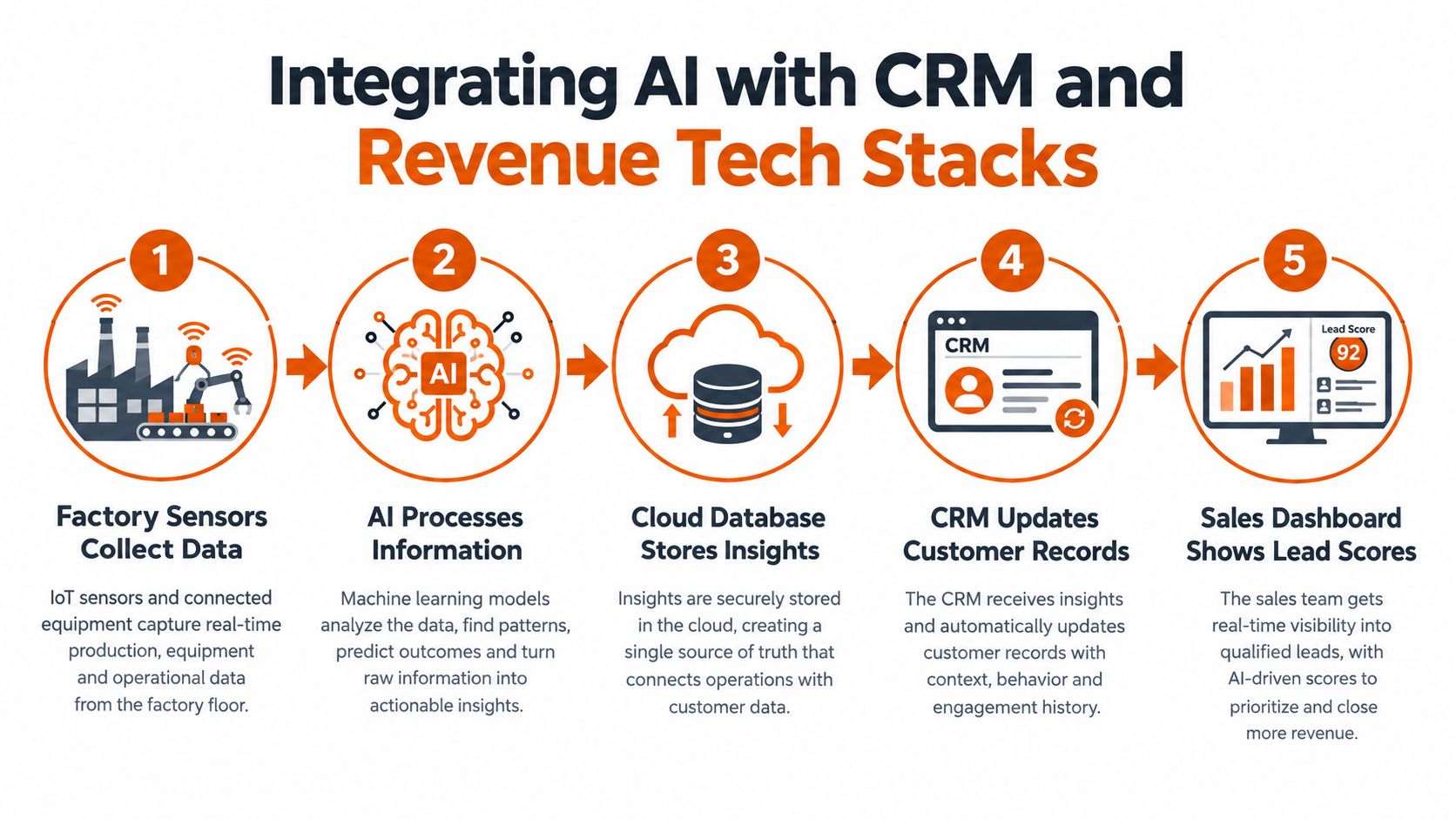
A practical architecture moves through five stages:
- Collection: Sensors, quality systems, ERP, manufacturing execution systems, and supply chain applications produce operational data.
- Interpretation: AI models classify anomalies, predict conditions, or identify likely exceptions.
- Governed storage: Approved insights enter a data platform with lineage, permissions, timestamps, and confidence information.
- Workflow activation: CRM, service, planning, and customer portal workflows receive only the signals relevant to their users.
- Commercial action: Sales and account teams adjust promises, prioritize outreach, manage risk, or identify expansion opportunities.
Where revenue teams benefit
A reliable production forecast can improve the quality of delivery conversations. Quality trends can help customer success teams identify accounts that need proactive support. Inventory and supply chain signals can help sales teams avoid promising products that the business can't deliver. Service history combined with operational data can also reveal recurring issues that deserve an account review or a commercial solution.
The integration should work in both directions. The CRM contains customer priority, contract terms, opportunity stage, service commitments, and relationship context. The factory contains capacity, quality, inventory, and delivery conditions. Combining those perspectives helps operations understand which orders carry the greatest commercial risk, while helping revenue teams understand which commitments are operationally realistic.
Revenue principle: Don't expose raw factory data to sales. Expose the decision, its business impact, its confidence, and the next approved action.
The most common integration failure is technical rather than strategic. Teams connect systems but don't define ownership, field semantics, escalation rules, or what happens when the model is wrong. A practical reference for connecting AI workflows to customer data is this guide to AI integration with CRM. The implementation should include human review for high-consequence decisions, especially where a prediction could alter a contractual commitment or customer communication.
Overcoming the Scale and Adoption Gap
The hardest manufacturing AI problem isn't proving that a model can work in one location. It's making the capability repeatable across sites, shifts, product lines, and leadership teams.
The evidence points to a scale problem. Deloitte reports that 84% of manufacturers already generate measurable value from AI, yet only 20% of use cases are scaled consistently across sites or across the enterprise in its AI in manufacturing research. The gap suggests that many companies can demonstrate value, but struggle to industrialize the surrounding processes.
Why pilots stall
A site-level pilot often depends on local knowledge that hasn't been documented. One plant manager knows how to interpret a particular alert. One engineer understands the data quirks. One maintenance team has developed an informal response process. When the company attempts to replicate the use case elsewhere, those assumptions disappear.
Scaling also exposes differences in equipment, naming conventions, data capture, maintenance practices, and incentive structures. A model may perform well in one environment and require recalibration in another. That isn't necessarily a model failure. It is a governance and operating-model requirement.
Deloitte identifies high implementation costs at 43%, lack of technical expertise at 35%, resistance to change at 35%, regulatory and compliance concerns at 34%, and data availability or quality issues at 30% as major blockers. These barriers reinforce an important buying principle: scale-readiness deserves as much attention as model selection.
Frontline leadership is the adoption system
Employees don't adopt AI because an executive approves a budget. They adopt it when supervisors explain how the tool changes work, when the output is credible, and when the organization makes room for the new process.
A Q3 2025 survey covered by PwC's research on frontline leadership and AI adoption in manufacturing found that 72% of respondents cited employee resistance, while 57% cited lack of training and readiness. The same research points to low confidence in leaders' ability to guide AI-driven change, uneven adoption across leadership levels, and limited data readiness.
That is why training alone won't solve the problem. A training session can show an operator how to read a dashboard. It can't decide who owns the resulting action, whether the alert changes a performance target, or how supervisors should handle disagreement between an experienced technician and a model.
Leaders should establish a repeatable adoption model:
- Name the decision owner: Assign accountability for each AI-supported workflow.
- Document the human override: Define when employees can reject an output and how they record the reason.
- Measure behavior: Track whether teams act on approved insights, not just whether the system generates them.
- Create a site playbook: Capture data definitions, operating procedures, escalation routes, and training requirements.
- Review outcomes openly: Share false positives, missed alerts, and process improvements so teams can improve trust.
Enterprise scale begins with operating discipline. The technology should support that discipline, not substitute for it.
Building an Implementation Roadmap and Success Metrics
A practical roadmap starts with business exposure, not a catalogue of available models. Choose a workflow where the cost of delay, defects, downtime, or inaccurate commitments is visible and where a specific team can act on the output.
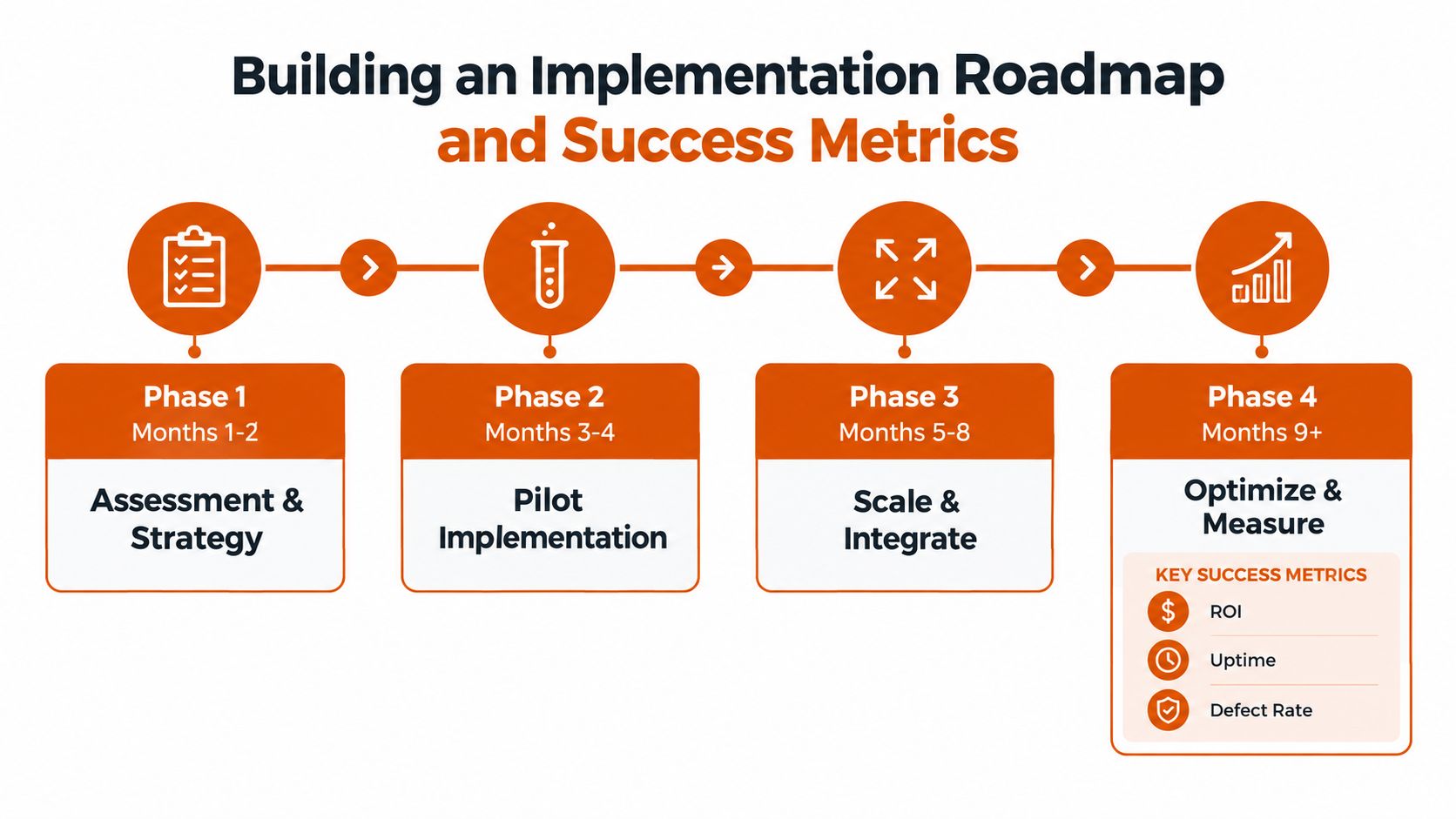
Phase one, assessment and strategy
Map the current data and workflow environment. Identify the relevant ERP, manufacturing execution, IoT, quality, service, and CRM systems. Interview operations and revenue stakeholders separately, then compare where their definitions of delivery risk, quality, and customer impact diverge.
The success measures at this phase are clarity and readiness:
- Use-case definition: The business problem, owner, decision, and expected outcome are documented.
- Data inventory: Source systems, data gaps, permissions, and lineage are understood.
- Baseline metrics: Current downtime, defects, inspection effort, delivery reliability, or workflow latency are recorded.
- Governance decision: Security, compliance, human review, and escalation requirements are agreed.
Phase two, pilot implementation
Choose one site or workflow, but design the pilot as a reusable product. Build connectors, naming conventions, feedback capture, and role-based access in a way that another site can understand.
Measure the operational result and the human response. Useful metrics include alert acceptance, time to action, false-alert burden, manual effort, defect detection, downtime, and the quality of the resulting maintenance or production decision. Don't declare success because a dashboard is live.
Phase three, scale and integrate
Once the pilot demonstrates useful performance, connect it to adjacent workflows. A maintenance prediction might connect to work orders and production scheduling. A quality signal might connect to service escalation and account management. A supply forecast might connect to inventory planning and opportunity risk.
At this stage, leaders should measure reuse across sites, data consistency, workflow completion, integration reliability, and the effect on customer-facing commitments. The objective is to create a standard capability with local configuration, not to copy a fragile experiment.
Phase four, optimize and measure
Optimization means more than retraining the model. Review drift, changing product mixes, new equipment, user feedback, override patterns, and commercial consequences. Compare the AI-supported process with the original baseline and retire workflows that no longer create value.
At the executive level, the scorecard should connect ROI, uptime, defect rate, delivery reliability, customer retention signals, and sales execution. If the system improves a plant metric but creates more customer escalations or manual reconciliation, the program needs redesign.
Evaluating Vendors and Choosing the Right Partner
Manufacturers often choose a vendor by comparing model features. A better comparison starts with the operating problem and then evaluates whether the vendor can support the full path from data to decision to business outcome.
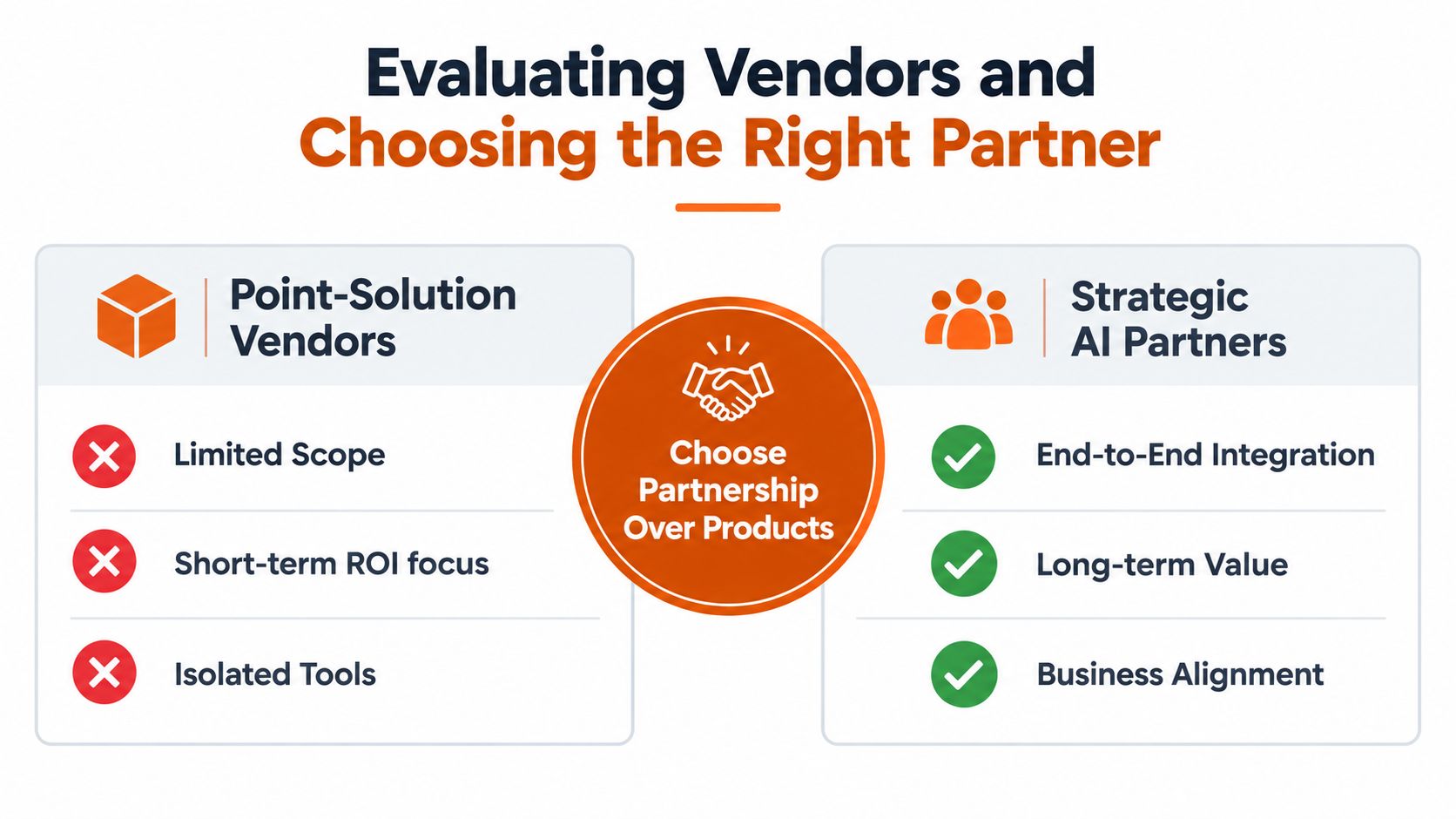
A point-solution vendor can be the right choice when the use case is narrow, the data is clean, the workflow is stable, and the organization already has strong integration capability. A specialized inspection, maintenance, or forecasting tool may provide speed and domain depth. The risk appears when the tool creates another dashboard, another data store, or another team responsible for reconciling information.
A strategic AI partner typically addresses a broader transformation. That can include readiness assessment, use-case prioritization, data and workflow design, CRM integration, adoption planning, governance, and measurement. The trade-off is greater implementation scope and a need for stronger executive alignment.
A practical evaluation table
| Evaluation area | Point-solution question | Strategic partner question |
|---|---|---|
| Integration | Can the tool connect to the immediate data source? | Can the partner connect operations, ERP, CRM, service, and revenue workflows? |
| Ownership | Who operates the application after launch? | Who owns adoption, governance, optimization, and measurable outcomes? |
| Security | How does the product protect its data? | How are access, lineage, retention, human review, and compliance handled across systems? |
| Commercial impact | What local efficiency does the tool improve? | How does the capability affect delivery promises, retention, account risk, or pipeline execution? |
| Scale | Can another line use the same product? | Can another site reuse the architecture, playbook, and measurement framework? |
Ask every vendor to demonstrate an actual workflow rather than a generic model. Show how an alert enters the system, who receives it, what action follows, how an exception is recorded, and how the result reaches the CRM or planning environment. Also ask what happens when data is missing, the model loses confidence, or an operator disagrees.
A partner such as Prometheus Agency approaches this type of work through AI enablement, CRM implementation and optimization, and go-to-market strategy, with an emphasis on connecting existing technology to measurable growth processes. Its AI evaluation framework for vendor selection offers a useful structure for comparing providers beyond feature lists.
Key Takeaways and Actionable Next Steps
AI manufacturing solutions create the most value when manufacturers stop treating them as isolated factory tools. The operational use case still matters, but the enterprise result comes from connecting production intelligence to planning, service, CRM, sales, and customer communication.
Key takeaways:
- Start with a decision, not a model: Define who must act, what changes, and how the business will measure the result.
- Treat scale as a design requirement: A pilot should include reusable data definitions, governance, workflow ownership, and adoption practices.
- Connect operations to revenue: Use approved production, quality, supply, and delivery signals to improve customer commitments and account decisions.
- Prioritize frontline leadership: Employees need clear responsibilities, training, override rules, and evidence that the system improves their work.
- Evaluate partners on outcomes: Integration, governance, adoption, and commercial accountability matter as much as technical capability.
Executives can begin with a focused audit. Ask operations which recurring failure creates the greatest exposure, ask sales which delivery or quality uncertainty damages customer conversations, and ask IT whether the required data is accessible and trusted. Then select one shared use case, establish a baseline, assign an owner from both operations and revenue, and define the conditions for scaling before development begins.
The impact opportunity is broader than reduced downtime or faster inspection. A well-designed system can help manufacturers make more credible promises, identify customer risk earlier, coordinate production with commercial priorities, and build a repeatable growth engine from data they already generate.
Prometheus Agency helps growth leaders connect AI enablement, CRM optimization, and go-to-market strategy into scalable revenue systems for manufacturing and other B2B organizations. Visit Prometheus Agency to discuss a Growth Audit and AI strategy session focused on turning factory-floor intelligence into measurable commercial action.