Construction accounted for 21% of all U.S. occupational fatalities in 2021, with falls, struck-by incidents, electrocutions, and caught-in incidents representing 65.5% of those deaths. AI in construction safety can help target these hazards through continuous monitoring, faster escalation, and risk analysis, but it only improves outcomes when safety teams connect alerts to accountable corrective action.
The strategic question for executives isn't whether an algorithm can identify a hard hat or detect movement near equipment. It's whether the organization can turn that signal into a verified intervention, a closed corrective action, and a measurable reduction in exposure. A high-performing detector without governance, workflow integration, and worker trust can become an expensive alert generator rather than a safety intervention.
The Case for AI in Construction Safety
Construction's risk profile makes it a strong candidate for targeted AI deployment. The sector accounted for 21% of all occupational fatalities in the United States in 2021, while the Focus Four hazards, falls, struck-by incidents, electrocutions, and caught-in or between incidents, accounted for 65.5% of construction-related deaths. Falls alone represented 35%, struck-by incidents 17%, electrocutions 7.6%, and caught-in incidents 5.8%, according to the published analysis of construction safety hazards.
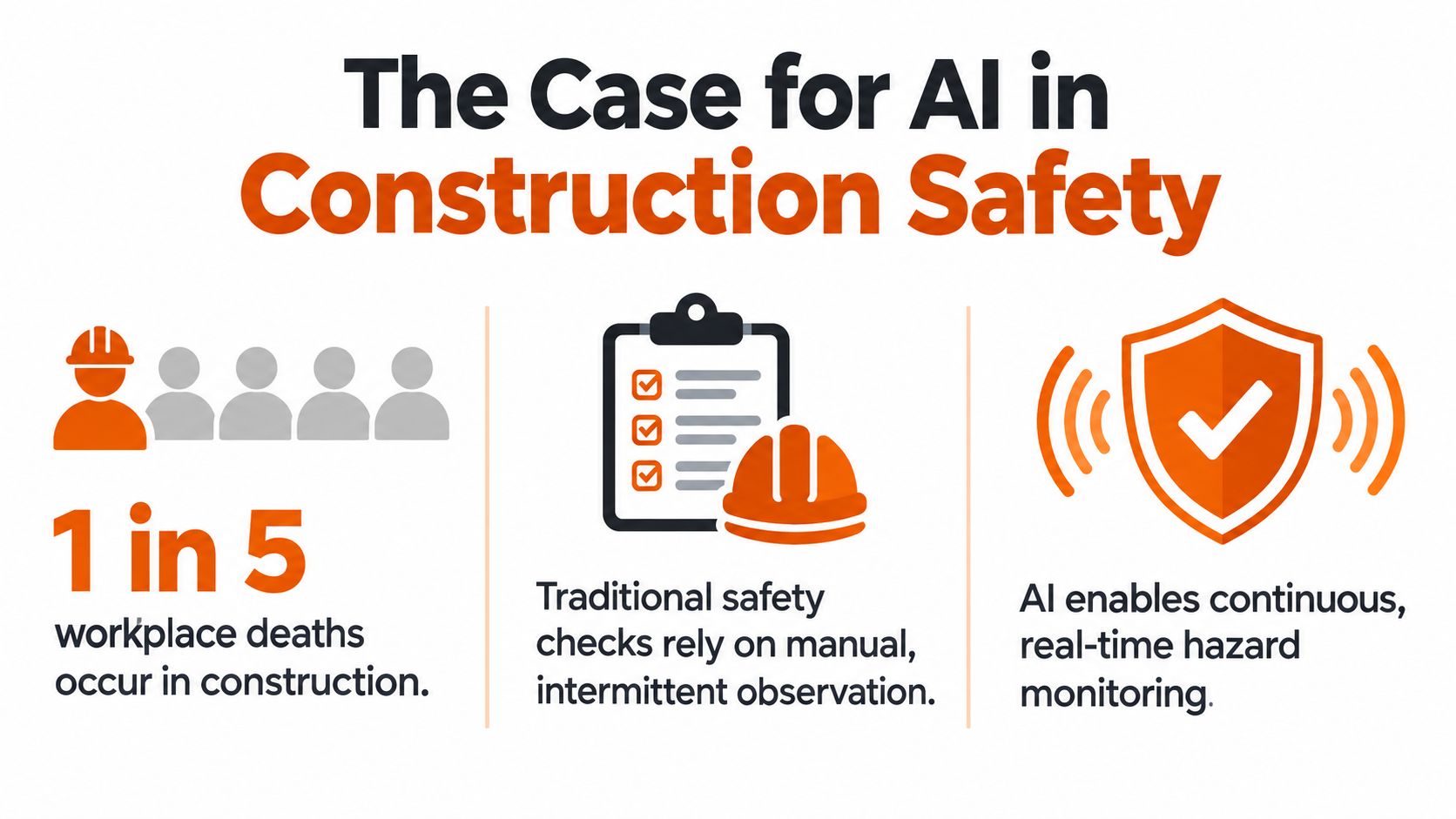
Those figures point to a deployment strategy, not a generic compliance workflow. Fixed cameras can monitor fall-protection conditions and PPE, location-aware systems can identify entry into equipment exclusion zones, and predictive models can combine incident history with schedules, weather, equipment movement, and near misses. The technology is most useful where delayed observation creates the greatest exposure.
Key Takeaways
- Target the Focus Four: Start with hazards that account for the largest share of construction deaths, rather than deploying a broad system without a defined risk hypothesis.
- Expand observation: Computer vision can review site footage continuously, helping identify missing PPE, unsafe behavior, restricted-zone entry, and fall risks.
- Shorten intervention time: An alert has value only when it reaches the responsible supervisor and produces a documented response.
- Keep humans accountable: AI should augment site supervision, training, engineering controls, competent-person inspections, and regulatory programs.
- Measure outcomes: Track confirmed hazards, corrective-action closure, near misses, exposure, and incidents alongside model performance.
Traditional inspections remain essential, but they are intermittent by design. A supervisor can't maintain continuous visual coverage across every work zone, shift transition, equipment interaction, and changing physical condition. AI adds an observation layer that can surface events for review while preserving professional judgment for classification and intervention.
Practical rule: Treat AI as an escalation system that expands visibility, not as an autonomous safety authority.
The deeper shift is from post-incident reporting toward continuous observation. That shift matters because the safety team can act while a hazard is still present, rather than reconstructing the event after harm has occurred. It also changes the executive dashboard. Model accuracy becomes a diagnostic measure, while confirmed hazards, response latency, closure quality, and injury trends become the measures of business value.
Core AI Applications Transforming Site Safety
AI in construction safety comprises several technology layers, and they don't have equal maturity or operational reach. Executives should evaluate each application against the hazard it addresses, the data it requires, and the decision a human must make after an alert.
| Technology | Primary Function | Deployment Maturity | Key Measurable Output |
|---|---|---|---|
| Computer vision | Detect PPE gaps, unsafe behavior, falls, proximity, and restricted-zone entry | Established for targeted visual checks, site conditions still matter | Class-specific precision, recall, alert latency, confirmed hazards |
| Wearable and environmental sensors | Monitor location, motion, exposure, and contextual conditions | Developing, with governance and worker acceptance central to adoption | Risk scores, exposure events, verified emergency alerts |
| Predictive analytics | Combine incidents, near misses, schedules, weather, equipment, and project data | Developing and dependent on data quality | Risk by task, location, asset, and contributing factor |
| Drones and robotics | Inspect difficult or hazardous areas without placing workers in direct exposure | Targeted and use-case dependent | Inspection observations, inaccessible-area coverage, escalation records |
| Automated reporting | Consolidate observations, images, timestamps, and corrective actions | Broadly applicable when integrated with EHS workflows | Closure time, repeat observations, audit-ready records |
Computer vision is the most direct application. It can analyze camera feeds for hard hats, fall-arrest systems, unsafe proximity to equipment, and intrusion into restricted areas. A vision model doesn't understand the full context of a task, so its output should be a prioritized observation with an image, timestamp, location, confidence, and recommended human review.
Wearables and environmental sensors add information cameras can't reliably capture. Location, motion, heat, fatigue indicators, air quality, and equipment telemetry can help safety teams understand whether a visible event is isolated or part of a larger exposure pattern. This category also carries a higher privacy burden because the data may relate directly to identifiable workers.
Predictive analytics is useful when the organization has enough structured history to support a meaningful risk model. Its value comes from combining signals, not from producing a mysterious score. A credible system should show which factors contributed to raised risk and route that result into a pre-task plan, inspection, staffing decision, or supervisor briefing.
Drones and robotics can reduce the need for workers to enter difficult inspection areas. Organizations using aerial systems should also treat flight planning, operator competence, and compliance as part of the safety case. Teams considering advanced aerial operations can review drone operator ReOC compliance training as part of their operator and governance planning.
Automated reporting completes the loop. A detection that remains in a vendor dashboard has limited operational value. A useful system creates an auditable record, assigns an owner, records the response, and makes repeat conditions visible in EHS reviews.
Documented Results from AI Safety Deployments
Published deployments show that AI can expand observation coverage and accelerate detection, but they also expose the difference between technical performance and safety outcomes. One reported 14-month computer-vision deployment processed more than 1.7 million video frames and identified 23,841 potential safety violations. The reported detection accuracy reached 92.3% for PPE-compliance violations, 87.9% for unsafe worker behaviors, and 94.6% for unauthorized-zone entries, as detailed in the deployment and research summary.
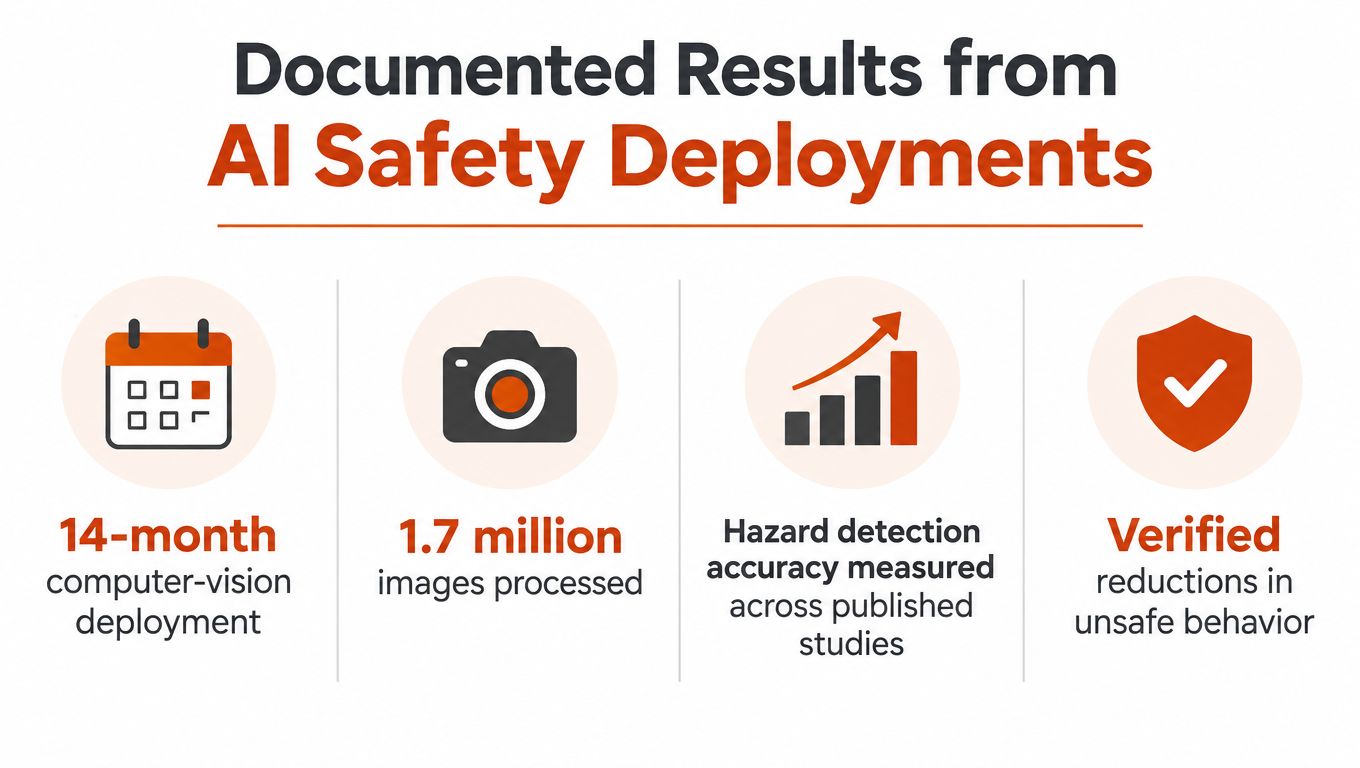
The same summary reports that 12 to 15 cameras covered approximately 94.7% of a typical construction site, compared with an estimated 22.5% coverage from human observation alone. Alerts reduced average response time to 97 seconds, compared with 29 minutes when teams relied solely on human monitoring. These findings make a strong operational case for continuous observation, particularly where a hazard can escalate during the time between scheduled inspections.
Detection is not the same as prevention
A separate longitudinal analysis of 28 construction projects reported an average 31.7% reduction in recordable incident rates during the first year of AI-enabled visual monitoring. It also reported improvements in fall-protection compliance of 64.3%, equipment-operation compliance of 47.8%, and scaffolding-assembly compliance of 53.2%. Those results are encouraging, but they shouldn't be treated as universal guarantees. Camera placement, lighting, data quality, worker acceptance, and follow-through after alerts can materially change performance.
The executive interpretation should be disciplined. The deployment evidence supports the hypothesis that broader coverage and faster response can improve safety management. It doesn't prove that installing a detector alone reduces injuries. Leaders should therefore ask for a measurement design that connects the signal to the intervention and the intervention to the outcome.
A useful evaluation compares baseline conditions with post-deployment performance by hazard category. It should distinguish an AI-generated observation from a confirmed violation, a confirmed violation from a corrective action, and a corrective action from a sustained reduction in exposure or incidents.
The documented results are most valuable when used as a benchmark for pilot design, not as a promise.
Implementation Roadmap from Pilot to Scale
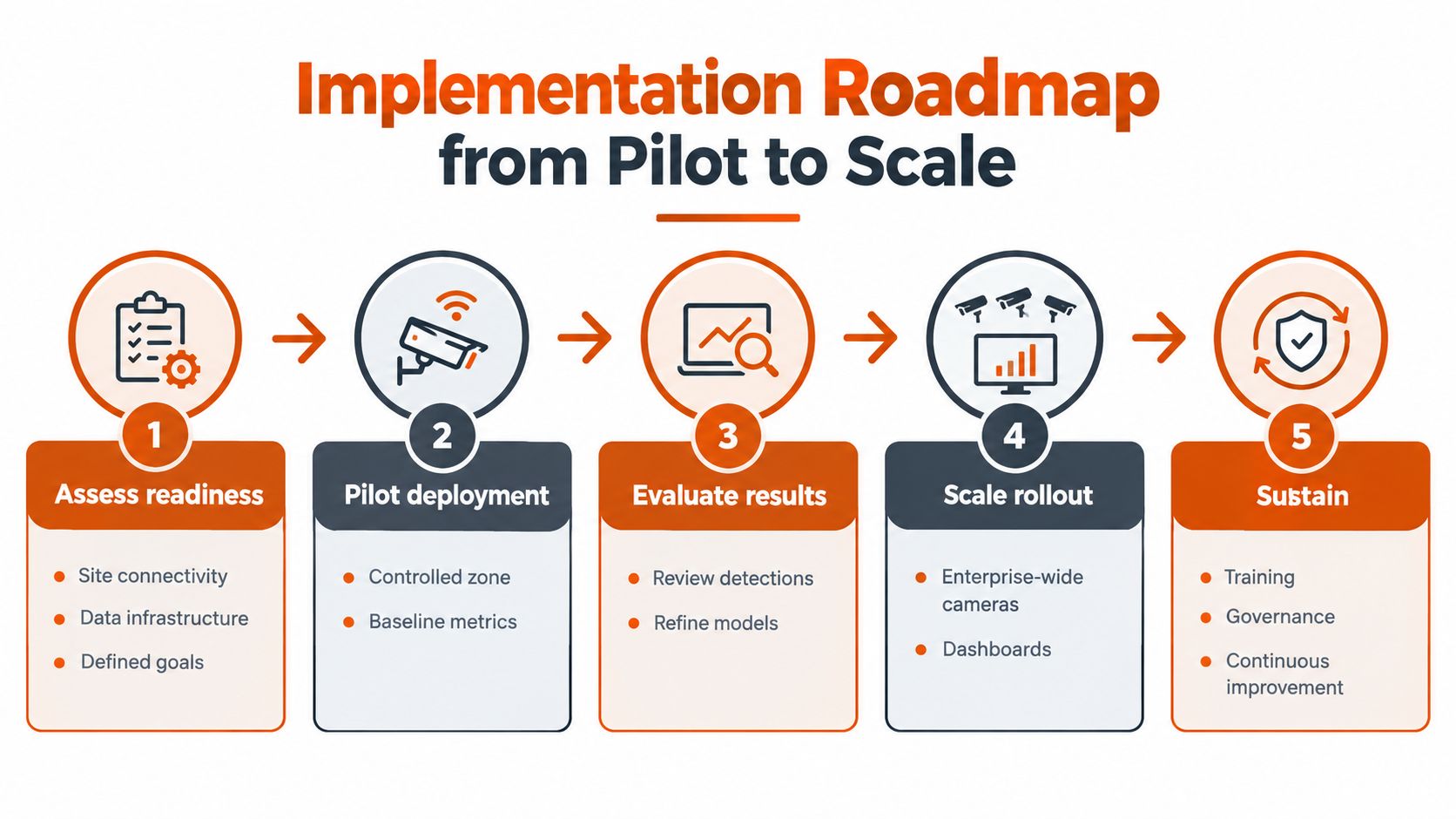
A successful deployment starts with a defined safety problem and a measurement plan. “Use AI to improve safety” is too broad to guide camera placement, model selection, alert routing, or investment decisions. A stronger pilot asks whether a specific intervention improves visibility, response, compliance, or closure for a defined hazard.
Establish the operating baseline
Document the current state before installing the system. Capture relevant incident and near-miss records, existing inspection practices, response paths, camera locations, connectivity, and the people responsible for corrective actions. Define what counts as a confirmed hazard and how the organization will distinguish routine observations from high-consequence events.
Then select a controlled zone or task. A focused pilot lets the team test the system under actual site conditions without creating enterprise-wide alert noise.
Validate locally before expanding
Public datasets can demonstrate that a model works in principle. They can't establish that it works from your camera angles, in your lighting, during your weather conditions, with your PPE, and around your work activities. Acceptance testing should use locally collected footage and project-level holdouts, so the same project's visual patterns aren't mixed carelessly between training and testing.
Track:
- Class-specific precision: How often an alert for a defined violation is correct.
- Recall: How many relevant violations the system identifies.
- False alerts per camera-hour: Whether the system creates a volume supervisors can manage.
- Detection latency: How quickly the alert reaches the person who can act.
- Verified hazards per alert: Whether the system produces useful observations rather than noise.
At scale, connect the outputs to EHS procedures, supervisor dashboards, training, and corrective-action management. The pilot-to-production implementation guidance provides a useful framework for managing that transition without treating deployment as a software installation alone.
Data Integration and Infrastructure Requirements
The strongest construction-safety systems are multimodal risk platforms, not isolated image classifiers. A camera may identify a worker near moving equipment, while a location signal, equipment state, schedule, weather condition, or incident history helps determine whether the event represents routine movement or a heightened struck-by risk.
Integration begins with a shared data model. Observations should be time-synchronized and linked to a common project, location, asset, worker role, and task identifier. Without those relationships, the organization may collect large volumes of events without being able to compare risk by activity or assign ownership.
Build the context layer
A practical architecture can combine:
- Vision data: PPE, proximity, access, fall protection, and visible behavior.
- Wearable data: Location, motion, fatigue indicators, and emergency events.
- Environmental data: Heat, air quality, weather, and other site conditions.
- Project data: Schedules, task sequences, work zones, and subcontractor assignments.
- EHS history: Incidents, near misses, inspections, training, and corrective actions.
- BIM and IoT data: Asset locations, equipment status, planned conditions, and sensor readings.
Each prediction should produce more than a risk label. It should include contributing factors, confidence, timestamp, location, and a recommended control or review path. That format makes the output usable in daily planning rather than merely interesting in an analytics dashboard.
Governance must sit alongside infrastructure. Before scaling, define retention periods, role-based access, worker notification, subcontractor data handling, human accountability, and the permitted uses of footage. The AI data readiness framework is relevant because deployment quality depends as much on identifiers, ownership, and workflow discipline as on model selection.
Common Misconceptions and Implementation Pitfalls
The most damaging misconception is that accuracy equals safety. Accuracy describes how a model performs against a test condition. Safety depends on whether the system sees the hazard, communicates it clearly, reaches the right person, prompts a suitable response, and prevents recurrence.
A reported YOLOv3-based model for real-time personal fall-arrest-system monitoring achieved 91.26% accuracy and 90.2% recall under tested conditions, according to the published computer-vision study. A recall of 90.2% still permits approximately one missed violation in ten under those conditions. For a high-consequence hazard, that limitation matters.
Four failure modes deserve executive attention
- Missed hazards: A false negative can create unwarranted confidence, particularly when supervisors assume the system is watching more reliably than it is.
- Alert fatigue: Excessive false positives can train users to ignore notifications, turning a technically active system into an operationally weak one.
- Context failure: A camera can identify a missing control, but a supervisor must determine whether the condition is temporary, authorized, misclassified, or immediately dangerous.
- Outcome blindness: A dashboard can show more detections without showing fewer injuries, faster closure, or reduced exposure.
The field remains more mature at identifying visible conditions than at proving causal reductions in harm. A review of 42 peer-reviewed empirical studies found vision-based systems and deep learning to be dominant, while technical metrics still often receive more attention than longitudinal injury outcomes, as described in the review of evidence and measurement gaps.
Measurement principle: Model performance is a leading indicator of system capability. It isn't proof of return on safety investment.
Executives should require a balanced scorecard. Include detection metrics, verified hazards per alert, intervention latency, corrective-action completion, repeat violations, near-miss closure time, recordable injuries, exposure hours, and worker-reported trust. The scorecard should identify who owns each response, because unassigned alerts cannot become safety outcomes.
Real-World Examples and Deployment Lessons
Shell's published account of a machine-vision pilot using the T-Pulse system offers a practical lesson in triage. Over a 50-day pilot, the technology generated 141 safety observations, of which 24 were classified by the health-and-safety team as high or very high risk, according to Shell's account of the machine-vision pilot.
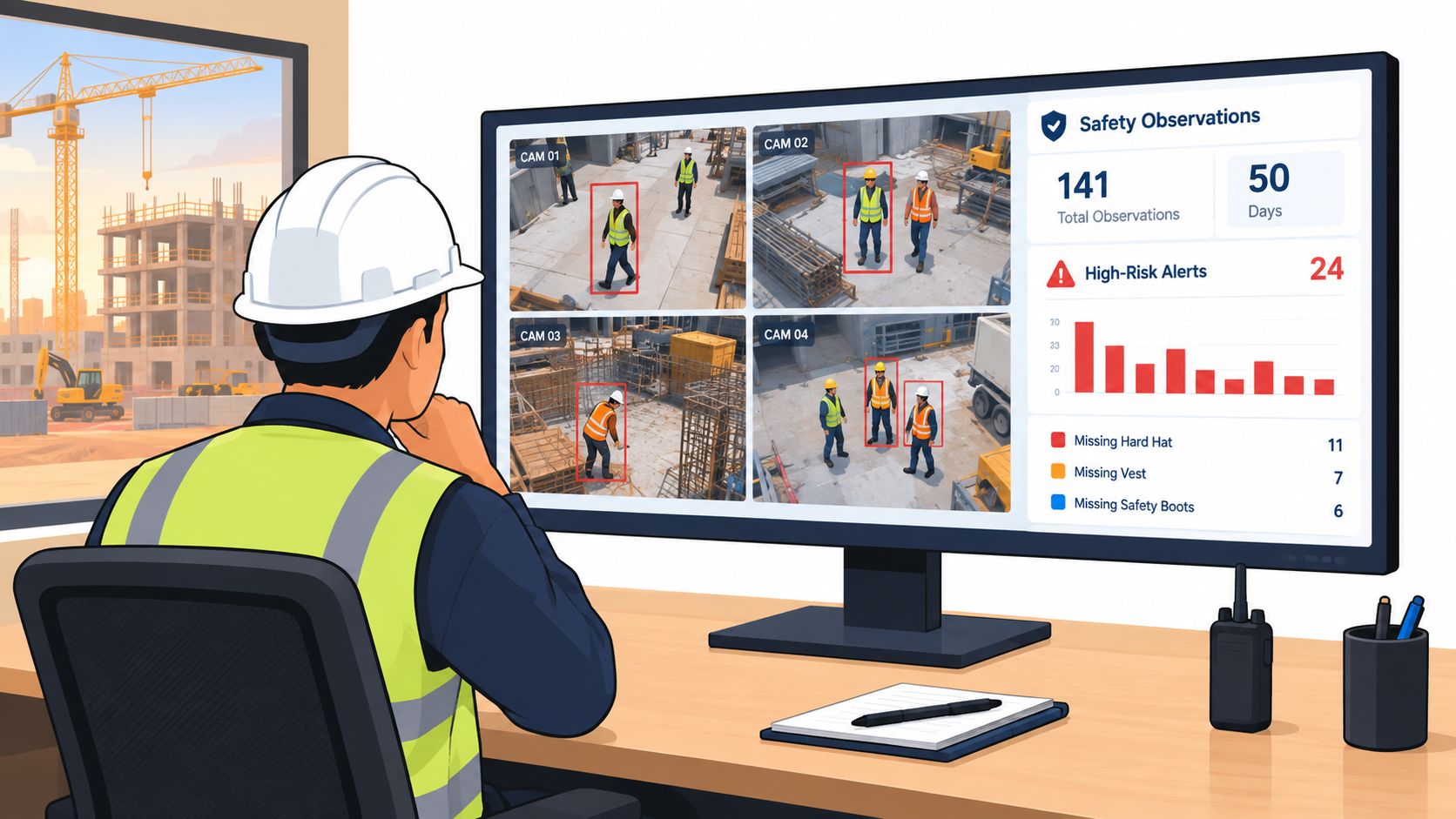
The value lies in the split between observations and severity. AI surfaced conditions continuously, while the health-and-safety team applied professional judgment to determine which events required urgent escalation. A construction organization can adapt that model by routing routine PPE observations into coaching or scheduled correction, while sending imminent equipment conflicts, fall risks, or restricted-zone entries directly to the responsible supervisor.
Design the escalation path before deployment
The workflow should specify:
- Who receives the alert: Assign a role, not a generic distribution list.
- What evidence is retained: Keep the event image, timestamp, location, and relevant context.
- How severity is classified: Use defined categories for routine, significant, and high-risk conditions.
- What response is required: Specify immediate intervention, inspection, coaching, or work stoppage where appropriate.
- How closure is verified: Require a human confirmation and record the corrective action.
- How recurrence is reviewed: Feed repeated observations into training, planning, and engineering controls.
Organizations adding aerial inspection should also establish flight planning and site coordination procedures. Guidance on using drones in construction workflow can help teams think through how aerial capture fits into broader project operations, but the safety process still determines how observations are validated and acted upon.
Regulatory and Ethical Considerations
A safety camera can protect workers, but it can also become a surveillance system if the organization fails to define its purpose. Privacy, legal accountability, transparency, bias, legacy-system integration, skills shortages, and labor relations aren't secondary concerns. They determine whether workers trust the alerts and whether supervisors use them consistently.
The responsible AI implementation guidance is useful for framing governance as an operating requirement rather than a communications exercise. A credible program should document:
- Purpose limitation: Use monitoring for hazard prevention, not productivity scoring or arbitrary discipline.
- Role-based access: Limit footage and event data to people with a defined safety responsibility.
- Short retention: Keep identifiable footage only as long as the safety, legal, or investigation purpose requires.
- Human review: Require human verification for high-consequence interventions and disputed events.
- Appeal procedures: Give workers a clear route to challenge an incorrect alert or classification.
- Bias testing: Test across PPE types, lighting, weather, languages, and worker groups.
- Worker communication: Explain what is monitored, what isn't monitored, and how data is used.
The operational distinction is simple. A system designed to identify hazardous conditions can support workers. A system that scores individuals behind the scenes can undermine the safety culture it was intended to strengthen. Worker representatives and subcontractors should have a feedback channel before scale-up, and management should publish accountability for alert review, data access, and corrective action.
Prometheus Agency helps executives evaluate AI opportunities, design measurable pilots, and connect new systems to existing processes and accountability structures. Visit Prometheus Agency to discuss an AI strategy for construction safety, data readiness, and responsible implementation.