The most popular advice about AI governance certification is wrong. Leaders are told to publish a responsible AI policy, add a certification badge to the website, and move on. That approach fails the first time an auditor asks who owns an AI system, how its risks were assessed, what happened after deployment, or where the supporting evidence lives.
Certification is not a branding exercise. It's an operational test of whether your organization can govern AI consistently across its lifecycle, including the models embedded in CRM platforms, marketing automation, sales intelligence tools, customer support systems, and third-party applications. For B2B executives, the important question isn't “How do we get the badge?” It's “Can our teams produce reliable evidence when a buyer, regulator, board, or auditor asks for it?”
Redefining AI Governance Certification
ISO/IEC 42001 is a starting point for AI governance certification, not a marketing badge. Published on 18 December 2023, it is the first international certifiable standard for artificial intelligence management systems. The standard sets requirements for establishing, implementing, maintaining, and continually improving an Artificial Intelligence Management System, or AIMS, as documented by ISO's ISO/IEC 42001 standard page.
An AIMS connects governance objectives with accountable roles, risk assessments, impact assessments, controls, operational records, internal review, and continuous improvement. A policy library alone will not satisfy that requirement. The organization must show that people perform defined activities and retain evidence, including records that can be retrieved from the systems where AI work occurs.
Certification is voluntary, and ISO does not issue certificates. Independent certification bodies assess organizations and issue certificates, so preparation must target an external audit rather than self-declaration. The resulting evidence supports claims about governance maturity only within the assessed scope and conditions.
What the standard changes for executives
The standard gives organizations that develop, provide, or use AI a shared audit framework. In Europe, EN ISO/IEC 42001:2026 was approved by CEN on 13 March 2026, and 34 countries are required to give it national-standard status by September 2026. This standardization gives procurement teams, partners, and auditors a common language for examining AI management practices.
The operational impact reaches revenue workflows. An AI-powered lead-scoring tool, automated account-research process, generative AI assistant inside a CRM, or customer-facing chatbot can create governance responsibilities. Executives need an inventory showing which systems exist, who owns them, what data they use, which decisions they influence, and how humans intervene when performance or outputs fail.
The audit gap usually appears between approved documents and machine-readable evidence. A policy may require human review, but the CRM must record who reviewed an output, what changed, and when the decision occurred. Without that trail, a governance statement remains difficult to verify.
Practical rule: If governance evidence cannot be tied to a system, owner, decision, and timestamp, it probably will not withstand a serious assessment.
Prometheus Agency's enterprise AI governance framework can help executives connect governance requirements with broader operating models. Build repeatable controls inside the workflows where AI affects customers and revenue, then make their evidence easy to retrieve during an audit.
Business Value and Impact Opportunity
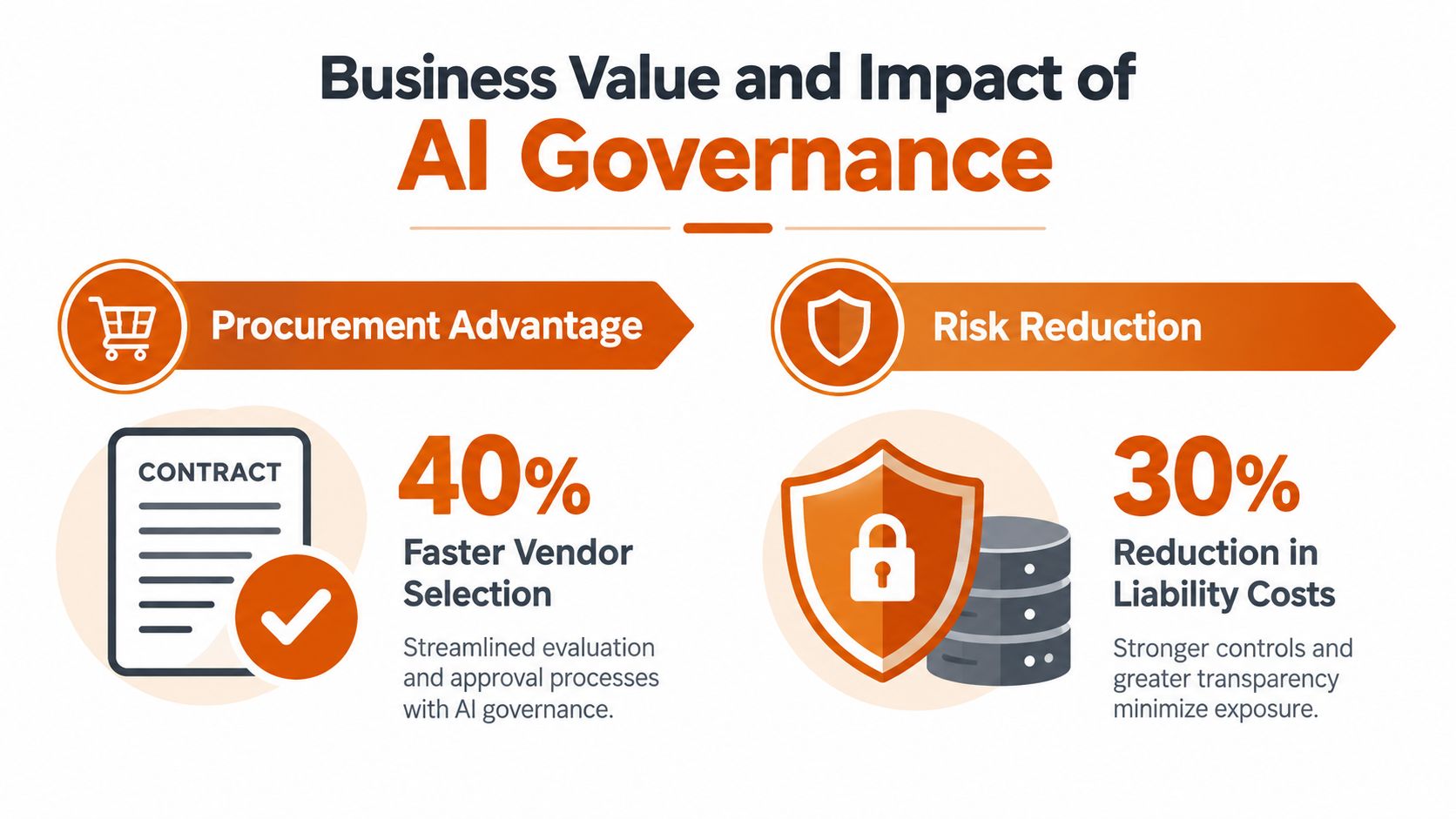
Governance becomes a commercial advantage when it removes uncertainty from a buyer's decision. Enterprise procurement teams increasingly ask vendors to explain how AI systems are managed, how data is handled, how human oversight works, and how incidents are addressed. A certification can't answer every question, but it can provide independent evidence that the organization operates a defined AI management system.
That evidence is especially useful in regulated and procurement-sensitive markets. A buyer evaluating an AI-enabled platform may need to review policies, risk registers, supplier controls, data documentation, incident processes, and oversight mechanisms. An independently assessed management system can reduce the amount of foundational diligence the buyer must perform from scratch.
Where revenue teams feel the difference
The impact opportunity isn't limited to legal risk. It appears in sales execution.
A sales team can use certification evidence to improve responses to security questionnaires and RFP requirements. Rather than asking account executives to describe governance from memory, the organization can maintain approved documentation covering system scope, ownership, risk treatment, oversight, and supplier evaluation. That gives sales operations a controlled evidence library and gives buyers a clearer path through their approval process.
Consider a B2B software company using generative AI to summarize customer conversations and recommend follow-up actions. Without operational governance, the buyer may ask whether the system processes sensitive information, whether outputs are reviewed, how errors are logged, and whether the vendor monitors third-party model changes. A strong AIMS won't eliminate those questions, but it gives the vendor a structured way to answer them.
- Procurement enablement: Give revenue teams accurate, approved evidence instead of informal assurances.
- Deal protection: Reduce the chance that unclear AI ownership or documentation becomes a late-stage blocker.
- Risk containment: Assign accountability before an AI workflow affects customers, employees, or commercial decisions.
- Market readiness: Build governance practices before a contract, regulation, or partner requirement makes them urgent.
Certification also helps executives prepare for a changing regulatory environment. It doesn't guarantee compliance with every applicable law, and it shouldn't be presented as a universal legal shield. It does create a repeatable governance foundation that can support additional regulatory and customer requirements.
The right business case is therefore practical: certification protects revenue when buyers need proof, not promises. It can also expose weak processes early, while the organization still has time to fix them without a distressed customer escalation or a rushed procurement response.
Comparing Certification Types and Competencies
Executives often conflate organizational certification with individual training. They solve different problems.
ISO/IEC 42001 certification applies to an organization's AI Management System within a defined scope. An individual credential demonstrates that a person has studied a body of knowledge or passed an assessment. Academic programs, vendor certifications, and professional courses may build useful skills, but they don't substitute for an external audit of the company's governance system.
The distinction matters when a buyer asks for organizational assurance. Funding an AI risk course for a compliance manager may improve internal capability. It won't, by itself, establish an AI inventory, assign system owners, document impact assessments, or prove that controls operate across CRM and GTM workflows.
Executives comparing personal credentials can use resources such as ranking AI risk management credentials to evaluate options by professional focus. The selection should follow the business requirement, not the popularity of a course.
AI certification paths compared
| Certification Type | Target Audience | Primary Focus | Business Utility |
|---|---|---|---|
| Organizational ISO/IEC 42001 certification | Companies that develop, provide, or use AI systems | AI Management System requirements, risk, impact, oversight, controls, and continual improvement | Independent evidence for procurement, governance maturity, and operational accountability |
| Individual AI governance credential | Privacy, legal, risk, compliance, and governance professionals | Professional knowledge of AI oversight, regulation, risk, and responsible use | Builds internal capability and gives teams a common governance vocabulary |
| Academic AI program | Technical, business, and policy professionals | Structured study across AI development, ethics, policy, or management | Develops strategic and analytical depth, but doesn't certify the employer's management system |
| Vendor-specific AI certification | Users, administrators, developers, and implementation teams | Safe and effective use of a particular platform or tool | Supports adoption discipline and technical competence within that vendor ecosystem |
| Model evaluation or technical credential | Data scientists, machine learning engineers, and technical reviewers | Model performance, testing, validation, benchmarking, or monitoring | Strengthens technical assurance, but doesn't cover the full socio-technical governance system |
Match the credential to the decision
If your buyer needs proof that the company governs AI, pursue organizational certification. If your team lacks expertise, develop individual capability in parallel. If your implementation depends on a specific platform, vendor training can reduce operational mistakes.
A mature program uses these credentials together. Technical specialists assess model behavior. Legal and risk teams evaluate impacts and obligations. Revenue leaders define acceptable use in customer workflows. Executives establish accountability and funding. ISO/IEC 42001 provides the management-system structure that connects those competencies.
Prometheus Agency's AI maturity model can help leaders determine whether the organization needs foundational capability, workflow implementation, or formal assurance first. Certification should follow sufficient operational maturity, not substitute for it.
Evaluating Audit Readiness and Common Gaps
The hardest certification work happens before the auditor arrives. Organizations usually don't fail because they lack an eloquent AI policy. They struggle because they can't produce complete, current, traceable evidence across the AI lifecycle.
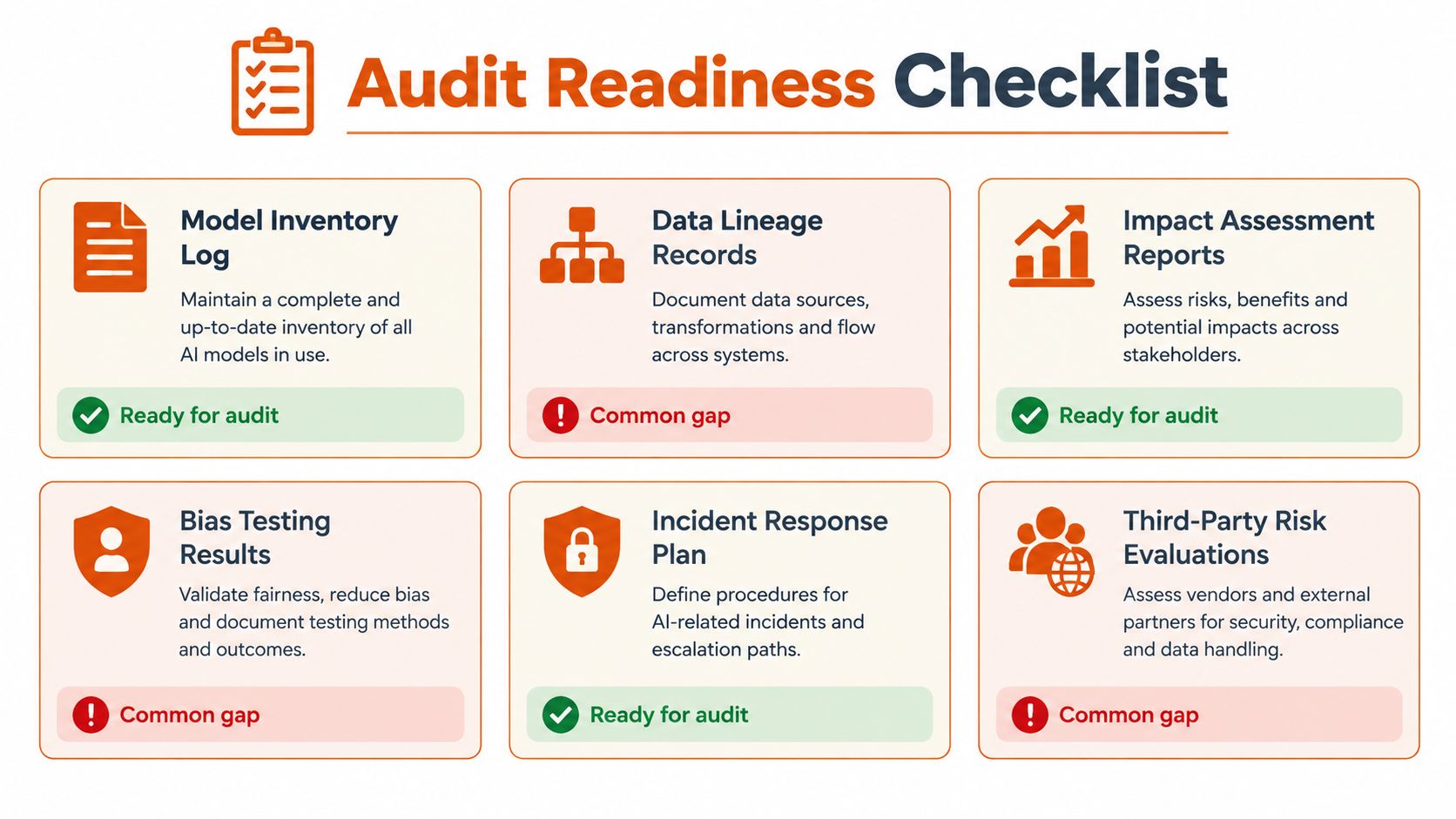
Annex A uses 38 controls organized into 9 control areas, and independent guidance identifies the operational evidence auditors look for, including AI system inventories, impact and risk assessments, data provenance and quality records, human-oversight mechanisms, incident logs, and supplier assessments in this overview of ISO/IEC 42001 controls.
The evidence gap inside revenue operations
A CRM may contain several AI features, while marketing and sales teams may also use external tools for enrichment, forecasting, content generation, call analysis, routing, and personalization. Those systems often enter the stack through departmental purchases, pilot programs, or platform updates. If no one maintains a central inventory, leadership may not know what's in scope.
Common gaps include:
- Incomplete inventory: The organization can't identify every AI system, embedded feature, third-party component, or workflow using AI-generated outputs.
- Unclear ownership: Teams use a tool, but nobody is accountable for risk decisions, monitoring, incident response, or retirement.
- Weak impact assessments: Documentation describes functionality but not consequences for individuals, groups, customers, or society.
- Missing provenance records: The organization can't trace important data sources, transformations, quality checks, or permitted uses.
- Unproven human oversight: A policy says humans review outputs, but the workflow contains no approval step, exception log, or review record.
- Limited supplier oversight: Vendor contracts and assessments don't address model changes, data handling, performance issues, or incident notification.
The fix is an internal gap analysis tied to operational systems. Start with an inventory that records the system name, business purpose, owner, provider, data inputs, outputs, users, decisions influenced, and lifecycle status. Then connect each system to its risk assessment, impact assessment, controls, monitoring records, incidents, and supplier documentation.
Auditors don't certify intentions. They assess whether the management system operates and whether the organization can demonstrate that operation.
A focused AI readiness assessment can help revenue and transformation leaders identify where governance breaks inside existing processes. The objective is to make evidence machine-readable where possible, with structured fields, approval states, timestamps, ownership records, and links to source documentation.
Implementation Roadmap and Time-to-Value
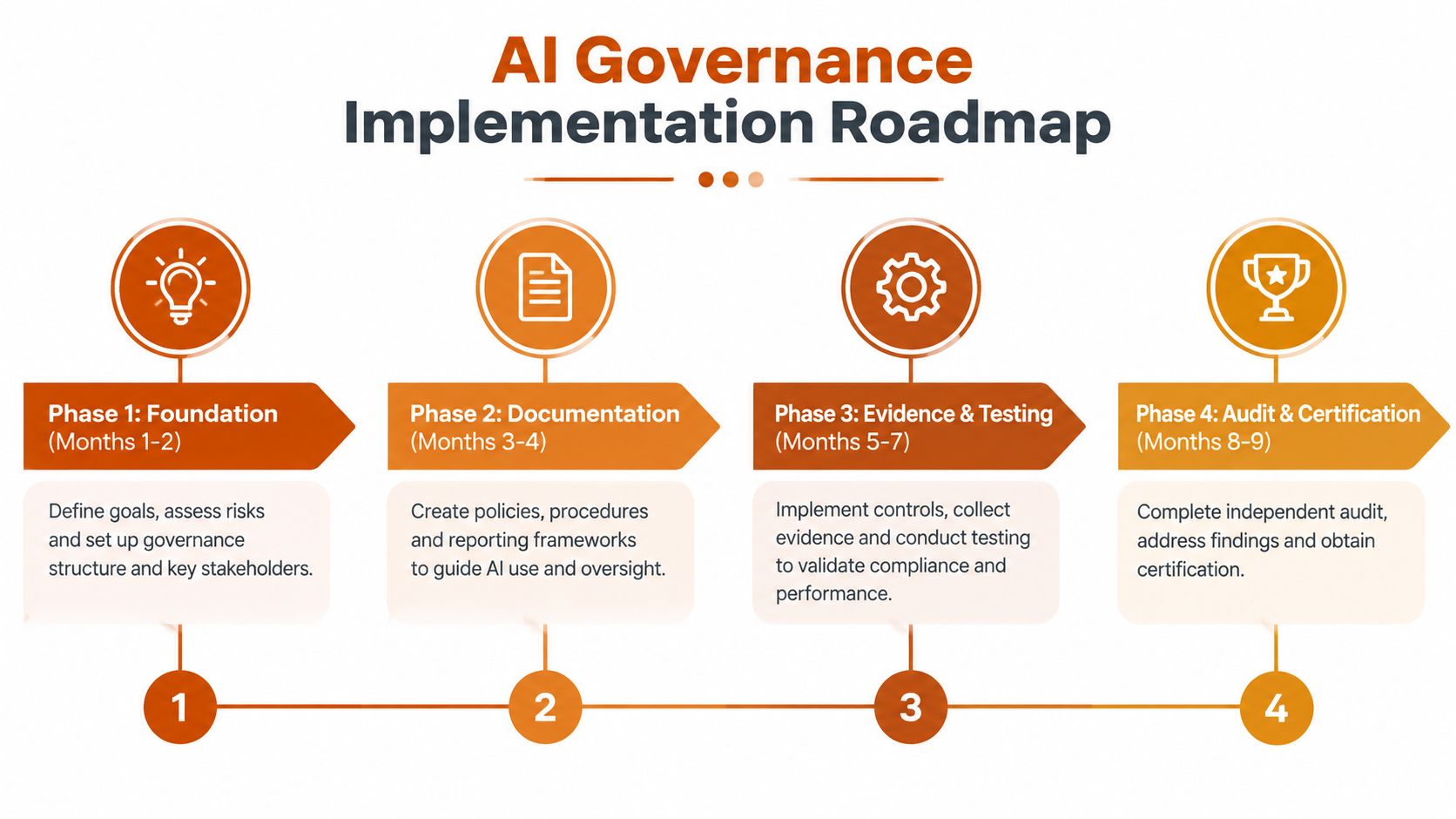
Certification should be managed as an operating program, not a last-minute documentation sprint. A commonly described path includes gap analysis, implementation, internal audit, a Stage 1 documentation and readiness audit, a Stage 2 implementation audit, annual surveillance audits, and recertification on a three-year cycle, as outlined in this ISO/IEC 42001 certification pathway.
Organizations may spend roughly 6 to 18 months implementing the system before initial certification, depending on maturity, according to the same guidance. Treat that range as a planning signal, not a promise. Your existing management systems, AI inventory, ownership model, documentation quality, and evidence tooling will shape the actual path.
Build the program in operational phases
Start with scope and ownership. Identify the business units, AI systems, processes, sites, and suppliers that certification will cover. Assign an executive sponsor, a program owner, system owners, risk owners, and operational participants from legal, security, data, engineering, sales, marketing, and customer success.
Translate requirements into workflows. Establish the AI policy, risk assessment method, impact assessment method, control ownership, incident process, supplier review, monitoring expectations, and Statement of Applicability. The Statement of Applicability should connect selected controls to the organization's scope and explain which controls apply, how they're implemented, and why any exclusions are justified.
Operate before auditing. Teams need time to perform assessments, approve decisions, monitor systems, record incidents, review suppliers, and correct weaknesses. A control that exists only in a document won't demonstrate sustained operation.
Test the evidence. Run an internal audit before Stage 1. Sample CRM workflows, model records, approval events, incident logs, vendor assessments, and monitoring outputs. Ask an uncomfortable question: could someone outside the team reproduce the governance decision from the evidence alone?
The ISO explanation of ISO/IEC 42001 reinforces the central point that certification is voluntary and conducted by independent certification bodies. Select the body early enough to understand scope, audit expectations, accreditation status, and surveillance requirements.
Annual surveillance changes the economics of the program. Your team must maintain evidence continuously, not rebuild it before each review. That cadence is where time-to-value becomes operational value, because governance activities become part of product development, vendor management, CRM administration, and revenue operations.
Choosing the Right Program and Next Steps
Start with the commercial problem, then define the certification scope. If enterprise buyers keep asking for AI controls, prioritize the systems that influence customer data, customer decisions, regulated processes, or contractual commitments. Don't begin by trying to certify every experiment in the company.
A sensible scope decision answers four questions:
- Which AI systems affect revenue or customer outcomes?
- Which systems process sensitive or commercially important data?
- Which vendors create dependencies outside your direct control?
- Which workflows create the greatest procurement, regulatory, or reputational exposure?
A customer-facing AI assistant may deserve early attention because it interacts directly with users and generates records that sales or service teams rely on. A low-risk internal drafting tool may belong in the inventory but not in the first certification scope. The decision should be documented through risk and impact assessment, not made purely by departmental preference.
Select the certification body carefully
ISO doesn't issue the certificate, so the certification body matters. Ask prospective bodies to explain their accreditation, relevant AI management-system experience, audit methodology, scope expectations, auditor competence, surveillance approach, and treatment of outsourced AI components. Clarify what evidence they expect at Stage 1 and Stage 2 before your team commits to a schedule.
Avoid programs that promise a fast badge without requiring operational proof. A weak assessment may create short-term marketing material while leaving the business exposed to buyer diligence, incidents, or future audits.
Put governance into the revenue stack
Governance belongs inside the workflows where decisions happen. In CRM and GTM operations, that can mean requiring an impact assessment before enabling an AI scoring feature, recording approval for automated customer communications, logging human overrides, documenting data sources for enrichment, and routing incidents to named owners.
This is also where certification should be placed in a broader assurance stack. The recent research on trustworthy AI signals and deployment governance raises a serious concern, buyers may struggle to distinguish trustworthy systems from systems that merely appear responsible. Certification can reduce some governance risk, but it doesn't prove real-world safety or compliance performance on its own.
Use certification alongside continuous monitoring, product documentation, supplier assurance, security and privacy controls, model testing, human review, and outcome measurement. The credential should validate a living system, not conceal the absence of one.
Key Takeaways and Transformation Support
AI governance certification is valuable when it changes how the business operates. A policy on a shared drive won't protect a deal, answer a buyer's diligence questions, or show an auditor that controls work. Your organization needs a current AI inventory, clear ownership, risk and impact assessments, traceable data records, human oversight, supplier reviews, incident logs, and evidence that teams monitor and improve the system.
Key Takeaways
- Treat ISO/IEC 42001 as an operating system: It establishes requirements for an AIMS, not a decorative compliance statement.
- Prepare for independent assessment: Certification is voluntary, but it's issued by independent certification bodies rather than ISO.
- Prioritize evidence over policy: Auditors need operational records connected to systems, owners, decisions, and controls.
- Connect governance to revenue: Use approved evidence in RFPs, vendor reviews, security questionnaires, and enterprise sales conversations.
- Build for continuity: Plan for Stage 1 and Stage 2 audits, annual surveillance, and a three-year certification cycle.
- Use certification as one assurance layer: Combine it with monitoring, technical evaluation, supplier oversight, human review, and outcome measurement.
A practical example is a B2B company that discovers its CRM vendor, sales intelligence platform, call-analysis tool, and marketing automation system all use AI. Instead of writing four separate policies, the company creates a central inventory, assigns owners, records data and impact assessments, defines review points, and gives sales a controlled evidence package. That approach improves audit readiness while making governance useful to the teams responsible for pipeline and retention.
Prometheus Agency helps growth leaders connect AI enablement, CRM implementation and optimization, and go-to-market strategy with operational governance. Its work can include assessing AI readiness, identifying workflow opportunities, defining adoption roadmaps, and translating governance requirements into accountable revenue processes. The right transformation partner won't just recommend tools. They'll help your teams make governance executable inside the systems they already use.
Prometheus Agency offers a complimentary Growth Audit and AI strategy session to assess your certification readiness, CRM and GTM workflows, and highest-value AI opportunities. Visit Prometheus Agency to start turning governance requirements into an operational plan that protects revenue and supports durable growth.