An effective AI-driven marketing strategy doesn’t start with buying new software. It begins with a hard look at your current marketing operations. This first step is all about auditing your goals, data, and tech to find where AI can actually make a difference in growth and efficiency.
Key Takeaways
A successful AI-driven marketing strategy is built on a thorough understanding of where you are right now. Start by auditing your marketing goals, mapping the customer journey, and identifying specific friction points. This foundational work ensures your AI investments solve real business problems, not just adopt new tech for its own sake.
Building Your Foundation for AI Success
Jumping into AI without a plan is like building a house without a blueprint. You might end up with something, but it probably won’t be stable, efficient, or what you actually needed. The hype around AI is real, but a successful rollout demands a solid, strategic base.
This means you have to resist the temptation to chase shiny new tools and instead focus on solving real business problems.
The initial phase is pure discovery. Before you can apply AI, you have to understand the market of your marketing and sales efforts. We're talking about a full audit of your growth engine to map the entire B2B customer journey, from that first touchpoint all the way to post-sale advocacy.
Pinpoint Your Greatest Opportunities
Your goal during this audit is to find the friction points—the gaps where AI can have the biggest impact.
Are your sales cycles dragging on for too long? Is your lead scoring system missing high-intent prospects until it’s too late? Maybe your content personalization efforts are falling flat, treating every lead the same regardless of their industry or pain points.
Practical Example: A mid-sized B2B SaaS company might find its customer service team spends 30% of its time on repetitive questions. An AI-powered chatbot becomes a clear, high-impact solution to this specific friction point. Asking these tough questions helps you move from a vague "we need AI" mindset to a specific, problem-solving approach.
The Impact Opportunity here is significant. By identifying and solving these friction points, you move beyond theoretical benefits and create a clear business case for AI, focusing investment on areas that promise the highest return in efficiency or revenue growth.
Assess Your Data and Tech Readiness
AI is only as good as the data you feed it. A huge part of building your foundation is getting real about the health of your data infrastructure. This goes way beyond just having a CRM; it’s about the quality, accessibility, and structure of your information.
Think about these key areas:
- CRM Hygiene: Are your records in platforms like Salesforce or HubSpot clean, complete, and free of duplicates? Messy data leads to garbage AI insights.
- Data Collection: Are you consistently capturing crucial lead info—like industry, company size, and engagement behavior?
- System Integration: Can your marketing automation platform, CRM, and other tools actually talk to each other? Siloed data will stop any AI initiative dead in its tracks.
The explosive growth of AI in business is impossible to ignore. Global spending on AI-enabled marketing is projected to jump from $36 billion in the early 2020s to a staggering $370 billion by 2032. Revenue from AI marketing applications is also expected to blow past $107 billion after 2028, showing just how seriously companies are investing here.
To help you get a clear picture of where you stand, we put together a simple framework. This isn't a pass/fail test, but a way to honestly assess your starting point.
AI Readiness Assessment Framework
This table helps you quickly gauge your organization's readiness for AI by looking at the core pillars of a successful strategy. Be honest with your self-evaluation—it's the first step to building a realistic plan.
| Assessment Pillar | Low Readiness Indicator | High Readiness Indicator | First Action Step |
|---|---|---|---|
| Data Quality | Inconsistent, incomplete, or duplicate data in CRM; manual data entry is common. | Clean, standardized, and enriched data with clear governance policies. | Initiate a data cleanup project focused on your most critical customer data sets. |
| Tech Integration | Key systems (CRM, MAP) are siloed and do not share data automatically. | Systems are integrated via APIs, with a centralized data warehouse or CDP. | Map your current tech stack and identify the top 2-3 most critical integration points. |
| Team Skills | Low familiarity with data analysis, AI concepts, or marketing analytics tools. | Team includes data analysts or marketing ops with proven analytical skills. | Assess your team's AI proficiency with our quick AI Quotient evaluation. |
| Strategic Clarity | Unclear business goals; AI is seen as a tech project, not a business driver. | Specific, measurable business problems are identified as top priorities for AI. | Host a workshop with marketing and sales leaders to define 1-2 key problems to solve. |
Taking stock of your current capabilities is the only way to build a realistic roadmap. Understanding your team's AI Quotient, for instance, can reveal skill gaps you need to address before you invest in new platforms.
It's also essential to get up to speed on emerging concepts like Generative Engine Optimisation (GEO). This kind of groundwork prevents costly mistakes and ensures your AI investment actually delivers a return.
Choosing High-Impact AI Marketing Projects
You’ve done the foundational work. Now for the exciting part: picking your first AI marketing project. It’s incredibly easy to get distracted by the shiny new AI tool of the week, but real B2B growth comes from focusing on specific, high-value applications that solve an actual problem.
Forget about chasing trends. The goal here is to map potential AI projects directly to your business objectives. The most successful initiatives are the ones that either fix a glaring pain point or unlock a massive, untapped opportunity.
Identifying B2B Use Cases
For B2B companies, sales cycles are long and complex. That’s precisely where AI can make the biggest difference. Think about the friction points in your funnel—where could intelligent automation step in and smooth things out?
Here are a few Practical Examples I’ve seen deliver real results:
- Smarter Lead Scoring: A predictive model can dig into your historical CRM data to find what really makes a lead likely to convert. This goes way beyond basic demographic scoring. It lets your sales team zero in on accounts that are showing genuine buying intent. This is often one of the quickest ways to prove the value of AI-powered lead generation.
- Account-Based Marketing (ABM) on Steroids: AI can sift through firmographic, technographic, and behavioral data to build hyper-targeted ABM lists. It’s fantastic at spotting "lookalike" companies that perfectly match your ideal customer profile but aren’t even on your radar yet.
- Dynamic Content Personalization: If you're selling to large enterprises with diverse needs, AI can dynamically serve up content tailored to a prospect’s specific industry, role, and stage in their journey. Every touchpoint becomes more relevant and, frankly, more valuable.
This workflow—auditing your current state, assessing your data, and then pinpointing the right opportunity—is the bedrock of any successful AI initiative.
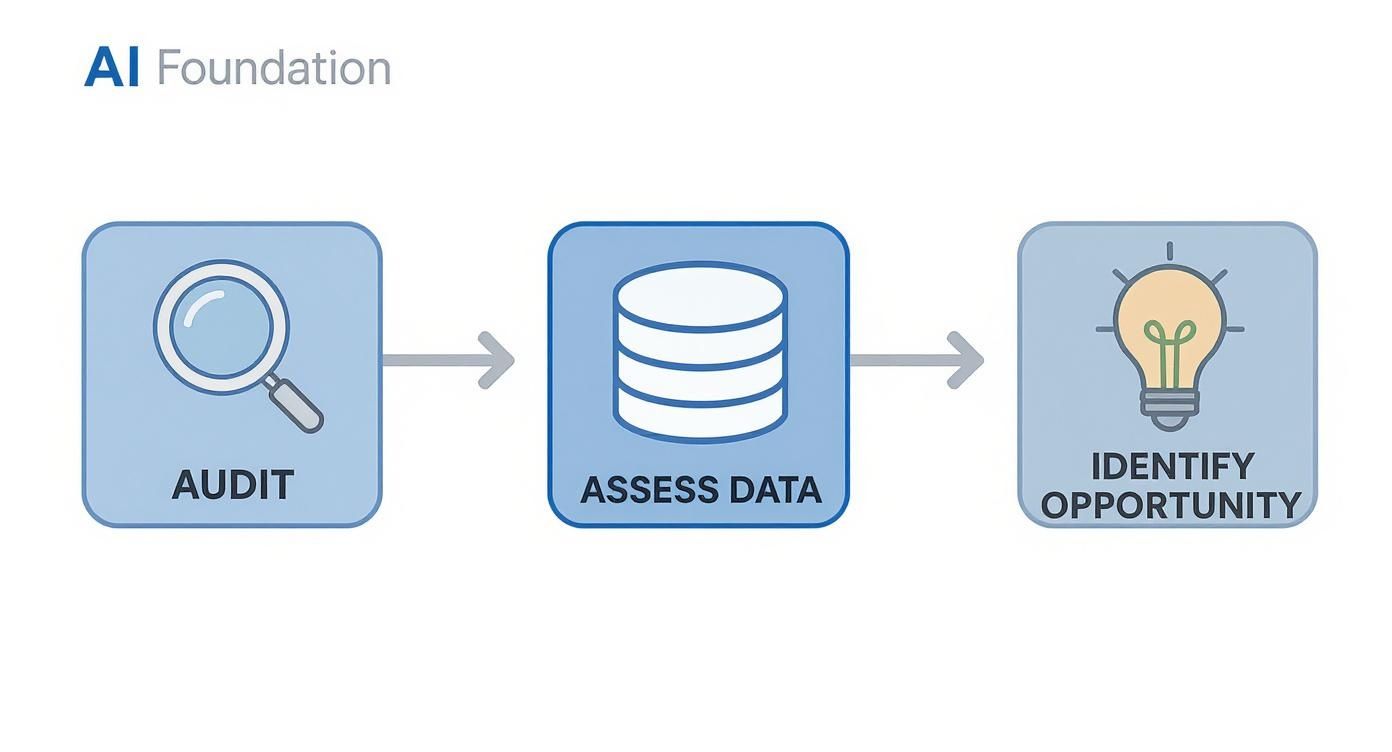
This isn’t about throwing darts at a board. As the visual shows, smart project selection is a direct result of a structured, honest look at what you’re capable of and what you need to achieve.
Prioritizing for Quick Wins
Let’s be real: not all AI projects are created equal. Some have enormous potential but will take a ton of time and resources. Others can deliver measurable results in a fraction of the time. To build momentum and get leadership excited, you need to start with a project that promises a quick, demonstrable win.
A simple use case matrix is perfect for this. Plot your potential projects on two axes: Potential Impact (low to high) and Implementation Difficulty (low to high). Your first move should be in that "High Impact, Low Difficulty" sweet spot.
A Practical Example of a quick win: A mid-sized SaaS company used AI to analyze product usage data to identify existing customers who were prime for an upsell. This was a home run—a high-impact project with relatively low difficulty because the data was already sitting right there in their systems. On the other hand, building a custom generative AI for content creation would be a high-difficulty beast, best left for when your team has a few wins under its belt.
The Impact Opportunity is massive. AI-driven personalization is dominating the conversation for a reason. By 2025, it's expected to be the single biggest trend, with 59% of marketers globally using it to optimize their campaigns. Why? Because AI can adapt messaging and ads in real time, creating hyper-relevant customer journeys that just plain work. Nielsen’s full analysis offers a deeper dive into this shift.
At the end of the day, your CRM is the heart of all this. It holds the data that fuels every insight and action. Your first project should always start with an honest look at what high-quality data you can easily pull from your CRM. The goal is to choose a targeted, high-value project that proves the concept and builds an undeniable case for future investment.
Integrating AI into Your Go-to-Market Engine
An AI tool sitting on a shelf is a wasted investment. The real magic happens when you weave it directly into your core business systems, turning it into the intelligent engine behind your entire go-to-market (GTM) strategy. This is how you turn abstract data points into real sales and marketing actions, creating a system where insights automatically trigger the right next step.
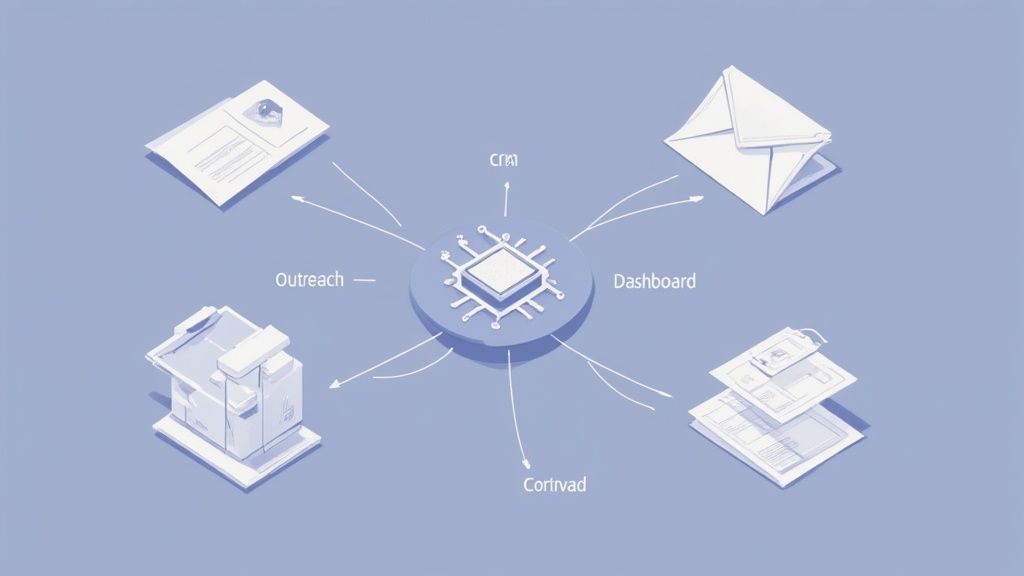
The goal here is a seamless data pipeline. Don't think of it as just connecting two apps; you're building a central nervous system for your revenue operations. Data has to flow effortlessly between your AI tools and foundational platforms like Salesforce or HubSpot.
This two-way street is what makes an ai driven marketing strategy so potent. It's not just about pushing AI-generated insights into your CRM. It's about your CRM feeding real-world outcomes back into the AI models, letting them learn, adapt, and get smarter over time.
Connecting AI to Your Core Systems
Before you write a single line of code or touch an API, you need to map the data flow. Sit down with marketing, sales, and IT to define exactly what information needs to move, where it needs to go, and what should happen when it gets there.
A predictive lead score, for example, is useless if it’s buried in a separate dashboard. It needs to show up directly within a sales rep’s view in the CRM, right next to the contact record. Better yet, the system should act on that score automatically.
Here’s what this looks like with Practical Examples:
- Lead Scoring to Sales Cadence: An AI model flags a lead with a score of 95/100. That score syncs to Salesforce, which instantly triggers an API call to a tool like Outreach or Salesloft. The lead is automatically enrolled in an aggressive, personalized follow-up sequence. No human intervention needed.
- Content Personalization: An AI tool sees a prospect is spending time on certain product pages. It pushes that data to your marketing automation platform (like Marketo), so the very next nurture email they receive features a case study from their specific industry.
- Account-Level Insights: For your ABM plays, an AI platform might identify an account suddenly showing strong buying signals across the web. This insight gets pushed to the CRM, creating a high-priority task for the account executive, complete with talking points based on the signals.
Key Takeaways
Integration is where the strategic value of AI is unlocked. The aim is to create automated workflows where AI insights directly trigger specific actions in your CRM and sales outreach platforms, eliminating manual handoffs and speeding up the entire sales cycle.
using specialized AI tools for marketing automation can make this much easier. Many of these platforms come with pre-built connectors that dramatically reduce the technical lift.
Overcoming the Human Hurdle
Let's be honest: the tech is only half the battle. The biggest barrier to a successful integration is almost always human. If your sales and marketing teams don't trust the AI, they won't use it, and the entire system falls apart.
Building that trust comes down to transparency and smart training.
Practical Examples for Driving Adoption
- Explainable AI (XAI): Whenever you can, choose AI tools that show their work. Instead of just a lead score of 92, the system should tell the rep why: "Visited pricing page 3 times," "Company size matches ICP," or "Downloaded the ROI calculator."
- Pilot Program Champions: Don’t roll it out to everyone at once. Find a few of your most tech-savvy and respected sales reps and make them part of a pilot program. Their success stories and testimonials will be your best internal marketing tool.
- Integrated Training: Train people in the context of their daily workflow. Don't just show them the new AI tool. Show them how the AI insights will appear inside the CRM and sales tools they already live in every single day.
The Impact Opportunity is massive. A well-integrated AI system can shrink lead response times from hours to minutes. It can help your sales reps focus their energy exclusively on the accounts most likely to close.
Ultimately, plugging AI into your GTM engine isn't just a nice-to-have; it's a strategic imperative. For a deeper dive into aligning technology with your revenue goals, check out our insights on building a powerful consulting GTM framework. This is how you transform your AI from a standalone novelty into the core of a smarter, faster, and more effective revenue machine.
Launching and Measuring Your First AI Pilot
To get your organization fully behind an AI-driven marketing strategy, you have to prove it works. Words aren't enough—you need results. This is where a focused, well-designed pilot program becomes your best friend. It’s your chance to show real wins, build confidence internally, and make a solid business case for a bigger investment.
The secret to a successful pilot is a tightly controlled scope. You're not trying to boil the ocean here. The goal is to pick a single, high-impact area where you can score a measurable victory, quickly and cleanly.

Defining a Controlled Scope
Think small to win big. A great pilot isolates just one variable to test against a control group. This simplicity is its strength—it makes it dead simple to attribute success directly to your AI initiative, leaving no room for doubt about its impact.
Here are a few Practical Examples of a pilot scope:
- Predictive Lead Scoring: Take just one of your product lines and apply a new AI lead scoring model to its inbound leads. Now, compare the sales-qualified lead (SQL) conversion rate of this group against leads from your other product lines still using the old method.
- Personalized Nurture Campaign: Find a single, underperforming email nurture sequence. Use an AI tool to dynamically personalize the content and send times for new leads entering that flow. Measure the lift in engagement against the original, static version.
- ICP Expansion: Use an AI platform to identify a fresh target segment of 500 net-new accounts that fit your ideal customer profile. Run a hyper-targeted digital ad campaign only to this group and track the cost per qualified meeting.
Establishing Baselines and KPIs
Before you press "go" on anything, you need to know your starting line. Without clear baseline metrics, you have no way to prove you’ve made a difference. Pull historical data for the six months leading up to your pilot to establish a firm benchmark.
Once your baseline is locked in, define the specific Key Performance Indicators (KPIs) you'll track. These must tie directly back to the business problem your pilot is supposed to solve.
The Impact Opportunity here is connecting your pilot's KPIs to revenue. Sure, a bump in email open rates is nice, but showing a reduction in the sales cycle for AI-qualified leads is what gets executives to sit up and listen. That’s how you get funding.
Key Takeaway
A winning AI pilot is built on a limited scope, clear baselines, and revenue-focused KPIs. By isolating a single use case—like predictive scoring for one product—you can definitively measure its impact on metrics like conversion lift or sales cycle reduction, building an undeniable business case for expansion.
The financial results are becoming too big to ignore. Sales and marketing teams using AI-powered tools are pulling ahead; for instance, 83% of sales teams using AI reported revenue growth, a stark contrast to the 66% of teams without it. With 63% of marketers projected to be using generative AI by 2025, running these pilots is non-negotiable for staying competitive. You can see more data on AI's business impact by reading the full report from Salesforce.
Calculating a Defensible ROI
After your pilot runs its course—usually 60-90 days—it's time to crunch the numbers. A simple, defensible ROI calculation is your best friend when you're in front of leadership. It needs to be easy to follow and tie directly back to business value.
Here's a straightforward framework to structure your ROI calculation:
| Metric Category | Description | Practical Example Calculation |
|---|---|---|
| Value Generated | The direct financial gain from the pilot. This could be new revenue, pipeline growth, or cost savings. | 20 additional SQLs x 25% close rate x $15,000 avg. deal size = $75,000 in new pipeline. |
| Costs Incurred | The total investment. Include software licenses, any consulting fees, and internal team hours. | $5,000 for AI tool license + 20 hours of team setup time @ $100/hr = $7,000 total cost. |
| Net Return | Total value minus total costs. This is your net profit (or loss) from the initiative. | $75,000 (Value) - $7,000 (Cost) = $68,000 Net Return. |
| ROI Percentage | Net return divided by costs, shown as a percentage. | ($68,000 / $7,000) x 100 = 971% ROI. |
This clear, numbers-driven approach takes all the guesswork out of it and builds a powerful case. A successful pilot, backed by a strong ROI calculation, is the final piece of the puzzle in proving the value of AI and securing the resources needed to scale your efforts across the entire organization.
So, your AI pilot was a smashing success. That’s a huge win, but it’s just the starting line, not the finish.
The real challenge is taking that controlled experiment and weaving it into the fabric of your day-to-day operations. This is where a lot of companies get stuck. It’s rarely a technology problem; it’s a people and process problem.
Scaling responsibly is about moving from isolated wins to consistent, company-wide impact. It means getting your MarTech stack in order so new AI tools actually integrate, rather than creating more data silos. It also demands a serious commitment to data quality, because every new AI application will depend on it to work correctly.
Pulling Together an AI Governance Committee
First things first: you need to form a cross-functional AI governance committee. This can't just be a marketing initiative. To do this right, you need a group of people who can see the strategy from every angle—technical, legal, and commercial.
Your committee should absolutely include leaders from:
- Marketing: To own the strategic goals and keep the user experience front and center.
- Sales: To make sure any AI-driven insights are actually useful on the front lines.
- IT: To handle the nuts and bolts of integration, security, and data infrastructure.
- Legal & Compliance: To navigate the tricky worlds of data privacy, ethical boundaries, and even copyright.
This group becomes the central command for your entire AI program. They set the rules of the road, tackle ethical questions like algorithmic bias, and ensure every model is accurate and compliant with regulations like GDPR. Without them, you’re just inviting chaos and big compliance headaches down the line.
Key Takeaway
Scaling an AI strategy means switching from a project mindset to a program mindset. This is held together by a cross-functional governance committee that sets clear rules for data privacy, ethical AI use, and model accuracy. It’s what keeps your strategy effective and compliant as you grow.
Building an Internal Center of Excellence
As you scale, that hard-won knowledge can get diluted fast. The fix is to create an internal center of excellence (CoE). This doesn’t need to be some giant, new department. It can start small, with a dedicated team who become your go-to experts on all things AI marketing.
The CoE’s job is to document what works, build out training programs, and be a resource for everyone else. They’re the internal champions who upskill the rest of the organization, making sure people know how to use these powerful tools effectively and responsibly. There’s a huge gap between how excited individuals are about AI and how ready their organizations are to support them, which makes this educational role absolutely critical.
A Practical Example: A manufacturing company rolling out an AI lead scoring model could have its CoE create a certification program for the sales team. The training wouldn't just be about reading a score, but understanding the signals behind it and knowing how to give feedback to make the model smarter over time. It closes the loop.
Creating a Long-Term Roadmap
Finally, scaling demands a real vision for the future. Your governance committee and CoE need to team up and build a multi-year roadmap for your AI driven marketing strategy.
And this isn't just a shopping list of new tools. It needs to be more strategic, detailing things like:
- Phased Rollouts: Which teams or regions get access to AI capabilities next?
- Capability Growth: What new skills does our team need to learn in the next 12 months?
- Technology Evolution: How will we keep an eye on new AI advancements and decide what’s worth adopting?
The Impact Opportunity of a proactive governance plan is that it does more than just keep you out of trouble; it actually helps you move faster. When you create clear guidelines and a supportive structure, you give your teams the confidence to experiment and innovate. This disciplined approach is what turns AI from a series of one-off projects into a real, lasting competitive advantage.
Common Questions About AI in Marketing
As B2B leaders start weaving AI into their marketing, a lot of practical questions pop up. Moving from a high-level idea to a real-world strategy means getting clear on what AI actually is, what it needs to work, and how to keep it in check. Let's tackle some of the most common questions.
AI Marketing vs. Automation: What’s the Real Difference?
It’s easy to use "AI" and "automation" interchangeably, but they’re two completely different animals. Getting this right is the foundation of a smart AI strategy.
Marketing automation is all about rules. It’s a series of "if-then" commands you set up yourself. A Practical Example is, "IF someone downloads our new ebook, THEN send them this exact three-part email nurture." It's a rigid system that does exactly what you tell it to, every single time. It reacts.
AI, on the other hand, doesn't wait for instructions—it predicts and adapts. It uses machine learning to chew through massive amounts of data and make its own decisions. Instead of following a fixed rule, an AI model might analyze a prospect’s behavior and decide the single "next-best-action." That could mean showing them a specific ad, sending a hyper-personalized email at the perfect moment, or even pinging a sales rep for an immediate follow-up.
Key Takeaway
The core difference is decision-making. Automation follows your commands. AI makes its own predictions. Automation is reactive; AI is proactive.
How Much Data Do I Actually Need for AI?
This is the big one, but there's no magic number. The amount of data you need depends entirely on the job you're trying to do.
A Practical Example is building a predictive lead scoring model. You'll need a good chunk of historical data to train it—often thousands of lead records with clear outcomes, like "converted" vs. "not converted." The algorithm needs this history lesson to spot the patterns that signal a hot lead.
But for something like a content personalization engine, you’d need a steady stream of behavioral data—clicks, page views, and time on site across lots of different users—to figure out what people actually want to see.
The most important thing to remember? Data quality beats data quantity, every single time. The Impact Opportunity lies in starting small. It's far better to launch a pilot with a smaller, clean, and well-structured dataset from your CRM than to wait until you have a massive, messy data lake. Plus, today's AI tools are getting much smarter about pulling real insights from more limited data.
What’s the Biggest Mistake Companies Make?
Easy. The single biggest mistake is treating AI like a technology you buy instead of a business strategy you build. Too many companies get dazzled by a shiny new AI tool, purchase it, and then try to figure out what business problem it’s supposed to solve.
That backwards approach almost always ends in disaster. The implementation sputters because the goals are fuzzy. The team ignores the tool because they don’t trust its "black box" recommendations. And worst of all, nobody can show a clear return on investment, which kills any chance of getting budget for future projects.
A winning ai driven marketing strategy always starts with a business goal. For example:
- "We need to cut customer churn by 10% this quarter."
- "Our goal is to shorten the sales cycle for enterprise deals by 15%."
Once you’ve defined the problem, you can figure out if AI is the right tool for the job. From there, you design a focused pilot to prove its value before even thinking about a full-scale rollout.
How Can We Ensure Our Use of AI Is Ethical?
Ethical AI isn't a box you check at the end—it has to be baked into your plan from day one. Responsible AI marketing stands on three pillars: transparency, fairness, and privacy.
Transparency: Be upfront with customers about how you use their data to create better experiences. This isn't just about compliance; it's about building trust and giving them control.
Fairness: You have to regularly audit your AI models for unintended bias. A Practical Example: a lead scoring model could easily start penalizing leads from certain industries or company sizes if the training data was skewed. This takes active monitoring and a willingness to make adjustments.
Privacy: This is non-negotiable. Strictly follow data privacy laws like GDPR and CCPA, and make sure you have clear consent for collecting and using data. The best way to manage this is with a cross-functional governance team—get people from legal, IT, and marketing in the same room to set the rules and enforce them. This proactive approach protects your customers and your brand.
Ready to transform your marketing and sales operations? Prometheus Agency is an AI transformation partner that helps growth leaders turn their existing tech stacks into scalable revenue systems. We combine AI enablement, CRM optimization, and go-to-market strategy to deliver business outcomes, not just new tools. Start with a complimentary Growth Audit and AI strategy session. Learn more and book your session with Prometheus Agency.