An AI-driven customer experience uses artificial intelligence to anticipate customer needs, delivering proactive, hyper-personalized support before they even have to ask.
It’s a fundamental shift away from simply reacting to problems. Instead, you're creating automated, intelligent journeys that feel custom-built for one person. This isn't just a new process; it's a completely different, more dynamic way of thinking about your customers.
Understanding the AI Driven Customer Experience
Think about trying to find your way around a new city. A traditional customer experience is like a pre-printed paper map. It gives you a static, one-size-fits-all route that gets the job done, but it can't adapt to you. If there’s a traffic jam or a sudden road closure, that map becomes a useless piece of paper.
Now, picture an AI-driven customer experience as a live GPS app like Waze or Google Maps. It doesn't just show you the best route; it reroutes you in real-time based on traffic, suggests a coffee shop it knows you'll like, and gives you an accurate arrival time. That’s the core difference—it’s proactive, predictive, and deeply personal.
Key Takeaways
- An AI-driven customer experience is proactive and predictive, not reactive.
- It moves from segment-based communication to hyper-personalized, one-to-one interactions.
- The goal shifts from simple problem resolution to creating customer delight and building long-term loyalty.
Traditional CX vs AI Driven Customer Experience
To grasp the change, it helps to see the two approaches side-by-side. The table below breaks down the core differences between the old, reactive way of doing things and the new, predictive model.
| Aspect | Traditional CX | AI Driven Customer Experience |
|---|---|---|
| Approach | Reactive (waits for customer to initiate contact) | Proactive (anticipates needs and initiates contact) |
| Personalization | Segment-based (e.g., "new customers") | Hyper-personalized (based on individual behavior and data) |
| Data Usage | Historical (reviews past interactions) | Real-time and predictive (analyzes current behavior to predict future) |
| Timing | Delayed (responds after an issue occurs) | Immediate (addresses potential issues before they escalate) |
| Goal | Problem resolution | Customer delight and loyalty |
It's clear that one approach is about putting out fires, while the other is about preventing them from ever starting. That's the power of putting AI at the core of your strategy.
From Reactive to Proactive Engagement
The most significant change here is moving from a reactive to a proactive model. Instead of waiting around for a customer to complain about an issue, an AI-driven system flags potential problems and solves them before they ever happen.
Practical Examples:
- E-commerce: An AI model sees that a customer's shipment is going to be delayed by a winter storm. Before the customer even thinks to check the tracking, the system automatically sends a text with a genuine apology and a discount code for their next purchase.
- SaaS: A software company's AI analyzes user behavior and spots someone struggling with a new feature. It immediately triggers an in-app guide offering a quick tutorial video or a link to the exact right help article.
These actions build real trust and show customers you respect their time and business.
An AI-driven experience anticipates needs, turning potential moments of friction into opportunities for delight. It's about solving the problem before the customer even knows they have one.
Impact Opportunity
The core impact is a shift in business mindset. By moving from a reactive to a proactive model, companies stop treating customer service as a cost center and start using it as a powerful driver of retention and competitive advantage. Proactive engagement prevents churn, builds brand loyalty, and turns potentially negative experiences into positive touchpoints that strengthen the customer relationship.
The Core Architecture of AI-Driven CX Systems
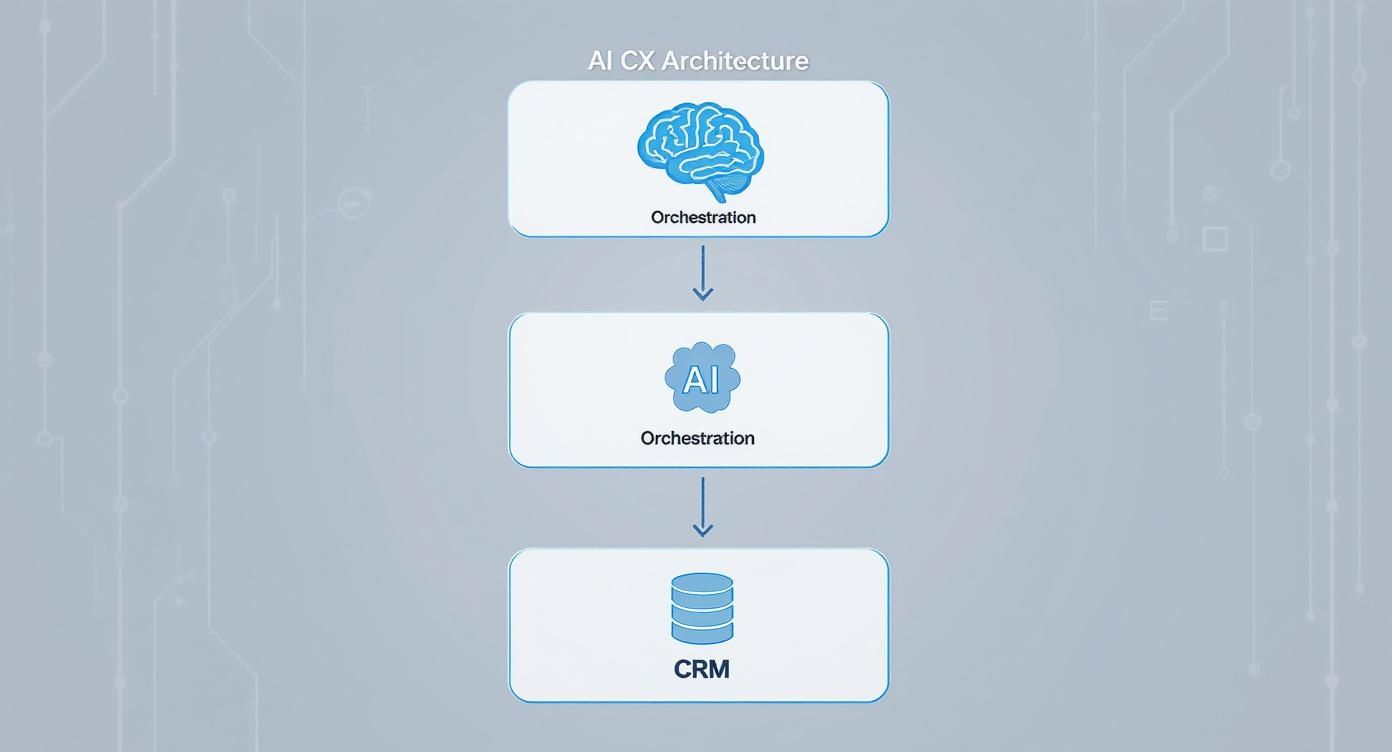
To understand how an AI-driven customer experience works, you have to look under the hood. The "magic" isn't a single piece of tech. It’s a powerful combination of three interconnected pillars.
Think of it like running a world-class restaurant. First, you have the CRM (the pantry), storing all your raw ingredients—your customer data. Next is the AI layer (the expert chef), which analyzes those ingredients to understand each diner's tastes and create the perfect, personalized menu. Finally, the Orchestration layer (the seamless waitstaff) delivers the right dish to the right person at the right time, no matter where they're sitting.
This structure turns isolated data points into cohesive, intelligent interactions that delight customers and drive business growth. Let's break down how each part contributes.
Key Takeaways
- A modern AI-driven CX system is built on three integrated pillars: CRM, AI, and Orchestration.
- The CRM acts as the single source of truth for all customer data, providing an essential foundation.
- The Orchestration layer is the critical link that delivers consistent, intelligent experiences across all channels.
Pillar 1: The CRM as Your Data Pantry
The foundation of any intelligent system is clean, accessible data. Your Customer Relationship Management (CRM) platform is that central pantry. It’s where every bit of information about your customers lives—purchase history, support tickets, website visits, and email interactions.
Without a well-organized CRM, your AI has nothing to work with. It's like asking a chef to cook a gourmet meal with an empty, disorganized pantry. A unified data source is non-negotiable for creating the personalized experiences customers now expect.
This is why a properly managed CRM is the absolute starting point for any successful AI CX initiative. Many businesses find that expert CRM integration is necessary to pull together data from various systems, ensuring the AI layer has a complete and accurate view of every customer.
Pillar 2: The AI Layer as The Expert Chef
Once your data is centralized in the CRM, the AI layer steps in. This is the "brain" of the operation. It analyzes huge amounts of customer data to spot patterns, predict future behavior, and decide the next best action for each individual.
This layer isn't just one thing; it's a collection of powerful tools:
- Predictive Analytics: This forecasts what customers might do next, like identifying someone at high risk of churning before they leave.
- Natural Language Processing (NLP): This allows AI to understand and respond to human language, which is what powers smart chatbots and analyzes customer feedback from surveys or reviews.
- Machine Learning (ML): These algorithms are constantly learning from new data, getting smarter over time and improving the accuracy of their recommendations and predictions.
Practical Example:
An e-commerce company’s AI can analyze a user's browsing history, past purchases, and even items they've added to a cart and then removed. Based on this, the AI doesn't just recommend similar products; it predicts the next logical product a customer might need and sends a timely, personalized offer, significantly increasing the likelihood of a sale.
Pillar 3: The Orchestration Layer as The Waitstaff
The final—and arguably most critical—pillar is orchestration. If AI is the chef, orchestration is the perfectly coordinated waitstaff. It ensures the insights cooked up by the AI are delivered consistently and in the right context across every single customer touchpoint.
Orchestration ensures a customer gets the same intelligent experience whether they are on your website, using your mobile app, talking to a chatbot, or speaking with a human agent.
Without orchestration, you have a brilliant chef (AI) whose delicious dishes (insights) never actually leave the kitchen. This layer is the connective tissue linking your CRM and AI to all your customer-facing channels—email, social media, call centers, and more—to execute those personalized actions.
Practical Example:
The AI might identify a high-value customer struggling on your website's checkout page. Orchestration is what automatically triggers a live chat invitation with a specialized agent. It could also seamlessly transfer the full context of a chatbot conversation to a human agent, so the customer never has to repeat themselves.
Impact Opportunity
When you build a cohesive architecture like this, you eliminate the data silos and channel inconsistencies that frustrate customers. You create a single, unified view of the customer that powers every single interaction. This integrated system ensures that the right message reaches the right customer through the right channel at the right moment, turning raw data into genuine delight and measurable business growth.
Mapping Your AI Customer Experience Maturity
Implementing an AI-driven customer experience isn't like flipping a switch. It’s a journey, an evolution. Businesses move through distinct stages, with each new level building on the capabilities of the one before it. Before you can map out a practical path forward, you have to know exactly where you are today.
A maturity model gives you that framework. It’s a tool to benchmark your current state, spot the gaps, and plan your next moves strategically. This turns a massive, intimidating transformation into a series of clear, manageable, and value-driven steps.
Key Takeaways
- AI adoption is a journey through four stages: Foundational, Applied, Integrated, and Predictive.
- Knowing your current stage is critical for planning realistic and effective next steps.
- The ultimate goal is to move from simply reacting to proactively shaping customer outcomes.
The Foundational Stage
This is ground zero for most companies. The main goal here is simple: start collecting customer data and get some basic automation in place. At this stage, data is usually scattered across different systems—a CRM over here, an email platform over there—and most processes are handled manually by your team.
- Characteristics: Siloed data, manual processes, and purely reactive customer support.
- Technology: Basic CRM, email marketing platforms, help desk software.
- Practical Example: A company uses a standard CRM to log customer support tickets and an email marketing tool to send out a monthly newsletter to its entire customer base. The systems are not connected, and all support is handled manually by agents.
The Applied Stage
In the Applied stage, you start to see the first real glimmers of AI. Companies begin rolling out specific AI tools to solve isolated problems. These applications are often effective, but they operate in their own little bubbles.
The Applied stage is defined by point solutions. You might have a great AI tool for one channel, but it doesn't talk to anything else, creating an inconsistent and sometimes frustrating customer experience.
- Characteristics: Use of isolated AI tools, channel-specific automation, and a still-disconnected customer experience.
- Technology: FAQ chatbots, sentiment analysis tools for social media, product recommendation engines.
- Practical Example: An e-commerce site implements a simple FAQ chatbot on its website. It can answer basic questions about shipping policies, but it has no connection to the CRM. It doesn't know who the customer is, their order history, or if they have an open support ticket.
The Integrated Stage
This is where things get interesting. The Integrated stage marks a huge leap forward, as businesses start connecting—or orchestrating—AI across multiple channels to create a unified, seamless experience. Those isolated tools from the Applied stage are finally plugged into the central CRM and other core systems.
- Characteristics: Connected data, cross-channel orchestration, and a consistent customer journey.
- Technology: Integrated CRM and AI platforms, journey orchestration engines.
- Practical Example: A customer starts a conversation with a chatbot on a company’s website. When the issue becomes too complex, the chatbot seamlessly hands off the entire conversation history to a human agent, who can pick up right where the bot left off without asking the customer to repeat anything. Getting here often requires evaluating your company's AI Quotient.
The Predictive Stage
The final, most advanced stage is Predictive. At this level, you’re no longer just reacting intelligently. You're using AI to proactively engage customers based on what you anticipate they’ll need next. The system crunches massive amounts of data to predict future behavior and then takes action to shape a better outcome.
- Characteristics: Proactive engagement, predictive modeling, and personalized journeys at scale.
- Technology: Advanced machine learning models, customer data platforms (CDPs), real-time journey orchestration engines.
- Practical Example: A SaaS company’s AI poring over product usage data flags a customer whose activity is dropping off—a major red flag for potential churn. The system automatically triggers a personalized email from their account manager offering a training session on the exact features they seem to be struggling with. This is a real-world application of predictive churn modelling.
Impact Opportunity
Using a maturity model provides a clear roadmap from simple data collection to true predictive engagement. It allows businesses to make smart, targeted investments, set achievable goals, and demonstrate incremental ROI at each stage. This ensures every step adds real, measurable value to the business and its customers, turning a complex transformation into a manageable strategy.
Putting AI to Work with B2B Use Cases
Theory and architecture are great starting points, but the real test is real-world impact. An AI-driven customer experience isn’t just a concept; it’s a tool that creates measurable value, especially in the complex, relationship-driven world of B2B. By focusing on high-value use cases, businesses are seeing serious ROI, boosting client retention, and making their own internal teams more effective.
Key Takeaways
- AI in B2B excels at solving specific, high-value problems like customer churn and operational inefficiency.
- Practical applications enable employees, providing them with tools to be more effective and proactive.
- Generative AI is transforming B2B communication by enabling personalized, context-aware conversations at scale.
Use Case 1: Proactive Churn Reduction for SaaS
The Challenge: Pinpointing at-risk customers before they’ve already made up their mind to leave. Manually sifting through usage data is too slow and almost always misses the subtle red flags.
Practical Example:
A B2B SaaS company selling project management software uses an AI model that constantly watches product usage patterns for every single client. It’s trained to spot the tell-tale signs of declining engagement—fewer logins, a drop-off in created tasks, or the abandonment of key features. When the AI flags an account with a high churn-risk score, it kicks off an automated workflow. The system triggers a personalized email from the client's dedicated account manager. The message never mentions "churn." Instead, it offers genuinely helpful resources tied to the very features the client stopped using. This simple, proactive intervention led to a 15% reduction in customer churn.
Use Case 2: enabling Field Technicians in Manufacturing
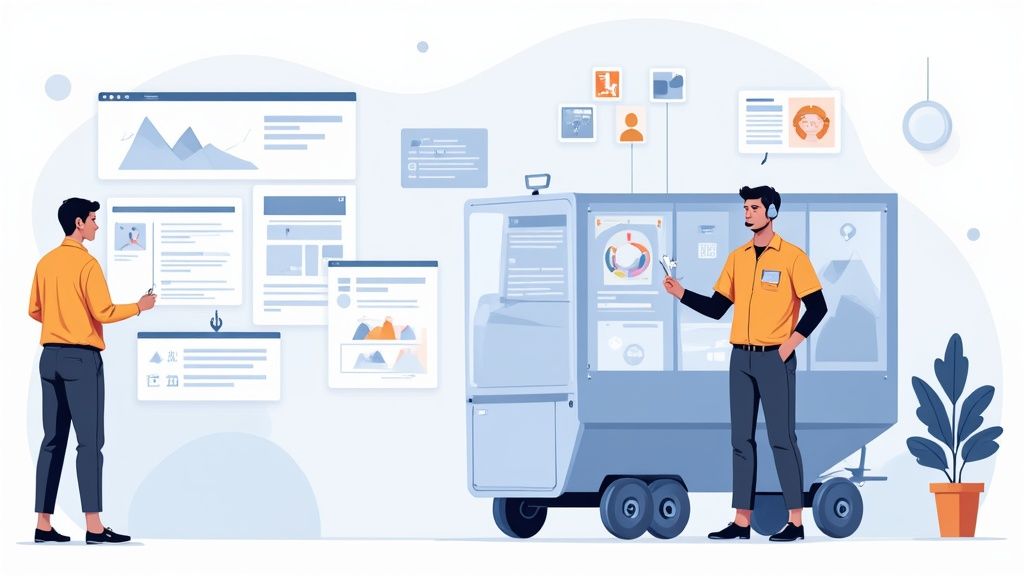
The Challenge: Field techs for a heavy machinery manufacturer were burning precious time flipping through dense paper manuals or calling back to HQ for guidance. Every minute wasted meant a longer delay and a more frustrated customer.
Practical Example:
The company armed its technicians with a ruggedized tablet running an AI-powered knowledge base. A tech can now use simple voice commands like, "Show me the step-by-step process for replacing the hydraulic pump on model X-45." In seconds, the AI serves up the right schematics, video tutorials, and safety warnings. This instant access to information drove a 30% increase in first-call resolution. Technicians get jobs done faster, equipment downtime is slashed, and customer satisfaction has shot through the roof.
An AI-powered knowledge base can transform a field technician from a problem-solver into a high-efficiency expert, armed with instant access to every piece of information they could possibly need.
Impact Opportunity
By implementing targeted AI use cases like these, you can generate a significant—and rapid—ROI. The impact is twofold: you solve critical business problems like customer retention and operational efficiency, and you enable your employees to perform their jobs better. These initial wins build momentum and prove the value of an AI-driven customer experience, paving the way for a much broader transformation. Tools like ChatGPT Brand Monitoring for E-commerce also demonstrate the expanding role of AI in maintaining brand health.
Building Your Implementation Roadmap
Having powerful technology is one thing; having a clear plan to use it is another. Without a strategic roadmap, even the most exciting AI-driven customer experience projects fizzle out. A phased rollout minimizes risk, gives you early wins to build momentum, and lets your team learn as you go. Each stage builds on the last, creating a solid foundation for real success.
Key Takeaways
- A phased implementation isn’t just safer—it helps build crucial momentum and organizational buy-in.
- Always start with a clear business goal and a focused pilot program before trying to scale.
- If you can't measure it, you can't prove its value. Tracking the right KPIs is non-negotiable.
Phase 1: Audit And Strategy
Before you write a single line of code or look at any software demos, you need to start with a serious audit. This first phase is all about defining your "why." What specific business problem are you trying to fix? Goals like "improve the customer experience" are too vague to be useful. Get specific, aiming for a goal like, "reduce customer support resolution time by 20%."
Phase 2: Foundational Tech
Once your strategy is locked in, it's time to get your tech house in order. This phase is all about getting your customer data into one place, usually your CRM. Your mission is to create a single source of truth for every customer interaction. Don't skip this part. If you do, your AI will be working with a blurry picture, leading to bad insights.
Phase 3: Pilot Program
With a solid foundation in place, it's time to prove your strategy works with a focused pilot program. The trick is to start small. Aim for a quick win by solving one high-impact problem. Resist the urge to boil the ocean with a massive project right out of the gate.
Practical Example:
A perfect pilot is building an AI-powered tool for your internal sales team. Imagine a tool that analyzes lead data in your CRM to score and prioritize prospects, telling reps exactly which accounts are most likely to convert. It's a low-risk, high-reward project that directly impacts revenue and shows stakeholders exactly what this technology can do.
A well-chosen pilot program is your proof-of-concept. Its success builds the business case and the organizational momentum you need to get buy-in for bigger, more ambitious initiatives down the road.
Phase 4: Scale And Optimize
After a successful pilot, you're ready to scale and optimize. This is where you take everything you learned and expand the solution across the entire customer lifecycle. This isn’t a one-and-done step; it’s a continuous loop of refinement. As your AI models get more data, they get smarter. You need to constantly monitor performance against your key metrics.
Key Performance Indicators (KPIs) to Track:
- Customer Lifetime Value (CLV): Are your best customers becoming even more valuable over time?
- Net Promoter Score (NPS): How likely are customers to recommend you? Are they happier?
- Customer Effort Score (CES): How easy is it for customers to get help when they need it?
Impact Opportunity
A structured roadmap makes sure your AI-driven customer experience project doesn't drift away from your core business goals. It forces you to deliver measurable results at each stage, building the confidence and executive support you need to make a long-term impact. This methodical approach turns what feels like a complex tech project into a manageable, value-first business strategy.
Common Pitfalls and How to Avoid Them
Knowing what not to do is just as important as knowing what to do. An AI-driven customer experience strategy can be a massive asset, but a few common missteps can easily derail even the best-laid plans. The biggest mistake? Falling in love with the tech before you've even identified a customer problem to solve.
Key Takeaways
- Always, always start with a well-defined business problem, not the technology.
- Bad data is the single most common and destructive reason AI projects fail.
- Never forget the human in the loop; AI should enable your team, not just replace tasks.
Pitfall 1: Focusing on Technology First
This is the classic "shiny object syndrome." A company decides it needs "an AI chatbot" without first asking what problem that chatbot is supposed to fix. This tech-first approach almost always creates a solution nobody wants, leading to a clunky customer experience and a wasted investment.
How to Avoid It:
Start with your customer journey map. Find the biggest friction points and ask, "Where could intelligent automation make the biggest difference for our customers and our bottom line?" Frame the project around a concrete outcome, like "slashing resolution time for shipping inquiries by 30%."
Pitfall 2: Underestimating Data Quality Issues
Your AI models are only as smart as the data you feed them. If your customer data is scattered, full of inconsistencies, or incomplete, your AI will spit out unreliable insights. It’s the immutable law of AI: garbage in, garbage out.
How to Avoid It:
Before you go all-in, run a thorough data audit. Know where your data lives and get an honest assessment of its quality. For your pilot, start small with a clean, well-defined dataset. This lets you prove the concept and iron out the kinks in your data pipelines.
An AI initiative built on a foundation of poor-quality data is destined for failure. Prioritizing data hygiene isn't just a best practice; it's a prerequisite for achieving any meaningful ROI.
Pitfall 3: Neglecting the Human Element
It’s a huge mistake to roll out AI without thinking about the people who have to work with it every day. If you drop new tools on your team without proper training or a clear "why," they'll see AI as a threat, not a co-pilot. That friction creates resistance and tanks adoption.
How to Avoid It:
Bring your customer-facing teams into the conversation from day one. Position AI as a tool that handles the repetitive tasks, freeing them up to tackle the complex, high-empathy issues where a human touch is irreplaceable. Give them great training and create feedback loops so they can help make the system smarter over time.
Impact Opportunity
By getting out in front of these common mistakes, you dramatically increase your odds of success. This isn't just about saving time and money—it's about protecting your customer relationships from the damage a poorly executed AI project can cause. The opportunity is to build a system that both your customers and your employees genuinely value, creating a sustainable competitive advantage.
Frequently Asked Questions
As leaders look to bring AI into their customer experience, a few key questions always come up. Here are the most common ones, along with straightforward answers to help you build your strategy with confidence.
Key Takeaways
- Start with an internal, high-impact project to build momentum and prove value quickly.
- ROI must be tied to core business metrics like CLV, FCR, and conversion rates.
- The goal of AI is to augment human agents by handling repetitive tasks, not to replace them.
Where Is The Best Place To Start With AI In CX?
Start with a high-impact, low-complexity problem. And if you can, solve an internal one first.
Practical Example:
A fantastic first project is building an AI-powered tool to help your own support agents find information faster. This creates an immediate win for your team and lets you work out the kinks before you ever put a new system in front of a customer. It directly improves agent efficiency and, by extension, the customer experience they deliver.
How Do You Measure The ROI Of An AI-Driven Customer Experience?
You have to connect your AI initiatives directly to core business metrics. Don't get distracted by vanity numbers; focus on what actually moves the needle on the bottom line.
Practical Examples:
- For a support chatbot: Look at things like First Contact Resolution (FCR) rates and the overall cost-per-interaction. Is it solving problems on the first try and reducing operational costs?
- For a personalization engine: The proof is in the numbers. Measure the direct lift in Customer Lifetime Value (CLV) and conversion rates.
If you can’t tie your AI project back to a clear financial outcome, it’s not worth doing.
Will AI Replace Our Human Customer Service Agents?
No. The goal isn't replacement; it's augmentation.
A smart AI strategy uses technology to handle the simple, repetitive tasks. This frees up your human experts to do what they do best: manage complex, high-empathy situations where their insight truly matters.
This partnership between AI and people creates a far better experience for everyone involved—your customers and your employees. It transforms your service center from a team bogged down by routine questions into a hub of expert problem-solvers. That’s how you build real, long-term customer loyalty.
Getting these questions answered early on builds the confidence and clarity you need to move forward. Prometheus Agency works with executives to create actionable roadmaps that turn existing technology into a scalable revenue system, ensuring your AI initiatives deliver real business outcomes. You can learn more about our approach on our website.