You've tested ChatGPT, added an AI writing tool to the marketing stack, and perhaps built a promising automation for one employee. The pilot works. The team still spends the same time copying data, chasing leads, answering repetitive questions, and preparing reports. The business is using AI, but AI isn't yet changing how the business operates.
That distinction defines the opportunity in AI consulting for small businesses. The value isn't another software subscription. It's the disciplined conversion of isolated experiments into reliable workflows, measurable productivity gains, and revenue systems your team can run.
The AI Adoption Gap in Small Business
A small professional-services firm offers a familiar example. Its sales manager uses an AI assistant to summarize discovery calls and draft follow-up emails. The drafts are useful, so the owner assumes the company has adopted AI. Three months later, the workflow still depends on the manager remembering to export notes, paste them into a separate tool, review the output, and manually update the CRM. Nobody else follows the process. The pilot succeeded as an experiment, but it failed as an operating system.
That's the experimentation trap. A business buys access, tests a capability, and mistakes individual usage for transformation. Transformation requires a defined workflow, a system connection, clear ownership, quality controls, and a business metric that moves when the process improves.
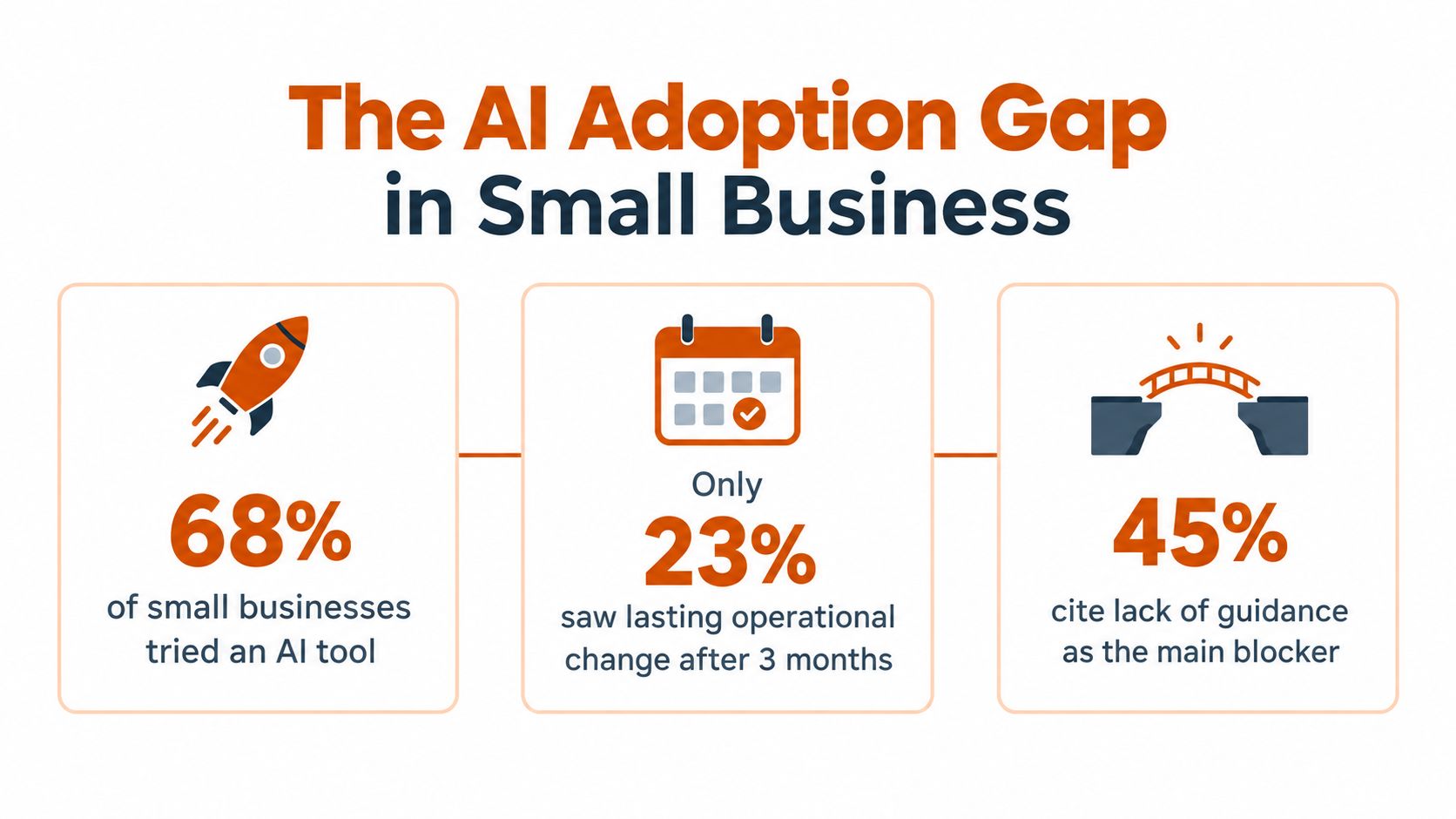
Adoption is growing, but the market remains uneven. The JPMorganChase Institute analysis of AI use by small businesses reports that small-business adoption rose from 1.7% in 2019 to 4.5% in 2022, reaching about 17.7% by the end of 2025. The same research describes a U.S. Small Business Credit Survey reading that moved from 6.3% of small businesses using AI six months earlier to 8.8% in the latest reading.
Those figures point to an early market with a practical problem. Many owners don't need advanced model optimization. They need help selecting a first workflow, protecting business data, connecting AI to existing systems, and training people to use the process consistently. Larger companies have more resources to close that gap internally, while smaller firms often need an external operator to turn intent into execution.
Adoption is not transformation
Ask three questions:
- Where does AI run? If it lives only in personal accounts or browser tabs, it isn't embedded in the business.
- Who owns the workflow? If nobody maintains prompts, inputs, approvals, and exception handling, the process will decay.
- Which metric changes? If the team tracks usage but not response time, throughput, quality, or revenue progression, it can't prove impact.
For a deeper view of the planning work involved, review this AI strategy guidance for companies under 500 employees. The central lesson is simple: AI adoption creates capability, but implementation creates business value.
What AI Consulting Actually Means for SMBs
AI consulting for small businesses is an operational partnership, not a product demonstration. A consultant examines how work moves through the company, identifies where people lose time or information, and designs an AI-enabled process around the systems already in place.
That usually means starting with the CRM, customer-support platform, accounting software, project-management workspace, or communication tools the team already uses. The consultant then determines where AI can assist without creating an unmanageable second system.
A practical engagement follows a clear sequence:
- Map the business objective. Decide whether the priority is faster sales follow-up, better customer-response coverage, more consistent proposals, improved reporting, or another operational outcome.
- Inspect the current workflow. Document inputs, handoffs, approvals, duplicate work, data gaps, and failure points.
- Choose one narrow use case. Select a high-volume process with a visible baseline and a manageable risk profile.
- Design the workflow around existing tools. Connect AI to the CRM or operational system instead of asking employees to maintain a disconnected manual routine.
- Add governance and training. Define what data may be used, where human review is required, and how employees should handle incorrect or incomplete output.
- Measure before expanding. Prove that the process improves a meaningful business metric before introducing more use cases.
The market is already moving beyond awareness. A 2026 Goldman Sachs survey of 1,256 small-business owners found that 76% already use AI, 93% of users said it had a positive impact, and 84% cited increased efficiency and productivity as the main benefit. Those findings support a direct recommendation: consulting should focus on measurable efficiency, not abstract innovation.
The consultant's real job
The consultant acts as a translator between technical capability and commercial execution. They don't just explain what a model can do. They decide whether the model belongs in a particular workflow, establish safeguards, and make the process useful to the people responsible for revenue and delivery.
For example, an AI assistant can draft a proposal, but a well-designed workflow can pull approved service details from a knowledge base, populate the opportunity record, flag missing information, route the draft for review, and record the final version. The second approach creates an operational asset.
This overview of AI consulting services reflects that broader role. The right partner helps your business make fewer disconnected tool decisions and more deliberate workflow decisions.
Where AI Delivers Real Business Impact
Small teams should begin with work that happens often, follows a recognizable pattern, and produces an observable output. Broad ambitions such as “automate marketing” or “replace administrative work” create confusion. A narrow workflow gives the team something it can test, improve, and trust.
The strongest starting point is usually productivity augmentation. In the U.S. Chamber Foundation's Main Street AI Monitor, 64% of small-business AI users said their primary use was personal productivity, including drafting, summarizing, and brainstorming. 59% said the saved time went toward doing more work or producing higher-quality output.
That evidence changes how consultants should frame value. The first question isn't, “How many jobs can AI eliminate?” It's, “Which bottleneck prevents this team from completing more valuable work?”
Productivity augmentation
A consulting team might start with:
- Proposal drafting: Convert structured discovery notes into a first proposal draft using approved language and pricing rules.
- Meeting intelligence: Summarize calls, extract commitments, and create follow-up tasks for review.
- Research support: Organize public information into a brief that an employee checks before using.
- Reporting: Turn recurring CRM or project data into a management summary with clear exception flags.
These workflows create value only when saved capacity becomes additional throughput or better quality. If employees save time but the business doesn't redirect that capacity, adoption may feel positive without producing meaningful growth.
CRM automation
The next opportunity is connecting AI to revenue operations. A consultant can design triggers that identify stalled opportunities, summarize account activity, suggest follow-up priorities, or route inbound inquiries according to defined criteria. The CRM remains the system of record, while AI assists with interpretation and action.
A lead-scoring workflow, for example, can combine firmographic information, engagement history, and salesperson input. It shouldn't make an irreversible decision without review. Its role is to reduce the time required to find the next best action.
Explore this AI workflow automation approach for a practical model of how systems, triggers, and human decisions fit together.
Customer experience and growth
Customer-facing applications can improve consistency without pretending that every interaction should be automated. AI can classify incoming questions, suggest responses, identify urgent requests, and personalize outreach based on approved customer information. Human employees still handle sensitive, unusual, or high-value situations.
The impact opportunity is strongest when the workflow sits close to revenue or retention. Faster follow-up can help a sales representative work a fuller pipeline. Better response triage can prevent important customer requests from disappearing. More consistent account summaries can help an account manager prepare for a renewal conversation.
Practical rule: Start where work is frequent, measurable, and already constrained by team capacity. Don't start with the most impressive demo.
DIY Implementation vs. Professional Consulting
DIY AI adoption makes sense for low-risk personal tasks. An owner can use ChatGPT to brainstorm headlines, summarize a document, or improve a draft without hiring outside help. That approach is inexpensive and useful for learning what the technology can do.
The trouble starts when a business tries to scale a personal shortcut into a company process. The owner may buy several overlapping tools, store sensitive information in unapproved accounts, create inconsistent prompts, and ask employees to copy results between systems. The software cost is visible. The larger cost is the time and confusion created by an unmanaged process.
A 2025 Intuit QuickBooks survey of more than 2,200 U.S. businesses with up to 100 employees found that 68% use AI regularly, 28% use it daily, and 74% of AI users said it makes them more productive. Regular use is a useful signal, but it doesn't prove integration. Employees can use AI every day and still operate inside disconnected workflows.
The trade-off in practice
| DIY implementation | Professional consulting |
|---|---|
| Fast experimentation with familiar tools | Structured diagnosis before tool selection |
| Useful for individual drafting and research | Designed for CRM and operational integration |
| Low initial commitment | Clear ownership, governance, and measurement |
| Depends on internal capacity | Adds external implementation expertise |
| Can create fragmented processes | Builds a repeatable workflow with training |
The DIY route often fails because nobody has time to maintain it. The founder is busy selling, the operations manager is fixing delivery issues, and the sales team is focused on pipeline. Prompt libraries become outdated. Integrations break. Employees revert to old habits because the new process adds friction.
When outside help earns its place
Hire a consultant when the use case touches customer data, revenue decisions, multiple systems, or more than one team. Outside support is also justified when previous pilots worked technically but never became part of daily operations.
A capable consultant should remain vendor-neutral, define the smallest useful pilot, document the workflow, and transfer operating knowledge to your team. Be cautious of anyone who leads with a tool catalog or proposes a company-wide transformation before understanding the business.
The right comparison isn't “consulting fee versus software fee.” It's structured implementation versus the opportunity cost of repeated failed experiments.
The AI Implementation Roadmap
A reliable rollout moves through Discovery, Pilot, and Scale. Skipping a phase creates predictable problems. Businesses that scale before proving a workflow spread bad inputs, unclear accountability, and weak adoption across the organization.
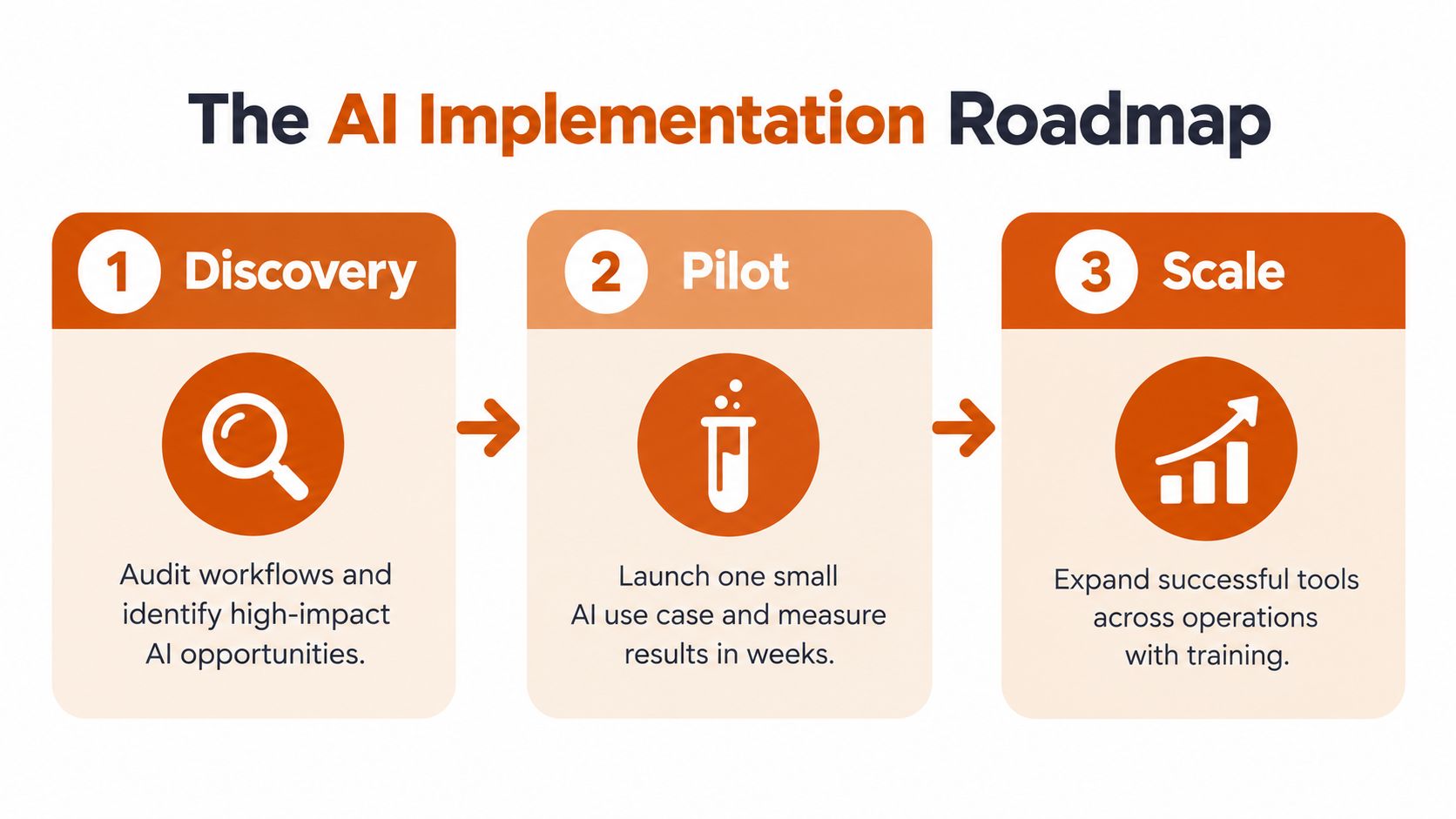
Phase one is discovery
Start by observing how work happens, not by asking which AI tool the team wants. Review the technology stack, identify repetitive handoffs, and locate the points where employees re-enter information or wait for decisions.
Ask:
- Which workflow consumes the most recurring staff attention?
- Where do leads, customer requests, or project details get delayed?
- Which data is reliable enough to support automation?
- What output requires human approval?
- Which process has a clear baseline?
The consultant should produce a prioritized opportunity map. A useful recommendation includes the business problem, expected workflow change, system dependencies, risk level, owner, and measurement plan.
The U.S. Chamber's small-business AI report reports that 58% of U.S. small businesses use generative AI, compared with 40% in 2024, and another 2025 survey placed usage at 55%. The same material highlights the implementation gap, with one independent analysis finding that only 14% had fully integrated AI despite 76% using it in some capacity. The implication is decisive: awareness is no longer the main problem. Operational readiness is.
Phase two is the pilot
Choose one department and one workflow. Define the baseline before launch, then specify what the AI system will do, what employees will review, and what counts as a failure.
A sales pilot might summarize inbound inquiries, classify intent, draft a response, and create a CRM task. Measure completion time, review quality, follow-up consistency, and progression through the defined sales stage. Don't expand because the output looks impressive. Expand because the workflow performs reliably under real conditions.
Use this video as a practical supplement while evaluating how a pilot can move from concept to operating process:
Phase three is scale
Scale only after the team can explain the workflow and its results. Integrate the successful process into standard operating procedures, train adjacent users, document exceptions, and assign someone to monitor performance.
Scaling may mean expanding from one sales team to customer success, or from proposal drafting to reporting. It shouldn't mean activating every available AI feature. Scale the proven operating pattern, not the novelty of the tool.
Measuring ROI and Overcoming Barriers
AI ROI begins with a baseline. Before implementation, record how long the current task takes, how often it occurs, who performs it, where errors appear, and what downstream work depends on it. Without that baseline, the team can report activity but can't demonstrate improvement.
Use three measurement layers:
- Operational efficiency: Track task completion time, manual steps, review volume, and throughput.
- Commercial performance: Monitor response progression, qualified opportunities, proposal completion, and customer retention indicators where the workflow directly affects them.
- Quality and risk: Review accuracy, escalation rates, privacy incidents, and employee adoption.
A consultant should tie each metric to a decision. If response drafting becomes faster but quality declines, the business needs stronger review rules. If a lead-routing workflow produces cleaner prioritization but salespeople ignore it, the problem is adoption design rather than model capability.
Solve the barriers before they become costs
The Service Direct small-business AI report identifies lack of understanding about benefits at 62% and lack of in-house resources at 60% as leading non-adoption barriers. Among adopters, integration and usage reached 72%, while data and privacy concerns reached 70%. Those figures describe why a strategy document alone won't solve implementation.
Address the risks directly:
- Unclear value: Define one business outcome and its baseline before selecting a tool.
- Limited capacity: Give the pilot a named owner and protect time for training and review.
- Integration friction: Connect the workflow to the systems employees already use.
- Privacy exposure: Classify information, restrict sensitive inputs, and require human approval for consequential outputs.
- Weak adoption: Involve the people doing the work, then redesign the process around their actual behavior.
Measurement discipline: If you can't name the baseline, owner, review rule, and decision threshold, you're not ready to call the initiative an ROI project.
A hiring checklist
Before engaging a consultant, ask for a discovery method, a pilot definition, an integration plan, a governance approach, and a reporting format. Ask how the consultant will respond if the first use case fails. A credible partner should be comfortable narrowing the scope, changing direction, or stopping a weak initiative.
Deciding if AI Consulting is Right for You
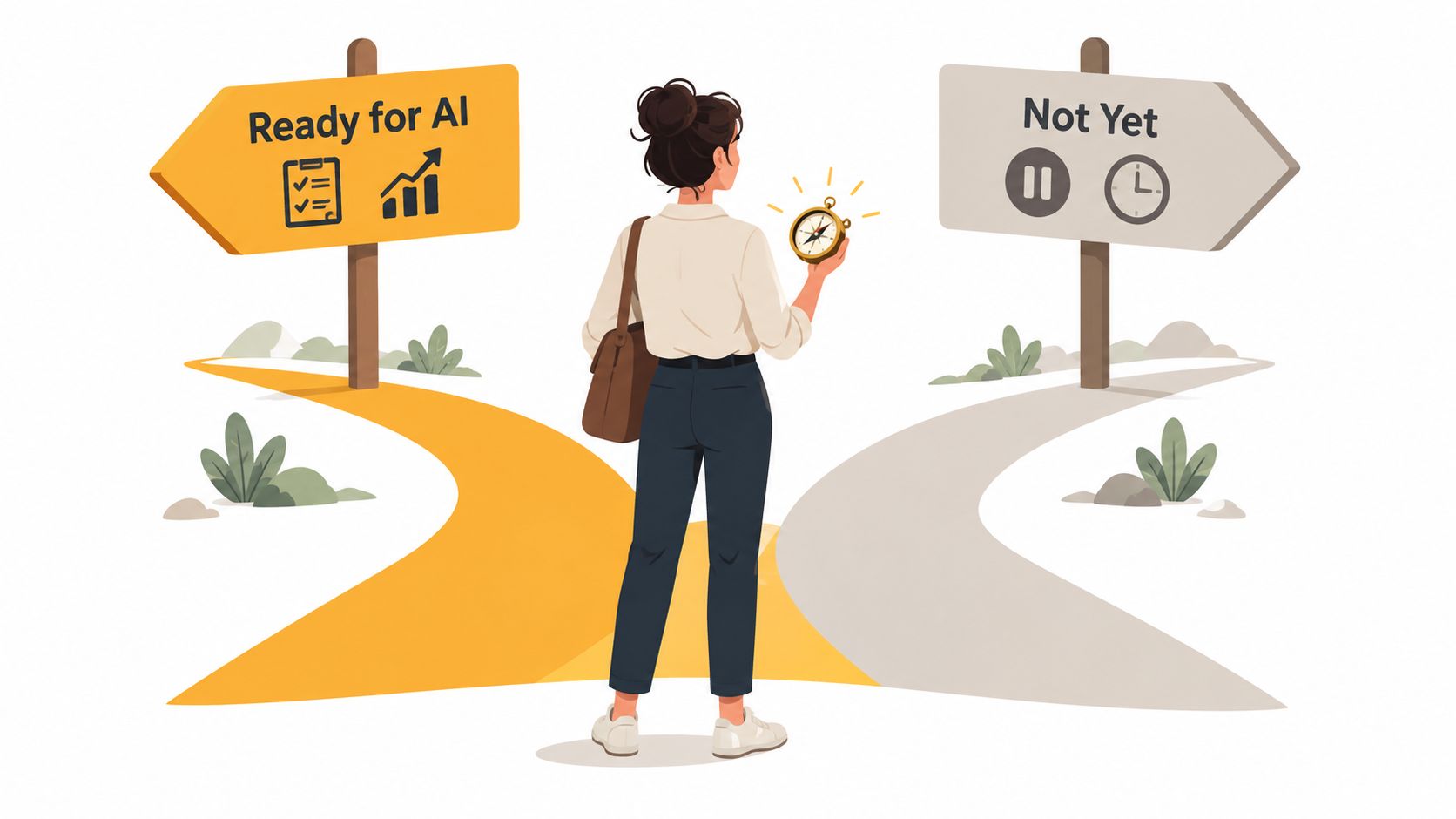
One owner reaches for AI after a team member spends hours preparing the same report every week. Another considers it after salespeople miss follow-ups because information sits across email, spreadsheets, and a CRM. Both may be ready, but readiness depends on the workflow, not on enthusiasm.
You're a strong candidate for AI consulting when:
- A repeated bottleneck is visible: The team performs the same high-volume task often enough to measure it.
- A business owner will sponsor the work: Someone can make decisions, remove blockers, and hold the process accountable.
- Your core data is accessible: The required information exists in systems the team can inspect and connect.
- The team accepts review responsibilities: Employees understand that AI assistance doesn't remove judgment.
- The initiative supports a commercial priority: The project improves delivery, customer experience, sales execution, or management visibility.
You're not ready for a complex engagement if the business lacks a stable process, has no accountable owner, or expects AI to repair unclear positioning and broken operations. Fix the workflow first. Clean the data you rely on. Choose one recurring task and document how it works today.
The best first engagement is usually smaller than the owner expects. It should identify one constraint, connect one workflow, establish one measurement plan, and train the people who will run it. Once that process becomes dependable, the business has a foundation for broader transformation.
Key Takeaways
- AI usage doesn't equal operational change.
- Start with a narrow, high-volume workflow.
- Connect AI to the CRM or system where work already happens.
- Measure time, throughput, quality, and commercial movement.
- Treat privacy, governance, and training as part of implementation.
- Scale only after the pilot earns expansion.
The impact opportunity is practical. Small businesses can use AI to help employees produce more, respond more consistently, and operate revenue workflows with less friction. The winning firms won't be the ones with the most tools. They'll be the ones that turn useful tools into durable business habits.
Prometheus Agency helps growth leaders turn existing technology stacks into scalable revenue systems through AI enablement, CRM optimization, go-to-market strategy, and focused implementation. Start with a workflow audit and an ROI-focused AI strategy session, then visit Prometheus Agency to discuss the smallest practical initiative your team can launch and measure.