AI construction estimating is already a practical growth lever, with 24% of firms identifying cost estimating as their most common AI use case in 2026. The firms gaining value aren't handing bids to machines, they're using AI to standardize repetitive work while protecting estimator judgment, firm-specific cost data, and margin decisions.
That distinction matters. Automated takeoff is useful, but it isn't the same as a defensible bid. A system can identify quantities from a clean drawing and still miss scope conditions, local pricing, subcontractor behavior, constructability constraints, or the assumptions that make one contractor's estimate different from another's.
Key Takeaways
- AI is a workflow wedge: Preconstruction is often the most practical place to begin because drawings, historical bids, assemblies, and pricing inputs can be structured.
- Takeoff is only one layer: AI can count, measure, classify, and flag anomalies, but estimators still own scope interpretation, risk, and bid strategy.
- Data readiness determines value: Inconsistent cost codes, fragmented files, and weak ERP connections can make an AI deployment faster at producing unreliable output.
- Human review must be designed in: Clean drawings and repetitive elements are suitable for automation, while irregular geometry, complex façades, and ambiguous scope need structured review.
- ROI should connect to revenue: Track bid cycle time, estimate variance, review effort, scope omissions, and the quality of decisions that protect margin.
Impact opportunity: The largest opportunity isn't just producing estimates faster. It's building a connected preconstruction system where historical bids become usable intelligence, revisions remain traceable, and project leaders can act before estimate assumptions turn into cost problems.
Why AI Construction Estimating Matters Now
A 2026 construction industry report found that 38% of contractors said they now see measurable results from AI, up from 17% in 2025. The same report identified cost estimating as the most common AI use case at 24% of firms, followed by bid management at 22%.
Those figures change the buying conversation. AI construction estimating isn't a speculative experiment reserved for technology teams. It has become an operational entry point for contractors that need to handle estimating pressure without just adding more manual labor. Preconstruction gives leaders a controlled environment where inputs are comparatively visible, bid activity is frequent, and the effect of workflow changes can be examined before expanding into wider project operations.
Practical rule: Start where your team can compare the old process with the new one. Estimating gives you a clear baseline for time, rework, assumptions, and variance.
The strategic value comes from the workflow around the model. A takeoff tool may identify doors, fixtures, wall areas, or concrete quantities. The contractor still needs a reliable cost structure, current labor and material assumptions, subcontractor coverage, and a review process that explains why the final number changed.
The adoption wedge
Preconstruction also exposes weaknesses that remain hidden in spreadsheets. If historical bids use inconsistent cost codes, if revisions sit in disconnected folders, or if field feedback never returns to the estimating database, AI won't repair those gaps by itself. It may process the available information more quickly while preserving the underlying inconsistency.
That makes AI estimating a useful diagnostic. A pilot can show whether a firm has the drawings, assemblies, cost history, and ownership discipline required for automation. Leaders can then decide whether the next investment should be a model, an integration, data cleanup, or a redesigned approval process.
The winners won't be the companies with the most impressive demo. They'll be the companies that turn estimating activity into a repeatable operating system for growth.
How AI Construction Estimating Actually Works
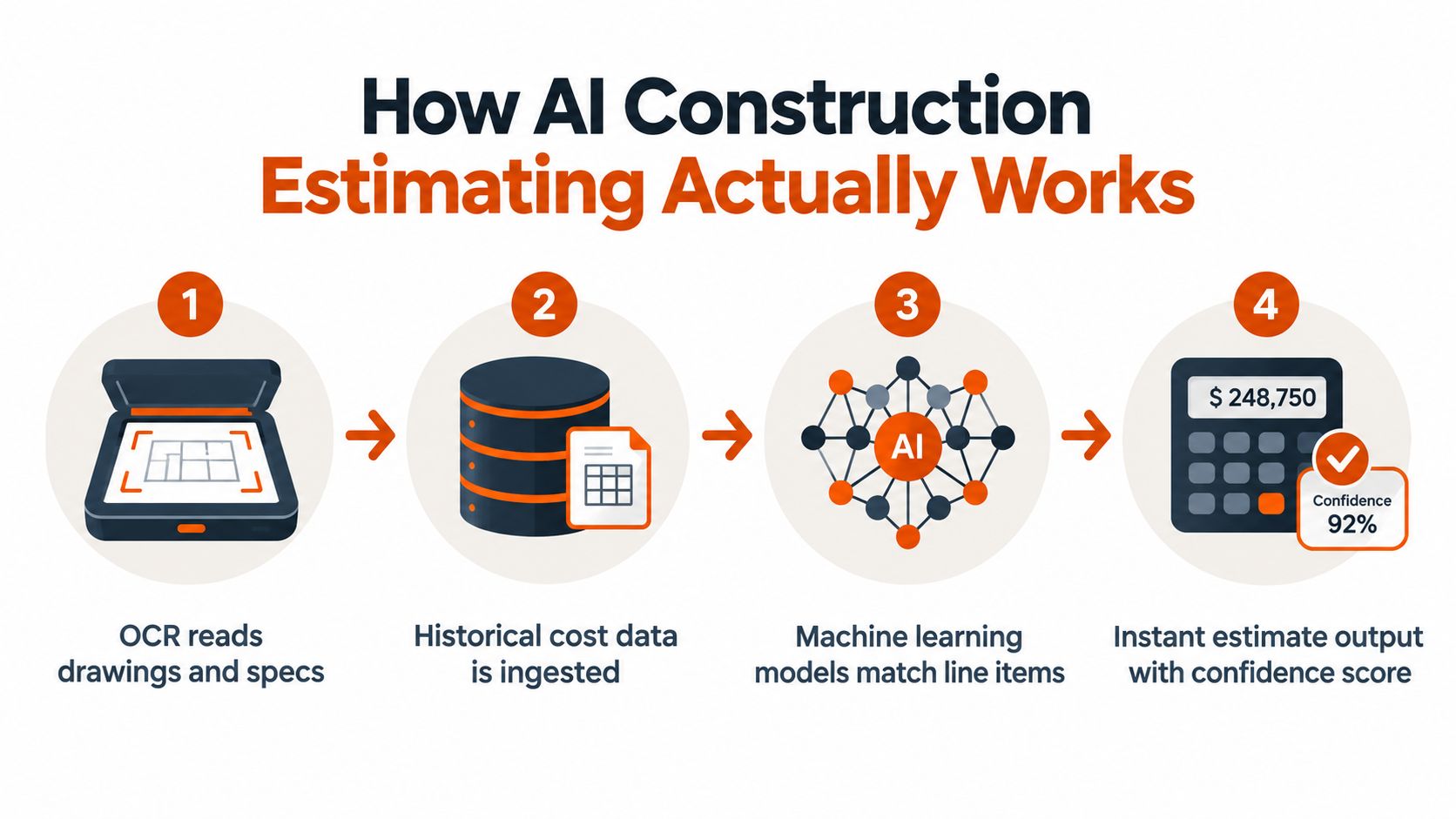
AI construction estimating combines several technologies that perform different jobs. Optical character recognition, or OCR, reads text and symbols from drawings and specifications. Computer vision identifies plan elements and measurements. Machine-learning models compare those elements with known assemblies, historical bids, and cost structures. A pricing layer then turns quantities into estimate lines, assumptions, and bid outputs.
From drawing to quantity
The workflow usually begins with drawing ingestion. The platform reads PDF sheets, plans, specifications, and sometimes model data, then identifies relevant symbols, labels, dimensions, and boundaries. Clean files with consistent visual conventions are easier to process than scanned documents, heavily marked-up sheets, or sets where revisions are difficult to distinguish.
Next, the system extracts quantities. It can count repeated elements, measure areas or lengths, group related items, and assign potential categories. AI can replace a substantial amount of repetitive manual work here, but the output still needs a confidence signal and an audit trail.
From quantity to price
The quantity engine isn't a pricing strategy. To produce a useful estimate, the platform needs a cost database such as RSMeans, the contractor's historical project data, or a controlled combination of both. Historical data becomes valuable only after it has been normalized by location, project type, scope, unit, assembly, and cost code.
The final stage assembles line items, allowances, labor assumptions, subcontractor inputs, exclusions, and markup rules. A strong workflow lets an estimator see the source quantity, the selected assembly, the price basis, and any unresolved exception. That transparency matters more than a polished total.
AI can also flag unusual values, missing categories, or changes between drawing versions. Those alerts help estimators focus on risk rather than recounting every standard element. The system should support judgment, not hide it behind an unexplained output.
Accuracy Limits and When Human Review Is Critical
AI quantity takeoff tools report 80% to 98% accuracy on well-drawn commercial construction sets, while early-stage estimates using RSMeans data or historical cost models typically fall within plus or minus 15% to 25% at the conceptual stage. Those figures describe specific use cases, not the reliability of a complete bid. The reported accuracy ranges and use-case limits are summarized here.
| Scenario | Reported Accuracy | Recommended Use Case |
|---|---|---|
| Well-drawn commercial construction sets | 80% to 98% | Assisted quantity takeoff and estimator review |
| Conceptual estimates using RSMeans or historical cost models | Plus or minus 15% to 25% | Feasibility studies and budget setting |
| Final bid with complex scope and custom assemblies | Requires project-specific validation | Human-controlled bid submission |
A comparative analysis published by the International Journal of Engineering Research and Technology reported an AI-assisted output of 983,550 total cost with a +2,610 difference, or +0.27% in its published comparison. The manual Excel workflow was +4.14% off, while the BIM or digital workflow was -0.91% off. The practical lesson is specific: AI can perform strongly when an estimator validates the output within a defined process. The result does not justify sending an unchecked model output to a client.
Where review becomes mandatory
A methodological study of AI takeoff accuracy found that systems perform best on repetitive, clearly bounded, orthogonal elements. It reported weaker performance on irregular geometries and complex façades, with near-perfect alignment for count-based items but statistically significant underestimation for area-based quantities. The study is available through EasyChair.
Require estimator review when:
- Drawings are unclear: Scanned sheets, handwritten changes, conflicting revisions, and incomplete specifications can produce confident-looking errors.
- Geometry is irregular: Curved façades, unusual assemblies, and nonstandard details require interpretation beyond repeated plan symbols.
- Scope is implied: Site access, phasing, temporary works, protection, and constructability decisions may not appear as measurable drawing elements.
- Pricing is local: Subcontractor coverage, crew productivity, market conditions, and supplier relationships depend on firm-specific knowledge and current inputs.
The same control applies to the data behind the estimate. Historical costs need consistent labels, current assemblies, and clear ownership. If those records are incomplete, AI may repeat outdated assumptions at scale. Integration with estimating, procurement, and project systems also needs defined permissions and an audit trail.
Set review thresholds by scope and risk. Document exceptions, record the assumptions behind major allowances, and require estimator approval for items that could materially affect margin. AI should reduce recounting and surface risk. It should not replace accountability for the submitted bid.
Real-World Estimating Workflows With AI
Consider a mid-sized general contractor preparing a commercial bid. The project manager begins with a drawing set, specifications, and a folder of previous estimates. Instead of opening a blank Excel workbook, the team uploads the controlled files into an AI-assisted estimating workflow and confirms the revision set before processing begins.
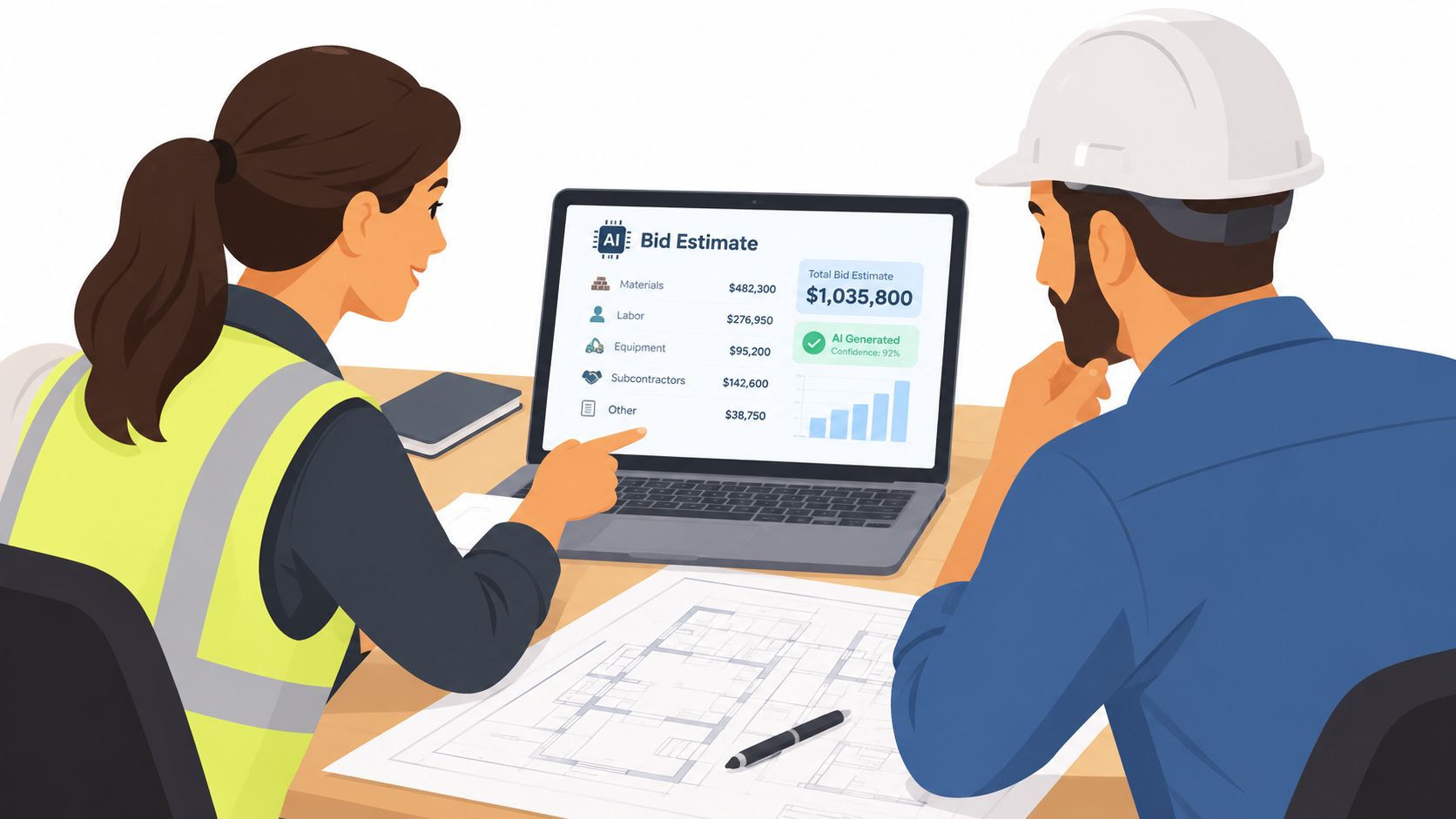
The system identifies standard plan elements and produces a preliminary quantity takeoff. It maps recognizable items to the contractor's assemblies, then surfaces quantities that differ from historical patterns. The estimator reviews those exceptions first, checks the drawings against the extracted quantities, and removes any items that the model classified incorrectly.
The contractor's historical data does more work than a generic cost library. It helps the team apply its own labor assumptions, material preferences, production knowledge, and recurring assembly logic. However, the database only helps if past bids are labeled consistently and if outdated or incomplete projects are separated from trusted reference data.
Subcontractor pricing remains a separate decision. The estimator still requests coverage, evaluates exclusions, compares scope, and accounts for procurement or schedule conditions that the drawings can't explain. AI may prepare the structure for comparison, but it can't take responsibility for a subcontractor's interpretation of the work.
A team that wants to formalize bid assembly can also review Bidwell bidding team software as part of its broader workflow research. The relevant question isn't whether one tool has the most features. It's whether the system keeps quantities, pricing, assumptions, approvals, and revisions connected.
The project manager then presents the reviewed estimate to operations. The discussion focuses on assumptions and unresolved scope rather than the mechanics of counting every standard element.
For teams exploring adjacent use cases, AI for wholesale quote generation offers a useful comparison point. The same principle applies: automate repeatable preparation, keep commercial judgment visible, and make exceptions easy to escalate.
Implementation Roadmap for Growth Leaders
AI estimating should be introduced as an operating change, not a software installation. A four-phase rollout gives executives a way to control risk while producing evidence for the next investment.
Phase one is assessment
Start with a data and workflow audit. Identify where drawings live, how revisions are named, which cost codes appear in historical bids, and how estimators record assumptions. Separate trusted projects from files that are incomplete, outdated, or impossible to interpret.
The first checkpoint is ownership. One person should be accountable for the estimating data model, while senior estimators define which assemblies and exceptions require human approval.
Phase two is a controlled pilot
Choose one project type with repeatable scope and accessible historical data. Run the AI workflow alongside the existing process rather than replacing it immediately. Compare quantities, assumptions, review comments, and final estimate changes.
A pilot should produce more than a demonstration. It should reveal which drawing formats work, which categories require correction, and whether estimators can understand the system's reasoning.
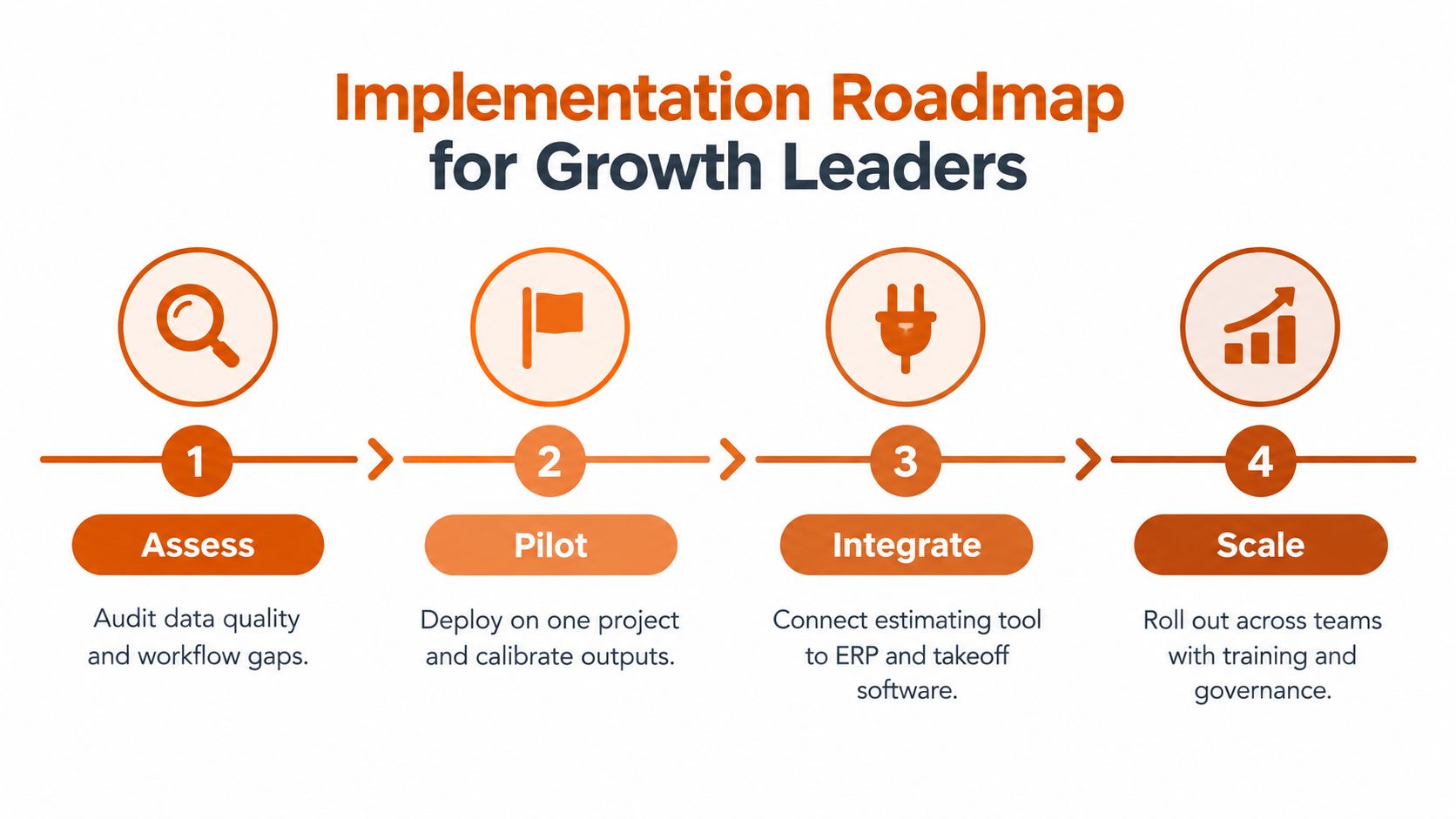
Phase three is integration
Connect the estimating workflow to the systems that carry decisions downstream. That may include CRM records, project management software, ERP cost structures, takeoff platforms, document storage, and approval workflows.
Integration should eliminate re-entry, not create another isolated dashboard. Define which system owns the project record, which fields flow into the estimate, and how approved assumptions return to the historical database. Leaders assessing the broader change can use this AI implementation roadmap to frame ownership, sequencing, and adoption work.
Phase four is scale and governance
Expand only after the pilot produces repeatable review behavior. Establish rules for model updates, cost-data changes, exception handling, access control, and estimator feedback. Training should show not only how to accept an output, but also how to challenge it and record the reason.
Track unresolved exceptions and recurring corrections. Those patterns tell you whether the issue is a model limitation, a data-quality problem, or a workflow that needs redesign.
Vendor Selection Criteria and Evaluation Matrix
The construction estimation AI market was valued at $8.4 billion in 2025 and is projected to reach $28.6 billion by 2034, implying a 16.2% compound annual growth rate, according to one 2025 market estimate. Market growth creates choice, but it also creates noise. A vendor demo can make every platform look capable if the evaluation never tests the firm's actual drawings, assemblies, integrations, and review requirements.
Use a decision matrix that examines operational fit rather than feature volume.
| Evaluation Dimension | What to Look For | Red Flags |
|---|---|---|
| Data flexibility and custom assemblies | Import of historical bids, configurable cost codes, custom assemblies, source traceability, and support for firm-specific pricing logic | Generic pricing only, unclear training-data process, no way to correct classifications |
| Integration depth | Reliable connections with CRM, ERP, document storage, takeoff, and project management systems | Manual exports, duplicate entry, weak revision handling, no clear ownership of records |
| Implementation support | Data cleanup guidance, estimator training, workflow mapping, pilot support, and adoption management | Vendor expects the contractor to configure everything alone |
| Accuracy transparency | Results by drawing type, confidence indicators, exception reporting, and reviewable outputs | One headline accuracy claim with no methodology or project-specific testing |
Ask each vendor to process representative files under controlled conditions. Include a clean drawing set and a difficult one. Test whether the system flags uncertainty, preserves source references, and lets an estimator explain a correction.
A guide to estimating software for trades can help teams broaden their initial vendor research, but it shouldn't replace hands-on validation. Leaders can also apply a structured AI evaluation framework for vendor selection before committing to a platform.
The strongest choice may not be the tool with the most advanced model. It may be the platform that fits existing data discipline, gives estimators control, and can move approved outputs into the systems the business already depends on.
Measuring ROI and Tracking Success KPIs
An AI estimating pilot needs a baseline before implementation. Record how the team handles a representative bid, including preparation time, manual takeoff work, review cycles, rework, missed scope, and the point at which the estimate becomes ready for a decision.
Run the same workflow after implementation. Compare more than quantity production speed. Measure whether estimators spend more time judging scope, whether revisions are easier to control, and whether leaders can trace cost changes to clear assumptions, drawing revisions, or data issues.
Build a practical scorecard
Track these indicators together:
- Time to bid: Measure elapsed time from a controlled drawing set to an approved estimate.
- Review effort: Record estimator time spent validating quantities, correcting classifications, and resolving exceptions.
- Estimate variance: Compare early outputs with reviewed quantities and later approved pricing. Separate model errors from scope changes.
- Scope completeness: Log missed items, exclusions, allowances, and recurring omissions.
- Bid confidence: Ask reviewers which assumptions remain uncertain before submission.
- Workflow adoption: Check whether estimators follow the approved process and whether corrections return to the shared data set.
A comparative residential construction study reported a +0.27% variance for AI-assisted quantity takeoff against manual workflows. As noted in the accuracy analysis above, that result supports human review and controlled validation. It should not become a universal target across trades, drawing types, or projects. Results depend on drawing quality, assemblies, cost libraries, and the firm's review process. International Journal of Engineering Research and Technology
Margin test: A faster estimate creates value only when the team can explain its assumptions and trust the decisions based on them.
Financial ROI should include avoided rework, capacity for additional bids, reduced duplicate entry, stronger review quality, and clearer visibility into cost risk. Do not attribute a change in win rate to AI unless the firm can separate its effect from market conditions, pricing strategy, project selection, and subcontractor coverage.
The feedback loop deserves its own KPI. Each corrected takeoff, rejected assembly, and changed assumption should improve the next estimate. If those decisions remain in email or isolated spreadsheets, the firm gains speed without building firm-specific cost intelligence. Track whether approved corrections are captured, reviewed, and available to future workflows.
Next Steps for Your Construction Growth Strategy
AI construction estimating is the beginning of a data-connected preconstruction system, not the finished product. The immediate priority is to identify where your team loses time, where cost assumptions become inconsistent, and where estimating data stops moving into project and revenue decisions.
Begin with a controlled review of your historical bids, drawing workflow, cost codes, integrations, and approval process. Select a project type with repeatable scope, define the human-review checkpoints, and measure the pilot against the current process. If the data isn't ready, treat cleanup and governance as part of the implementation rather than delaying the business case indefinitely.
A complimentary Growth Audit and AI strategy session can help leadership assess data readiness, identify practical integration opportunities, and define a phased implementation plan around the existing technology stack. The right plan should connect estimating with CRM, project operations, field information, and financial visibility without forcing the business into an isolated tool.
Successful adoption requires process redesign, estimator participation, and accountable governance. Once those foundations are in place, AI can help the firm turn recurring estimating work into a durable growth system.
Prometheus Agency helps construction and B2B growth leaders assess AI readiness, improve CRM and workflow integration, and turn practical pilots into accountable revenue systems. Visit Prometheus Agency to explore a complimentary Growth Audit and AI strategy session for your estimating and preconstruction workflow.