A construction contract can be reviewed in under two minutes by an AI platform, yet that same platform may still miss the risk that matters most, the conflict created when several documents modify one another. A 2025 market overview reports that AI platforms can process a standard construction agreement in under two minutes with clause-identification accuracy above 95%, compared with 8–15 hours for traditional manual review and accuracy of roughly 70–80%, depending on reviewer experience (market overview of AI construction contract intelligence).
Key Takeaways: AI construction contract review works best as a first-pass extraction and triage system. It can identify unusual clauses, deadlines, obligations, and deviations quickly, but it shouldn't make the final legal or commercial decision. The highest-value deployment combines document preparation, construction-form calibration, workflow integration, and human validation of cross-document logic.
The practical opportunity is substantial. Teams can reduce repetitive reading, create more consistent risk registers, and give counsel a focused list of issues instead of an unstructured document pile. The practical danger is equally clear. A confident summary of one clause doesn't prove that the tool understood how the prime contract, addenda, Division 01 requirements, specifications, and trade packages operate together.
Understanding AI Contract Review for Construction
AI contract review uses language-processing systems to identify clause types, extract obligations, compare wording against a playbook, and summarize potential risk. In construction, useful categories include payment terms, insurance, indemnity, notice deadlines, changes, schedule obligations, termination, dispute resolution, and flow-down requirements.
The market is expanding because legal risk analysis and risk-clause automation address a persistent operational problem. Project teams must review lengthy, highly negotiated documents under schedule pressure, often while comparing an owner agreement with subcontracts and purchase orders. A 2025 industry benchmark estimates the global AI contract intelligence for construction market at $1.4 billion, with a projection to $17.8 billion by 2034 at a 32.76% CAGR. It also reports that risk-clause automation represented 44.2% of capability share, while general contractors managing 50 or more concurrent subcontracts reported 60–75% cycle-time reductions in contract-review workflows (2025 construction contract intelligence benchmark).
What the system actually delivers
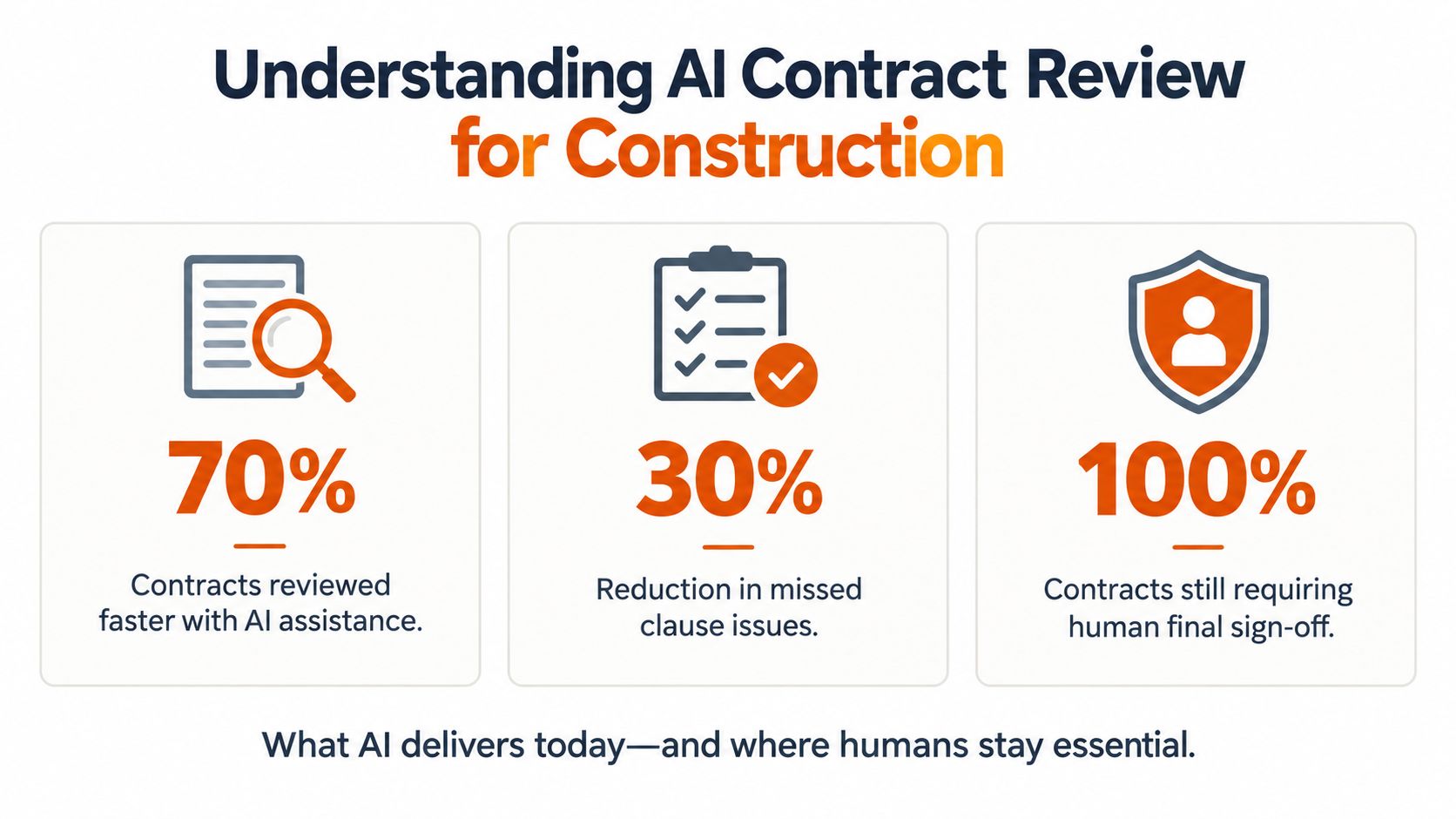
A reliable review platform can extract a notice period, identify an insurance obligation, compare indemnity wording with a company standard, and highlight a payment provision that differs from the preferred form. It can also produce a usable first-pass report for a project manager, estimator, contract administrator, or attorney.
That doesn't make the system a construction lawyer. It doesn't know whether a particular allocation is acceptable given the project scope, the negotiated price, the counterparty, or the governing law unless those factors are deliberately supplied and verified.
The main limitation is cross-document logic. A tool may accurately summarize a limitation-of-liability clause in the prime contract while missing a supplementary condition that expands liability elsewhere. It may find a notice deadline in the general conditions but fail to connect it to a stricter requirement in Division 01 or a trade package. Construction disputes often arise from those interactions, not from one isolated sentence.
The correct operating assumption is simple: AI finds candidates for attention. Qualified people decide what those findings mean.
Choosing the Right AI Model Approach
Generic language models and purpose-built construction tools can both assist with contract review, but they solve different problems. A general model is useful for summarizing clearly written text, organizing extracted obligations, or generating questions for a reviewer. It usually needs more supervision when the analysis depends on a particular contract family, amendment structure, or jurisdiction.
Construction contracts contain mechanics that broad legal language models may not interpret reliably. Payment structures, compensation events, interim valuations, lien waivers, no-lien clauses, flow-down obligations, and notice conditions often depend on terminology and relationships that are specific to construction practice. The same wording can also carry different consequences under different governing laws.
Calibration by contract form
Before selecting a platform, test its performance against the forms your business uses. A tool that performs well on a clean AIA agreement may not understand how amendments alter an NEC contract. A system familiar with FIDIC terminology may still mishandle a bespoke schedule of amendments or fail to connect Particular Conditions to the General Conditions.
The useful comparison is not “generic AI versus construction AI” in the abstract. Assess each approach against these questions:
- Form coverage: Can it distinguish and analyze AIA, FIDIC, NEC, and JCT structures, including amendments and supplementary conditions?
- Clause recognition: Can it identify payment, change, indemnity, insurance, notice, and responsibility provisions without relying only on keywords?
- Relationship extraction: Can it show which party bears an obligation, what event triggers it, and which document modifies it?
- Citation discipline: Does every finding point to the exact source text, page, section, and document version?
- Escalation behavior: Does the system expose uncertainty instead of presenting a weak inference as a settled conclusion?
When ensembles make sense
Model selection should also consider whether a single model is sufficient for the extraction task. A 2025 peer-reviewed study benchmarked 12 NLP and machine-learning models for risk and responsibility extraction. The best individual model reached 89% accuracy for sentence types and 83% for related parties. An ensemble improved accuracy from 0.87 to 0.89 and F1 from 0.83 to 0.86 (peer-reviewed study of automated construction contract analysis).
Those results don't establish a universal threshold for every project. They do show why extraction reliability deserves testing rather than assuming that fluent output equals accurate analysis. For high-stakes work, a specialized model, retrieval from approved contract sources, and an independent validation layer will usually provide a stronger foundation than an unconfigured chatbot.
Preparing Construction Contract Data for AI Review
The quality of the review depends on the quality of the contract set. Uploading a single prime contract PDF and asking an AI tool to identify risk creates a neat report from incomplete evidence. That report may look professional while omitting the addendum, specification, exhibit, or trade document that changes the commercial meaning.
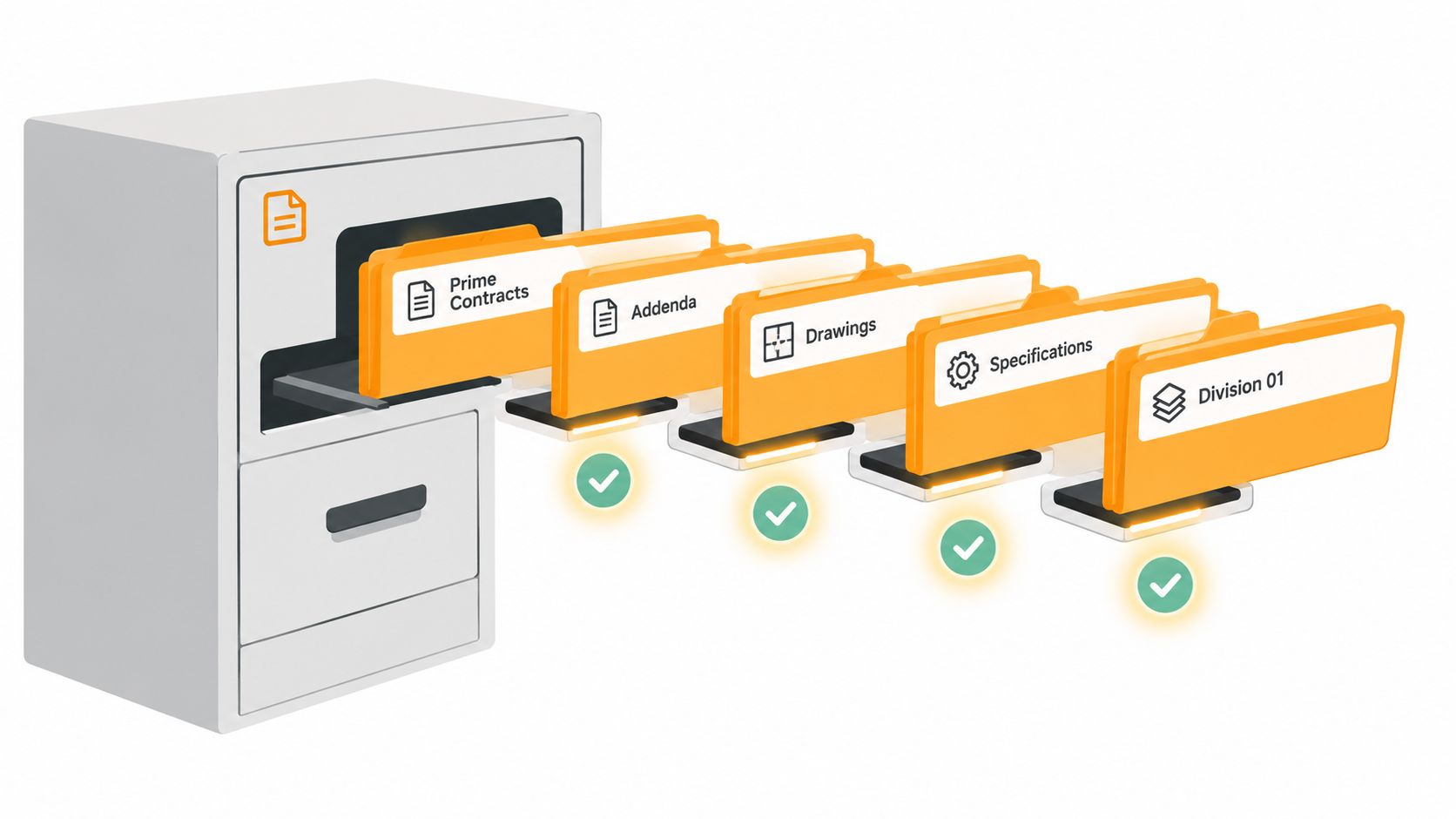
The first task is to assemble the full set of documents that controls the work. Include the prime agreement, general and supplementary conditions, addenda, Division 01 requirements, specifications, drawings where they contain contractual obligations, schedules, exhibits, bid forms, scopes of work, and relevant subcontract templates.
Build a document map first
Create a register that gives every file a stable name, document type, revision, effective date, and priority in the contract hierarchy. Don't allow a tool to treat “Addendum 2,” “Addendum 2 revised,” and “Addendum 2 final” as interchangeable files. The reviewer needs to know which version was analyzed and why it controls.
A practical preparation sequence looks like this:
- Deduplicate files: Remove repeated scans and superseded drafts, but preserve an archive outside the active review set.
- Tag revisions: Record the revision date, addendum number, issuing party, and relationship to the base agreement.
- Map references: Connect “Section 01 20 00,” “Supplementary Condition 7,” and similar references to the actual source document.
- Preserve structure: Use OCR carefully for scans, retain page numbers, and avoid flattening headings that help the system understand hierarchy.
- Define precedence: Record which document controls if the general conditions, supplementary conditions, specifications, and trade package conflict.
The hardest failures occur when the system reads documents independently. Supplementary conditions, Division 01 requirements, and trade packages can silently shift scope, notice responsibility, payment timing, or back-charge rights across the contract set. Current construction guidance identifies this cross-document logic as a major gap in the way AI contract review is commonly presented (analysis of cross-document risk in engineering and procurement contracts).
For teams building a repeatable intake process, a documented AI data readiness workflow can help connect file governance, source hierarchy, and retrieval quality before model testing begins.
Require traceable findings
Every output should link back to the exact document, page, section, paragraph, and version. If the tool says that the subcontract contains a notice condition, the reviewer should be able to open the underlying language immediately and compare it with the prime contract.
That traceability is more valuable than a polished risk score. It allows counsel to challenge an inference, lets commercial staff understand the obligation, and creates an audit record showing how the finding was accepted, rejected, or escalated.
Integrating AI Review with Contract Management Systems
A risk report that sits in a download folder has limited operational value. The review becomes useful when each finding enters the same workflow the project team already uses for approvals, negotiations, obligations, and escalations.
Start by defining a structured finding record. At minimum, capture the project, contract, document version, clause category, source citation, risk description, responsible stakeholder, priority, status, reviewer decision, and due date. Avoid copying a long AI narrative into a task system without preserving the source citation and the original output.
Route findings by consequence
Not every flag deserves the same path. A missing insurance requirement, unusual indemnity, or compressed notice deadline should route to legal or senior contract administration. A minor formatting inconsistency may go to the document owner. A possible conflict between a prime contract and subcontract should create a linked task for both commercial and project stakeholders.
A useful workflow separates:
- High-risk findings: Hold execution or external communication until a qualified reviewer resolves the issue.
- Medium-risk findings: Assign an owner, require a documented decision, and include the matter in the negotiation schedule.
- Low-risk findings: Allow controlled handling by trained staff, subject to playbook rules and sampling.
- Unresolved findings: Preserve the disagreement and escalate it rather than forcing the system to choose.
The system should also connect findings to obligations after execution. A notice deadline identified during review can become a monitored task. An insurance requirement can link to certificate verification. A flow-down obligation can be associated with the relevant subcontract and responsible manager.
Design for error, not confidence
AI legal tools can produce plausible but unsupported answers. One 2026 review cites Stanford research indicating that AI legal tools hallucinate more than 17% of the time on standard queries, which makes validation and routing controls essential (review of AI tools for construction law).
The integration should therefore block unreviewed AI text from becoming a contractual commitment. Require a human approval state before a proposed redline, notice, interpretation, or external message leaves the system. Keep the prompt, source documents, output, edits, and final decision in an audit trail.
For teams that need additional administrative capacity around document intake, issue tracking, and reviewer coordination, virtual legal assistant services can support the human workflow without transferring legal judgment to software.
Establishing Governance and Validation Standards
Governance isn't a policy document placed in a shared drive after the tool goes live. It is the operating system that determines who can use AI, which documents may be processed, what the system may recommend, and who remains accountable for the result.
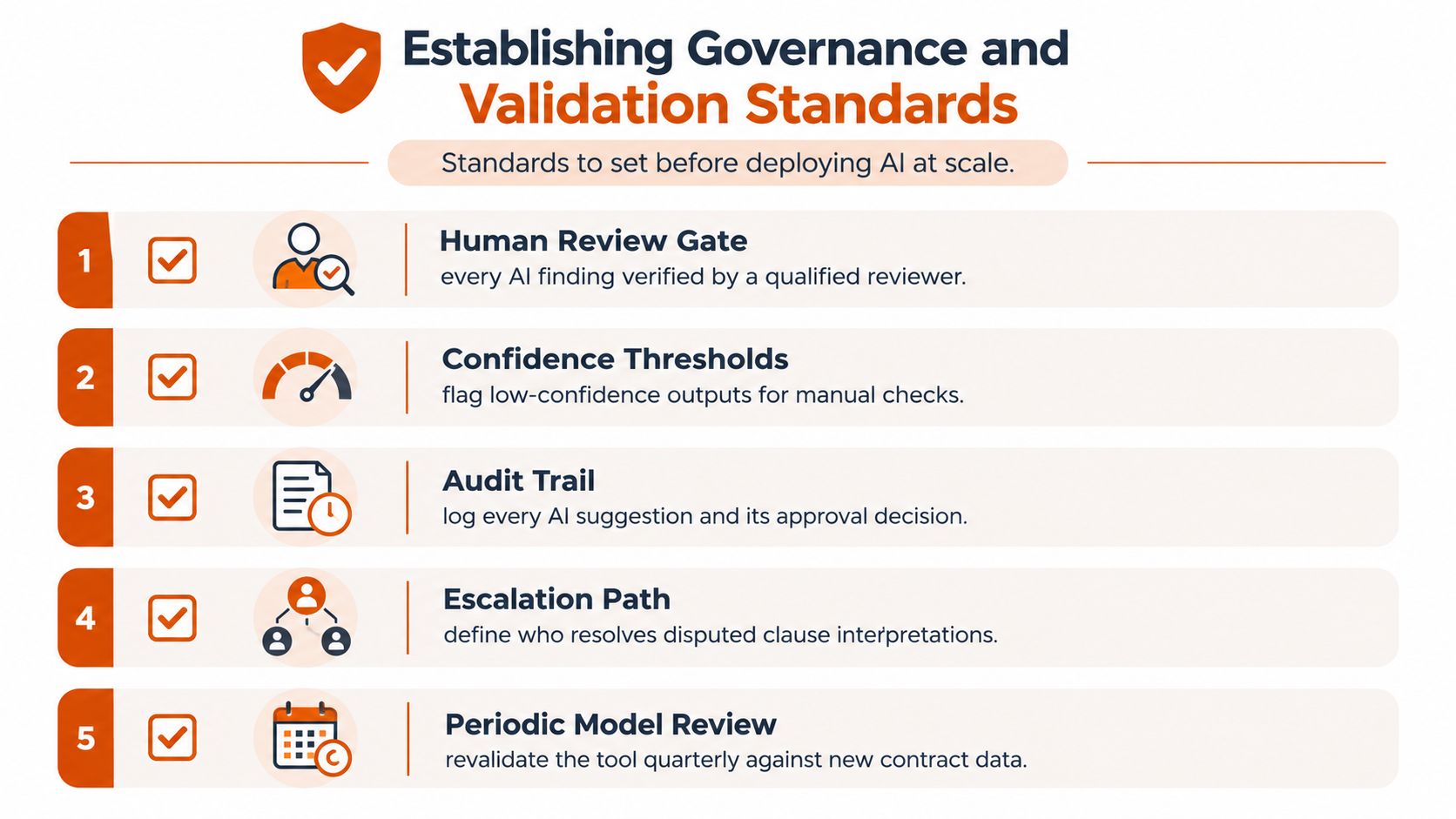
The first control is a human review gate. Every finding that affects indemnity, insurance, payment, lien rights, notice, dispute resolution, scope, or liability should be verified by someone qualified to interpret the contract and project context. A project manager can confirm commercial relevance, while counsel may need to resolve jurisdiction-specific legal questions.
Set standards before scale
Use a written validation standard that defines what acceptable performance means for each use case. A clause-extraction task may have a different tolerance for error than a tool proposing negotiation language. The standard should also require source citations, confidence indicators, and a documented response when the system can't resolve a conflict.
A defensible governance framework includes:
- Human approval: No material AI finding becomes a final position without named reviewer approval.
- Confidence handling: Low-confidence or conflicting outputs go directly to manual review.
- Source integrity: Reviewers can trace every conclusion to the exact document and version.
- Escalation ownership: The company identifies who resolves disputes between legal, commercial, and project teams.
- Ongoing testing: The tool is rechecked against new contract forms, amendments, and known errors.
Governance rule: If a reviewer can't reproduce the finding from the cited contract language, the finding isn't ready for decision.
Jurisdiction creates another boundary. AI may identify indemnity or lien language correctly while missing a state-law notice requirement elsewhere in the project documents. It may confuse an addendum with the base contract or fail to identify a discrepancy in a referenced document. Construction-law guidance warns that these errors are especially consequential because indemnity, lien rights, insurance, and dispute-resolution provisions can vary by jurisdiction and project type (construction-law guidance on reducing AI contract risk).
Document the governing law, project location, contract form, and internal playbook used for every review. For a practical recordkeeping structure, use an AI governance and documentation framework that makes approvals, exceptions, and model behavior visible to management and counsel.
The following video can help teams introduce governance discussions during implementation:
Running a Measurable AI Contract-Review Pilot
A pilot should test a workflow, not merely a demo. Choose a controlled group of contracts with known reviewers, stable document access, and a clear approval process. Include examples that contain amendments, addenda, subcontract flow-downs, and potential conflicts. A clean contract alone will make almost any tool appear more capable than it is.
The pilot should begin with a baseline created by the people who already perform the work. Record how long a review takes, which issue categories are checked, how findings are documented, and where reviewers disagree. Then run the same set through the AI system and compare the outputs against the validated baseline.
Use prompts that force evidence
Prompts should ask for structured extraction rather than broad legal conclusions. For example:
- “Identify every payment deadline, state the triggering event, name the responsible party, and cite the document, page, and section.”
- “Compare the subcontract's insurance and indemnity obligations with the prime contract. List each missing or expanded flow-down requirement and cite both provisions.”
- “Find every notice deadline. Group them by claim type, identify conflicts across documents, and mark any deadline that requires legal review.”
- “List clauses that shift back-charge responsibility. Explain which document creates the obligation and whether another document limits it.”
The tool should not be asked to decide whether a company should accept a risk. It should expose the language and the relationship so a responsible person can make that decision.
Measure the handoff
Track cycle time, validated issue detection, unsupported findings, reviewer corrections, unresolved conflicts, and the number of items escalated to counsel. The purpose isn't to produce a flattering dashboard. It's to find where the system saves effort and where it creates additional verification work.
A practical example starts with a project manager uploading the prime contract, addenda, and Division 01 specifications. The AI extracts notice deadlines, insurance obligations, indemnity language, and flow-down requirements, then highlights a conflict between the prime contract and a proposed trade package. The project manager sends the cited conflict to contract administration, and counsel resolves it before execution. That is the right division of labor.
Independent construction guidance positions AI as a first-pass risk extraction system that can flag deviations from company standards and highlight indemnity, insurance, notice, and payment provisions while humans and attorneys retain final approval authority (construction industry guidance on AI contract review).
Scale only after the team can explain false positives, missed issues, source failures, and escalation delays. A documented AI pilot-to-production checklist can help executives turn those observations into a controlled deployment decision.
Key Takeaways and Next Steps for Implementation
The impact opportunity is straightforward. AI can compress repetitive contract review from hours to minutes, improve consistency, and reduce the chance that deadline-based or cross-referenced terms disappear in a document pile. Those benefits materialize only when the system receives the complete contract set and every important finding remains subject to human approval.
The strongest use case is a first-pass review of documents that would otherwise consume significant attention. A project team can ask the system to extract obligations, compare a subcontract against the prime agreement, identify deviations from a playbook, and create a negotiation schedule. Counsel then spends more time on interpretation, strategy, and exceptions instead of locating every potentially relevant clause manually.
What should happen next
Start with one contract family and one controlled workflow. Don't begin by asking AI to draft every agreement, resolve every dispute, or issue formal notices. Establish a narrow purpose, define the documents that belong in scope, and decide which findings must stop execution until reviewed.
Then make the following decisions explicit:
- Document control: Who assembles the complete contract set, confirms revisions, and defines precedence?
- Model calibration: Which forms, amendments, jurisdictions, and clause categories must the tool understand?
- Reviewer accountability: Who approves findings related to payment, indemnity, insurance, notice, lien rights, and dispute resolution?
- Workflow integration: Where do accepted findings become tasks, negotiation points, obligation alerts, or escalation records?
- Performance validation: Which errors, omissions, unsupported citations, and reviewer corrections will determine whether the pilot expands?
Cross-document validation deserves particular attention. A system may identify a risky clause in the prime contract but fail to recognize that a supplementary condition changes its effect. It may detect a subcontract obligation without confirming that the upstream agreement contains a matching right. The reviewer must test relationships, not just summaries.
AI-era contract drafting creates another emerging governance issue. Teams should examine whether force majeure, indemnity, confidentiality, warranties, and audit rights address AI system outages, model failures, vendor training on project data, and AI-generated errors. These provisions are still developing, so legal review remains necessary before adopting standard language.
The right conclusion isn't that AI construction contract review is unreliable. The right conclusion is that its value depends on boundaries. Use it for speed, coverage, extraction, and prioritization. Don't give it unreviewed authority over legal interpretation, negotiation strategy, jurisdictional conclusions, or final execution.
A disciplined deployment gives executives a measurable impact opportunity without disguising the remaining risk. Prepare the data, calibrate the model, route findings into accountable workflows, preserve citations, and require qualified human validation wherever a missed interaction could affect money, time, scope, or dispute rights.
Prometheus Agency helps teams design AI-enabled contract workflows that classify incoming agreements, apply the appropriate playbook, propose first-pass redlines, and route high-risk issues to legal with defined guardrails. Visit Prometheus Agency to discuss a practical AI strategy and implementation plan for your contract-review operation.