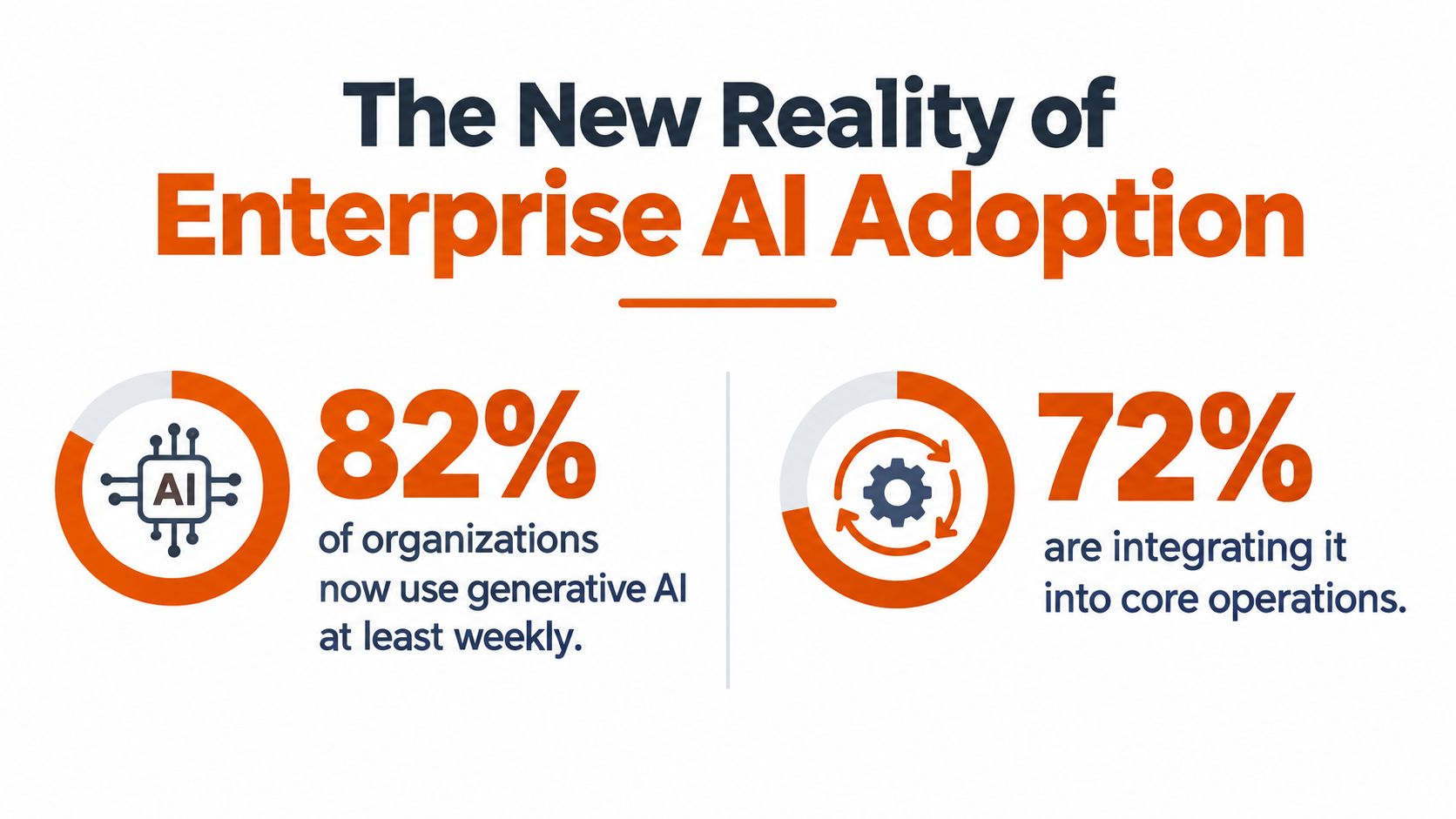
82% of organizations use generative AI at least weekly, and 72% are formally measuring its return on investment, according to the 2025 Wharton-GBK enterprise AI adoption report. AI adoption has moved beyond curiosity and isolated experimentation. For B2B growth leaders, the question is no longer whether the company should test AI, but whether it can turn scattered experiments into reliable revenue operations without creating new data, workflow, and governance problems.
The gap between enterprise-scale ambition and middle-market execution is widening. Large companies may have dedicated data teams, transformation offices, and formal governance structures, while mid-market firms often need to prove value with existing CRM records, lean teams, and limited implementation capacity. A practical AI adoption strategy closes that gap by connecting one measurable workflow to the next, rather than treating AI as a standalone technology purchase.
The New Reality of Enterprise AI Adoption
The adoption numbers change the standard for responsible planning. The Wharton-GBK report found that 82% of organizations use generative AI at least weekly, while 46% use it daily. It also found that 72% formally measure Gen AI ROI, 88% expect Gen AI budgets to increase over the next 12 months, and 62% expect those budgets to rise by 10% or more. Together, these figures show that AI has entered the operating cadence of many businesses, not just their innovation labs.
That shift creates a difficult executive question. If competitors already use AI in recurring workflows, a company that remains in endless pilot mode may lose speed in sales research, customer response, content production, forecasting, and internal decision support. Yet moving quickly without ownership, controls, and clean data can produce the opposite result. Teams acquire disconnected tools, duplicate records, inconsistent prompts, and automations nobody trusts.
The Enterprise Scale Gap
A 2025 McKinsey global survey found that 88% of respondents said their organizations used AI in at least one business function, up from 78% a year earlier. The same survey found that 44% said AI was scaling across the enterprise, compared with 38% in the prior year.
Those figures describe progress, but they also expose the bottleneck. Adoption in one department is relatively easy to announce. Scaling across sales, marketing, service, finance, and operations requires shared definitions, connected systems, clear decision rights, and managers who can change daily behavior. Middle-market companies often have an advantage here because they can make decisions faster, but only if they resist buying tools before assigning workflow ownership.
Prometheus's track record illustrates the operating principle behind durable transformation. The useful unit of change isn't “AI across the company.” It's a specific process, such as account research before a sales meeting, lead routing after a form submission, or service triage when a customer reports an issue. Leaders evaluating autonomous systems can also review agent hiring use cases by role to connect emerging capabilities with defined responsibilities rather than vague job replacement narratives.
Why pilots fail before value appears
The Stanford Enterprise AI Playbook findings summarized in this enterprise adoption guide report that 61% of implementations experienced at least one significant failure before reaching production value, even though AI use is widespread. The lesson isn't that pilots are flawed by design. It's that many pilots test technical capability without testing the operating conditions required for sustained use.
A pilot that produces impressive outputs in a workshop may still fail when it encounters incomplete CRM fields, unclear approval rules, outdated documentation, or a manager who doesn't trust the result. The executive sponsor then sees a technology problem, while the team is facing a workflow design problem.
Practical rule: Treat every pilot as a production rehearsal. Test data access, ownership, escalation, user behavior, and measurement before you promise scale.
Assessing Organizational Readiness for AI
Readiness begins with the work, not the software. Before selecting a model or vendor, map the decisions employees make repeatedly, the information they need, and the systems they update afterward. A company may have modern Salesforce or HubSpot infrastructure and still lack the consistent field definitions or process ownership needed for reliable AI.

The strongest warning signal is data quality. 52% of organizations cite data quality as the top barrier, while more than half report skills gaps or recruitment challenges. The same analysis of AI adoption challenges finds that 56% to 64% of implementation challenges are human factors, with insufficient training accounting for 38% of adoption challenges.
A readiness checklist that reaches the workflow
Use a sequential review. Don't score readiness from a generic technology checklist alone.
Define the business outcome. Choose a metric connected to a real executive priority, such as speed to qualified opportunity, service resolution time, forecast quality, or sales capacity. “Use AI more” isn't an outcome. “Reduce manual research before account reviews” gives the team something testable.
Trace the current process. Document the trigger, human decisions, system updates, approvals, and exceptions. If nobody can explain who owns a step, AI won't fix the ambiguity. It will automate it or hide it.
Inspect the data path. Review duplicate records, missing fields, inconsistent lifecycle stages, stale account information, and conflicting definitions between marketing automation and CRM. Pay particular attention to whether the data used for a recommendation is also updated after the recommendation is accepted.
Check permission boundaries. Decide which records an AI system may read, what it may write, and which actions require human approval. A useful pilot can often operate with narrow access and a clear escalation route.
Assess user capability and incentives. Identify who will use the output, who will maintain the workflow, and what managers expect from the team. Training can't compensate for a process that adds work without removing work elsewhere.
Set a readiness decision. Proceed when the workflow has an accountable owner, usable data, a defined user group, an approval path, and a measurable outcome. If those conditions aren't present, invest first in data governance or process cleanup.
A readiness assessment should end with a decision, not a presentation. The AI readiness assessment for teams approach is useful because it frames the diagnostic around practical team capability, process fit, and implementation priorities.
A short working session can reveal more than a broad survey. Ask a sales manager to demonstrate how a lead moves from capture to assignment. Ask a service leader to show how an urgent request is escalated. Then compare the stated process with the actual records and automations.
The following video provides another way to think about readiness, particularly the relationship between people, process, and technology.
A middle-market company doesn't need perfect data before it starts. It needs enough data discipline to know where confidence is justified and where a human must remain in control. That distinction prevents both reckless deployment and unnecessary delay.
Designing High-Impact AI Pilot Programs
A strong pilot begins with a boring problem. High-volume, repetitive knowledge work usually offers the clearest path to value because the team can observe the baseline, define the handoffs, and review errors without putting the entire revenue engine at risk.
Consider a B2B company receiving inbound requests from multiple campaigns. Marketing wants faster qualification, sales wants better context, and operations wants consistent routing. An appropriate pilot might classify incoming leads, summarize the stated need, identify missing information, and recommend a routing queue. The AI doesn't make the final commercial decision. It prepares a structured recommendation inside the CRM for a sales or operations owner.
Select the use case before the tool
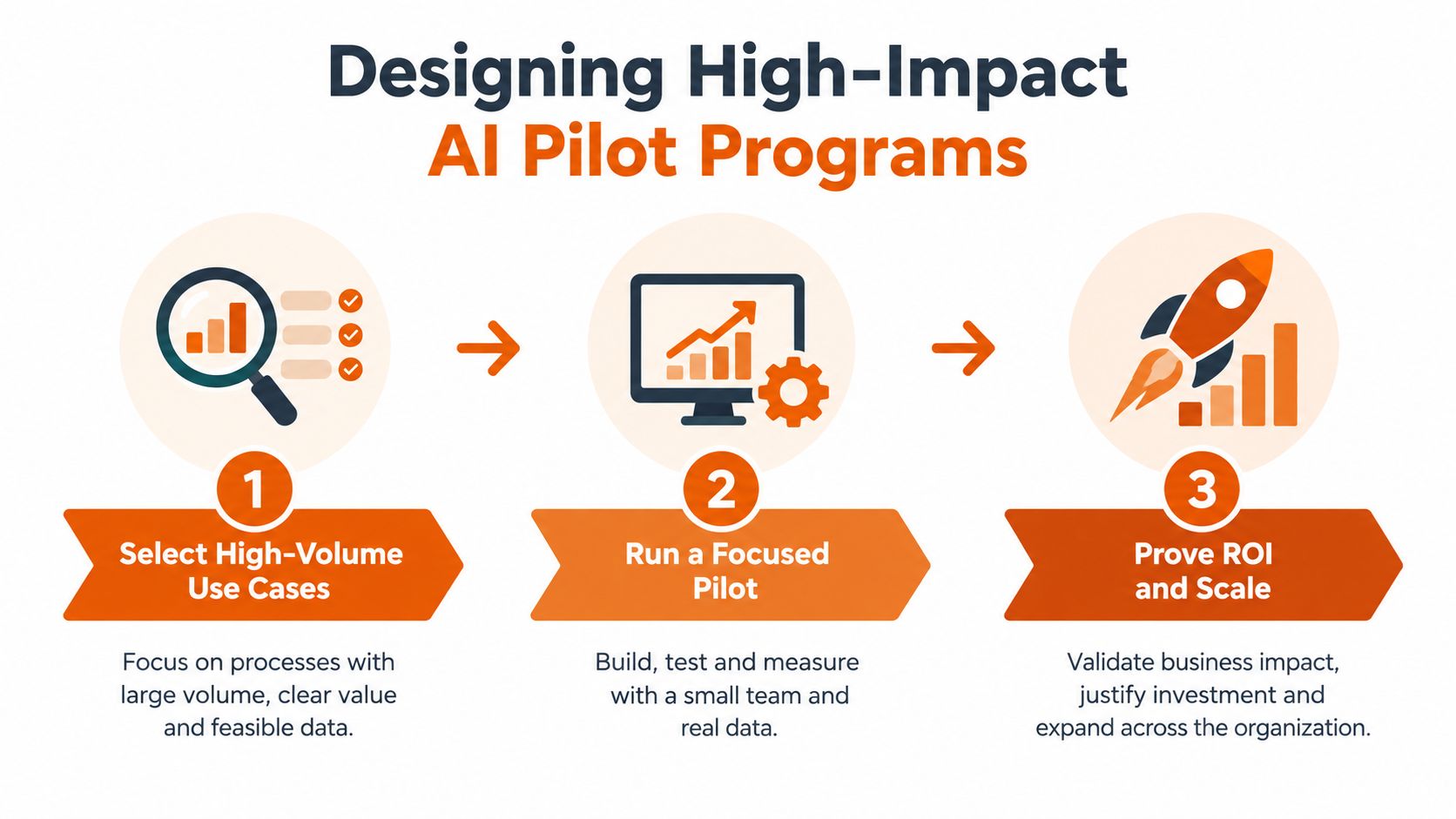
The enterprise AI adoption strategy guidance recommends starting with high-volume, repetitive knowledge work, using a 10 to 50 user team, and targeting less than 90 days to value during the pilot phase.
Use those parameters as operating constraints, not guarantees. A focused group is large enough to produce varied feedback and small enough to manage directly. The time-to-value target forces the team to choose a workflow with visible activity, accessible data, and a decision-maker who can remove blockers.
A practical selection screen includes four questions:
- Is the work frequent? Repeated activity creates enough observations to identify whether the new process helps.
- Is the risk contained? Start with recommendations, summaries, classification, or draft creation before granting permission to make irreversible changes.
- Is the owner available? The person accountable for the existing process should define acceptable output and approve changes.
- Can value be measured? Track the time required, the number of handoffs, the rate of accepted recommendations, and the business result connected to the workflow.
Prove value without confusing activity for impact
A chatbot can attract usage without improving performance. A lead-scoring assistant can show high interaction but still fail if sales representatives ignore its recommendations. Measure the pilot across three layers:
| Layer | What to measure | Why it matters |
|---|---|---|
| Deployment | Whether the workflow runs reliably and reaches the right records | Confirms the technical path works |
| Adoption | Whether the intended users use and accept the output | Shows the process fits daily work |
| Proficiency | Whether users make better decisions or complete work faster | Connects activity to business value |
For the lead-routing example, compare the old manual path with the pilot path. Record the time from submission to assignment, the quality of the information available to the seller, the number of manual touches, and the percentage of recommendations requiring correction. Then connect those measures to pipeline progression without claiming that correlation proves causation.
A pilot earns scale when the team can explain both the benefit and the boundary.
Don't hide exceptions. If the model performs well on standard inquiries but struggles with partner referrals, international accounts, or incomplete forms, encode those conditions into the operating design. A controlled exception is more valuable than a broad launch that creates silent errors.
The AI pilot to production framework can help teams structure the transition from a promising demonstration to an owned production workflow. The decision to scale should depend on repeatable value, user confidence, data reliability, and a named owner for ongoing maintenance.
Integrating AI with Existing CRM and Workflows
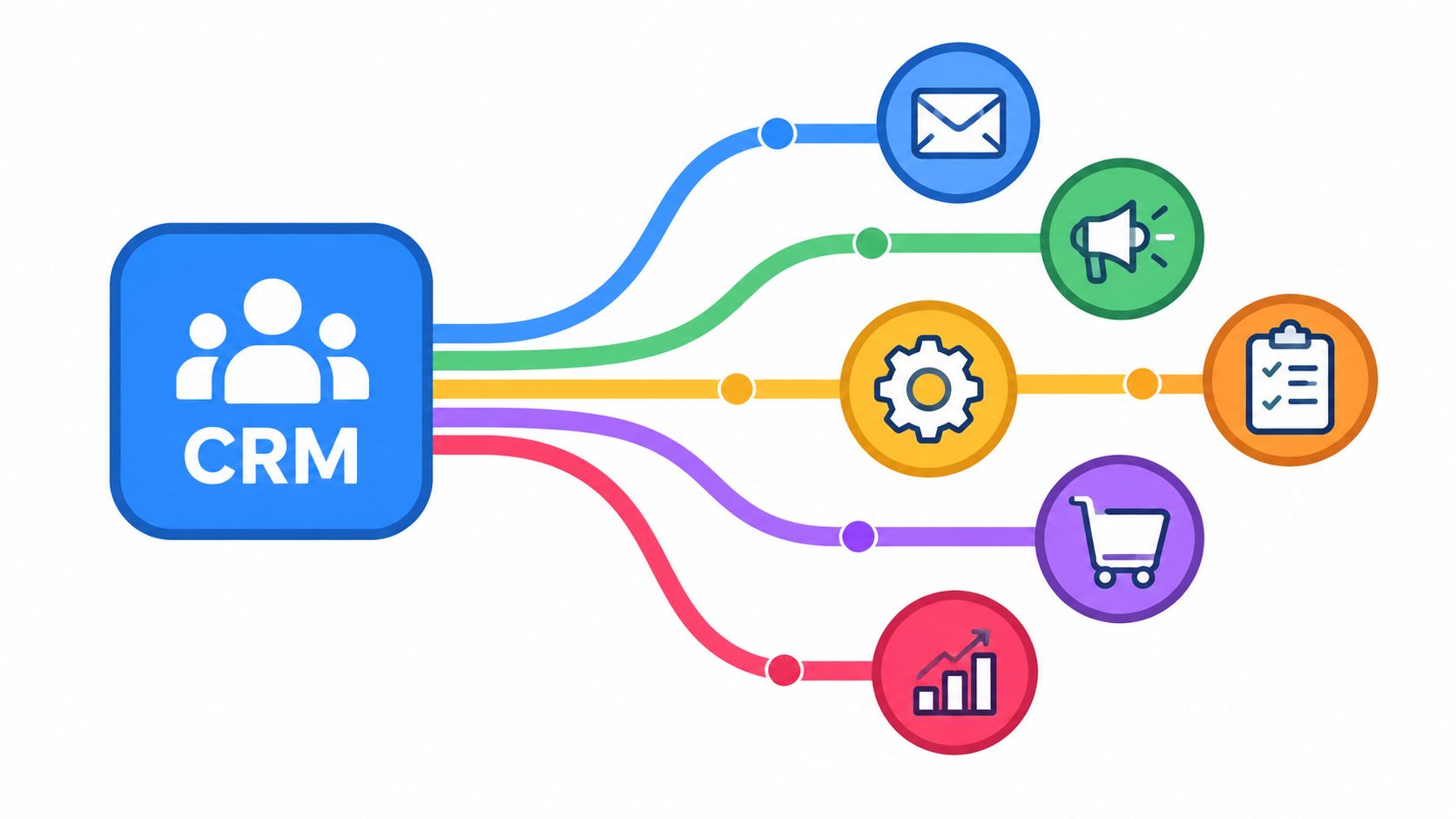
An AI tool creates value only when its output changes the next action. If a seller must copy a recommendation from a separate interface into Salesforce, or if a service agent receives a summary without the ability to update the case, the company has added another information silo.
Integration choices usually fall into two paths. Pre-built CRM automation is faster to deploy and easier for a lean team to maintain. Custom development offers more control over data transformation, user experience, and specialized logic, but it creates a larger ownership burden.
Choose the right integration path
| Decision factor | Pre-built CRM automation | Custom AI solution |
|---|---|---|
| Speed | Usually faster for standard workflows | Requires design, development, and testing |
| Control | Constrained by platform features and vendor rules | Greater control over logic and interface |
| Maintenance | Vendor updates reduce some internal burden | Internal teams own changes, monitoring, and failures |
| Fit | Strong for common sales, marketing, and service tasks | Useful for differentiated processes or complex data |
| Risk | May encourage teams to accept default workflows | Can create technical debt if ownership is unclear |
For most middle-market companies, the sensible starting point is to extend the existing CRM rather than replace it. Use native objects, permissions, workflow triggers, and reporting wherever they fit. Build custom components only where a clear business requirement justifies the additional complexity.
The integration design should answer five operational questions:
- What triggers the AI action? A new lead, a changed opportunity stage, an incoming service case, or a scheduled account review?
- What context does the system need? Define the approved fields, documents, activities, and permissions.
- Where does the result go? Store summaries, classifications, recommendations, and confidence indicators in a location users already inspect.
- Who approves the next step? Make the human decision explicit for pricing, qualification, customer commitments, and other sensitive actions.
- How do you monitor drift? Review changes in data quality, output accuracy, user overrides, and workflow completion.
CRM automation has a direct economic case. The supplied benchmark reports $8.71 in revenue for every dollar invested, primarily through reduced costs and accelerated sales cycles. Use that figure as a reference point, not a promise for every implementation. Your own business case should connect investment to one workflow, one owner, and one measurable commercial or operational outcome.
An operational approach to AI content is also useful when content production connects to CRM stages, audience data, approvals, and distribution. Generating more drafts isn't the same as improving revenue operations. The content must enter the right campaign, carry the right context, and produce a trackable next action.
The AI integration with CRM guidance provides a practical reference for connecting AI capabilities to existing customer workflows without treating integration as a separate technology project. The best architecture is usually the one that makes the new behavior easier than the old workaround.
Navigating Change Management and Training
Training fails when it teaches features instead of work. A seller doesn't need a tour of every AI capability in a CRM. They need to know how to prepare for an account review, verify an AI-generated summary, challenge a weak recommendation, and record the final decision.
The change plan should begin before launch. Explain which tasks AI will support, which decisions remain with people, what data the system can access, and how employees can report errors. Employees are more likely to engage when leaders describe the boundaries plainly instead of presenting AI as either magic or a threat.
Build enablement around roles
Create different learning paths for revenue leaders, individual contributors, operations specialists, and administrators.
- Executives need the scorecard. Show the business outcome, the risk controls, the investment owner, and the decision points for scaling.
- Managers need coaching routines. Give them examples of acceptable use, review questions, and a way to spot whether the workflow is improving or merely generating activity.
- Practitioners need task-based practice. Use real but approved records, walk through common exceptions, and let users compare AI output with the existing process.
- Administrators need control over the system. Document permissions, prompt or instruction changes, data sources, escalation rules, and incident response.
Keep the first onboarding concise. The enterprise guidance cited earlier recommends an initial onboarding of roughly two hours, with training completion, usage frequency, and manager confidence as leading indicators. Those measures don't prove ROI, but they reveal whether the organization has created the conditions for meaningful use.
Make governance visible in daily work
Governance shouldn't live only in a policy document. Put approval prompts, source visibility, edit history, and escalation options inside the workflow. If a representative can't tell why a recommendation appeared or how to correct it, trust will decline quickly.
A useful operating model assigns four kinds of ownership:
- Business owner: accountable for the outcome and process design.
- Data owner: responsible for field definitions, access, quality, and retention.
- Technical owner: responsible for integrations, monitoring, reliability, and change control.
- People manager: responsible for coaching, feedback, and adoption in the team.
Create a feedback loop that distinguishes model errors from process errors. If a lead is routed incorrectly because the model misunderstood the record, improve the instructions or evaluation. If the record lacked the industry field needed for routing, fix the data capture process. Treating every failure as an AI problem leads to expensive tinkering.
Training is complete only when a person can use the system, verify its output, and recover when it fails.
Champions can accelerate learning, but don't turn them into unpaid support staff. Give them a defined route for surfacing patterns, a regular review with operations, and permission to recommend workflow changes. Celebrate useful behavior, such as a well-documented correction or a process improvement, rather than celebrating raw login counts.
Scaling and Governing Your AI Strategy
Scaling should follow the revenue system, not the org chart alone. Once a pilot proves value, expand to the next workflow that shares data, users, or decision logic. For example, a lead qualification assistant may connect naturally to account research, opportunity preparation, and service handoff. That creates a coherent operating sequence instead of a collection of unrelated tools.
The McKinsey survey results show why this matters. 88% of respondents said their organizations used AI in at least one business function, while 44% said AI was scaling across the enterprise, up from 38% a year earlier. Enterprise adoption is becoming cross-functional, but scale increases exposure to inconsistent permissions, fragmented data, and unclear accountability.
Use a phased scale model
Phase one, prove the workflow. Establish the baseline, define the user group, set approval rules, and measure deployment, adoption, proficiency, and business impact.
Phase two, harden the operating system. Document the process, clean the necessary data, create monitoring, assign owners, and train managers. Don't scale a workflow that only works because one enthusiastic operator is manually correcting it.
Phase three, expand by adjacency. Add departments or use cases that share the same customer data, systems, or decision points. Reuse controls and evaluation methods, but reassess the risk and user needs for every new workflow.
Phase four, manage the portfolio. Review each use case against value, adoption, risk, maintenance cost, and strategic relevance. Retire tools that create activity without measurable improvement.
Financial planning must match the maturity curve. The Wharton-GBK report found that about four in five respondents expected Gen AI investments to pay off in roughly two to three years. That doesn't excuse weak pilots or vague measurement. It means executives should separate early workflow proof from the longer horizon required for enterprise capability, infrastructure, and workforce change.
Impact opportunity: Middle-market companies can compete by standardizing a small number of high-value workflows before complexity makes change expensive.
Executive accountability should be explicit. A revenue leader owns the commercial outcome, operations owns process integrity, technology owns reliability, and finance validates the business case. With those roles in place, an ai adoption strategy becomes a managed growth program rather than an open-ended software experiment.
Prometheus Agency helps growth leaders assess AI readiness, prioritize practical use cases, connect AI to CRM and go-to-market workflows, and turn pilots into accountable revenue systems. If your team needs a clearer path from isolated experiments to measurable adoption, visit Prometheus Agency to explore a Growth Audit and AI strategy session.