Full-funnel marketing is much more than a buzzword. It's a holistic strategy that addresses the entire customer journey, from the first time someone hears your brand name to the moment they become a loyal advocate. Instead of treating marketing as a set of separate tasks, this approach views the whole process as a single, interconnected system designed for one thing: sustainable growth.
Understanding The Full-Funnel Marketing Blueprint
Many businesses conduct their marketing in isolated sprints. They might go all-in on lead generation one quarter, then pivot entirely to closing deals the next. The result is often a clunky, disjointed experience that leaves potential customers feeling confused or ignored. People fall through the cracks.
Full-funnel marketing is the solution. It’s about mapping out and optimizing every single stage of the customer lifecycle. It aligns marketing, sales, and service teams toward one unified goal: creating a smooth, seamless journey that builds genuine relationships over time.
Think of it like building a relationship. You don't propose on the first date. You introduce yourself (Awareness), get to know each other (Consideration), make a commitment (Conversion), and then, ideally, build a lasting partnership (Loyalty). This methodical approach ensures you're delivering the right message at the right time, every time.
The Core Stages of The Customer Journey
The path from a total stranger to a loyal advocate is predictable. We can break it down into distinct phases, and each one requires a different strategy. Understanding these stages is the first step toward building a marketing plan that connects with people, no matter where they are in their decision-making process.
This visual lays out the four key stages—Awareness, Consideration, Conversion, and Loyalty—and the primary objective for each one.
As you can see, the pool of potential customers narrows as you move from awareness down to conversion, but the goal of the loyalty stage is to turn those customers into advocates for your brand.
To help you keep these stages straight, here’s a quick breakdown of the core objective and customer mindset at each point.
The Full Marketing Funnel Stages at a Glance
| Funnel Stage | Primary Objective | Customer Mindset |
|---|---|---|
| Awareness | Introduce your brand and capture attention. | "I have a problem, but I don't know the solution yet." |
| Consideration | Position your brand as the best solution. | "I'm researching my options and comparing solutions." |
| Conversion | Turn a prospect into a paying customer. | "I'm ready to make a decision and choose a provider." |
| Loyalty & Advocacy | Retain customers and turn them into promoters. | "I made the right choice and I want to share my experience." |
This table serves as a simple but powerful reference for aligning your marketing activities with what your customer is actually thinking and feeling.
Why a Holistic Approach Matters
Focusing on just one part of the funnel, like lead generation, is a short-term game. If you don't have a solid awareness strategy, your lead pipeline will eventually run dry. And if you neglect a loyalty program, you're stuck on a treadmill, constantly paying to acquire new customers instead of keeping the ones you already worked so hard to win.
Key Takeaways
- Full-funnel marketing is a comprehensive business growth strategy, not just a marketing tactic.
- It shifts focus from one-off transactions to building long-term customer value.
- This approach creates a more resilient and predictable revenue model by ensuring no part of the customer journey is ignored.
Practical Example A B2B SaaS company invests in top-of-funnel content marketing, creating in-depth guides about industry challenges. This attracts a wide audience. They then use email marketing to nurture these leads with case studies and webinars. Finally, they offer personalized demos to convert them into customers. Post-sale, they provide excellent support and an exclusive community, turning customers into advocates who refer new business. This interconnected process ensures a steady flow of leads and maximizes customer lifetime value.
Impact Opportunity The opportunity here is massive. A Nielsen meta-analysis found that a full-funnel approach can deliver up to 45% higher ROI and a 7% increase in offline sales compared to campaigns that only focus on a single stage. The data is clear: investing across the entire customer journey pays off significantly. A perfect example of this in action is understanding what a lead magnet funnel entails, as it’s a classic tactic for bridging the crucial gap between the awareness and consideration stages.
Capturing Attention at the Top of the Funnel
Every marketing journey starts with a single, make-or-break moment: the first impression. This is the Top of the Funnel (TOFU), also known as the Awareness stage. At this point, your audience isn't looking for you. They’re just starting to understand a problem or pursue an interest.
Your job is to show up as a helpful guide, not a pushy salesperson.
Building Your Brand's Foundation
At this stage, your content needs to educate, inform, and even entertain without expecting anything in return. The goal is simple: attract a wide audience and introduce your brand as a credible, trustworthy resource by answering their earliest questions.
This is where Search Engine Optimization (SEO) becomes your best friend. By building content around the broad, problem-focused keywords your audience is using, you make sure your website is one of the first things they see. It's the digital equivalent of being the first friendly face they meet when they walk into a new town.
Key Takeaways
- The top of the funnel is about generosity; you provide value upfront to build brand familiarity long before you ask for a sale.
- Success at this stage isn’t measured in revenue but in reach and engagement.
- The objective is to become a trusted resource in your industry.
Effective TOFU Channels and Strategies
To grab attention, you have to meet your audience where they already are. That means using a mix of channels that prioritize broad reach and high-value content.
- Content Marketing: Think blog posts, comprehensive guides, and articles that dig into common pain points. A B2B software company might publish a guide on "How to Improve Team Productivity."
- Social Media Campaigns: Use platforms like LinkedIn or Instagram to share eye-catching visuals, short-form videos, and posts that spark conversation and build a community.
- Search Engine Optimization (SEO): Go after informational keywords to pull in organic traffic from people who are actively looking for answers.
- Paid Media: Run awareness campaigns on Google, LinkedIn, or even Connected TV to hit a wide but relevant audience. Strategic paid media services can get your message out there and build brand recognition much faster than organic efforts alone.
Practical Example A home security company wants to connect with new homeowners. Instead of running ads that scream, "Buy Our Alarms!" they create a blog series called "The Ultimate Checklist for New Homeowners." It covers everything from changing the locks to checking smoke detectors, subtly positioning them as a go-to expert in home safety. They push this checklist on social media and optimize it for search, drawing in thousands of potential customers at the very start of their journey.
Measuring Success at the Awareness Stage
Since the goal isn't to make a sale right away, your Key Performance Indicators (KPIs) for the TOFU stage should be all about reach and engagement. These numbers tell you how well you are introducing your brand to new people.
- Impressions: How many times your content or ad was shown.
- Reach: The number of unique people who saw your content.
- Website Traffic: The amount of new visitors landing on your site.
- Click-Through Rate (CTR): The percentage of people who saw your link or ad and actually clicked it.
- Social Media Engagement: Likes, shares, comments, and new followers.
Impact Opportunity Investing in the top of the funnel isn't just a short-term play; it's how you build a sustainable pipeline for the future. By creating brand equity and a large, engaged audience now, you’re filling your funnel with people who will eventually be ready to buy. A strong TOFU strategy lowers your customer acquisition costs over time because you’re building relationships before your competitors even know these prospects exist. That early trust is the most valuable asset you can build.
Building Trust in the Middle of the Funnel
You’ve captured their attention. Now the real work begins.
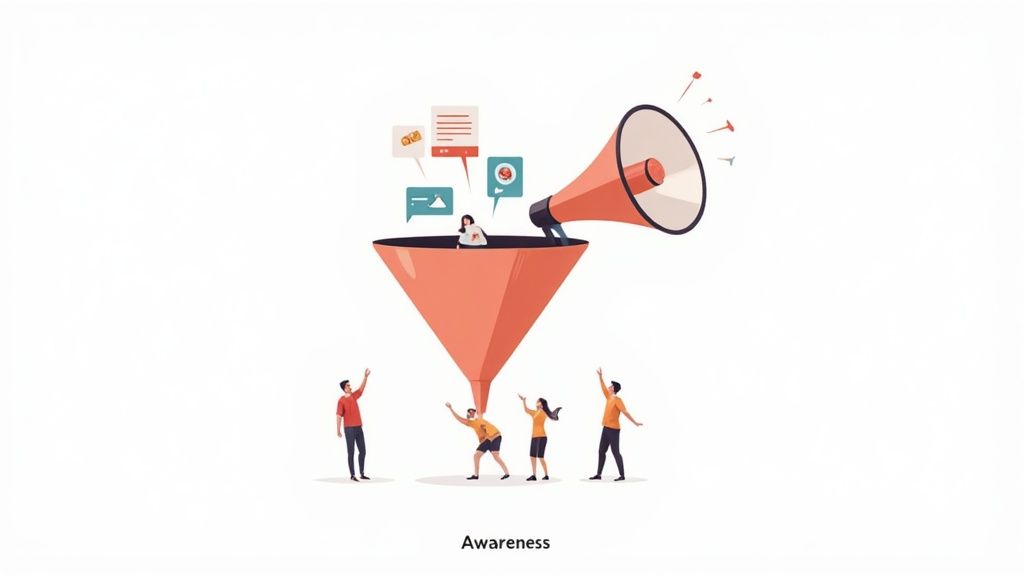
Welcome to the Middle of the Funnel (MOFU), also known as the consideration stage. Prospects are no longer strangers; they know you exist and are now actively evaluating whether you’re the right solution for their problem.
The mindset shift here is critical. At the top of the funnel, they were asking, "What is my problem?" Now, they're asking, "What's the best way to solve my problem?" Your job is to go from being a helpful resource to becoming their preferred solution. It’s all about building trust and demonstrating your expertise.
From Broad Awareness to Targeted Engagement
The middle of the funnel is where you start filtering the crowd down to genuine, qualified leads. These are the people who have shown real interest by engaging with your initial content. Now, you need to offer them something more substantial in exchange for a little information, like an email address.
This is the exact moment an anonymous visitor becomes a known contact. Your content must become more specific, more detailed, and far more solution-oriented. You’re not just educating them about their problem anymore—you're showing them how to fix it, with your product or service positioned as the perfect tool for the job.
Key Takeaways
- The MOFU is where you prove your value and build credibility with solution-focused content.
- The goal is to transition an anonymous visitor into a known lead by offering a fair value exchange (e.g., content for an email address).
- Success here turns passive interest into active consideration for your brand.
High-Impact MOFU Strategies and Channels
To nurture these prospects, your tactics need to deliver deep value and put your unique expertise on display. This isn't the time for another generic blog post; it's time to bring out the high-value assets.
- In-depth Webinars: Host live or on-demand sessions that dive deep into a specific challenge your audience is facing. Use it as a chance to demo your product in a real-world context.
- Detailed Case Studies: Nothing builds trust like social proof. Showcasing success stories from other customers proves you’ve already delivered real results for people just like them.
- Downloadable Guides and Whitepapers: Offer comprehensive resources packed with expert-level insights. This is how you solidify your authority.
- Email Nurture Sequences: Once you have their email, use automated sequences to drip helpful, relevant content over time. This keeps your brand top-of-mind and moves them closer to a decision.
To get this right, you have to understand how these assets fit together. Many of the smartest brands map out every step of their ideal customer journey, making sure each piece of content logically leads to the next.
Practical Example A financial software company knows its prospects—small business owners—dread tax season. They offer a free webinar titled "The 5-Step Checklist for a Stress-Free Tax Season." During the session, they give out truly actionable advice while naturally showing how their software makes each step easier. Attendees who sign up with their email address become highly qualified leads who can then be nurtured with more specific content.
Measuring Success in the Consideration Stage
Your metrics need to shift right along with your strategy. In the middle of the funnel, we move away from reach and impressions to focus on engagement and lead generation. The goal is to see how well you're turning general interest into genuine leads.
- Lead Conversion Rate: What percentage of your visitors fill out a form to get your content or sign up for a webinar?
- Cost Per Lead (CPL): How much are you spending on marketing to acquire a single new lead?
- Content Downloads: The total number of downloads for your gated assets like guides and case studies. This shows what's resonating.
- Email Engagement: Open rates and click-through rates on your nurture sequences tell you if your follow-up is hitting the mark.
Impact Opportunity A strong MOFU strategy is your best qualification tool. By offering valuable content in exchange for an email, you’re not just building a list—you’re segmenting prospects based on their specific interests. This opens the door for hyper-personalized follow-ups that dramatically boost your chances of making the sale. To really nail this, integrating leading influencer marketing tools can be a game-changer for managing campaigns that build trust at this critical stage.
Driving Action at the Bottom of the Funnel

This is the moment of truth. You’ve put in the work building awareness and nurturing real interest, and now you’ve arrived at the Bottom of the Funnel (BOFU). This is the decision stage, where the goal is crystal clear: convert highly interested prospects into paying customers.
The entire mindset shifts here. Prospects aren’t just browsing anymore; they're actively comparing their final choices. They’re looking for that last piece of validation they need to pull the trigger. Your job is to make that decision feel as easy and logical as possible by knocking down any final barriers.
Converting Intent into Revenue
At the bottom of the funnel, your strategy pivots from broad education to razor-sharp persuasion. This is where every previous marketing touchpoint connects directly to revenue. The key is to be direct, helpful, and compelling—showing them exactly why your solution is the best choice for them.
A deep understanding of what is full funnel marketing really pays dividends here. When you optimize every stage, you make your ad spend more efficient and create a better customer experience from start to finish. Digging into metrics like conversion rates and cost-per-acquisition lets brands fine-tune their campaigns with real performance data, cutting out the wasted budget. You can discover more insights about full-funnel efficiency on Mountain.com to explore this further.
High-Conversion BOFU Tactics
Your tactics at this stage need to be designed to close the deal. They should be hyper-targeted and offer tangible proof or a solid incentive that drives immediate action.
- Compelling Product Demos: Offer personalized, one-on-one demos that show how your product solves a prospect's specific problems.
- Free Trials or Pilots: Let them see the value for themselves. For software and service businesses, a hands-on trial is one of the most powerful conversion tools there is.
- Personalized Offers and Discounts: Use limited-time discounts or special bundles to create urgency and reward them for their interest.
- Targeted Retargeting Ads: Remind users who visited pricing pages or abandoned their carts what they’re missing. A well-placed ad can be the final nudge they need.
Key Takeaways
- Focus on Action: Every piece of content and every interaction at the BOFU stage needs a clear, direct call to action.
- Remove Friction: Make the purchase process as simple as possible. Eliminate unnecessary steps or confusing forms.
- Provide Social Proof: Customer testimonials, reviews, and detailed case studies are incredibly persuasive when someone is on the fence.
Practical Example An online course platform sees a user who watched 90% of a course demo but didn’t sign up. Within 24 hours, they serve that user a retargeting ad on social media. The ad features a testimonial from a happy student and a limited-time 15% discount on enrollment. This one-two punch of social proof and urgency is built specifically to overcome final hesitation and drive that conversion.
Measuring Success at the Decision Stage
The KPIs for the bottom of the funnel are tied directly to your bottom line. These metrics paint a clear picture of your sales efficiency and whether your marketing campaigns are actually profitable.
| Metric | What It Measures | Why It Matters |
|---|---|---|
| Conversion Rate | The percentage of leads who become customers. | This is the ultimate measure of how well your funnel turns interest into sales. |
| Cost Per Acquisition (CPA) | The total cost to acquire one new customer. | This tells you how much you're spending to win business, helping you manage budget. |
| Return on Ad Spend (ROAS) | The revenue generated for every dollar spent on ads. | This is a critical profitability metric showing the direct financial return of your ads. |
Impact Opportunity When you master the bottom of the funnel, the impact on your revenue is immediate and direct. By optimizing this final stage, you aren't just making more sales—you're getting the maximum return on your entire marketing investment. Every small improvement you make to your conversion rate here gives your profitability a significant boost, proving the value of all the hard work you put into the top and middle of the funnel.
Creating Loyalty Beyond the First Purchase
The sale is not the finish line; it’s the starting line for the most profitable relationship you can build.
The final stage of a full-funnel strategy is all about loyalty and advocacy. This is where you turn a one-time buyer into a lifelong fan—someone who not only keeps coming back but also brings their friends along.
Too many businesses pour their entire budget into acquiring new customers, a notoriously expensive habit. Real, sustainable growth comes from maximizing the value of the customers you already have. This post-purchase phase is your chance to prove your brand's promise wasn't just a sales pitch. It was the start of a real partnership.
Nurturing Lifelong Brand Advocates
Once a purchase is made, the customer experience is everything. Your goal is to make them feel so good about their decision that choosing anyone else feels like a downgrade. This isn’t about luck; it’s about a proactive, value-driven approach that kicks in long after the transaction is complete.
Success here is built on consistent, positive engagement. It’s about creating a sense of community and making customers feel seen and appreciated well after their credit card has been put away.
Key Takeaways
- The loyalty stage is a massive force multiplier for your marketing.
- It reduces churn, boosts customer lifetime value, and turns your happiest customers into your most authentic (and effective) sales team.
- The focus shifts from acquisition to retention and advocacy.
Strategies for Fostering Customer Loyalty
You can't just hope customers will stick around. You have to give them compelling reasons to stay. Here are a few practical ways to forge that lasting connection.
- Personalized Post-Purchase Follow-Ups: Go beyond the generic "thank you" email. Send tips on how to get the most out of their new product. Check in to see how things are going. Offer exclusive content that’s actually relevant to their purchase.
- Exclusive Customer Communities: Set up a VIP group on a platform like Slack, Discord, or a private Facebook group. This gives customers a place to connect, share their wins, and get direct access to your team. It makes them feel like insiders.
- Rewarding Referral Programs: Don't just hope for word-of-mouth—encourage it. Offer a real benefit when customers refer a friend. This formalizes advocacy and shows them you value their loyalty.
Practical Example Imagine a coffee subscription service. They don't just ship beans and disappear. After the first order, they send an email with a brewing guide tailored to the specific coffee the customer bought. A month later, they invite them to an exclusive online community where members share recipes and vote on upcoming roasts. They also offer a 20% discount on the next box for every friend a customer successfully refers. That’s how you build a tribe.
Measuring Long-Term Success and Retention
To know if your loyalty efforts are actually working, you need to track metrics that reflect long-term value, not just a quick sale. These KPIs tell you how healthy your customer relationships really are.
| Metric | What It Measures | Why It Matters |
|---|---|---|
| Customer Lifetime Value (CLV) | The total revenue a single customer is expected to generate over their entire relationship with your brand. | This is the ultimate scorecard for your retention efforts and shows the long-term worth of a customer. |
| Repeat Purchase Rate | The percentage of customers who have bought from you more than once. | A direct, no-fluff indicator of whether you're giving customers a reason to come back. |
| Net Promoter Score (NPS) | A simple metric that gauges loyalty by asking how likely customers are to recommend your brand to others. | This quantifies word-of-mouth potential and overall satisfaction, linking directly to advocacy. |
Impact Opportunity Investing in the post-purchase experience has a massive financial upside. The data doesn't lie: increasing customer retention rates by just 5% can boost profits by 25% to 95%. Why? Because retained customers buy more over time and cost far less than finding new ones.
Even better, you can get ahead of churn before it happens. By applying techniques like predictive churn modelling, you can spot at-risk customers and re-engage them before they’re gone for good. A strong loyalty program isn't a cost center; it's one of the most powerful revenue generators you have.
Measuring Your Full-Funnel Marketing Success
It’s an old saying, but it holds true: you can’t optimize what you don’t measure. A full-funnel strategy is a powerful engine for growth, but you only unlock its true potential when you can directly connect your top-of-funnel brand building to bottom-line results.
Looking at metrics from each stage in isolation can be dangerously misleading. For instance, a blog post might pull in tons of traffic (TOFU metric) but fail to generate a single lead (MOFU metric). On the flip side, a high-converting sales page (BOFU metric) will eventually dry up if the awareness campaigns feeding it get shut off.
You need a unified measurement plan to see the complete picture and truly prove your marketing return on investment (ROI). This means adopting a data-first mindset that gives you precise insights every step of the way. In fact, companies that nail this with a well-integrated, test-and-learn strategy have seen a 15 to 20 percent lift in marketing ROI. You can get a deeper look into this scientific approach by exploring full-funnel ROI measurement on Blogginc.com.
Understanding Attribution Models
Attribution is the science of assigning credit to the different marketing touchpoints that influence a conversion. Without it, you’re just guessing which channels are actually doing the heavy lifting. Picking the right model is critical to understanding the real impact of your efforts.
Key Takeaways
- Attribution modeling connects your marketing budget directly to business outcomes.
- First-touch attribution is ideal for measuring awareness, while last-touch is best for measuring conversion-driving channels.
- Multi-touch attribution provides the most balanced and realistic view of how different marketing efforts contribute to a sale.
Here are three common models and when they make the most sense:
First-Touch Attribution: This model gives 100% of the credit to the very first interaction a customer had with your brand. It’s perfect for understanding which channels are best at generating initial awareness and bringing new people into your orbit.
Last-Touch Attribution: The complete opposite of first-touch, this gives all the credit to the final touchpoint right before a conversion. This model is great for highlighting which channels are most effective at closing deals.
Multi-Touch Attribution: Instead of picking one winner, this model distributes credit across multiple touchpoints in the customer journey. It provides a more balanced and realistic view, acknowledging that different interactions all play a part in the final decision.
Connecting Top-Of-Funnel Activities To Revenue
The real challenge in full-funnel marketing is proving the value of awareness campaigns that don't lead directly to a sale. How do you justify a social media campaign or a top-ranking blog post? You need the right tools and frameworks that connect all the dots.
Impact Opportunity A robust measurement framework does more than just report on past performance; it gives you the confidence to invest smartly in the future. By tying top-of-funnel activities to bottom-line results, you can justify bigger budgets for brand building, knowing it will eventually pay off in conversions down the road.
Practical Examples Let’s see how this works in the real world:
E-commerce Brand: An e-commerce store uses a multi-touch model and makes a key discovery. While their paid search ads close the most sales (last-touch), their Instagram awareness campaigns (first-touch) are responsible for introducing 40% of their highest-value customers. This insight stops them from cutting the Instagram budget, preserving a key source of new, high-quality business.
B2B SaaS Company: A software company tracks a user's entire journey, from downloading an educational whitepaper to attending a webinar and finally requesting a demo. By using a linear multi-touch model, they see that each step contributes equally to the final sale. This validates their investment in mid-funnel content and proves its worth.
Ultimately, measuring your full-funnel success is about building a complete, data-backed story of your customer’s journey. It’s how you transform marketing from a cost center into a predictable engine for growth.
Still Have Questions? Let's Clear Things Up
Even with a solid plan, a few practical questions always pop up when you're ready to dive in. Here are some of the most common ones we hear, with straight-up answers to help you move from theory to action.
How Do I Start Full-Funnel Marketing on a Small Budget?
You don’t need a massive budget to get started. It’s all about being smart and focusing on high-impact, low-cost moves at each stage of the funnel.
- Top of Funnel: Go all-in on organic. Your best bet is creating genuinely helpful, SEO-driven blog content that answers the exact questions your ideal customers are Googling.
- Middle of Funnel: You only need one great resource to start. Build a simple checklist or a practical guide, then offer it up to capture leads. It doesn't have to be fancy, just valuable.
- Bottom of Funnel: Now that you have those leads, use email to nurture them. It's one of the most cost-effective ways to stay top-of-mind and guide people toward a purchase.
The trick is to nail this for one specific customer segment first. Build out a complete, lean funnel for them, prove it works, and then expand.
What Are the Best Channels for Each Funnel Stage?
The right channel always depends on where your audience hangs out, but some general rules of thumb definitely apply.
The goal is to match the channel to the customer’s mindset. Go broad at the top to get noticed, then get direct and personal at the bottom to close the deal.
- Awareness (TOFU): SEO, content marketing, and social media are your power trio for reaching new people who don't know you exist yet.
- Consideration (MOFU): This is where you build trust. Webinars, deep-dive case studies, and automated email sequences are perfect for showing you know your stuff.
- Conversion (BOFU): Time to drive action. Paid search ads on your brand name, smart retargeting campaigns, and personalized email offers are absolute closers.
How Long Does It Take to See Results?
The million-dollar question. The honest answer? It depends. You can absolutely see bottom-funnel wins from targeted ads in just a few weeks. But the real magic of a full-funnel marketing strategy is a long game.
Building that top-of-funnel brand awareness and mid-funnel trust takes time—expect to see a real impact from your organic efforts in about 3-6 months. Think of it as an investment. You’re building a sustainable pipeline that will pay you back over and over by lowering acquisition costs and boosting customer lifetime value.
Ready to stop patching together disconnected marketing tactics? The team at Prometheus Agency specializes in building integrated, AI-powered revenue systems that align every stage of the customer journey. We turn your existing tech into a growth engine. Start with a complimentary Growth Audit and AI strategy session to build your full-funnel roadmap.