Account-based marketing (ABM) is a powerful, laser-focused B2B growth strategy. It's all about concentrating your sales and marketing firepower on a handpicked list of high-value target accounts. Instead of casting a wide net for just any lead, ABM treats each target account as a market of one. This requires a deep commitment to personalization and a tightly orchestrated effort to engage the key decision-makers within those specific companies.
Key Takeaways
- Precision Targeting: ABM is a strategic B2B approach that focuses sales and marketing efforts on a defined set of high-value target accounts.
- Personalization is Core: The strategy relies on creating highly personalized campaigns and messaging tailored to the specific needs and pain points of each individual account.
- Unified Effort: ABM requires tight alignment between sales and marketing teams to orchestrate a cohesive customer experience across all touchpoints.
What Is Account Based Marketing, Really?
Think of traditional marketing as fishing with a giant net. You cast it wide, hoping to catch as many fish (leads) as you can, and then sort through them later to find the keepers. It works, but it's not exactly efficient. You end up with a lot of leads that are a poor fit for what you're selling.
So, what is account-based marketing in this scenario? It’s spear fishing.

With ABM, you identify your most valuable fish—those high-potential accounts—before you even step in the water. Then, you focus every bit of your energy, tools, and expertise on landing that specific target. This is precision at its best, and it's why a staggering 94% of B2B marketers now report using ABM as a core part of their playbook. It's become a near-universal standard.
Flipping The Funnel On Its Head
At its heart, ABM is a complete flip of the traditional marketing and sales funnel. The old way was to attract a huge volume of anonymous leads at the top and slowly nurture them down. ABM starts by identifying the best-fit companies first.
Impact Opportunity: The real impact of ABM is simple: it stops you from wasting time, money, and energy on prospects who were never going to buy from you anyway. By focusing exclusively on accounts with the highest revenue potential, you boost efficiency, shorten sales cycles, and ultimately drive a much higher return on your marketing investment.
This shift has a few profound implications for any B2B growth leader:
- Quality Over Quantity: Forget lead volume. Success is measured by the depth of engagement and the pipeline you build within your target accounts.
- Sales And Marketing Alignment: ABM isn't optional; it forces sales and marketing to operate as one unified team. They have to agree on target accounts, messaging, and how to coordinate every touchpoint.
- Personalization At Scale: Generic outreach is dead. ABM is built on creating bespoke content, tailored messaging, and campaigns that speak directly to the specific pain points and strategic goals of each target account.
ABM works hand-in-glove with sales methodologies like Target Account Selling, a B2B sales strategy that ensures your sales reps are just as focused on these high-value accounts as your marketers are.
To put it in perspective, here's a quick breakdown of how the two approaches stack up.
Traditional Marketing vs Account Based Marketing At A Glance
This table highlights the fundamental shift in mindset and execution between casting a wide net and throwing a spear.
| Aspect | Traditional Lead Generation (The Net) | Account Based Marketing (The Spear) |
|---|---|---|
| Primary Goal | Generate a high volume of individual leads. | Penetrate and build relationships within specific high-value accounts. |
| Targeting | Broad, based on personas and firmographics. | Narrow and deep, focused on a predefined list of named accounts. |
| Key Metric | Cost Per Lead (CPL), Marketing Qualified Leads (MQLs). | Account Engagement, Pipeline Velocity, Revenue from Target Accounts. |
| Sales & Marketing | Often siloed, with a linear handoff from marketing to sales. | Tightly integrated and collaborative from start to finish. |
| Content | Broad, one-to-many content to attract a wide audience. | Highly personalized, one-to-one or one-to-few content. |
| Process | Lead -> Nurture -> Qualify -> Convert | Identify -> Engage -> Land & Expand |
The difference is clear. ABM is an intentional, strategic play designed for impact, not just volume.
Why Is Everyone Talking About ABM Now?
The move toward ABM isn't just a fleeting trend. It's a direct response to an increasingly complicated B2B buying market. Today, purchasing decisions aren't made by a single person; they're made by large buying committees.
ABM is built to navigate this complexity by engaging multiple stakeholders across an entire organization at the same time. The numbers back this up—according to one report, 70% of marketers globally now have an active ABM program in place. It's a proof to its proven effectiveness in getting your message in front of the entire decision-making unit, not just one isolated contact.
Why ABM Is a Game Changer for B2B Growth
So, what is it about account-based marketing that makes it so potent? The core idea is simple but powerful: focus beats volume. But why does this focused approach so consistently run circles around traditional, broad-funnel methods?
The secret is its profound efficiency. ABM forces you to concentrate your budget, time, and creative energy only on your best-fit, highest-potential accounts. You stop wasting resources trying to be everything to everyone and start being the perfect solution for the right few. This isn't just about saving money—it's about reallocating it for a much higher return on investment.
This strategic pivot creates a ripple effect. Sales cycles get shorter because you're engaging qualified, interested buyers from day one. Deal sizes often get bigger because the hyper-personalized approach uncovers more opportunities and builds a stronger business case within the account.
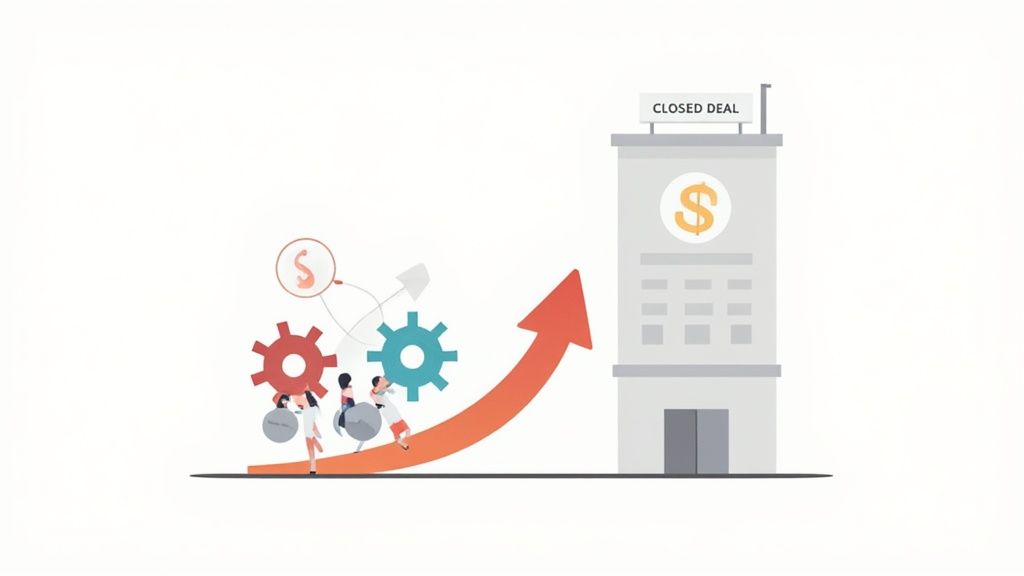
Most importantly, ABM helps you build rock-solid customer relationships. By treating target accounts like partners from the very beginning, you set the stage for superior customer lifetime value (LTV). You turn that first big win into a long-term, mutually beneficial partnership.
A Practical Example: From Frustration to Six-Figure Deals
Let’s make this real. Picture a B2B SaaS company desperate to land a major enterprise client. For months, they’ve been casting a wide net with generic ads, mass emails, and cold calls. Their message gets lost in the noise, never reaching the actual decision-makers. All they have to show for it is a flat pipeline and a frustrated team.
So, they pivot to an ABM strategy.
- Step 1: Research. They stop broadcasting and start listening. They dig in and identify the key stakeholders in the buying committee—the VP of Operations, the Head of IT, and the CFO. They learn their individual pain points and priorities.
- Step 2: Personalization. Armed with this insight, they create a bespoke demo. It’s not a one-size-fits-all pitch; it directly addresses the operational challenges they uncovered and includes a clear ROI projection just for the CFO.
- Step 3: Orchestration. Finally, marketing and sales coordinate their attack. Marketing runs hyper-targeted ads on LinkedIn aimed squarely at those key players, while the account executive reaches out with a personal message referencing the custom demo.
The result? Within weeks, they secure a high-level meeting. A few months later, they close a six-figure deal that their old spray-and-pray approach could never have touched.
The True Impact of ABM
This story gets to the heart of what ABM does. It forces a level of discipline and alignment that drives real business outcomes. You stop chasing vanity metrics like lead volume and start focusing on what truly matters: penetrating high-value accounts and generating revenue.
Impact Opportunity: The biggest win with ABM is the dramatic reduction of wasted effort. When you focus sales and marketing exclusively on accounts with the highest revenue potential, you get higher win rates, larger deals, and a more predictable pipeline—all while spending less on unqualified prospects.
This strategic alignment is the engine behind ABM’s success. When sales and marketing work from the same playbook, targeting the same accounts with a unified message, your entire go-to-market motion becomes exponentially more powerful. This collaboration is a non-negotiable for modern growth, especially as teams bring in advanced tactics like AI-powered lead generation to sharpen their targeting even further.
Key Takeaways
- Higher ROI: ABM delivers a far better return by cutting spend on poor-fit leads and doubling down on accounts that are actually likely to buy.
- Shorter Sales Cycles: Engaging the entire buying committee with personalized messaging from the start helps accelerate decisions and collapse the timeline from first touch to closed deal.
- Stronger Alignment: The strategy mandates a deep partnership between sales and marketing, forging a unified revenue team that’s simply more efficient and effective.
The Core Components of a Winning ABM Strategy
A powerful Account-Based Marketing program isn’t a single tactic—it's a complete system built on a few critical, interconnected pillars. Think of it like a high-performance engine. Every component has to be perfectly tuned and work in sync. If one part misfires, the whole machine sputters.
In the same way, a winning ABM strategy is built on three foundational components that flow into one another: picking the right accounts, creating truly personalized experiences, and orchestrating every touchpoint without a single misstep. Nailing these three is what separates a disjointed, random campaign from a predictable revenue engine.
Account Selection and Tiering
First things first: you have to decide who you're going after. This isn't about casting a wide net and hoping for the best. It's about using data to curate a hyper-selective list of your absolute best-fit future customers. The starting line for this entire process is a rock-solid understanding of your Ideal Customer Profile (ICP).
An ICP isn't a persona; it's a detailed blueprint of the perfect company for your solution, built on hard data that signals a great match.
- Firmographic Data: This is the basic stuff—industry, annual revenue, employee count, and where they're located. A cybersecurity firm, for example, might only target financial services companies with over 1,000 employees.
- Technographic Data: This is all about the tech stack they already use. If your software has a killer integration with a specific CRM, you can zero in on companies that already have it installed.
- Intent Data: This is where it gets powerful. Intent data tells you which companies are actively researching solutions like yours right now. These signals could be anything from downloading a whitepaper on a specific topic to visiting a competitor’s pricing page.
Once your TAL is in place, it’s time to tier it. Why? Because not all target accounts are created equal, and you can't treat them that way. Tiering is how you intelligently allocate your time, budget, and energy. It usually breaks down into three groups:
- Tier 1 (One-to-One): These are your crown jewels, the absolute must-win accounts. They get the white-glove treatment with deeply bespoke, one-to-one marketing and sales plays, like a custom-built demo or a highly personalized direct mailer.
- Tier 2 (One-to-Few): These accounts are grouped into small clusters based on a shared trait, like being in the same industry or facing a similar business challenge. They get personalized campaigns tailored to their specific cluster.
- Tier 3 (One-to-Many): This is your broadest tier. Here, you use technology to deliver light personalization at scale, making sure you can still reach a wider group of good-fit accounts without blowing your budget.
A critical part of getting this right is understanding exactly how well an account aligns with your ICP. This can be made much simpler by building a strong fit score directly within your CRM or marketing automation platform.
Personalized Engagement
With your accounts identified and tiered, the game shifts to creating messages and experiences that actually connect. Generic, one-size-fits-all content is the enemy of ABM. The whole point is to make each account feel like you’re talking directly to them—because you’ve actually done the homework.
And let's be clear: personalization is so much more than dropping a {first_name} token into an email. Real personalization means delivering genuine value by speaking directly to their specific business pains, their strategic goals, and the pressures they face in their industry.
For example, instead of sending a generic case study, you might create a "mini-ROI report" for a Tier 1 account, projecting the exact financial impact your solution could have on their business. This level of detail requires sales and marketing to be in lockstep, sharing intelligence to build compelling content for the entire buying committee.
Coordinated Orchestration
The final piece of the puzzle is orchestration. This is where you bring all your smart targeting and deep personalization to life through synchronized, multi-channel campaigns. Orchestration ensures that every single interaction a target account has with your brand—an ad, an email, a sales call—feels connected, intentional, and part of a single conversation.
Imagine your marketing team running hyper-targeted LinkedIn ads to key decision-makers at a target account. The moment engagement on those ads peaks, an account executive follows up with a perfectly timed, relevant message that references the very same pain points from the ad. That seamless handoff is the hallmark of great orchestration.
To pull this off, a well-defined CRM strategy is non-negotiable; it's the central nervous system for all your sales and marketing activity.
Proper orchestration stops "random acts of marketing" and creates a unified, guided buying journey. It demands a shared calendar, clear rules of engagement, and a tech stack that gives both sales and marketing full visibility into every account interaction. When you get it right, your outreach feels less like a sales pitch and more like a helpful, ongoing conversation.
Key Takeaways
- Start with Data: The foundation of ABM is a data-driven Target Account List (TAL) built from a clear Ideal Customer Profile (ICP).
- Tier Your Targets: Not all accounts are equal. Tiering your TAL (e.g., Tier 1, 2, 3) allows you to allocate resources effectively, saving high-touch efforts for the highest-value accounts.
- Orchestrate, Don't Annoy: Success depends on coordinating all sales and marketing touchpoints into a single, seamless conversation with the account.
How to Build Your ABM Playbook Step by Step
Knowing the theory behind account-based marketing is one thing. Actually putting it into practice is where most initiatives get stuck. To make ABM work, you need a structured plan—a playbook—that turns the buzzword into a repeatable system for generating revenue. This isn't about guesswork; it's about building a clear, step-by-step process that gets your entire team on the same page and focuses their energy where it counts.
This doesn't mean you have to flip a switch and overhaul the entire company overnight. The most successful ABM programs I’ve seen always start small. They launch a focused pilot, prove the model works, and then expand. This approach builds momentum, gets executive buy-in, and lets you fine-tune your strategy with real-world feedback.
This five-step process is the roadmap we use to launch winning ABM programs. The visual below breaks down the key stages, from getting your teams aligned to hitting the "launch" button.
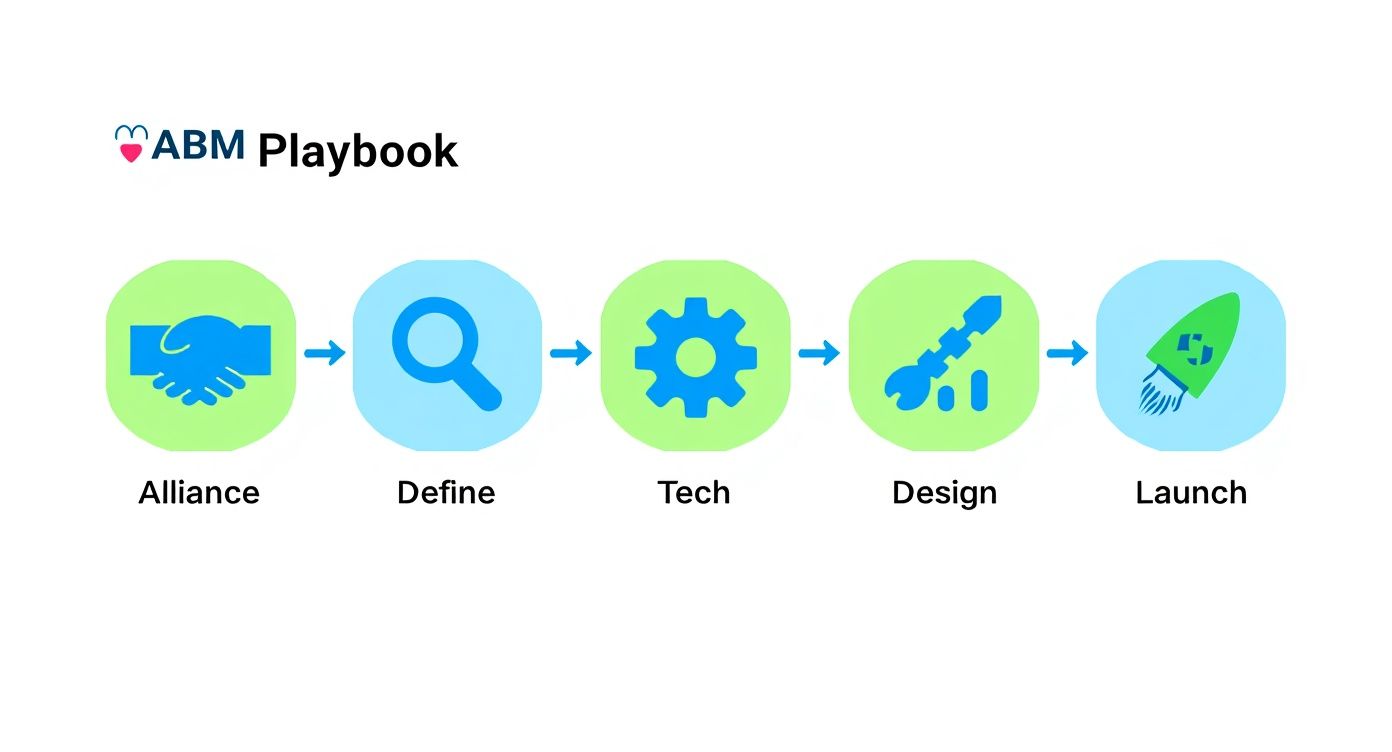
Think of this as a sequence. Each step builds on the last, ensuring every action you take is deliberate and connected.
Step 1: Forge a Sales and Marketing Alliance
Before you write a single email or launch one ad, you have to get sales and marketing completely aligned. This is the absolute, non-negotiable foundation of ABM. If you skip this, you’re setting yourself up for disjointed efforts, mixed messages, and a lot of wasted money.
The best way to lock in this partnership is with a shared Service Level Agreement (SLA). This isn't just some corporate formality; it's a contract that spells out roles, responsibilities, and what success looks like for both teams.
Your ABM SLA needs to clearly define:
- Shared Definitions: What exactly is a target account? What does a "Marketing Qualified Account" (MQA) look like? Get on the same page with your terminology.
- Engagement Rules: Who owns which channel? How will you coordinate outreach so you don't bombard an account from all sides?
- Success Metrics: What KPIs are both teams accountable for? This is where you shift the focus from lead volume to things that really matter, like account engagement and how fast deals are moving through the pipeline.
When this is done right, everyone is rowing in the same direction, working from the same list, with the same goal in mind.
Step 2: Define Your ICP and Target Account List
Now that your revenue team is united, it's time to get surgical about who you're targeting. It all starts with refining your Ideal Customer Profile (ICP). This should be a data-backed description of the companies that get the most value from what you sell. Don't guess. Dig into your firmographic, technographic, and intent data to build this profile.
Once your ICP is rock-solid, you build your Target Account List (TAL). This is your hand-picked list of high-value companies that are a perfect match. A rookie mistake here is making the list way too big. It's much, much better to start with a tight, manageable list of 20-50 accounts for your pilot program.
Impact Opportunity: A focused, data-driven TAL is the single biggest lever you can pull to improve marketing ROI. By concentrating your budget and effort on accounts that are most likely to buy, you eliminate waste and massively increase your odds of winning.
Step 3: Select Your ABM Technology Stack
Strategy always comes before tools, but let’s be real—you need the right technology to execute ABM at any kind of scale. Your tech stack doesn't have to be massive, but it does need to handle the core functions: targeting, engaging, and measuring your results.
A solid ABM stack usually includes:
- CRM: Your Customer Relationship Management platform (like HubSpot or Salesforce) acts as the single source of truth for all account and contact data.
- Marketing Automation: This is where you’ll orchestrate your email campaigns and track digital engagement.
- ABM Platform: Specialized tools like 6sense, Demandbase, or Terminus are fantastic for identifying in-market accounts with intent data and running targeted ad campaigns.
- Sales Engagement Tools: Platforms like Salesloft or Outreach help your reps execute coordinated outreach across multiple channels.
The goal is to build a stack that gives you a unified view of what's happening at an account and allows for seamless handoffs between teams. For a deeper look at creating strategic guides that integrate your strategy and tech, check out our resources on building effective playbooks.
Step 4: Design Your Campaigns
With the foundation in place, you can finally design the actual plays you’ll run to engage your target accounts. A tiered approach works best here, so you can align your effort with the value of the account. This ensures your most resource-intensive activities are saved for the biggest fish.
- One-to-One Plays: These are for your Tier 1, "crown jewel" accounts. We're talking highly bespoke campaigns that involve deep research and custom-made assets, like a personalized ROI report, a high-value direct mail gift, or even a custom workshop for their buying committee.
- One-to-Few Plays: For your Tier 2 accounts, you can group them into small clusters based on shared traits, like their industry or a specific challenge they're facing. Then, you can create personalized plays for each cluster, like a webinar that addresses their common pain points or an industry-specific case study.
This tiered model gives you the best of both worlds: deep personalization where it matters most, and scalability for the rest.
Step 5: Launch, Measure, and Optimize
The final step is to launch your pilot. But your work is far from over. ABM is all about iteration—you have to constantly monitor your results and optimize. Keep a close eye on your core metrics: account engagement, pipeline velocity, and win rates within your TAL.
Hold regular syncs with the sales team to talk about what’s working and what’s not. Is a certain message hitting home? Is a particular channel falling flat? Use these insights to make adjustments on the fly. This relentless cycle of launching, measuring, and optimizing is what separates a good ABM program from a great one, ultimately creating a predictable engine for B2B growth.
Measuring ABM Success With The Right Metrics
So, how do you prove your account-based marketing strategy is actually working? If you're still pointing to Marketing Qualified Leads (MQLs) as your North Star, you're looking at the wrong map.
ABM is a completely different game, and it demands a completely different scoreboard.
In the world of ABM, the individual lead is no longer the hero of the story. The entire account is. This means your focus has to shift from tracking individual actions, like a single form fill, to measuring account-level progress and—most importantly—revenue. It’s a move away from vanity metrics and toward real business outcomes.
Key Takeaway: Success in ABM isn't about lead volume. It’s about creating real, meaningful engagement within your highest-value target accounts, pushing them through the pipeline faster, and winning bigger deals. Your metrics have to reflect this account-centric reality.
To show the clear business impact, you need a new dashboard of KPIs. These metrics generally fall into three buckets that, together, tell the full story: initial engagement, pipeline acceleration, and cold, hard revenue.
Gauging Account Engagement
The first question your metrics need to answer is simple: "Are we getting the attention of the right people at the right companies?"
This is where engagement metrics come in. They’re the earliest signs that your strategy is cutting through the noise and connecting with your target account list. Instead of just looking at overall website traffic, you need to zero in on the traffic that truly matters.
- Target Account Coverage: What percentage of your target accounts has your marketing even reached? This shows the breadth of your initial outreach.
- Target Account Website Visits: How many of your named accounts are actually visiting your site? This is a direct measure of whether your targeted ads and content are bringing the right people to your digital doorstep.
- Engagement Minutes Per Account: How much time are key stakeholders from a single account spending with your content? Deeper engagement almost always signals higher interest.
These numbers prove that your efforts are hitting the mark and setting the stage for more valuable sales conversations.
Monitoring Sales Cycle Velocity
Once you have an account’s attention, the next question is, "Are we moving them forward effectively?"
Sales cycle velocity metrics track how quickly and efficiently your target accounts are progressing through the sales pipeline. This is where you can really see if your sales and marketing alignment is paying off. When ABM is working, you should see a noticeable speed-up in the sales process for your target accounts compared to everyone else.
- Pipeline Velocity: How fast are deals with target accounts moving from one stage to the next? A faster velocity means less friction and a more efficient sales engine.
- MQA to SQL Conversion Rate: For accounts that meet your "Marketing Qualified Account" criteria, how many actually convert into sales-accepted opportunities? This KPI is a direct gut-check on the quality of the engagement you're generating.
Faster cycles mean a quicker path to revenue and a more predictable forecast—a powerful story to tell any leadership team.
Measuring Direct Revenue Impact
Ultimately, every marketing strategy has to answer the most important question of all: "Did we drive revenue?"
Revenue impact metrics are the final proof point of your ABM program's success. They connect your team’s hard work directly to the bottom line, leaving no doubt about the ROI. This is where you can clearly demonstrate how focusing on the right accounts leads to better business outcomes.
- Win Rate for Target Accounts: What percentage of opportunities within your target list do you successfully close? A higher win rate here is one of the strongest signals that ABM is working.
- Average Deal Size: Are the deals you close with target accounts larger than your company average? ABM’s personalized approach often uncovers more opportunities within an account, leading to bigger contracts.
- Customer Lifetime Value (LTV): Do customers brought in through ABM stick around longer and spend more over time? This metric showcases the long-term value of acquiring your best-fit customers from the start.
Tracking these KPIs is essential for painting a complete picture of your ABM program's health. You need a mix of metrics that show not just what you're doing, but the tangible business growth you're driving.
Here’s a simple breakdown of the most critical KPIs to watch at each stage of the funnel.
Essential KPIs For Account Based Marketing
| Funnel Stage | Primary KPI | Description |
|---|---|---|
| Awareness | Target Account Coverage | The percentage of your target account list that has been exposed to your marketing activities. |
| Engagement | Website Visits from Target Accounts | The number of unique visitors from your target accounts landing on your website. |
| Engagement | Engagement Minutes Per Account | Total time key contacts from a target account spend interacting with your content and website. |
| Conversion | Marketing Qualified Accounts (MQAs) | The number of target accounts that meet predefined engagement and firmographic criteria. |
| Pipeline | MQA to SQL Conversion Rate | The percentage of MQAs that are accepted by sales and become Sales Qualified Leads or Opportunities. |
| Pipeline | Pipeline Velocity | The speed at which deals with target accounts move through the sales funnel, from creation to close. |
| Revenue | Win Rate for Target Accounts | The percentage of closed/won opportunities from your target account list. |
| Revenue | Average Deal Size | The average contract value for closed deals with target accounts versus non-target accounts. |
| Loyalty | Customer Lifetime Value (LTV) | The total revenue a business can expect from a single customer account acquired via ABM. |
By focusing on these metrics, you can move beyond simple lead counts and start having conversations about real business impact. This is how you prove the value of ABM to stakeholders and secure the resources to scale your efforts.
Common Questions About Account Based Marketing
Even the most buttoned-up strategies spark questions. As you shift from understanding the what of account-based marketing to the how, practical concerns are bound to pop up. This section cuts through the noise and tackles the most common questions we hear from B2B growth leaders, giving you clear, direct answers to build confidence in your ABM approach.
How Is ABM Different From Just Good B2B Marketing?
This is a great question, and the distinction is critical. Good B2B marketing is typically about casting a wide net. You build buyer personas, create content for those personas, and aim to generate a high volume of leads to fill the top of the funnel. It's a proven, effective model for broad-based demand generation.
Account-based marketing completely flips that script. It’s not about volume; it’s about precision. Instead of starting with a wide audience, you start by identifying a specific, hand-picked list of high-value accounts before a single marketing dollar is spent. From there, every ad, every piece of content, and every sales touchpoint is personalized for those specific companies and the key people within them.
The real difference is the starting point. Traditional marketing starts wide and narrows down. ABM starts with a hyper-focused list of target accounts and works to build deep, meaningful engagement within them.
Think of it this way: traditional marketing is like setting up a fantastic storefront to attract as many shoppers as possible. ABM is like being a personal shopper who already knows a few VIP clients, understands their exact needs, and curates a perfect experience just for them.
What Is a Realistic Budget for an ABM Program?
There’s no magic number here. An ABM budget depends entirely on the scale and ambition of your strategy. A "one-to-one" campaign targeting a handful of dream accounts will have a very different price tag than a "one-to-many" approach aimed at a few hundred.
However, any realistic budget needs to cover three core areas:
- Technology: This includes your CRM and marketing automation, plus a dedicated ABM platform for intent data and advertising, like 6sense or Demandbase.
- Content & Creative: High-impact personalization costs money. This could mean designing bespoke industry reports, sending high-end direct mailers to your top-tier accounts, or creating industry-specific content for broader segments.
- People: Never forget the cost of your team's time. This covers all the hours spent on research, campaign orchestration, sales coordination, and performance analysis.
A smart way to start is by running a pilot. Carve out 10-20% of your existing marketing budget and focus it on a small, manageable list of target accounts. This lets you prove the ROI and build a business case before you go all-in.
Can ABM Work for Small Businesses?
Absolutely. There's a big misconception that ABM is only for enterprises with huge budgets. While the flashy "one-to-one" campaigns with expensive gifts might be out of reach, a practical, focused ABM strategy is incredibly powerful for small and mid-sized businesses (SMBs). The key is to use a "one-to-few" or "one-to-many" approach.
- A Practical Example: A small SaaS company could identify its top 25 target accounts within a specific industry. Instead of sending luxury gifts, they could create a highly relevant webinar that solves a common pain point for that industry. Then, they run targeted LinkedIn ads to promote the webinar only to key decision-makers at those 25 companies and follow up with coordinated sales outreach referencing the webinar content.
This focused approach is a massive advantage for SMBs. By concentrating limited resources on a small list of best-fit accounts, you can compete head-on with larger companies. It’s not about outspending them; it’s about out-strategizing them. ABM levels the playing field by replacing brute-force budget with intelligence and focus.
Ready to stop wasting resources on the wrong leads and start focusing your efforts on your highest-value accounts? At Prometheus Agency, we help B2B leaders build scalable revenue systems powered by AI and a strategic, account-based approach. We integrate your technology, processes, and strategy to build a durable engine for growth.
Transform your go-to-market strategy. Schedule your complimentary Growth Audit and AI strategy session today.