You're in the executive review meeting. The CRM migration dashboard is green, every assigned training module is complete, and the implementation partner has declared success. Yet sales representatives still maintain shadow spreadsheets, managers don't trust the pipeline report, and revenue hasn't moved. The AI assistant is available, but employees use unsanctioned tools because the approved workflow adds friction.
This is the gap between technical deployment and operational adoption. Operational change management closes it by redesigning the way work gets done, then measuring whether people trust, use, and benefit from the new operating model.
Why Most Rollouts Stall Before the Software Goes Live
The problem usually appears before launch. Leaders approve a platform, project teams configure it, learning teams schedule training, and communications teams prepare announcement emails. Each group completes its deliverable. Nobody owns the harder question: what must change in roles, decisions, incentives, and daily workflows for the investment to create value?
That omission creates a familiar result. A CRM goes live, but sellers skip required stages. An AI tool is licensed, but employees don't know which decisions it can support or what information they can safely enter. A manufacturing system records production activity, but supervisors continue managing from local files. The software works. The operating model doesn't.
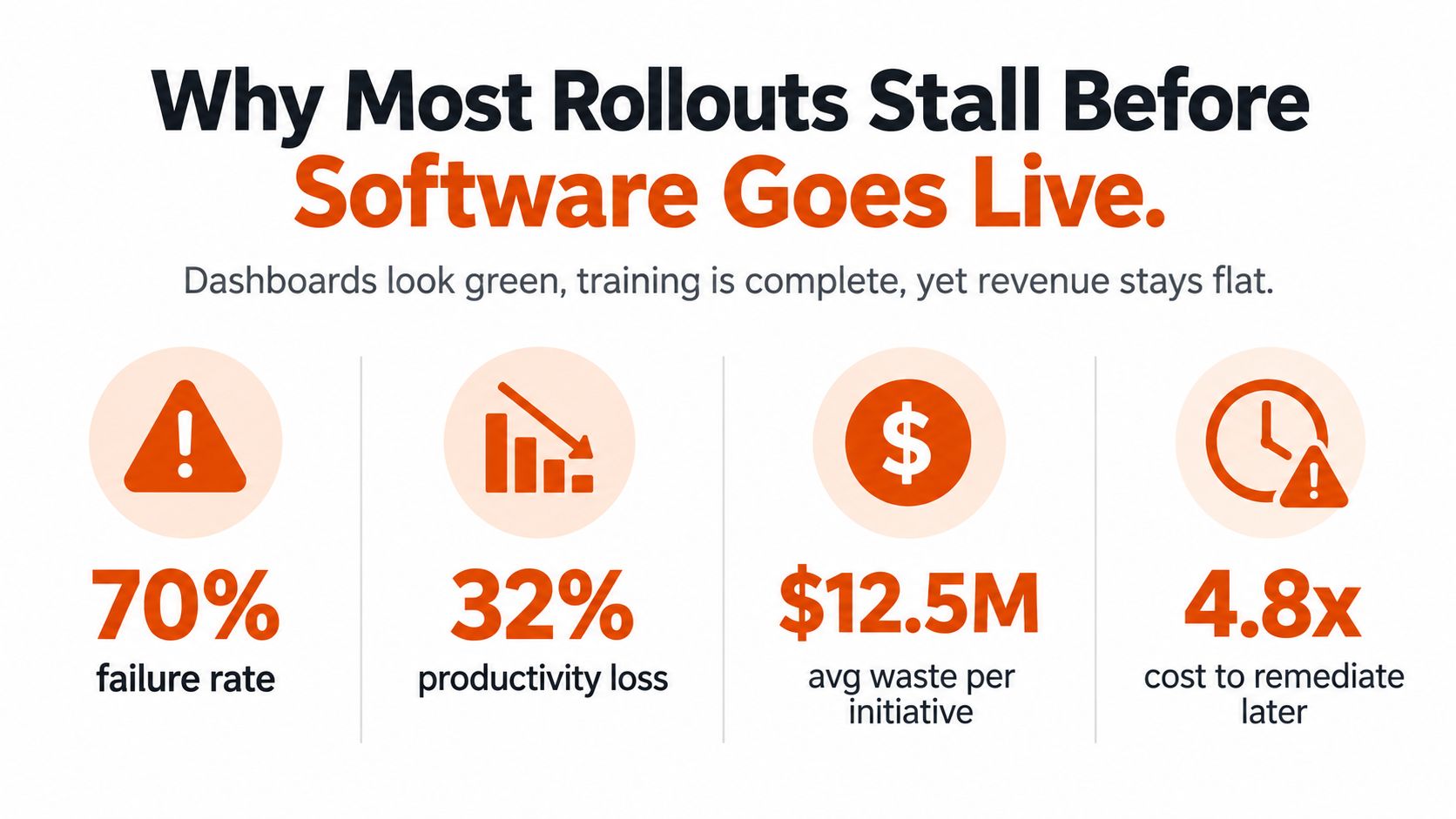
The widely repeated claim that 70% of organizational change initiatives fail is not a reliable universal benchmark. Mark Hughes' critical review of the 70% change failure claim found that none of the five commonly cited sources provided a valid, generalizable basis for that figure. The definitions of failure, samples, and origins varied too much to support a single percentage.
That finding matters because executives need a useful diagnosis, not a dramatic slogan. A rollout can fail financially, miss adoption targets, suffer schedule disruption, or produce short-lived behavior change. Those are different problems requiring different interventions.
Key takeaway: A green project dashboard proves that the project team completed tasks. It doesn't prove that the business changed.
Operational change management sits between project delivery and learning and development. Project management controls scope, budget, risks, and delivery. Training builds capability. Operational change management makes sure the new capability becomes the normal way work happens, with managers reinforcing it and dashboards exposing gaps. Before approving another rollout, review your last CRM migration checklist and ask whether it measured behavior after launch, not just readiness before it.
What Operational Change Management Actually Means
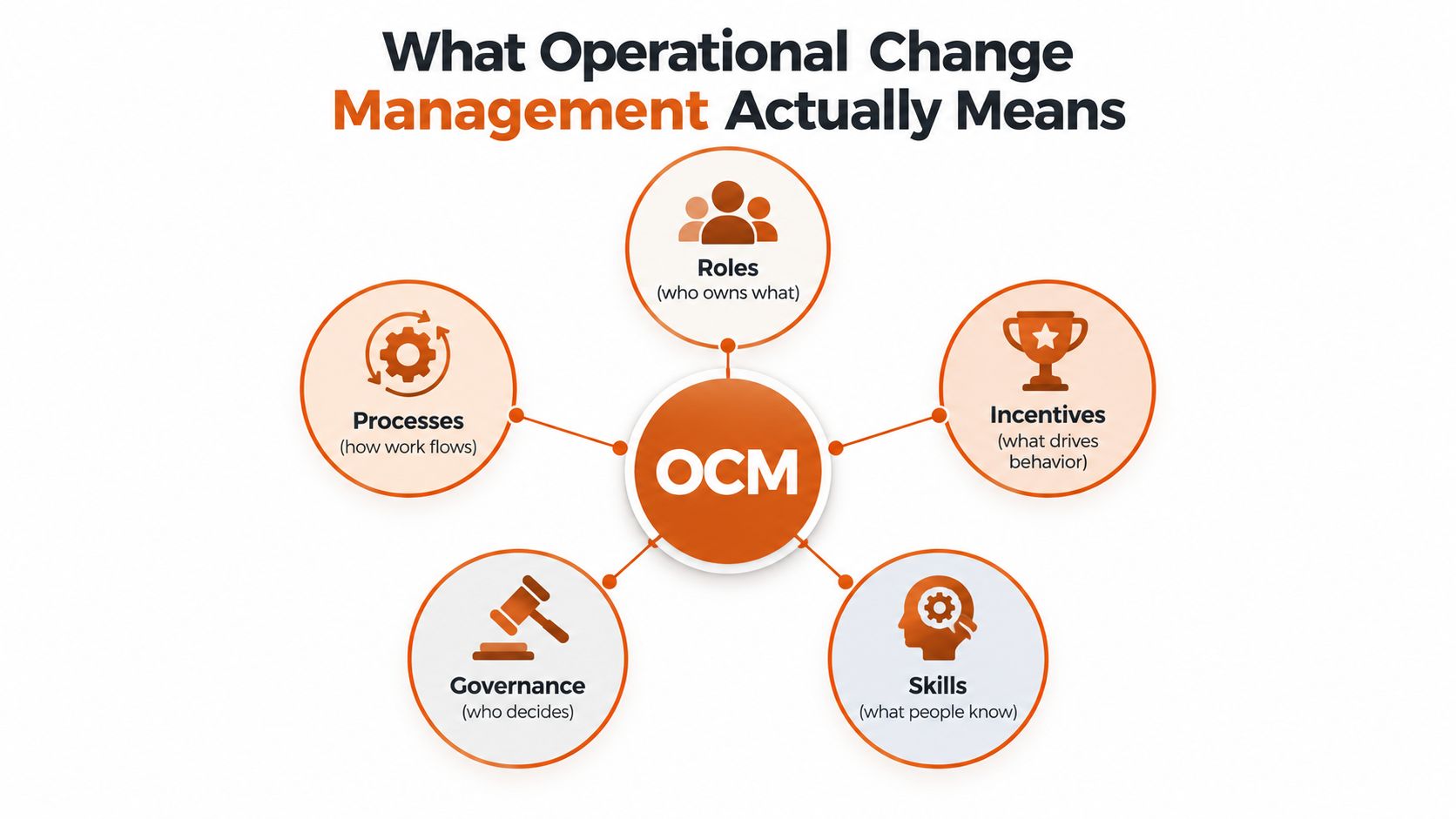
Operational change management is the disciplined redesign of an operating model so people can perform new work consistently and the organization can measure the resulting value. It covers five connected elements:
- Roles: Who owns each action, approval, exception, and outcome.
- Processes: How work moves from trigger to completion.
- Incentives: What makes the new behavior worthwhile or unavoidable.
- Governance: Who decides, who can change the design, and who resolves conflicts.
- Skills: What people must know and practice to perform effectively.
Think of an airline before takeoff. The aircraft may be serviced and the flight plan filed, but the crew still confirms responsibilities, procedures, contingencies, and communication. A system rollout needs the same operational briefing. The question isn't whether the tool is ready. It's whether every person involved understands what changes, who decides, what happens when the process breaks, and how leaders will know adoption is real.
Where the discipline begins and ends
Project management asks whether the new platform will be delivered. Organizational development asks how the organization builds long-term capability and culture. Learning and development asks whether employees can acquire specific skills. Technology adoption often tracks whether users activate or access a product.
Operational change management connects all four to business execution. It turns a desired future state into defined work, accountable owners, manager routines, feedback channels, and outcome measures. That makes it especially important for CRM, AI, and go-to-market initiatives, where technical completion can coexist with unchanged frontline behavior.
A workflow-level change might clean up CRM stages. An operating-model change creates a new revenue motion in which marketing, sales, customer success, and finance share definitions, decision rights, handoffs, and performance measures. Confusing those two levels is a common cause of stalled transformation. A stage label can change in an afternoon. A revenue motion changes how teams prioritize work, forecast, coach, and accept accountability.
The popular failure narrative also deserves scrutiny. A 2011 review by Mark Hughes found that none of the five sources commonly cited for the 70% claim supported a valid, generalizable conclusion, with inconsistent definitions and samples. Leaders should replace the slogan with initiative-specific baselines and success criteria. For a practical perspective on the commercial consequences, why GTM fails without change management is a useful companion resource.
Frameworks and Playbooks Worth Knowing
Frameworks help leaders structure difficult conversations, but none can substitute for ownership or evidence. Choose a framework based on the change you're making, then adapt it to the workflows and constraints people actually face.
Kotter's eight-step model works well when leaders need to mobilize an organization around a visible operating-model shift. Its emphasis on urgency, coalition building, communication, barrier removal, short-term wins, and reinforcement gives executives a strong sequence for enterprise programs. It can break down in AI rollouts when the work changes faster than the formal campaign, or when leaders mistake a compelling vision for role-level guidance.
ADKAR is useful for diagnosing individual adoption. Awareness, desire, knowledge, ability, and reinforcement help a manager identify whether an employee lacks context, motivation, practice, or follow-through. Its limitation is scope. A seller may understand a CRM workflow and still avoid it because compensation, manager inspection, or data quality makes the workflow impractical.
Prosci's methodology gives teams a structured approach to sponsorship, impact assessment, preparation, management, and reinforcement. It suits organizations building repeatable change capability across multiple initiatives. It becomes less effective when teams treat its artifacts as paperwork rather than using them to make decisions about process design, stakeholder risk, and adoption barriers.
McKinsey's 7-S framework is valuable when the change affects strategy, structure, systems, shared values, skills, style, and staff together. It exposes misalignment that a training plan will miss. It can feel too broad for a contained workflow change, and teams can spend too much time diagnosing the organization without assigning a concrete owner to fix the process.
Lean and Agile change approaches fit environments where teams need to test, learn, and adjust in short cycles. They are strong for AI experimentation, product-led process improvement, and phased CRM releases. They can fail when leaders use iteration as an excuse to avoid a target operating model, decision rights, or clear release criteria.
A practical selection matrix
| Framework | Best fit program type | Common limitation in CRM or AI rollouts |
|---|---|---|
| Kotter | Enterprise operating-model redesign | Can become a slow top-down campaign |
| ADKAR | Role-based adoption and individual barriers | Doesn't resolve broken incentives or process design |
| Prosci | Repeatable change portfolio management | Risks turning into template completion |
| McKinsey 7-S | Cross-functional organizational alignment | Can remain diagnostic without execution ownership |
| Lean and Agile | Iterative capability building and experimentation | Can lack durable governance and end-state clarity |
Pick one spine. Use ideas from other frameworks where they solve a specific problem, but don't make employees work across three methodologies at once. The operating team needs one language for decisions, escalation, reinforcement, and measurement.
Governance, Roles, and Decision Rights
Adoption isn't created by a RACI chart stored in a project folder. It emerges when named people make timely decisions, remove workflow friction, and inspect the behaviors the new operating model requires.
The executive sponsor owns the business case and removes cross-functional obstacles. The process owner defines the future workflow and accepts design tradeoffs. Local change agents translate the change into team language and surface friction early. The change management office coordinates impact assessment, communication, enablement, feedback, and measurement. Frontline managers reinforce the behavior in one-to-ones, team meetings, and operating reviews.
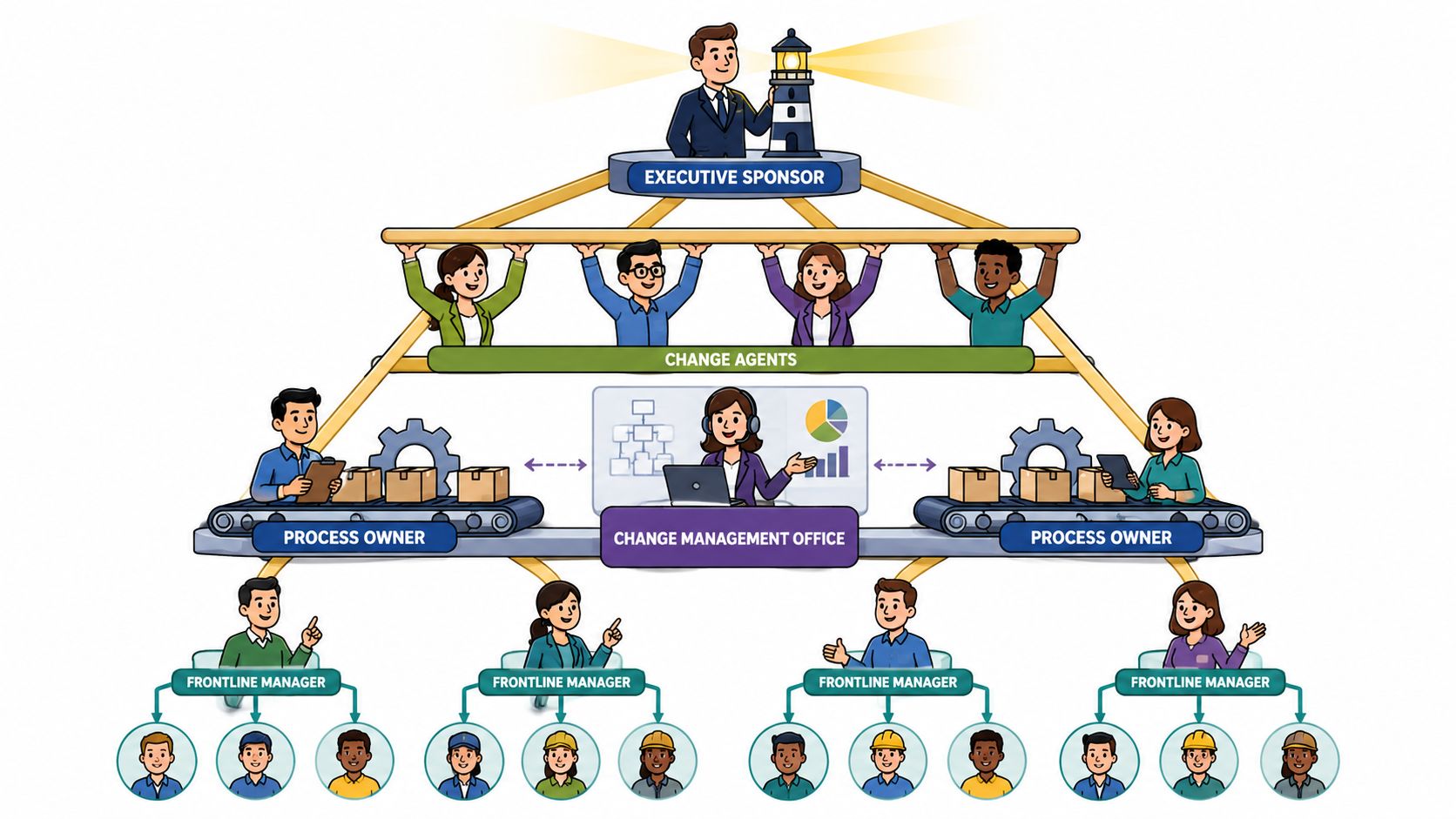
Staffing should match complexity, not organizational fashion. A 50-person company may need one accountable executive, a process owner, several trusted users, and managers who inspect adoption directly. A 500-person company needs a coordinated network with regional or functional change agents, a dedicated program lead, and a clear escalation path. A mid-market manufacturer may need plant-level champions, production supervisors, IT ownership, quality involvement, and a process owner who can balance standardization with local operating realities.
A study of 633 architecture, engineering, and construction change cases found that no single intervention reliably produced adoption. At least five change-management strategies had to work together, while local change agents and a realistic implementation timeframe were especially influential in very successful cases, according to the study of change strategies across 633 casesME.1943-5479.0001051).
Write decision rights before the kickoff
For every critical workflow, document:
- Decision owner: The person who makes the final call.
- Input owners: The people who must provide operational evidence.
- Escalation trigger: The condition that moves an issue upward.
- Resolution window: The time allowed before the issue threatens the release.
- Reversal rule: The evidence required to pause, redesign, or roll back.
A realistic implementation calendar sequences process design, manager preparation, role-based practice, pilot use, feedback, reinforcement, and performance review. A launch date alone creates theatre. If you need distributed implementation or specialized operational capacity, remote staffing services can support the staffing model, but accountability for adoption must remain with the business.
Measuring Adoption Without Fooling Yourself
Training completion is a readiness signal, not an adoption metric. A person can finish a course and return to the old spreadsheet before lunch.
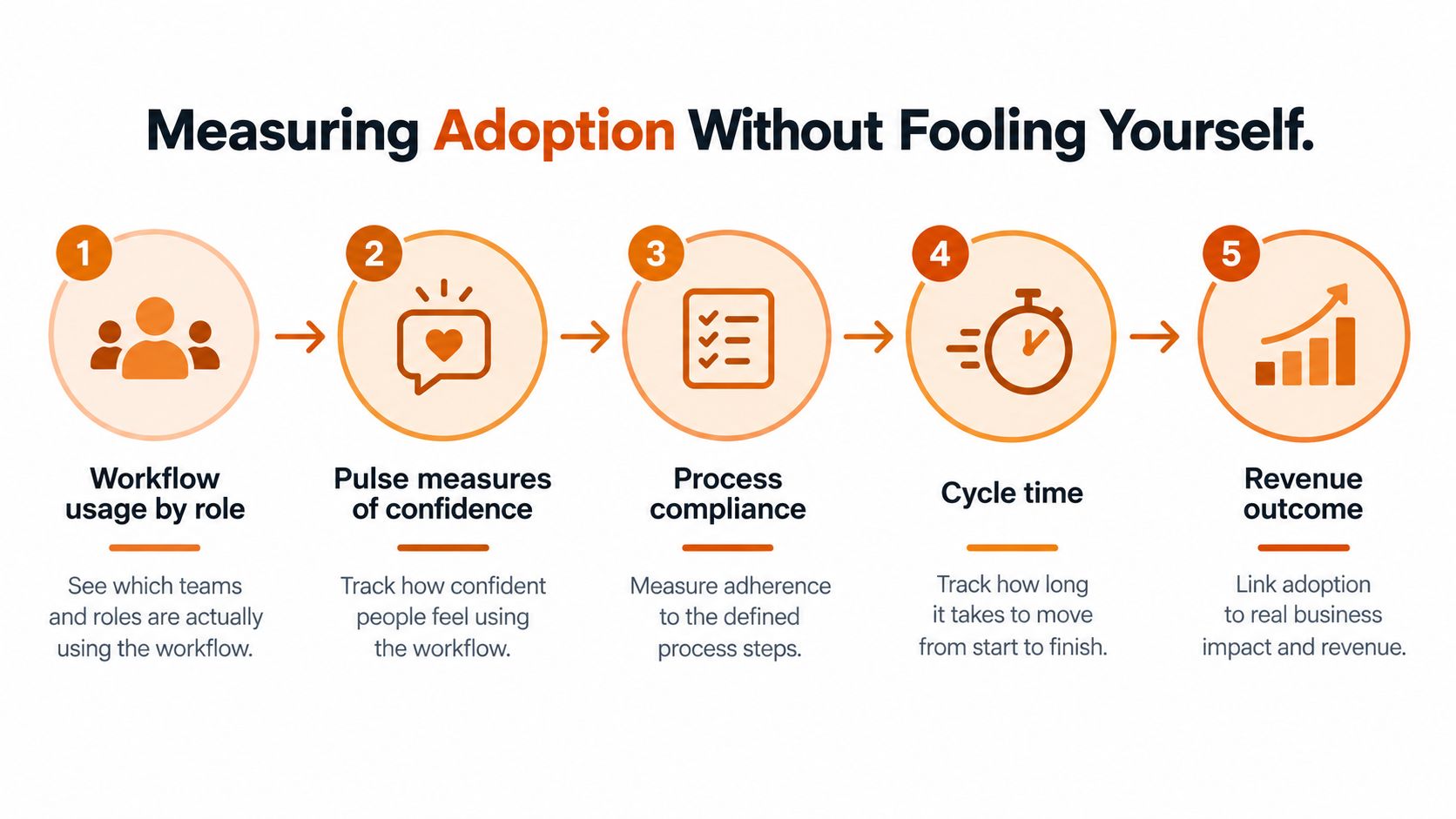
Build a measurement chain that moves from behavior to business value:
- Workflow usage by role and team: Are people using the required stage, assistant, approval, or production step?
- Confidence and trust: Do employees believe the workflow works and that leaders will respond to problems?
- Process compliance: Are the required fields, controls, handoffs, and decision rules being followed?
- Cycle time and quality: Is work moving faster, with fewer errors, exceptions, or rework?
- Revenue, cost, or customer outcome: Is the redesigned operation producing its intended result?
Gartner's 2025 HR research, based on a survey of more than 2,850 employees, found that only 32% of business leaders reported healthy employee change adoption, while 79% of employees reported low trust in change, as reported in Gartner's employee change adoption research. The gap points to a legitimacy problem. Leaders may believe communication is sufficient while employees experience an unworkable process, added workload, or unexplained risk.
Pair telemetry with a short weekly pulse. Ask whether employees understand the reason for the change, can complete the workflow, trust the data, and believe managers will address friction. Segment results by role, site, manager, and workflow. Aggregate averages hide the team where adoption is failing.
Practical rule: If your dashboard reports course completion but not sustained workflow use, it is measuring activity around the change, not the change itself.
For a CRM stage-gate rollout, track stage usage, required-field completion, manager inspection, sales-cycle movement, and forecast reliability. For an AI assistant, track approved workflow usage, human review, quality outcomes, time saved, and policy exceptions. For a manufacturing update, track process execution, defects, rework, throughput, and supervisor observations.
Use the first 30 days to find friction, the next 60 days to correct process and coaching gaps, and the next 90 days to connect behavior with business outcomes. A dashboard should help an executive decide what to change next, not merely report that the rollout happened.
Applying Change Management to CRM Rollouts
Consider two CRM programs with identical training materials. A SaaS company introduces a new lifecycle-stage model. A mid-market manufacturer replaces a spreadsheet pipeline with a shared CRM. Both teams attend demonstrations and complete exercises. Their outcomes diverge because the operating-model impact is different.
The SaaS company needs agreement on definitions, ownership, handoffs, routing, and manager inspection. Marketing and sales must decide when a lead becomes an opportunity, who can move a stage, and what evidence supports the change. The manufacturer needs a different design: data migration, account ownership, quoting workflow, field access, supervisor routines, and a practical replacement for the spreadsheet habits people rely on.
The CRM sequence that holds up
Start with the revenue process, not the software menu. Map the current workflow, identify failure points, clean the underlying records, define the future stages, and assign a process owner. Then pilot the workflow with a group that can expose friction without putting the entire revenue operation at risk.
Train managers before representatives. Managers determine whether the CRM becomes a coaching system or a passive database. Tie stage compliance and data quality to one-to-ones, forecast reviews, and pipeline conversations. If the dashboard contradicts what sellers see in the field, stop blaming users and investigate definitions, permissions, data quality, and process fit.
Common failure modes include:
- Orphaned records: Historical accounts or opportunities lack clear ownership.
- Ignored stages: Sellers bypass stages because the required evidence is unclear or the workflow slows them down.
- Untrusted dashboards: Leaders continue using private reports because the CRM data isn't complete.
- Manager inconsistency: Some teams inspect the new workflow while others permit workarounds.
- Unresolved exceptions: Edge cases accumulate until employees create shadow processes.
A synthesis of 298 qualitative organizational-change cases reported a 67% success rate and a 24% failure rate, with the remaining cases producing mixed or unclear conclusions. The review identified insufficient employee buy-in, weak awareness of implementation barriers, negative reactions, and ineffective communication as recurring factors, as documented in the meta-ethnographic synthesis of organizational-change cases. The lesson for CRM leaders is direct: adoption work must expose barriers before launch and give managers authority to resolve them.
Use this CRM implementation strategy as a planning reference, then build your own operating scorecard. A CRM is successful when teams use it to make better decisions and managers trust the resulting operating picture, not when the vendor marks the implementation complete.
Applying Change Management to AI Enablement
AI adoption is already happening inside most organizations. The executive choice isn't whether employees will experiment. It's whether leaders will govern that experimentation or force useful work into an unsafe shadow layer.
A workforce survey reported that nearly 9 in 10 employees use AI at work, while only 5% use it in advanced ways that transform their work. Across surveyed sectors, 23% to 58% reported bringing their own AI tools to work, according to EY's workforce research. Those figures point to an enablement problem, not just a licensing problem. Employees need approved use patterns, practical role guidance, data and privacy guardrails, and managers who can distinguish productive experimentation from unacceptable risk.
Govern the workflow, not just the tool
Before approving an AI pilot, executives should answer four questions:
- Which workflow is changing? Name the task, owner, trigger, and current bottleneck.
- Which decision will AI support? Separate drafting, classification, recommendation, and autonomous action.
- Which guardrails apply? Define approved data, review requirements, access controls, and escalation paths.
- Which value signal matters? Choose time saved, quality, cycle time, error reduction, or customer outcome before launch.
Training intensity should follow process criticality. Employees in high-risk customer, revenue, compliance, or production workflows need supervised practice, manager coaching, office hours, and feedback. Low-risk use cases can rely more heavily on self-service guidance.
The training evidence is striking. EY reported that employees receiving 81 or more hours of AI training annually saved 14 hours per week, compared with 3 hours per week among those receiving fewer than 4 hours. The same survey found 64% perceived workload increases and 38% feared job loss without replacement, as reported in the EY Work Reimagined survey. The point isn't that every employee needs the same training dosage. It's that enablement must be connected to work design, practice, and measurable outcomes.
A useful AI enablement framework should therefore include sanctioned experimentation, role redesign, manager coaching, review controls, and a measurement plan. Don't count activated licenses as value. Count the completed workflow, the quality of the result, the time saved, and the risk controlled.
Your Operating Rhythm for the First 90 Days
A rollout needs an operating rhythm, not a launch event. The first two weeks should establish the readiness baseline, map impacted roles and workflows, assign process owners, and write decision rights. Measure current usage, confidence, trust, process performance, and the business outcome the change is meant to improve.
During weeks three through six, prepare managers and local change agents before broad enablement. Pilot the critical workflow, instrument usage and compliance, collect weekly pulse feedback, and resolve friction through the governance path. Keep the release calendar realistic. If the process isn't workable in practice, more announcements won't rescue it.
In weeks seven through ten, reinforce the behavior through manager reviews, targeted coaching, office hours, and visible fixes. Compare teams rather than relying only on the average. A team with strong training completion but weak workflow usage needs a different intervention from a team with high usage but poor quality.
Use weeks eleven and twelve to formalize the operating model. Move adoption metrics into regular performance reviews, document exception handling, retire conflicting legacy practices, and connect workflow behavior to revenue, cost, customer, or production outcomes. The board should see an evidence trail from readiness to use, compliance, cycle time, and value capture.
McKinsey's survey of 750 employees and leaders found that organizational readiness accounted for 48% of the difference between leaders who reported capturing AI value and those who did not, compared with 25% for individual readiness, according to McKinsey's research on AI transformation readiness. That is the impact opportunity: invest in the organization around the tool, including workflows, governance, roles, incentives, and measurement.
Key takeaways:
- Start with the operating model: Define roles, processes, incentives, governance, and skills before configuring technology.
- Treat trust as operational data: Pair usage telemetry with employee pulse measures.
- Use coordinated interventions: Sponsorship, change agents, realistic timing, process redesign, and reinforcement must work together.
- Measure value separately from adoption: A used system can still produce poor outcomes, and a trained workforce can still avoid the workflow.
- Make managers accountable: They turn new behavior into a routine through inspection, coaching, and reinforcement.
Operational change management becomes credible when the next executive review can answer three questions: Are people using the new workflow, is the workflow improving performance, and what will leaders change when the evidence says it isn't working?
Prometheus Agency helps growth leaders connect CRM implementation, AI enablement, go-to-market strategy, adoption support, and performance dashboards to measurable operating outcomes. Visit Prometheus Agency to request a complimentary Growth Audit and AI strategy session for your next transformation.