If you want to boost your sales conversion rate, you need a plan. It's not about throwing a bunch of new tactics at the wall and seeing what sticks. It's about a focused, four-part strategy: nailing down your data, mastering lead quality, refining your sales process, and being smart about technology. This isn't a quick fix—it's how you build a predictable revenue engine.
Key Takeaways:
- Focus on Four Pillars: A successful strategy to improve sales conversion rate hinges on four core areas: data analysis, lead quality, sales process refinement, and strategic technology use.
- Data is the Foundation: You cannot improve what you don't measure. Establishing a clear, segmented baseline is the first step to identifying real opportunities.
- Quality Over Quantity: A high conversion rate starts with focusing sales efforts on high-intent, qualified leads, not just filling the top of the funnel.
- Process Creates Predictability: A well-defined, repeatable sales process removes guesswork, improves consistency, and makes growth scalable.
Why Your Sales Conversion Rate Is Your Most Critical Growth Metric
Your sales conversion rate is more than just a number on a dashboard. Think of it as the pulse of your entire revenue operation. It tells you exactly how efficient your go-to-market strategy is at turning interested people into actual paying customers.
When that rate is low, it’s a massive red flag. It points to friction somewhere in your process, wasted ad spend, and deals that are slipping through the cracks.
Practical Example: Boosting your conversion rate from 2% to 3% isn't a 1% lift—it's a 50% increase in revenue from the exact same marketing budget and lead volume. That’s why this metric is so powerful; it directly reflects the health of your sales process and how well marketing and sales are actually working together.
The Four Pillars of Conversion Improvement
To build a plan that actually works and scales, we're going to focus on four core pillars. Each one zeroes in on a critical part of the journey a buyer takes, from their very first interaction all the way to signing on the dotted line. This isn't just theory; it's a practical framework for finding the real problems and driving meaningful growth.
To give you a clearer picture, here’s a quick breakdown of these fundamental areas.
Core Pillars for Improving Sales Conversion Rate
| Pillar | Primary Goal | Key Performance Indicator (KPI) |
|---|---|---|
| Data-Driven Baselines | Establish a clear, accurate starting point to measure all future improvements. | Lead-to-Opportunity Conversion Rate |
| Lead Quality Mastery | Ensure the sales team is focused on high-intent prospects, not just any lead. | Marketing Qualified Lead (MQL) to Sales Qualified Lead (SQL) Rate |
| Sales Process Refinement | Create a repeatable, efficient process that guides buyers to a close. | Average Sales Cycle Length |
| Strategic Technology Use | Empower the sales team with tools that automate tasks and personalize outreach. | CRM Adoption Rate |
These pillars aren't independent silos; they work together. A refined sales process won't matter if your leads are terrible, and great leads can still get lost in a clunky, manual workflow. By tackling all four, you create a system where each part reinforces the others.
Impact Opportunity: A high sales conversion rate is the ultimate sign of a healthy business. It proves your product, marketing, and sales efforts are perfectly aligned to solve a real customer problem. That alignment is what leads directly to higher profits and predictable, scalable growth.
Establishing Your Baseline to Uncover Hidden Opportunities
Before you can fix your conversion rate, you have to know what it actually is. That sounds obvious, but a single, company-wide number often hides more than it reveals.
To really get a grip on performance, you have to move beyond averages and start segmenting your data. A healthy overall rate might be masking a marketing channel that’s bleeding money or a sales rep who’s struggling. On the flip side, a poor aggregate number could be hiding a goldmine lead source you should be doubling down on. The goal here is to stop guessing and start making decisions with cold, hard facts.
Defining and Tracking Your Core Conversion Points
Every sales process is different. For a B2B SaaS company, the journey might be from a demo request to a closed-won deal. For an e-commerce brand, it’s all about the path from "add-to-cart" to "purchase complete."
First things first: map out these critical stages. Pinpoint the specific, measurable actions a prospect takes as they move from a curious visitor to a paying customer.
You’ll want to track a few key micro-conversions, including:
- Lead to Opportunity Rate: What percentage of new leads are actually qualified enough to enter your active sales pipeline?
- Opportunity to Demo Rate: Of those qualified opps, how many get to a product demo or discovery call?
- Demo to Proposal Rate: After seeing your solution, how many prospects get a formal proposal?
- Proposal to Closed-Won Rate: What’s your final closing percentage on the deals you send out?
Tracking these smaller steps is like X-raying your sales funnel. A low lead-to-opportunity rate might point to weak lead quality from marketing. A big drop-off after the demo could signal a problem with your sales pitch or even your product-market fit.
The Power of Granular Segmentation
Once your core conversion points are defined, the real magic happens with segmentation. This is where you slice and dice your data to compare performance across different variables. A solid CRM is non-negotiable for this; it lets you build a dashboard that becomes your single source of truth.
Key Takeaway: Stop looking at one conversion rate for your whole business. Segmenting by lead source, campaign, sales rep, and product line is how you find your biggest growth opportunities and most urgent problems. This granular view is fundamental to any strategy for improving sales conversion rates.
Start by digging into these key segments:
- By Lead Source: Compare conversion rates from organic search, paid ads, referrals, and social media. You might find that while paid ads bring in volume, organic leads convert at double the rate—a clear sign to rethink your budget allocation.
- By Marketing Campaign: Did that webinar you ran last month generate leads that converted faster than the ones from your latest ebook? This tells you which marketing efforts deliver not just leads, but actual revenue.
- By Sales Representative: Breaking down conversion rates by individual reps quickly shows who’s crushing it and who might need a bit more coaching. It also helps you spot the best practices from your top performers that you can scale across the team.
Practical Example: A B2B software company was stuck with a 3% lead-to-close rate. By segmenting their data, they found that leads from their "Get a Quote" form converted at a whopping 12%, while leads from their "Download Whitepaper" campaign converted at a measly 0.5%. Armed with that insight, they shifted their ad spend to campaigns that drove high-intent quote requests. The result? They massively boosted their overall conversion rate without spending an extra dime. This is exactly how a deep dive into your funnel analytics can lead to smarter, more profitable decisions. For companies that need help setting this up, professional reporting and analytics services can turn that raw data into a clear roadmap for growth.
Impact Opportunity: Building this data-driven foundation has a huge ripple effect. It ends the "our leads are bad" vs. "your follow-up is slow" debates between sales and marketing by bringing objective data to the table. It clarifies where to invest your time and money for the highest return and gives you a clear benchmark to measure the success of every change you make. With a segmented baseline, you're no longer flying blind. You have a precise map showing you exactly where to focus your efforts to drive your sales conversion rate up.
Mastering Lead Qualification to Focus on High-Value Prospects
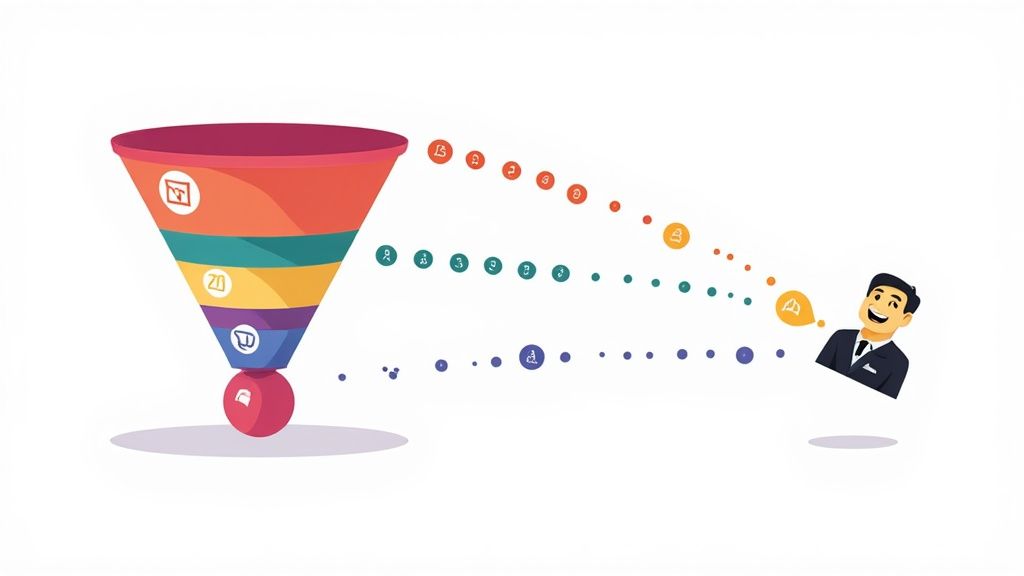
Let’s be honest: a low conversion rate is often a symptom of a much bigger problem. Your sales team is probably spending way too much time chasing leads that were never going to close in the first place.
When your reps are stuck on calls with window shoppers or prospects who just aren't a good fit, your real opportunities are slipping through the cracks. The fix? Get serious about lead qualification.
It's all about building a system that automatically filters the promising leads from the noise. This lets your team pour their energy into conversations that actually lead to revenue. Before you can do that, though, you need a rock-solid definition of what constitutes a qualified lead for your business. That definition is the bedrock of your entire strategy.
Building a Powerful Lead Scoring Model
A lead scoring model is your secret weapon for objectivity. It's a system that assigns points to leads based on who they are and what they do, effectively measuring how ready they are to buy. No more relying on gut feelings.
Think of it as a credit score for your prospects. A high score flags a lead as a high-value target, telling your reps exactly where to focus their attention first. It’s how you make sure your closers are always working the hottest deals.
Key Takeaway: A well-designed lead scoring model stops your team from wasting time on low-quality leads. By assigning points for specific actions and demographic traits, you can automatically identify and prioritize the prospects most likely to buy, directly impacting your sales conversion rate.
For instance, a prospect who hits your pricing page is sending a much stronger buying signal than someone who downloaded a top-of-funnel eBook. Your scoring model needs to reflect that.
- Behavioral Scoring: This is all about tracking engagement. Are they opening your emails, showing up for webinars, or visiting your site over and over? Those are green flags.
- Demographic Scoring: This side of the equation checks how well a lead fits your ideal customer profile (ICP). You're looking at things like job title, company size, industry, and location.
Practical Scoring Criteria Examples
To build your model, you need to decide which actions and attributes actually matter. Let’s walk through a quick example for a B2B SaaS company to make this tangible.
| Criteria Type | Action or Attribute | Assigned Points | Rationale |
|---|---|---|---|
| High-Intent Behavior | Submitted "Request a Demo" Form | +50 | This is a direct hand-raise. They want to talk to sales. |
| High-Intent Behavior | Visited Pricing Page | +25 | Shows they're evaluating cost and seriously considering your solution. |
| Mid-Intent Behavior | Attended a Product Webinar | +15 | They've invested time to learn, signaling active interest. |
| Firmographic Fit | Company Size (50-250 Employees) | +20 | This prospect fits right in your sweet spot for customer success. |
| Low-Intent Behavior | Downloaded a Whitepaper | +5 | A good start, but they're likely still in the research phase. |
This tiered system ensures that leads showing real buying intent get pushed to the front of the line, right where they belong.
Automating Lead Routing for Maximum Speed
Once you’re scoring leads, you have to act fast. Research has shown that responding to a lead within five minutes can boost your conversion odds by 9x.
This is where automated routing rules in your CRM become non-negotiable. You can set up workflows to instantly assign high-scoring leads to the right person on your team.
- Create a Threshold: First, define the score that officially makes a lead "sales-ready," or a Marketing Qualified Lead (MQL). A common starting point is 75 points.
- Set Up Routing Rules: As soon as a lead hits that 75-point mark, your CRM should automatically route it. You can assign based on territory, industry expertise, or a simple round-robin to keep things fair.
Automating the handoff cuts out the manual lag time that kills deals. Hot leads don't go cold in someone's inbox, and your top performers stay busy closing. Once this is running smoothly, you can explore more advanced AI-powered lead generation tactics to fill the top of your funnel even faster.
Impact Opportunity: Putting a solid lead qualification and routing system in place is a game-changer. Your sales team stops being a filter for bad leads and becomes a closing machine focused exclusively on high-probability opportunities. You'll see your conversion rate climb, but you'll also see team morale skyrocket. It makes your entire revenue engine stronger, more predictable, and way more efficient.
Personalization and Automation: Guiding the Buyer Journey
Once a prospect is qualified, the clock starts. The game is no longer just about selling; it's about delivering a buying experience that feels like it was built just for them. A generic sales pitch is a fast track to a dead deal.
Prospects today expect you to know their business, understand their pain points, and anticipate their needs—all before the first call even happens. This is where a smart mix of personalization and automation becomes your secret weapon for lifting that sales conversion rate.
The goal isn't to replace your sales team with bots. It’s about letting technology handle the repetitive, time-consuming tasks so your reps can do what they do best: build real human connections. Good automation works quietly in the background, making personalization consistent and scalable.
Key Takeaway: Personalization at scale isn't an oxymoron; it's a modern sales necessity. When you use CRM data to automate customized outreach and follow-ups, every prospect feels seen and understood. This directly boosts engagement and accelerates deals by proving you’ve done your homework from the start.
Turning CRM Data into True Personalization
Your CRM is a goldmine, but most teams are only scratching the surface. Every data point—from the pages a prospect visited on your site to their job title and industry—is a clue. It’s time to stop thinking of your CRM as a digital filing cabinet and start treating it like an intelligence engine.
Here are a few practical examples of how to put that data to work:
- Customized Email Outreach: Ditch the generic "just checking in" emails. If you know a prospect is in the logistics industry, send them a case study from a similar company. If they downloaded a whitepaper on supply chain efficiency, your follow-up should reference it and offer deeper insights.
- Tailored Product Demos: Before you jump on a demo, review their activity. Did they spend five minutes on the pricing page for a specific feature? Make that feature the star of the show.
- Smart Follow-Up Sequences: Use triggers to automate intelligent follow-ups. For example, if a prospect in manufacturing opens your email but doesn’t click, the next automated step could be sending a short video testimonial from another manufacturing client.
To really dial in your automated and personalized communication, it pays to explore specialized tools. A curated list of Top Email Outreach Tools for High-ROI Campaigns can give you options that plug right into your CRM, making this whole process a lot smoother.
Bringing AI into the Sales Process
Artificial intelligence isn't some futuristic concept anymore; it's a practical tool that can seriously supercharge your sales efforts. AI can crunch massive amounts of data to spot patterns and suggest actions that a human might easily miss, making your outreach smarter and far more effective.
Practical Example: AI-powered tools can analyze sales call transcripts to pinpoint common objections or highlight moments where a prospect's sentiment turned positive. That data is pure gold. You can use it to refine your sales scripts, provide hyper-targeted coaching to your reps, and make sure your team is consistently hitting the right notes.
Impact Opportunity: A powerful use case for AI is letting it recommend the perfect piece of content at the perfect time. Imagine your CRM automatically suggesting the ideal case study to send a prospect based on their industry, company size, and the specific pain points they brought up on a discovery call. That kind of timely, relevant support can be the one thing that turns a stalled deal into a closed one.
Optimizing for the Modern Buyer
The way people buy has fundamentally changed. A huge chunk of their research and evaluation now happens on a phone. A clunky, slow mobile experience creates instant friction and sends a clear message: you don't care about their time. This is obviously critical in e-commerce, but it’s just as true for B2B—decision-makers are reviewing emails and proposals on the go all the time.
While the global average e-commerce conversion rate hovers around 2.5% to 3%, businesses that obsess over their mobile experience often see a significant lift. A crucial first step is to audit your mobile site speed. Google's data is unforgiving: 53% of visitors will bail if a page takes longer than three seconds to load.
Ultimately, a winning strategy marries technology with a deep, empathetic understanding of your customer. By automating the mundane and personalizing the meaningful, you create a seamless and compelling buyer journey. You won't just improve your sales conversion rate—you'll build stronger, more loyal customer relationships that last.
Refining Your Sales Process for Predictable Growth
A high-performing sales team runs on a well-defined process, not guesswork. Think about it: without a roadmap, every rep is just winging it. That leads to inconsistent results, deals that go cold for no reason, and a forecast that feels more like a lottery ticket than a business plan.
Refining your sales process is all about creating a repeatable blueprint for success. It’s about mapping out each step your buyer takes and defining the exact actions your team needs to follow to guide them. This structure doesn't just help your reps—it gives you a clear framework for improving your entire sales motion.
The whole thing starts with good data, which you then use to make your outreach personal before scaling it up with automation.
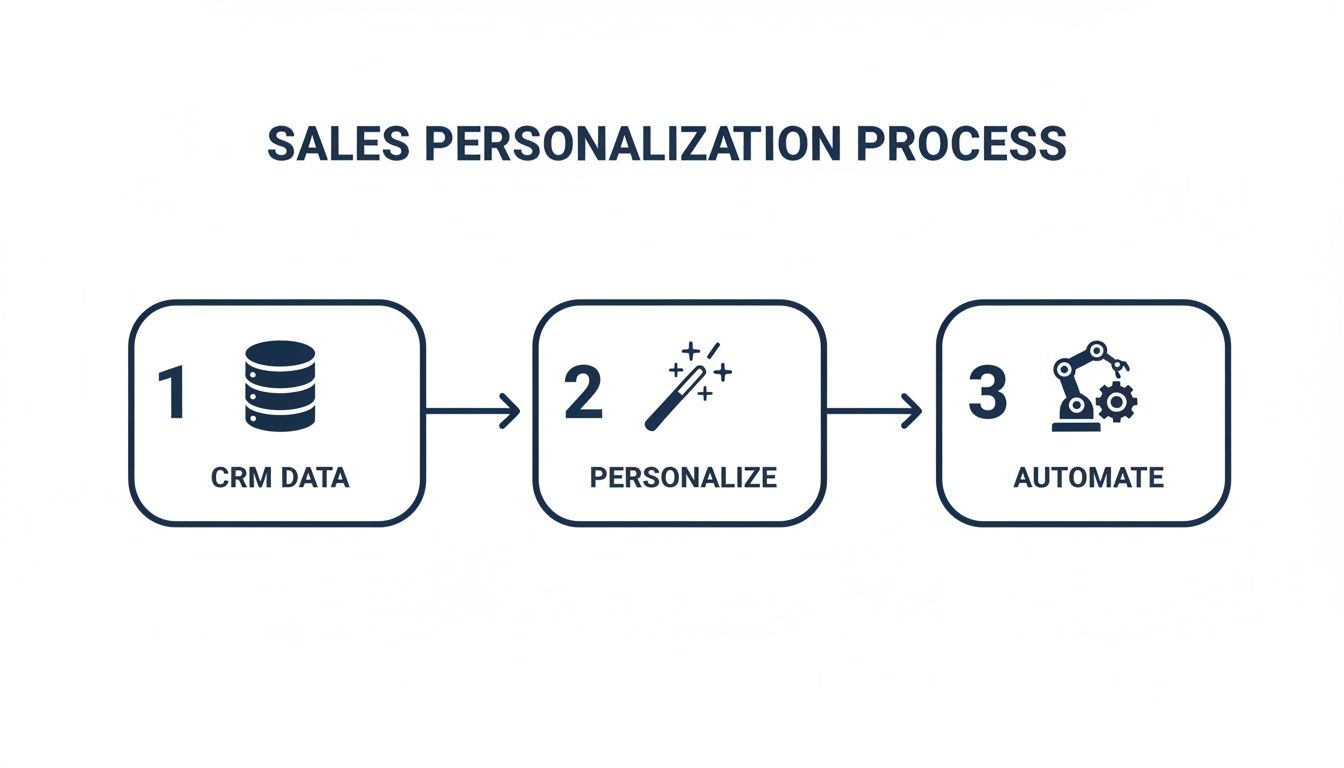
It’s a simple flow, but it's the foundation of effective sales execution.
Mapping Your Sales Stages to the Buyer Journey
Here’s where most companies get it wrong: they build their sales process around their own internal needs. The best processes are built from the outside in, mirroring the steps your ideal customer actually takes when they decide to buy something.
When your process lines up with their journey, you eliminate friction and build momentum naturally.
Start by thinking through the typical phases a buyer goes through:
- Awareness: The moment a prospect realizes they have a problem or a need.
- Consideration: They start digging in, researching potential ways to solve that problem.
- Decision: They’re narrowing down their options and are ready to pick a vendor.
With that in mind, you can design sales stages that actually make sense. The following table provides a practical example for a B2B software company:
| Buyer's Journey Stage | Corresponding Sales Stage | Key Rep Activity | Exit Criteria for Stage |
|---|---|---|---|
| Awareness | Discovery | Initial call to dig into their pain points. | We've confirmed their problem is one we can solve. |
| Consideration | Solution Demo | Show them exactly how the product solves their specific pain. | They agree that our solution is a strong fit for their needs. |
| Decision | Proposal & Negotiation | Send a detailed quote and handle any final questions. | We have a verbal "yes" to move forward. |
This alignment ensures your team is always on the same page as the buyer, delivering the right information at just the right time.
Building Your Sales Enablement Toolkit
A documented process is just a piece of paper without the right tools to bring it to life. This is where sales enablement comes in—equipping your reps with the content, training, and resources they need to win at every stage.
Key Takeaway: A well-defined sales process is the backbone of a predictable revenue engine. By mapping your sales stages to the buyer's journey and equipping your team with practical enablement tools like battle cards and demo scripts, you create a consistent experience that guides prospects to a close more efficiently.
Start by putting together a core toolkit that tackles the most common hurdles your team faces. Here are some practical examples:
- Objection-Handling Battle Cards: For every common pushback ("It's too expensive," "We're happy with our current vendor"), create a one-pager. It should validate their concern, offer a sharp counterpoint focused on value, and back it up with a real customer story.
- Standardized Demo Scripts: Demos should always feel personal, but a core script ensures no one forgets to hit the critical value props. Think of it as a flexible framework, not a rigid monologue, that reps can adapt based on what they learned in discovery.
- Email Templates for Each Stage: Build out customizable email templates for key moments, like the post-demo follow-up or when you send over a proposal. It saves a ton of time and keeps communication professional and consistent across the board.
Impact Opportunity: Putting a structured sales process and enablement toolkit in place is a game-changer. Reps suddenly feel more confident and prepared, which leads to much better conversations and higher close rates. It also makes onboarding new hires 69% faster because they have a clear playbook from day one. For sales leaders, it provides a concrete way to coach the team. You can pinpoint exactly where deals are stalling and jump in with targeted support. A clear process is fundamental to understanding what a CRM system really does for your sales team, because it gives the software a defined workflow to track and optimize. This approach turns random sales activities into a predictable system for growth.
Building a Culture of Continuous Sales Improvement
Boosting your sales conversion rate isn't a one-and-done project. It's a discipline. The best sales organizations treat optimization as a core part of their culture. They build systems for constant learning and experimentation, which ensures they’re always adapting and sharpening their edge.
This is all about moving past gut feelings and embracing a data-driven mindset to see what actually works. It's about creating a tight feedback loop where insights from reps on the front lines are captured, tested, and then rolled out to the entire team. This is how small, incremental wins stack up into significant, long-term gains.
Fostering a Test-and-Learn Mentality
A culture of improvement really takes root when you start experimenting. You have to give your team the green light to run simple, effective A/B tests on every part of their process. This creates an environment where reps are actively hunting for small advantages that can compound over time.
Here are some practical examples of variables you can test:
- Email Subject Lines: Does a question-based subject line outperform a statement? Pit "Quick question about your Q4 goals?" against something like "Idea for your Q4 goals" and see what gets more opens.
- Voicemail Scripts: Try comparing a script that teases value versus one that directly asks for a callback. Track which one generates more returned calls over a 30-day period.
- Pricing Presentations: Test two different ways of walking a prospect through your pricing. Maybe one version leads with the ROI and total value, while the other breaks down features and their associated costs.
Key Takeaway: Continuous improvement is a mindset, not a task. By consistently A/B testing small variables like email subject lines or call scripts, you create a powerful system for identifying what works and scaling those winning tactics across the entire sales team.
Analyzing Results and Scaling Wins
Of course, running tests is only half the battle. You need a solid process for analyzing the results and, more importantly, acting on what you find. When a test reveals a clear winner—say, that question-based subject line increases open rates by 15%—the next move is to scale that learning.
This means documenting the new best practice and updating your sales enablement materials. Share the results in the next team huddle, explain why it works, and get those email templates updated. This simple step ensures that one rep's successful experiment benefits everyone, effectively raising the performance floor for the entire team.
Impact Opportunity: Creating this feedback loop has a massive effect on your overall sales conversion rate. It compounds knowledge, keeps reps from repeating the same mistakes, and ensures best practices are shared and adopted fast. This system transforms your sales team from a group of individuals into a cohesive, learning organization that consistently refines its approach to winning deals.
Common Questions About Boosting Sales Conversion
When you start digging into a conversion rate project, a lot of practical questions pop up. Let's tackle the most common ones we hear from teams as they move from strategy to real-world action.
What’s a Good Sales Conversion Rate for My Industry?
This is always the first question, and the honest answer is: it depends. There’s no magic number that works for everyone. What’s considered "good" is completely tied to your industry, how long your sales cycle is, and your average deal size.
Practical Example: A high-volume SaaS product with a low monthly price might be thrilled with a 5-10% trial-to-paid conversion rate. But an enterprise software company with a six-figure price tag and a six-month sales cycle? They might be celebrating a 20-25% conversion rate from qualified opportunity to closed-won.
The real key is to benchmark against your own historical performance first. Use industry averages for a bit of context, but don't treat them as the ultimate goal.
How Long Until We See Real Improvements?
The timeline for seeing a jump in your sales conversion rate really hinges on the kinds of changes you're making.
- Quick Wins (2-4 Weeks): Simple tweaks can deliver fast results. Think A/B testing email subject lines, polishing a call script, or adding a better CTA to your website. You can often see the impact in less than a month.
- Process Changes (1-3 Months): Rolling out something bigger, like a new lead scoring model or redefining your sales stages, takes more time. You need a few months for the team to adopt the changes and for enough data to come in to show a clear impact.
- Strategic Shifts (6+ Months): A total overhaul of your sales process or putting in a new CRM is a long-term play. It's a significant investment, but it's what drives major, lasting improvements over time.
Key Takeaway: Aim for a mix of short-term tests and long-term strategic improvements. The quick wins build momentum and get everyone excited, which helps secure the buy-in you need for the bigger projects that truly change the game.
What Are the Must-Have Tools for Improving Sales Conversion?
While there’s a whole universe of sales tools out there, a few are absolutely essential if you're serious about this.
- A Solid CRM (Customer Relationship Management): This is non-negotiable. Your CRM is the single source of truth for every piece of data about your leads, pipeline, and customers.
- A Sales Automation Platform: Tools that handle automated email sequences, scheduling, and activity logging are a lifesaver. They free up your reps from busywork so they can actually focus on selling.
- Analytics and Reporting Software: You can't improve what you don't measure. This is how you track your KPIs, slice and dice the data, and see if your changes are actually working.
If you have to start somewhere, start with a great CRM. It’s the data foundation that makes every other tool and strategy work.
Ready to turn your sales process into a predictable revenue system? At Prometheus Agency, we partner with growth leaders to implement the technology and strategies that drive real results. Start with a complimentary Growth Audit and AI strategy session to uncover your biggest opportunities.
Find out how we can help you improve your sales conversion rate.