Learning how to automate your business isn't a single event—it's a deliberate, four-part discipline. You start by identifying the repetitive grind, selecting the right tech (like a CRM or AI), implementing it in smart phases, and then measuring the hell out of it to see what's working. This isn't just about tweaking a process; it's a strategic shift away from manual drag and toward intelligent workflows that let your team actually focus on growth.
Key Takeaways
- Identify First: Before buying software, pinpoint the repetitive, rule-based tasks that consume the most time and create the most friction.
- Start Small: Implement automation in controlled phases, beginning with a pilot program to prove value and build momentum.
- enable People: Frame automation as a tool to eliminate tedious work, freeing up your team for high-value strategic tasks, not replacing jobs.
- Measure Everything: Track specific KPIs like cycle time reduction and error rate to prove ROI and build the case for scaling your efforts.
From Manual Tasks to Automated Workflows
Getting away from manual processes is no longer a "nice-to-have" for any business with ambition. It's a fundamental requirement. The pressure to do more with less is relentless, and every hour your team spends on mind-numbing data entry, chasing down approvals, or updating spreadsheets is an hour stolen from strategy and innovation.
Business process automation (BPA) is how you reclaim that time. It's about building systems that handle the grunt work so your people can do what they do best: solve complex problems, create, and build relationships.
The goal isn't just speed. It's about building an operation that's more resilient, accurate, and ready to scale. Once a process is automated, it runs the same way, every single time. That consistency slashes the human errors that cause expensive headaches in finance, sales, or customer support.
The Growing Momentum Behind Automation
This isn't just a trend; it's a market in hyperdrive. The global business process automation market hit $14.87 billion in 2024 and is on track to reach $16.46 billion by 2025, largely thanks to breakthroughs in AI and machine learning. These aren't just simple, rule-based bots anymore; we're talking about intelligent workflows that can learn and adapt on the fly.
For any leader paying attention, this is a massive opportunity. Before diving in, it's worth getting the fundamentals right. This guide on What is Workflow Automation? is a great primer—it lays a solid foundation for everything that comes next.
To give you a clear, high-level view of what this playbook covers, here's a quick-start framework. Think of it as your roadmap for turning theory into action.
| Your Automation Quick-Start Framework |
|---|
| Core Principle |
| Pinpoint High-Impact Drudgery: Don't automate for the sake of it. Find the repetitive, low-value tasks holding your team hostage. |
| Start Small, Win Fast: Choose quick wins to build momentum. Focus on simple, rule-based processes before tackling complex ones. |
| Measure What Matters: Track specific KPIs from day one. If you can't measure it, you can't prove its value. |
| enable, Don't Replace: The goal is to free up human talent for strategic work, not to eliminate headcount. |
This framework is the backbone of a successful automation strategy. It keeps you focused on real business outcomes instead of getting lost in the tech.
The Impact Opportunity and Key Takeaways
Impact Opportunity: The real payoff from automation goes way beyond just saving a few hours. It has a direct line to your bottom line, your team's morale, and your customers' happiness. When you systemize the routine stuff, you create a predictable engine for growth, freeing up cash and people to pour into the things that truly move the needle.
Key Takeaways:
- Strategic Focus: This isn't about replacing people. It's about reassigning their brainpower to the kind of strategic work that actually drives revenue and creates new ideas.
- Error Reduction: Automated systems don't have bad days. They eliminate the costly human mistakes that sneak into invoicing, data management, and customer onboarding.
- Scalability: A well-automated business can handle a spike in volume without having to throw more bodies at the problem. You can grow without your operational costs growing in lockstep.
Finding Your Best Automation Opportunities
Jumping into automation software without a clear target is like buying a solution for a problem you haven’t defined yet. I’ve seen it happen time and again. The most successful initiatives always start with a deliberate hunt for the right opportunities—those bottlenecks and mind-numbing repetitive tasks that are quietly killing productivity and morale.
This discovery phase is where you build your business case. It's how you ensure your efforts will deliver a return people can actually see and feel.
The first move? Get out of the boardroom and see how work really gets done. Talk to the people on the front lines in finance, sales, and HR. What are the manual tasks they absolutely dread? Where are they constantly chasing people down for approvals or information? Their answers are your treasure map, pointing directly to the best places to start.
Practical Example: Shadowing an employee for a few hours can be incredibly revealing. You might find a sales coordinator who spends two hours every single day manually copying lead data from a web form into your CRM. That’s a classic, high-value automation candidate staring you right in the face.
Uncovering Hidden Inefficiencies
Beyond direct observation, your existing systems are dropping clues all over the place. Digging into your support tickets, for example, might reveal the same simple questions coming up over and over. An automated chatbot or a smart knowledge base workflow could handle those in a heartbeat, freeing up your support team for the complex issues that actually require a human brain.
Mapping a workflow from start to finish is another powerful move. Take employee onboarding. When you lay out every single step—from the signed offer letter to the first-week training schedule—you can immediately see where the delays and friction points are. Those manual handoffs are prime targets.
This process helps you zero in on the low-hanging fruit:
- Rule-Based Tasks: These are the processes that follow a strict "if this, then that" logic. A great example is invoice processing, where an invoice over a certain amount always needs a specific manager's approval.
- High-Volume Activities: Look for tasks that happen dozens, or even hundreds, of times a week. Automating just a small piece of a high-volume process adds up to massive time savings over a year.
- Data Entry and Transfer: Any process that involves moving information from one system to another (think spreadsheets to an ERP) is a hotbed for human error. It’s a perfect candidate for automation.
This simple decision tree can help you gut-check whether a task is a good fit.
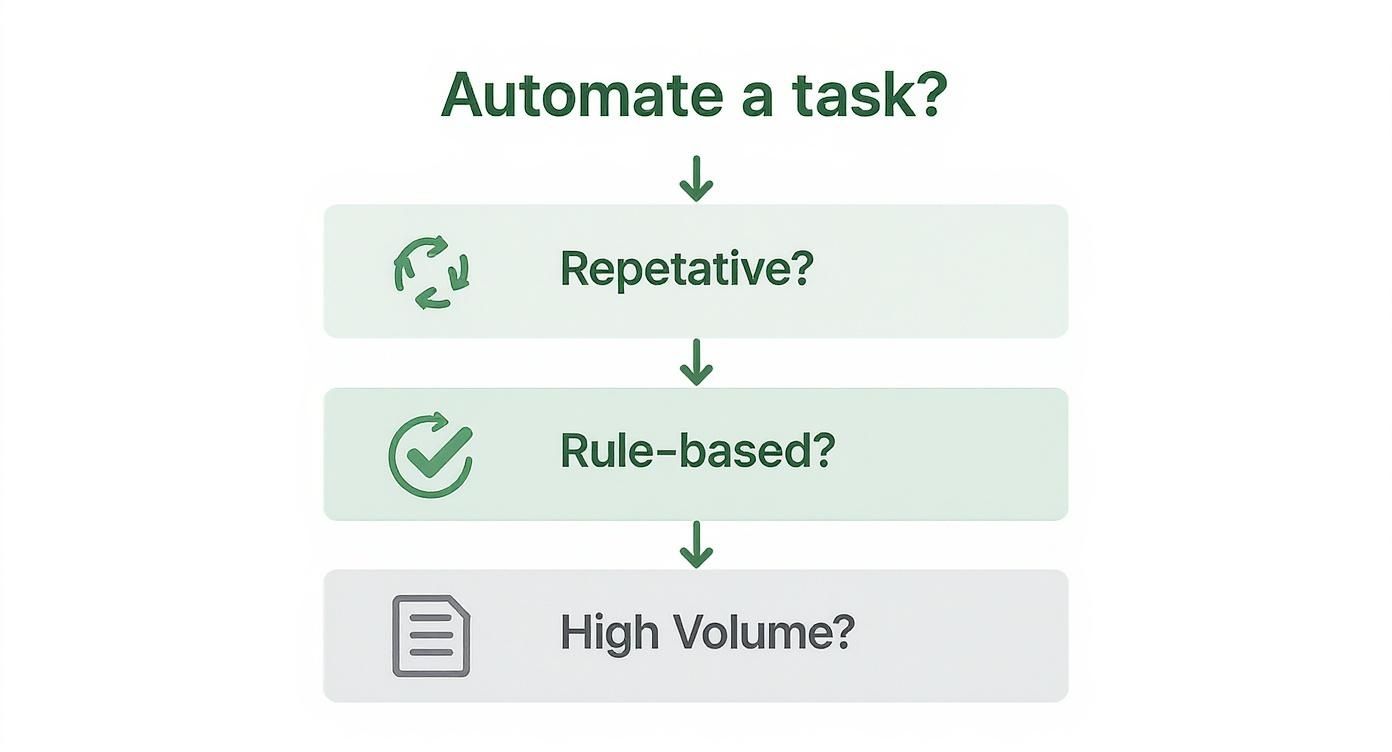
Essentially, you're looking for tasks that are repetitive, follow clear rules, and happen a lot. That’s the sweet spot.
Prioritizing for Maximum Impact
Once you’ve got a list of potential projects, you need to decide what to tackle first. Not all opportunities are created equal. This is where a simple impact-versus-effort matrix is your best friend.
Plot each idea on a grid with "Impact" on one axis and "Effort" on the other. This visual forces you to get real about what’s feasible and what will move the needle. For leaders wanting to dig deeper into their current systems before prioritizing, understanding the importance of conducting a CRM audit can give you critical context on data health and process gaps.
The goal is to find the "quick wins"—high-impact, low-effort projects. These build momentum, show immediate value, and get everyone bought in for the bigger, more ambitious initiatives down the road.
Practical Example: A Prioritization Scenario
Imagine your finance team has two potential automation projects on the table:
- Automating Invoice Processing: This would automatically pull data from incoming invoices and route them for approval. The impact is high (saves a ton of time, slashes errors), and the effort is medium (needs some software setup and integration).
- Redesigning the Entire Budget Approval Workflow: This is a complete overhaul of a core financial process. The impact is very high, but the effort is also very high, touching multiple departments and requiring serious change management.
Using the matrix, automating invoice processing is the clear quick win. It delivers tangible results fast and with less risk. That success makes it much easier to get the green light for the bigger, more complex project later. It's a strategic approach that makes sure your first foray into automation is a success story, not a cautionary tale.
Choosing the Right Automation Technology
Once you’ve pinpointed a high-impact opportunity, the real work begins: picking the right technology to bring your vision to life. This isn't about chasing the flashiest new tool. It’s about building a smart, integrated system that solves your specific problem and can scale as you grow.
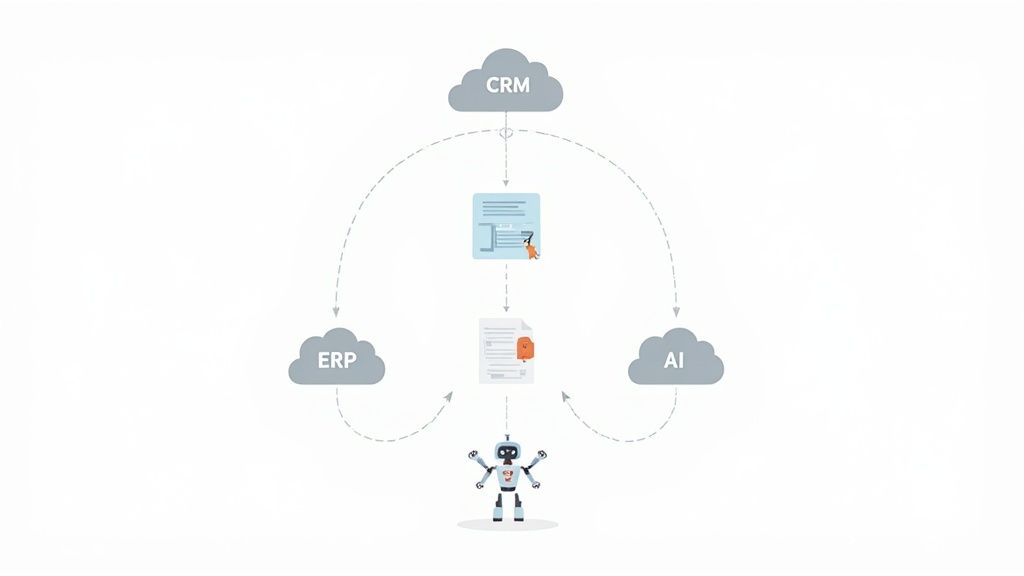
Let’s be clear: effective automation rarely lives on an island. The modern approach isn’t about single-purpose apps. It’s about creating an ecosystem where your core platforms—like your CRM and ERP—talk to each other seamlessly. This connected framework is what turns isolated tasks into a fluid, end-to-end workflow and unlocks real operational efficiency.
The market for these tools is exploding. In 2024, about 66% of businesses have automated at least one process, and that figure is expected to hit 85% by 2029. This isn't just a trend; it's a fundamental shift, with the automation software market projected to grow from $13 billion to $23.9 billion in that same window.
Building Your Integrated Tech Stack
Your goal should be to select tools that not only do one thing well but also play nicely with your existing software. A disjointed tech stack just creates new manual work—the very thing you're trying to kill.
Practical Example: Think about a classic B2B headache. A sales rep closes a deal in the CRM. Now, someone in finance needs to manually copy that data into the ERP to generate an invoice. That’s a recipe for typos, delays, and frustration. An automated workflow can instantly create a draft invoice in the ERP the moment the deal is marked "Closed-Won" in the CRM.
This is where the right automation tech comes in.
- Robotic Process Automation (RPA): RPA is a lifesaver for connecting legacy systems that don't have modern APIs. Think of RPA "bots" as digital employees who can log into apps, copy-paste data, and fill out forms just like a person, only faster and without getting bored or making mistakes.
- AI-Powered Document Processing: If your team is drowning in paperwork like invoices, contracts, or new client forms, AI tools can completely change the game. These platforms use machine learning to scan documents, pull out key information (like invoice numbers or contract dates), and automatically send it to the right system or person for approval.
- Integration Platform as a Service (iPaaS): Tools like Zapier or Workato are the central nervous system for your applications. They let you build simple "if this, then that" workflows that connect hundreds of different software tools, making an action in one system trigger an automatic response in another.
A Practical Vendor Evaluation Checklist
Choosing a vendor is a long-term commitment. You need a partner whose solution not only solves today's problems but is flexible enough for whatever comes next. Before you sign on the dotted line, you have to put potential vendors through their paces.
It’s also crucial to understand how to implement the tech effectively, not just what it does. For companies aiming to build a strong internal capability, our guide on AI enablement services provides a solid framework for embedding these advanced tools into your operational DNA.
Key Takeaways for Vendor Selection
- Scalability is Non-Negotiable: Can the solution handle a 10x increase in volume without a 10x price hike or a nosedive in performance? It has to.
- Integration is Everything: Prioritize vendors with pre-built connectors to your core systems (CRM, ERP, etc.) or a well-documented, flexible API. Don't settle for less.
- Security Cannot Be an Afterthought: Ensure the vendor meets industry-standard security and compliance requirements, especially if you handle sensitive customer data. This is table stakes.
- Support Defines the Partnership: Look for a vendor with a rock-solid reputation for responsive, expert support. When an automation breaks—and it will—you need a partner who can help you fix it, fast.
The Impact Opportunity Goes Way Beyond Efficiency
Impact Opportunity: The strategic impact of the right technology extends far beyond just saving time. When you connect systems that were once siloed, you create a single source of truth for your business data. This unified view enables your team to make faster, smarter decisions based on real-time information, not outdated, fragmented reports.
For example, when your sales CRM is integrated with your customer support platform, you get a 360-degree view of the customer journey. A salesperson can instantly see if a prospect has an open support ticket before they make a call. That context leads to more relevant, empathetic conversations.
This is how automation transforms from a simple cost-cutting tool into a powerful revenue-generating asset. The right tech stack doesn't just make you faster; it makes you smarter.
Rolling Out Automation and enabling Your Team
Getting the tech up and running is the easy part. The real work in any automation project is navigating the human side of the equation. Success isn't about the software; it's about the people. It demands a thoughtful rollout that minimizes disruption and gets buy-in from the very team members whose day-to-day is about to change.
Flipping a switch on a new system overnight is a surefire way to breed resentment and failure. The smart move? Start with a pilot program.
Think of it as a controlled experiment. You run a small-scale test with a hand-picked group of users to iron out the kinks, get honest feedback, and build a success story you can share before going company-wide.
Practical Example: If you're automating lead qualification, don't throw it at the entire sales team at once. Pick your top two reps. Let them live in the new workflow for a couple of weeks, track their experience, and help you fine-tune the process. Their early wins become the best internal marketing you could ask for.
Leading Change and Building Trust
Let's be honest: fear is your biggest hurdle. When people hear "automation," they often think "job replacement." Your most critical task as a leader is to get out ahead of that fear with a clear, direct communication strategy.
You have to frame automation as a tool that kills tedious work, not jobs. The story is about augmentation, not replacement. You’re freeing your team from the soul-crushing, repetitive tasks so they can focus on the strategic, high-value work that actually requires a human brain.
Despite the obvious upside, most companies are just scratching the surface. Research shows that only about 4% of businesses have fully automated their workflows, while around 31% have automated at least one function.
That's a massive runway for growth, especially when you consider that some estimates suggest up to 50% of current work activities could be automated with today's tech. If you want to dig deeper, check out these workflow automation statistics—they really highlight how much potential is still on the table. This is exactly why getting the human-centric approach right is so critical.
From Rollout to Ownership
A good communication plan is a great start, but it's not enough. To truly enable your team, you have to invest in them and build a culture where automation is an ally, not an enemy.
- Upskill with Purposeful Training: Forget generic training videos. Your sessions have to be role-specific, showing each person exactly how this new tool makes their job better. Show the customer service agent how automated ticket routing frees them up to solve the complex, meaty problems that make them feel accomplished.
- Create Automation Champions: Find the enthusiasts and early adopters on each team and make them your official "champions." Give them a bit of extra training and enable them to be the go-to person for their colleagues. Peer-to-peer support is almost always more effective than a top-down mandate.
- Build a Feedback Loop: Automation is never "done." You need an easy way for people to flag issues and suggest improvements. The process should be a living thing that evolves with real user feedback, making sure it stays sharp and aligned with what the business actually needs.
Key Takeaways for a Smooth Rollout
- Start Small with a Pilot: Test your automation with a small, focused group. Prove the value and squash the bugs before you even think about a company-wide launch.
- Communicate the "Why": Frame this as a way to kill grunt work and free up your team for more fulfilling, strategic tasks. The goal is to elevate roles, not get rid of them.
- Invest in Role-Specific Training: Don't just show them how to use it. Show them why it makes their specific job better, easier, or more impactful.
When your team starts to see automation as something that works for them instead of something being done to them, you've already won the biggest battle. You’ve laid the groundwork for a culture of continuous improvement where tech helps people do their absolute best work.
Measuring Success and Scaling Your Initiative

Getting an automation live isn’t the finish line; it’s the starting gun. To get the buy-in you need for future projects, you have to prove this one was worth it. That means moving beyond anecdotal wins and telling a compelling story with hard, quantifiable data.
Success isn't just about saving money, either. It’s about tangible improvements in speed, accuracy, and even your team’s day-to-day work life. The goal is to build a clear dashboard of key performance indicators (KPIs) that prove the true value of your efforts.
Defining Your Key Performance Indicators
Before you can measure success, you have to define what it actually looks like. Your KPIs need to connect directly back to the problems you originally set out to solve. Ditch vague goals like "improved efficiency" and get specific.
Here are a few practical examples of what you should be tracking:
- Operational Efficiency: This is all about getting more done with less friction. Think cycle time reduction—like seeing a 40% decrease in the time it takes to get an order from placement to fulfillment. Or track manual effort reduction by logging the hours your team saves each week on mind-numbing data entry.
- Quality and Accuracy: Automation is a beast at eliminating human error. You should see a huge drop in mistakes, like a 95% decrease in data entry errors in your CRM or fewer compliance red flags during audits.
- Employee Experience: This one is crucial but often gets overlooked. A simple survey can measure employee satisfaction scores for the new automated processes. A 20-point jump is a powerful sign that you’re not just making the business faster—you're making work better for your people.
This kind of disciplined tracking gives you the hard evidence to build a business case for scaling your automation efforts. For those serious about connecting the dots, professional reporting and analytics services can uncover insights that basic dashboards miss, tying automation outcomes directly to revenue growth.
To give you a clearer picture, here’s a framework we use to track the real-world impact of our automation initiatives.
Automation Impact Measurement Framework
| Metric Category | Example KPIs | Measurement Method | Business Impact |
|---|---|---|---|
| Operational Efficiency | Cycle Time Reduction (%) | Before-and-after process timing | Faster service delivery, increased throughput |
| Financial | Cost Per Transaction ($) | Total process cost / # of transactions | Lower operational costs, higher profitability |
| Quality & Accuracy | Error Rate Reduction (%) | Manual audit of outputs vs. automated | Fewer costly mistakes, improved compliance |
| Employee Experience | Satisfaction Score (1-10) | Team surveys, qualitative feedback | Higher morale, better employee retention |
This framework helps turn abstract benefits into concrete numbers that everyone, especially leadership, can understand and get behind.
Calculating Your Return on Investment
ROI is the language of the boardroom. Calculating it is non-negotiable if you want to secure funding for future projects. While it sounds intimidating, a back-of-the-napkin calculation can be pretty straightforward as long as you account for both direct cost savings and the value of reclaimed time.
Impact Opportunity: A clear ROI calculation turns your project from a simple operational tweak into a strategic financial win. The conversation shifts from "this feels faster" to "this initiative generated a 3x return in its first year."
Here’s a simplified formula to get you there:
ROI = (Net Financial Gain / Cost of Investment) x 100
To find your "Net Financial Gain," you need to add up a few things:
- Cost Savings: Tally up the direct savings from reduced labor. If you free up an employee for 10 hours per week who earns $30/hour, you’ve just saved $15,600 a year.
- Value of Increased Output: If automation helps your team process 20% more orders without hiring anyone, calculate the profit from that extra volume.
- Cost of Error Reduction: Put a number on the financial impact of fewer mistakes. If data entry errors used to cost you $5,000 a year in rework, that’s a direct gain.
Add up those gains, subtract the total cost of the software and implementation, and you have a clean ROI figure that speaks for itself.
Scaling From Project to Program
The real goal here is to move beyond one-off projects and build a sustainable, company-wide automation program. This is how you turn a tactical fix into a core part of your continuous improvement engine.
A great way to do this is by creating a small Center of Excellence (CoE). This doesn't have to be some formal, stuffy department. It can start as a scrappy, cross-functional team of "automation champions" from different parts of the business.
Their job is to:
- Share Best Practices: Document what works (and what doesn't) so other teams can skip the trial-and-error phase.
- Identify New Opportunities: Proactively hunt for other high-impact, low-effort processes ripe for automation.
- Govern the Technology: Make sure the tools are used consistently and securely, preventing the rise of new data silos.
This CoE becomes the brain of your automation strategy. It turns your early wins into a repeatable playbook that can be deployed across the whole company, embedding the principles of how to automate business processes deep into your organization’s DNA.
Common Questions About Business Process Automation
As leaders start thinking seriously about automating business processes, a few practical questions always come up. Moving from theory to action brings up real concerns about cost, complexity, and how it all affects the team. Let's tackle the big ones head-on with straightforward answers based on what we see in the field.
Where Should a Small Business Start with Automation?
If you’re a smaller business, the trick is to keep it simple. Don't try to boil the ocean by automating some massive, cross-departmental workflow right out of the gate. Look for the small stuff first.
Find a task that's high-frequency, low-complexity, and a known headache for your team.
A great place to start is often in sales or finance—the engine room of the business.
Practical Examples:
- Automated Lead Nurturing: Set up a basic email sequence in your CRM. When a new lead comes in, it automatically gets a series of follow-ups. This keeps the conversation going without a salesperson having to remember to send every single email.
- Invoice Reminders: This one is a classic for a reason. Automate the reminders for overdue invoices. It's a simple workflow that can massively improve your cash flow and frees up your finance team from chasing payments.
The goal is to score a quick win. You want something that delivers a visible result with minimal spend. That success builds the confidence and momentum you need to take on bigger, more ambitious projects.
How Much Does Business Process Automation Cost?
This is the "how long is a piece of string?" question. The cost of automation is all over the map and really depends on what you're trying to do and the tools you pick. It’s definitely not a single line item.
The cost isn't just the software license. You have to factor in implementation, training, and ongoing maintenance. A "cheaper" tool that needs a ton of custom development can easily end up costing more than a pricier, all-in-one platform.
Here’s how the costs usually break down:
- Subscription-Based Tools: Think platforms like Zapier or Make. They offer tiered pricing based on usage and often have free or low-cost plans to get you started. They're perfect for simple automations connecting your cloud apps.
- Enterprise Platforms: When you get into more complex workflows, you’re looking at more strong solutions like RPA or dedicated BPA software. These come with higher subscription fees and often require professional help to get them set up right.
- In-House Development: Building your own automation solution gives you total control, but it also carries the highest upfront and ongoing costs. You're paying for developer salaries, infrastructure, and all the maintenance that comes with custom code.
Will Automation Replace Jobs on My Team?
This is the big one, and it needs a straight answer. The goal of automation should be to augment your team, not replace it. How you frame this is everything. This is about eliminating the tedious, soul-crushing work so your people can do what they do best.
Practical Example: Take customer support. Automating ticket routing doesn’t get rid of your support agents. It frees them from the mind-numbing task of sorting and assigning tickets. Now, they can spend their time actually solving complex customer problems—the work that requires a human touch, empathy, and critical thinking.
The Impact Opportunity here is huge. When you free people from repetitive tasks, job satisfaction goes up. They get to focus on more strategic, creative, and engaging work, which is a massive driver for retention. In a tight labor market, making your team’s work more meaningful is a serious competitive advantage.
Ready to move from theory to a clear, actionable roadmap? Prometheus Agency is an AI transformation partner that helps growth leaders turn their existing tech into scalable revenue systems. We'll help you identify high-impact automation opportunities and build a strategy that delivers measurable results.
Start with our complimentary Growth Audit and AI strategy session at https://prometheusagency.co.